WS Game Two: The Brewers—“They had us right where we wanted them”

Sal Frelick

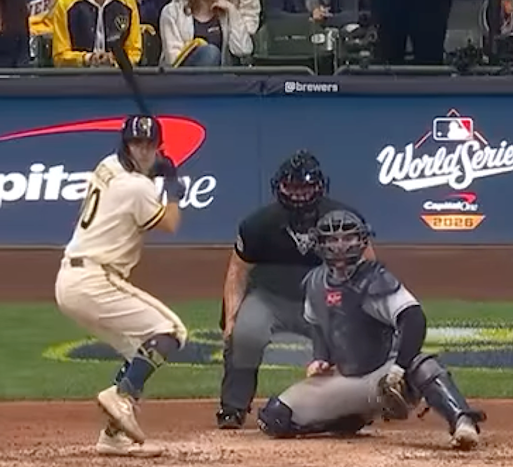
Sal Frelick hitting the first Brewers World Series home run since Ben Oglivie 16,075 days previous . . . (Fox Sports capture.)

Not even the mild controversy of Game Two’s final strike could erase what’s becoming a theme for these postseason Brewers. They won’t let any deficit keep them from the steady but certain completion of their self-appointed rounds.

Jump them with a little help from one of their own mistakes for four runs in the first, the way the Rays did Saturday night? The Brewers just look, listen, and think, They have us right where we want them.

Pry two right back out of the Rays’s ace Drew Rasmussen in the bottom of the inning, but leave first and third and let Rasmussen settle in for one of his usual outings? They have us right where we want them.

Sneak a third run in the fourth on a ball sneaking through Rays first baseman Jonathan Aranda’s legs with first and third and one out? They have us right where we want them.

Stay a run behind opening the bottom of the sixth, watch right fielder Sal Frelick wring his way to a full-count ninth pitch off Rays reliever Ian Seymour? They have us right where we want them. Watch Frelick homer on that pitch? They had us right where we wanted them.

Because that’s just the Brewers, too.

And that was about a week after they fell behind 4-0 to the Damndodgers in National League Championship Series Game Four. A deficit that included a still-ailing Shohei Ohtani finding enough of a power reserve to hit a three-run homer measured not in distance but on the Richter scale.

They had us right where we wanted them, too. And—a two-run single in the fourth, an RBI single and a bases-loaded game-tying walk in the fifth, a leadoff homer in the sixth, and a two-out homer in the ninth later, the Brewers finished the pennant sweep they started.

Now, with a 5-4 Game Two win in the World Series, the Brewers look unsinkable and the Rays look half sunk. Beware how deceptive looks can be. Remind yourself there’s still time for the Rays to pick themselves up, dust themselves off, say to themselves, They have us right where we want them, too.

They can make the Brewers suffer in the Trop, a pressure cooker of a dome equal to American Family Field’s roof closure for a racket down from the stands. They can force the Series back to Milwaukee with those comeback kids needing yet another comeback. Or two.

Can’t they?

Who knows? It’s not looking great for the Rays after Rasmussen—who hadn’t allowed three or more runs in his previous thirty-six innings of work—got pried for three runs in three and two-thirds innings Saturday night.

It’s not looking great for the Rays after their bullpen, the fifth-best in the American League on the regular season, couldn’t even think about getting Games One and Two to their lights-out ninth-inning man Bryan Baker.

It’s not looking great for the Rays after Frelick fought Seymour through eight pitches most of which Frelick admitted later enabled less-than-comfortable swings, then got what he wanted on the ninth pitch, a sinker right down Main Street—and hit it on a high line over the center field fence. For the first World Series home run any Brewer has hit in 16,075 days. (The last: Ben Oglivie, fifth inning, 1982 Game Seven, off the Cardinals’s Joaquín Andújar.)

It’s not looking great for the Rays after rookie Brewers shortstop Cooper Pratt—who enabled their early lead in the first place by throwing Yandy Díaz’s game-opening grounder away—atoned for that with second baseman Brice Turang on third (leadoff double; advance on a fly out) when he lined a single into shallow right field, letting Turang score the fifth Brewers run without a sweat.

It’s not looking good for the Rays when they’re up against a Brewers bullpen that has a 1.24 ERA this entire postseason while their own pen minus Baker has a 4.20.

And, when they’re up against an Aaron Ashby who isn’t the Brewers’s designated closer but has a zero ERA and a 1.24 fielding-independent pitching rate over three and a third Series innings so far. Not to mention 15.2 scoreless innings to start his entire postseason, a third of an inning shy of the record sixteen Cleveland’s Andrew Miller set in 2016. Over that 15.2? Five hits, three walks, seventeen punchouts.

There was Ashby on the mound with Díaz at the plate and the Rays down to their final out Saturday night. There was Ashby in the hold 3-1 to the dangerous enough Díaz. There was Brewers catcher William Contreras calling for and getting a curve ball that froze Díaz like a turkey awaiting its Thanksgiving dinner thaw. There was Contreras calling for a second straight curve, Ashby throwing it down and in, Díaz unable to keep from swinging.

The Rays’s designated hitter tried to check the swing. An appeal to first base rung him up with the game-ending out. The swing looked so bloody close on replays—the general rule is that if the bat head passes the front of the plate, it’s a swing and a strike, though Díaz’s bat head was so close the call could have gone either way.

If it had been ruled check swing, ball four, it would have meant Aranda batting with first and third and two out. Aranda had one double that came to naught on the night, but he’d gone 3-for-3 with a run scored in Game One. He wouldn’t exactly have been easy meat, even for Ashby.

But rest assured. If it did happen that way, Ashby and the Brewers would have given themselves a quick review, looked at Aranda checking in, and thought to themselves, yet again: They have us right where we want them.

Beware. The Rays had 98 comeback wins on the regular season to the Brewers having a mere 34. But the Brewers have done it seven times this postseason—including four straight to the Damndodgers—to the Rays doing it nada.

Other than the change of venue, and even with rejuvenated Freddy Peralta scheduled to start Game Three, the Rays can’t yet look at the Brewers and think, They have us right where we want them.
WS Game One: “Just get the outs”

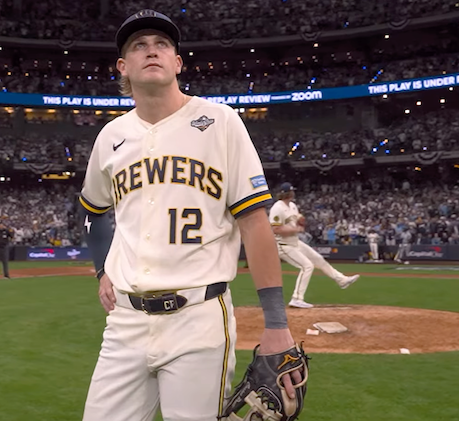
As closer Trevor Megill (right) takes an ump up on some extra keep-loose tosses, Brewers shortstop Cooper Pratt watches a replay of the double play that wasn’t, compelling Megill to go after and punch out Rays center fielder Jonny DeLuca to end the Brewers’ World Series-opening win Friday night. (Fox Sports capture.)

Opening night for Les Mis in the World Series wasn’t exactly one for award consideration. It didn’t have to be. The company around him was more than able to save the show when he had an off night. An off night for him, not anyone else.

Jacob Misorowski with a five-inning line of three punchouts, four hits, one earned run, and a 2.50 fielding-independent pitching rate is an off night for the likely National League Cy Young Award winner whose regular season showed a 174.2-inning line of 252 punchouts,  a 2.17 FIP, and a 1.80 earned run average.

But it was enough to keep his Brewers in the game until manager Pat Murphy decided it was time to reach for the secondary cast. Abner Uribe and Aaron Ashby made life difficult enough for the Rays, before Trevor Megill made it almost interesting enough for the Rays to overthrow the Brewers

Emphasis on almost.

The not-even-close-to-artificially-intelligent Brewers and not-even-close-to-artificially-intelligent Rays played it tight, overcame mistakes, and ground it out until the final outs that weren’t, before the Brewers held on tight to their 3-2 Game One win.

They had William Contreras to thank for a lot of it, their defense for a lot of it, the bullpen for a lot of the rest of it, and the replay review for the next-to-last act.

First, Contreras repaid longtime franchise face Christian Yelich for that bottom of the first RBI triple that just did elude diving Rays center fielder Jonny DeLuca. He slashed the first pitch he saw from Rays starter Nick Martinez through the hole at shortstop to send Yelich home and the Brewers to a nice, early 2-0 lead.

Then, with one out and Rays first baseman Jonathan Aranda (base hit) aboard in the sixth, Contreras caught Uribe’s swinging strikeout pitch to Rays left fielder Chandler Simpson and whipped a textbook perfect strike up the pipe to nail Aranda trying to swipe second.

Martinez, the elder Rays righthander who has a between-pitches habit of stepping up and down as though he’s peeking over a fence waiting for the right time to leap over and rob the place, settled well from there. He justified Rays manager Kevin Cash holding his own ace Drew Rasmussen until Game Two.

With the benefit of a run-scoring ground out by Liam Hicks in the top of the fourth to cut that lead in half, Martinez had his way with the Brewers for the most part the rest of his assignment.

He got away with Brewers right fielder Sal Frelick singling with one out in the second and helping himself to third after being bunted to second when he struck left fielder Jackson Chourio out to end the second.

He got away with murder in the fifth because Brewers third baseman David Hamilton took a bad turn rounding second trying to turn his one-out double into a triple, and the relay from right fielder Victor Mesa, Jr. to second baseman Ben Williamson to third baseman Junior Caminero was flawless enough to nail the diving Hamilton by a full foot plus.

Did that knock the Brewers into the oxygen tent?

Not a chance. Veteran Steven Matz—last seen in the World Series as a rookie with the 2015 Mets—shook off a pair of two-out walks in the sixth to escape and landed a pair of seventh-inning outs following a leadoff walk to Brewers rookie shortstop Cooper Pratt. Cash lifted Matz for Kevin Kelly, wanting the right-on-right match with Chourio.

Right on, the Brewers thought, when Chourio punched Pratt home with a base hit through the right side.

Naturally, things had to get more than interesting in the top of the ninth. As in, Brewers closer Trevor Megill allowing a pair of base hits (Aranda and Simpson) and a double steal, then walking the bases loaded for Hicks. Those hoping the Brewers might find their own Mariano Rivera some day had to settle for finding their own Craig Kimbrel Friday night.

Heaven help Megill if his mojo stops working. So far, he can work his way out of trouble of his own making faster than you can say “kill the save.” And he won’t say no to any help he can get. He got it Friday night, from Hicks and from his infield and from New York.

As in, Hicks grounding into what looked like a bang-bang-bang double play. As in, Caminero looking out at second, Hicks called out at first, and the Rays calling for a review. Megill wasn’t sure why. He may have been the only human being in American Family Field who wasn’t sure. At first. Then . . .

“I thought they were challenging the play at first,” he told reporters postgame. “I didn’t even think about it. I thought my cleat was dragging across the base. I just kind of looked at one of the umpires there and said, ‘Hey, what are you hearing in your ear?’ He said, ‘Uh, whatever, not too good. Do you want to throw some baseballs?”

The extra tosses did Megill a huge favour after replays showed Pratt covering second came off the pad before he had the ball to record the out while his throw on to first got Hicks. Meaning pinch runner Jorge Mateo was safe at home with the second Rays run and DeLuca checking in at the plate.

Once upon a time, that double play would have stood. It used to be called the infamous neighbourhood play. The out at second would be called if the fielder happened to be in the neighbourhood whether or not his foot hit the pad before he threw on. The crackdown on that play started around 2016. Bye, neighbour.

This was a night both sides didn’t exactly look like virtuosi on the bases, either. Now, though, Megill was hell bent on just blowing DeLuca away with two men still in scoring position. He dropped to 2-1 on fastballs, then dropped a delicious curve in on DeLuca to freeze him for strike two. 

“Anytime you can land a curveball at the bottom right there like that,” the husky righthander said, “it definitely sets up your next one. It’s just pitching and trusting what William is putting down back there.”

Contreras wanted that curve again. Megill was only too happy to oblige. He threw it, DeLuca swung through it, and the game belonged to the Brewers.

That’s not exactly what the Rays want to hear. This postseason, just the bullpen trinity of Uribe, Ashby, and Megill have a combined 0.95 earned run average, even if Megill likes to do it the hard way a little too often. Not the best pickings for a Rays team that was the American League’s best on the season but went 0-for-6 with men in scoring position Friday night.

“Has any team won a World Series with a starting rotation that was mostly just the nightly warm-up act for its bat-smothering relief crew?” asked The Athletic‘s Jayson Stark. “This is not a rhetorical question anymore.”

Megill had a non-rhetorical answer. “I don’t know, man. It just don’t matter how we get the outs,” he told Stark. “Just get the outs.”

Just get the outs. Because, as Yelich himself said postgame, “All of these games are going to be close. But it was good to get that first one.” Especially when it took forty-four years to get another crack at it.

A special, cool little story

Milwaukee Brewers

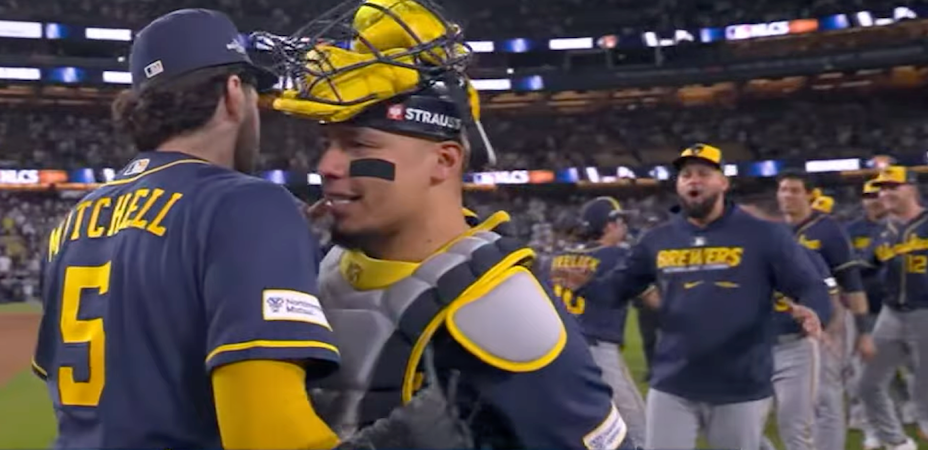
Center fielder Garrett Mitchell, catcher William Contreras, and more celebrate the Brewers’s first pennant since 1982—when they were in the American League. (Fox Sports capture.)

Whatever else you can accuse Dodgers manager Dave Roberts of thinking, you can’t impeach his simple, to the point valedictory after his team got hunted, pecked, bumped, flecked, and shoved out of their World Series three-peat hopes: “At the end of the day, we got beat. We got outplayed in all facets.”

That tells two things. The story of this National League Championship Series, and only half the story of what the Brewers sweep really signifies. What’s the other half, you wondered Thursday night, while watching the Brewers do just one of many things they’ve done like virtuosi this week.

“What Major League Baseball doesn’t want to discuss, as it portrays its sport as a broken landscape of haves and have-nots,” says The Athletic‘s Ken Rosenthal, who doubles as a Fox Sports television analyst, “is that big-money teams can sustain success only for a finite period, if they achieve success at all.”

Bleat to your heart’s content that these Dodgers are as imperious and intolerable as the early-to-mid 20th century Yankees. The mighty do fall, and get felled, and more often than you think. And, as often as not, they get felled as this year’s Dodger’s did.

Not by the edicts of a commissioner who’s six parts snake oilman and half a dozen parts Rube Goldberg and thinks the good of the game is nothing more than making money for it. Not by the owners who think they should be making money regardless of whether they care about their on-field product.

They get felled between the lines, at the plate, on the mound, out of the bullpen.

The beauties of baseball include that the moment the umpire hollers, “Play ball,” all arguments for salary caps and against salary floors disappear faster than the Dodgers did in this year’s National League Championship Series. The game that’s played is the game that counts.

“They may have a bunch of Hall of Famers,” said Brewers manager Pat Murphy, “but we’ve got a bunch of gamers. And the gamers won this week.”

The Brewers weren’t disrespectful so much as they couldn’t have cared less how many Hall of Famers wore Dodger uniforms or how many dollars each Dodger puts in the bank every week. They cared about runs on the scoreboard and couldn’t have cared less who put them there first.

The Damndodgers (yes, people still say it as one word, ladies and gentlemen) scored first in three out of the four NLCS games and led in all four of them. And they still got swept. By the team they swept out of last year’s NLCS. The only previous time that ever happened was never.

What nobody likes to remember or admit about the Damndodgers is that it. is. not. just. the salaries they’re willing to pay their players that made them winners of thirteen out of fourteen straight National League West titles and defending back-to-back World Series champions.

What a lot of those harrumphers didn’t like to remember or admit, while going in believing the Brewers would be just the latest upstarts ground beneath the Dodger boot heel, is that the teams are an even match where it matters most before the game begins. The Dodgers think well, develop well, coach well, teach well, and analyse well, as well as play well. The Brewers, who had baseball’s best record winning this year’s NL Central, think, develop, coach, teach, and analyse likewise.

But these Brewers did in a Dodger team that was a lot more vulnerable than its enemies wanted to hear. Sentence the Damndodgers to the seventh circle of hell if you must. But you must also be fair and remember that they got within the proverbial cat’s whisker of losing last year’s World Series. (Remember? They never led Game Seven until the eleventh inning.) And, that their age might be catching up to them at last.

So Shohei Ohtani finally found his way through his health issues to crank a three-run homer with two outs in the Game Four bottom of the second, giving his Dodgers a 4-0 lead? Let him have his fun.

Concurrently, ask yourselves just why the Dodgers didn’t insist on Ohtani hitting the injured list for proper healing of his knee and his biceps down the stretch. In thirty-two postseason plate appearances this time around, that homer was the only one of his five hits to mean extra bases.

What Ohtani really did, though, was give the Brewers an 0-4 lead. You’d have seen that if you paid close enough attention. You’d have seen the Brewers one and all watching Ohtani round the bases behind the two aboard in front of him and thinking, They have us right where we want them.
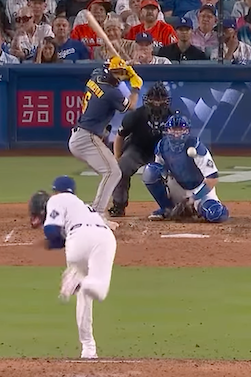
A one-out walk (to second baseman Brice Turang) and a ground rule double (by catcher William Contreras) set the top of the fourth table for NLCS Most Valuable Player Jake Bauers. And the first baseman rapped a ground rule double immediately, cutting the deficit in half. One inning later, third baseman David Hamilton singled right fielder Sal Frelick home, compelling Roberts to lift his starter Tyler Glasnow and bring Evan Phillips in.

Phillips proved the gift that kept on giving. He got Jackson Chourio to line out, but he walked the bases loaded before coming out in favour of Alex Vesia. And Bauers wrung Vesia for a four-pitch, game-tying walk. One inning after that, with Dodger closer Tanner Scott in a little bit earlier than normal but the Dodger season on the line—he fought center fielder Garret Mitchell to a full count, before Mitchell sent one over the center field fence.

David Hamilton, Edwin Díaz

David Hamilton, half a second from turning Edwin Díaz’s service into Brewers insurance Friday night.

The Brewers—those patient souls who blend small, medium, and large ball with the fine hands of the brewers who once made Milwaukee famous, and shake off their occasional mistakes and malfunctions—must have been the only ones in Dodger Stadium who thought their 5-4 lead was safe.

“Man,” marveled another Athletic writer, Levi Weaver, who usually covers the Rangers for the journal. “The Brewers just straight-up absorbed the momentum-shifting mega-moment from Ohtani. They took the blow, calmly stood back up, and just kept hammering away at the load-bearing walls of the dynasty. Two runs in the fourth, two more in the fifth, one (so far) in the sixth. Absolutely unflappable.”

However much the Dodgers’s age showed, however creaky one or two parts must have been, these were still the Dodgers. They were still capable of undoing the Brewers to play another day. Weren’t they?

Not this time. Not even when the Dodgers turned to Edwin Díaz, their glandular off-season free agency relief signing, who missed too much time with injuries, didn’t pitch too well when he could pitch on the season, and hadn’t yet poked his nose out of his postseason mouse hole—and Díaz recorded a possibly unexpected* eight straight outs into the top of the ninth.

Leave it to Hamilton to spoil Díaz’s splendid turn with a flog into the right field seats. Just call him Liberty Mutual. (The insurer shares the Brewers’s team colours.) But if you dare send Limu Emu out to follow him around the bases, we’re going to fight.

Brewers reliever Aaron Ashby saw and raised Díaz. He took six straight outs into the bottom of the ninth. Then, he finished what he started. Tommy Edman, pinch hitting for veteran Dodgers third baseman Max Muncy? Full-count ground out.

Center fielder Andy Pages, one of last year’s World Series heroes, the guy who’d run over his grandmother, grandfather, and teammate to catch the would-be-Series-winning Blue Jays extra-base hit? Looking at strike three.

Utility expert Enrique Hernández, said teammate, he of a duffel bag full of postseason heroics in years previous? A hard, high liner to left center field run down by Jackson Chourio for the NLCS-ending final out.

And, just like that, the Damndodgers—baseball’s bogeymen, the team denigrated as everything wrong with the sport in dollar terms by those ignorant of everything else they did right for so long—lost the pennant.

To a team whose dollar endowments might not be even halfway toward the Dodgers’s bucks but whose brains, teaching, analytics, and development sent them to the postseason in eight out of veteran Christian Yelich’s nine Brewers seasons.

“We believe in ourselves,” said Yelich postgame. “We didn’t just, like, wake up and find ourselves here. We expected to be a team that was in this position and have this opportunity. We didn’t feel like this was unexpected or a special, cool, little story.”

When you win the pennant and become the second modern (post-1900) Show team to win one in each league (the first: the Astros), you can afford to come up short in the rhetoric department.

Except that it is a special, cool story.

Commissioner Pepperwinkle and his merry band of salary cappers. The lamer owners who refuse as opposed to being unable to deliver reasonably competitive baseball teams, making the sport a game of wills and will nots, not haves and have nots. The ignorant fan and media cadres who buy their Kickapoo Joy Juice at full price. They’re all witless to understand.

The only postseason team more fun than these Brewers are those well-oiled, well-constructed, well-instructed, exuberantly fun Guardians. They have a 2-1 ALCS lead over the well-oiled, well-constructed, well-instructed, as-much-fun-as-glue-drying Rays. Give me one Petey Halpin over twenty-six cownoses.

—————————————————————————————————-

* Edwin Díaz, the Dodgers closer, has not pitched once this series. But here he is, in what is totally the exact situation the Dodgers pictured him in when they shelled out $69 million for him last winter—down a run in the top of the seventh.—Katie Woo, The Athletic.