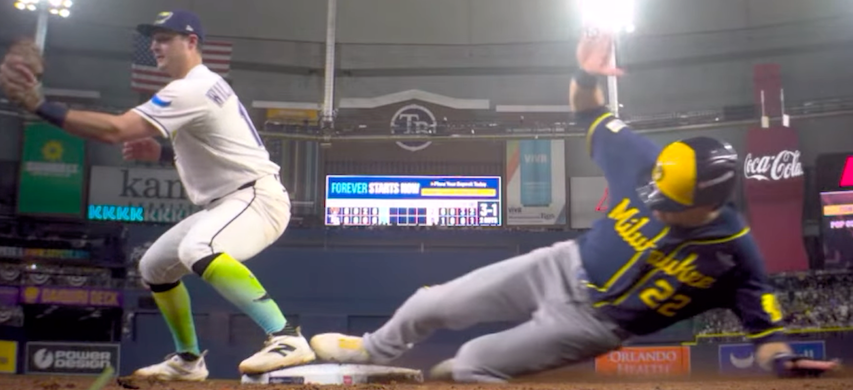
Sliding Scale Dept: Christian Yelich holding onto second base for dear life, upheld safe on review and opening the door to the eight-run fifth inning flood. (Fox Sports capture.)
Until Monday night, 88 meant the number of piano keys over which distinguished hands danced. Hands such as those belonging to Dave Brubeck, Philippe Entremont, Red Garland, Herbie Hancock, Vladimir Horowitz, Oscar Peterson, Bud Powell, and Professor Longhair.
On Monday night, in Tropicana Field, they meant eight Brewers runs on eight Brewers hits in a single fifth inning during World Series Game Three, which ended in a 10-1 massacre leaving the formerly perky, plucky, pesky Rays on the ropes. And, possibly, at the end of their ropes.
All courtesy of such now- or long-distinguished hands on bats as Jackson Chourio, Christian Yelich, William Contreras, Brice Turang, Cameron Mitchell, Cooper Pratt, Sal Frelick, and David Hamilton.
And, in Yelich’s case, maybe the single most powerful walk of all time.
And, the Brewers accomplished something unseen in no World Series before Monday night. All eight of those runs came home on two outs. Turning a mere 2-0 Brewers lead entering the frame into a 10-1 burial in which the lone Rays run—an RBI double with two outs in the bottom of the ninth—seemed like a pardon-us show of lingering life.
In what may yet prove to be the understatement of the postseason, Rays manager Kevin Cash was asked about that fifth. He knew it was the inning upon which everyone may yet look back and think it was the inning above all that sealed the Rays’s fate.
“It’s definitely deflating,” Cash said at his postgame presser. “How could it not be?”
Charles Cornwallis telling that to his soldiers before surrendering to George Washington at the Seige of Yorktown couldn’t have been more understated.
There’s still a fourth game to play at minimum. If the Rays have heretofore undetected cards to play and powers upon which to draw, they’d better play them and draw upon them Tuesday night.
In a Series matching two teams who play small-to-medium ball the way the aforementioned Garland played the blues, the Brewers are making the Rays resemble students who’ve barely gotten through the semester’s opening days.
This time, the Brewers didn’t have to strike from a deficit. This time, there was no early Rays scoring to prompt them to think, They have us right where we want them. This time, Yelich and Contreras staked them to a 2-0 lead with back-to-back RBI singles in the top of the third. For the first time in this World Series, they had an early lead to defend entering their half of the fifth.
Two RBI singles wasn’t supposed to turn Rays starter Freddy Peralta into an emergency ward patient. But then came Yelich, whose ages-ago acquisition from the Marlins could be argued as the moment the Brewers began returning to competitiveness and slouching toward greatness.
This time, it wasn’t a big stick but a big eye. He worked his way back from 1-2 to three straight takes out of the upper strike zone with Chourio (one-out single, stolen base) on second and two outs.
Then Contreras squeaked one toward third. Rays third baseman Junior Caminero picked it with his running momentum tugging him more toward the outfield. He threw to second instead of going for the theoretically simpler out at first. Second baseman Ben Williamson took the throw as Yelich’s right, front foot hit the pad about a half-inch ahead of the ball hitting Williamson’s glove.
Unlike Rays left fielder Chandler Simpson, caught stealing when he slid just past the pad to end the bottom of the first, Yelich never let his foot or his leg leave the pad behind.
The replays confirmed it. The Brewers now had the bases loaded and two outs. Cash took no chances with a parade of mostly portside swingers in the offing. He brought lefthander Cam Booser in. Before this, Booser was one of the Rays’s least touchable pen men and nobody in this postseason could claim an earned run off him. Yet.
But Turang shot one right off the glove of Rays shortstop Taylor Walls to shoot Chourio and Yelich home. Mitchell shot one the other way to left for the single that sent Contreras home. Pratt interrupted the left-side parade by pulling one off Caminero’s glove for a two-run double. Frelick—who’s hit the lone Brewers home run of the set, and who was robbed of an extra-base RBI hit in the second by a spectacular Simpson running catch—so went the other way to left, doubling Pratt home.
Robert Gasser—How to make like Sandy Koufax and be almost ignored in six easy lessons . . .
Booser couldn’t have been blamed if he reached for a double shot of booze after coming out in favour of righthander Cole Sulser. After Hamilton singled Frelick home and Chourio doubled Hamilton home—the fourth hit of the night just for the Brewers left fielder alone—first baseman Jake Bauers flied out to left. Almost the way he’d done to make the last known Brewers out before the battering rams started battering.
Almost lost in the superlatives that followed to describe and analyse the Brewers’s fifth inning flogging was their starting pitcher Robert Gasser. His repertoire doesn’t exactly match his name, since he makes his living offering diets of breaking balls and off-speed stuff for the most part.
He only pitched six shutout innings in which he collaborated with the fielders behind him the way Brubeck once collaborated with his classic quartet. He pitched them facing the minimum eighteen batters over the six. The last lefthander to do that? Some ancient Hall of Famer named Sandy Koufax, in 1965. In any other World Series, that would have been headlines upon headlines atop headlines.
But who the hell needed Gasser this night? Or, his relief Antonio Senzatella, who fired two perfect innings of his own? Only one Brewers pitcher could have taken minds off that assault-and-battery fifth. That was the guy who hadn’t pitched since the Fourth of July and recovered quicker than expected from shoulder capsule surgery to make this Series roster.
The guy who’s been a Brewer for life and interrupted more rudely by injuries than hecklers dare to interrupt comedians. The guy Brewers manager Pat Murphy—who spent much of the late game wheeling his supporting cast into and out of the game just to let them have a Series taste—sent out to pitch the ninth.
Brandon Woodward wrung his way around that excuse-us Rays run—a one-out single (pinch hitter Cedric Mullins); a two-out RBI double (Yandy Díaz)—to lure Jonathan Aranda into a first-pitch, game-ending ground out to second.
Only these Brewers could take that kind of game with that kind of fifth-inning bloodletting and make it into a feel-good game in the end. The looks on Woodward’s face after Turang threw Aranda out were the kind you borrow for feel-good product advertisements. It couldn’t have happened to a nicer guy than the one who threw the National League’s only 2023 pitching shutout, missed 2024, a piece of 2025, and two-thirds of 2026 with shoulder trouble.
Woodruff was first penciled in to start Game Four. But with the Brewers enjoying a glandular lead and Murphy unwilling to stop handing out favours, he asked Woodruff if he wanted that or to have the Game Three ninth.
“I want it right now,” the Forever Brewer (as he’s known around the Brewers and the game) said.
He could have been giving the entire team a watchword for the rest of the Series. A rest of the Series that could end Tuesday night. A rest of the Series in a stadium where almost precisely half the crowd was traveling, racket-making Brewers fans for whom travel and the Trop were cheaper than too many of the American Family Field Series tickets.
We want it right now, the Brewers will think as they begin Game Four. As the Rays begin, they’ll want to sing, You can’t always get what you want. That may not be simple the night after a journey to the fifth inning dimension.