
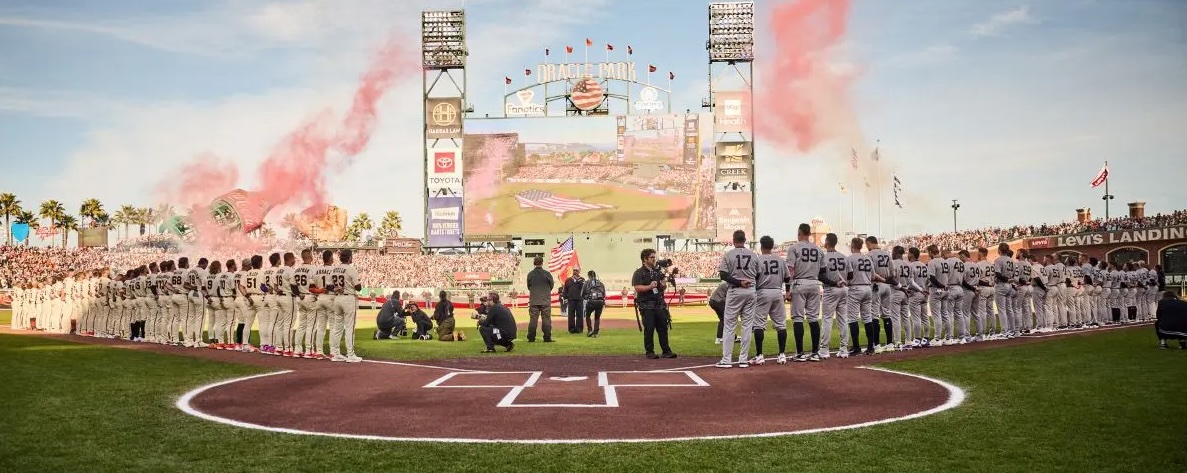
Oracle Park’s Opening Night pagenatry turned to a 1-0 loss and a season-opening three-game losing streak . . . a giant harbinger of disaster to come for the Giants this season . . .
As the dog days of August go, this year’s dogs took their time to run, even if they weren’t always as brutal on the heat side. (At least, not in my neighbourhood.) On the other hand, when I sat down to write seven American League teams with losing records remained in the wild card picture and nobody in the AL West had a winning record. (The Astros opened Sunday at .500.)
Thus do we approach September’s advent. With the National League slightly more respectable than the AL, with a mere four teams holding losing records and lingering wild card hunt positions. But Sunday also began with the Giants one game away from joining the Rockies at being eliminated from the postseason mathematically.
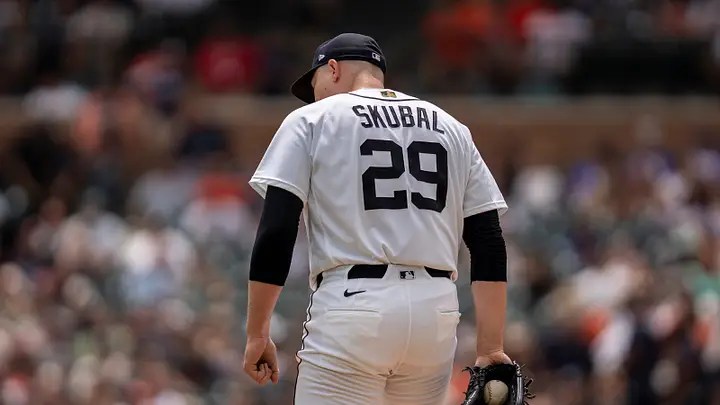
The Giants didn’t even have to lift a finger for that elimination. They had the scheduling quirk of a Sunday off-day, resuming play against the Diamondbacks to end the month. All they needed was the Dodgers to beat the Tigers, and they could relax. Well. The Dodgers won, 6-1, taking two out of three from the Tigers beginning with former Tiger Tarik Skubal’s ten punchout masterwork to open the set.
How on earth did these Giants sink to Rockies-level calamity? You don’t even have to bring up the ups, downs, quirks, and jerks of Rafael Devers and company, though you might want to consider Matt Chapman and Willy Admaes on big deals but approaching the downturn if they haven’t hit it already.
Start with the starting rotation. Behind Logan Webb (who opened with a whisper before rounding back up) it has no pitcher with a strikeout-to-walk ratio over 2.5 except Webb, and only one pitcher not named Webb (Landon Roupp) has a fielding-independent pitching rate under 4.00
They’re hardly the least run-preventive pitching staff in the Show (the team FIP is a league-average 4.16) but between those non-Webb starters and a bullpen losing enough leads after six innings to be tried by jury for treason, the Giants aren’t exactly the group the other guys’ batters fear.
Not to mention that PBO Buster Posey—Hall of Famer in waiting as a retired catcher, too many growing pains running the organisational show—spent much of the year with a shallow farm and a lack of bench depth when the injury bug proved a bit of a swarm. His trade deadline activity brought back some value but that won’t be manifest for another year or so.
Not to mention further that, well, you could dress these Giants up but you couldn’t take them anywhere. Entering Sunday they were .338 on the road (23-45) compared to .478 (33-36) at home. Their traveling secretary must have had a few too many days prepared to beg, “Do I really have to?”
Now, their long National League nightmare of 2026 is all over but for the September string. They sat at 9-19 for August following Sunday’s day-off mercy killing, the worst month of a season in which they never got closer in any full month than a game below .500 (in July).
Meanwhile, around the bases, down the lines, and up from the dugouts . . .
MVPete Dept.—That three-homer Friday Pete Crow-Armstrong treated himself against the fading Reds catapulted him a little more ahead of the NL’s Most Valuable Player Award pack. Entering Sunday’s play, moreover, PCA led the entire Show with 8.3 WAR on the season (almost two full ahead of Shohei Ohtani) and 296 total bases. He also entered the day leading the NL in slugging, OPS, and OPS+.
He’s no slouch in center field, being seven runs above the league average for total zone runs and fourteen above the league average for defensive runs saved. Did we mention that he also leads the NL in win probability added? With Ohtani a mere sixth and Sal Stewart, the league’s runs batted in leader entering Sunday’s play, nowhere to be found in the top ten.
You Know Us, Sal Dept.—Stewart’s league leadership in the team-dependent RBI department ([RBI’s] depend on managerial control, a hitter’s position in the batting order, park dimensions, and the success of his teammates in getting on base ahead of him.—Branch Rickey) has the old/mold school salivating on his MVP behalf.
WPA isn’t the only truly critical category where Stewart sits outside the league’s top ten. He’s also outside the top ten in WAR overall, offensive WAR, defensive WAR, OBP, slugging, OPS, OPS+, hits, extra base hits, and walks. He’s a good player who promises greatness. But he doesn’t belong in the MVP conversation yet.
Knee Trembling Dept.—The Yankees’s promising rookie shortstop, George Lombard, Jr., suffered a brief spell of defensive hiccups after an eye-opening beginning, and now he’s dodged a serious knee issue. He “tweaked” his knee swinging during a Saturday game against the Red Sox. It turned out to have no structural damage but inflammation that might yet land him on the injured list at this writing.
Wild Teoscar Dept.—Back to that 6-1 Dodger win Sunday. It might have been a mere 3-1 but for Teoscar Hernández on the loose after he was hit by a pitch with Mookie Betts on second, Freddie Freeman on first, and one out in the top of the eighth. Tigers reliever Tanner Rainey promptly wild pitched the Mookie Monster home. Max Muncy almost promptly singled Freeman home from there. Then Hernández scored on another Rainey wild pitch.
All that after Hernández busted a one-all tie against Tigers starter Framber Valdez in the top of the sixth, smashing a hanging changeup into the center field seats with Freeman aboard.
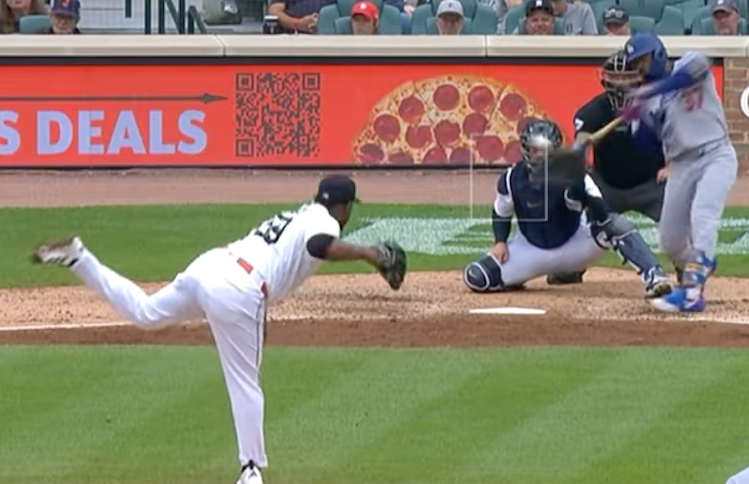
Hernández about to send that hanger out . . . (SNLA capture.)
Mercy, Mercy Mess Dept.—Dropping two of three to the Astros this weekend won’t slaughter the Mets’s otherwise fine August. (They were 14-12 after Sunday’s 6-3 loss.) But they were 11-6 as of 19 August. Then, they went 3-6 including Sunday. Still, watching their youth brigade continue to play without surrender has been fun, and they will finish August with their second winning month of the season.
But only their second, alas.




 Throneberry Fields Forever