WS Game Three: The fifth-inning dimension

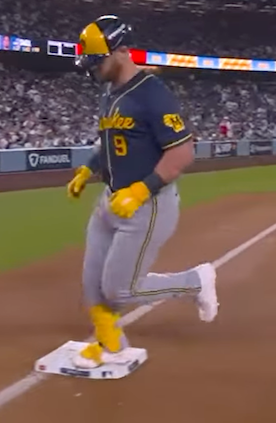
Christian Yelich

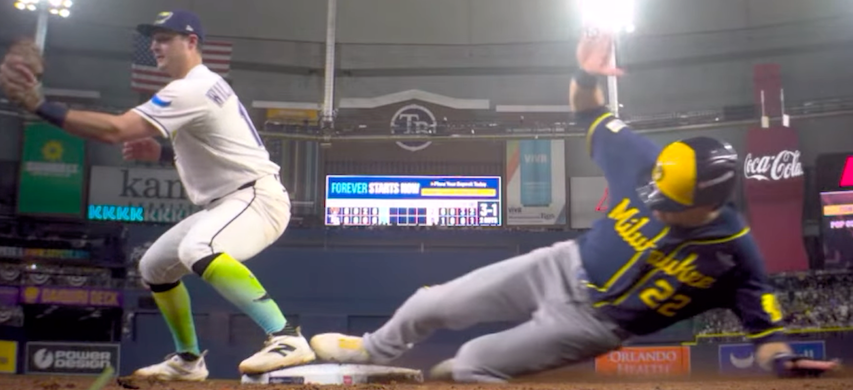
Sliding Scale Dept: Christian Yelich holding onto second base for dear life, upheld safe on review and opening the door to the eight-run fifth inning flood. (Fox Sports capture.)

Until Monday night, 88 meant the number of piano keys over which distinguished hands danced. Hands such as those belonging to Dave Brubeck, Philippe Entremont, Red Garland, Herbie Hancock, Vladimir Horowitz, Oscar Peterson, Bud Powell, and Professor Longhair.

On Monday night, in Tropicana Field, they meant eight Brewers runs on eight Brewers hits in a single fifth inning during World Series Game Three, which ended in a 10-1 massacre leaving the formerly perky, plucky, pesky Rays on the ropes. And, possibly, at the end of their ropes.

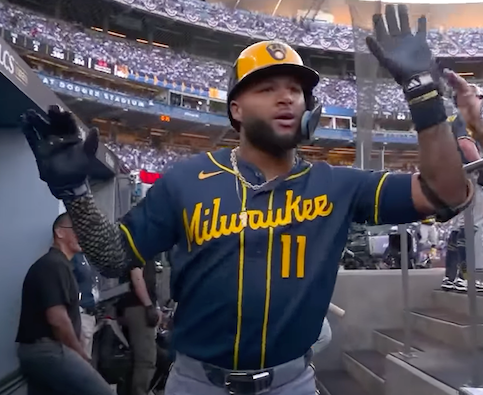
All courtesy of such now- or long-distinguished hands on bats as Jackson Chourio, Christian Yelich, William Contreras, Brice Turang, Cameron Mitchell, Cooper Pratt, Sal Frelick, and David Hamilton.

And, in Yelich’s case, maybe the single most powerful walk of all time.

And, the Brewers accomplished something unseen in no World Series before Monday night. All eight of those runs came home on two outs. Turning a mere 2-0 Brewers lead entering the frame into a 10-1 burial in which the lone Rays run—an RBI double with two outs in the bottom of the ninth—seemed like a pardon-us show of lingering life.

In what may yet prove to be the understatement of the postseason, Rays manager Kevin Cash was asked about that fifth. He knew it was the inning upon which everyone may yet look back and think it was the inning above all that sealed the Rays’s fate.

“It’s definitely deflating,” Cash said at his postgame presser. “How could it not be?”

Charles Cornwallis telling that to his soldiers before surrendering to George Washington at the Seige of Yorktown couldn’t have been more understated.

There’s still a fourth game to play at minimum. If the Rays have heretofore undetected cards to play and powers upon which to draw, they’d better play them and draw upon them Tuesday night.

In a Series matching two teams who play small-to-medium ball the way the aforementioned Garland played the blues, the Brewers are making the Rays resemble students who’ve barely gotten through the semester’s opening days.

This time, the Brewers didn’t have to strike from a deficit. This time, there was no early Rays scoring to prompt them to think, They have us right where we want them. This time, Yelich and Contreras staked them to a 2-0 lead with back-to-back RBI singles in the top of the third. For the first time in this World Series, they had an early lead to defend entering their half of the fifth.

Two RBI singles wasn’t supposed to turn Rays starter Freddy Peralta into an emergency ward patient. But then came Yelich, whose ages-ago acquisition from the Marlins could be argued as the moment the Brewers began returning to competitiveness and slouching toward greatness.

This time, it wasn’t a big stick but a big eye. He worked his way back from 1-2 to three straight takes out of the upper strike zone with Chourio (one-out single, stolen base) on second and two outs.

Then Contreras squeaked one toward third. Rays third baseman Junior Caminero picked it with his running momentum tugging him more toward the outfield. He threw to second instead of going for the theoretically simpler out at first. Second baseman Ben Williamson took the throw as Yelich’s right, front foot hit the pad about a half-inch ahead of the ball hitting Williamson’s glove.

Unlike Rays left fielder Chandler Simpson, caught stealing when he slid just past the pad to end the bottom of the first, Yelich never let his foot or his leg leave the pad behind.

The replays confirmed it. The Brewers now had the bases loaded and two outs. Cash took no chances with a parade of mostly portside swingers in the offing. He brought lefthander Cam Booser in. Before this, Booser was one of the Rays’s least touchable pen men and nobody in this postseason could claim an earned run off him. Yet.

But Turang shot one right off the glove of Rays shortstop Taylor Walls to shoot Chourio and Yelich home. Mitchell shot one the other way to left for the single that sent Contreras home. Pratt interrupted the left-side parade by pulling one off Caminero’s glove for a two-run double. Frelick—who’s hit the lone Brewers home run of the set, and who was robbed of an extra-base RBI hit in the second by a spectacular Simpson running catch—so went the other way to left, doubling Pratt home.
Robert Gasser

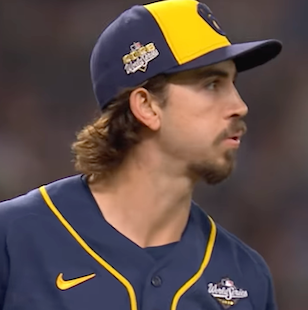
Robert Gasser—How to make like Sandy Koufax and be almost ignored in six easy lessons . . .

Booser couldn’t have been blamed if he reached for a double shot of booze after coming out in favour of righthander Cole Sulser. After Hamilton singled Frelick home and Chourio doubled Hamilton home—the fourth hit of the night just for the Brewers left fielder alone—first baseman Jake Bauers flied out to left. Almost the way he’d done to make the last known Brewers out before the battering rams started battering.

Almost lost in the superlatives that followed to describe and analyse the Brewers’s fifth inning flogging was their starting pitcher Robert Gasser. His repertoire doesn’t exactly match his name, since he makes his living offering diets of breaking balls and off-speed stuff for the most part.

He only pitched six shutout innings in which he collaborated with the fielders behind him the way Brubeck once collaborated with his classic quartet. He pitched them facing the minimum eighteen batters over the six. The last lefthander to do that? Some ancient Hall of Famer named Sandy Koufax, in 1965. In any other World Series, that would have been headlines upon headlines atop headlines.

But who the hell needed Gasser this night? Or, his relief Antonio Senzatella, who fired two perfect innings of his own? Only one Brewers pitcher could have taken minds off that assault-and-battery fifth. That was the guy who hadn’t pitched since the Fourth of July and recovered quicker than expected from shoulder capsule surgery to make this Series roster.

The guy who’s been a Brewer for life and interrupted more rudely by injuries than hecklers dare to interrupt comedians. The guy Brewers manager Pat Murphy—who spent much of the late game wheeling his supporting cast into and out of the game just to let them have a Series taste—sent out to pitch the ninth.

Brandon Woodward wrung his way around that excuse-us Rays run—a one-out single (pinch hitter Cedric Mullins); a two-out RBI double (Yandy Díaz)—to lure Jonathan Aranda into a first-pitch, game-ending ground out to second.

Only these Brewers could take that kind of game with that kind of fifth-inning bloodletting and make it into a feel-good game in the end. The looks on Woodward’s face after Turang threw Aranda out were the kind you borrow for feel-good product advertisements. It couldn’t have happened to a nicer guy than the one who threw the National League’s only 2023 pitching shutout, missed 2024, a piece of 2025, and two-thirds of 2026 with shoulder trouble.

Woodruff was first penciled in to start Game Four. But with the Brewers enjoying a glandular lead and Murphy unwilling to stop handing out favours, he asked Woodruff if he wanted that or to have the Game Three ninth.

“I want it right now,” the Forever Brewer (as he’s known around the Brewers and the game) said.

He could have been giving the entire team a watchword for the rest of the Series. A rest of the Series that could end Tuesday night. A rest of the Series in a stadium where almost precisely half the crowd was traveling, racket-making Brewers fans for whom travel and the Trop were cheaper than too many of the American Family Field Series tickets.

We want it right now, the Brewers will think as they begin Game Four. As the Rays begin, they’ll want to sing, You can’t always get what you want. That may not be simple the night after a journey to the fifth inning dimension.
WS Game One: “Just get the outs”

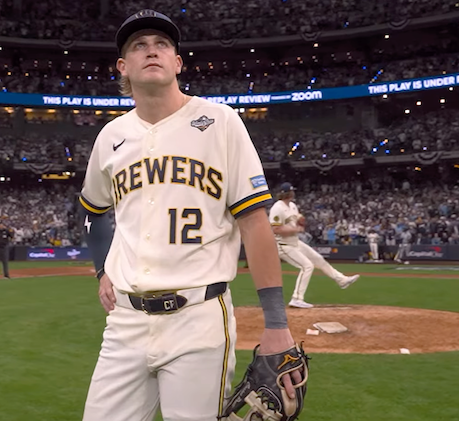
As closer Trevor Megill (right) takes an ump up on some extra keep-loose tosses, Brewers shortstop Cooper Pratt watches a replay of the double play that wasn’t, compelling Megill to go after and punch out Rays center fielder Jonny DeLuca to end the Brewers’ World Series-opening win Friday night. (Fox Sports capture.)

Opening night for Les Mis in the World Series wasn’t exactly one for award consideration. It didn’t have to be. The company around him was more than able to save the show when he had an off night. An off night for him, not anyone else.

Jacob Misorowski with a five-inning line of three punchouts, four hits, one earned run, and a 2.50 fielding-independent pitching rate is an off night for the likely National League Cy Young Award winner whose regular season showed a 174.2-inning line of 252 punchouts,  a 2.17 FIP, and a 1.80 earned run average.

But it was enough to keep his Brewers in the game until manager Pat Murphy decided it was time to reach for the secondary cast. Abner Uribe and Aaron Ashby made life difficult enough for the Rays, before Trevor Megill made it almost interesting enough for the Rays to overthrow the Brewers

Emphasis on almost.

The not-even-close-to-artificially-intelligent Brewers and not-even-close-to-artificially-intelligent Rays played it tight, overcame mistakes, and ground it out until the final outs that weren’t, before the Brewers held on tight to their 3-2 Game One win.

They had William Contreras to thank for a lot of it, their defense for a lot of it, the bullpen for a lot of the rest of it, and the replay review for the next-to-last act.

First, Contreras repaid longtime franchise face Christian Yelich for that bottom of the first RBI triple that just did elude diving Rays center fielder Jonny DeLuca. He slashed the first pitch he saw from Rays starter Nick Martinez through the hole at shortstop to send Yelich home and the Brewers to a nice, early 2-0 lead.

Then, with one out and Rays first baseman Jonathan Aranda (base hit) aboard in the sixth, Contreras caught Uribe’s swinging strikeout pitch to Rays left fielder Chandler Simpson and whipped a textbook perfect strike up the pipe to nail Aranda trying to swipe second.

Martinez, the elder Rays righthander who has a between-pitches habit of stepping up and down as though he’s peeking over a fence waiting for the right time to leap over and rob the place, settled well from there. He justified Rays manager Kevin Cash holding his own ace Drew Rasmussen until Game Two.

With the benefit of a run-scoring ground out by Liam Hicks in the top of the fourth to cut that lead in half, Martinez had his way with the Brewers for the most part the rest of his assignment.

He got away with Brewers right fielder Sal Frelick singling with one out in the second and helping himself to third after being bunted to second when he struck left fielder Jackson Chourio out to end the second.

He got away with murder in the fifth because Brewers third baseman David Hamilton took a bad turn rounding second trying to turn his one-out double into a triple, and the relay from right fielder Victor Mesa, Jr. to second baseman Ben Williamson to third baseman Junior Caminero was flawless enough to nail the diving Hamilton by a full foot plus.

Did that knock the Brewers into the oxygen tent?

Not a chance. Veteran Steven Matz—last seen in the World Series as a rookie with the 2015 Mets—shook off a pair of two-out walks in the sixth to escape and landed a pair of seventh-inning outs following a leadoff walk to Brewers rookie shortstop Cooper Pratt. Cash lifted Matz for Kevin Kelly, wanting the right-on-right match with Chourio.

Right on, the Brewers thought, when Chourio punched Pratt home with a base hit through the right side.

Naturally, things had to get more than interesting in the top of the ninth. As in, Brewers closer Trevor Megill allowing a pair of base hits (Aranda and Simpson) and a double steal, then walking the bases loaded for Hicks. Those hoping the Brewers might find their own Mariano Rivera some day had to settle for finding their own Craig Kimbrel Friday night.

Heaven help Megill if his mojo stops working. So far, he can work his way out of trouble of his own making faster than you can say “kill the save.” And he won’t say no to any help he can get. He got it Friday night, from Hicks and from his infield and from New York.

As in, Hicks grounding into what looked like a bang-bang-bang double play. As in, Caminero looking out at second, Hicks called out at first, and the Rays calling for a review. Megill wasn’t sure why. He may have been the only human being in American Family Field who wasn’t sure. At first. Then . . .

“I thought they were challenging the play at first,” he told reporters postgame. “I didn’t even think about it. I thought my cleat was dragging across the base. I just kind of looked at one of the umpires there and said, ‘Hey, what are you hearing in your ear?’ He said, ‘Uh, whatever, not too good. Do you want to throw some baseballs?”

The extra tosses did Megill a huge favour after replays showed Pratt covering second came off the pad before he had the ball to record the out while his throw on to first got Hicks. Meaning pinch runner Jorge Mateo was safe at home with the second Rays run and DeLuca checking in at the plate.

Once upon a time, that double play would have stood. It used to be called the infamous neighbourhood play. The out at second would be called if the fielder happened to be in the neighbourhood whether or not his foot hit the pad before he threw on. The crackdown on that play started around 2016. Bye, neighbour.

This was a night both sides didn’t exactly look like virtuosi on the bases, either. Now, though, Megill was hell bent on just blowing DeLuca away with two men still in scoring position. He dropped to 2-1 on fastballs, then dropped a delicious curve in on DeLuca to freeze him for strike two. 

“Anytime you can land a curveball at the bottom right there like that,” the husky righthander said, “it definitely sets up your next one. It’s just pitching and trusting what William is putting down back there.”

Contreras wanted that curve again. Megill was only too happy to oblige. He threw it, DeLuca swung through it, and the game belonged to the Brewers.

That’s not exactly what the Rays want to hear. This postseason, just the bullpen trinity of Uribe, Ashby, and Megill have a combined 0.95 earned run average, even if Megill likes to do it the hard way a little too often. Not the best pickings for a Rays team that was the American League’s best on the season but went 0-for-6 with men in scoring position Friday night.

“Has any team won a World Series with a starting rotation that was mostly just the nightly warm-up act for its bat-smothering relief crew?” asked The Athletic‘s Jayson Stark. “This is not a rhetorical question anymore.”

Megill had a non-rhetorical answer. “I don’t know, man. It just don’t matter how we get the outs,” he told Stark. “Just get the outs.”

Just get the outs. Because, as Yelich himself said postgame, “All of these games are going to be close. But it was good to get that first one.” Especially when it took forty-four years to get another crack at it.

NLCS Game Three: “Be really stubborn in there”

Jackson Chourio

Chourio accepts his props for hitting Game Three’s first pitch into the bleachers Thursday night.

After his Dodgers lost National League Championship Series Game One by a measly 2-1 score, Mookie Betts said they needed to start playing Dodger baseball, “whatever Dodger baseball is.” Then, they lost Game Two a little more decisively, 7-4.

Now, you might not really want to know what they’re thinking. Not after the Brewers knocked them into the NLCS hole 0-3, with Wednesday night’s quite emphatic 6-2 Game Three win.

The Damndodgers are on the brink of winter vacation without a World Series berth to show for being 2026 baseball’s . . . second-winningest team. For being even-up with the Brewers prior to this NLCS, going 8-2 in their last regular season ten and going 15-5 in their last regular season twenty and going 20-10 in their last regular season thirty.

Oops. The Brewers went 22-8 in their last regular season thirty. They also went 4-3 against the Dodgers in their regular season series against each other. The Brewers team OPS was .743 to the Dodgers’s .762, a -19 point difference. Their team fielding-independent pitching (fourth in Show this year) showed the Dodgers (second in Show) only four points lower.

In other words, there wasn’t that much reason to assume the Damndodgers—those money-throwing monstrosities who can’t possibly have anything else such as scouting, player development, analytics, brains, and guts to make them NL West champions thirteen of the last fourteen seasons—were that far superior to these saintly scrappers out of the Milwaukee bargain houses.

Well, now. The Family Dollars are on the threshold of going to the Big Dance. All they have to do is take one more from the Cartiers. Difficult, but not impossible.

If the Dodgers find a way to batter the Brewers in Game Four Thursday night, the Brewers could always elect to make sacrificial lambs of relievers they haven’t yet deployed, comfortable knowing they have Jacob Misiorowski to ride in Game Five. Les Mis, plus their usual case of off-off-off-off-Broadway anti-stars. Even if it’s a Misiorowski-Tarik Skubal rematch.

Misiorowski to one side, how many people outside the burg that made beer ubiquitous could name one of the Brewers’s current cadre of characters not named Les Mis, Christian Yelich, Jackson Chourio, or William (Kid Brother of Willson) Contreras, before this postseason began?

Chourio merely renewed his name recognition Thursday night. All the left fielder had to do was exactly what he did in Dodger Stadium, hit Game Three’s first pitch the other way and over the right center field fence.* With one swing, he renewed his prospects of becoming the second Jackson behind a certain Hall of Famer to be thought of as any type of Mr. October.

“I was still putting my batting gloves on to get ready,” said Brewers first baseman Jake Bauers, who batted fifth in the lineup Thursday. “I just saw the ball flying, and I knew he got it. It kind of set the tone for the day and let everyone know that we’re here to win this game.”

There’d be two more bombs to come later in the game, from two of the Brewers’s heretofore-unknown soldier contingency. From Bauers, hitting a two-run homer in the seventh, then from center fielder Garrett Mitchell, following almost immediately with a solo blast landing not far from Bauers’s bomb.

So where did this power originate? Isn’t that anything but the Brewers’s usual game of scrape, fleck, hunt, and peck?

Jake Bauers

Bauers rounding third off his eleventh-pitch two-run homer.

“It’s funny,,” said outfielder Sal Frelick postgame. “We are hitting some homers, but that’s not the approach at the plate. It’s just: apply pressure, apply pressure. I think by applying pressure, we’re able to dictate that pace of play. It’s not result-oriented, it’s just at-bat oriented. It doesn’t matter if you get out, get on, strike out, whatever. Just take a chunk of the pitcher with you and establish playing that way.”

They’d take their chunks out of Dodgers starting pitcher Blake Snell in due course. First, they had to navigate the lefthander shutting them out for five innings to follow Chourio’s rude introduction. Other than a one-out walk (Mitchell) and base hit to left (rookie shortstop Cooper Pratt) in the second, Snell looked as though he’d filed ownership papers on the guys too many still underrate.

Brewers starter Robert Gasser (now, there’s a name for a pitcher, even if his fastball isn’t the type to be called a gasser) was almost as good as Snell before turning it over to the bullpen. He pitched five solid and survived the Dodgers putting their leadoff men aboard three times and coming up scoreless.

At first, it looked as though manager Pat Murphy played the wrong hand. Abner Uribe, heretofore one of the Brewers’s more effective relievers, had his first truly shaky postseason outing in the sixth: walk (left fielder Teoscar Hernández), walk (right fielder Kyle Tucker), swinging strikeout (pinch hitter Max Muncy), walk (still-ailing designated hitter Shohei Ohtani), two-run double (catcher Will Smith). Forcing Murphy to reach for DL Hall to keep the deficit to 1-2.

Come the top of the seventh, though, the Brewers made Dodgers manager Dave Roberts pay for forgetting Snell’s career-long vulnerability: going the third time around the enemy lineup. Already leaving himself vulnerable by switching parts of his better defense out of the game, Roberts’s forgetfulness may yet prove a key reason why the Dodgers don’t three-peat, if they don’t.

Snell walked DH Andrew Vaughn after a seven pitch battle to open. With Christian Yelich pinch running, the lefthander fought the portside-swinging Bauers epically, through ten pitches. On the full-count eleventh pitch, Yelich took off as though a police cruiser bore  down upon him . . . and Bauers hit the pitch into the right field bleachers.

That overthrew the not-quite-secure Dodger lead by a run. Mitchell checked in, took ball one, then drove one not far from where Bauers’s blast landed. Ending Snell’s evening two batters too late, leaving Evan Phillips to come in and get three outs to contain the damage.

Unfortunately for the Dodgers, that containment lasted only long enough for Roki Sasaki to surrender back-to-back one-out eighth-inning singles to second baseman Brice Turang and catcher Contreras. Roberts brought Justin Wrobleski in for Yelich. Wrobleski put Yelich in the hole 0-2 before throwing a ball off the plate and Smith’s mitt, enabling Turang to score.

It almost felt as though the Brewers rubbed it in a little in the ninth. Pratt singled with one out, stole second with two out and third baseman Joey Ortiz at the plate, then came home with the sixth and final run when Ortiz punched a bast hit. Walk the line? They’ll walk, single, punch, slash, grind, and bomb the line. Whatever it takes.

“Murph says it, Murph preaches it, Murph expects it. Ball-strike them, get good pitches to hit,” said Vaughn post-game. “If [the pitcher’s] not going to give you anything, walk to first base. Be really stubborn in there, and that’s going to help us win ballgames.”

“Not swinging at crap” is the way Pratt put it. Roberts isn’t that blunt, but he all but agreed with the freshman shortstop.

“They’re taking better at-bats than they did last year,” said Roberts, recalling the Dodgers’s sweeping the Brewers in last year’s NLCS. “Their ball-in-play averages, gosh dang, it’s got to be .400. When they put the ball in play, it’s a hit. They’re also slugging, which they didn’t do last year. Those are good combos.”

Good, stubborn combos. The kind that win postseason games. Postseason series, even.

* As analyst Jessica Brand pointed out, it’s the first game-opening, first-pitch, first-batter bomb in Brewers history. Chourio hit a first-pitch, first-inning homer in NLCS Game Two last year, but it was the bottom of the first.