For the Mets, Hall of Fame day and play

Jeff Kent, Andruw Jones, Carlos Beltrán

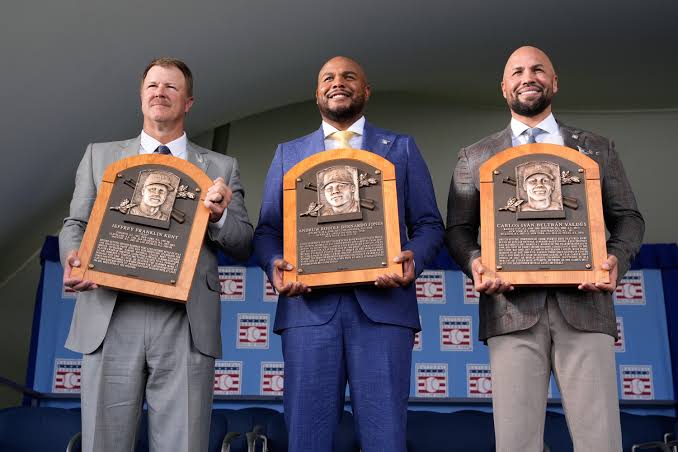
Former Mets Jeff Kent and Carlos Beltrán sandwich longtime Braves center field vacuum and bomber Andruw Jones at the Hall of Fame Sunday. Today’s Mets even made them proud back in New York. (National Baseball Hall of Fame photo.)

So little has gone right for the Not-So-Amazin’ Mess (er, Mets) this season that even the grumpiest cynic among Met fans must have entered Sunday praying for something, anything. On a day when two former Mets were inducted into the Hall of Fame, one of whom elected to be represented as a Met, the least the Mets could do was win a damn game.

Carlos Beltrán was one of baseball’s center field greats. Not open for debate or debunk. He was a demolition expert at both sides of the plate. He’s one of only five men to hit 400+ home runs and steal 300+ bases. And, as Jayson Stark (The Athletic) hoisted forth, there are only two men in all baseball history to play 40+ postseason games and a) bat .300+; b) reach base for a .400+ on-base percentage; and, slug .600+

Who’s the other guy? Some moon-faced mug named Ruth.

“[W]ith apologies to Reggie Jackson,” Mr. Stark croons, “Beltrán may have been the real Mr. October.” (Sit down and shut up about that 2006 National League Championship Series-ending called strikeout. His Babehood saw and raised, running unconscionably into a World Series-ending out trying like a fool to steal a base he couldn’t have stolen aboard a scooter by then.)

No apologies necessary. Nobody forgets Jackson’s three-bomb Series-winning party in Game Six of the 1977 Series, of course. But take a look at what counts in the long haul, Beltrán over 65 postseason games and Jackson over 77 (WPA: win probability added, not the Works Progress Administration of the New Deal):

Will the real Mr. October please stand up?

  BA OBP SLG OPS WPA
Carlos Beltrán .307 .412 .609 1.021 2.26
Reggie Jackson .278 .358 .527 .885 1.22

It’s almost to wonder how come Beltrán never earned a nickname comparable to Hall of Famer Rickey Henderson’s. Did you know Beltrán is the only player in major league history with 312 stolen bases and an 86.4 percent stolen base percentage? The Man of Steal has a mere 80.7 theft percentage.

Beltran was also as run preventive as the day was long with his glove. Maybe not quite as run preventive as fellow Sunday Hall inductee Andruw Jones—but nobody else was, either. Not even the immortal Willie Mays. Jones and Mays are numeros uno y dos, after whom come Paul Blair, Jim Piersall, Kenny Lofton, and Devon White. If only those four could have hit in the Beltrán-Jones league, never mind Mays.

“When people ask me why I choose this cap,” Beltrán said during his induction speech, referring to the Mets after saluting every team for whom he played, “I have to say this, guys. It’s simple. Every organization shapes your career. New York shaped my life.”

Jeff Kent wasn’t all that much as a very young Met, of course. He was prickly at his best at that time. Dealt from the Blue Jays (for pitching great David Cone), Kent answered a prank from his new teammates with fury. From there to the Indians in another trade and then to the Giants, he built a parallel rep as a solid player (especially at the plate) and a bit of a sour belly.

As a Giant, Kent yanked himself into the books. No, it didn’t hurt that he got to bat with Barry Bonds’s kind of protection, but that kind of protection matters nothing if you don’t or can’t take advantage. Kent took. And how. Six straight seasons of 20+ home runs and 100+ runs batted in; nine straight of 20+ bombs and 90+ steaks.

By his own eventual admission, Kent found it difficult to impossible to let himself be seen as human. Yet when the Contemporary Era Committee elected him last winter, Kent let himself show what he didn’t dare unless he was getting into a scrum with Bonds: real emotion.

He even thanked his Giants manager, Dusty Baker, profusely enough. “He was the right man at the right time for me, and I’m naturally a half-empty guy . . . Looking back, I think I complicated the game a lot more than it needed to be. And Dusty was the opposite. Dusty didn’t complicate the game. He respected it.”

If only the Jeff Kent at the Cooperstown podium could have been available to the Jeff Kent who snapped at pranking teammates, lied about popping wheelies on his motorcycle his final Giants spring training, and chewed out mercurial Dodger teammate Milton Bradley for non-hustle when Bradley was playing on a balky knee that exploded on him on a subsequent baserunning play. Among others.

Meanwhile, back in New York, Kent’s and Beltrán’s former Mets were going to be damned if they were going to let the Dodgers take a third straight from them on Hall of Fame day.

Freddy Peralta, whose shaky season seems to have ensured his Mets tenure will be short and somewhat less than sweet, pitched four decent innings of six-hit, three-run (two earned) ball. The Mets bullpen put the Dodgers on lockdown the rest of the way for the most part.

Then the Mets took what they could get from Dodger starter Emmet Sheehan (a first-inning RBI single from Francisco Lindor) and his nasty little array of heaters and skidders, before he yielded after five innings. Then the Mets got to abuse the Dodger pen starting in the sixth. Jack Dryer walked a pair around one out, but Evan Phillips had the honour of Tyrone Taylor blasting his 1-1 service into the left field seats.

An inning later, a passed ball enabling A.J. Ewing to score led to a two-out walk to Jorge Polanco, which led to Marcus Semien—one of the gaggle of Mets brought aboard for this season only to find themselves playing out of position (and possibly out of their gourds) often enough—banging Will Klein’s 1-1 offering over the left field fence.

All the Mets had to do was keep the Dodgers pinned the final two frames. Luke Weaver squirmed unscathed out of a bases-loaded jam into which he’d squirmed a little too handily in the eighth—Freddie Freeman singling; Tommy Edman singling two outs later; Kyle Tucker hit by a pitch—before Teoscar Hernández bounced one to the third base side that Weaver himself grabbed and threw on from a fadeaway angle to just get the third out. Then Devin Williams found enough of his once formidable self in the ninth to shake off a leadoff single and strike the side out.

Met fans could be forgiven for asking why ex-Mets couldn’t be inducted into Cooperstown every day; or, at least, five out of seven days. Because on the sunny day when two received their plaques, the Mets had the great sense to play like the team they were supposed to have been cobbled, knobbled, and roped together to be this season.
Ron Hunt, RIP: Plunk rock

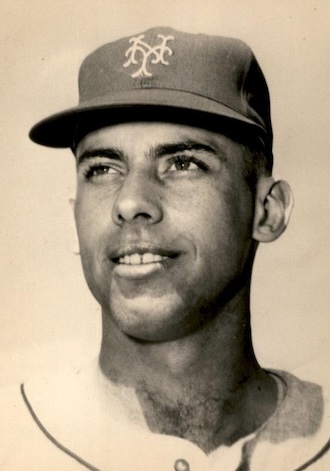
Ron Hunt

“He crowds the plate like Raquel Welch crowds a bikini.”–The Pittsburgh Press, about Ron Hunt, long after he left the Mets in a heartbreaking trade.

Many enough in New York were impressed early and often with Ron Hunt, the first Met to earn a starting berth in an All-Star Game (1964, played in newborn Shea Stadium), aside from us kids who believed the comically inept Mets were just that much more human than the aloof, imperial Yankees.(“The Yankees,” Bill Veeck once wrote, “always took the attitude that they were doing you a favour by permitting you to watch them perform.”)

The impressed included Roger Angell, in only his second year of writing literarily virtuosic baseball reports, opinions, asides, and epitaphs for The New Yorker. “The sun’s brightest rays this spring,” Angell wrote, in a May 1963 essay, “have shone around the middle of the [Mets’s] infield.”

Ron Hunt, a skinny twenty-two-year-old second baseman up from the Texas League . . . has quick hands, excellent range to his left, and a terrier’s eagerness for a moving ball . . . [He] has kept his [batting] average close to .300. He reminds me of Pee Wee Reese at the plate—an unassuming, intelligent swinger who chokes up on the bat and slaps singles to all fields.

Hunt ripped a walkoff double for the first Mets win of 1963; original owner Joan Payson sent his wife, Jackie, two dozen roses. He actually finished second to Pete Rose in the National League’s 1963 Rookie of the Year vote. A year later, Hunt impressed Angell yet again. “The Mets are short on heroes,” Angell wrote.* “Their gamecock, their small nova, is Ron Hunt, the second baseman.”

Now in his second season, Hunt appears to be one of those rare ballplayers who improve from year to year. Four years ago, he batted .191 in the low minors. Last year, as a major-league rookie, he hit a solid .272, and so far this young season a stream of modest singles and doubles has kept him constantly above the .300 mark. Originally a third baseman, he now has mastered the pivot at second and he fields with assurance, if not brilliance. His new partnership with Roy McMillan, the veteran shortstop just purchased from the Braves**, cements the Mets’ infield. McMillan has slowed down a step or two and is having trouble at the plate, but he is a tough, tobacco-chewing, old-time pro and a boon to this young team.

He also began mastering the art of taking one for the team, quite literally. His 243 lifetime drills were a modern major league record when he retired in spring 1975. (“He gets good flesh on the ball,” cracked one newspaper once upon a time.) If they’d had walkup music in that era, you could have had a field day picking Hunt’s. He was 1960s/1970s baseball’s great plunk rocker.

In May 1965, Cardinals infielder Phil Gagliano blasted Hunt on a takeout slide as Hunt tried to pick a slow grounder by Hall of Famer Lou Brock. That shoulder separation almost killed a season which began with Hunt missing its first fifteen games with a jammed finger. He came back early that August but the season was more than lost.

After returning to form enough to make the NL All-Stars in 1966, Hunt ran afoul of Mets manager Wes Westrum (Casey Stengel’s successor) and was dealt to the Dodgers with outfielder Jim Hickman for former NL batting titlist Tommy Davis and outfielder/infielder Derrell Griffith, who’d never play a single major league game for the Mets or anyone else again.

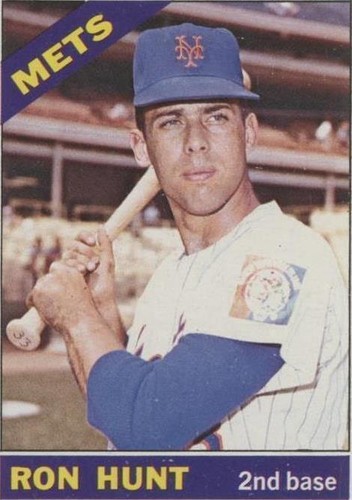
Ron Hunt

Hunt’s final Topps baseball card as a Met. He didn’t exactly look the junkyard-dog type.

“The trade broke his heart,” wrote Hunt’s Society for American Baseball Research biographer Tad Myre. “The Hunts loved New York City, the Mets team, and the Mets fans. Ron figured he’d be a Met forever and wanted to be around when the club started to win. It did not help that he had to learn of the trade from sportswriter Dick Young.”

With the Dodgers for a season, the Giants (after a trade) for three, the Expos for three and two thirds, and his hometown Cardinals for shy of a third, Hunt broadened his reputation as a baseball junkyard dog. For seven straight years he led the National League in getting hit by pitches, and for the first six he led the entire Show. He also walked far more than he struck out, but he once said pitchers told him if he got them to 3-1 in the count they might as well drill him.

“He even practised getting hit in batting practise,” said his Expos manager, Gene Mauch. “Hunt has had to fight for everything he got . . . Hunt has a big day, goes four-for-four, the next day he’s out early wanting to work on some things, wanting to do it again, nor being satisfied.”

When his playing career ended, Hunt—who died last Wednesday at 85, after a long battle with Parkinson’s disease that may have come from four baseball concussions and “indeterminate” ones when he played high school football—involved himself in farming, liquor and sporting goods stores, and a youth baseball association from 1987-2003 aimed at preparing kids aiming to play college baseball.

The great plunk rocker also made sure that at least one piece of his Mets past stayed with him: he kept two pairs of seats from the late Shea Stadium in his home. (He was also known to have saved a good number of the balls that hit him during plate appearances as well.***)

Hunt was probably one of the most classic examples of the player whose guts you hated with a passion—until or unless he became your teammate. If you made him a friend, you had a friend for life, according to just about every published tribute to the man.

If you made him a husband, as his high school sweetheart Jackie Stewart did, you had what Myre called a marriage “for the storybooks” which produced two children, Tracie and Ronnie. “The happiest day of my life,” Hunt called his 1961 wedding day. “That’s what she told me to say.”

Ron and Jackie Hunt had a habit of making friends among the fans with whom they dwelled off the field. Veteran New York Post writer Ken Davidoff, profiling Hunt and his Parkinson’s battle in 2018, asked whether he wanted Met fans to pray for him. “Just tell them I said hi,” Hunt replied. “I don’t know them. They don’t know me personally. Just tell them I said hi. I’ll never forget you.”

His wife, children, grandchildren, fans, and friends won’t forget him, either. Here’s hoping Hunt’s entry into the Elysian Fields was gentler than his near-customary way of reaching base.


* Both Roger Angell essays quoted were included in the first of his imperative anthologies, The Summer Game. (New York: Viking Press, 1972; Nebraska: Bison Books, 2004.)

** Hunt himself was an acquisition from the Braves, the Mets having bought him after their first tremendously, hysterically horrendous (or should that be horrendously hysterical) season.

*** Don Baylor broke Hunt’s modern-era lifetime plunk record in 1987 and retired with 267. Hall of Famer Craig Biggio broke Baylor’s record in 2005 and retired with 285.)

The break, and the breaks, and . . .

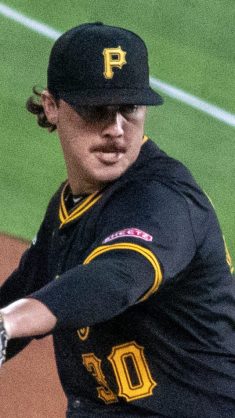
Paul Skenes

Skenes will miss the All-Star Game after a stellar Sunday start . . .

‘Twas the day before the All-Star break. And all through baseball’s house . . .

The Big Skenes of Things Dept.—That was prior to 7 July: The Pirates lost nine straight starts by Paul Skenes, hanging him with the loss in six of those games, and leaving him out to dry in five of the games during which he pitched well enough to be credited with a win.

This was a second straight Skenes start, Sunday afternoon, in which the Pirates won with double-digit scoring while their man pitched well enough to get credit for a win: a 14-5 blowout of the Brewers, during which Skenes surrendered a mere two earned runs while striking seven out in five and a third innings’ work.

The Pirates did it despite hitting only one into the seats, DH Marcel Ozuna’s leadoff blast in the fourth that ignited a ten-run inning. Everything else came on RBI singles, doubles, one RBI triple, one bases-loaded walk, and a bases-loaded hit batsman preceding that walk.

Skenes was picked for the National League All-Star team but won’t pitch in the game thanks to starting Sunday. Rest assured. He may be complaining only a little bit.

Les Mis-sing in Action Dept.—Would the Pirate blowout have gone differently if Jacob Misiorowski had pitched Sunday? We’ll never know for certain. But the Brewers rested him after he turned up with what the team called “fatigue.”

Box office watchers should take heart: the Brewers and the Pirates meet for four in August and three in September, meaning Skenes and Misiorowski could have a showdown in either set.

But those watching the development of young, lively, even larger-than-life pitching arms have cause for alarm if the Brewers fear Les Mis didn’t recover as normal from his last start. The sprout has busted a few pitching speed marks already, but it’s an open question whether that might mean a busted arm, elbow, or shoulder down the road.

Like Skenes, Misiorowski has already been replaced on the NL All-Star team.

Cam the Fan Dept.—The American League’s ERA leader will be at the All-Star Game . . . as a fan, not a pitcher. Yankees righthander Cam Schlittler elected not to pitch in the Game despite it falling on his normal throwing day between starts.

“Just feels like, on his recovery day, to go back out there throwing one hundred miles an hour is something that he felt a little apprehensive about,” said Yankee manager Aaron Boone to reporters Sunday “Certainly support that decision and obviously he understands what’s at stake here in the second half for us and for him.”

Fifth Wheel Dept.—Phillies righthander Zach Wheeler was so offended by his initial All-Star snub that he declined a later invitation to join in the fun. “Maybe I didn’t earn it from the get-go, but maybe just second choice,” he told NBC Sports Philadelphia Saturday. “Once I feel like they kind of messed that up, I’m out.”

As if to continue proving how wrong his snub was, Wheeler squared off against Tarik Skubal of the Tigers Sunday and pitched six scoreless with ten strikeouts while his Phillies mates waxed Skubal’s and his relief Keider Montero’s tails, 5-0.

In fairness: it wasn’t all Skubal’s fault. He surrendered only one earned while in the game, but after leaving following Bryce Harper’s leadoff single in the sixth, Montero surrendered an infield hit, a sacrifice bunt, and an intentional walk—before Tigers All-Star Kevin McGonigle’s throwing error enabled two runs scoring behind Harper on J.T. Realmuto’s RBI double.

Realmuto came home on Bryson Stott’s infield hit after that.

Coming five days after he flattened the Reds by tying his career high with fourteen punchouts, Wheeler certainly slammed an exclamation point upon his unwarranted snub.