WS Game Two: The Brewers—“They had us right where we wanted them”

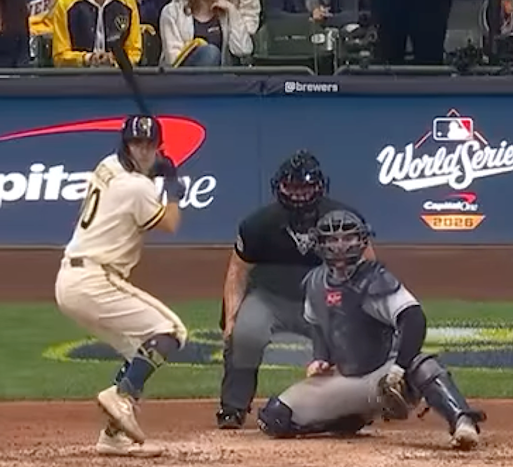
Sal Frelick

Sal Frelick hitting the first Brewers World Series home run since Ben Oglivie 16,075 days previous . . . (Fox Sports capture.)

Not even the mild controversy of Game Two’s final strike could erase what’s becoming a theme for these postseason Brewers. They won’t let any deficit keep them from the steady but certain completion of their self-appointed rounds.

Jump them with a little help from one of their own mistakes for four runs in the first, the way the Rays did Saturday night? The Brewers just look, listen, and think, They have us right where we want them.

Pry two right back out of the Rays’s ace Drew Rasmussen in the bottom of the inning, but leave first and third and let Rasmussen settle in for one of his usual outings? They have us right where we want them.

Sneak a third run in the fourth on a ball sneaking through Rays first baseman Jonathan Aranda’s legs with first and third and one out? They have us right where we want them.

Stay a run behind opening the bottom of the sixth, watch right fielder Sal Frelick wring his way to a full-count ninth pitch off Rays reliever Ian Seymour? They have us right where we want them. Watch Frelick homer on that pitch? They had us right where we wanted them.

Because that’s just the Brewers, too.

And that was about a week after they fell behind 4-0 to the Damndodgers in National League Championship Series Game Four. A deficit that included a still-ailing Shohei Ohtani finding enough of a power reserve to hit a three-run homer measured not in distance but on the Richter scale.

They had us right where we wanted them, too. And—a two-run single in the fourth, an RBI single and a bases-loaded game-tying walk in the fifth, a leadoff homer in the sixth, and a two-out homer in the ninth later, the Brewers finished the pennant sweep they started.

Now, with a 5-4 Game Two win in the World Series, the Brewers look unsinkable and the Rays look half sunk. Beware how deceptive looks can be. Remind yourself there’s still time for the Rays to pick themselves up, dust themselves off, say to themselves, They have us right where we want them, too.

They can make the Brewers suffer in the Trop, a pressure cooker of a dome equal to American Family Field’s roof closure for a racket down from the stands. They can force the Series back to Milwaukee with those comeback kids needing yet another comeback. Or two.

Can’t they?

Who knows? It’s not looking great for the Rays after Rasmussen—who hadn’t allowed three or more runs in his previous thirty-six innings of work—got pried for three runs in three and two-thirds innings Saturday night.

It’s not looking great for the Rays after their bullpen, the fifth-best in the American League on the regular season, couldn’t even think about getting Games One and Two to their lights-out ninth-inning man Bryan Baker.

It’s not looking great for the Rays after Frelick fought Seymour through eight pitches most of which Frelick admitted later enabled less-than-comfortable swings, then got what he wanted on the ninth pitch, a sinker right down Main Street—and hit it on a high line over the center field fence. For the first World Series home run any Brewer has hit in 16,075 days. (The last: Ben Oglivie, fifth inning, 1982 Game Seven, off the Cardinals’s Joaquín Andújar.)

It’s not looking great for the Rays after rookie Brewers shortstop Cooper Pratt—who enabled their early lead in the first place by throwing Yandy Díaz’s game-opening grounder away—atoned for that with second baseman Brice Turang on third (leadoff double; advance on a fly out) when he lined a single into shallow right field, letting Turang score the fifth Brewers run without a sweat.

It’s not looking good for the Rays when they’re up against a Brewers bullpen that has a 1.24 ERA this entire postseason while their own pen minus Baker has a 4.20.

And, when they’re up against an Aaron Ashby who isn’t the Brewers’s designated closer but has a zero ERA and a 1.24 fielding-independent pitching rate over three and a third Series innings so far. Not to mention 15.2 scoreless innings to start his entire postseason, a third of an inning shy of the record sixteen Cleveland’s Andrew Miller set in 2016. Over that 15.2? Five hits, three walks, seventeen punchouts.

There was Ashby on the mound with Díaz at the plate and the Rays down to their final out Saturday night. There was Ashby in the hold 3-1 to the dangerous enough Díaz. There was Brewers catcher William Contreras calling for and getting a curve ball that froze Díaz like a turkey awaiting its Thanksgiving dinner thaw. There was Contreras calling for a second straight curve, Ashby throwing it down and in, Díaz unable to keep from swinging.

The Rays’s designated hitter tried to check the swing. An appeal to first base rung him up with the game-ending out. The swing looked so bloody close on replays—the general rule is that if the bat head passes the front of the plate, it’s a swing and a strike, though Díaz’s bat head was so close the call could have gone either way.

If it had been ruled check swing, ball four, it would have meant Aranda batting with first and third and two out. Aranda had one double that came to naught on the night, but he’d gone 3-for-3 with a run scored in Game One. He wouldn’t exactly have been easy meat, even for Ashby.

But rest assured. If it did happen that way, Ashby and the Brewers would have given themselves a quick review, looked at Aranda checking in, and thought to themselves, yet again: They have us right where we want them.

Beware. The Rays had 98 comeback wins on the regular season to the Brewers having a mere 34. But the Brewers have done it seven times this postseason—including four straight to the Damndodgers—to the Rays doing it nada.

Other than the change of venue, and even with rejuvenated Freddy Peralta scheduled to start Game Three, the Rays can’t yet look at the Brewers and think, They have us right where we want them.
WS Game One: “Just get the outs”

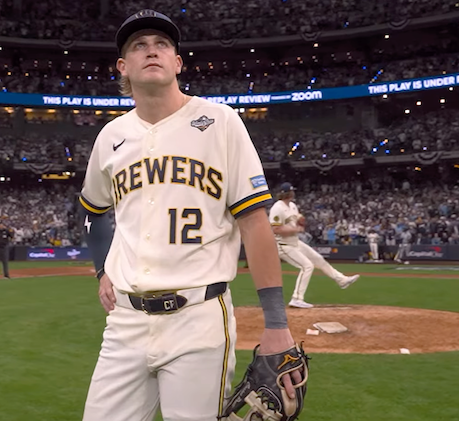
As closer Trevor Megill (right) takes an ump up on some extra keep-loose tosses, Brewers shortstop Cooper Pratt watches a replay of the double play that wasn’t, compelling Megill to go after and punch out Rays center fielder Jonny DeLuca to end the Brewers’ World Series-opening win Friday night. (Fox Sports capture.)

Opening night for Les Mis in the World Series wasn’t exactly one for award consideration. It didn’t have to be. The company around him was more than able to save the show when he had an off night. An off night for him, not anyone else.

Jacob Misorowski with a five-inning line of three punchouts, four hits, one earned run, and a 2.50 fielding-independent pitching rate is an off night for the likely National League Cy Young Award winner whose regular season showed a 174.2-inning line of 252 punchouts,  a 2.17 FIP, and a 1.80 earned run average.

But it was enough to keep his Brewers in the game until manager Pat Murphy decided it was time to reach for the secondary cast. Abner Uribe and Aaron Ashby made life difficult enough for the Rays, before Trevor Megill made it almost interesting enough for the Rays to overthrow the Brewers

Emphasis on almost.

The not-even-close-to-artificially-intelligent Brewers and not-even-close-to-artificially-intelligent Rays played it tight, overcame mistakes, and ground it out until the final outs that weren’t, before the Brewers held on tight to their 3-2 Game One win.

They had William Contreras to thank for a lot of it, their defense for a lot of it, the bullpen for a lot of the rest of it, and the replay review for the next-to-last act.

First, Contreras repaid longtime franchise face Christian Yelich for that bottom of the first RBI triple that just did elude diving Rays center fielder Jonny DeLuca. He slashed the first pitch he saw from Rays starter Nick Martinez through the hole at shortstop to send Yelich home and the Brewers to a nice, early 2-0 lead.

Then, with one out and Rays first baseman Jonathan Aranda (base hit) aboard in the sixth, Contreras caught Uribe’s swinging strikeout pitch to Rays left fielder Chandler Simpson and whipped a textbook perfect strike up the pipe to nail Aranda trying to swipe second.

Martinez, the elder Rays righthander who has a between-pitches habit of stepping up and down as though he’s peeking over a fence waiting for the right time to leap over and rob the place, settled well from there. He justified Rays manager Kevin Cash holding his own ace Drew Rasmussen until Game Two.

With the benefit of a run-scoring ground out by Liam Hicks in the top of the fourth to cut that lead in half, Martinez had his way with the Brewers for the most part the rest of his assignment.

He got away with Brewers right fielder Sal Frelick singling with one out in the second and helping himself to third after being bunted to second when he struck left fielder Jackson Chourio out to end the second.

He got away with murder in the fifth because Brewers third baseman David Hamilton took a bad turn rounding second trying to turn his one-out double into a triple, and the relay from right fielder Victor Mesa, Jr. to second baseman Ben Williamson to third baseman Junior Caminero was flawless enough to nail the diving Hamilton by a full foot plus.

Did that knock the Brewers into the oxygen tent?

Not a chance. Veteran Steven Matz—last seen in the World Series as a rookie with the 2015 Mets—shook off a pair of two-out walks in the sixth to escape and landed a pair of seventh-inning outs following a leadoff walk to Brewers rookie shortstop Cooper Pratt. Cash lifted Matz for Kevin Kelly, wanting the right-on-right match with Chourio.

Right on, the Brewers thought, when Chourio punched Pratt home with a base hit through the right side.

Naturally, things had to get more than interesting in the top of the ninth. As in, Brewers closer Trevor Megill allowing a pair of base hits (Aranda and Simpson) and a double steal, then walking the bases loaded for Hicks. Those hoping the Brewers might find their own Mariano Rivera some day had to settle for finding their own Craig Kimbrel Friday night.

Heaven help Megill if his mojo stops working. So far, he can work his way out of trouble of his own making faster than you can say “kill the save.” And he won’t say no to any help he can get. He got it Friday night, from Hicks and from his infield and from New York.

As in, Hicks grounding into what looked like a bang-bang-bang double play. As in, Caminero looking out at second, Hicks called out at first, and the Rays calling for a review. Megill wasn’t sure why. He may have been the only human being in American Family Field who wasn’t sure. At first. Then . . .

“I thought they were challenging the play at first,” he told reporters postgame. “I didn’t even think about it. I thought my cleat was dragging across the base. I just kind of looked at one of the umpires there and said, ‘Hey, what are you hearing in your ear?’ He said, ‘Uh, whatever, not too good. Do you want to throw some baseballs?”

The extra tosses did Megill a huge favour after replays showed Pratt covering second came off the pad before he had the ball to record the out while his throw on to first got Hicks. Meaning pinch runner Jorge Mateo was safe at home with the second Rays run and DeLuca checking in at the plate.

Once upon a time, that double play would have stood. It used to be called the infamous neighbourhood play. The out at second would be called if the fielder happened to be in the neighbourhood whether or not his foot hit the pad before he threw on. The crackdown on that play started around 2016. Bye, neighbour.

This was a night both sides didn’t exactly look like virtuosi on the bases, either. Now, though, Megill was hell bent on just blowing DeLuca away with two men still in scoring position. He dropped to 2-1 on fastballs, then dropped a delicious curve in on DeLuca to freeze him for strike two. 

“Anytime you can land a curveball at the bottom right there like that,” the husky righthander said, “it definitely sets up your next one. It’s just pitching and trusting what William is putting down back there.”

Contreras wanted that curve again. Megill was only too happy to oblige. He threw it, DeLuca swung through it, and the game belonged to the Brewers.

That’s not exactly what the Rays want to hear. This postseason, just the bullpen trinity of Uribe, Ashby, and Megill have a combined 0.95 earned run average, even if Megill likes to do it the hard way a little too often. Not the best pickings for a Rays team that was the American League’s best on the season but went 0-for-6 with men in scoring position Friday night.

“Has any team won a World Series with a starting rotation that was mostly just the nightly warm-up act for its bat-smothering relief crew?” asked The Athletic‘s Jayson Stark. “This is not a rhetorical question anymore.”

Megill had a non-rhetorical answer. “I don’t know, man. It just don’t matter how we get the outs,” he told Stark. “Just get the outs.”

Just get the outs. Because, as Yelich himself said postgame, “All of these games are going to be close. But it was good to get that first one.” Especially when it took forty-four years to get another crack at it.

So what’s in a name?

This is about to spring forth in Milwaukee . . .

The Milwaukee Brewers have unveiled the logo for their home field’s name change as of 2021. From Miller Park to American Family Field. From a brewer to an insurer. Social media shows so far that Brewers fans are rather less than amused, though not yet ready for war over it.

For one thing, as one such fan tweeted, “Miller actually cared about the logo, the team and the branding of both. American Family is only interested in their own product.”

Presumably, the Brewers’ administration cares greatly about the $4 million a year American Family Insurance will pay for the next fifteen years in return for the park bearing their name. It’s buzzard feed compared even to the Brewers’ actual $1.2 billion worth, but it’s income regardless.

American Family’s apparent concession to the Brewers involves that part of the intended logo that references Miller Park’s unique retractable roof, a stylising of the five curved sections that open and close above the field like a hand-held fan, more or less. One Twitter wag suggested American Family really wanted to show the launch angles of the home runs the adjacent Chicago Cubs tend to hit all over the place in the place. (Last year, the Cubs hit twenty out in ten games there.) Serious Brewer fans suggested, plausibly enough, that they’ll never think of the place as other than Miller Park for time immemorial.

. . . from this.

They’re not necessarily wrong about that, and not just because Miller Park’s official logo marries both the brewery’s logo and two baseballs on either end in a rather handsome badging.

Some of the world’s most famous structures remain referenced by their birth names no matter how often their actual names are changed. You may or may not know the Met Life building in New York City, but New Yorkers still refer to it as the Pan Am building—never mind that Pan American World Airways went cease and desist 28 years ago.

Ask a Chicagolander about Willis Tower and he or she will rejoin, “That’s the Sears Tower to you, fool.” Willis Group Holdings of London owns the naming rights until 2024. The name might change twenty times over the century to follow and Chicago children will be taught to call it the Sears Tower.

Baseball’s ballpark names have been a goulash of sorts. Some have borne or still bear the team name: Yankee Stadium, Dodger Stadium, Nationals Park, Tiger Stadium, Colt Stadium (Houston), Braves Field (Boston). Some have borne the names of team owners: Baker Bowl (William Baker, the Philadelphia Phillies), Comiskey Park (Charles Comiskey, the Chicago White Sox), Ebbets Field (Charles Ebbets, the Brooklyn Dodgers), Griffith Stadium (Clark Griffith, the Washington Senators), Navin Field (Frank Navin, the Detroit Tigers) . . .

Oops. Some parks have born the name of more than one owner. Wrigley Field (William, then Philip K.) was born as Weeghman Field. (Charles, who bought the Cubs after the Federal League collapsed. Wasn’t it kind of the Tribune Company to leave the name intact after buying the Cubs from the Wrigleys in the first place?) It remains the only baseball park known to wear the name of a chewing gum maker.

Navin Field eventually became Briggs Stadium during the Tigers’ ownership of Spike Briggs. Shibe Park (Ben Shibe, the Philadelphia Athletics until his death in 1922) eventually became Connie Mack Stadium (Shibe’s successor owner), though the main entrance bore both park names in due course. Sportsman’s Park (the St. Louis Cardinals) eventually became the first of three Busch stadiums. Two were named concurrently for the team’s principal owner and the brewery whose name is half theirs; the third’s such name nods kindly to history.

Busch Stadiums, Miller Park, and Coors Field (Colorado) have been the only major league stadiums named after breweries, which seems amiss considering that baseball and beer have been married longer and more successfully than most human marriages today. I still remember some whisperings in the early 1960s, when I was boy just beginning to embrace baseball, that the forthcoming home of my New York Mets might be named for its principal broadcasting sponsor. Now, there was a thought.

Alas, the playpen into which the Mets moved in 1964 wasn’t named for Rheingold beer.  (My beer is Rheingold the dry beer!) It was named for the corporate attorney (William A. Shea) who had a major hand in stirring the late 1950s pot (the proposed Continental League) that eventually brewed the National League’s return to New York. Who said we could have everything? (Or, why didn’t they name it for Branch Rickey, once the Dodgers’ chieftain, whose brainchild the Continental League actually was?)

Two ballparks, one of which has some nerve thinking of itself as a park, are named for orange juice: Tropicana Field (Tampa Bay) and Minute Maid Park (Houston). Three guesses which refreshment out-sells orange juice there. The most prominent sight in San Francisco’s PacBell/SBC/AT&T/Oracle Park, other than the Giants playing baseball, is a large, stylised soda pop bottle behind the left field bleachers, making you wonder why—when it came to the place’s naming rights—Coke wasn’t it.

When Shea Stadium’s life was to expire at last, the Mets’ new home—designed deliberately with references to the Brooklyn Dodgers whom ancient, autocratic city and state planning czar Robert Moses tried to strong-arm into what became Shea (If we play in Queens, we won’t be the Brooklyn Dodgers anymore—Walter O’Malley)—stirred hope (mine, mostly) that they might name the place for someone prominent in Mets history. (Stengel Field? Seaver Park?) Hope sprang infernal when the Mets sold the naming rights to a bank.

That wasn’t exactly going against the grain incumbent or to be, as fans who’ve spent time in such financially-named parks as Bank One Ballpark (Arizona, now known as Chase Field), Comerica Park (Detroit), SunTrust/Truist Park (Atlanta), PNC Park (Pittsburgh) or Guaranteed Rate Field—oops! Real Chicagolanders will never cease to call the place Comiskey Park.

At least one major league ballpark bore a name having nothing to do with baseball and everything to do with capturing Fort Duquesne from the French in 1758. Pittsburgh Pirates owner Barney Dreyfuss named Forbes Field in honour of the colonial general who led the capture. When Dreyfuss died, his family resisted entreaties to re-name the Old Lady of Schenley Park (one of the joint’s colloquial nicknames) in his honour.

Enough major league ballparks have had boring utilitarian names, though depending upon their locations and conditions they’ve been handed delightful colloquial nicknames: the Mistake on the Lake (Municipal Stadium, Cleveland), the Old Gray Lady of 33rd Street (Memorial Stadium, Baltimore).

Speaking of old ladies, once upon a time, Tiger Stadium bore the colloquial nickname “the Old Girl.” It caused havoc enough in the Florida household of ancient Tigers pitcher Elden Auker, who’d attended the park’s closing ceremonies. Auker’s local newspaper, the Vero Beach Press Journal, headlined that attendance: “Auker Says Good-bye to Old Girl.” As he wrote in his memoir (Sleeper Cars and Flannel Uniforms), it created a ticklish situation for the wife he loved for sixty-seven years until his death:

The headline . . . jumped off the page . . . and grabbed the attention of our housekeeper. She waited until I left the room and sidled up to Mildred with an expression made up of part sympathy and part admiration of Mildred’s strength. She wanted Mildred to know she had a friend in her time of need.

“Who was she?” Darlene whispered, and then braced herself for an explanation of the apparent scandal. Darlene thought the “old girl” in the headline was some old flame of mine.

Auker may have been more than a little wistful about Tiger Stadium’s demise, but he drew the line between wistful and unrealistic. “Who am I to complain about progress?” he wrote in the memoir. “After all, I’m on my fourth pacemaker.”

In Baltimore, of course, the Old Gray Lady of 33rd Street was succeeded delightfully by Oriole Park at Camden Yards, officially. Unofficially, of course, it’s Camden Yards. Nobody’s even thought of selling naming rights afresh there yet, so far as I know. Better stop there. We don’t want to give them any more bright ideas.

If you think re-naming a ballpark for an insurance company is a little off balance, consider: The longtime home of the New York Giants was the third structure on that site to be known as the Polo Grounds. Many things happened at those Polo Grounds, shaped in fact like a horseshoe, up to and including the two maiden absurdist seasons of the Mets. Polo wasn’t one of them.