Garret Anderson, RIP: The quiet, infectious Angel

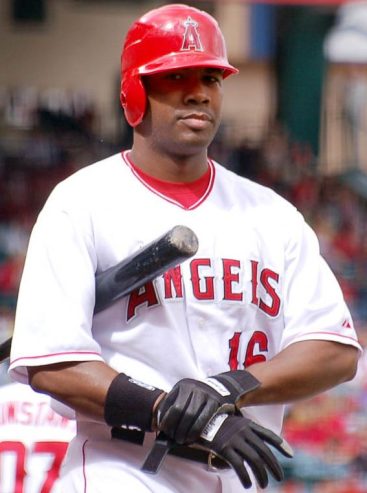
Garret Anderson

All business in the batter’s box or left field, Garret Anderson was liable to break into an infectious smile and good baseball and life talk with teammates otherwise.

“Maintaining an even strain” was a way of life for legendary military test pilots and often a way of anguish for their wives. It’s also a way of life for enough baseball players, and often a source of anguish for enough of their fans. Show me the player who maintains an even strain, and I’ll show you the fans who mistake it for indifference.

Garret Anderson, whose death of a heart attack at 53 Thursday shocked his sport, was such a player. At least, until his Angels shocked his and their sport and won the 2002 World Series in seven rather thrilling games.

“I used to be called lazy,” he told one reporter, after his three-run double in the fifth inning of Game Seven put the Angels ahead to stay. “Now that we win a World Series, I’m called graceful.”

Anderson at the plate was a sight more likely to inspire engineers than artists. He didn’t look at pitchers as though he wanted to carve his initials into their foreheads. He didn’t look or act like an ogre measuring up his next meal or a junkyard dog finding intruders under every wreck. He swung methodically but attentively, line drives a specialty, even if he did win the 2003 Home Run Derby.

“So stoic was Anderson in the box,” wrote Sports Illustrated‘s Tom Verducci in tribute, “that he came to the plate 9,177 times and saw 30,503 pitches and was hit by only eight of those pitches, the fewest ever by anyone who came to the plate 9,000 times. There was no filigree to Anderson. No self-promotion. Nothing extraneous. How he played happened to be exactly how he lived his life.”

“That swing that I was using tonight is not a swing that I try to use during the season,” he said after he won that Derby. “It was just strictly for trying to hit balls over the fence. During the season, mentally and physically, I don’t do that. I look for mistakes and try to hit them hard.”

Pitchers, other opponents, and even teammates understimated or dismissed Anderson at their own peril. In a seventeen-year career, all but two seasons of which were with the Angels, Anderson was as reliable as the day or night was long. He led the American League back-to-back in doubles; he averaged 21 home runs per 162 games; he didn’t walk much but only ever struck out 100 times once; he finished with his play in left field worth 95 total zone runs above his league average, fourth on the all-time list.

Still, there were those who assumed Anderson too benign to make the Big Plays. They assumed incorrectly.  “He doesn’t dive for balls because he gets there quicker than most guys,” said Darin Erstad, Anderson’s longtime Angels outfield partner, and a classic junkyard dog type of player. If that type holds Anderson in high esteem, best listen.

Not that Anderson was allergic to diving or lunging. He simply thought it meant he’d been caught unawares for a very rare moment. “I never should have had to dive for that ball,” Anderson once said after making a diving catch against the Twins. “I got a bad jump. I study hitters. I have an idea of where the ball is going. I don’t dive because I don’t have to.”

Somewhere in the Elysian Fields, Joe DiMaggio must be grinning, if not ready to mix Anderson a tall, cold one.

So the 2003 All-Star Game MVP didn’t resemble the offspring of a secret in vitro union between Rickey Henderson and Robin Williams. The laugh tillers still need the straight men.

“His passion to play this game was very real, and although maybe it didn’t manifest itself the way it did with some other players, Garret played hard, he wanted to win,” said his longtime Angels manager Mike Scioscia, when Anderson was inducted into the team’s Hall of Fame. “He’s got that internal competitive nature that every great player has to have, and he was really the foundation of our championship run back in 2002 and for many other years. He just was a terrific talent and a terrific person.”

Teammates were also among the first to get tastes of Anderson’s dry, disarming wit. Midwest-born former first baseman Scott Spiezio learned the hard way when his fashion sense, or lack thereoff, came into Anderson’s sights. “I’d get on the [team] plane, he’d be like, ‘Spiez, you got on a horse blanket? You’re giving me allergies’,” Spiezio said. “Before you know it, I’m buying Canali, Hugo Boss and Armani.”

Like George Harrison’s reputation as the “Quiet Beatle,” Anderson’s reputation as the Quiet Angel was often deceptive. And, like Harrison, in a good way.

Win or lose, by blowout or by single run, Anderson prided himself and his best teammates on consistency, whether fellow stoics or class clowns alike. “You can’t get wrapped up in one game,” he said in April 2002, after the Angels blew Cleveland out 21-2 one fine day.

Guys’ personalities on this team are the same day-to-day. Guys are walking around the clubhouse the same way they were last week when we were getting our butts kicked. That’s good to see. We have a lot of games to play.

“Yes, he was quiet, but let me tell you that if you entered his inner circle, he was deeply, deeply engaging, even loquacious,” said Joe Maddon, eventually a World Series-winning manager himself but then the Angels’s bench coach. “I so enjoyed our conversations. He was just a sweetheart of a guy. All of us who knew him are just broken up about [his death]. We all loved him. This is really, really hard.”

Maybe the hardest hit might have been Tim Salmon, drafted by the Angels a year before Anderson. A pair of southern California guys, one from Los Angeles (Anderson) and one from Long Beach (Salmon), who forged a deep brotherhood out of opposites, but also out of a few common threads (each married their high school sweethearts, for one), Anderson’s even strain somehow finding its neatest complement in the far more outgoing Kingfish.

“I mean, it’s devastating. As devastating as anything can be in your life,” Salmon began when reached by a reporter.

We’ve pretty much been in this game together at the same time the whole time. I just remember seeing this kid driving this really nice Mustang [in their instructional league days]. He must’ve spent his entire signing bonus on it. Here comes this tall, lanky kid. I was like, ‘Oh, what kind of attitude we’re gonna have here?’ And it was the complete opposite. He was just so mild-mannered and quiet, and you had to draw it out. But he was infectious. He became a favorite of his teammates from the beginning.

“When I first got drafted,” said Angels outfielder/DH Mike Trout, long enough The Man in Anaheim before the injury bug rudely interrupted him, and the only Angel to score more runs lifetime than Anderson, “[Anderson] was the guy. He meant a lot to this organization . . . I don’t think I’ve ever heard anything bad said about him. It’s just a tough, tough loss.”

Anderson’s impact wasn’t just on his own team. He made a big impression on another southern California kid who grew up making Anderson—who was also respected for signing autographs for kids for long periods daily while he played—his baseball hero.

“You always hear, ‘Don’t meet your heroes’,” said Freddie Freeman, the Dodgers’s Hall of Fame-bound first baseman. “But then I got to meet him, and I was like, ‘I’m glad I did.’ Because he was a beautiful man. And I wish he was still here. He meant a lot to so many people … I’m at a loss for words really.”

The only people to whom he could mean more were his wife, Teresa; their daughters, Brianne and Bailey; and, their son, Garret (Trey) Anderson III. As great as baseball’s grief is, theirs is greater. Lord watch over them as You welcomed him home, a little bit early, but no less safe and sound.

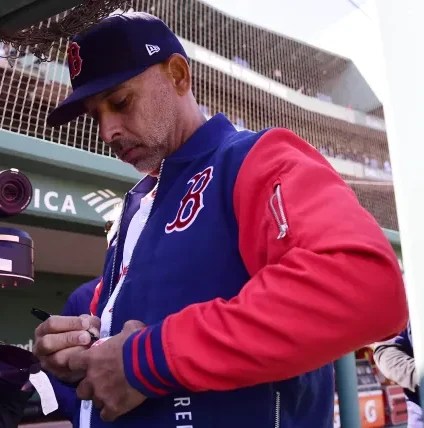
Phil Garner, RIP: Two sides of scrap iron

Phil Garner

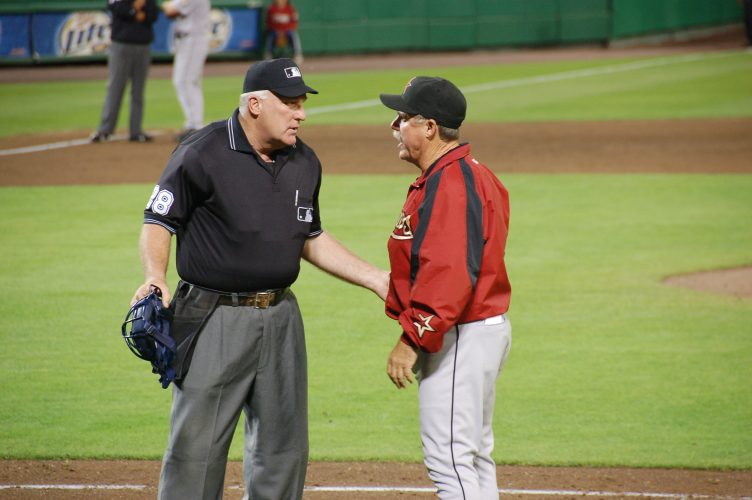
Phil Garner debates with umpire Larry Young in 2006. He didn’t always act like his Scrap Iron nickname.

Phil Garner was nicknamed Scrap Iron for his feisty side but had a side gentle enough that he once promised his wife to hit a grand slam for her when she missed the first one he hit as a major leaguer. Don’t make promises you can’t keep. Unless you can. And he did.

Garner was a rough-and-ready second baseman whose fortés did not include power hitting. (He averaged nine homers a year lifetime.) So, after Mrs. Garner missed him taking Cardinals pitcher Bob Forsch in the bottom of the sixth on 14 September 1978, the loving husband promised her another salami slice ASAP.

Naturally, it came the next day, against the Montreal Expos. And neither Garner had to wait beyond the bottom of the first, when hubby squared off against Woodie Fryman with the pads padded and hit one over the left field fence. It was the first time a National League player sliced salami in back-to-back games in 77 years.

That was the guy who’d grow up to manage the Astros to their first pennant in 2005, when they were still a National League club. The bad news was the Astros grappling their way to it through the Cardinals only to get swept by the White Sox.

And, the who’d go from there to the Athletics’ front office as an advisor, to the team who once traded him after the guy they traded to manage the Pirates, Chuck Tanner, told his new team to trade for the second base slasher. In that advisory role, Garner proved invaluable to an old teammate named Bob Melvin, when both were Giants and Garner was near the end of the line.

Maybe that was also because, when managing the Brewers and the Tigers once upon a time, Garner made Melvin his bench coach at both stops, and Melvin appreciated Garner talking to him in terms of actualities and not what-ifs.

“When he would talk to me,” said Melvin to The Athletic‘s Tyler Kepner about Garner, who died of pancreatic cancer Saturday night, “he would always say, ‘When you manage …’ Not one time did he ever say, ‘If you manage …’ And it just resonated with me that he had that much confidence in me. Obviously, I did end up managing, and a lot of my philosophies and a lot of my values in baseball come from him. There’s no more impactful guy in my career than Phil Garner.”

Garner did that in a lot of places. When he became a Pirate, he engaged in some good-natured jousting with Hall of Famer Dave Parker, who’d first been astonished that his team sent six players to Oakland in the swap that made Garner a Pirate in the first place.

Parker zinged him, Garner zinged back, and the new guy’s “initiation was complete,” as Parker remembered in his memoir, Cobra, “and I had a new sparring partner.” He also had an almost immediate appreciation for Garner one spring training afternoon after Garner’s arrival.

“In the twilight,” the Cobra wrote, “ol’ Scrap Iron was still out there, hours later, taking extra fielding practice at third base. As pissed as I was about the trade, I knew it was the smart move and we got ourselves a winning player.” A guy to win a World Series with, as they did with the Fam-I-Lee Pirates of 1979.

And, a guy who knew how to help bring a roster together, as the team’s relief ace Kent Tekulve told Kepner. “Our team was known to be, oh, a little rowdy, a little cocky, and nobody was safe in the clubhouse,” Tekluve began.

It didn’t matter where you stood in the pecking order, everybody was fair game, and a lot of that was Gar. It was hilarious every day when we’d come in. Whichever one got there first—Parker or Gar—you were waiting for the second one, because it was going to start. You’ve got this 6-foot, 5-inch, huge Black guy and this 5-foot, 9-inch little redneck, and they’d just start in on each other, and that spread. Everybody’s involved now.

And he knew what was going on. I mean, Phil was a smart guy. He knew if he got on Parker, then everybody else would get on him, too. And Parker liked that, because that gave him a reason to prove you wrong.

That’s the man whom Tigers pitcher C.J. Nitkowski once ripped publicly after “a frustrating game,” as Kepner phrased it. Garner bawled him out for it in a clubhouse meeting the next day . . . but accepted the pitcher’s apology privately. Garner even tried to acquire Nitkowski when managing the Astros later on.

“It really spoke to me and made me reflect on how I want to handle myself,” said Nitkowski, who went from the mound to the broadcast booth in due course. “He showed what professionalism looks like, and what forgiveness looks like.”

Another of his pitchers, Steve Sparks, remembered a tough loss that stirred Garner to “shredding us in the locker room” and turning the postgame food spread into a miniature landfill. If Garner couldn’t cool himself off, his lady could—and did.

“At the end of [the tirade],” Sparks remembered, “his wife Carol has a Harley-Davidson wheeled into the clubhouse for his birthday—and right away he turns into Jerry Seinfeld in the ‘schmoopie’ episode, from one character to another in the blink of an eye. He was so relatable. He knew how to laugh at himself.”

Hopefully some of that laughter will come through the tears when they lay the body to rest and wish the man a safe journey home to the Lord. Where Dave Parker’s just liable to be waiting for him with a cold beer in hand and a mouthful of wisecracks with which to serve it.

First published by Sports-Central.

Three swipes, you’re out

Jo Adell

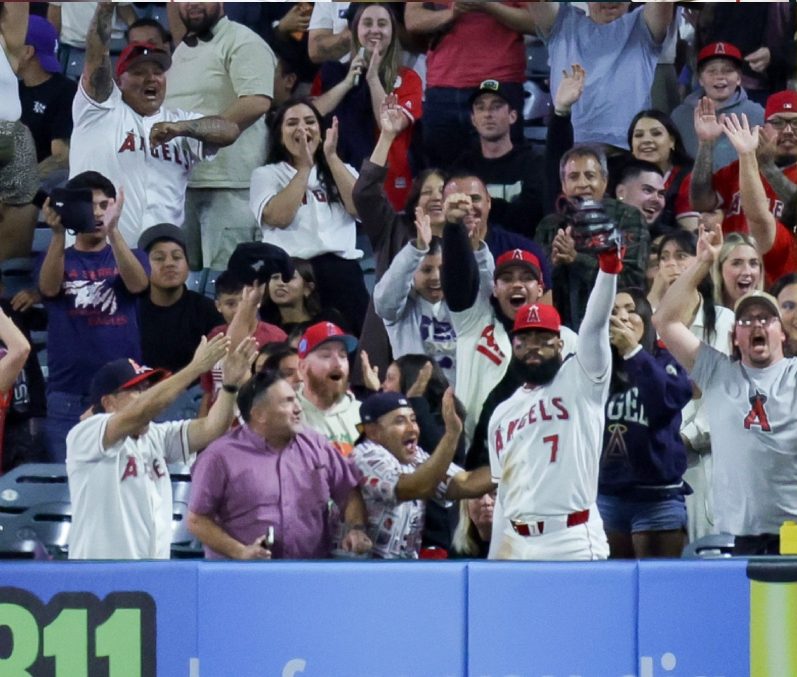
Jo Adell (7) holds the ball in his glove aloft after his third Saturday night home run theft proved the most spectaculer of the three.

Let’s assume there were cynics in Angel Stadium Saturday. Let’s assume at least a few of them said, “I’d like to see him do that again,” when Jo Adell took a flying leap and robbed Mariners star catcher Cal Raleigh of a home run. Those cynics and Raleigh hadn’t seen anything yet.

“I don’t know if I’ve ever seen a guy rob two homers in one game, much less three,” said Raleigh after the game. “Baseball can amaze you night in and night out. You can see something you’ve never seen before. I’ve never seen anything like that.”

Did the Big Dumper say three?

He did.

And he wasn’t just whistling tea kettle, either.

Raleigh was only the second batter of the game. It took until the eighth inning for Adell to get another crack at grand theft homer, when Josh Naylor lofted a long fly to just about the same right center field real estate over which Raleigh tried to fly. Once again, Adell took a flying leap. Once again, he snatched the fly before it could hit the high wall above the yellow line that determines whether a drive might be a homer or not when hitting the wall.

Adell had one more piece of business to tend an inning later. This time, J.P. Crawford thought for dead last certain that his long fly toward the seats behind the lower right field corner wall would make it into those seats for the run that eluded the Mariners all game long to that point.

Not quite.

Adell ran toward that wall, leaped with his back to the fans in that section, extended his glove hand, and speared the ball, snapping his glove around a split half-second before he fell all the way behind the wall . . . before springing up none the worse for wear and with the ball still secured.

Only two players stole four home runs at all all last season, Jacob Young of the Nationals and Fernando Tatis, Jr. of the Padres. Adell stole three of them in one night’s work.

For an outfielder who’d always had the tools but not always the results, you could only imagine what was or wasn’t shooting into and back out of his head after the Angels banked the 1-0 win. (The lone run? Zach Neto taking Emerson Hancock’s fourth service of the game over the left center field fence in the first.)

“Defense was something that I struggled with,” Adell told reporters postgame. “Just finding ways to improve and get better and find a way to learn. At the end of the day, defense is one of those things where it’s just about trying to get the job done.”

Sounds very much like a man who took some wise counsel on more than one occasion from former Angel and longtime former Twins center field star Torii Hunter. But what did Hunter think? “It’s amazing, man,” said the man who’s mentored Adell during spring trainings. “That’s probably the greatest defensive game I’ve ever seen.”

“Front row seat to the Jo Show,” Xtweeted Mike Trout, whose healthy resurgent season took a rude but hopefully very short disruption Sunday afternoon, incurring a contusion when hit by a pitch late in the Angels’s 8-7 win.

“You just get there, and it’s just decision-making,” said Adell of his backward leap and fall while robbing Crawford. “Just got there, and was able to fall over and end up in somebody’s lap. I don’t know who, but it was a softer landing than I thought it would be. It’s kind of crazy.”

“Kind of crazy” might be a kind way to phrase it. He may have been lucky the landing was far more shallow than the one Tampa Bay’s Manuel Margot had catching one in a flying leap over a right-side wall with a deeper landing in Game Two of the 2020 American League Championship Series. But then Margot was lucky to come up with his skeleton intact.

The Mariners proved to be good sports about it all. On their clubhouse bulletin board, someone inscribed the Sunday game plan: “Don’t hit the ball to Joseph Adell.” They only hit three in Adell’s direction Sunday—once for a double, once a home run, and once an RBI single.

The home run, from second baseman Cole Young in the top of the fifth, flew high enough over the right field fence in front of a ballpark maintenance alley that Adell couldn’t have even thought of stealing it, even by catapult. Even the best of thieves need time off for good behaviour.