WS Game Two: The Brewers—“They had us right where we wanted them”

Sal Frelick

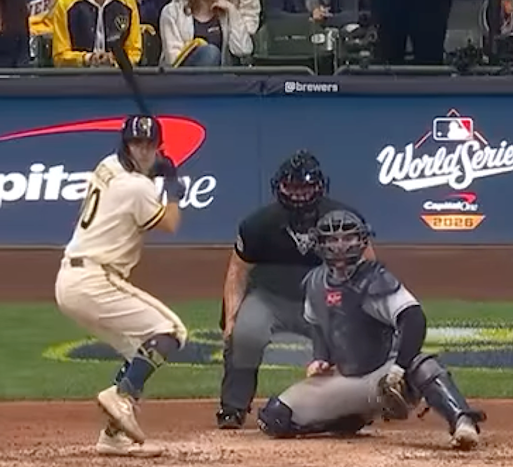
Sal Frelick hitting the first Brewers World Series home run since Ben Oglivie 16,075 days previous . . . (Fox Sports capture.)

Not even the mild controversy of Game Two’s final strike could erase what’s becoming a theme for these postseason Brewers. They won’t let any deficit keep them from the steady but certain completion of their self-appointed rounds.

Jump them with a little help from one of their own mistakes for four runs in the first, the way the Rays did Saturday night? The Brewers just look, listen, and think, They have us right where we want them.

Pry two right back out of the Rays’s ace Drew Rasmussen in the bottom of the inning, but leave first and third and let Rasmussen settle in for one of his usual outings? They have us right where we want them.

Sneak a third run in the fourth on a ball sneaking through Rays first baseman Jonathan Aranda’s legs with first and third and one out? They have us right where we want them.

Stay a run behind opening the bottom of the sixth, watch right fielder Sal Frelick wring his way to a full-count ninth pitch off Rays reliever Ian Seymour? They have us right where we want them. Watch Frelick homer on that pitch? They had us right where we wanted them.

Because that’s just the Brewers, too.

And that was about a week after they fell behind 4-0 to the Damndodgers in National League Championship Series Game Four. A deficit that included a still-ailing Shohei Ohtani finding enough of a power reserve to hit a three-run homer measured not in distance but on the Richter scale.

They had us right where we wanted them, too. And—a two-run single in the fourth, an RBI single and a bases-loaded game-tying walk in the fifth, a leadoff homer in the sixth, and a two-out homer in the ninth later, the Brewers finished the pennant sweep they started.

Now, with a 5-4 Game Two win in the World Series, the Brewers look unsinkable and the Rays look half sunk. Beware how deceptive looks can be. Remind yourself there’s still time for the Rays to pick themselves up, dust themselves off, say to themselves, They have us right where we want them, too.

They can make the Brewers suffer in the Trop, a pressure cooker of a dome equal to American Family Field’s roof closure for a racket down from the stands. They can force the Series back to Milwaukee with those comeback kids needing yet another comeback. Or two.

Can’t they?

Who knows? It’s not looking great for the Rays after Rasmussen—who hadn’t allowed three or more runs in his previous thirty-six innings of work—got pried for three runs in three and two-thirds innings Saturday night.

It’s not looking great for the Rays after their bullpen, the fifth-best in the American League on the regular season, couldn’t even think about getting Games One and Two to their lights-out ninth-inning man Bryan Baker.

It’s not looking great for the Rays after Frelick fought Seymour through eight pitches most of which Frelick admitted later enabled less-than-comfortable swings, then got what he wanted on the ninth pitch, a sinker right down Main Street—and hit it on a high line over the center field fence. For the first World Series home run any Brewer has hit in 16,075 days. (The last: Ben Oglivie, fifth inning, 1982 Game Seven, off the Cardinals’s Joaquín Andújar.)

It’s not looking great for the Rays after rookie Brewers shortstop Cooper Pratt—who enabled their early lead in the first place by throwing Yandy Díaz’s game-opening grounder away—atoned for that with second baseman Brice Turang on third (leadoff double; advance on a fly out) when he lined a single into shallow right field, letting Turang score the fifth Brewers run without a sweat.

It’s not looking good for the Rays when they’re up against a Brewers bullpen that has a 1.24 ERA this entire postseason while their own pen minus Baker has a 4.20.

And, when they’re up against an Aaron Ashby who isn’t the Brewers’s designated closer but has a zero ERA and a 1.24 fielding-independent pitching rate over three and a third Series innings so far. Not to mention 15.2 scoreless innings to start his entire postseason, a third of an inning shy of the record sixteen Cleveland’s Andrew Miller set in 2016. Over that 15.2? Five hits, three walks, seventeen punchouts.

There was Ashby on the mound with Díaz at the plate and the Rays down to their final out Saturday night. There was Ashby in the hold 3-1 to the dangerous enough Díaz. There was Brewers catcher William Contreras calling for and getting a curve ball that froze Díaz like a turkey awaiting its Thanksgiving dinner thaw. There was Contreras calling for a second straight curve, Ashby throwing it down and in, Díaz unable to keep from swinging.

The Rays’s designated hitter tried to check the swing. An appeal to first base rung him up with the game-ending out. The swing looked so bloody close on replays—the general rule is that if the bat head passes the front of the plate, it’s a swing and a strike, though Díaz’s bat head was so close the call could have gone either way.

If it had been ruled check swing, ball four, it would have meant Aranda batting with first and third and two out. Aranda had one double that came to naught on the night, but he’d gone 3-for-3 with a run scored in Game One. He wouldn’t exactly have been easy meat, even for Ashby.

But rest assured. If it did happen that way, Ashby and the Brewers would have given themselves a quick review, looked at Aranda checking in, and thought to themselves, yet again: They have us right where we want them.

Beware. The Rays had 98 comeback wins on the regular season to the Brewers having a mere 34. But the Brewers have done it seven times this postseason—including four straight to the Damndodgers—to the Rays doing it nada.

Other than the change of venue, and even with rejuvenated Freddy Peralta scheduled to start Game Three, the Rays can’t yet look at the Brewers and think, They have us right where we want them.
The Guardians aren’t out of it until . . .

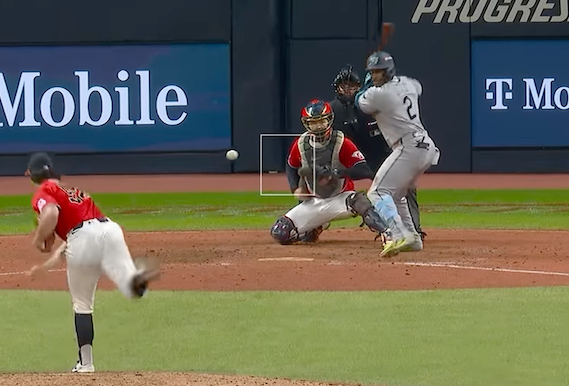
Yandy DîazYou’ve been warned. The Rays are going to win the American League Championship Series. Why? Because Yandy Diaz says so, that’s why.
“It all ends tomorrow,” Díaz said, after the Rays hung on to win Game Five, 3-1, in Progressive Field Sunday. “We’re going to win tomorrow.”

His two-run homer in Game Four and his 3-for-5 performance in Game Five give him some psychological leverage.

But unless you’re a spit, scuff, mud, or scratchballer living rent free in opposing hitters’s heads (good afternoon, Hall of Famers Whitey Ford and Gaylord Perry), or a road runner living likewise before you reach base in the first place (likewise, Hall of Famers Luis Aparicio and Rickey Henderson), it’s not advisable to play the psych-out card.

More often than not, that card becomes bulletin board stuff. The kind that irons the other guys up. Ask David Cone. He’s the Mets pitcher who called Dodgers reliever Jay Howell “a high school pitcher” in a ghostwritten newspaper before Game Two of the 1988 National League Championship Series. Oops.

Dodgers manager Tommy Lasorda posted the column on their clubhouse bulletin board. Guess who turned up as the Mets’s Game Two starter. Guess who got beaten like a piñata for five runs in two innings? Guess who ended up losing the pennant in seven games, before the Dodgers went on to bury the Bash Brothers Athletics in five in the World Series?

Díaz might want to beware.

Assume the Guardians have no intention of going home before getting to play a seventh ALCS game, even in Tampa. They didn’t play terribly in Game Five. They did everything they could short of having the Rays’s pitchers on the day kidnapped, and got only one run on a ground ball for their trouble.

Predicting victory the day after you take a 3-2 series advantage isn’t always a safe prediction. The combatants who predict their outcomes are never really safe. Joe Namath remains among the outliers.

Sonny Liston once predicted he’d flatten an upstart kid known then as Cassius Clay early, often, and permanently. (I don’t think it’ll go past two. It better not go past three.) He got out-thought most of the fight, then got so out-boxed in the sixth round that he couldn’t answer the bell for the seventh.

Jack Kent Cooke was a very confident Los Angeles Lakers owner before Game Seven of the 19679 NBA finals. Confidence is good. Unless it compels you to order championship balloons suspended from the L.A. Forum rafters in advance. And, to order flyers on the Forum’s seats saying what would happen when the Lakers won.

Somebody forgot to tell Bill Russell and his Boston Celtics. Ruh-roh. Nobody needed to tell him or them. The furious Celtics ended up upsetting the Lakers by two points.

Eat Your Vegetables, Not Your Children Dept.—Remember Mike Tyson saying he’d eat Lennox Lewis’s children? Now, remember Lewis having Tyson for lunch in the eighth round?

You can assume Seattle fans still haven’t forgiven Seahawks quarterback Matt Hasselback for his 2003 NFL wild card game overtime-opening faux pas after winning the coin toss. He took the ref’s microphone and purred, for all to hear, “We want the ball, and we’re gonna score.”

Green Bay Packers cornerback Al Harris responded, “That’s what you think.” Hasselbeck’s pick-six throw ended up in Green’s hands. Green ended up going 52 yards for the win. The only Seahawks comfort was the Packers being stopped in overtime by the Philadelphia Eagles in the divisional round.

Now, you can’t really fault Díaz for feeling a little overconfident. The Rays did tie with the National League pennant-winning Brewers for the Show’s best home record this year. The Guards had the sixth-best road record. The Rays get to throw Freddy Peralta—the former Brewer, the guy who deflated as a Met before he was re-inflated as a Ray—out to start Game Six. The Guards are all but forced to go to a bullpen Game Six.

They’ve been there, done that, time enough and again enough. Their skipper Stephen Vogt isn’t exactly worried, about Díaz’s confidence or anything else the Rays might dream up for the Guards bulletin board.

“We don’t have another choice,” Vogt told MLB.com’s Adam Berry. “We don’t like being in this position, but, like we said the last series, our backs were against the wall. They’ve been against the wall for a long time. This is when this team thrives.”

The Guards were one win away from early winter vacation in their division series against the feel-better White Sox. Then they out-scored the Pope Sox 20-8 and swept the next three. Pope, schmope, listen to a yogi: the Guards aren’t out of it until they’re out of it. Even Díaz knows it.

“We know we’ve got our work cut out for us,” Vogt went on. “It’s a really good team, and a really good team when they play at home, especially. So we know this is going to be tough, but if there’s a group I’m betting on to get this done, it’s our guys.”

They’ll have to. They didn’t look like their usual contact-hitting, brainy-baserunning, timely-swinging selves on Sunday. Sure, their lone run came on a mid-game ground out. But they’ve scored only four runs since Petey Halpin’s Game Three two-run homer and beyond-epic bat flip off it.

The Guards will open with Shawn Armstrong, a reliever who was so-so on the season but who’s been wonderful world this postseason so far. (1.51 fielding-independent pitching; 4.5 K/9, no walks, in 7.2 innings including four in the ALCS.) It’s a risk since he’s appeared in three games this ALCS, and they’ll have to find a way through Peralta.

And, through Díaz’s pronouncement of their death.

The All-Scar Game

Austin Riley, Pete Alonso

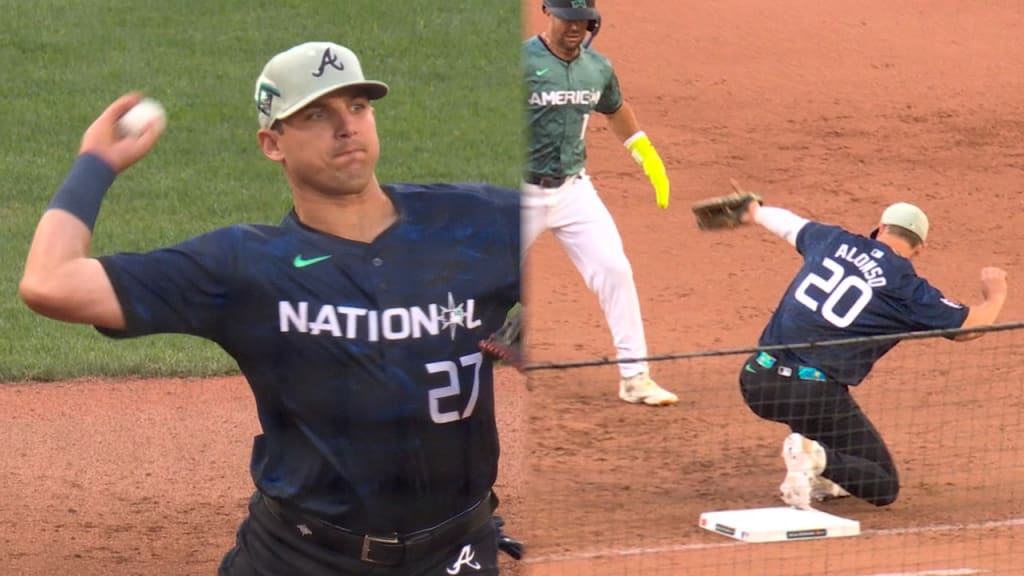
Austin Riley’s (Braves, left) kneeling throw to kneeling scooper Pete Alonso (Mets, right) ended the bottom of the All-Star Game eighth with a double play . . . (MLB.com photo) . . .

The best thing about Tuesday night’s All-Star Game? Easy. That snappy eighth inning-ending double play into which Athletics outfielder Brent Rooker hit. He shot one up the third base line to Braves third baseman Austin Riley, who picked and threw on one knee across to Mets first baseman Pete Alonso, who scooped on one knee to nail two outs for the price of one, doubling Blue Jays second baseman Whit Merrifield up.

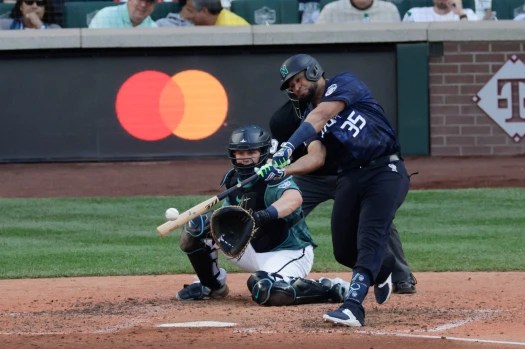
That play preserved what proved the National League’s 3-2 win over the American League in Seattle’s T-Mobile Park. They got the second and third runs in the top of that eighth, when Elias Díaz (Rockies) pinch hit for Jorge Soler (Marlins) with Nick Castellanos (Phillies) aboard after a nine-pitch leadoff walk and nobody out. Díaz sent Orioles righthander Félix Bautista’s 2-2 splitter off a bullpen sidewall, then off an overhang into the left field seats.

It meant the first NL All-Star win since 2012. It also meant Díaz becoming the Rockies’s first-ever All-Star Game Most Valuable Player award winner. Otherwise? It meant almost nothing. Because the worst thing about this year’s All-Scar Game was . . . just about everything else.

Mr. Blackwell, call your office. All-Star Game specific threads have been part of it for long enough. They began ugly and devolved to further states of revulsivity. But Tuesday night took the Ignoble Prize for Extinguished Haberdashery. The only uniforms uglier than this year’s All-Star silks are those hideous City Connect uniforms worn now and then during regular season games. Both should be done away with. Post haste. Let the All-Stars wear their regular team uniforms once again.

Who are those guys? They sort of anticipated long ovations for the hometown Mariners’ All-Star representatives. But they didn’t anticipate they’d be longer than usual. To the point where two Rays All-Stars—shortstop Wander Franco, pitcher Shane McLanahan—weren’t even introduced, when they poured in from center field among all other All-Stars. (Rays third baseman Yandy Díaz, an All-Star starter, did get introduced properly. But still.)

Maybe the two Rays jumped the gun trotting in while the ovation continued, but they should have been announced regardless.

While I’m at it, what was with that nonsense about bringing the All-Stars in from center field instead of having them come out of the dugouts to line up on the opposite base lines? Some traditions do deserve preservation. Not all, but some. What’s next—running the World Series combatants’ members in from the bullpens? (Oops! Don’t give the bastards any more bright ideas!)

Down with the mikes! In-game miking of players has always been ridiculous. But on Tuesday night it went from ridiculous to revolting. When Rangers pitcher Nathan Eovaldi took the mound miked up, the poor guy got into trouble on the mound almost at once. He had to pitch his way out of a two-on, one-out jam in the second inning. He sounded about as thrilled to talk while working his escape act as a schoolboy ordered to explain why he put a girl’s phone number on the boys’ room wall.

What’s the meaning of this? We’ve got regular-season interleague play all year long now. The National League All-Stars broke a ten-season losing streak? Forgive me if hold my applause. So long as the entire season is full of interleague play, the All-Star Game means nothing. Wasn’t it bad enough during those years when the outcome of the All-Star Game determined home field advantage for the World Series?

The road to making the All-Star Game mean something once more is eliminating regular-season interleague play altogether.

Elias Díaz

. . . saving the lead (and, ultimately, the game) Elias Díaz gave the NL with his two-run homer in the top of the eighth. (And, yes, the All-Star uniforms get uglier every year. Enough!) (AP Photo.)

Tamper bay. Sure it was cute to hear the T-Mobile Park crowd chanting for Angels unicorn star Shohei Ohtani to come to Seattle as a free agent. The problem is, he isn’t a free agent yet. He still has a second half to play for the Angels. I’ll guarantee you that if any team decided to break into a “Come to us!” chant toward Ohtani, they’d be hauled before baseball’s government and disciplined for tampering.

I get practically every fan base in baseball wanting Ohtani in their teams’ fatigues starting next year. If they don’t, they should be questioned by grand juries. But they really should have held their tongues on that one no matter how deeply you think the All-Scar Game has been reduced to farce. Lucky for them the commissioner can’t fine the Mariners for their fans’ tamper chants. (Not unless someone can prove the Mariners put their fans up to it, anyway.)

Crash cart alert. Cardiac Craig Kimbrel (Phillies) was sent out to pitch the ninth. With a one-run lead. The National League should have put the crash carts on double red alert, entrusting a one-run lead to the guy whose six 2018 postseason saves with a 5.90 ERA/6.74 fielding-independent pitching still felt like defeats. The guy who has a lifetime 4.13 ERA/4.84 FIP in postseason play.

Kimbrel got the first two outs (a fly to right, a strikeout), then issued back-to-back walks (six and seven pitches off an even count and a 1-2 count, respectively) before he finally struck Jose Ramirez (Guardians) out—after opening 0-2 but lapsing to 2-2—to end the game. Making the ninth that kind of interesting should not be what the Phillies have to look forward to if they reach the coming postseason.

Sales pitch. How bad is the sorry state of the Athletics and their ten-thumbed owner John Fisher’s shameless moves while trying and failing to extort Oakland but discovering Nevada politicians have cactus juice for brains? It’s this bad—when the T-Mobile crowd wasn’t chanting for Ohtani to cast his free agency eyes upon Seattle, they were chanting “Sell the team!” when Rooker whacked a ground rule double in the fifth.

Can you think of any other All-Star ballpark crowd chanting against another team’s owner in the past? Not even George Steinbrenner’s worst 1980-91 antics inspired that. That’s more on Fisher, of course, but it’s still sad to think that a team reduced to cinder and ashes with malice aforethought captured an All-Star Game crowd’s attention almost equal to the attention they might have paid the game itself.