A special, cool little story

Milwaukee Brewers

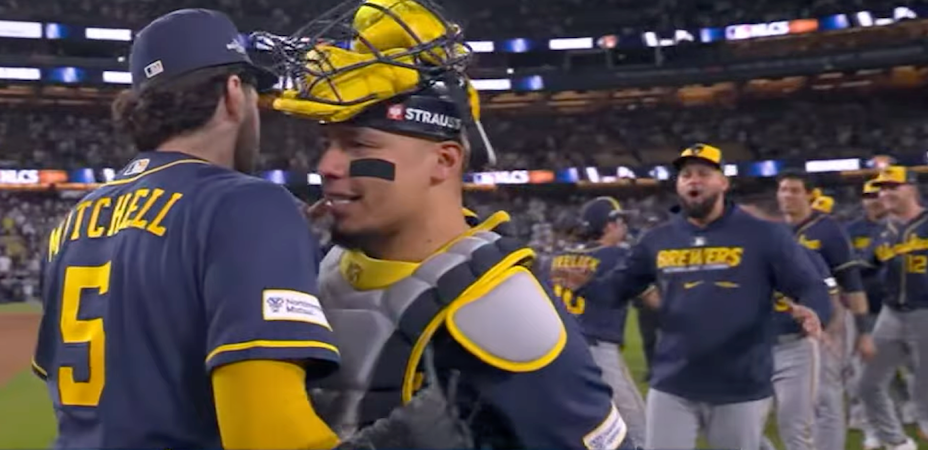
Center fielder Garrett Mitchell, catcher William Contreras, and more celebrate the Brewers’s first pennant since 1982—when they were in the American League. (Fox Sports capture.)

Whatever else you can accuse Dodgers manager Dave Roberts of thinking, you can’t impeach his simple, to the point valedictory after his team got hunted, pecked, bumped, flecked, and shoved out of their World Series three-peat hopes: “At the end of the day, we got beat. We got outplayed in all facets.”

That tells two things. The story of this National League Championship Series, and only half the story of what the Brewers sweep really signifies. What’s the other half, you wondered Thursday night, while watching the Brewers do just one of many things they’ve done like virtuosi this week.

“What Major League Baseball doesn’t want to discuss, as it portrays its sport as a broken landscape of haves and have-nots,” says The Athletic‘s Ken Rosenthal, who doubles as a Fox Sports television analyst, “is that big-money teams can sustain success only for a finite period, if they achieve success at all.”

Bleat to your heart’s content that these Dodgers are as imperious and intolerable as the early-to-mid 20th century Yankees. The mighty do fall, and get felled, and more often than you think. And, as often as not, they get felled as this year’s Dodger’s did.

Not by the edicts of a commissioner who’s six parts snake oilman and half a dozen parts Rube Goldberg and thinks the good of the game is nothing more than making money for it. Not by the owners who think they should be making money regardless of whether they care about their on-field product.

They get felled between the lines, at the plate, on the mound, out of the bullpen.

The beauties of baseball include that the moment the umpire hollers, “Play ball,” all arguments for salary caps and against salary floors disappear faster than the Dodgers did in this year’s National League Championship Series. The game that’s played is the game that counts.

“They may have a bunch of Hall of Famers,” said Brewers manager Pat Murphy, “but we’ve got a bunch of gamers. And the gamers won this week.”

The Brewers weren’t disrespectful so much as they couldn’t have cared less how many Hall of Famers wore Dodger uniforms or how many dollars each Dodger puts in the bank every week. They cared about runs on the scoreboard and couldn’t have cared less who put them there first.

The Damndodgers (yes, people still say it as one word, ladies and gentlemen) scored first in three out of the four NLCS games and led in all four of them. And they still got swept. By the team they swept out of last year’s NLCS. The only previous time that ever happened was never.

What nobody likes to remember or admit about the Damndodgers is that it. is. not. just. the salaries they’re willing to pay their players that made them winners of thirteen out of fourteen straight National League West titles and defending back-to-back World Series champions.

What a lot of those harrumphers didn’t like to remember or admit, while going in believing the Brewers would be just the latest upstarts ground beneath the Dodger boot heel, is that the teams are an even match where it matters most before the game begins. The Dodgers think well, develop well, coach well, teach well, and analyse well, as well as play well. The Brewers, who had baseball’s best record winning this year’s NL Central, think, develop, coach, teach, and analyse likewise.

But these Brewers did in a Dodger team that was a lot more vulnerable than its enemies wanted to hear. Sentence the Damndodgers to the seventh circle of hell if you must. But you must also be fair and remember that they got within the proverbial cat’s whisker of losing last year’s World Series. (Remember? They never led Game Seven until the eleventh inning.) And, that their age might be catching up to them at last.

So Shohei Ohtani finally found his way through his health issues to crank a three-run homer with two outs in the Game Four bottom of the second, giving his Dodgers a 4-0 lead? Let him have his fun.

Concurrently, ask yourselves just why the Dodgers didn’t insist on Ohtani hitting the injured list for proper healing of his knee and his biceps down the stretch. In thirty-two postseason plate appearances this time around, that homer was the only one of his five hits to mean extra bases.

What Ohtani really did, though, was give the Brewers an 0-4 lead. You’d have seen that if you paid close enough attention. You’d have seen the Brewers one and all watching Ohtani round the bases behind the two aboard in front of him and thinking, They have us right where we want them.

A one-out walk (to second baseman Brice Turang) and a ground rule double (by catcher William Contreras) set the top of the fourth table for NLCS Most Valuable Player Jake Bauers. And the first baseman rapped a ground rule double immediately, cutting the deficit in half. One inning later, third baseman David Hamilton singled right fielder Sal Frelick home, compelling Roberts to lift his starter Tyler Glasnow and bring Evan Phillips in.

Phillips proved the gift that kept on giving. He got Jackson Chourio to line out, but he walked the bases loaded before coming out in favour of Alex Vesia. And Bauers wrung Vesia for a four-pitch, game-tying walk. One inning after that, with Dodger closer Tanner Scott in a little bit earlier than normal but the Dodger season on the line—he fought center fielder Garret Mitchell to a full count, before Mitchell sent one over the center field fence.
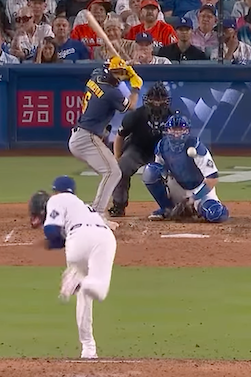
David Hamilton, Edwin Díaz

David Hamilton, half a second from turning Edwin Díaz’s service into Brewers insurance Friday night.

The Brewers—those patient souls who blend small, medium, and large ball with the fine hands of the brewers who once made Milwaukee famous, and shake off their occasional mistakes and malfunctions—must have been the only ones in Dodger Stadium who thought their 5-4 lead was safe.

“Man,” marveled another Athletic writer, Levi Weaver, who usually covers the Rangers for the journal. “The Brewers just straight-up absorbed the momentum-shifting mega-moment from Ohtani. They took the blow, calmly stood back up, and just kept hammering away at the load-bearing walls of the dynasty. Two runs in the fourth, two more in the fifth, one (so far) in the sixth. Absolutely unflappable.”

However much the Dodgers’s age showed, however creaky one or two parts must have been, these were still the Dodgers. They were still capable of undoing the Brewers to play another day. Weren’t they?

Not this time. Not even when the Dodgers turned to Edwin Díaz, their glandular off-season free agency relief signing, who missed too much time with injuries, didn’t pitch too well when he could pitch on the season, and hadn’t yet poked his nose out of his postseason mouse hole—and Díaz recorded a possibly unexpected* eight straight outs into the top of the ninth.

Leave it to Hamilton to spoil Díaz’s splendid turn with a flog into the right field seats. Just call him Liberty Mutual. (The insurer shares the Brewers’s team colours.) But if you dare send Limu Emu out to follow him around the bases, we’re going to fight.

Brewers reliever Aaron Ashby saw and raised Díaz. He took six straight outs into the bottom of the ninth. Then, he finished what he started. Tommy Edman, pinch hitting for veteran Dodgers third baseman Max Muncy? Full-count ground out.

Center fielder Andy Pages, one of last year’s World Series heroes, the guy who’d run over his grandmother, grandfather, and teammate to catch the would-be-Series-winning Blue Jays extra-base hit? Looking at strike three.

Utility expert Enrique Hernández, said teammate, he of a duffel bag full of postseason heroics in years previous? A hard, high liner to left center field run down by Jackson Chourio for the NLCS-ending final out.

And, just like that, the Damndodgers—baseball’s bogeymen, the team denigrated as everything wrong with the sport in dollar terms by those ignorant of everything else they did right for so long—lost the pennant.

To a team whose dollar endowments might not be even halfway toward the Dodgers’s bucks but whose brains, teaching, analytics, and development sent them to the postseason in eight out of veteran Christian Yelich’s nine Brewers seasons.

“We believe in ourselves,” said Yelich postgame. “We didn’t just, like, wake up and find ourselves here. We expected to be a team that was in this position and have this opportunity. We didn’t feel like this was unexpected or a special, cool, little story.”

When you win the pennant and become the second modern (post-1900) Show team to win one in each league (the first: the Astros), you can afford to come up short in the rhetoric department.

Except that it is a special, cool story.

Commissioner Pepperwinkle and his merry band of salary cappers. The lamer owners who refuse as opposed to being unable to deliver reasonably competitive baseball teams, making the sport a game of wills and will nots, not haves and have nots. The ignorant fan and media cadres who buy their Kickapoo Joy Juice at full price. They’re all witless to understand.

The only postseason team more fun than these Brewers are those well-oiled, well-constructed, well-instructed, exuberantly fun Guardians. They have a 2-1 ALCS lead over the well-oiled, well-constructed, well-instructed, as-much-fun-as-glue-drying Rays. Give me one Petey Halpin over twenty-six cownoses.

—————————————————————————————————-

* Edwin Díaz, the Dodgers closer, has not pitched once this series. But here he is, in what is totally the exact situation the Dodgers pictured him in when they shelled out $69 million for him last winter—down a run in the top of the seventh.—Katie Woo, The Athletic.
NLCS Game One: A Damndodger hole

Brice Turang, Tarik Skubal

Brice Turang about to send Tarik Skubal’s unsinking sinker into the bullpen Sunday night . . .

When the National League Championship Series opened Sunday night, guess what didn’t happen? The big spending blue whale didn’t devour the anchovies hosting them in the somewhat foggy Milwaukee pond. American Family Field hoisted baseball’s best (the home team) and second-best (the visitors) records this season.

The visiting Damndodgers and the hosting Brewers even got to throw their best pitchers at each other. How often do you get a defending Cy Young Award winner against the guy likely to win one this time around? Forget that a moment. This was going to be shades of Sandy Koufax v. Whitey Ford. Wasn’t it?

Not quite. Not this time. Neither Jacob Misiorowski nor Tarik Skubal dominated the way their previous notices showed them capable of doing. They were good enough. Not great enough. Certainly not overpowering or dominant enough.

Oh sure, Les Mis hit 101+ mph on the gun more than a few times—44 such pitches, in fact—just the way he’s supposed to do. And the Damndodgers went in hell bent on refusing to let those bullets beat them. Those bullets got only an 18.5 percent miss rate; 21.7 percent less than on the regular season.

Skubal went two-thirds of an inning further than Misiorowski and struck out two more. But he was pried for a pair of runs to his counterpart’s one. The bullpens went to work from there. And the 2-1 lead the NL Central-champion Brewers wrestled out of the NL West-champion Damndodgers stuck for the Game One win.

Until game time, of course, you could hear everyone across the great divides moaning that the Damndodgers were going to do it again. They were going to prove yet again that money talks. Talks, divides, and conquers. Weren’t they?

This was, of course, the beginning of a rematch between last year’s NLCS combatants. That was then: The Damndodgers led every inning but one. (And, got thatclose to losing the World Series in seven.) This was Sunday night: The Damndodgers led in only two innings.

So quit assuming they’re going to throw the Brewers out of the running like the sheriff running the town drunk off. These Brewers are going to make the Damndodgers work for it. They might even make the Damndodgers go home for the winter early enough to cause questions, doubts, and recriminations enough. Might.

When Shohei Ohtani and his still-balky inflamed left knee checked in at the plate leading off the second with no score yet, couldn’t you just hear the groaning that the only thing the Damndodgers did moving him to the cleanup spot was delay the inevitable?

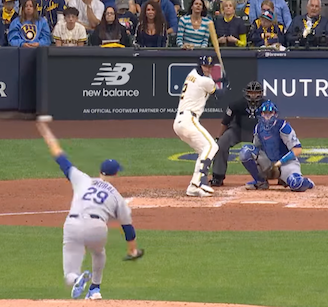
Well, the only man in the house splitting the heavens or threatening the opposite hemisphere Sunday night was Brewers second baseman Brice Turang. He opened the bottom of the fourth ahead of Skubal, 2-0, when he caught hold of a sinker meant to go inside, which didn’t get that far in, and which didn’t have all that much sink. Turang sunk it behind the left center field fence, right into the Brewers’s bullpen, tying the game at one each.

Two innings earlier, Ohtani took care of what proved the lone Damndodger run of the night when he let Misiorowski walk him on four pitches none of which arrived where he likes to hit. Then, he came around to score on one line drive hit to right (Teoscar Hernández) and another base hit through the hole at second (Andy Pages).

Go ahead and say it. Say that you think the Damndodgers were damn lucky to catch Les Mis on an off night. How off? Jayson Stark (The Athletic) dug it up: During the regular season, the opposition hit a mere .174 off the Misiorowski heater. On Sunday night, they hit .500 off it.

Go ahead and say it. Say that you think the Brewers might have been lucky that the Damndodgers couldn’t do a thing with anything else Misiorowski threw. Remember: He’s got breaking balls that dance the way people once did on Soul Train. He kept the Damndodgers to 1-for-8 when throwing his curve ball, cutter, and slider, two of which got turned into inning-ending double plays.

Skubal lasted only a little bit longer, until he walked Garrett Mitchell to open the Milwaukee fifth, surrendered a Cooper Pratt bunt to the right side pushing Mitchell to second base, then surrendered a first-pitch, tie-breaking single through the hole at shortstop from Luis Lara, a rookie whose calling card until Game One was sterling defense—enough to be worth eleven defensive runs saved above the National League average.

So Misiorowski vs. Skubal didn’t quite live up to its advance publicity? News flash: the heavily hyped duels sometimes don’t. They played baseball other than the joust that wasn’t Sunday night.

“He’s going to be fine,” said Brewers manager Pat Murphy of Skubal. “I’m sure he’s going to be able to feed his family and be a great dad. He can lose tonight, and he’ll be fine.”

Both sides threw strong-enough bullpens at each other once the big arms were done for the evening. Almost.

The Brewers handed themselves a grand opportunity for insurance damage in the bottom of the eighth. Jackson Chourio—their knight of the earlier postseason rounds—opened with a base hit and chased Damndodger reliever Even Phillips, who’d struck the side out in the seventh. Against Tanner Scott, the Brewers bunted Chourio to second (Turang), accepted a walk on the house (Willson Contreras), then a strikeout-following second wak on the house (Andrew Vaughn) to load the pads.

Who bunts that soon after hitting a big bomb? “Not shocking at all,” said Turang of seeing a bunt sign from his third base coach. “To me, it was almost like if he would have told me to hit, I would have been like, I’m gonna bunt—because I just know the situation in the game is calling me to bunt there.”

That’s one kind of dangerous-enough risk. Unless you’re bunting for base hits, something the Brewers did extremely well this season, surrendering an out to move a runner who has (yes, you can look it up) less enough than a fifty percent chance of scoring after the bunt than he had before it, is not normally smart baseball.

But Scott’s kind of risk-taking usually invites a team to teach the risking opponent a little lesson in foolishness, no matter what time of game it might be. The only lesson Mitchell taught this time was how to waste a gift that should have kept on giving, when he grounded out to Betts at short for the side and the strand.

Then it was Trevor Megill’s turn to come out of the Brewers pen and . . . channel his inner Craig Kimbrel. Not the good side, either.

In a scene Cardiac Craig might know only too well, Megill got two quick outs. Then, the fun began. He walked Tucker on a full count and pinch hitter Josue De Paola on 3-1 with Betts looming on deck.

The regular season wasn’t a typical Betts season. It’s been a couple of years since he had one of those, and it’s entirely possible that age (he’s 33) might be creeping up on him at long enough last. But he’s still Mookie Betts, he still posted a .950 OPS on the year with men on first and second at all, and he still posted a 1.039 OPS with men on first and second and two out.

He picked the wrong time to face Megill when the latter decided he’d had enough of being the new Craig Kimbrel. Megill got Betts to fly out to the track in right to end it. And, like Kimbrel on one too many occasions since 2018, Megill still got a save credit for squirming out of a jam entirely of his own making.

“You try to get them to play from behind, to get them out of their game,” said Damndodgers manager Dave Roberts. “You’ve got to be sound fundamentally to not give them extra outs. Yeah, they’re very consistent in how they play the game, and that’s a credit to all those guys.”

“We should play Dodger baseball,” Betts said. “Whatever Dodger baseball is, that’s what we should do. We should not try to play Milwaukee Brewers baseball.” Whatever Dodger baseball is?

Interesting post mortem, that. As pesky, spunky, and insistent as they are, the Brewers couldn’t have gotten that far into Dodger heads already. Could they?

The forecast is in

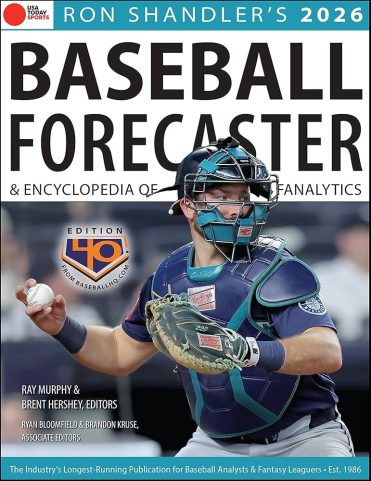
Yes, this year’s cover boy is Cal Raleigh. (And, yes, alas, Raleigh still wears the hideous nickname “the Big Dumper.”)

Well. Spring training is entering full swing, if you’ll pardon the expression. We like to think it’s as the poets and the pundits alike have enunciated time and again, the early acts producing the new birth, of spring by the calendar and by baseball season.

We’d rather not be sobered up until the first disgruntled fan of the White Sox, the Reds, the Rockies, the Angels, the Marlins, or the Mets pronounces the season to come lost upon one bad inning . . . on Opening Day.

The editors of Ron Shandler’s 2026 Baseball Forecaster & Encyclopedia of Fanalytics, alas, hew to the truth that facts don’t care about your feelings. (“Fanalytics” is their compound of fantasy and analytics.) They also uphold the truth that the only crime in information behind, beyond, and beneath the surfaces is rejecting it.

Whether you’re a fan, fantasy ballplayer, sportswriter, player, coach, manager, player agent, or front office muckety-muck, ignorance isn’t bliss.

This fortieth edition of Baseball Forecaster (Mr. Shandler birthed it the last year his beloved Mets won a World Series) contains what the old and very much missed Elias Baseball Analyst once contained: the most important information for Americans to master this side of the Declaration of Independence, the Constitution, and The Federalist Papers.

Shandler himself fires the opening high hard one after a brief anti-soliloquy regarding “Casey at the Bat” in which Mighty Casey’s descendants remain ascendant but his conqueror may be one pitch from disaster. Not the kind that flies over the fence, either: Oh here where hearts are heavy, and fans are homeward bound/The infield shouts in triumph, but there’s silence from the mound/The pitcher grabs his elbow, his face white as a ghost/Casey may have struck out, but our ace’s arm is toast.

Just in case you hadn’t taken the point, deciding Mr. Shandler tastes best when served up on the short end of a long stick, he has the temerity to point out that the number of major league pitchers who can throw past 95 miles per hour has risen from 64 in 2014 to 163 in 2024. And, the number of days pitchers spent on injured lists rose from 20,014 in 2014 to 32,250 in 2024.

Concurrently, Mr. Shandler obseves, the eight full seasons ending last October “have been an unprecedented era of record-breaking offensive performances. The new rules introduced in 2023—pitch clock, shift restrictions, larger bases, etc.—amped things up, but you can detect a subtle tipping point when hitters started making headlines even earlier.” (Italics in the original.)

The more detailed timeline Mr. Shandler sketches only begins with the team then known as the Indians including pitchers who set a new single-season major league team strikeout record in 2014. (The number: 1,450; or, eight more pitching strikeouts than that year’s Astros hitters recorded at the plate.)

Three years later, the Show set a single-season home run record. (6,105.) One year after that, major league batters struck out more than they hit safely. Don’t faint; the difference between the hits and the strikeouts was . . . 189. Or, three strikeouts fewer than ill-fated Orioles first baseman Chris Davis had at the plate that season.

One year after that, in 2019, the entire Show set a new single-season home run record (6,776) and Pete Alonso, the National League’s Rookie of the Year, set the rookie home run record. (53.) Two years later, Shohei Ohtani went nuclear: 46 home runs at the plate; a 3.18 ERA with 156 strikeouts on the mound. (Ohtani also led the Show with eight triples.)

What happened in the four seasons to follow? 2022: Aaron Judge broke Roger Maris’s American League home run record. (62.) 2023: Ronald Acuña, Jr. delivered baseball’s first 40/70 (home runs/stolen bases) season. 2024: Ohtani delivered its first 50/50 season and was the fastest to hit 40/40 en route. 2025: Cal Raleigh’s 60 home runs set single-season records for catchers (he only hit 49 while in the game as a catcher, but it was still enough to eclipse Hall of Famer Johnny Bench) and switch-hitters.

But 2025 didn’t stop there, either. Ohtani became only the sixth with back-to-back 50+ home run seasons. (Mr. Shandler notes four of the other five did it during the era of actual or alleged performance-enhancing substances and the fifth was a fossil named Ruth.) The year was also the first without no-hitters since 2005, and the Mets and the Braves set new Show records for using the most pitchers. (46.)

“[C]onsidering all [that],” Mr. Shandler writes,

I can’t escape one unavoidable conclusion:

MLB must view the destruction of pitchers’ arms as acceptable collateral damage for boosting offense and fan-friendly record chases. Pitchers are fungible, like the $1 players [fantasy baseballers] draft after Round 20. There are hundreds more arms available throughout the minors, after all. Yes, they are less skilled, but that only helps increase offense even more. It’s a win-win.

Unless you’re a pitcher. (Italics in the original.)

Baseball Forecaster includes a section of “Research Abstracts,” perhaps prime among them orthopedist Dr. James C. Ferretti addressing that recent spike in pitching injuries. He acknowledges the chase for speed is its major cause but advises there’s more to the story and analyses accordingly. Hint to Joe and Jane Fan and Old Coach Cup: Don’t think the ulnar collateral ligament just blows out, and don’t assume it’s only the hardest throw that does it.

Mr. Shandler and company deliver an “Encyclopedia of Fanalytics,” which divides into five portions: Fundamentals, Batters, Pitchers, Prospects, and Gaming. In the first portion, their performance validation criteria is instructive. It’s an attempt to determine whether Thumper O’Thrasher at the plate or Slingshot D. Stonegrinder on the mound post stats that reflect their skills accurately. It combines age, health, minor league background, his historical trends, ballpark effects, team chemistry effect, batting or pitching style, usage patterns, coaching effects or lack thereof, off-season life (Has the player spent the winter frequenting workout rooms or banquet tables?), and personal factors.

Don’t laugh or sharpen your nastygram pens just yet. Never discount a player’s personal life affecting his baseball play. Dig deep as you’re allowed and you’ll find any number of players whose seasons were compromised if not ruined by family crises. (Dig deeper and you may not want to know or stomach those whose seasons if not careers were ruined by their inability to reject domestic violence.)

Back to the health factors for a moment or three. Call this the “Watch Your Language” department. Especially when you hear a report on an injured player say, “No structural damage.” Mr. Shandler and company knock that one down the line: “[It] sounds reassuring, but it’s often misleading . . . it’s a way of saying that whatever body part being imaged is intact, with no broken bone or soft tissue tear. This is not the same as a ‘normal” or “negative’ diagnosis. When you hear ‘no structural damage,’ continue to keep a close eye on the situation.”

Wait until you get to their breakdown, “Paradoxes and Conundrums.” Read carefully and defy yourself to think to yourself that a good many sportswriters and no few team officials don’t talk through their chapeaus or see with their mouths: Play hurt, take statistical dive, risk your job; admit you’re hurt, leave the lineup or the rotation to recover, and . . . risk your job.

The crew also isolate what they consider three paths to a player’s retirement: the George Brett (you’re still producing and the fans still adore you), the Steve Carlton (you stayed too long, your numbers are toxic, and nobody remembers when you were top of the heap), and the Johan Santana. (You’re on the injured list so long your retirement flies past “until your name shows up on a Hall of Fame ballot.”)

Meanwhile, the news gets worse instead of better for Emmanuel Clase. The nearly thirty-page indictment against him unsealed Friday says he got a text message reading, “Throw a rock at the first rooster in today’s fight.” It wasn’t Warner Bros. Animation telling him how they wanted him to open a new Foghorn Leghorn cartoon.

“Yes, of course, that’s an easy toss to that rooster,” the indictment says Clase replied. Translation: The beneficiary of one of his rigged pitches in an interleague game against the Reds last May had a bet on Clase throwing it low. This revelation is part of a broadening picture of the federal case that includes charges of Clase rigging a pitch or two in 2024, including during Game One of the Guards’s American League division series against the Tigers.

Shandler and company note that Clase’s hits per ball in play and stranded runner rate regressed in 2025, but other than a drop in ground ball pitches and “save” opportunities, “it was mostly business as usual through” before his pitch-rigging scandal broke. Mostly.

“But then,” they continue, “it turned out his business was anything but usual—and in fact, was allegedly illegal. Indicted in a sports betting case in November, it’s very likely this will be his final box in this book.” The promise of Baseball Forecaster‘s continuance is far more appealing than the promise of Clase’s final punishment if he graduates from alleged to absolute pitch-rigger for fun and microbetting profit.

We can’t have nice things for too long

Emmanuel Clase

Emmanuel Clase, whom the feds charge masterminded a pitch-rigging scheme for bettors and his fellow Guardians pitcher Luis Ortiz.

How tempting is it to define the present era as the one that tells us we can’t have nice things? And, the one that delivers the message more brutally after each of the rare nice things we get.

Baseball just delivered us a postseason for the ages, even if you don’t hold with the wild card system. Put that to one side a moment and admit it. The game we love spent a month showing us that, any time we care to write the game off as a self-immolating bore, it’ll be more than happy to disabuse us.

Think about it. When you get seven postseason sets ending with winner-take-all games, you’ve been blessed to the tenth power. When you get more than one extra-inning postseason hair raiser without the disgrace of Manfred Man (who’s not allowed anywhere near the postseason—yet), you’ve been blessed that big again.

When you get utter cream-always-rises defiance against the wild card system, putting nobody in either League Championship Series except teams whose butts were parked in first place at season’s end, you’ve been blessed above and beyond whatever it was you had the right to expect.

When you get Shohei Ohtani spending one postseason game striking ten out from the mound and hitting three out at the plate, then spending World Series Game Three reaching base nine times—five with the near-complete consent of the Blue Jays who seemed to prefer death to Ohtani’s singular controlled mayhem—your cups runneth over.

When you get a postseason seeing regular-season supermen continue their feats of derring-do and damage (can we forget Cal Raleigh crowning a 60-homer regular season with five intercontinental ballistic missle launches while the Mariners were in the postseason? Freddie Freeman’s eighteenth-inning walkoff?), and heretofore dismissable Clark Kents turning into assorted breeds of Supermen (Addison Barger, Miguel Rojas, call your offices), your bowls, barrels, vats, and tanks runneth over, under, sideways, down, and back.

In other words, this postseason couldn’t have been more entertaining, exciting, and exemplary if it had been coordinated, produced, and directed by Bill Veeck, Casey Stengel, Kevin Costner, and The Chicken.

No, that beyond good deed couldn’t go unpunished, could it? Can we have (demand) this Sunday back?

First there came the should-be-frightening revelation that, according to a popular podcast, Bryce Harper—he who told commissioner Rob Manfred firmly enough to get the you know what out of the Phillies clubhouse if he wanted to talk salary cap, though the two shook hands and shook it off later on—was threatened by “one of Manfred’s deputies,” who said, supposedly, “Don’t ever disrespect [the Commish] like that again. That’s how people end up in a ditch.”

“If this threat is true,” wrote Yardbarker‘s David Hill, “the next labor stoppage could get ugly fast.” If that threat is true, we don’t have to wait for a lockout or a strike to get ugly fast. It’s just become ugly fast.

And how about the ugly-fast-enough revelation that two Guardians pitchers, relievers Emmanuel Clase and starter Luis Ortiz, on administrative leave since late July on pitch-rigging suspicions, have just graduated from suspicion to formal charges of fraud, conspiracy, bribery, and money laundering? Charges “stemming,” as the federal indictment out of Brooklyn says, “from an alleged scheme to rig individual pitches that led to gamblers winning hundreds of thousands of dollars, according to an indictment unsealed by federal prosecutors Sunday.”

The U.S. Attorney’s Eastern District office in Brooklyn said Sunday that Clase’s involvement in the pitch-rigging plot goes back to May 2023, with Ortiz joining up last June. It didn’t exactly cripple the Guardians’s season to lose the pair, especially when they ended up snatching the American League Central from the unexpectedly rising/unexpectedly sputtering Tigers.

But then came the postseason. The Tigers nudged the Guardians out of the picture in a wild card series. From there, aside from the usual off-season doings, undoings, maneuverings, and meanderings, the question around the Guards became when the other shoes would drop around Clase and Ortiz.

They dropped Sunday, all right. The indictment says Clase arranged with a gambler to throw particular pitches for ball counts so the bettor could bet on those pitches (it’s called proposition betting) and reap the financial reward. The indictment says further that gamblers won almost half a million betting on pitches thrown by the Guardians pair, while the pitchers themselves earned kickbacks for helping the bettors clean up.

Clase and Ortiz, said Eastern District U.S. Attorney Joseph Nocella, Jr., “deprived the Cleveland Guardians and Major League Baseball of their honest services.”

They defrauded the online betting platforms where the bets were placed. And they betrayed America’s pastime. Integrity, honesty and fair play are part of the DNA of professional sports. When corruption infiltrates the sport, it brings disgrace not only to the participants but damages the public trust in an institution that is vital and dear to all of us.

“While the pervasiveness of legalized gambling has upended the sports world, the allegations against Clase and Ortiz are the most severe for the sport since Pete Rose agreed to a lifetime ban for betting on baseball in 1989,” ESPN’s Jeff Passan wrote. “MLB’s rules against gambling on the sport are strict, and Clase and Ortiz could face lifetime bans similar to the one delivered last year to San Diego Padres infielder Tucupita Marcano, who placed nearly 400 bets on baseball.

Nocella’s office described Clase as the scheme’s mastermind, saying he’d throw balls instead of strikes and sliders instead of cutters on first pitches, with gamblers betting on each pitch to be called balls or traveling under specific speeds. The indictment said further that such proposition bets would be stacked in parlays often as not, meaning bigger winnings.

But the indictment also charges that Clase gave money to gamblers to bet on his own behalf, texted with them while games were in progress, and was joined up by Ortiz after he  came to the Guards in a winter 2024-25 trade, Passan said.

Among others, Clase helped gamblers win $27,000 apiece on one Clase pitch faster than 94.9 mph in an interleague game with the Mets. “Weeks later,” Passan said, referring to the indictment, “bettors added a leg to a parlay for a pitch to be a ball slower than 94.95 mph—and won $38,000 when Clase spiked a slider at least five feet in front of home plate.”

By last April, Clase asked for and got kickbacks for throwing specific pitches. He even asked one winning bettor to send kickback money to his native Dominican Republic “for repairs at the country house.” Last June, Ortiz joined the scheme by agreeing to be paid $5,000 to throw a first second-inning pitch for a ball call, with Clase getting $5,000 himself for arranging it, the indictment charges.

The same month, Ortiz agreed to open the third inning with ball one for $7,000. The indictment also says bank security cameras caught Clase withdrawing $50,000 cash, $15,000 of which went to one bettor in a group who placed $18,000 on that pitch.

Ortiz’s attorney denied in a formal statement that his client would do anything to influence a game improperly, “not for anyone and not for anything.”

Clase was making $4.9 million for 2025 and stood to make $6.4 million for 2026, with a pair of team options for 2027 and 2028 at $10 million each. Ortiz wasn’t near six figures yet so far as I could determine, but he wasn’t exactly improverished, either. Why on earth would either man slide into a shady side profession that could end their baseball lives if convicted and banished?

Maybe we shouldn’t ask. Maybe it won’t matter, at least until the case goes to trial, barring any for-now-unknowable chance of one or both pitchers coming to take plea deals and then throwing themselves upon the mercy of the courts of law and public opinion.

Maybe it won’t mean a thing until or unless baseball decides to take a second, third, and fourth look at its cross-promotion deals with legal sports books. Yes, those were supposed to encourage fan betting alone. Baseball’s prohibitions against players, coaches, managers, and team personnel betting on the sport remain stringent.

Oops. Manfred took a presidential gumshoe in the gluteus to declare Rose’s “permanent” and wholly justified banishment applied only while he was alive on earth—thus making Rose eligible to appear on the Hall of Fame’s next Classic Baseball Era Committee ballot.

But five months after Ohtani’s original interpreter Ippei Mizuhara went to the federal calaboose for stealing $17 million of Ohtani’s money to support an out-of-control gambling habit, it might be wise to review and perhaps repel those cross-promotions. Which might require the kind of spine this commissioner displays very selectively.

When an uppity player told Manfred where he can take his salary cap talk, the commissioner’s office ironed up to slap him down. But when an uppity president behaving like the school bully crooked his finger and demanded Rose be sent to Cooperstown as soon as last week, regardless that Rose earned his banishment, Manfred’s spine went Vaseline.

The stove isn’t the only thing that’s hot. It won’t shock me if baseball tempers get a little hot for a good while. That’s the risk whenever baseball’s witless remind us that we can’t have nice things for very long.

NLCS Game Four: Shoh there!

Shohei Ohtani

Shohei Ohtani is about to send his second of three NLCS Game Four bombs to somewhere approaching the Delta Quadrant . . .

Was this destiny, or the mere re-awakening of a sleeping giant? Had he gone 2-for-the-National League Championship Series entering Game Four only to set Dodger Stadium and the world up for a display any world’s fair including last century’s gaudy boondoggles in New York would have been proud to hoist?

Don’t ask. You’ll drive yourself mad trying to answer, becasuse any answer might be right and any might be wrong. Just remember that Shohei Ohtani did what he did to win Game Four on both sides of the ball.

On side one he was Bob Gibson without the glare and stare, throwing six innings of two-hit, ten-punchout, shutout ball, before he ran into a spot opening the seventh ticklish enough for Dodgers manager Dave Roberts to lift him with two on, nobody out, and Alex Vesia warm and good in the bullpen.

On side two, Ohtani was . . . oh, David Ortiz, Reggie Jackson, and Babe Ruth, all at once. If there’s such a thing as a postseason series sweep you could call dramatic, Ohtani made sure this one was it.

The vanquished Brewers who’d only managed to muster up a single run in each of the four games could do little enough other than watch and appreciate what was being made on their dollar. Even as they could only mourn that, whatever they were doing to keep Ohtani on his best behaviour prior to Game Four, it failed them miserably enough.

“We’re watching something we’ve never seen before,” said Dodgers manager Dave Roberts, who probably still couldn’t believe the manner in which his team’s ticket to the World Series was stamped Friday night. The scoreboard said 5-1, Dodgers. The margin was four runs; the Dodgers out-hit the Brewers by four. But . . .

There have been ouitlier pitchers who’ve hit home runs in postseason play. As Jayson Stark exhumes, only two starting pitchers have ever hit two postseason bombs in their whole careers: Hall of Famer Gibson (1964, 1968) and one-time Orioles co-ace Dave McNally (1966, 1974). And, “[s]eeing as how all pitchers not named Ohtani aren’t even allowed near a bat rack anymore, that’s a record that will never be broken,” Stark adds. “Unless Ohtani breaks it!”

Babe Ruth, you say? Well, now. Ruth pitched 166 games lifetime, including the postseason, and never hit two homers in any but one of those games, on 13 June 1921. He also recorded one measly strikeout that day. The Bambino hit three homers in a single postseason game twice, Game Four in the 1926 Wortld Series, and Game Four in the 1928 Series. Guess how many innings he didn’t pitch in either of those games.

It gets even more insane from there. How would you like to name all the pitchers who’ve hit more home runs at the plate in a game than what they allowed from the mound in the same game? Stark has named the two, Philadelphia’s Rick Wise (23 June 1971) throwing a no-hitter and Detroit’s Jesse Doyle (28 September 1925) in relief but hung with the loss despite getting eleven outs during his turn.

Yes, it’s very fair to say that Ohtani blasted those two right out of the running. What the hell, he began the blasting in the first inning. Top—he shook off a leadoff walk to Brewers second baseman Brice Turang to strike out the side. Then he led off at the plate in the bottom half, worked the count full against Brewers starter Jose Quintana, and hit one into the right field bleachers.

Two base hits and a strikeout later, Tommy Edman singled Mookie Betts home and Teoscar Hernández pushed a ground out to first that enabled Will Smith to score. As things turned out, that was really the only scoring the Dodgers needed on the night. These Brewers may have had the regular season’s best record and outlasted the wild-card Cubs in the division series, but they found themselves playing the futility flutes against the Dodgers’ big brass.

Bottom of the fourth, the count 3-1: Ohtani launched Brewers reliever Chad Patrick’s 3-1 offering to and past the rear end of the right center field bleachers. Speculation that the ball ended up making its way to the Hollywood Freeway wasn’t unreasonable.

“My reaction,” said Dodger president of baseball operations Andrew Friedman, “was just mouth agape. Trying to track it. Not seeing it come down. And saying: Did that one just leave the stadium?” All I could see was the ball flying over a Starlux Airlines sign and its roof section. Maybe it ended up somewhere in nearby Glendale, maybe in the back yard that once belonged to Hall of Fame manager/character Casey Stengel.

The sad part was that blast being the only real blemish against Patrick on the evening. He pitched four relief innings and kept all but one of the Dodgers from getting any cute ideas against him. If the Brewers now ponder the what-ifs if Patrick could have started, you can’t exactly say they’re wrong.

Bottom of the seventh, Trevor Megill relieving Patrick and striking Andy Pages out to open. Megill, who’d posted a 2.49 regular-season ERA and a .209 opponents’ batting average against him. Pitched respectably in the earlier rounds this postseason, too. Now he had Ohtani in the hole 1-2. The next launch had to settle for landing a few rows up the left field bleachers.

Well, what did you expect? You thought Ohtani would hit a third bomb into satellite orbit? The man’s only human, after all.

Here are the guys I feel sorry for other than the Brewers, who ran entirely out of fuel at the worst possible time after such a magnificent season: the Mariners. They finally fought back hard against the Blue Jays who’d threatened to sweep them away in their own Seattle playpen, en route an American League Championship Series fall.

Then, they had an eighth inning to remember Friday: Cal Raleigh leading off with a Game Five-tying home run; then, after back-to-back walks and a hit batsman, prodigal Eugenio Suaárez hitting an opposite-field grand slam four rows up the right field seats. Guaranteeing a Game Six back in Toronto, where they’d swept the Jays out of Games One and Two.

Cal who? Eugenio what? Not even their late-hour of power could erase the magnitude and the impact of the Shoh in Los Angeles.

Go ahead. Review every great single-game postseason performance. Then tell me if they were better than Friday night in Chavez Ravine. Tell me Reggie Jackson seeing only three pitches and hitting every one of them onto or near the el train behind Yankee Stadium in Game Six of the 1977 World Series was a better performance. Now, tell me how many innings he pitched at all in that game.

Tell me Don Larsen’s perfecto in the 1956 World Series and Roy Halladay’s no-no in the 2010 National League division series were better performances. Now, tell me how many home runs they also hit in those games.

I don’t remember Bill Mazeroski, Kirk Gibson, Joe Carter, David Ortiz, and David Freese pitching even in the bullpen in their Big Postseason Games. Nor do I remember Howard Ehmke, Carl Erskine, Sandy Koufax, or Moe Drabowsky dialing the Delta Quadrant at the plate during their postseason pitching virtuosities.

Bob Gibson punched out ten and hit one out in the decisive Game Seven of the 1967 World Series. He did the same thing in Game Four of the 1968 Series. In between was his seventeen-punchout jewel in Game One of the ’68 Series without hitting one into the seats. None of them equal 10+K/3 HR in the same game, either.

(Who the eff is Moe Drabowsky, you say? He the eff is the guy who relieved Dave McNally in Game One, 1966 World Series, and pitched 6.2 innings of spotless, eleven-strikeout, one-hit, shutout relief the rest of the way, launching the Orioles on their surprising sweep of the last-standing Koufax-Drysdale Dodgers. At the plate, alas, Drabowsky went 0-for-2 with a walk and a strikeout.)

I don’t want to leave either the Mariners or the Blue Jays hexed or vexed as they get ready to resume ALCS hostilities. But remember that the Dodgers won the first three NLCS games without Ohtani doing much at the plate. They’re dangerous enough without him. Friday night was a staggering reminder of how dangerous they are when he is on. Whomever wins the American League pennant has a lot of studying to do.