WS Game One: “Just get the outs”

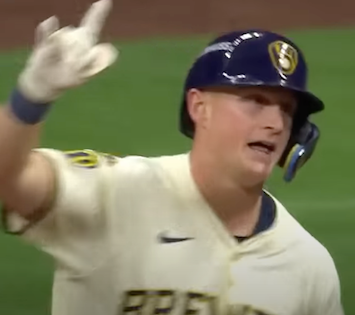
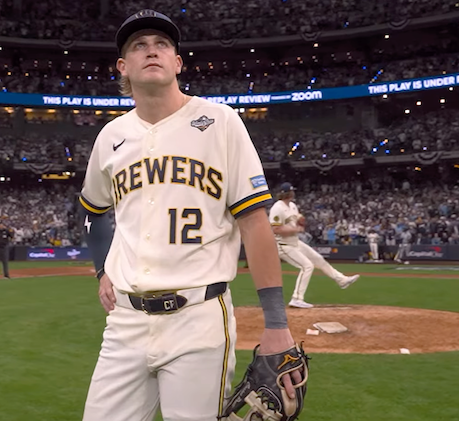
As closer Trevor Megill (right) takes an ump up on some extra keep-loose tosses, Brewers shortstop Cooper Pratt watches a replay of the double play that wasn’t, compelling Megill to go after and punch out Rays center fielder Jonny DeLuca to end the Brewers’ World Series-opening win Friday night. (Fox Sports capture.)

Opening night for Les Mis in the World Series wasn’t exactly one for award consideration. It didn’t have to be. The company around him was more than able to save the show when he had an off night. An off night for him, not anyone else.

Jacob Misorowski with a five-inning line of three punchouts, four hits, one earned run, and a 2.50 fielding-independent pitching rate is an off night for the likely National League Cy Young Award winner whose regular season showed a 174.2-inning line of 252 punchouts,  a 2.17 FIP, and a 1.80 earned run average.

But it was enough to keep his Brewers in the game until manager Pat Murphy decided it was time to reach for the secondary cast. Abner Uribe and Aaron Ashby made life difficult enough for the Rays, before Trevor Megill made it almost interesting enough for the Rays to overthrow the Brewers

Emphasis on almost.

The not-even-close-to-artificially-intelligent Brewers and not-even-close-to-artificially-intelligent Rays played it tight, overcame mistakes, and ground it out until the final outs that weren’t, before the Brewers held on tight to their 3-2 Game One win.

They had William Contreras to thank for a lot of it, their defense for a lot of it, the bullpen for a lot of the rest of it, and the replay review for the next-to-last act.

First, Contreras repaid longtime franchise face Christian Yelich for that bottom of the first RBI triple that just did elude diving Rays center fielder Jonny DeLuca. He slashed the first pitch he saw from Rays starter Nick Martinez through the hole at shortstop to send Yelich home and the Brewers to a nice, early 2-0 lead.

Then, with one out and Rays first baseman Jonathan Aranda (base hit) aboard in the sixth, Contreras caught Uribe’s swinging strikeout pitch to Rays left fielder Chandler Simpson and whipped a textbook perfect strike up the pipe to nail Aranda trying to swipe second.

Martinez, the elder Rays righthander who has a between-pitches habit of stepping up and down as though he’s peeking over a fence waiting for the right time to leap over and rob the place, settled well from there. He justified Rays manager Kevin Cash holding his own ace Drew Rasmussen until Game Two.

With the benefit of a run-scoring ground out by Liam Hicks in the top of the fourth to cut that lead in half, Martinez had his way with the Brewers for the most part the rest of his assignment.

He got away with Brewers right fielder Sal Frelick singling with one out in the second and helping himself to third after being bunted to second when he struck left fielder Jackson Chourio out to end the second.

He got away with murder in the fifth because Brewers third baseman David Hamilton took a bad turn rounding second trying to turn his one-out double into a triple, and the relay from right fielder Victor Mesa, Jr. to second baseman Ben Williamson to third baseman Junior Caminero was flawless enough to nail the diving Hamilton by a full foot plus.

Did that knock the Brewers into the oxygen tent?

Not a chance. Veteran Steven Matz—last seen in the World Series as a rookie with the 2015 Mets—shook off a pair of two-out walks in the sixth to escape and landed a pair of seventh-inning outs following a leadoff walk to Brewers rookie shortstop Cooper Pratt. Cash lifted Matz for Kevin Kelly, wanting the right-on-right match with Chourio.

Right on, the Brewers thought, when Chourio punched Pratt home with a base hit through the right side.

Naturally, things had to get more than interesting in the top of the ninth. As in, Brewers closer Trevor Megill allowing a pair of base hits (Aranda and Simpson) and a double steal, then walking the bases loaded for Hicks. Those hoping the Brewers might find their own Mariano Rivera some day had to settle for finding their own Craig Kimbrel Friday night.

Heaven help Megill if his mojo stops working. So far, he can work his way out of trouble of his own making faster than you can say “kill the save.” And he won’t say no to any help he can get. He got it Friday night, from Hicks and from his infield and from New York.

As in, Hicks grounding into what looked like a bang-bang-bang double play. As in, Caminero looking out at second, Hicks called out at first, and the Rays calling for a review. Megill wasn’t sure why. He may have been the only human being in American Family Field who wasn’t sure. At first. Then . . .

“I thought they were challenging the play at first,” he told reporters postgame. “I didn’t even think about it. I thought my cleat was dragging across the base. I just kind of looked at one of the umpires there and said, ‘Hey, what are you hearing in your ear?’ He said, ‘Uh, whatever, not too good. Do you want to throw some baseballs?”

The extra tosses did Megill a huge favour after replays showed Pratt covering second came off the pad before he had the ball to record the out while his throw on to first got Hicks. Meaning pinch runner Jorge Mateo was safe at home with the second Rays run and DeLuca checking in at the plate.

Once upon a time, that double play would have stood. It used to be called the infamous neighbourhood play. The out at second would be called if the fielder happened to be in the neighbourhood whether or not his foot hit the pad before he threw on. The crackdown on that play started around 2016. Bye, neighbour.

This was a night both sides didn’t exactly look like virtuosi on the bases, either. Now, though, Megill was hell bent on just blowing DeLuca away with two men still in scoring position. He dropped to 2-1 on fastballs, then dropped a delicious curve in on DeLuca to freeze him for strike two. 

“Anytime you can land a curveball at the bottom right there like that,” the husky righthander said, “it definitely sets up your next one. It’s just pitching and trusting what William is putting down back there.”

Contreras wanted that curve again. Megill was only too happy to oblige. He threw it, DeLuca swung through it, and the game belonged to the Brewers.

That’s not exactly what the Rays want to hear. This postseason, just the bullpen trinity of Uribe, Ashby, and Megill have a combined 0.95 earned run average, even if Megill likes to do it the hard way a little too often. Not the best pickings for a Rays team that was the American League’s best on the season but went 0-for-6 with men in scoring position Friday night.

“Has any team won a World Series with a starting rotation that was mostly just the nightly warm-up act for its bat-smothering relief crew?” asked The Athletic‘s Jayson Stark. “This is not a rhetorical question anymore.”

Megill had a non-rhetorical answer. “I don’t know, man. It just don’t matter how we get the outs,” he told Stark. “Just get the outs.”

Just get the outs. Because, as Yelich himself said postgame, “All of these games are going to be close. But it was good to get that first one.” Especially when it took forty-four years to get another crack at it.
NLCS Game One: A Damndodger hole

Brice Turang, Tarik Skubal

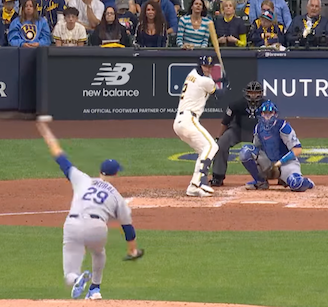
Brice Turang about to send Tarik Skubal’s unsinking sinker into the bullpen Sunday night . . .

When the National League Championship Series opened Sunday night, guess what didn’t happen? The big spending blue whale didn’t devour the anchovies hosting them in the somewhat foggy Milwaukee pond. American Family Field hoisted baseball’s best (the home team) and second-best (the visitors) records this season.

The visiting Damndodgers and the hosting Brewers even got to throw their best pitchers at each other. How often do you get a defending Cy Young Award winner against the guy likely to win one this time around? Forget that a moment. This was going to be shades of Sandy Koufax v. Whitey Ford. Wasn’t it?

Not quite. Not this time. Neither Jacob Misiorowski nor Tarik Skubal dominated the way their previous notices showed them capable of doing. They were good enough. Not great enough. Certainly not overpowering or dominant enough.

Oh sure, Les Mis hit 101+ mph on the gun more than a few times—44 such pitches, in fact—just the way he’s supposed to do. And the Damndodgers went in hell bent on refusing to let those bullets beat them. Those bullets got only an 18.5 percent miss rate; 21.7 percent less than on the regular season.

Skubal went two-thirds of an inning further than Misiorowski and struck out two more. But he was pried for a pair of runs to his counterpart’s one. The bullpens went to work from there. And the 2-1 lead the NL Central-champion Brewers wrestled out of the NL West-champion Damndodgers stuck for the Game One win.

Until game time, of course, you could hear everyone across the great divides moaning that the Damndodgers were going to do it again. They were going to prove yet again that money talks. Talks, divides, and conquers. Weren’t they?

This was, of course, the beginning of a rematch between last year’s NLCS combatants. That was then: The Damndodgers led every inning but one. (And, got thatclose to losing the World Series in seven.) This was Sunday night: The Damndodgers led in only two innings.

So quit assuming they’re going to throw the Brewers out of the running like the sheriff running the town drunk off. These Brewers are going to make the Damndodgers work for it. They might even make the Damndodgers go home for the winter early enough to cause questions, doubts, and recriminations enough. Might.

When Shohei Ohtani and his still-balky inflamed left knee checked in at the plate leading off the second with no score yet, couldn’t you just hear the groaning that the only thing the Damndodgers did moving him to the cleanup spot was delay the inevitable?

Well, the only man in the house splitting the heavens or threatening the opposite hemisphere Sunday night was Brewers second baseman Brice Turang. He opened the bottom of the fourth ahead of Skubal, 2-0, when he caught hold of a sinker meant to go inside, which didn’t get that far in, and which didn’t have all that much sink. Turang sunk it behind the left center field fence, right into the Brewers’s bullpen, tying the game at one each.

Two innings earlier, Ohtani took care of what proved the lone Damndodger run of the night when he let Misiorowski walk him on four pitches none of which arrived where he likes to hit. Then, he came around to score on one line drive hit to right (Teoscar Hernández) and another base hit through the hole at second (Andy Pages).

Go ahead and say it. Say that you think the Damndodgers were damn lucky to catch Les Mis on an off night. How off? Jayson Stark (The Athletic) dug it up: During the regular season, the opposition hit a mere .174 off the Misiorowski heater. On Sunday night, they hit .500 off it.

Go ahead and say it. Say that you think the Brewers might have been lucky that the Damndodgers couldn’t do a thing with anything else Misiorowski threw. Remember: He’s got breaking balls that dance the way people once did on Soul Train. He kept the Damndodgers to 1-for-8 when throwing his curve ball, cutter, and slider, two of which got turned into inning-ending double plays.

Skubal lasted only a little bit longer, until he walked Garrett Mitchell to open the Milwaukee fifth, surrendered a Cooper Pratt bunt to the right side pushing Mitchell to second base, then surrendered a first-pitch, tie-breaking single through the hole at shortstop from Luis Lara, a rookie whose calling card until Game One was sterling defense—enough to be worth eleven defensive runs saved above the National League average.

So Misiorowski vs. Skubal didn’t quite live up to its advance publicity? News flash: the heavily hyped duels sometimes don’t. They played baseball other than the joust that wasn’t Sunday night.

“He’s going to be fine,” said Brewers manager Pat Murphy of Skubal. “I’m sure he’s going to be able to feed his family and be a great dad. He can lose tonight, and he’ll be fine.”

Both sides threw strong-enough bullpens at each other once the big arms were done for the evening. Almost.

The Brewers handed themselves a grand opportunity for insurance damage in the bottom of the eighth. Jackson Chourio—their knight of the earlier postseason rounds—opened with a base hit and chased Damndodger reliever Even Phillips, who’d struck the side out in the seventh. Against Tanner Scott, the Brewers bunted Chourio to second (Turang), accepted a walk on the house (Willson Contreras), then a strikeout-following second wak on the house (Andrew Vaughn) to load the pads.

Who bunts that soon after hitting a big bomb? “Not shocking at all,” said Turang of seeing a bunt sign from his third base coach. “To me, it was almost like if he would have told me to hit, I would have been like, I’m gonna bunt—because I just know the situation in the game is calling me to bunt there.”

That’s one kind of dangerous-enough risk. Unless you’re bunting for base hits, something the Brewers did extremely well this season, surrendering an out to move a runner who has (yes, you can look it up) less enough than a fifty percent chance of scoring after the bunt than he had before it, is not normally smart baseball.

But Scott’s kind of risk-taking usually invites a team to teach the risking opponent a little lesson in foolishness, no matter what time of game it might be. The only lesson Mitchell taught this time was how to waste a gift that should have kept on giving, when he grounded out to Betts at short for the side and the strand.

Then it was Trevor Megill’s turn to come out of the Brewers pen and . . . channel his inner Craig Kimbrel. Not the good side, either.

In a scene Cardiac Craig might know only too well, Megill got two quick outs. Then, the fun began. He walked Tucker on a full count and pinch hitter Josue De Paola on 3-1 with Betts looming on deck.

The regular season wasn’t a typical Betts season. It’s been a couple of years since he had one of those, and it’s entirely possible that age (he’s 33) might be creeping up on him at long enough last. But he’s still Mookie Betts, he still posted a .950 OPS on the year with men on first and second at all, and he still posted a 1.039 OPS with men on first and second and two out.

He picked the wrong time to face Megill when the latter decided he’d had enough of being the new Craig Kimbrel. Megill got Betts to fly out to the track in right to end it. And, like Kimbrel on one too many occasions since 2018, Megill still got a save credit for squirming out of a jam entirely of his own making.

“You try to get them to play from behind, to get them out of their game,” said Damndodgers manager Dave Roberts. “You’ve got to be sound fundamentally to not give them extra outs. Yeah, they’re very consistent in how they play the game, and that’s a credit to all those guys.”

“We should play Dodger baseball,” Betts said. “Whatever Dodger baseball is, that’s what we should do. We should not try to play Milwaukee Brewers baseball.” Whatever Dodger baseball is?

Interesting post mortem, that. As pesky, spunky, and insistent as they are, the Brewers couldn’t have gotten that far into Dodger heads already. Could they?

Who has the next-to-last-laugh now?

Kyle Tucker

Kyle Tucker’s seventh-inning strikeout seemed to take what remained of the Cubs’ wind away Saturday night. (TBS television capture.)

“It’s really the only inning you could talk about,” lamented Cubs manager Craig Counsell about the top of the sixth, after National League division series Game Five. “We just didn’t do much.

“We had six base runners. You’re going to have to hit homers to have any runs scoring in scenarios like that,” Counsell continued. “They pitched very well. I mean, they pitched super well and we didn’t.”

“They” were the Brewers, whom Counsell used to manage, until he reached managerial free agency and the Cubs decided to dump David Ross for no reason better than that Counsell became available. Cubs president of baseball operations Jed Hoyer admitted as much earlier this month.

Two second-place National League Central finishes and one division series loss later, Cub fans could be forgiven if they think it’s been karma for the manner in which Ross was vaporised. The Brewers won Game Five, 3-1, with 90 percent pitching depth, five percent unusual slugging, and maybe five percent karma-the-bitch.

Until, that is, they review the seventh inning in American Family Field Saturday night. First and second, nobody out, and Kyle Tucker—the man for whom the Cubs traded three to the Astros last December, in perhaps the signature moment that explains why they made that trade—coming to the plate.

He faced Aaron Ashby, the nephew of former major league pitcher Andy Ashby, and possibly the best relief pitcher on the Brewers staff. (Regular season: 2.16 ERA; 2.70 fielding-independent pitching rate.) His Cubs were down only 2-1. He got ahead of Ashby three balls, no strikes. Michael Busch (leadoff single) and Nico Hoerner (hit by a pitch) leaned away from second and first itching for a reason to take off.

The odds were in favour of them getting that reason momentarily. Tucker had spent the first three games of the division series as a singles hitter, but in Game Four he finally unloaded, blasting a leadoff home run in the bottom of the seventh. Maybe, despite an early strikeout and a subsequent ground out Saturday night, Tucker’s power strokes were back from the fixit shop.

Big maybe. Ashby pumped a pair of bullets Nolan Ryan himself might have applauded. Tucker swung through both of them.

Then Brewers manager Pat Murphy brought rookie righthander Chad Patrick into the game. Patrick, a righthander with seven minor league seasons behind him and not one Show appearance until the Brewers called him up from AAA Nashville for this year. He got Seiya Suzuki—who’d tied the game at one in the top of the second, when he answered William Contreras’s first-inning solo home run with a bomb of his own against Jacob Misiorowski—to drive one to left that found Jackson Chourio’s glove. He dropped strike three called in on Ian Happ.

Not one Cub came home in that inning or the rest of the way. The Brewers added one more in the seventh, when Brice Turang took Cub reliever Andrew Kitteredge over the right center field fence.

“I was looking up at the heavens to Bob Uecker,” said Brewers general manager Matt Arnold, referencing the beloved late Hall of Fame broadcaster and wit, who’d become as much a face of the Brewers as any player in their history until his passing last January. “Like, during the game, I’m like, ‘Bob, we need you’.”

“I must be in the front row,” Uecker must have said from his roost in the Elysian Fields.

He must have. This team had baseball’s best regular season record this year but entered the division series with a string of failure to get past their first postseason stages for five out of the previous six seasons. They were still recovering from their former closer Devin Williams, now a reliever and frequent hate object (by their own fans) for the Yankees, serving a pitch Mets first baseman Pete Alonso demolished like a munitions expert in the deciding wild card series game last year.

This time, they had to recover from the Cubs, their next-door-state rivals, coming back from a 2-0 game deficit.

This time, they made it. So far.

They have a National League Championship Series date with the Dodgers. They secured the date doing what enough people thought they couldn’t do if it meant paying the ransoms for their kidnapped families: slug. Contreras and Turang were joined by Andrew Vaughn in the fourth, blasting a full-count service from Collin Rea into the left field seats.

They even did it with men who weren’t even topics on last year’s team. Vaughn and Patrick were joined in that club by Misiorowski, who relieved Game Five’s opening closer Trevor Megill, surrendered only Suzuki’s second-inning smash, but otherwise worked spotlessly for his four innings. In what turned out a bullpen battle, the Brewers pen was just that much more efficient than the Cubs pen, which also deployed one starter (Rea) among a group of bulls.

Andrew Vaughn

Vaughn running out his fourth-inning bomb. (TBS television capture.)

And, boy, is the deal that brought Vaughn from the pathetic White Sox to the Brewers looking better every hour. It happened when the Brewers elected to move Aaron Civale from the starting rotation to the bullpen, and Civale responded with a spoken desire to play somewhere else if that was the case. Be careful what you wish for, was the answer . . . and Civale went from a contender to a basement dweller just like that, in early June, with Vaughn—once a first-round draft pick, demoted to the farm a month earlier—coming aboard.

Therein lies a distinction between these Brewers and the Cubs they just turned aside. The Brewers don’t have Cub money, but they don’t let that stop them from constant upgrade searching when necessary. The Cubs have Cub money.  But they’d rather undergo root canal without anesthetic than spend it. And they lack the Brewers’s bargain basement ingenuity. They haven’t yet figured out that you don’t have to shop at the Magnificent Mile all the time. You can find amazing upgrades at Lots 4 Less.

How will these Brewers be perceived going into an NLCS against those Dodgers? Contradictorily, of course. The Brewers swept the Dodgers in their regular-season series, 6-0. But there’ll be more than enough who think the Dodgers will still be the overdogs. Even if the Dodgers’ NLCS ticket was stamped by a horror of a throwing error by Phillies relief pitcher Orion Kerkering in Game Four of their division series.

But how will these Cubs be perceived going into winter vacation? Not too favourably, after all, one fears. The top of their lineup acquitted themselves well enough, particularly Busch with three of his four division series hits clearing the fences and Nico Hoerner with his hits in each game and his team-leading .476 postseason on-base percentage. But the bottom of the lineup disappeared. The collective slash line of the Cubs’ bottom five? .120/.215/.205.

And they’re likely enough to move forward without Tucker, who becomes a free agent and who’s perceived widely enough as thinking about moving on. Even if this usually un-expressive fellow who prefers to let his game do his talking calls it “an honour” to play with this group of Cubs.

That group of Cubs needs a small, not major bullpen remake, and they need to romance and re-sign Tucker, whom they could and should have extended during the second half of the season. But maybe the Cubs need a front-office overhaul, too. The kind that brings in persuaders who can convince the Ricketts family that it’s time to open the purse strings but think about trying Lots 4 Less after that one Magnificent Mile splurge.

Finishing with their best regular-season record since 2018 shouldn’t be enough. Three straight second-place NL Central finishes shouldn’t be enough. But maybe watching the Brewers go forth and tangle honourably with the ogres of the National League West will give these Cubs—and their ownership that’s as endowed as Mercedes-Benz but prefers to drive indiscriminately off the Chicago Auto Warehouse lot—more than a little pause.

The Brewers couldn’t care less for now. They’re enjoying their first postseason series clincher since 2018, the year they shoved the Rockies aside in a division series sweep. And if they wanted any further incentive, they got it from cynics and Cub fans alike who snarked that they hadn’t won a postseason series yet as they took the Cubs on. As if their round-one bye meant squat.

So who has the next-to-last laugh now?

Once upon a time, the early rock and roll era included a novelty hit, “Beep Beep,” in which a little Nash Rambler (I always presumed it to be the anti-classic, two-seat Metropolitan) went tire-to-tire with a Cadillac in a daring little race. The Brewers are the Nash Rambler about to go tire-to-tire with the Dodgers’ Cadillacs.

And, unlike “Beep Beep’s” challenger, they know how to get themselves out of second gear.