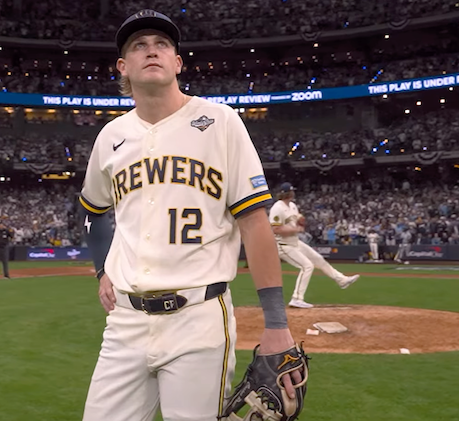
WS: At long last, Bushville wins again

Milwaukee Brewers

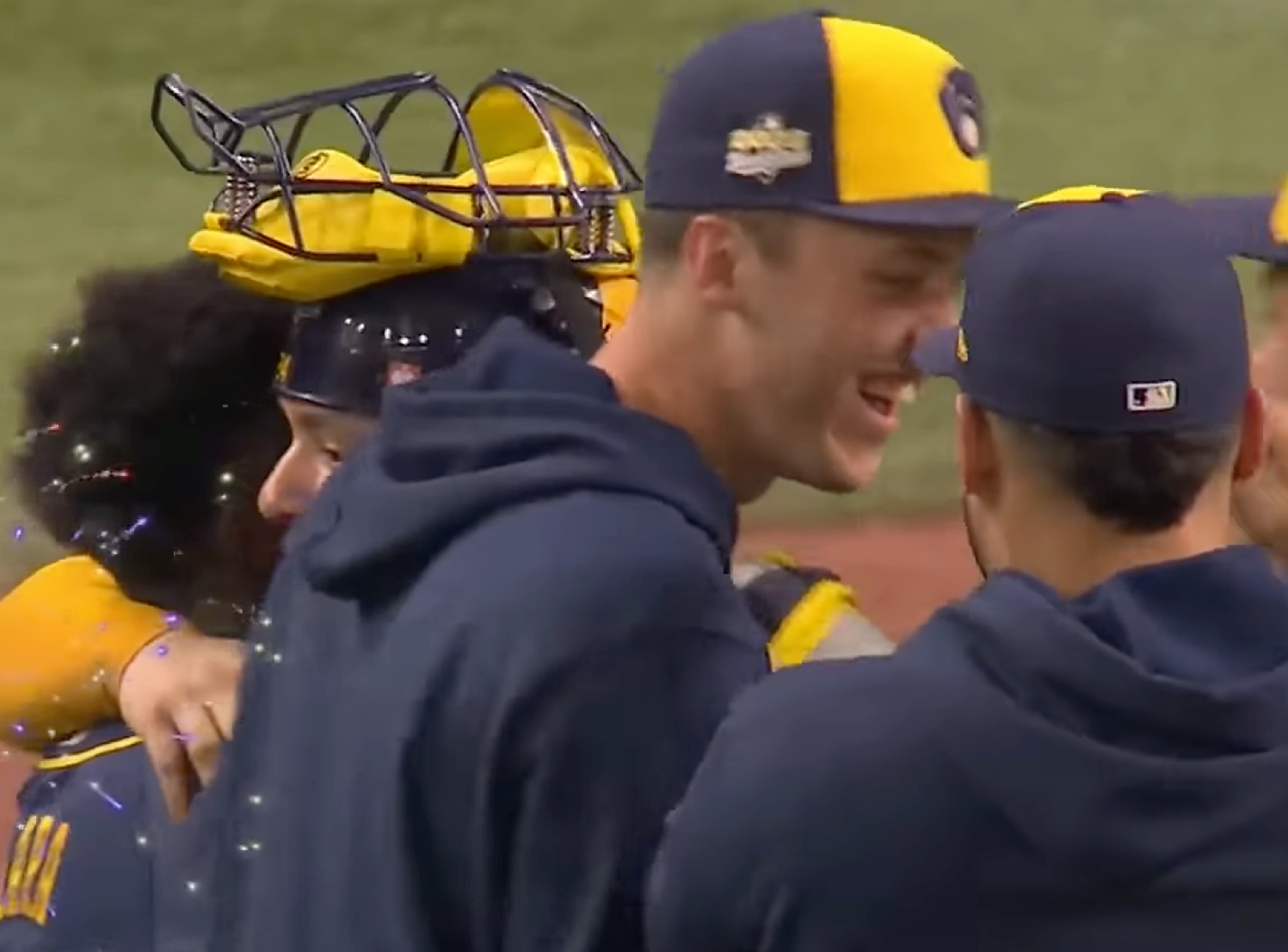
Series MVP William Contreras (with mask), Les Mis, and the Brewers give Milwaukee its first World Series title since Sputnik I. (Fox Sports capture.)

Long enough ago, in a world far enough away, Milwaukee hosted its first World Series champion. It happened in the same month as Sputnik I greeted the world and Albert Camus won the Nobel Prize for Literature. The city the Yankees dismissed as Bushville embraced the insult as a badge of glory.

Those Braves turned the Yankees aside in seven games, led by a Yankee discard named Lew Burdette, who went forth to make the world’s worst country music record until the advent of the Legendary Stardust Cowboy. And, by three Hall of Famers (Henry Aaron, Eddie Mathews, Warren Spahn) equal to those Yankees’s three. (Yogi Berra, Whitey Ford, Mickey Mantle.)

Bushville won. It only took another 69 years for the city putting on the Schlitz to host another World Series champion. The Brewers of Bushville kept the Rays of Tampa at bay yet again Wednesday night. Their 4-1 Game Five triumph had everything except the kitchen sink thrown into it.

The Series in which only four balls were hit over fences didn’t need the long ball for both sides to engage, electrify, and entertain. Until the Rays plain ran out of petrol after their Game Four semi-surprise win, both teams had enough small, medium, and rub-a-dub-dub mojo working to leave fans wanting as much more as they could offer.

This wasn’t just a World Series conquest.

The Brewers swept their nemeses from L.A. out of this year’s National League Championship Series. The same Damndodgers who dispatched them from three of their seven previous postseasons. The Brewers also became only the fifth team to win 100+ regular season games and get rid of the previous season’s World Series winners.

They won eight straight postseason games from the final game of their division series win to Game Three Tuesday night. Tying the postseason streak records of the 2019 Nationals, the 2014 Royals, the 2005 White Sox, and the 2004 Red Sox. It might have been nine straight for these Brewers if only manager Pat Murphy removed his caution vest for the bottom of the Game Four twelfth.

After his sharp rookie shortstop Cooper Pratt hit the tiebreaking home run in the top of the Game Four twelfth, Murphy could and arguably should have sent his scheduled Game Five starter Jacob Misiorowski out for the bottom of the Game Four twelfth. The World Series is three outs from being in your vault, Skip!

To everyone snarking that Misiorowski’s Game Five triumph proved Murphy right in holding him back—and sending unknown soldier Shane Drohan out to surrender the tying and losing runs on four straight singles—consider that it also proved Les Mis might well have nailed the Series-winning outs without anything interrupting him.

Inexperience! some might have snarked at suggesting Misiorowski should have been saved. Aside from him already having established himself in this postseason, starting pitchers have been sent out for attempted shutdown relief with past World Series wins on the line or close enough to it. At all levels of experience.

And, rookies or sophomores haven’t been unheard of pitching in Series games where survival is on the menu or winning is just within reach. Come to think of it, another Brewers rook, Robert Gasser, got lost in the aftermath after that unprecedented two-out, eight-hit, eight-run Game Three fifth memory-lapsed his magnificent starting six shutout innings.

So it was Drohan, after Rays third baseman Joey Ortiz’s very unfortunate throwing error allowed Junior Caminero aboard (though he’d come out for a runner after dinging his leg) prodded Murphy to life Antonio Senzatela. Drohan, a rookie. Inexperience!

You are ok with sending a rookie out who’d shown up once, in the NLCS, where he  surrendered an earned run, two walks, and a hit in one inning’s work, to nail down a World Series sweep? But you’re not ok with sending out a sophomore who’s the likely National League Cy Young Award winner and gave you a 1.86 fielding-independent pitching rate in the first two postseason rounds?

That scratching sound you heard was Casey Stengel on his head from the Elysian Fields, trying to remind you of his law: If you have an opening, shove with your shoulder.

Then it was single, RBI single, single, and Ben Williamson becoming a Tampa Bay hero singling the game winner home Tuesday night. For the first time since the Series moved to Tampa in the first place, the racket inside the Trop belonged to the Rays fans who made up about half the audience.

Their joy lasted long enough for Misiorowski to take the Game Five ball, pitch five and two-thirds shutout innings, and get about ten times as many ground and (especially) fly outs as he got strikeouts (two). Now the racket belonged to the traveling Brewers faithful.

Now, it was stout Rays starting pitcher Drew Rasmussen going gamely forth on short rest and working four one-run, four-punchout innings, before yielding to a Rays bullpen whose needle was just about pointing to E.

Now, it was Series MVP Willson Contreras doing his usual steering of the ship from behind the plate, deploying the ABS system almost as though it had his name on it, and pitching in at the plate by thanking Christian Yelich for taking one on the leg for the team opening the top of the sixth with an RBI double right away.

Now, it was three more Brewers runs to come through that pen, from an RBI single in the fifth to the aforesaid Contreras double plus a long foul sacrifice fly in the sixth.

When Chandler Simpson, the Rays left fielder who turns basepaths and outfield routes into track meets, singled catcher Liam Hicks home in the bottom of the ninth, it seemed almost like the Rays were tempted to say excuse us before expiring.

They don’t need excuses. Both sides made a few mistakes along the way. Both sides took the other’s measure and found nothing wanting. Two teams who looked like an even match in abilities and approaches entered this World Series. The Brewers found ways to resemble the Third Army without a crowd big tanks or incendiary devices.

Even their fans found ways to persevere, especially when World Series ticket prices for the Milwaukee leg of the Series compared proportionally to the ancient, discredited $200 hammer. Brewers fans traveled to Tampa in such force that Tropicana Field could have been mistaken for the Brewers’s alternate or spring training digs. And American Family Field packed full regardless for showing Games Three through Five on the LEDs.

Nothing remained but for baseball itself to get the message that its government’s narrative about the Davids helpless against the Goliaths has always been a lie. The Brewers, no Goliaths they, have won five of the past six National League Central titles and six of the past nine. The Rays, except for shaky 2024 and 2025, have three American League East titles and a second place finish in the past seven years.

But The Narrative would have you think the Damndodgers coming thatclose to losing last year’s World Series before getting swept out of this year’s NL pennant was an aberration. It would have you think the Rays knocking the Empire Emeritus out this year in a division series sweep was a hiccup.

It would have you think anything except that the whining from Commissioner Pepperwinkle and his will-nots (remember: this isn’t haves versus have-nots, this is wills versus will-nots, and the wills aren’t limited to kabillionaires on the coasts) is a sales pitch for Uncle Rob’s Happy Henbane.

It would have you think that nothing means anything except the big player salaries that must be capped. It would have you think that there’s nothing wrong with under-investing in the kind of managing, coaching, training and medicine, scouting and player development, analytical minds and attitudinal minds.

The kind that enable a Pat Murphy to dismiss the Damndodgers as a lot of Hall of Famers who proved lesser than a lot of gamers. (The Damndodgers sure didn’t help their own cause by letting Shohei Ohtani play while still hurting, did they?)

Murphy knows better than that. He knows bloody well that it isn’t just dollars or Cooperstown candidates that make them the Damndodgers. He wouldn’t have hoisted the World Series trophy or sent his game sweatshirt to an eager Hall of Fame if he didn’t. But he’s entitled to be a smartass for a little while.

A will won the World Series. A will lost it after beating another will for a pennant. With Commissioner Pepperwinkle’s only-too-eager help, the will-nots will continue flogging the wrong horse. They’ll never get that this postseason and this World Series knocked Uncle Rob’s Happy Henbane harrumph into a cocked blue and gold hat.
WS Game Three: The fifth-inning dimension

Christian Yelich

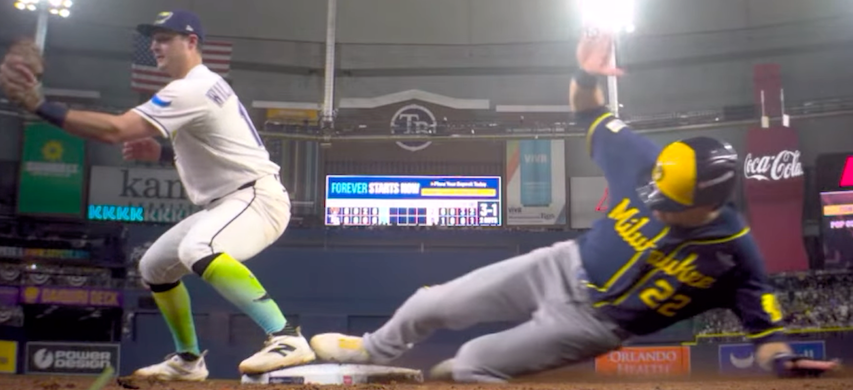
Sliding Scale Dept: Christian Yelich holding onto second base for dear life, upheld safe on review and opening the door to the eight-run fifth inning flood. (Fox Sports capture.)

Until Monday night, 88 meant the number of piano keys over which distinguished hands danced. Hands such as those belonging to Dave Brubeck, Philippe Entremont, Red Garland, Herbie Hancock, Vladimir Horowitz, Oscar Peterson, Bud Powell, and Professor Longhair.

On Monday night, in Tropicana Field, they meant eight Brewers runs on eight Brewers hits in a single fifth inning during World Series Game Three, which ended in a 10-1 massacre leaving the formerly perky, plucky, pesky Rays on the ropes. And, possibly, at the end of their ropes.

All courtesy of such now- or long-distinguished hands on bats as Jackson Chourio, Christian Yelich, William Contreras, Brice Turang, Cameron Mitchell, Cooper Pratt, Sal Frelick, and David Hamilton.

And, in Yelich’s case, maybe the single most powerful walk of all time.

And, the Brewers accomplished something unseen in no World Series before Monday night. All eight of those runs came home on two outs. Turning a mere 2-0 Brewers lead entering the frame into a 10-1 burial in which the lone Rays run—an RBI double with two outs in the bottom of the ninth—seemed like a pardon-us show of lingering life.

In what may yet prove to be the understatement of the postseason, Rays manager Kevin Cash was asked about that fifth. He knew it was the inning upon which everyone may yet look back and think it was the inning above all that sealed the Rays’s fate.

“It’s definitely deflating,” Cash said at his postgame presser. “How could it not be?”

Charles Cornwallis telling that to his soldiers before surrendering to George Washington at the Seige of Yorktown couldn’t have been more understated.

There’s still a fourth game to play at minimum. If the Rays have heretofore undetected cards to play and powers upon which to draw, they’d better play them and draw upon them Tuesday night.

In a Series matching two teams who play small-to-medium ball the way the aforementioned Garland played the blues, the Brewers are making the Rays resemble students who’ve barely gotten through the semester’s opening days.

This time, the Brewers didn’t have to strike from a deficit. This time, there was no early Rays scoring to prompt them to think, They have us right where we want them. This time, Yelich and Contreras staked them to a 2-0 lead with back-to-back RBI singles in the top of the third. For the first time in this World Series, they had an early lead to defend entering their half of the fifth.

Two RBI singles wasn’t supposed to turn Rays starter Freddy Peralta into an emergency ward patient. But then came Yelich, whose ages-ago acquisition from the Marlins could be argued as the moment the Brewers began returning to competitiveness and slouching toward greatness.

This time, it wasn’t a big stick but a big eye. He worked his way back from 1-2 to three straight takes out of the upper strike zone with Chourio (one-out single, stolen base) on second and two outs.

Then Contreras squeaked one toward third. Rays third baseman Junior Caminero picked it with his running momentum tugging him more toward the outfield. He threw to second instead of going for the theoretically simpler out at first. Second baseman Ben Williamson took the throw as Yelich’s right, front foot hit the pad about a half-inch ahead of the ball hitting Williamson’s glove.

Unlike Rays left fielder Chandler Simpson, caught stealing when he slid just past the pad to end the bottom of the first, Yelich never let his foot or his leg leave the pad behind.

The replays confirmed it. The Brewers now had the bases loaded and two outs. Cash took no chances with a parade of mostly portside swingers in the offing. He brought lefthander Cam Booser in. Before this, Booser was one of the Rays’s least touchable pen men and nobody in this postseason could claim an earned run off him. Yet.

But Turang shot one right off the glove of Rays shortstop Taylor Walls to shoot Chourio and Yelich home. Mitchell shot one the other way to left for the single that sent Contreras home. Pratt interrupted the left-side parade by pulling one off Caminero’s glove for a two-run double. Frelick—who’s hit the lone Brewers home run of the set, and who was robbed of an extra-base RBI hit in the second by a spectacular Simpson running catch—so went the other way to left, doubling Pratt home.

Robert Gasser

Robert Gasser—How to make like Sandy Koufax and be almost ignored in six easy lessons . . .

Booser couldn’t have been blamed if he reached for a double shot of booze after coming out in favour of righthander Cole Sulser. After Hamilton singled Frelick home and Chourio doubled Hamilton home—the fourth hit of the night just for the Brewers left fielder alone—first baseman Jake Bauers flied out to left. Almost the way he’d done to make the last known Brewers out before the battering rams started battering.

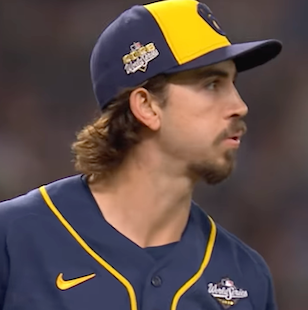
Almost lost in the superlatives that followed to describe and analyse the Brewers’s fifth inning flogging was their starting pitcher Robert Gasser. His repertoire doesn’t exactly match his name, since he makes his living offering diets of breaking balls and off-speed stuff for the most part.

He only pitched six shutout innings in which he collaborated with the fielders behind him the way Brubeck once collaborated with his classic quartet. He pitched them facing the minimum eighteen batters over the six. The last lefthander to do that? Some ancient Hall of Famer named Sandy Koufax, in 1965. In any other World Series, that would have been headlines upon headlines atop headlines.

But who the hell needed Gasser this night? Or, his relief Antonio Senzatella, who fired two perfect innings of his own? Only one Brewers pitcher could have taken minds off that assault-and-battery fifth. That was the guy who hadn’t pitched since the Fourth of July and recovered quicker than expected from shoulder capsule surgery to make this Series roster.

The guy who’s been a Brewer for life and interrupted more rudely by injuries than hecklers dare to interrupt comedians. The guy Brewers manager Pat Murphy—who spent much of the late game wheeling his supporting cast into and out of the game just to let them have a Series taste—sent out to pitch the ninth.

Brandon Woodward wrung his way around that excuse-us Rays run—a one-out single (pinch hitter Cedric Mullins); a two-out RBI double (Yandy Díaz)—to lure Jonathan Aranda into a first-pitch, game-ending ground out to second.

Only these Brewers could take that kind of game with that kind of fifth-inning bloodletting and make it into a feel-good game in the end. The looks on Woodward’s face after Turang threw Aranda out were the kind you borrow for feel-good product advertisements. It couldn’t have happened to a nicer guy than the one who threw the National League’s only 2023 pitching shutout, missed 2024, a piece of 2025, and two-thirds of 2026 with shoulder trouble.

Woodruff was first penciled in to start Game Four. But with the Brewers enjoying a glandular lead and Murphy unwilling to stop handing out favours, he asked Woodruff if he wanted that or to have the Game Three ninth.

“I want it right now,” the Forever Brewer (as he’s known around the Brewers and the game) said.

He could have been giving the entire team a watchword for the rest of the Series. A rest of the Series that could end Tuesday night. A rest of the Series in a stadium where almost precisely half the crowd was traveling, racket-making Brewers fans for whom travel and the Trop were cheaper than too many of the American Family Field Series tickets.

We want it right now, the Brewers will think as they begin Game Four. As the Rays begin, they’ll want to sing, You can’t always get what you want. That may not be simple the night after a journey to the fifth inning dimension.

WS Game One: “Just get the outs”

As closer Trevor Megill (right) takes an ump up on some extra keep-loose tosses, Brewers shortstop Cooper Pratt watches a replay of the double play that wasn’t, compelling Megill to go after and punch out Rays center fielder Jonny DeLuca to end the Brewers’ World Series-opening win Friday night. (Fox Sports capture.)

Opening night for Les Mis in the World Series wasn’t exactly one for award consideration. It didn’t have to be. The company around him was more than able to save the show when he had an off night. An off night for him, not anyone else.

Jacob Misorowski with a five-inning line of three punchouts, four hits, one earned run, and a 2.50 fielding-independent pitching rate is an off night for the likely National League Cy Young Award winner whose regular season showed a 174.2-inning line of 252 punchouts,  a 2.17 FIP, and a 1.80 earned run average.

But it was enough to keep his Brewers in the game until manager Pat Murphy decided it was time to reach for the secondary cast. Abner Uribe and Aaron Ashby made life difficult enough for the Rays, before Trevor Megill made it almost interesting enough for the Rays to overthrow the Brewers

Emphasis on almost.

The not-even-close-to-artificially-intelligent Brewers and not-even-close-to-artificially-intelligent Rays played it tight, overcame mistakes, and ground it out until the final outs that weren’t, before the Brewers held on tight to their 3-2 Game One win.

They had William Contreras to thank for a lot of it, their defense for a lot of it, the bullpen for a lot of the rest of it, and the replay review for the next-to-last act.

First, Contreras repaid longtime franchise face Christian Yelich for that bottom of the first RBI triple that just did elude diving Rays center fielder Jonny DeLuca. He slashed the first pitch he saw from Rays starter Nick Martinez through the hole at shortstop to send Yelich home and the Brewers to a nice, early 2-0 lead.

Then, with one out and Rays first baseman Jonathan Aranda (base hit) aboard in the sixth, Contreras caught Uribe’s swinging strikeout pitch to Rays left fielder Chandler Simpson and whipped a textbook perfect strike up the pipe to nail Aranda trying to swipe second.

Martinez, the elder Rays righthander who has a between-pitches habit of stepping up and down as though he’s peeking over a fence waiting for the right time to leap over and rob the place, settled well from there. He justified Rays manager Kevin Cash holding his own ace Drew Rasmussen until Game Two.

With the benefit of a run-scoring ground out by Liam Hicks in the top of the fourth to cut that lead in half, Martinez had his way with the Brewers for the most part the rest of his assignment.

He got away with Brewers right fielder Sal Frelick singling with one out in the second and helping himself to third after being bunted to second when he struck left fielder Jackson Chourio out to end the second.

He got away with murder in the fifth because Brewers third baseman David Hamilton took a bad turn rounding second trying to turn his one-out double into a triple, and the relay from right fielder Victor Mesa, Jr. to second baseman Ben Williamson to third baseman Junior Caminero was flawless enough to nail the diving Hamilton by a full foot plus.

Did that knock the Brewers into the oxygen tent?

Not a chance. Veteran Steven Matz—last seen in the World Series as a rookie with the 2015 Mets—shook off a pair of two-out walks in the sixth to escape and landed a pair of seventh-inning outs following a leadoff walk to Brewers rookie shortstop Cooper Pratt. Cash lifted Matz for Kevin Kelly, wanting the right-on-right match with Chourio.

Right on, the Brewers thought, when Chourio punched Pratt home with a base hit through the right side.

Naturally, things had to get more than interesting in the top of the ninth. As in, Brewers closer Trevor Megill allowing a pair of base hits (Aranda and Simpson) and a double steal, then walking the bases loaded for Hicks. Those hoping the Brewers might find their own Mariano Rivera some day had to settle for finding their own Craig Kimbrel Friday night.

Heaven help Megill if his mojo stops working. So far, he can work his way out of trouble of his own making faster than you can say “kill the save.” And he won’t say no to any help he can get. He got it Friday night, from Hicks and from his infield and from New York.

As in, Hicks grounding into what looked like a bang-bang-bang double play. As in, Caminero looking out at second, Hicks called out at first, and the Rays calling for a review. Megill wasn’t sure why. He may have been the only human being in American Family Field who wasn’t sure. At first. Then . . .

“I thought they were challenging the play at first,” he told reporters postgame. “I didn’t even think about it. I thought my cleat was dragging across the base. I just kind of looked at one of the umpires there and said, ‘Hey, what are you hearing in your ear?’ He said, ‘Uh, whatever, not too good. Do you want to throw some baseballs?”

The extra tosses did Megill a huge favour after replays showed Pratt covering second came off the pad before he had the ball to record the out while his throw on to first got Hicks. Meaning pinch runner Jorge Mateo was safe at home with the second Rays run and DeLuca checking in at the plate.

Once upon a time, that double play would have stood. It used to be called the infamous neighbourhood play. The out at second would be called if the fielder happened to be in the neighbourhood whether or not his foot hit the pad before he threw on. The crackdown on that play started around 2016. Bye, neighbour.

This was a night both sides didn’t exactly look like virtuosi on the bases, either. Now, though, Megill was hell bent on just blowing DeLuca away with two men still in scoring position. He dropped to 2-1 on fastballs, then dropped a delicious curve in on DeLuca to freeze him for strike two. 

“Anytime you can land a curveball at the bottom right there like that,” the husky righthander said, “it definitely sets up your next one. It’s just pitching and trusting what William is putting down back there.”

Contreras wanted that curve again. Megill was only too happy to oblige. He threw it, DeLuca swung through it, and the game belonged to the Brewers.

That’s not exactly what the Rays want to hear. This postseason, just the bullpen trinity of Uribe, Ashby, and Megill have a combined 0.95 earned run average, even if Megill likes to do it the hard way a little too often. Not the best pickings for a Rays team that was the American League’s best on the season but went 0-for-6 with men in scoring position Friday night.

“Has any team won a World Series with a starting rotation that was mostly just the nightly warm-up act for its bat-smothering relief crew?” asked The Athletic‘s Jayson Stark. “This is not a rhetorical question anymore.”

Megill had a non-rhetorical answer. “I don’t know, man. It just don’t matter how we get the outs,” he told Stark. “Just get the outs.”

Just get the outs. Because, as Yelich himself said postgame, “All of these games are going to be close. But it was good to get that first one.” Especially when it took forty-four years to get another crack at it.

Freeman frees the Braves to await their NLCS opponent

Freddie Freeman

Jubilant Freddie Freeman approaches the plate to finish the eighth-inning bomb that held up to win the NLDS for the Braves Tuesday night.

Maybe it didn’t have quite the last-split-second hair raising quotient that the Red Sox’s final two American League division series wins had. But it wasn’t any less dramatic for Freddie Freeman and his Braves in winning their National League division series Tuesday.

Freeman’s eighth-inning tiebreaking home run off Brewers relief ace Josh Hader turned out the finishing blow in a set during which both teams scored as many runs in the first three games as they ended up scoring in Game Four alone.

What made the bomb so luminous, too, was that it was only the second time in the whole 145-year history of the franchise that any Brave delivered what proved a postseason series-winning hit in the eighth or later. It took one season shy of three decades for Freeman’s homer to join Francisco Cabrera’s National League Championship Series-winning base hit. (The fabled Sid Bream mad-broken-bodied-dash.)

“I’ve had a lot of cool moments in my career,” Freeman said postgame, “but so far I think that’s going to top them right there. But hopefully that’s not the last cool one.” Right now, nobody’s willing to bet too heavily against either Freeman or his Braves. Yet.

You heard all season long about this or that team being wracked by injuries and surrealities? Few had to compensate as heavily as the Braves did. Too many teams losing their number-two franchise player, one of their best young pitchers, and a reliable other power bat might have collapsed like a blimp.

The Braves lost Ronald Acuna, Jr. thanks to a torn ACL making a play in center field. They lost Mike Soroko after his Achilles tendon blew out in May—after nine months’ rehab following its initial 2020 tear. They looked as though their season had paid put to hit without once seeing .500.

They lost Marcell Ozuna when the outfielder/bombardier was arrested for domestic violence in July—charged first with felonious aggravated assault and attempted strangulation, charges reduced to misdemeanor simple assault and battery, on administrative leave through the end of the Braves’ season, after he entered a diversion program.

When Acuna went down, and the Braves more or less sputtered into and past the All-Star break, general manager Alex Anthopoulos made his first move, bringing former Dodger Joc Pederson aboard from the Cubs in exchange for a minor league prospect.

That was Pederson pinch hitting for Braves reliever Luke Jackson in the Game One eighth and hitting a solo home run off Brewers reliever Adrian Houser for the only Braves run in the only series loss. That was also Pederson in Game Three, pinch hitting for Braves starter Ian Anderson, facing Houser again, and launching the three-run homer that proved the only Game Three scoring.

Houser may start seeing Pederson in his sleep. The Braves just want to keep seeing him mash. Even if he got the Game Four start as his reward and had to settle for pushing home the first of the two runs that tied things at four with a ground out to second base.

Freeman thinks landing Pederson merely began the Braves’ reversal. “When Alex went out and got Joc,” he said, “it brought a sense of energy that it just showed us that they still believed in us, to go add at the deadline.” Which is exactly what Anthopolous did. He nailed three 30 July trades to bring Jorge Soler from the Royals, Adam Duvall from the Marlins, and Eddie Rosario from the Guardians-to-be.

The NL East wasn’t a powerful division to begin with. But the longtime-leading Mets imploded, the Nationals hit the reset button, and the Phillies proved just short of being able to hold on. In Atlanta, as proverbially and poetically as feasible, that which didn’t destroy the Braves only made them stronger.

They went 36-19 to finish the regular season, including a too-simple-seeming sweep of the Phillies opening the final week to keep them from finishing what they threatened awhile to do and overthrow the Braves. They even shook off Soler’s COVID diagnosis entering the postseason. Now they’ve dispatched a Brewers team that won seven more regular-season games to lead an only slightly stronger NL Central.

They’re waiting to see who’ll be the last men standing between the Dodgers and the Giants, after the Dodgers tied that division series in Los Angeles Tuesday night in an all-Dodgers/all-the-time 7-2 win.

The game was a still-manageable 2-0 Dodger lead, with the Giants compelled to a bullpen game against a short-rested but deadly effective Walker Buehler, when Mookie Betts checked in in the fourth against Jarlin Garcia—after Buehler himself led off by reaching on an infield error.

“It’s not something we want to do all the time,” said Buehler about going on only three days rest, “but I felt that if things didn’t go our way [in the third game], I would feel really weird not pitching a game that we could lose a series.”

He didn’t have to worry. Until he surrendered a leadoff single to Evan Longoria and a one-out walk to Steven Duggar in the fifth, Buehler pitched stoutly and had to shake only one previous first-and-second spot of trouble away in the second. He even had the Giants slightly flummoxed when he went to his changeup a little more often than they were accustomed to seeing from him.

When the Mookie Monster parked an 0-1 pitch into the right center field bleachers, it suddenly seemed a question not of whether but by how big the Dodgers would take the game. An inning later, Betts sent Cody Bellinger home with a sacrifice fly deep to left center field. But Dodger catcher Will Smith—just call him the Fresh Prince of Dodger Stadium—squared off against Giants reliever Jake McGee with Corey Seager aboard (leadoff line single) and hit the first pitch over the left center field fence.

The Giants looked so overmatched in Game Four that their only two runs scored on ground outs, one with the bases loaded. That was Evan Longoria scoring on Darin Ruf’s grounder to second. The other was Brandon Crawford coming home in the eighth when Kris Bryant grounded one to the hole at third.

Buehler’s short-rest deliverance plus the Dodgers’ bats ensured Julio Urias on regular rest starting Game Five against Logan Webb in San Francisco Thursday. For the Braves, that’s going to be very must-see television. Which is what it already was on the left coast and elsewhere.

For the Brewers, it’s a too-early winter vacation after their pitching virtuosity proved futile against the disappearance of their bats. Christian Yelich’s back injury-abetted struggles continued in the division series, and while the Braves didn’t exactly bring the walls crumbling down the Brewers hit a measly .192 in the set—32 points below the Braves.

They did get beaten in the end when the Braves’ best batter launched against their best pitcher in the Game Four eighth. Starting Eric Lauer for Game Four because ace Corbin Burnes said he wasn’t feeling one hundred percent proved a mistake, and so did manager Craig Counsell not bringing Brandon Woodruff in earlier in higher-leverage.

But then here’s where the Brewers’ best bats fell too short. Avisail Garcia? Eight strikeouts, only two hard-hit balls, and two singles in fifteen at-bats. Kolten Wong? Five strikeouts, likewise only two hard-hit balls, and one single in fifteen at-bats. Willy Adames? Five hits in seventeen at-bats—four singles and a double, plus nine strikeouts and only three balls hit hard.

That’s why the Brewers pitched the division series like Hall of Famers—their three starters Burnes, Woodruff, and Luis Peralta showed a collective 1.56 ERA and 0.92 walks/hits per inning pitched rate, not to mention nineteen strikeouts in 17.1 innings pitched—but the Braves still took them out sweeping three after a Game One Brewers win.

“The vibe is the best that we ever had in this series,” Adames said before Game Four. “Today, the guys, I guess they woke up in a great mood. They came with energy. And I feel today we had the best vibe that we’ve had so far this series so far.”

The trouble was that the Brewers went in with the best vibes but the Braves played them as if they were jazz vibes legend Milt Jackson hammering out another virtuoso chorus of “Bags’ Groove.” Now the Braves wait to see who gets bagged in San Francisco Thursday night.