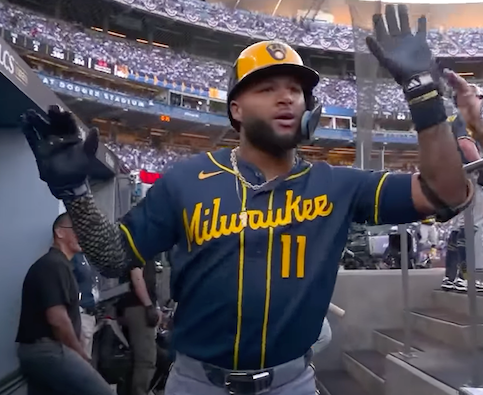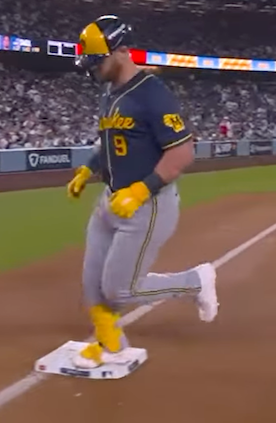
For Bauers, everything’s Jake

Jake Bauers, Blake Snell

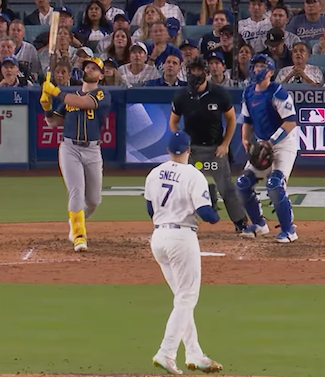
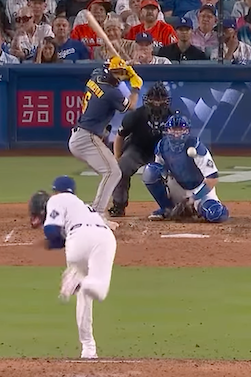
Jake Bauers (9) sending Blake Snell’s eleventh pitch over the right center field fence in NLCS Game Three. His breakout 2026 has landed Bauers a neat, appropriate four-year deal with the Red Sox. (Fox Sports capture.)

Maybe the second-most viral remark Pat Murphy made last month was his valedictory after his Brewers sent the Damndodgers home for the winter.”They may have a bunch of Hall of Famers, but we’ve got a bunch of gamers,” he crowed. “And the gamers won this week.”

The first-most? Easy. It was the skipper’s remark to his National League Championship Series MVP Jake Bauers, as Bauers handed him the ball from the out that finished the World Series with the Brewers as the new world champions.

“You’re going to be a rich [fornicator],” said the skipper, mindful that Bauers was about to become a free agent after a late-baseball-life breakout season and postseason. “Just remember when you’re on that horse[spit] Yankees team and you guys are all playing for yourself? Just remember, say, ‘This is the way we used to do it’.”

Murphy was right about Bauers on the threshold of riches but wrong about the source.* He’s going to be a $58 million over four years rich you-know-whater on that horse[spit] Red Sox team. That’s the team that horse[spit] Yankees team shoved out of an American League wild card set in two straight before the Rays swept them in turn out of a division series in three straight.

That’s pretty good for a too-much-traveled first baseman who pondered retirement until his wife became pregnant with their second child. The guy for whom the need for health insurance thus loomed larger than even the gassed Blake Snell against whom Bauers eventually wrestled toward an eleventh NLCS Game Three pitch that he drove over the right center field fence.

The fun part becomes just what the Red Sox plan to do with their new world champion toy. Clearly, Bauers comes from a baseball culture in which elementary fundamentals mattered as much as big moments. Indeed, it was one in which elementary fundamentals provided the big moments.

The World Series between a pair of teams who play that way and build that way resulted in one team becoming America’s Team by beating the other team who might have become America’s Team. The well-enough-rested Brewers caught a Rays team who’d left almost everything behind in winning the American League Championship Series. Every time the Rays thought they had the advantage, the Brewers thought back, They have us right where we want them.

The Red Sox could use more than a little of that kind of brio.

They also know Bauers is not the strongest defender at first base or in the outfield and is suited best to designated hitting. Even at age 31, Bauers was better than a lot of 2026 Red Sox lumber. The Olde Towne Team was below the American League average in categories only beginning with OPS and slugging percentage (nineteenth each).

With the Red Sox making it known they’re keeping incumbent Willson Contreras through his final contract year, Bauers could become a committed DH with days to spell Contreras at first base. That would solve one problem while leaving a second, DH surplus to be addressed.

Incumbent Masataka Yoshida has owned that lineup slot when healthy, but he might not be an easy move with $18.6 million coming to him in the last of a five-year deal, according to The Athletic. That doesn’t mean impossible, of course, but his medicals will influence if and where he goes before next winter. Those and the fact that he hasn’t been much more than ho-hum.

Roman Anthony? He’s moved between the outfield corners and the DH slot in his two major league seasons, but he’s a very plus rightfielder (+12 defensive runs saved) when he’s healthy. A smart Red Sox lineup minds his health and slots him in right field (in left he’s exactly league average).

Then, the Red Sox have to decide whom among their outfield logjam of Jarren Duran (a frequent trade-rumour subject and fresh off a career-worst year, The Athletic reminds us), Wilyer Abreu, Cedanne Rafaela, and Eli White stays or goes.

They’ve already decided the risks were worth it to land Bauers in the first place. Since the Brewers offered Bauers a qualifying offer that he turned down to play the market, the Red Sox lose their second- and fifth-highest draft picks and $1 million out of their international market pool for the coming signing time, The Athletic‘s Ken Rosenthal and Will Sammon noted.

However, they’re “acting the way a big-market team with a good farm system should,” the Athletic pair said. Took them long enough to wake back up, too, right?

“[T]he Red Sox likely view their decisions to sign free agents who rejected qualifying offers as measured calculations,” Sammon and Rosenthal go on. “Their major-league roster features a number of good young players under multiple years of club control. They are not exactly emptying the tank with their farm system, either.”

Ask another Athletic analyst, Keith Law, and he’ll tell you the Brewers should be thinking about adding pitching. They have first base covered, with Andrew Vaughn ready to step in and a pocketful of prospects close to major league ready—especially Andrew Fischer. But the Brewers really need reinforcement on the mound, Law says:

Their bigger need is the rotation, where they have the [National League] Cy Young winner at the top followed by a lot of uncertainty. Jacob Misiorowski was the only Brewer to throw 130+ regular-season innings in 2026, and I worry about regression from some of their best relievers after long seasons—which isn’t a criticism of their usage, just to be clear. They’ll need more innings from somewhere to fill those gaps, and that might be a better investment than a four-year deal—even a cheap one—for a 31-year-old first baseman they can probably replace with internal pieces.

The Brewers have so much talent coming from one of baseball’s best farm systems that they’ll be contenders for another five years, at least, as long as ownership backs it up by spending to fill gaps in the rest of the roster.

Maybe the Red Sox also gazed upon the Brewers’s run to the World Series triumph and decided they should pounce as available upon anyone from that culture who might inject more than a little of that they have us right where we want them spirit, that balance of small, medium, large, and rub-a-dub-dub ball thinking and executing, into their culture.

Bauers is one of the perfect men to teach his new team how to play for each other. At $14.5 million a year, he’s also bargain enough even at 31. Which would only be reminding the Red Sox that, once upon a time, they had teams who played that way, too. And they have four 21st century World Series winners to prove it.


* Murphy also hastened to apologise to Yankees general manager Brian Cashman and clarify he wasn’t referring to this year’s Yankees.
A special, cool little story

Milwaukee Brewers

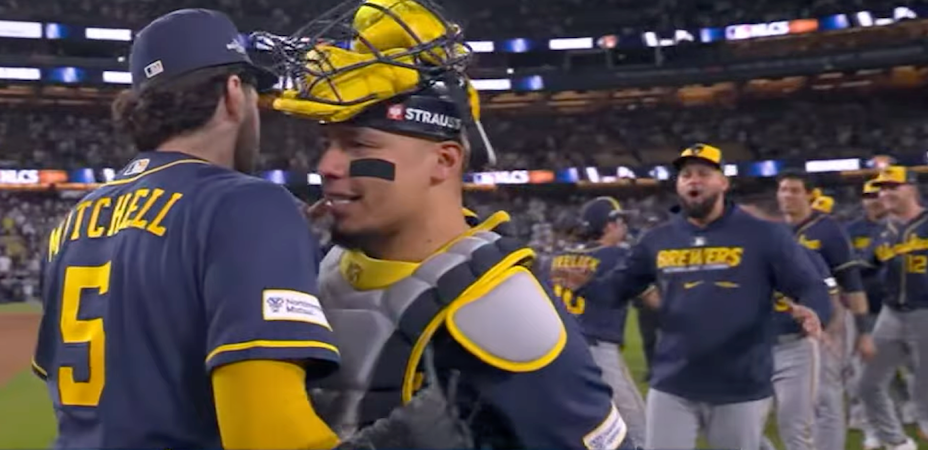
Center fielder Garrett Mitchell, catcher William Contreras, and more celebrate the Brewers’s first pennant since 1982—when they were in the American League. (Fox Sports capture.)

Whatever else you can accuse Dodgers manager Dave Roberts of thinking, you can’t impeach his simple, to the point valedictory after his team got hunted, pecked, bumped, flecked, and shoved out of their World Series three-peat hopes: “At the end of the day, we got beat. We got outplayed in all facets.”

That tells two things. The story of this National League Championship Series, and only half the story of what the Brewers sweep really signifies. What’s the other half, you wondered Thursday night, while watching the Brewers do just one of many things they’ve done like virtuosi this week.

“What Major League Baseball doesn’t want to discuss, as it portrays its sport as a broken landscape of haves and have-nots,” says The Athletic‘s Ken Rosenthal, who doubles as a Fox Sports television analyst, “is that big-money teams can sustain success only for a finite period, if they achieve success at all.”

Bleat to your heart’s content that these Dodgers are as imperious and intolerable as the early-to-mid 20th century Yankees. The mighty do fall, and get felled, and more often than you think. And, as often as not, they get felled as this year’s Dodger’s did.

Not by the edicts of a commissioner who’s six parts snake oilman and half a dozen parts Rube Goldberg and thinks the good of the game is nothing more than making money for it. Not by the owners who think they should be making money regardless of whether they care about their on-field product.

They get felled between the lines, at the plate, on the mound, out of the bullpen.

The beauties of baseball include that the moment the umpire hollers, “Play ball,” all arguments for salary caps and against salary floors disappear faster than the Dodgers did in this year’s National League Championship Series. The game that’s played is the game that counts.

“They may have a bunch of Hall of Famers,” said Brewers manager Pat Murphy, “but we’ve got a bunch of gamers. And the gamers won this week.”

The Brewers weren’t disrespectful so much as they couldn’t have cared less how many Hall of Famers wore Dodger uniforms or how many dollars each Dodger puts in the bank every week. They cared about runs on the scoreboard and couldn’t have cared less who put them there first.

The Damndodgers (yes, people still say it as one word, ladies and gentlemen) scored first in three out of the four NLCS games and led in all four of them. And they still got swept. By the team they swept out of last year’s NLCS. The only previous time that ever happened was never.

What nobody likes to remember or admit about the Damndodgers is that it. is. not. just. the salaries they’re willing to pay their players that made them winners of thirteen out of fourteen straight National League West titles and defending back-to-back World Series champions.

What a lot of those harrumphers didn’t like to remember or admit, while going in believing the Brewers would be just the latest upstarts ground beneath the Dodger boot heel, is that the teams are an even match where it matters most before the game begins. The Dodgers think well, develop well, coach well, teach well, and analyse well, as well as play well. The Brewers, who had baseball’s best record winning this year’s NL Central, think, develop, coach, teach, and analyse likewise.

But these Brewers did in a Dodger team that was a lot more vulnerable than its enemies wanted to hear. Sentence the Damndodgers to the seventh circle of hell if you must. But you must also be fair and remember that they got within the proverbial cat’s whisker of losing last year’s World Series. (Remember? They never led Game Seven until the eleventh inning.) And, that their age might be catching up to them at last.

So Shohei Ohtani finally found his way through his health issues to crank a three-run homer with two outs in the Game Four bottom of the second, giving his Dodgers a 4-0 lead? Let him have his fun.

Concurrently, ask yourselves just why the Dodgers didn’t insist on Ohtani hitting the injured list for proper healing of his knee and his biceps down the stretch. In thirty-two postseason plate appearances this time around, that homer was the only one of his five hits to mean extra bases.

What Ohtani really did, though, was give the Brewers an 0-4 lead. You’d have seen that if you paid close enough attention. You’d have seen the Brewers one and all watching Ohtani round the bases behind the two aboard in front of him and thinking, They have us right where we want them.

A one-out walk (to second baseman Brice Turang) and a ground rule double (by catcher William Contreras) set the top of the fourth table for NLCS Most Valuable Player Jake Bauers. And the first baseman rapped a ground rule double immediately, cutting the deficit in half. One inning later, third baseman David Hamilton singled right fielder Sal Frelick home, compelling Roberts to lift his starter Tyler Glasnow and bring Evan Phillips in.

Phillips proved the gift that kept on giving. He got Jackson Chourio to line out, but he walked the bases loaded before coming out in favour of Alex Vesia. And Bauers wrung Vesia for a four-pitch, game-tying walk. One inning after that, with Dodger closer Tanner Scott in a little bit earlier than normal but the Dodger season on the line—he fought center fielder Garret Mitchell to a full count, before Mitchell sent one over the center field fence.

David Hamilton, Edwin Díaz

David Hamilton, half a second from turning Edwin Díaz’s service into Brewers insurance Friday night.

The Brewers—those patient souls who blend small, medium, and large ball with the fine hands of the brewers who once made Milwaukee famous, and shake off their occasional mistakes and malfunctions—must have been the only ones in Dodger Stadium who thought their 5-4 lead was safe.

“Man,” marveled another Athletic writer, Levi Weaver, who usually covers the Rangers for the journal. “The Brewers just straight-up absorbed the momentum-shifting mega-moment from Ohtani. They took the blow, calmly stood back up, and just kept hammering away at the load-bearing walls of the dynasty. Two runs in the fourth, two more in the fifth, one (so far) in the sixth. Absolutely unflappable.”

However much the Dodgers’s age showed, however creaky one or two parts must have been, these were still the Dodgers. They were still capable of undoing the Brewers to play another day. Weren’t they?

Not this time. Not even when the Dodgers turned to Edwin Díaz, their glandular off-season free agency relief signing, who missed too much time with injuries, didn’t pitch too well when he could pitch on the season, and hadn’t yet poked his nose out of his postseason mouse hole—and Díaz recorded a possibly unexpected* eight straight outs into the top of the ninth.

Leave it to Hamilton to spoil Díaz’s splendid turn with a flog into the right field seats. Just call him Liberty Mutual. (The insurer shares the Brewers’s team colours.) But if you dare send Limu Emu out to follow him around the bases, we’re going to fight.

Brewers reliever Aaron Ashby saw and raised Díaz. He took six straight outs into the bottom of the ninth. Then, he finished what he started. Tommy Edman, pinch hitting for veteran Dodgers third baseman Max Muncy? Full-count ground out.

Center fielder Andy Pages, one of last year’s World Series heroes, the guy who’d run over his grandmother, grandfather, and teammate to catch the would-be-Series-winning Blue Jays extra-base hit? Looking at strike three.

Utility expert Enrique Hernández, said teammate, he of a duffel bag full of postseason heroics in years previous? A hard, high liner to left center field run down by Jackson Chourio for the NLCS-ending final out.

And, just like that, the Damndodgers—baseball’s bogeymen, the team denigrated as everything wrong with the sport in dollar terms by those ignorant of everything else they did right for so long—lost the pennant.

To a team whose dollar endowments might not be even halfway toward the Dodgers’s bucks but whose brains, teaching, analytics, and development sent them to the postseason in eight out of veteran Christian Yelich’s nine Brewers seasons.

“We believe in ourselves,” said Yelich postgame. “We didn’t just, like, wake up and find ourselves here. We expected to be a team that was in this position and have this opportunity. We didn’t feel like this was unexpected or a special, cool, little story.”

When you win the pennant and become the second modern (post-1900) Show team to win one in each league (the first: the Astros), you can afford to come up short in the rhetoric department.

Except that it is a special, cool story.

Commissioner Pepperwinkle and his merry band of salary cappers. The lamer owners who refuse as opposed to being unable to deliver reasonably competitive baseball teams, making the sport a game of wills and will nots, not haves and have nots. The ignorant fan and media cadres who buy their Kickapoo Joy Juice at full price. They’re all witless to understand.

The only postseason team more fun than these Brewers are those well-oiled, well-constructed, well-instructed, exuberantly fun Guardians. They have a 2-1 ALCS lead over the well-oiled, well-constructed, well-instructed, as-much-fun-as-glue-drying Rays. Give me one Petey Halpin over twenty-six cownoses.

—————————————————————————————————-

* Edwin Díaz, the Dodgers closer, has not pitched once this series. But here he is, in what is totally the exact situation the Dodgers pictured him in when they shelled out $69 million for him last winter—down a run in the top of the seventh.—Katie Woo, The Athletic.

NLCS Game Three: “Be really stubborn in there”

Jackson Chourio

Chourio accepts his props for hitting Game Three’s first pitch into the bleachers Thursday night.

After his Dodgers lost National League Championship Series Game One by a measly 2-1 score, Mookie Betts said they needed to start playing Dodger baseball, “whatever Dodger baseball is.” Then, they lost Game Two a little more decisively, 7-4.

Now, you might not really want to know what they’re thinking. Not after the Brewers knocked them into the NLCS hole 0-3, with Wednesday night’s quite emphatic 6-2 Game Three win.

The Damndodgers are on the brink of winter vacation without a World Series berth to show for being 2026 baseball’s . . . second-winningest team. For being even-up with the Brewers prior to this NLCS, going 8-2 in their last regular season ten and going 15-5 in their last regular season twenty and going 20-10 in their last regular season thirty.

Oops. The Brewers went 22-8 in their last regular season thirty. They also went 4-3 against the Dodgers in their regular season series against each other. The Brewers team OPS was .743 to the Dodgers’s .762, a -19 point difference. Their team fielding-independent pitching (fourth in Show this year) showed the Dodgers (second in Show) only four points lower.

In other words, there wasn’t that much reason to assume the Damndodgers—those money-throwing monstrosities who can’t possibly have anything else such as scouting, player development, analytics, brains, and guts to make them NL West champions thirteen of the last fourteen seasons—were that far superior to these saintly scrappers out of the Milwaukee bargain houses.

Well, now. The Family Dollars are on the threshold of going to the Big Dance. All they have to do is take one more from the Cartiers. Difficult, but not impossible.

If the Dodgers find a way to batter the Brewers in Game Four Thursday night, the Brewers could always elect to make sacrificial lambs of relievers they haven’t yet deployed, comfortable knowing they have Jacob Misiorowski to ride in Game Five. Les Mis, plus their usual case of off-off-off-off-Broadway anti-stars. Even if it’s a Misiorowski-Tarik Skubal rematch.

Misiorowski to one side, how many people outside the burg that made beer ubiquitous could name one of the Brewers’s current cadre of characters not named Les Mis, Christian Yelich, Jackson Chourio, or William (Kid Brother of Willson) Contreras, before this postseason began?

Chourio merely renewed his name recognition Thursday night. All the left fielder had to do was exactly what he did in Dodger Stadium, hit Game Three’s first pitch the other way and over the right center field fence.* With one swing, he renewed his prospects of becoming the second Jackson behind a certain Hall of Famer to be thought of as any type of Mr. October.

“I was still putting my batting gloves on to get ready,” said Brewers first baseman Jake Bauers, who batted fifth in the lineup Thursday. “I just saw the ball flying, and I knew he got it. It kind of set the tone for the day and let everyone know that we’re here to win this game.”

There’d be two more bombs to come later in the game, from two of the Brewers’s heretofore-unknown soldier contingency. From Bauers, hitting a two-run homer in the seventh, then from center fielder Garrett Mitchell, following almost immediately with a solo blast landing not far from Bauers’s bomb.

So where did this power originate? Isn’t that anything but the Brewers’s usual game of scrape, fleck, hunt, and peck?

Jake Bauers

Bauers rounding third off his eleventh-pitch two-run homer.

“It’s funny,,” said outfielder Sal Frelick postgame. “We are hitting some homers, but that’s not the approach at the plate. It’s just: apply pressure, apply pressure. I think by applying pressure, we’re able to dictate that pace of play. It’s not result-oriented, it’s just at-bat oriented. It doesn’t matter if you get out, get on, strike out, whatever. Just take a chunk of the pitcher with you and establish playing that way.”

They’d take their chunks out of Dodgers starting pitcher Blake Snell in due course. First, they had to navigate the lefthander shutting them out for five innings to follow Chourio’s rude introduction. Other than a one-out walk (Mitchell) and base hit to left (rookie shortstop Cooper Pratt) in the second, Snell looked as though he’d filed ownership papers on the guys too many still underrate.

Brewers starter Robert Gasser (now, there’s a name for a pitcher, even if his fastball isn’t the type to be called a gasser) was almost as good as Snell before turning it over to the bullpen. He pitched five solid and survived the Dodgers putting their leadoff men aboard three times and coming up scoreless.

At first, it looked as though manager Pat Murphy played the wrong hand. Abner Uribe, heretofore one of the Brewers’s more effective relievers, had his first truly shaky postseason outing in the sixth: walk (left fielder Teoscar Hernández), walk (right fielder Kyle Tucker), swinging strikeout (pinch hitter Max Muncy), walk (still-ailing designated hitter Shohei Ohtani), two-run double (catcher Will Smith). Forcing Murphy to reach for DL Hall to keep the deficit to 1-2.

Come the top of the seventh, though, the Brewers made Dodgers manager Dave Roberts pay for forgetting Snell’s career-long vulnerability: going the third time around the enemy lineup. Already leaving himself vulnerable by switching parts of his better defense out of the game, Roberts’s forgetfulness may yet prove a key reason why the Dodgers don’t three-peat, if they don’t.

Snell walked DH Andrew Vaughn after a seven pitch battle to open. With Christian Yelich pinch running, the lefthander fought the portside-swinging Bauers epically, through ten pitches. On the full-count eleventh pitch, Yelich took off as though a police cruiser bore  down upon him . . . and Bauers hit the pitch into the right field bleachers.

That overthrew the not-quite-secure Dodger lead by a run. Mitchell checked in, took ball one, then drove one not far from where Bauers’s blast landed. Ending Snell’s evening two batters too late, leaving Evan Phillips to come in and get three outs to contain the damage.

Unfortunately for the Dodgers, that containment lasted only long enough for Roki Sasaki to surrender back-to-back one-out eighth-inning singles to second baseman Brice Turang and catcher Contreras. Roberts brought Justin Wrobleski in for Yelich. Wrobleski put Yelich in the hole 0-2 before throwing a ball off the plate and Smith’s mitt, enabling Turang to score.

It almost felt as though the Brewers rubbed it in a little in the ninth. Pratt singled with one out, stole second with two out and third baseman Joey Ortiz at the plate, then came home with the sixth and final run when Ortiz punched a bast hit. Walk the line? They’ll walk, single, punch, slash, grind, and bomb the line. Whatever it takes.

“Murph says it, Murph preaches it, Murph expects it. Ball-strike them, get good pitches to hit,” said Vaughn post-game. “If [the pitcher’s] not going to give you anything, walk to first base. Be really stubborn in there, and that’s going to help us win ballgames.”

“Not swinging at crap” is the way Pratt put it. Roberts isn’t that blunt, but he all but agreed with the freshman shortstop.

“They’re taking better at-bats than they did last year,” said Roberts, recalling the Dodgers’s sweeping the Brewers in last year’s NLCS. “Their ball-in-play averages, gosh dang, it’s got to be .400. When they put the ball in play, it’s a hit. They’re also slugging, which they didn’t do last year. Those are good combos.”

Good, stubborn combos. The kind that win postseason games. Postseason series, even.

* As analyst Jessica Brand pointed out, it’s the first game-opening, first-pitch, first-batter bomb in Brewers history. Chourio hit a first-pitch, first-inning homer in NLCS Game Two last year, but it was the bottom of the first.