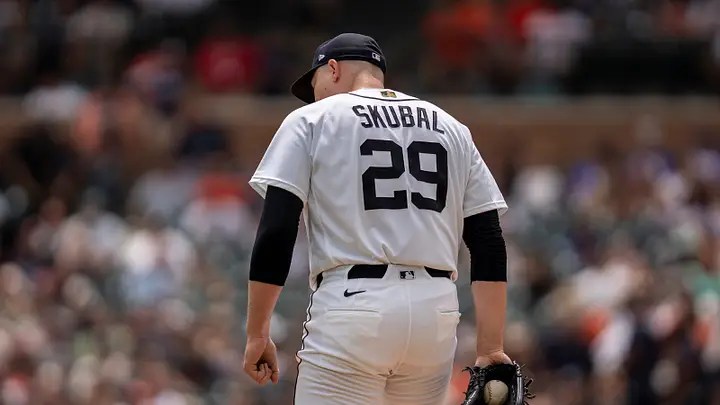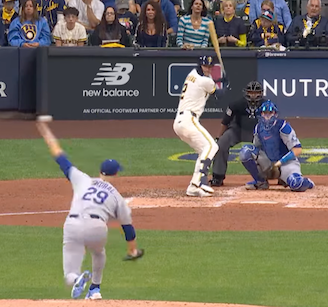
Brice Turang about to send Tarik Skubal’s unsinking sinker into the bullpen Sunday night . . .
When the National League Championship Series opened Sunday night, guess what didn’t happen? The big spending blue whale didn’t devour the anchovies hosting them in the somewhat foggy Milwaukee pond. American Family Field hoisted baseball’s best (the home team) and second-best (the visitors) records this season.
The visiting Damndodgers and the hosting Brewers even got to throw their best pitchers at each other. How often do you get a defending Cy Young Award winner against the guy likely to win one this time around? Forget that a moment. This was going to be shades of Sandy Koufax v. Whitey Ford. Wasn’t it?
Not quite. Not this time. Neither Jacob Misiorowski nor Tarik Skubal dominated the way their previous notices showed them capable of doing. They were good enough. Not great enough. Certainly not overpowering or dominant enough.
Oh sure, Les Mis hit 101+ mph on the gun more than a few times—44 such pitches, in fact—just the way he’s supposed to do. And the Damndodgers went in hell bent on refusing to let those bullets beat them. Those bullets got only an 18.5 percent miss rate; 21.7 percent less than on the regular season.
Skubal went two-thirds of an inning further than Misiorowski and struck out two more. But he was pried for a pair of runs to his counterpart’s one. The bullpens went to work from there. And the 2-1 lead the NL Central-champion Brewers wrestled out of the NL West-champion Damndodgers stuck for the Game One win.
Until game time, of course, you could hear everyone across the great divides moaning that the Damndodgers were going to do it again. They were going to prove yet again that money talks. Talks, divides, and conquers. Weren’t they?
This was, of course, the beginning of a rematch between last year’s NLCS combatants. That was then: The Damndodgers led every inning but one. (And, got thatclose to losing the World Series in seven.) This was Sunday night: The Damndodgers led in only two innings.
So quit assuming they’re going to throw the Brewers out of the running like the sheriff running the town drunk off. These Brewers are going to make the Damndodgers work for it. They might even make the Damndodgers go home for the winter early enough to cause questions, doubts, and recriminations enough. Might.
When Shohei Ohtani and his still-balky inflamed left knee checked in at the plate leading off the second with no score yet, couldn’t you just hear the groaning that the only thing the Damndodgers did moving him to the cleanup spot was delay the inevitable?
Well, the only man in the house splitting the heavens or threatening the opposite hemisphere Sunday night was Brewers second baseman Brice Turang. He opened the bottom of the fourth ahead of Skubal, 2-0, when he caught hold of a sinker meant to go inside, which didn’t get that far in, and which didn’t have all that much sink. Turang sunk it behind the left center field fence, right into the Brewers’s bullpen, tying the game at one each.
Two innings earlier, Ohtani took care of what proved the lone Damndodger run of the night when he let Misiorowski walk him on four pitches none of which arrived where he likes to hit. Then, he came around to score on one line drive hit to right (Teoscar Hernández) and another base hit through the hole at second (Andy Pages).
Go ahead and say it. Say that you think the Damndodgers were damn lucky to catch Les Mis on an off night. How off? Jayson Stark (The Athletic) dug it up: During the regular season, the opposition hit a mere .174 off the Misiorowski heater. On Sunday night, they hit .500 off it.
Go ahead and say it. Say that you think the Brewers might have been lucky that the Damndodgers couldn’t do a thing with anything else Misiorowski threw. Remember: He’s got breaking balls that dance the way people once did on Soul Train. He kept the Damndodgers to 1-for-8 when throwing his curve ball, cutter, and slider, two of which got turned into inning-ending double plays.
Skubal lasted only a little bit longer, until he walked Garrett Mitchell to open the Milwaukee fifth, surrendered a Cooper Pratt bunt to the right side pushing Mitchell to second base, then surrendered a first-pitch, tie-breaking single through the hole at shortstop from Luis Lara, a rookie whose calling card until Game One was sterling defense—enough to be worth eleven defensive runs saved above the National League average.
So Misiorowski vs. Skubal didn’t quite live up to its advance publicity? News flash: the heavily hyped duels sometimes don’t. They played baseball other than the joust that wasn’t Sunday night.
“He’s going to be fine,” said Brewers manager Pat Murphy of Skubal. “I’m sure he’s going to be able to feed his family and be a great dad. He can lose tonight, and he’ll be fine.”
Both sides threw strong-enough bullpens at each other once the big arms were done for the evening. Almost.
The Brewers handed themselves a grand opportunity for insurance damage in the bottom of the eighth. Jackson Chourio—their knight of the earlier postseason rounds—opened with a base hit and chased Damndodger reliever Even Phillips, who’d struck the side out in the seventh. Against Tanner Scott, the Brewers bunted Chourio to second (Turang), accepted a walk on the house (Willson Contreras), then a strikeout-following second wak on the house (Andrew Vaughn) to load the pads.
Who bunts that soon after hitting a big bomb? “Not shocking at all,” said Turang of seeing a bunt sign from his third base coach. “To me, it was almost like if he would have told me to hit, I would have been like, I’m gonna bunt—because I just know the situation in the game is calling me to bunt there.”
That’s one kind of dangerous-enough risk. Unless you’re bunting for base hits, something the Brewers did extremely well this season, surrendering an out to move a runner who has (yes, you can look it up) less enough than a fifty percent chance of scoring after the bunt than he had before it, is not normally smart baseball.
But Scott’s kind of risk-taking usually invites a team to teach the risking opponent a little lesson in foolishness, no matter what time of game it might be. The only lesson Mitchell taught this time was how to waste a gift that should have kept on giving, when he grounded out to Betts at short for the side and the strand.
Then it was Trevor Megill’s turn to come out of the Brewers pen and . . . channel his inner Craig Kimbrel. Not the good side, either.
In a scene Cardiac Craig might know only too well, Megill got two quick outs. Then, the fun began. He walked Tucker on a full count and pinch hitter Josue De Paola on 3-1 with Betts looming on deck.
The regular season wasn’t a typical Betts season. It’s been a couple of years since he had one of those, and it’s entirely possible that age (he’s 33) might be creeping up on him at long enough last. But he’s still Mookie Betts, he still posted a .950 OPS on the year with men on first and second at all, and he still posted a 1.039 OPS with men on first and second and two out.
He picked the wrong time to face Megill when the latter decided he’d had enough of being the new Craig Kimbrel. Megill got Betts to fly out to the track in right to end it. And, like Kimbrel on one too many occasions since 2018, Megill still got a save credit for squirming out of a jam entirely of his own making.
“You try to get them to play from behind, to get them out of their game,” said Damndodgers manager Dave Roberts. “You’ve got to be sound fundamentally to not give them extra outs. Yeah, they’re very consistent in how they play the game, and that’s a credit to all those guys.”
“We should play Dodger baseball,” Betts said. “Whatever Dodger baseball is, that’s what we should do. We should not try to play Milwaukee Brewers baseball.” Whatever Dodger baseball is?
Interesting post mortem, that. As pesky, spunky, and insistent as they are, the Brewers couldn’t have gotten that far into Dodger heads already. Could they?