Unknown's avatar

About Jeff Kallman

Member, Internet Baseball Writers Association of America and the Society for American Baseball Research.

He almost hit .400. But . . .

2019-05-17 TonyGwynn1994

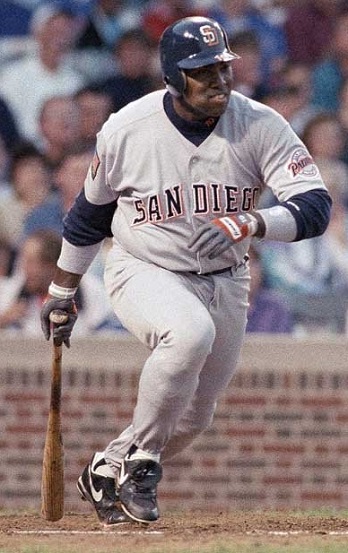
Hall of Famer Tony Gwynn hitting in Wrigley Field during 1994 . . .

Baseball fans love anniversaries as much as anything else about or around the game. This year’s a good one for those, and I’ve written about a couple of them already this year: the 1919 Reds (yes, they were a World Series winner but yes, they were robbed) centenary, and the 1969 Mets’ golden anniversary.

It’s also the 80th anniversary season of the day Lou Gehrig took himself out of the Yankee lineup to stay. And, the 30th anniversary of the season in which Pete Rose got banished for violating Rule 21(d), alas.

It’s also the quarter century of Hall of Famer Tony Gwynn’s chase to become baseball’s first .400 hitter since his old friend and fellow Hall of Famer Ted Williams. He almost made it, too. Six points short. Closer than fellow Hall of Famer George Brett got in 1980, when Brett came up short by ten.

The 1994 owners’ strike (call it what it really was: the owners pushed for and got that players’ strike no matter what you’ve read otherwise) cut Gwynn off at the pass. And it was both more and less than you thought while he was doing it.

More because you’ve got to have some kind of self discipline to hit that often, and Gwynn did lead the National League with his .394 final batting average and his .454 on-base percentage. (It was the only time he ever led the league in on-base percentage.) Less because it didn’t do as much to put or help runs onto the scoreboard as you’d think a near-.400 hitter reaching base that often will do.

The 1994 Padres were fourth in the National League West with a 47-70 record when the strike ended the season. They were outscored 531-479, a -52 run differential. Their only winning month was August, and they were 6-4 when the strike began. If you consider elementary run production as the sum of the runs you score and the runs you drive in, Gwynn produced 143 runs, which accounted for 27 percent of the Padres’ run production that season.

That he was only seven RBIs above the major league average for batters with 475 plate appearances should tell you how good that year’s Padres weren’t at reaching base ahead of him. He had a total of 306 baserunners when he batted and drove in 20 percent of those. And his extra base hit percentage (29) was only about four points above his career average (25).

If you consider my concept of real batting average—total bases + walks + intentional walks + sacrifices divided by plate appearances—this was Tony Gwynn in 1994. We’ll compare his 1994 first to George Brett’s 1980. In parentheses are their final season’s traditional batting averages, which (here we go again) should really be called hitting averages. Sorry, purists, but (here we go again again) something that treats all hits equal when all hits are not equal, and divides that number by official at-bats only, without accounting for everything a man does at the plate, is a batter’s incomplete story.

Player PA TB BB IBB Sacs RBA XBH%
Tony Gwynn (.394) 475 238 48 16 6 .648 29
George Brett (.390) 515 298 58 16 7 .736 38

Gwynn’s 1994 RBA is 122 points above his career number. And, his career number is the lowest among all nine post-World War II/post-integration/night ball era Hall of Fame right fielders and 51 points below the average RBA for those Hall of Fame right fielders. Chasing a .400 hitting average, Gwynn in 1994 batted well over his own formidable head. It’s a shame that Gwynn’s team hurt him as much as he helped them, and the 1994 Padres—talking strictly about their non-pitchers—batted .283 with a .330 on-base percentage as a team.

The 1994 metrics say the Padres would have scored ten runs a game if they could have had nine Tony Gwynns in the lineup. Gwynn created (as opposed to produced) 104 runs that season and used a sliver less than three outs a run to do it, which is splendid run creation for a high-average hitter with minimal power in an abbreviated season. He was still likely to finish well over his lifetime head if the season had played all the way: lifetime per 162 games, Gwynn created 109 runs and used 4.1 outs to do it.

Brett played a little over his own head in 1980, too. His RBA is 176 points above his career number, and he played a far more demanding field position, as he did for the majority of his career. Brett’s career RBA is just two points below the average RBA among seven Hall of Fame third basemen of the same era, and fourth behind, in ascending order, Eddie Mathews, Chipper Jones, and Mike Schmidt. The 1980 Royals (who also won the pennant that year) would have scored twelve runs a game if they could have had nine George Bretts in the lineup. Brett created 134 runs and used 2.2 outs to do it in 1980; lifetime, his 162-game average is 112 runs created using 4.1 outs to do it.

There are several post-World War II/post-integration/night ball era .300 hitters in the Hall of Fame who used more outs per run created in their careers; there are several who used fewer. Here’s a look, including their extra-base hit percentages, also including a player who would be in the Hall of Fame if not for, you know, the other stuff:

Player RC/162 Outs/162 Outs/RC (162) XBH%
Ted Williams 169 374 2.2 42
Stan Musial 137 415 3.0 38
Edgar Martinez 129 416 3.2 37
Chipper Jones 127 432 3.4 39
Willie Mays 128 436 3.4 40
Frank Thomas 140 426 3.4 42
Mike Piazza 117 430 3.7 37
Henry Aaron 123 449 3.7 39
Vladimir Guerrero 123 453 3.7 38
Wade Boggs 116 436 3.8 25
George Brett 112 459 4.1 35
Tony Gwynn 109 442 4.1 25
Kirby Puckett 109 480 4.4 29
Roberto Clemente 104 458 4.4 28
Pete Rose 101 470 4.7 24

Nice company to be in if you can get it.

But was Tony Gwynn the best man at the plate in the National League in 1994? Let’s look at the RBAs and extra-base hit percentages of the top ten hitting average finishers that season, in descending order. (Sorry, I’m staying with the program. Their hitting averages are in parentheses.)

Player PA TB BB IBB Sacs RBA XBH%
Tony Gwynn (.394) 475 238 48 16 6 .648 29
Jeff Bagwell (.368) 479 300 79 12 10 .837 50
Mike Kingery (.349) 301 160 30 2 13 .681 34
Moises Alou (.339) 471 250 42 10 5 .651 41
Hal Morris (.335) 483 214 34 8 8 .547 30
Kevin Mitchell (.326) 380 211 59 15 8 .771 49
Gregg Jefferies (.325) 447 194 45 12 4 .570 31
Larry Walker (.322) 452 230 47 5 6 .637 51
Bret Boone (.320) 424 187 24 1 11 .526 32
Bip Roberts (.320) 449 110 17 1 1 .287 18

You are now free to stop rubbing your eyes. (As I had to after calculating Bip Roberts, even running it three times to be absolutely sure I wasn’t seeing things. You’ve heard of the empty .300 average? The Sahara Desert isn’t that parched.) You’re also free to admit that you didn’t remember Mike Kingery and Hal Morris as quickly as you might have remembered Moises Alou, Kevin Mitchell, Gregg Jefferies, Larry Walker, and Bret Boone.

Gwynn’s fellow Hall of Famer Jeff Bagwell led the league in extra-base hits, slugging percentage, OPS, offensive winning percentage, win probability added, and times on base, with only four more plate appearances than Gwynn. Bagwell’s hitting average was 26 points lower than Gwynn’s chartbuster, but his RBA is a glandular 189 points higher.

Marry that to Bagwell’s having to put up with the Astrodome as his home park and I’m pretty sure that RBA is glaring enough without throwing in that his 51 percent extra-base hits is just a little more impressive than Larry Walker’s 51. (I bet you forgot the old wreck known as Olympic Stadium was a pretty fair hitter’s park, though nothing like the one Walker would get to play in in Colorado.)

Gwynn’s home park, still known then as Jack Murphy Stadium, was more neutral. He ended up tenth in slugging percentage, fourth in OPS and offensive winning percentage, sixth in win probability added, and second in times on base. That ain’t peanuts and Cracker Jack. But Bagwell also led the National League with 137 runs created and he used one fewer out to do it than Gwynn used creating 104 runs that season.

And if you want to look at the more team-dependent runs produced, adding runs scored and runs batted in, Gwynn was good for 166 . . . but Bagwell (who led the league in runs scored and the Show in runs batted in) was good for 220. You know how often writers and broadcasters love to grind away at if the season ended right now during the second half of any season? Try to imagine how far off the charts Bagwell would have been if the 1994 season went the distance after all.

MLB.com’s A.J. Cassavelli commemorates Gwynn’s cleanest shot at hitting .400 with a nicely rounded analysis suggesting he might have gone all the way there if the strike hadn’t hit. The way he was in 1994, Gwynn might well have gotten to or even a little bit past his career 162-game average of 92 runs scored and 76 runs batted in, too. And it still would have meant at least 52 runs short of Bagwell’s 1994 deliverance.

It’s not Gwynn’s fault that his team wasn’t as good as Bagwell’s. If you put Gwynn on Bagwell’s team, even in the Astrodome, Gwynn might have done a little better: he hit .357 lifetime in 107 games in the World’s Biggest Hair Dryer (thank you, Joe Pepitone), and his RBA there is only four points below his lifetime RBA. Now, change his uniform to the Astros’ fatigues. With a couple of better table setters ahead of him and a couple of more consistent run deliverers behind him.

Everyone admired Gwynn’s craftsmanship in 1994 especially, when he had a better than moderate shot at meeting his friend Ted Williams in the .400 club, just as they admired it in George Brett in 1980. Gwynn just might have joined the club, especially as torrid as he started in August before the strike began. If the only thing you saw was his traditional batting average, his hitting average, you’d have thought he was the man at the plate that year.

But when I look at him without team-dependent factors at play, I conclude that yes, he was off even his own charts as a great player in 1994, though it was actually the fifth-best season of his career. He had a no-questions-asked Hall of Fame career, but thanks to the strike we’ll never really know whether he’d have moved past the four seasons that were better than ’94 for him.

In 1994’s National League you had to like your chances a lot more with Jeff Bagwell at the plate. The Most Valuable Player Award voters certainly did. Bagwell won the 1994 award overwhelmingly, with 392 votes total and all 28 first-place votes. Come to think of it, you’d have liked your chances a lot more with Bagwell that season, too. Both men were almost equal for scoring after reaching base (Bagwell: 35 percent; Gwynn: 33 percent), but Bagwell was almost twice as likely to take the extra base on a followup hit than Gwynn. (Bagwell’s extra base taken percentage was 61 percent—for perspective, Hall of Famer Willie Mays’s lifetime percentage is 60 percent—and Gwynn’s was 35 percent.)

And I didn’t even have to think about wins above replacement-level player (WAR) until now. Keep in mind Baseball Reference‘s conjugation: 8.0 or better is MVP caliber; 5.0 or better, All-Star caliber; 2.0 or better, good enough to be a regular starter; 0.0-2.0, reserve; -0.0, replacement level, and you’re likely to be replaced. So here it is for the 1994 National League: Only Hall of Fame pitcher Greg Maddux did better than Jeff Bagwell, 8.7 (Maddux) to 8.2 (Bagwell). Only one other NL player (Barry Bonds) earned 6.0 WAR or better in ’94. Gwynn earned 4.2 WAR, closer to All-Star level than just being another guy in the starting lineup.

God rest Mr. Padre’s soul in peace. I hope he and his old homeboy/friend/teacher Teddy Ballgame keep bending everyone else’s ears off about the art and science of hitting, even if Yogi Berra sidles up to them with the bad-ball hitter’s perspective insisting you can’t think and hit at the same time.

Getting within a hair’s breadth of .400 made Tony Gwynn better than his own team and invaluable copy aside from the pending strike. But it didn’t mean he was the National League’s best or most complete hitter that year.

As I write, Cody Bellinger of the Dodgers is hitting .404. He leads the Show in on-base percentage (.481), slugging percentage (.788), OPS (1.270), total bases (123), and hits (63). His team’s quality around him also has him leading in runs scored (41) and runs batted in (42). Would you like to see how he really looks with all that?

PA TB BB IBB Sacs RBA XBH%
Cody Bellinger (.404) 185 123 25 4 3 .837 43

If he sustains it (it’s probably a very big “if”), and with no strike threatening to shorten the season, Bellinger could yet generate two things from 1994: Tony Gwynn’s copy, and Jeff Bagwell’s value. Neither would be unbecoming.
Exit under launch. Please.

2019-05-16 AaronJudge

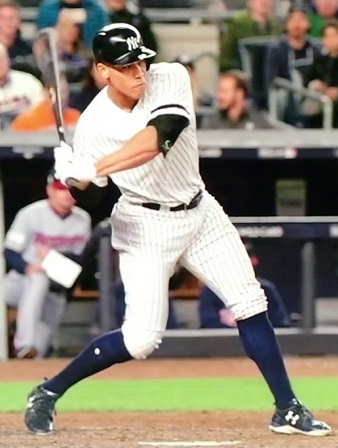
Do this man’s launch angles and exit velocities make his skyrockets any less moon drives?

You thought “runners in scoring position” fancified men on second and third? Welcome to the era of “exit velocity,” “launch angles,” and other locutions you might have thought more appropriate to a space launch than a baseball game.

Somehow it had to come to pass, unfortunately. All those years we obsessed about which pitchers hit three figure speed on the radar guns were bound to send someone off to give the hitters equal time. Continuing hangover from the Year of the Pitcher? Who knows?

So now for every Aroldis Chapman who throws a 100 mph pitch, we have to hear about an Aaron Judge (or we will, again, when he returns from the injured list) who hits one over 100 mph. That was then: the pitcher who threw the lamb chop past the wolf. This is now: The hitter who drives the lamb chop past the wolf.

One of these days the wolves are going to sue for willful starvation. It’ll happen sooner than language mavens sue to stop turning baseball into coverage of the space program, whatever’s left of it. It betrays my age but I never thought of Frank McGee as Vin Scully’s heir apparent. Though it might have been more fascinating to hear Scully report Alan Shepard’s Mercury flight than to hear McGee calling a World Series.

It’s one thing for my newly-minted friend Bill Denehy (former pitcher) to say the bomb Dick Allen hit off him in his first major league start “wasn’t a home run. That was a moon drive.” (It sailed on a rising line up toward the overhang of Connie Mack Stadium’s upper deck, stopped from landing in Delaware, as Denehy described it, only by the Coca-Cola sign on top of that overhang.) It’s something else now to hear and read baseball commentators and reporters discussing launch angles. Not to mention front office analytics departments as concerned about launch angles as astronauts were about re-entry angles.

Lots of players from the advent of the home run as a regular weapon have used uppercut swings. And we called them uppercut swings. Some of us described it a little more colourfully. “Dave Kingman’s like me,” Hall of Famer Mickey Mantle once said. “Swings from his ass.”

Kingman was a 6’6″ galoot with a long, loping uppercut swing and power equal to a nuclear weapon when he connected right and equal to a wind tunnel when he didn’t connect. Mantle himself once saw Kingman connect right and then some. “I know I never saw one like it,” he said.

He spoke of Kingman a brand-new Met facing brand-new Yankee Catfish Hunter in the first spring training 1975 exhibition between the two teams. Kingman caught hold of a Hunter slider and drove it so high and far out of the park that, according to Roger Angell in a piece collected in Five Seasons, it sailed over several palm trees before hitting the ground on the practise field behind it. Almost all the way to that field’s second base.

“A six-base blow,” Angell remarked dryly. In the same piece, he suggested the real impact of Kingman’s moon drive was to welcome Hunter—the first huge-money free agent, after he was made one thanks to Charlie Finley reneging on a contracted-for insurance payment—to his new Yankee mates: “There is nothing like a little public humiliation to make a five-million-dollar executive suddenly seem lovable.”

They didn’t talk about Kingman’s launch angle then or for any of the 442 major league home runs he hit in his career, enough of which homers traveled surrealistic distances. But they didn’t have to talk about his launch angle, either. The blast he sent clean out of Wrigley Field onto a porch three houses down on Waveland Avenue in 1979 may have been only the most obvious evidence. As also one of his nicknames, Sky King.

Today they’d analyse Kingman’s launch angles nigh unto death. Just the way they do with Cody Bellinger, Chris and Khris Davis, Joey Gallo, Aaron Judge, and Christian Yelich, to name a few. They shouldn’t be wearing baseball uniforms, they should be wearing NASA space suits. And maybe Houston should recommission the Astrodome, where once upon a time grounds crews in mock space suits manicured the Astroturf with upright vacuum cleaners.

Statcast figured out that balls hit in the air were more likely to become hits than those hit on the ground. So did enough players, with or without a little help from their analytically rounded front offices. “Ground balls are outs,” Josh Donaldson once said. “If you see me hit a ground ball, even if it’s a hit, I can tell you: It was an accident.” So why don’t we just say fly balls anymore?

Vin Scully, calling a monstrous Darryl Strawberry home run in Game Seven of the 1986 World Series: “High drive into deep right field, Evans to the track, at the wall—gone!” Now, try to imagine Scully compelled to toe the launch angle lines: “Thirty degrees into deep right field . . . ” There’d be a degree of madness in that mangle.

When showing television viewers a replay of Strawberry’s bomb, Scully began, “Here’s another look at that skyrocket, a towering drive . . .” Prose poetry. Thirty degrees into deep right field isn’t even “There once was a man from South Central . . .”

As much as I’ve accepted, embraced, and bathed happily in statistics and analytics, as profoundly as I reject the notion that statistics are the blood poisoning of a game whose very life blood is statistics, even I have my limits. Not just because it doesn’t matter how you hit your home runs as long as you hit them, period.

As I’ve written in the recent past, Roger Maris didn’t have launch angles; his homers were somewhat high line drives most of the time. And they were no less home runs than Darryl Strawberry’s skyrockets or Dick Allen’s moon drives or . . . well, who knows what to nickname Babe Ruth’s bombs? In his day transoceanic flight was done mostly by low-altitude flying boats. Or, by airships like the Graf Zeppelin and the Hindenburg, which weren’t that high and weren’t that fast. Man on the moon was science fiction.

One of those flying boats, a Boeing 314 flown by Pan American World Airways, inspired nicknaming Joe DiMaggio the Yankee Clipper. The 314 had a kind of rough beauty on the outside but inside it was a textbook model of beauty and grace. Which is how they thought of DiMaggio—likewise kind of rough looking as a youth (he became legitimately  handsome in his retirement), until he swung the bat or ran down a ball in center field.

And who cares how fast a ball sails for a base hit or over the fence? Unless you’re really that obsessed with pace-of-game, of course. The problem is that it doesn’t matter whether a home run reaches the seats faster than a speeding bullet or floats there like the Goodyear blimp. No matter how fast the ball travels, it’ll still land before the bombardier even reaches first base running it out, whether he’s pimping or running full speed.

When the opportunity arises, I argue that analytics divorced from scouting means the kids torn unnecessarily between two contentious parents. Scouting can’t tell you everything about a prospect’s potential deep value, and analytics can’t tell you whether you’re going to get a committed baseball avatar or a first class jerk. (By which I don’t mean players having, God help us, fun playing the game.)

But I know analytics can turn baseball’s lingo into something between poeticide and gobbledegook. Let me go as analytical as I please, but don’t ask me to eliminate the skyrockets, the moon drives, the bullet liners, the frozen ropes, and the seeing-eye grounders. (And don’t go there about “contact hitting” unless you can show me a batter who can breathe a base hit or home run.)

When Hall of Fame manager Casey Stengel was doing what he could with the absurdist Original Mets, one of his pitchers was future pitching guru and pennant-winning manager Roger Craig. As Hall of Famer Willie McCovey approached the plate in one game, Stengel went to the mound to talk to Craig. “How do you want to pitch him?” the Ol’ Perfesser asked. “Upper deck or lower deck?”

Stengel might be one of the arguable founding fathers of analytics (Baseball is percentage plus execution), doing the things analytics people adore decades before anyone ever heard of sabermetrics. And he created his own distinctive lingo of triple-talk. (It was known far and wide as Stengelese.) But he knew. He didn’t have to come right out and say it. Even accepting that he couldn’t just come right out and say something if he studied with Henry Higgins himself.

Launch angles and exit velocity matter a lot more for making New York to London in six hours or less than for putting runs on the scoreboard. A homer is a homer is a homer is a homer. Doesn’t matter whether it’s imitating Apollo 11 or the Yankee Clipper. It isn’t rocket science.

Let’s start the counterrevolution. How do you want to pitch Aaron Judge when he comes back from the injured list? Upper deck or lower deck?

Watching your language, baseball division

Detroit Tigers Manager Sparky Anderson watches his

Sparky Anderson, who murdered the King’s English now and then but whose baseball lyricism was second to few.

There are times—in cyberspace or otherwise—when stumbling upon something you missed when it first arrived can sting rather than charm. Especially if it’s a fine essay on baseball jargon, and you discover you’re just as guilty as everyone else of making mincemeat out of it. Or, you rediscover that you’re a repeat offender who’d better be grateful he doesn’t live in a state with a three-strikes law.

The essay in question is Allen Barra’s, from The Atlantic, in June 2012. He took a good, long look at what became of baseball’s language and was not amused. More saddened than infuriated, Barra decided, with apologies to Yogi Berra (whose biographer Barra admires him for his syntax as much as his baseball virtuosity), that he wished baseball people really hadn’t said half the things they’ve said since, oh, around 1980.

I’d love to be able to say much as changed. But then I’d love to be able to say I’m not guilty of failing to pay my syntax, too. Say, regarding runners in scoring position, which bothered Barra as “an ugly and imprecise term, originating mostly with broadcast announcers.” Once we had a runner on second, a runner on third, or runners on second and third, customarily. We’ve had runners in scoring position since the Reagan Administration.

“The new phrase means, of course, a runner in position to score on a single,” Barra wrote, “which is true only if the base runner is not Jason Giambi, who generally needs a double to have a break-even chance of scoring from second. Used indiscriminately. . . it is not merely vague and confusing, it’s incorrect. You can just as easily call the batter’s box a ‘scoring position’.”

Especially if the batter is someone like, say, Tommy La Stella, the Angels’ new toy, acquired in an offseason deal with the Cubs where he’d made himself into a useful substitute (wait, just wait) but didn’t exactly threaten to become the next Mike Trout. Oops. At this writing La Stella has hit exactly as many home runs this season (ten) as he’d hit in his entire previous major league career. He also has a season’s OPS just 72 points below Trout’s. At the rate he’s going now, La Stella is in scoring position when he merely checks in at the plate.

On the other hand, someone did come up with something other than “the bases loaded” to describe, well, the bases loaded. I could be wrong but I think it was Rex Hudler, then an Anaheim/Los Angeles Angels broadcaster, who went swimming and came up with a beauty: “ducks on the pond.” He didn’t say “ducks in scoring position, either.” One up for Raspasaurus Rex.

Barra had no great love for pitchers versus position players, either. Hard to blame him. “When I played Babe Ruth League ball we had pitchers and regulars, the latter term referring to players who play every day,” he wrote. “Now we’ve got something called ‘position players,’ which takes up two more syllables than ‘regulars’ and is misleading, since pitcher is as much of a position as the other eight spots. We also have ‘role players,’ which says nothing and takes up two more syllables than ‘subs,’ short for substitutes. ‘Role players,’ too, is inaccurate; doesn’t every player on the team have a role?”

Yankee substitutes of the late 1950s-early 1960s had a term for themselves. Tell me scrubeenies doesn’t sound friendlier, and funnier, to the game and to the ear, than “role players.” It won’t cost you an extra syllable, either.

Coaches and managers have roles, too. But let’s not get too technical. I’m pretty sure the announcer who dreamed the term up decided “position players” was a sensible way to distinguish everyday men from not-quite-everyday pitchers. I’m also pretty sure men walked on the moon, women won’t become pregnant from a mere kiss, and children think of only one thing when it comes to their parents. (Divide and conquer, and thank you, Danny Thomas.)

Barra also didn’t like “velocity” for extremely fast fastballs, “location” for what we used to call “pinpoint control” or “excellent control,” or “walkoff hit/home run” for “game-ending hit/home run.” (I’d also like to know just when and just why “home run” became a compound word.) But he didn’t complain about “gas,” “bullets,” “BBs,” or “cheese” for extremely fast fastballs.

Showed him the high cheese, then I punched him out with the yakker—Hall of Famer Dennis Eckersley. In case you wondered, “yakker” in what was once known as Dial-Eck referred to a curve ball. Curve balls are also known as benders, 12-to-6, and Uncle Charlie. Then Dwight Gooden had to spoil it: his curve ball was so curvy and so deadly when he was on it became known as Lord Charles. Lord, have mercy.

I may be wrong but I think we have legendary Braves pitching coach Leo Mazzone to thank for turning pinpoint control into a real estate pitch. It did and does get a little sickening after awhile, listening to pitchers talk about “location, location, location.” Even if they were such Mazzone charges as Hall of Famers Greg Maddux, Tom Glavine, and John Smoltz.

Just once, I’d pay money to hear any pitcher talk about painting, working, climbing, hitting, or using the corners the way Hall of Famer Whitey Ford or anyone speaking and writing about him once did. Let a pitcher speak of his failure to “locate” his pitches, I’d like to ask him when, where, and how he misplaced them. Maybe that was the problem. “Sorry, Skip, I lost that hanger.” We found it for you, kiddo, we retrieved it from behind the ballpark.

(Which reminds me: If there’s one sportswriter question that should earn immediate excommunication, it’s “What were you thinking?” after a hitter’s been humiliated with a called third strike breaking into the zone when he least expected. Or, after a pitcher’s been hit for a ten mile drive. What do you think a hitter was thinking about getting frozen alive? What did you think a pitcher was thinking about getting taken across the state line? In front of 35,000-55,000 in the ballpark and about ten million on television or next to radios? I guarantee it wasn’t, “I thought to myself, what a wonderful world.”)

The game-winning home run gave the winner great praise, Barra wrote, referencing Bobby Thomson and Bill Mazeroski specifically. The walkoff home run, he frowned, is “a term that thumbs its nose at the loser since the team in the field begins to walk off as soon as the ball clears the fence, while the batter is still circling the bases.”

And, while the winning team pours out of dugout and bullpen at once, and en masse, the better to commemorate the blast by turning the blaster into game-winning hamburger. “I’m just about out of breath,” heaved David Freese after he hit that staggering game-winning, 2011 World Series-tying home run in the bottom of the eleventh of Game Six. “I just got beat up by thirty guys.”

Barra admired Virginia Woolf’s admiration for Ring Lardner, whose best stories and articles were “about games, for one may guess that Mr. Lardner’s interest in games has solved one of the most difficult problem of the American writer; it has given him a clue, a center, a meeting place for the diverse activities of people whom a vast continent isolates, whom no tradition controls. Games give him what society gave his English brother.”

In other words, Barra continued, “millions of immigrants, no matter what language they spoke when they came here, came together around baseball. And that happened because even if you knew just a little English you could, by listening to the broadcasts, learn baseball Baseball language once drew newcomers into the game. Now, it’s becoming a language that shuts many people out, one that makes them feel as if what’s happening on the field is something a little more complicated than they thought. The ultimate result is that we all end up knowing less—particularly about baseball.”

And yet. “We try every way we can think to kill this game, but for some reason nothing nobody does never hurts it,” said Hall of Fame manager Sparky Anderson, who could have been tried by jury for murdering the King’s English (not to mention the Queens, the Bronx, the Manhattan’s, and the Staten Island’s) now and then, but whose baseball lyricism was second to few. And who never saw men in scoring position sent home on walkoff hits off misplaced pitches. (I think.)

But I’m getting a little ahead in the count. (In baseball, that’s a good thing. In writing, it isn’t.) To Barra, turning fielding into defense and hitting into offense is, well, offensive. “When, exactly, did ‘fielding’ become ‘defense’? The word fielding perfectly described what a baseball team in the field was doing. Defense was the term common to basketball.”

I have one answer: I can remember Mets broadcaster Bob Murphy, of blessed memory, opening a 1960s home game broadcast by “setting up the dee-fense for the New York Mets.” Little by little I heard more people doing it. Defense was also a term common to football and hockey, too. The last I looked, sporting goods stores still don’t sell defenders’ gloves.

“For that matter, when did hitting and base-running get lumped together under the leaden term ‘offense’?” Barra added. “Were ‘batting’ and ‘hitting’ and ‘base running’ too quaint for an audience that also watched football and basketball? When did we decide that because football and basketball had offense and defense that baseball had to have them, too?”

Unfortunately, people who ought to know better decided long enough ago that baseball itself had to have things football and basketball had, too. Things like diluted championships, salary caps, and other cancers.

When baseball first went to divisional play, it didn’t have “playoffs”—it had League Championship Series. Then, baseball introduced the wild cards. In 2012 it introduced the second wild cards. And speaking of wild cards, leave it to baseball—which makes gambling Original Sin—to describe a batter hitting with two balls, two strikes, two out and two men on, as “deuces wild.” That one’s aces in my book.

Once upon a time, baseball’s only known wild Cards were the Gas House Gang, that bunch of particularly randy, rowdy 1934-35 St. Louis Cardinals. (The 1957 Braves, the 1986 Mets, and the 1993 Phillies were just a bunch of wild and crazy guys.) How long, now, before baseball’s governors, arbiters, and shepherds introduce not just every team in a division, practically, going to play for a championship with the World Series becoming something with an unrecognisable name?

Hey, it could be worse. At least three major team sports have identifiable championships. We have the World Series, still; not even Rob Manfred is willing to throw that one out of the game. The National Football League has the Super Bowl, and they’re welcome to it, never mind that it sounds more like something—in hand with the scrambled brains of football play—you’d see involving a wrestling title.

The National Hockey League has had the Stanley Cup Finals to itself since the folding of the original World Hockey League in 1926, after the Montreal Maroons defeated the Victoria Cougars. The National Basketball Association has . . . the NBA Finals. They can’t even call it the Naismith Finals, never mind that that’s the trophy the winner wins. How boring, for a sport of perpetual motion, whose championship trophy is named after its founding father.

Once upon a time, if the occasional fight broke out on the baseball field, we had Red Barber to thank for telling us we had quite a rhubarb going there. Wouldn’t you rather have a rhubarb than a bench-clearing brawl? (We once had Barber to thank, too, for describing the bases loaded as “FOB”—full of Brooklyns.) It beats the hell out of “donnybrook,” which sounds more like naming a soap opera super couple than a rhubarb, anyway. (I wonder: did the couple have themselves a donnybrook over the rhubarb?)

We have Barber’s disciple and successor, Vin Scully, to thank for the can of corn—the easy outfield fly. The can of corn probably originated in the old-time grocer picking off a high-mounted can of food with a hook stick, prompting it to drop almost lazily into his apron, unless the rest of the shelf’s contents came down upon his head first. Name me one football, basketball, or hockey term that was born in the A&P. (Oops! Today we’d say Wal-Mart.)

I once promised to send every last gasp of gibberish in my baseball writing out (at the plate and otherwise) to the best of my ability. And I know I broke that promise so liberally so often you could mistake me for an elected official. Or, decide to run me for office in the first place. William F. Buckley, Jr., wherever you are, may I borrow your immediate response to the question of the first thing you’d have done if you’d been elected? (It wasn’t, “I’m going to Disneyland,” either.)

I’ve sent more than my share of men in scoring position home on misplaced pitches turned into walkoff hits, and I didn’t even show them the high cheese, never mind that I couldn’t punch them out with the yakker. (Guilty, Judge Robinson: I’ve used “punchout” for strikeout. Yes, I know it wasn’t Muhammad Ali throwing one at Joe Frazier. I throw myself upon the mercy of the court, Your Honour.)

I plead no contest. But as Michael Corleone once said to his wife—when she reminded him it was seven years since he promised the Family would be completely legitimate in five years—“I’m trying, darling, I’m trying.” As James Thurber once said, you could look it up. But I’d rather you take my words for it.

Dr. Pujols and Mr. Hydes

2019-05-10 AlbertPujols2000thRBI

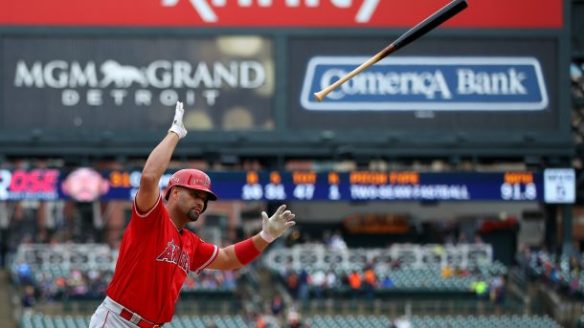
Albert Pujols flips his bat heartily after hitting the solo home run that meant RBI number 2,000 Thursday . . .

Sometimes it just doesn’t pay to catch history in your hands. Even when you’re not trying to get paid for it.

Albert Pujols cranked a hefty solo home run in Comerica Park Thursday to land his 2,000th career run batted in. The blast put the future Hall of Famer into some very distinguished company as it was.

Cap Anson drove in his 2,000th run at the end of the 1896 season, but unless the Hall of Fame has an online-accessible library I couldn’t discover just how he drove it in. And the run batted in wasn’t counted as an official statistic until 1920.

But Henry Aaron drove his 2000th in in July 1972 with a three-run homer and Alex Rodriguez drove his 2000th in in June 2015 with a two-run homer. Babe Ruth is in the 2,000 RBI club, too. Yes, you might think the Big Fella did it with a big blast but, yes, you’d be wrong: he worked out a walk with the bases loaded against the St. Louis Browns in May 1932 to do it.

A 33-year-old Tigers fan named Ely Hydes just so happened to catch Pujols’s bomb in the top of the third, after Pujols turned on a Ryan Carpenter fastball right down the pipe and drove it into the left field seats, right into Hydes’s waiting hands.

Along came baseball government to prove that no good deed goes unpunished. When its representatives at the game refused to authenticate the ball, it crowned Hyde’s indignation not over the milestone sphere but things in general at Comerica Park involving the Tigers, as he sees it.

“I am not rich. I am a broke-ass law student,” Hydes wrote in a Facebook post. “I did not do this out of any sort of  ‘entitlement’ . . .  I had the best of intentions. This ball will most likely end up in the Hall of Fame. I’m sorry if no one can ‘authenticate’ it, but the only reason I ended up with it is because Tigers management treated me so terribly.”

Detroit Free Press reporter Aleanna Siacon writes that the Tigers and the Angels each made “generous efforts” to retrieve the milestone ball but Hydes didn’t much like being treated like an opportunist. You know, the sort of fan who can’t wait to cash in a history-making baseball for prolific pelf. Giants fans brawled in the stands over who’d get to leave the park with the ball Barry Bonds smashed for his 600th career home run in 2002.

And sometimes such opportunists try stealing souvenirs with less history attached to them. In 2014, a Minute Maid Park fan wearing a Derek Jeter shirt in the field boxes on Opening Day—Jeter’s last as a player—was spotted by Jeter himself. But when the longtime Yankee captain tried to hand the girl a ball, a woman in an Astros jersey sitting in front of her in the seats tried to steal the ball. Jeter wouldn’t have it. He leaned up against the rail and put the ball in the girl’s hands despite the woman’s upstretching.

Hydes wasn’t exactly in the frame of mind to brawl over the Pujols bomb, nor did he steal it from any adjacent fans.

“I considered it an honor to catch Pujols’s ball,” Hydes wrote in his Facebook post, “and tried to act all day with the honor I thought it obligated me to.” Indignant about current Comerica Park policies such as refusing to allow ballpark ushers to be tipped, which he said compelled him to put tips right into their pockets physically, Hydes tore into the younger generation of Illitches and how callously he thinks they’ve behaved since the death of Tigers owner Mike Illitch.

But his indignation with MLB is just about equal. “Honestly, if they were just cool about it I would’ve just given them the ball,” he told WXYT interviewer Kyle Bogenschutz. “I don’t want money off of this, I was offered five and ten thousand dollars as I walked out of the stadium, I swear to God . . . I just couldn’t take being treated like a garbage bag for catching a baseball.”

Pujols himself took a sanguine attitude about the ball and Hydes.

“I think he was given a little hard time and I told the guys, just you know, just leave it,” Pujols told reporters. “Just let him have it, I think he can have a great piece of history with him, you know. When he look at the ball he can remember . . . this game, and I don’t fight about it. You know, I think we play this game for the fans too and if they want to keep it, I think they have a right to. I just hope, you know, that he can enjoy it . . . He can have it . . . He can have that piece of history. It’s for the fans, you know, that we play for.”

Hydes was aware of Pujols’s comment. “You’re a class act,” he wrote, addressing Pujols. “You wouldn’t pay me a penny for the ball and I wouldn’t take a penny.”

When Roger Maris finally hit his 61st home run on 1961’s final day, busting Ruth’s single-season record, a 19-year-old Yankee Stadium fan, Brooklyn truck driver Sal Durante, caught the ball with one bare hand in the right field seats. Stadium ushers came to Durante for the ball. Durante asked only one thing—to hand it to Maris personally.

The ushers agreed. They brought him to the Yankee clubhouse and Durante—who later admitted he’d had to borrow the money from his future wife, Rosemarie, to get his ticket for that game in the first place—handed it to Maris saying, “Here’s the ball, Roger.”

With his family and some team officials around him, Maris surprised Durante by signing and dating the ball and handing it back to him. “Keep it, kid,” Maris said genially. “Put it up for auction. Somebody will pay you a lot of money for the ball. He’ll keep it for a couple of days and then give it to me.”

Somebody did. California restauranteur Sam Gordon paid Durante $5,000 for the ball and then turned it over to Maris. Gordon also paid for the honeymoon when Durante married Rosemarie, with whom he raised three children as a Coney Island bus driver.

Durante was subsequently offered another $1,000 to catch the ball on the street after being dropped from the top of a giant Seattle World’s Fair ferris wheel (the Space Needle was ruled out for safety reasons)—by Tracy Stallard, the Red Sox pitcher who’d thrown the ball Maris hit out for the record. Durante wore a catcher’s mitt for the stunt and the ball hit the mitt and bounded right to the pavement. He got the $1,000 anyway.

Maris died in 1985. Rosemarie Durante died in 2014. Sal Durante is still alive at 77. He once admitted that he, like a lot of Yankee fans and other baseball people at the time, hoped originally that Hall of Famer Mickey Mantle and not Maris would break Ruth’s record. He once said meeting Maris and his family made him glad it turned out to be Maris.

Sometimes giving a player a milestone ball hurts in the aftermath. When New York cell phone salesman Christian Lopez caught the ball Jeter clobbered for a home run that was also his 3,000th major league hit, in 2011, Lopez happily gave Jeter the ball, and Jeter and the Yankees happily gave him season tickets for the rest of that season and a pile of signed memorabilia. The guesstimated value was $80,000.

The bad news was that Lopez would be hit with a hefty tax bill for his effort. A number of companies ponied up to pay it for the generous fan.

Alex Rodriguez remembered. When A-Rod homered off Justin Verlander for his 3,000th major league hit, a fan named Zack Hample—notorious as an all-but-professional souvenir hunter (his trophies are said to include Mike Trout’s first major league home run)—refused to turn the ball over.

“The thing I was thinking about is, where’s (Jeter’s) guy?” Rodriguez said after Hample refused to hand over ball—which was authenticated almost on the spot, by the way. “The guy that caught (Jeter’s) ball? That’s the guy that I needed here. Where is that guy? I wasn’t so lucky.”

“A-Rod will not be in possession of this ball tonight,” Hample harrumphed, “unless he personally mugs me outside on 161st St.”

Hydes says the Pujols ball now reposes on his coffee table. But not for long, perhaps. “I don’t know it’s been a rat race so far, but I’ve got a brother who’s a huge St. Louis Cardinals fan,” he says, referring to the club where Pujols shone for so long, “so I might give him the best gift ever.”

Pujols’s milestone mash made 4-0 a game that ended with the otherwise struggling Angels blowing the Tigers out, 13-0. He would have been overtaken after awhile by Angels second baseman Tommy La Stella hitting two out, one in the second and one in the seventh, if baseball government hadn’t been so cavalier about the milestone mash.

In a career that’s seen a glandular share of headlines and bombs, married to an equal reputation for being one of the game’s most humane players, Pujols probably never figured to achieve a milestone with controversy attached to it, even as his career has had a sad decline phase provoked mostly by injuries since becoming an Angel.

But, typical of the man, he’s handled this one with the class baseball government lacked.


UPDATE: Several hours after I published the foregoing essay, Ely Hydes changed his mind, agreeing to give the ball to either Albert Pujols or the Hall of Fame.

“All I ever wanted was to sleep on it,” he told the Detroit News. “I slept on it and I woke up and I think [Pujols] is a class act. He’s not my player, he’s not my guy, I don’t deserve the ball. I reconsidered. One-hundred percent, I’m either going to give it to Pujols or to the Hall of Fame.”

Hydes still refuses to accept money for the ball, too.

Hunger pains

2019-05-09 PeteRosePlayHungry

Going on sale come 4 June . . .

To my late younger brother, Bruce, wherever you are, guess what’s coming forth on what would have been your 59th birthday on earth. A new Pete Rose book. By Pete Rose himself. The title is Play Hungry: The Making of a Baseball Player. And if NBC Sports’ Craig Calcaterra can be believed, which he can be as one of the country’s most acute baseball writers, it stands to be a page-turning stomachache.

“I just got this book in the mail,” Calcaterra tweeted in about the same Thursday time frame during which Albert Pujols bopped a solo home run to nail his 2,000th career run batted in. “It has 2.5 pages (out of 290) about his gambling and ban. No specifics other than a claim that he only bet on the Reds to win, which is irrelevant. There are 6 pages about Pete Rose Jr.’s 11-game big league career.”

Bruce, so help me God I had nothing to do with a birthday present like that.

But I’m also feeling a little like Michael Corleone in The Godfather Part III. You know. “Just when I thought I was out, they pull me back in.” Just when I think I can keep any promise not to address Rose again, something pulls me back in. That’s not exactly the same thing as trying to ditch a life of murder, of course. But just as Michael Corleone could never truly escape organised crime until his own death, I suspect no baseball writer will truly escape Rose until his own or Rose’s death, whichever comes first.

You could argue plausibly that using a mere two and a half pages on a subject to which Rose devoted almost an entire previous book (My Prison Without Bars) makes a certain perverted sense in the current context. “I Blew It and I Know It,” he calls that very brief chapter. Even if it took him three decades and a volume enough of obstructions and lies before he could finally say it that way.

From what Calcaterra says and the advance synopses verify, the book’s prime premise is how Rose willed himself past his long self-admitted skill limits to become the Hall of Famer he would have been if it hadn’t been for, you know, that other stuff. It’s also the fifth autobiographical book he’s produced. And its timing, just like that for My Prison Without Bars and the much earlier Pete Rose: My Story, is just a little too ticklish.

This season the Reds commemorate franchise milestones. Baseball should pay a lot more attention to the 1919 Reds, a hundred years ago, whose World Series triumph was delegitimised by the Series fix plot among some White Sox. How troublesome it must be to the Reds that baseball’s two most notorious gambling scandals injured them directly. The first compromised the integrity of the their first World Series winners through no fault of their own. The second cost them a franchise icon and manager through all fault of his own.

My Prison Without Bars, of course, hit the bookstores in one of the most grotesque cases of horrible timing in baseball history, the same week it was announced that Paul Molitor and Dennis Eckersley were elected to the Hall of Fame. Pete Rose: My Story came forth shortly after his original banishment from baseball and the death of the commissioner who banished him, A. Bartlett Giamatti. And, with its recalcitrant denials of his betting on baseball, the book accomplished nothing other than staining the reputation of its co-author, Roger Kahn (The Boys of Summer).

Indeed, when Rose sat for a 2007 interview with ESPN in which he said, “I bet on my team to win every night because I loved my team,” Kahn—who’d begun researching Pete Rose: My Story before Rose started facing the investigation that got him banished— admitted he wanted to reach for an airsick bag. And that was before the Bertolini notebooks were made public and shredded every last lingering defense Rose and his supporters might have still had.

At least Play Hungry‘s publication date doesn’t cross into a known baseball commemoration. Unless you think anyone would really like to celebrate the 45th anniversary of the drunken ninth inning fan riot that led to an Indians forfeit to the Rangers on 1974’s Ten Cent Beer Night.

The Rose story has been told so often and so voluminously that its sole relevance now would be toward younger fans today who have little idea who this Pete Rose might be, other than that he’s an annual controversy, however large, whenever Hall of Fame votes or Hall of Fame inductions cross our paths. I’m not sure there’s a more polarising Hall of Fame-concurrent subject to be found, not even when other controversial Hall of Fame candidates or inductees (Phil Rizzuto, Jack Morris, Harold Baines, etc.) are involved.

Either writers or online forum denizens pipe up about Rose at those times. The drift runs between keeping Rose out for the transgressions that got him banished from baseball and made ineligible to stand for Hall of Fame election; and, forgiving, forgetting, and letting him in on his career accomplishments while he’s still alive to appreciate the honour. Because, you know, it’s just not a legitimate Hall of Fame without the Hit King.

And the former group has the latter group whipped every time when they ask, as you absolutely must, “Which portion of Rule 21(d) do you still have trouble comprehending?”

Once upon a time Rose autographed baseballs for those visiting his stands in Las Vegas or Cooperstown with this beneath his name: “I’m sorry I bet on baseball.” His autograph repertoire has expanded liberally since. Rose-signed baseballs abound with such additional phrases as:

“HOF?” (Not until a) he’s reinstated to baseball (it won’t happen); or, b) the Hall of Fame changes its rule denying those on baseball’s ineligible list standing on any Hall ballot. And why should the Hall change that rule?)

“I didn’t do steroids.” (No, but he was doing greenies—amphetamines—in his time. Players then and beyond have been given steroid shots for pain, too. Yes, cortisone is a steroid, technically though non-anabolically. And, a lot of those who turned to later actual or alleged performance-enhancing substances, whether particular steroids or human growth hormone, started doing so for pain relief. Yes, you can look it up.)

“There is no crying in baseball.” (Apparently, he doesn’t always remember the tears of joy he shed at first base after he passed Ty Cobb on the career hit parade.)

“Mr. Trump, Make America Great Again.” (President Tweety thinks Rose belongs in the Hall of Fame despite breaking the rules. That could be called sympatico from a man to whom the rules often seem to be that there ain’t no rules.)

“I’m sorry I shot J.F.K.” (In the immortal words of the late Robin Williams, as Mork from Ork, “Humour—ar! ar! ar! ar!”)

“I regret I ever got involved in the book,” Kahn once told the Los Angeles Times about Pete Rose: My Story. “It turns out that Pete Rose was the Vietnam of ballplayers. He once told me he was the best ambassador baseball ever had. I’ve thought about that and wondered why we haven’t sent him to Iran.”

Penguin Press, which is publishing Play Hungry, has also published volumes by the like of Matthew Arnold, Francis Bacon, William Blake, Samuel Taylor Coleridge, and John Steinbeck. (Don’t even think about asking which papers they wrote for, Yogi, wherever you are.) Imagining Pete Rose in their company is something comparable to imagining Denny Crane in Clarence Darrow’s.

“Culture,” Arnold wrote, “is to know the best that has been said and thought in the world.” Along comes Rose, whose flair for the jarring aphorism once made sportswriters hunger but also made baseball men reluctant to investigate what were then only whispers about his darker sides. “Playing baseball for a living is like having a license to steal” is pithy but hardly “Some books are to be tasted, others to be swallowed, and some few to be chewed and digested.” (Bacon.)

“The road of excess,” wrote another Penguin author, Blake, “leads to the palace of wisdom.” Baseball fans know that by way of Annie Savoy quoting it indignantly to Crash Davis in Bull Durham. The road of excess led Rose to breaking baseball’s gambling rule and away from the palace of Cooperstown he craves to join. But wisdom isn’t the same as being a wisenheimer now and then.