Heart, stones, and Tarik Skubal

Tarik Skubal

Tarik Skubal, now a Dodger. Stop screaming, start thinking.

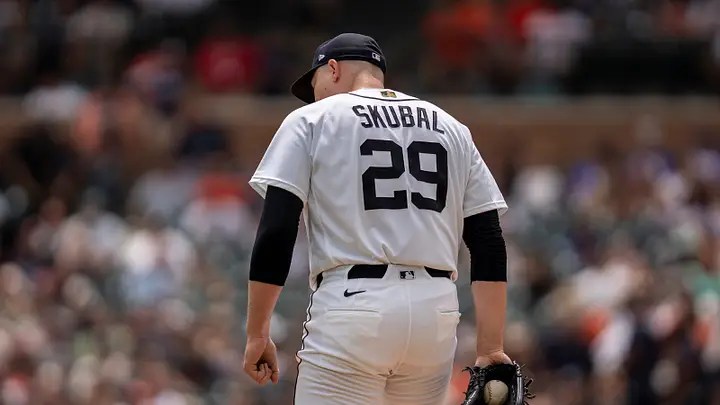
Last Wednesday, Tarik Skubal took the mound for the Tigers, in Comerica Park, with just about the entire world deciding it was going to be his last such appearance before this year’s trade deadline. Is that the way you saw it, with no room for alternative views?

If so, then boy did the Tigers do everything in their power not to prove they wanted to keep him and try to re-sign him.

Skubal did his part. It only began with fighting back from the 2-0 hole to strike Orioles leadoff hitter Tyler Ward out to open the game. That made Skubal the second-fastest pitcher in major league history to reach a thousand strikeouts (he missed Hall of Famer Randy Johnson by one game) and the fastest in Tiger history to do it.

Then, he worked six and two thirds while his mates staked him to a 7-1 lead, scoring three in the third, two in the fifth, and two in the sixth. And what kind of appreciation did the Tiger bullpen show with a mission of protecting a six-run lead with a mere three and a third innings to go, theoretically?

The Orioles absolutely trashed the Tiger pen for two runs charged to Skubal’s jacket after he left the game and seven more to come before they came away with a twelve-inning, 10-9 triumph. The only surprise should have been Skubal not known to have demanded a ticket out of town post haste after that kind of depreciation.

Three days and nights later, Skubal was traded. No thanks for the memories, Tarik. And try not to knock those three delicious prospects—righthanded pitchers  River Ryan (if that doesn’t sound like a movie star’s name, I’m not sure what would) and Brady Smith; outfielder Zyhir Hope—on their asses when you pass them on the way to downtown Dodgerville.

“Here comes the anti-Dodger hysteria,” snarked The Athletic‘s Ken Rosenthal when the deal got done. “Here comes another round of small-market defeatism. Here comes the lockout, not that its occurrence was ever in doubt.” Defeatism? How about small-market self-immolation? How about small-market brain impairment?

The Tigers just couldn’t summon up the will or the ways to stay near the American League race fringes the rest of this season, never mind summoning up the will and the ways to think that maybe Skubal would be the anchor of a new generation of Tiger competitors. And before you all continue yapping money!money!money! and cap!cap!cap!, how about catching a breath and doing a little serious thinking for a change?

For one thing, serious thinking is embedded just as deeply in the Dodger DNA as reputedly bottomless financial resources. “Skubal to the Dodgers was not a fait accompli,” Rosenthal writes, “nor should it have been.”

Other contenders had big-time prospects to offer. Every team could afford the remaining $9.4 million on Skubal’s contract. How is it that the Dodgers again were the ones to step up? How is it they so often pull off these kinds of moves, even when money is not the deciding factor?

. . . The Dodgers aren’t just doing this with money, though their vast revenues sure help. They are the industry standard, or close to it, in scouting, developing, trading and every other aspect of a baseball operation. They also possess a singular quality that most other teams do not, a fearlessness that could help them become the first team to win three straight World Series since the 1998 to 2000 Yankees.

. . . They’ve exploited their ability to withhold from revenue sharing a healthy portion of their mammoth local TV deal, an arrangement that arose from a settlement in bankruptcy court between MLB and former owner Frank McCourt.

They’ve also exploited their signing of Shohei Ohtani, the greatest player of our generation, to an absurdly deferred $700 million deal that he offered to every club pursuing him in free agency, including his previous one, the Los Angeles Angels.

By the way, the Dodgers landing Skubal’s rental isn’t a guarantee that they’ll get the World Series three-peat they crave. Try to remember (as Rosenthal does) that the Dodgers got knocked off in two straight division series by the Padres and the Diamondbacks, and almost lost a third straight such set to the Padres again.

And, in case you’ve forgotten, winning their second straight Series last fall wasn’t exactly a lopsided demolition derby. The Blue Jays forced them to a seventh game, and it took fortune, surrealism, and survival for the Dodgers to win it at last.

The word around the game according to several known reports is that a number of teams including the National League Central-leading Brewers and the AL East-leading Rays weren’t shy about paying Skubal the rest of the season. So how did the Damn Dodgers—who have the resources as well as the attitudes to think about extending Skubal long and handsomely—end up with the trade season’s big prize?

The aforementioned fearlessness. Never mind the ancient Washington Senators in Damn Yankees singing you gotta have heart. (And stop paying more attention to whatever Lola wants, too.) You gotta have stones, too. The Dodgers have those in as much abundance as they have heart.

“[H]ere’s something else the Dodgers exploit: the risk-averse nature of so many other clubs in today’s game,” Rosenthal continues. ” . . . [T]he dirty little secret of a salary cap and floor system is that it would not guarantee small-market teams success. Many would need to develop more of a killer instinct, an instinct the Dodgers demonstrate time and again.”

They used to say that about the Damn Yankees, too. Around the turn of the century.

Phil Garner, RIP: Two sides of scrap iron

Phil Garner

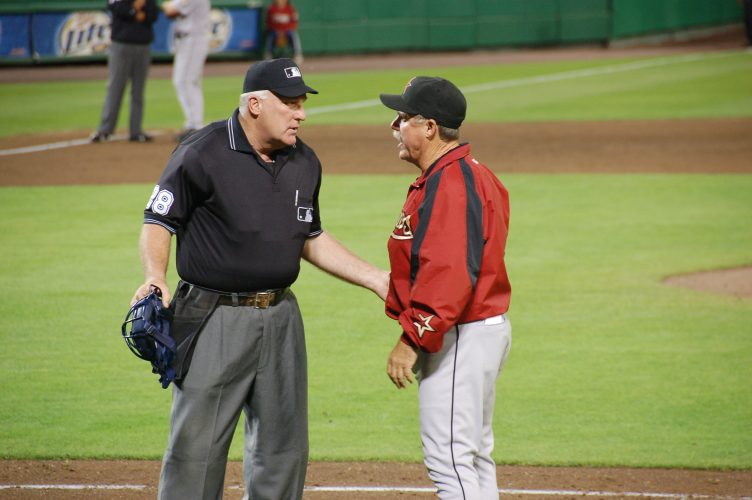
Phil Garner debates with umpire Larry Young in 2006. He didn’t always act like his Scrap Iron nickname.

Phil Garner was nicknamed Scrap Iron for his feisty side but had a side gentle enough that he once promised his wife to hit a grand slam for her when she missed the first one he hit as a major leaguer. Don’t make promises you can’t keep. Unless you can. And he did.

Garner was a rough-and-ready second baseman whose fortés did not include power hitting. (He averaged nine homers a year lifetime.) So, after Mrs. Garner missed him taking Cardinals pitcher Bob Forsch in the bottom of the sixth on 14 September 1978, the loving husband promised her another salami slice ASAP.

Naturally, it came the next day, against the Montreal Expos. And neither Garner had to wait beyond the bottom of the first, when hubby squared off against Woodie Fryman with the pads padded and hit one over the left field fence. It was the first time a National League player sliced salami in back-to-back games in 77 years.

That was the guy who’d grow up to manage the Astros to their first pennant in 2005, when they were still a National League club. The bad news was the Astros grappling their way to it through the Cardinals only to get swept by the White Sox.

And, the who’d go from there to the Athletics’ front office as an advisor, to the team who once traded him after the guy they traded to manage the Pirates, Chuck Tanner, told his new team to trade for the second base slasher. In that advisory role, Garner proved invaluable to an old teammate named Bob Melvin, when both were Giants and Garner was near the end of the line.

Maybe that was also because, when managing the Brewers and the Tigers once upon a time, Garner made Melvin his bench coach at both stops, and Melvin appreciated Garner talking to him in terms of actualities and not what-ifs.

“When he would talk to me,” said Melvin to The Athletic‘s Tyler Kepner about Garner, who died of pancreatic cancer Saturday night, “he would always say, ‘When you manage …’ Not one time did he ever say, ‘If you manage …’ And it just resonated with me that he had that much confidence in me. Obviously, I did end up managing, and a lot of my philosophies and a lot of my values in baseball come from him. There’s no more impactful guy in my career than Phil Garner.”

Garner did that in a lot of places. When he became a Pirate, he engaged in some good-natured jousting with Hall of Famer Dave Parker, who’d first been astonished that his team sent six players to Oakland in the swap that made Garner a Pirate in the first place.

Parker zinged him, Garner zinged back, and the new guy’s “initiation was complete,” as Parker remembered in his memoir, Cobra, “and I had a new sparring partner.” He also had an almost immediate appreciation for Garner one spring training afternoon after Garner’s arrival.

“In the twilight,” the Cobra wrote, “ol’ Scrap Iron was still out there, hours later, taking extra fielding practice at third base. As pissed as I was about the trade, I knew it was the smart move and we got ourselves a winning player.” A guy to win a World Series with, as they did with the Fam-I-Lee Pirates of 1979.

And, a guy who knew how to help bring a roster together, as the team’s relief ace Kent Tekulve told Kepner. “Our team was known to be, oh, a little rowdy, a little cocky, and nobody was safe in the clubhouse,” Tekluve began.

It didn’t matter where you stood in the pecking order, everybody was fair game, and a lot of that was Gar. It was hilarious every day when we’d come in. Whichever one got there first—Parker or Gar—you were waiting for the second one, because it was going to start. You’ve got this 6-foot, 5-inch, huge Black guy and this 5-foot, 9-inch little redneck, and they’d just start in on each other, and that spread. Everybody’s involved now.

And he knew what was going on. I mean, Phil was a smart guy. He knew if he got on Parker, then everybody else would get on him, too. And Parker liked that, because that gave him a reason to prove you wrong.

That’s the man whom Tigers pitcher C.J. Nitkowski once ripped publicly after “a frustrating game,” as Kepner phrased it. Garner bawled him out for it in a clubhouse meeting the next day . . . but accepted the pitcher’s apology privately. Garner even tried to acquire Nitkowski when managing the Astros later on.

“It really spoke to me and made me reflect on how I want to handle myself,” said Nitkowski, who went from the mound to the broadcast booth in due course. “He showed what professionalism looks like, and what forgiveness looks like.”

Another of his pitchers, Steve Sparks, remembered a tough loss that stirred Garner to “shredding us in the locker room” and turning the postgame food spread into a miniature landfill. If Garner couldn’t cool himself off, his lady could—and did.

“At the end of [the tirade],” Sparks remembered, “his wife Carol has a Harley-Davidson wheeled into the clubhouse for his birthday—and right away he turns into Jerry Seinfeld in the ‘schmoopie’ episode, from one character to another in the blink of an eye. He was so relatable. He knew how to laugh at himself.”

Hopefully some of that laughter will come through the tears when they lay the body to rest and wish the man a safe journey home to the Lord. Where Dave Parker’s just liable to be waiting for him with a cold beer in hand and a mouthful of wisecracks with which to serve it.

First published by Sports-Central.

The unsinkable Mariners

Jorge Polanco

Jorge Polanco shooting the game and ALDS-winning base hit for the Mariners in the bottom of the fifteenth . . .

“Life is what happens when you’re busy making other plans,” sang John Lennon on the last album he released in his lifetime. Instead of singing it in the middle of a sweet lullaby he wrote for his then five-year-old son, the former Beatle could have been singing about baseball.

He could have been singing, too, about such contests as the just-concluded American League division series between the Tigers and the Mariners. The one that came to a fifth game that came down to a fifteenth inning and, possibly, both teams wondering just whom was going to commit a fatal flub, flop, or faux pas, Phillies-like or otherwise.

“It felt the whole game,” said Tigers shortstop Javier Baez post-mortem, “like whoever made a mistake was going to lose.”

Well, nobody in either Tiger or Mariner uniforms made any truly grave mistakes Friday night. The Mariners punched their ticket to the American League Championship Series the old-fashioned way, a hair-raiser of a ball game they finished when Jorge Polanco slashed a single with two out and the bases loaded in the bottom of the fifteenth.

Until that half-inning, the Tigers and the Mariners threw everything at each other except the proverbial kitchen sink. The sink showed up in the bottom of the fifteenth. When Tommy Kahnle relieved a gutsy Jack Flaherty for the Tigers, and J.P. Crawford opened the proceedings with a base hit, the third Mariners leadoff runner in four innings.

But Kahnle followed that by plunking Randy Arozarena on the first pitch, before Cal Raleigh lined out but left Arozarena safe at second thanks to Tigers center fielder Parker Meadows’s errant throw. Then the Tigers ordered Julio Rodriguez walked on the house. In situations leaving first base open with a season on the line, it was the smart move after dodging a Raleigh artillery shell.

Now came Polanco. He and Kahnle fought to a full count with no place to put him. Then Kahnle threw a fastball Polanco shot on a line through the right side and into right field, Crawford racing home and jumping onto the plate and into the arms of teammates who might have been forgiven if they’d just been wondering how much longer this epic could play.

“The back half of that game is like a game in itself,” said Tigers manager A.J. Hinch post-mortem. “We dodged a few bullets, and so did they . . . I didn’t want it to end, certainly,  the way that it did, but I wanted to just keep giving ourselves a puncher’s chance, and they outlasted us.”

Until the bottom of the fifteenth, it was fair to say the Tigers and the Mariners outlasted each other.

From the brilliance of starting pitchers Tarik Skubal and George Kirby to the magnificence of both bullpens plus a pair of starting pitchers pressed into all-hands-on-deck relief service, this game made you wonder whether anyone from the big bats to the supporting cast really knew how to hit anymore.

Skubal in particular pitched like the Cy Young Award winner he seems destined to become this year. He surrendered one run but set a new postseason record with seven straight strikeouts, then set another one with thirteen total strikeouts in a postseason elimination game. He pitched six virtuoso innings and left with his tank below empty.

How could he have known at that moment that things would end up with him making grand, Hall of Famer-like showings in his two ALDS starts but his team ending up on the losing side?

Kirby was almost as brilliant as Skubal. In fact, the only run charged against him scored when he’d left the game in the bottom of the sixth, after surrendering Baez’s leadoff double. Gabe Speier took over and Tigers right fielder Kerry Carpenter hit a 1-0 service into the right center field seats.

That gave the Tigers a 2-1 lead lasting long enough for the Mariners in the bottom of the seventh to tie it up with a little shuck-and-shuffling on the part of skipper Dan Wilson.

He sent Dominic Canzone to pinch hit for Mitch Garver, whose second-inning sacrifice fly opened the scoring in the first place. Hinch promptly brought Tyler Holton in to relieve Skubal’s relief Kyle Finnegan. Wilson countered by sending Leo Rivas up to pinch hit for Canzone.

In the first postseason plate appearance of his major league career, measuring Holton for the cutters and changeups he was most likely to throw, Rivas took a strike, then lined a changeup for a base hit to left to send Polanco home with the tying run.

From that point forward, the bullpens, with or without starters pressed into emergency all-hands-on-deck duty, were brilliant, even when they were slithering, sneaking, or bludgeoning their ways out of jams you could charge were some of their own making.

“It was like (we) got them on the ropes, and then they wiggle out of it. They got us on the ropes, and we wiggle out of it,” said Finnegan postgame. “It was an absolute roller-coaster of a game. That’s the beauty of this sport.”

“A heartbreaker of a finish,” said Tigers first baseman Spencer Torkelson, who’d gone hitless in six Game Five plate appearances, “but an unbelievable baseball game to be part of.”

“My experience feels like the ground was shaking every inning,” said Rivas. He wasn’t exactly wrong. Especially over the extra innings, when it seemed nobody in T-Mobile Park dared to sit back down.

“We knew this was not going to be a football score, that it was going to be a tight pitchers’ duel,” said Mariners president of baseball ops Jerry Dipoto, himself a former major league pitcher, “and our general take was: keep it close until Skubal’s out of there and we’ve got a chance to win this game.”

Even if it took nine innings from Skubal’s exit to do it. But once Speier yielded to Matt Brash, what came out of the Mariners’ bullpen—including and especially starters who hadn’t relieved in either eons or since early minor league days, whichever came first—was magnificent.

Brash himself got six outs for the first time since 2003. Andrés Muñoz, the Mariners’ usual designated closer, walked a pair but escaped and then pitched a spotless ninth. Logan Gilbert, a starter, pitched a pair of scoreless innings. Eduard Bazardo landed eight outs, something he’d never done in his career until Friday night. Luis Castillo, who hadn’t relieved in almost a decade, got rid of all four batters he faced.

The problem was the group of people rooting and cheering even louder than the ballpark crowd: the Blue Jays. Broadcast announcers noted it until even they got sick of saying it, but as the extra innings accumulated the Blue Jays had to have been roaring with delight knowing that, whichever team would meet them in the ALCS, that team’s pitching might be depleted temporarily.

That’s not what you want to throw at the Blue Jays and their own howitzer offense in their own playpen to open. The ALCS may come down to first and second game survival for the Mariners before they can bring the set back to T-Mobile Park. But when they do, the Mariners have at least one comfort upon which to lean: the Blue Jays were a game below .500 on the road while playing .667 ball at Rogers Centre.

And both teams want to end pennant droughts expeditiously as possible.

The Blue Jays haven’t hit the World Series since they won their second of two straight in 1993. The Mariners haven’t hit the World Series at all in their 48 years of existence. The last time they showed up in an ALCS, they’d won 116 games on the regular season, had the 2001 Rookie of the Year in future Hall of Famer Ichiro Suzuki, another Hall of Famer in Edgar Martinez, and lost to the Yankees.

The Tigers haven’t reached a World Series since 2006 or won one since 1984. They wouldn’t mind ending a drought, either. But on a night when Carpenter went four-for-five while the rest of the Tigers managed only four hits, Carpenter becoming the first since Babe Ruth to reach base five times and homer in a winner-take-all postseason game probably made Tiger fans wish they could have run nine of him to the plate Friday night.

It’s hard to think, “What a year,” when thinking of the Tigers. Sure, they’re talented, likeable, and their own kind of resilient. But these are the same Tigers who became this year’s first to win thirty, then forty, then fifty, then sixty games . . . before the worst September win percentage of any postseason baseball team ever. They played September as if on crutches.

The Mariners won their division handily enough, playing September with controlled fury and rolling their best month’s record of the season, 17-8/.680, while earning a round-one bye in the postseason. They proved unbreakable when the Tigers took them to the bitter end Friday night.

And the game proved unbreakable without Manfred Man, the free cookie on second base to begin each half inning. Manfred Man’s extinction should not be restricted to the postseason alone. No mistake.

A tale of two front office executions

Chris Young, Jon Daniels

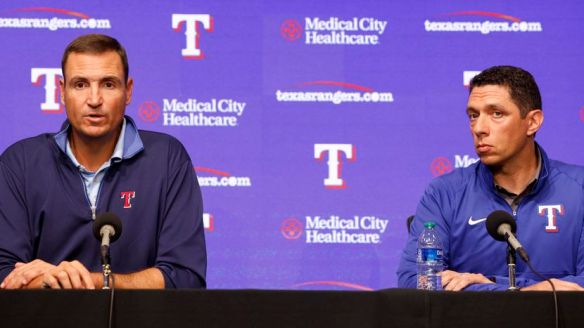
Pitcher-turned-MLB executive-turned-Rangers executive Chris Young (left) now succeeds Jon Daniels (right) as the Rangers’ GM . . . but the move’s timing days after Daniels was made to fire manager Chris Woodward was strange to be most polite.

When the Rangers executed manager Chris Woodward and general manager Jon Daniels, it looked at first as though the organisation simply decided too much was too little and enough already. Likewise when the Tigers decided several days earlier that there was a guillotine with general manager Al Avila’s name on it.

Avila’s dispatch wasn’t exactly likely to generate much in the way of sympathy or empathy.   Tigers owner Chris Illitch probably starting drawing up the warrant after Avila made a pair of 2017 deals that sent away future Hall of Fame pitcher Justin Verlander and ace designated hitter J.D. Martinez and brought back what proved no major league help.

Both those players went from there to help make World Series wins possible with their new clubs, back-to-back even: Verlander helped pitch the Astros to the 2017 Series rings and Martinez helped swing the 2018 Red Sox to the rings a year later.

Never mind how tainted both Series triumphs are, though it’s possible to make the case that Verlander (and his fellow Astros pitchers) wasn’t exactly among the conspirators that birthed and bred Astrogate. And we don’t know for dead last certain whether or how often Martinez himself benefitted from the Rogue Sox’s replay room reconnaissance ring.

From Avila’s first season on the job his Tigers, as Defector notes, were baseball’s second-worst hitters and second-worst pitchers on a team level, not to mention the second-worst in the Show for winning and losing—behind the Orioles, who’ve spent this year going remarkably and maybe inexplicably from the tanks to within a half game’s reach of the wild card picture.

“Then again,” observes Defector writer Ray Ratto (once a longtime San Francisco Bay Area sportswriter), “[Orioles GM] Mike Elias didn’t guarantee a quarter billion dollars in current and future salaries to players who have amassed a 43-68 record, worse than every team in baseball save Oakland and Washington, who have shed payroll to be bad. Spending more to be just as bad is, well, spectacularly contraindicated.”

That was the Avila legacy in an envelope. He gave them his son Alex as a catcher and in exchange steered the team into a ditch. His best year was his first, and that’s never a good way to keep the boss from snarking you up on your way out the door. The current team is on pace to have its second-lowest runs per game output in franchise history (and since we know you’re going to ask, 1904) and the fewest homers in a full season since 1954. We’d call them God-awful, but God has lawyers.

. . .The Tigers just . . .  faded away. Neither hated nor condemned, they just eased into the Phantom Zone and stayed there. They’re not even appreciated for playing the fastest games in the majors, which is the one blessing you can provide your fans when you stink on a daily basis.

Al Avila

Al Avila, watching the Tigers work out the day before Opening Day, seeded his demolition with two 2017 trades.

In other words, if Avila was actively and consciously tanking, he had a mad genius for doing it as far away from deep scrutiny as the current Cubs, Reds, Royals, Pirates, and Nationals have drawn. (“Even the Angels get more condemnation,” Ratto writes wryly, “but that’s because unlike the Tigers, they kept their best players and still failed.”)

So the rebuilding Tigers have to start their rebuild all over again. So, apparently, do the Rangers, whose owner Ray Davis announced Daniels’s firing by saying, “Bottom line is we’re not good, and we haven’t been good for six years. To be competitive going forward, I felt that we needed to make a change.”

It was the way Davis made the change that left more than a few eyes rolling and jaws falling. He made Daniels announce Woodward’s wiring into the electric chair just a couple of days before he threw the switch on Daniels himself, whose contract was due to expire at season’s end.

Saying the decisions were brewing for several months before last Monday’s Woodward execution leaves Daniels with what The Athletic‘s Rangers beat writer Levi Weaver calls “a bad look.” That’s like saying the deal with Adolf Hitler to swap Czech freedom for “peace in our time” left Neville Chamberlain with nothing more than the proverbial egg on his face.

Except that the Czechs knew exactly what was coming, even if portions enough of the world around them still couldn’t believe it. As Weaver writes, Daniels was sent to face the press explaining Woodward’s dispatch with no knowledge that his own hemlock cocktail was being mixed.

What troubles Weaver is that, for all that dispatching Daniels might have been necessary at last, it was done not only underhandedly but a couple of years too late:

After all, as Davis made sure to point out, the Rangers haven’t had a winning season since 2016. In retrospect, the rebuild that began in earnest in 2020 probably should have begun in 2017 — never mind that one source familiar with proceedings said that Daniels intended to do just that, but was pressured into putting a better product on the field for the first season of the new ballpark. Still, Nomar Mazara, Rougned Odor, Chi Chi Gonzalez and a passel of other home-grown talent didn’t turn out to be the next core of stars that fans hoped. Those decisions land at Daniels’ feet and maybe warranted a parting of ways.

But if that were the case, it should have been done back in 2020, when it was clear that plan hadn’t worked.

Those are purely baseball considerations. They fall under such headings as the Rangers’ farm yielding negligible crops; the front office’s unique stability in the Daniels era meaning a lack of fresh blood; and, a lot of circumstantial misfortune such as a pitching staff bedeviled with injuries over too long a period.

But Weaver isolates another problem with the manner in which Daniels was handled now. Reporters so often speak to a man’s peers in a business and Weaver learned things about Daniels from fellow GMs and their underlings that might make him an exception rather than a rule in a sport whose business is as cutthroat and duplicitous as its play is ennobling.

“Daniels cared about his people,” Weaver writes. “Sometimes, in the opinion of those around the league, he cared too much, seeing the best in his employees and keeping them around when others might have pulled the plug.”

Sure, he would make a hard decision when he had to — occasionally, the fit between employee and organization just wasn’t working and it was time to part ways. But the only times Daniels ever took me to task for my reporting was when I wrote those stories. Every time, the message was the same: if you need to blame someone, blame me. I don’t want this guy’s family to read him getting ripped in the press. I’m front-facing; I can handle it.

With [Daniels’ sudden firing] it’s clear that loyalty didn’t work its way up to the ownership level . . .

. . . Choosing one’s employees is an owner’s prerogative. But to fire Daniels publicly after such a long tenure showed a lack of common courtesy or decency. Even if Davis had decided not to renew Daniels’ contract at the end of the year, keeping him around to help with the transition would have accomplished two things. One, it would have given some well-deserved dignity to Daniels, allowing him to quietly step down at the end of the season. He has earned that, and to surprise him with a firing now — just two days after he was the face of a managerial firing — is disrespectful at best.

Secondly, allowing Daniels to finish the year could have potentially been beneficial to [pitcher turned MLB vice president in charge of discipline to Daniels understudy Chris] Young. In an advisory role, Daniels could have helped to prepare Young for the remainder of the responsibilities he was inheriting. We’ll never know now: Davis didn’t run the idea by Young before making the move, opting to act now and let Young deal with the fallout.

Respected for brains on the mound and as a baseball executive in the making, Young doesn’t exactly have people worrying about whether he’ll crack. But Daniels had almost two decades on the job and shepherded the last two (and back-to-back while they were at it) Rangers World Series entrants. (They lost decisively to the Giants in 2010; they were two outs from winning the 2011 Series when they ran into a Cardinals buzz saw named David Freese.)

Daniels and Young enjoyed a close relationship for a very long time, going back to Young’s initial major league seasons pitching for the Rangers. Surely Young knows that being a people person was one of Daniels’s above-average strengths. And the Rangers have had small improvements this year even if they weren’t obviously making more better promises for next year.

How Young balances himself between people personhood and making the hard assessents of the Rangers’ roster and front office should provide interesting observations. But if he assesses the depth of the handling and timing of his former boss’s sentence to the Phantom Zone and finds himself compelled to keep one eye over his shoulder, you can’t necessarily blame him.

3,000 hits, and one for the game’s integrity

Miguel Cabrera

Miggy Stardust standing alone at first base after becoming baseball’s only 3,000-hit/500-home run/Triple Crown winning player Saturday afternoon.

Well, it proved too much to ask that Miguel Cabrera should get number 3,000 by launching one over the fences in Comerica Park Saturday afternoon. Sometimes the Elysian Fields insist that drama takes an inning off. But he didn’t wait long for the big knock, either. A sharply-cued single is equal to a home run in the hit total.

With Robbie Grossman aboard with a leadoff single in the bottom of the first, Cabrera shot a 1-1 fastball from Rockies pitcher Antonio Senzatela through the right side of the infield as if he’d lined up a money shot in a pool tournament. The bedlam began before he had a chance to hold up at first.

The Comerica audience chanted and cheered down upon him from just about the moment he left the batter’s box. He raised his fist at first as the ballpark scoreboard gave him the fireworks equivalent of a 21-gun salute. Former teammate José Iglesias, now a Rockie, ambled over to give him a bear hug—and the ball he’d just hit into history.

The Tigers poured out of their dugout to congratulate their man. His wife, his son, his daughter, and his mother gave and received hugs with him behind the plate while time was still in effect. Who says it wasn’t worth the extra day’s wait?

Cabrera barely had time to settle back in at first base when Jeimer Candelario struck out but Jonathan Schoop pushed him to second and Austin Meadows (safe on a fielder’s choice) home with an infield hit, and Spencer Torkelson—who’s taken first base over while Cabrera settles in strictly as a designated hitter—hit Senzatela’s first pitch to him into the right field seats.

Just like that, the Tigers showed they knew how to celebrate Miggy Stardust’s big knock the right ways. Then, after Grossman singled home a fifth run in the fourth, the big puddy tats ramped up the party with two outs in the sixth, and the guest of honour struck again, his two-run single being sandwiched between a pair of RBI singles, including Candelario pushing Meadows home on another infield hit.

Tigers manager A.J. Hinch gave Cabrera the rest of the game off, and his mates treated him to another two-out four-run inning in the seventh, this time Meadows singling home a pair, Candelario drawing a bases-loaded walk, and Schoop singling Meadows home. The Tiger bullpen took care of the rest, even if Angel De Jesus had to claw his way out of a self-inflicted bases-loaded jam to seal the 13-0 win.

That was the opener of a doubleheader in which the Rockies threatened to shut the Tigers out in the nightcap until Meadows hit a two-out, two-run triple off Rockies reliever Alex Colome. But Colome struck pinch hitter Harold Castro out swinging on three straight cutters to nail the 3-2 Rockies win.

Cabrera picked up another base hit in the nightcap’s bottom of the first to set first and third up for Candelario, who struck out swinging before Meadows forced the guest of honour at second for the side. But nothing could spoil Cabrera’s party, not even a doubleheader split. Nothing could spoil him becoming the first man ever to nail 3,000+ hits, 500+ home runs, and win a Triple Crown.

Not even the Comerica crowd booing wrongly when the Yankees ordered him walked in the bottom of the eighth Thursday, so their lefthanded reliever Lucas Luetge could have a more favourable matchup with the lefthanded-hitting Meadows.

That debate poured into the following two days, even as the Tigers and the Rockies were rained out of playing Friday night. It was a foolish debate, in which the booing Tiger fans proved nothing more than that they’re not averse to a little tanking—when it might involve one of their own getting the ideal matchup to get the big knock after he’d gone 0-for-3 thus far on that day.

Down 1-0, Yankee manager Aaron Boone could have been accused of a little tanking himself if he’d let Luetge pitch to the righthanded Cabrera, whose splits show he manhandles pitching from both sides but is that much better against the portsiders, and handed Cabrera the immediate advantage going in.

Boone had even a slight a chance to hold those Tigers and keep his Yankees within simple reach of overcoming and winning. History be damned, he took it. And even if the lefthanded-swinging Meadows did wreck the maneuver promptly with a two-run double, it happened just as honestly as the free pass to Cabrera occurred.

“What a shame and not a good call by the opposing team,” sniffed one social media denizen about the Yankees, a sentiment expressed by only a few too many thousand from the moment Cabrera took his base that day. “Just let him have his victory at home for the fans. What a shame.”

Just “let” him have his victory?

No—the shame would have been if the Yankees let Cabrera have one more chance to  help beat them even with an historic hit providing a little extra Tiger insurance. The game’s integrity includes especially that everyone present and playing makes an honest effort to compete and win. That’s what the Yankees did in that moment.

Cabrera may be aging, but he’s still a formidable bat. A Hall of Famer whose age is only too pronounced but whose spirit and love of the game hasn’t been eroded out of its career-long presence is too smart not to know the Yankees weren’t about to let him bury them alive if they could help it.

So he waited an extra day or two to swing into the history books. The only thing wrong Saturday was probably that it couldn’t have been a home run. It’s happened before when baseball competition required precedence over baseball history. It can happen again with the next significant milestone approached by the next significant player. For integrity’s sake, we should hope that the participants play the game right then, too, even if it means history waiting an extra day or two.

The Comerica Park racket after Cabrera pulled up at first in the first should tell you one historic swing wasn’t just worth the wait, it was good for baseball, the Tigers, and Miggy Stardust. And in that order.