Unknown's avatar

About Jeff Kallman

Member, Internet Baseball Writers Association of America and the Society for American Baseball Research.

Fiers burns a milestone

2019-05-07 MikeFiers

After spreading his wings to no-hit the Reds, Mike Fiers spread his wings to start the celebration . . .

You’d be hard pressed when asked to think of things baseball people love more than milestones. Except maybe excuses for puns clever and otherwise.

“A’s to Reds: You’re Fiered!” went one such posted on Facebook, after Mike Fiers threw a curve ball that took a swan dive below Eugenio Suarez’s bat to finish a no-hitter Tuesday night.

Imagine if that Facebooker and others in the moment knew it was the 300th no-hitter in major league history. Three hundred has a few magic connotations in baseball and otherwise.

Pitching wins are now overrated in evaluating a pitcher’s actual value, but even those who overrate them with cause like to ponder who’s likely to to be credited for 300 of them next. CC Sabathia’s out of that running since he plans to retire after this season and isn’t likely to earn 52 wins between now and then. Justin Verlander may have an outside shot if his arm obeys his known wishes and lets him pitch another five or six years.

But Fiers didn’t just pitch baseball’s 300th no-hitter but the second one of his otherwise journeyman major league career. With a 4.38 lifetime fielding-independent pitching rate (that’s your ERA when your defenses are removed from the equation, folks) so far in a nine-year career, to go with his 4.11 lifetime ERA, Fiers isn’t exactly a Hall of Famer in the making.

But modestly gifted men have been known to perform immodest deeds now and then. And fans of modest intelligence have been known to say that certain milestones “should” be reached by none but the proven absolute greats.

Such fans several generations ago said it about Roger Maris daring to chase, catch, and pass Babe Ruth’s single-season home run record. You could almost hear the isolated harrumphing now: “Who the hell is this guy to pitch the 300th no-hitter? That’s supposed to be Max Scherzer! Or Justin Verlander! Or Clayton Kershaw! Mike Who?!?”

Unfortunately, baseball doesn’t always work that way, bless the game. If the guy you wouldn’t spot in a Grand Central Station rush hour throng can come up big in the biggest moments like the postseason (Howard Ehmke, Al Gionfriddo, Sandy Amoros, Don Larsen, Moe Drabowsky, Al Weis, Denny Doyle, Mark Lemke, and David Freese, anyone?), why can’t the guy you’d never mistake for Tom Seaver throw a milestone no-hitter?

There are 35 pitchers who’ve thrown more than one no-hitter in their careers and, not counting such still-active men as Justin Verlander and Max Scherzer, 22 of them aren’t Hall of Famers.

Among those like Fiers who’ve thrown two, Cooperstown has seven: Pud Galvin, Christy Mathewson, Addie Joss, Warren Spahn, Jim Bunning, Randy Johnson, and Roy Halladay. Three men have thrown three and only one of those, Larry Corcoran, isn’t a Hall of Famer.

Fiers is also one of only eight men to pitch a no-hitter for more than one team. He’s done it for the Astros (in 2015) and now the A’s. The list includes Cy Young, Bunning, Johnson, and Ryan among the Hall of Famers and Ted Breitenstein, Adonis Terry, and Hideo Nomo otherwise.

Johnny Vander Meer (not a Hall of Famer) is still the only man to pitch no-hitters in back-to-back starts; Sandy Koufax is still the only man to throw no-hitters in four consecutive seasons, with his fourth proving literally that practise makes perfect. Nolan Ryan fell short of that streak by a season (he pitched two in 1973 and one each in 1974 and 1975) while working toward his record seven.

Fiers is in rather charmed company now. Especially since May is the month for milestone no-nos, and the two previous to his were also thrown by Hall of Famers. Carl Hubbell threw number 100 ninety years ago today; and, Dennis Eckersley threw number 200 on 30 May 1977. Anyone care to predict which May to come will feature no-hitter number 400?

And Fiers is another kind of outlier. No pitcher ever took a season’s 6.81 ERA to the mound before throwing a no-hitter.

“I’m just glad they got those lights working,” Fiers deadpanned after the 2-0 win.

He referred to three panels of lights failing above the left field stands in Oakland’s otherwise unloveable Oakland-Alameda County Coliseum. Game time was delayed a little over an hour and a half. Finally, the A’s and the Reds said let’s play ball and Joey Votto checked in at the plate to open.

Votto popped out to the infield to open. Suarez struck out to finish. Except for an error at third in the fourth, Suarez working out a leadoff walk in the seventh, and Yasiel Puig walking later in the inning, no Red reached base in any way, shape or form.

And, yes, Fiers needed a little help from his friends in the sixth inning, such as Jurickson Profar ambling out to shallow right to catch Kyle Farmer’s quail and, especially, Ramon Laureano—making a fresh reputation as an outfield acrobat—taking a home run away from Votto with a leap up the short end of left center field wall.

Not to mention Profar driving home both the runs in the game, first with a two-out double in the second with Stephen Piscotty aboard and then with a two-out launch over the right field fence in the seventh.

Maybe the testiest moment of the game came in the ninth with one out, when Fiers fell behind Votto 3-1 before throwing the Reds first baseman a changeup nasty enough to be worth nothing more than a ground out to first base.

For Laureano that play was an awakening. “That’s the first time I realized he had a no-hitter,” he said of Fiers’ performance. “Really, I didn’t know.”

“I think the stars aligned tonight,” said Farmer of the Profar and Laureano catches. “Once we saw those two plays happening, we said this might be his night.”

It wasn’t exactly a picnic for the last A’s pitcher to throw a no-hitter. “It was way more nerve-wracking then when I was doing it,” said Sean Manea, who threw his last year but who’s still working his way back from September surgery to repair a torn shoulder labrum. “I was shaking on the bench. I don’t know, it was crazy seeing him do it.”

It didn’t stop Manea from being the man to shower Fiers—who wouldn’t have pitched Tuesday at all if the A’s hadn’t shuffled their rotation on their off day, as things turned out—with the Gatorade tank.

“I remember when I was drafted, I wasn’t too high on the charts,” Fiers told reporters after surviving the mobbing he got on the mound when the game ended. “I was a guy throwing 88 to 90, down in South Florida. I’m one in a million down there.” And in more ways than one, his million-to-one shot came home.
Kung Fu Pitcher

2019-05-06 PabloSandoval

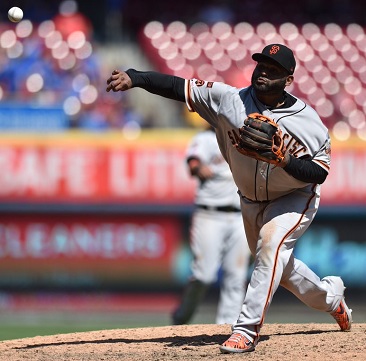
Pablo Sandoval on the mound . . . 

The late Joaquin Andujar was known as a time bomb on the mound and an occasional philosopher: “In baseball, there’s just one word—you never know.” I call it Andujar’s Law.

Brother, was Andujar’s Law upheld without the slightest chance for an appeal in Cincinnati Monday.

And, oh, how Andujar himself would have loved it. Not for the final score, with the Reds smothering the Giants 12-4, but for Pablo Sandoval of all people entering the history books.

Next to Hall of Fame pitcher Christy Mathewson, of all people.

He stole third in the third. He hit a three-run homer in the sixth, in the bottom of which inning the Reds sent five across the plate including by way of two of their record five men hit by pitches taking the plunks with the bases loaded. With the game that far out of hand, Giants manager Bruce Bochy let Sandoval pitch the eighth.

And why on earth not? You’re getting blown out. You don’t want to burn another reasonably reliable relief pitcher if you can help it. What do you have to lose by sending a third baseman about whom roly-poly may be the understatement of the season out to the mound to take one for the team?

What’s the worst that can happen? He gets beaten like a pinata before he gets a third out in a game that left the airport like a Dreamliner long before you got to this point? On the bright side, Sandoval gave you an inning once before, on the wrong end of another blowout, and didn’t surrender a single run.

And he still hasn’t after Monday’s effort. Kung Fu Pitcher faced the minimum three batters and not a single Red crossed the plate on him.

Mathewson had a 2.13 ERA at the time he nailed his bomb, theft, and shutout in the same game, also for the Giants, which he did 23 May 1905—also against the Reds, incidentally. The fact that Sandoval’s only pitched two full major league innings in his life is a mere technicality. He has a couple of bragging rights on the Big Six.

In fact, other than the one that plunked Jose Peraza leading off and another that sailed up and away from pinch-hitter Josh Van Meter, Sandoval worked around the corners and the edges of the plate, believe it or not. More unbelievable: Sandolval threw first pitch strikes to two of his three hitters and threw seven strikes out of ten pitches total. He could have a future as a slop-tossing relief pitcher with a bit of a flair for making bats produce contact outs.

Because after Sandoval plunked Peraza—no, it wasn’t anywhere near a purpose pitch, since Peraza was one of the least offensive Reds bats to that point in the game—Van Meter flied out to left. Then he sent one low enough in the zone for Nick Senzel to dial Area Code 6-4-3 for the side.

Served Senzel right for going long twice earlier in the game, hitting Giants starter Drew Pomeranz’s second pitch over the right field fence to open the bottom of the first and, perhaps showing Pomeranz just a shade of mercy, waiting till the third pitch leading off the second to send one a few columns to the right of where his first bomb landed.

In between those two homers the Reds dropped four more on the Giants in their half of the first, with Eugenio Suarez hitting a two-run home with nobody out yet, then a one-out walk, an RBI triple, and an RBI single.

The only other problem with Senzel’s first bomb was that he had to wait until a swarm of bees finally abandoned the home plate area. Considering the outcome it was as though they were sending the Reds a little encouragement: “Sting ’em!”

Because the only stinging the Giants really did was relief pitchers Pat Venditte and Sam Dyson stinging the Reds with hit batsmen in the sixth. Venditte, the ambidextrous reliever, hit Jose Iglesias, Peraza, and Van Meter with pitches, VanMeter with the bases loaded. Then Dyson took over, caught Senzel looking at strike three on the corner, and plunked Joey Votto on 0-2 with the bases loaded still.

The Reds scored five times in the inning and two base hits accounted for three of them. The four plunks tied a major league record for a single inning, set during the same year in which the Brooklyn Bridge opened to traffic and Chester A. Arthur was in the third year of his only term in the White House.

Still, when the game-opening bees or the Reds outscoring the Giants 37-24 in the four-game set split weren’t the talk of the hour, Sandoval’s relief pitching was. Aided and abetted by Sandoval himself.

“Pitching is not easy, but it’s easy for me because I have fun with it,” he told reporters after Monday’s game. “I don’t care about the situation.” Probably excellent thinking when you’re on the mound no matter what the game looks like when you take it. Then the Panda got somewhat serious. Only somewhat.

“Today was tough because I wasn’t in the windup,” he said. “I had a man on first. I just throw the ball up there. They hit it. What are you going to do?”

You could do just what Sandoval actually did—throw strikes and work around the rim of the zone. He ended up having the best strike percentage of any of the Giants’ six pitchers on the day. And, better than the Reds’ three.

You won’t necessarily hear Sandoval complain. Even if he makes possibly retired Bartolo Colon look like a Jenny Craig poster boy. Do we now call him the Bigger Sexy?

“It was fun,” Kung Fu Pitcher said. “It was a tough loss. Whatever I can do to help this team. I’m going to be a man. I’m going to take a punch and sacrifice everything to help the bullpen to rest one more day.”

Maybe Bochy won’t have too many qualms if he finds himself with a tired pen later in the season, a game more on the line than Monday’s, and a willing Sandoval ready to take the bump? Dare to dream. But isn’t part of baseball’s fun dreaming?

These foolish things

MLB: Atlanta Braves at Miami Marlins

Braves catcher Brian McCann with the ball that just zipped behind Jose Urena, squarely in his mitt, squarely behind Urena’s leg . . .

It didn’t take even an eighth as long as it took Hunter Strickland to let Bryce Harper have it over a pair of monstrous postseason home runs. But it took long enough, and was just as stupid. The other difference is that the Braves’ Kevin Gausman threw behind, not into the Marlins’ Jose Urena in the second inning Friday night.

If you need to know what Gausman intended, you don’t remember what happened last 15 August. When Urena threw what ESPN Stats & Info determined was the hardest and fastest pitch he’d thrown all year to that point right into Braves Rookie of the Year in waiting Ronald Acuna, Jr.’s elbow to lead off the first.

Urena simply didn’t like Acuna treating the Marlins like batting practise pitchers. If they couldn’t get him out, Urena was going to try to take him out. And the warnings were handed out immediately after the umpires then tossed Urena on the spot.

Friday night, there were no warnings issued going in, not until Gausman—who’d just surrendered the tying run on an infield ground out after hitting Marlins third baseman Jon Berti with a pitch—sailed one behind Urena’s thighs.

When Urena drilled Acuna last August, he was condemned almost universally but quite rightfully for hitting him after he’d put on a long distance show for two nights running. Gausman himself suggested there might be consequences for that after that game.

“I think he decided he was going to handle it a certain way,” Gausman said after that game, which the Braves went on to win 5-2. “I don’t agree with it, but it’s his career and he’s going to have to deal with the consequences.”

You might have thought the consequences would have come sooner than Friday night. Usually though not exclusively someone else in the Marlins lineup might have faced a message pitch. On the same night. Even despite the warnings.

But none went forth that night last August. Or, in the subsequent set between the Braves and the Marlins in Miami later that month, one of which games Gausman himself started. Urena got a six game suspension for drilling Acuna, which a lot of people thought was impossibly lenient in the circumstance, and didn’t face the Braves in that Miami set.

Having sort of telegraphed it after last August’s postgame remarks, Gausman didn’t exactly deny premeditation after the Braves banked their 7-2 win Friday night, either. “Obviously, the umpire thought that there was a reason behind it and decided to throw me out of the game,” the righthander told reporters. “Obviously, MLB’s going to look at it, investigate it, so I’m not going to really comment anything further than that.”

Obviously, too, Gausman had his chances to send the Marlins a message last August if he wanted to. He could have replied in kind when the Marlins batted in the top of the second after Acuna was drilled, despite the warnings, sending one up and in just enough to drop the hint.

If those warnings were too much for him to think about, he could have sent the message later that month when the Braves went to Miami and he started one of the games.

He didn’t do it either time. Whether it was a mutual agreement among the Braves’ pitchers to wait until they might face Urena himself again isn’t known as I write. Just as Urena looked to one and all as though committing a premeditated act last August, Gausman looked the same Friday night.

At least Urena got the start for the Marlins this time, a mere eight months after drilling Acuna. It’s not as though Gausman had three years to plot revenge.

But the late Don Newcombe had a policy of going after the opposition’s hottest lineup hand whenever he thought they needed an immediate message to be sent, whether it was over their pitcher knocking down or hitting a Dodger batter or—as he did once with the Phillies—silencing a bench coach throwing racial insults at the Dodgers’ early black players by dropping Del Ennis, at the time the Phillies’ hottest hitter.

When Cubs pitcher Bill Hands opened a critical September 1969 showdown with the onrushing Mets by knocking Tommie Agee down leading off, Mets starter Jerry Koosman—following Newcombe’s policy—sent one up and in tight to Hall of Famer Ron Santo in reply the next inning.

“I knew right away I was going to go after their best hitter,” Koosman said years later. (Santo led the National League with 112 runs batted in at the time.) “You mess with my hitters, I’m going after your best one. I’ll go after him twice if I have to.” Santo got hit on the wrist as he fell away from the chin music.

“If it didn’t hit his arm,” Mets outfielder Ron Swoboda said, “it would have hit him onside his head.” Mets bullpen coach Joe Pignatano had another verdict: “Koosman won the pennant for us that night.” (Agee didn’t exactly shrivel, either: when he faced Hands again in the third that night, he sent one over the fence.)

Urena looked cowardly drilling Acuna last August after Acuna’d been a wrecking crew at the Marlins’ expense. But Gausman had his chances to send the Marlins a message last year and he didn’t take a one of them. He doesn’t look all that much better than Urena did. And there’ll be those saying his possible five- or six-game suspension won’t be sufficient, either.

The old school, which is discredited often enough and with cause these days, says there do come times to take one for the team. Especially when the season is still young and you’re less likely to cost your team something critical that you would be down the stretch of a pennant race. The Braves may be lucky it happened the third night of May.

If you doubt Gausman’s or the Braves’ premeditation, be advised they called up pitcher Touki Toussaint before Friday night. Guess who went out to pitch for the Braves after Gausman got the ho-heave, stopped the second inning bleeding, and pitched four total innings of one-run, six-strikeout ball to give the Braves’ bullpen a respite.

“In the end, the biggest failure in this situation has to fall on the umpiring crew,” says Call to the Pen‘s David Hill. “Anyone who saw that the Braves called up Toussaint, and that Urena was the opposing starter, had to know what was going to happen. That both benches were not warned prior to the start of the game, or that Gausman was ejected after throwing that pitch, is entirely their mistake.”

Not theirs entirely.

“From the beginning, they were saying I did it on purpose,” said Urena about the Acuna drill and Friday night’s festivities, “but look at how they did it. That’s the way they claim they are professional?” Unfortunately, when it comes to professionalism, Urena isn’t exactly in any position to talk.

Red Sox and White Houses

2019-05-03 BostonRedSox2018Series

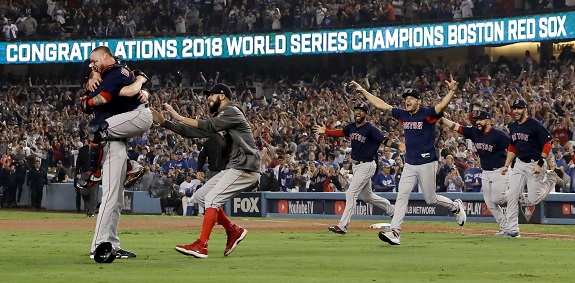
The Red Sox start celebrating their 2018 World Series conquest in Dodger Stadium . . .

On purely baseball terms the season barely a month old hasn’t been outstanding for the defending world champion Red Sox. There are small signs of them turning a corner, but small is the key word. So far.

They’re 14-18 to open, after a bullpen faltering led to a one-out, game-winning three-run homer by Nicky Delmonico of the White Sox in the bottom of the ninth Thursday night. It left the Red Sox six and a half games out of first in the American League East, while their eternal rivals from the south Bronx—battered as they’ve been so far—sit a mere two and a half out.

On terms just outside the lines these are interesting days for the Olde Towne Team. They’re scheduled to visit the White House next Thursday, after finishing a set with the Orioles in Baltimore, which is one sort of convenience. Maybe the only sort. Not that every last Red Sox plans to be there, but the club didn’t make the visit mandatory and offered their personnel the option to join or not.

The Athletic believes that traces back to an incident that followed their 2004 triumph, when co-owner Tom Werner turned up at a rally for presidential candidate John Kerry wearing a Red Sox jacket. He’d been criticised heavily for wearing the jacket at a political rally, and he says accepting the Trump invitation is simply a question of a presidential honour regardless of whom the office holder happens to be.

“To me, having sort of reflected on it, this is something that is an honor that’s been bestowed by the president and the White House on the Red Sox, and it’s not a mandatory event for the players,” Werner told the magazine. “Many players are excited to go, and many players have elected not to go, but we feel as an organization that we are appreciative of the invitation and we look forward to the experience.”

Werner, co-owner John Henry, their organisation, and their players are mindful enough that no matter who decides what it could be taken the wrong way, considering the political climate. Massachussetts isn’t exactly a bastion of unquestioned support for President Tweety, but the invitation did put the Red Sox in a kind of metaphysical bind, as The Athletic notes:

[A]ccepting or declining the invitation could have been spun as a political statement. In that sense, the Red Sox were in a lose-lose situation. If they turned down the invitation, the decision would have been cheered by many as a strong rebuke of the Trump administration, but it would have been derided by others as an overreach of political ideology. By accepting the invitation, the Red Sox have allowed their players a perhaps once-in-a-lifetime opportunity, while disappointing some of their blue-state fan base who will see, perhaps not an endorsement, but a tacit acceptance of the president’s more extreme statements and views.

The individual Red Sox are a mixed group when it comes to who will or won’t be at the White House next week. And Werner prefers it that way.

Manager Alex Cora still hasn’t decided whether to go; he’s been critical of how the Trump Administration dealt with hurricane relief in his native Puerto Rico. Pitcher Chris Sale and still-ailing second baseman Dustin Pedroia plan to be there. J.D. Martinez, the Red Sox designated hitter/outfielder, is an open Second Amendment supporter and is liable to be there, too.

Some observers may fear Trump himself will take those absent personally. or his supporters may take it as an indication the Red Sox need to be brought to heel. Maybe it ought to be made plain that accepting an invitation to the White House after a World Series or other triumph shouldn’t be assumed a concurrent gesture of support for a particular White House’s policies or politics, no matter who happens to occupy it.

Regardless of how many Red Sox actually show up next week, they’ll be the first baseball team of the 21st century to have met three sitting presidents. The stupefying, actual-or-alleged curse bust in 2004 plus their 2007 followup got them two meetings with George W. Bush. Their 2013 triumph, the first time they’d won a World Series in Fenway Park itself since Babe Ruth was still one of their pitchers, got them a meeting with Barack Obama.

The Yankees have some catching up to do. For that matter, so do the Giants: their Series conquests this century got them meetings with only one president (Obama), albeit three times. The way things are now, with the Giants in painful need of a remaking/ remodeling, the Yankees have a better chance to meet either Trump or his immediate successor.

Baseball and the White House were casual acquaintances for the most part since the Grant White House hosted its first professional major league team—the 1869 Cincinnati Red Stockings. Ronald Reagan—who began his professional life as a baseball broadcaster in Iowa and remained a baseball fan for life—turned inviting World Series winners to the White House into the tradition it’s become.

The Dodgers (twice), the Cardinals, the Orioles, the Royals, the Mets, and the Twins visited Reagan after their 1980s World Series wins. For his part, Reagan preceded those visits with calls to their managers (Tommy Lasorda, Whitey Herzog, Joe Altobelli, Dick Howser, Davey Johnson, Tom Kelly) immediately after they won those Series.

When Pete Rose broke Ty Cobb’s career hits record, the Reds’ then player-manager got a congratulatory telephone call from Reagan, who said, “You know, Pete, I’ve been rooting for you your whole career. Come to think of it, I used to root for the fella whose record you broke.” Had he still been in office when Hall of Famer Nolan Ryan blew Hall of Famer Rickey Henderson away for his 5,000th career strikeout (Ryan’s, not Henderson), Reagan would likely have called the Express.

Reagan himself entered the broadcast booth one more time before his term expired in 1988, joining Cubs broadcast legend Harry Caray. “You know, in a very few months I’m going to be out of work, so I thought I ought to audition,” the president quipped—before delivering an inning and a half of very credible play-by-play.

Try to imagine Trump, Obama, Bush (who was actually a former Rangers co-owner), Bill Clinton, or George H.W. Bush as baseball announcers, even in jest. Don’t ask, don’t tell.

What a difference over half a century made. The Washington Senators (the ancient, not-quite-wholly-accurate legend: “Washington—First in war, first in peace, and last in the American League”) won the 1924 World Series but Calvin Coolidge, who wasn’t exactly a baseball fan, wasn’t in any big hurry to host them at the White House–despite a flood of fan mail begging him to do it.

The Senators won the 1925 pennant and then Silent Cal met the Old Nats—right before they lost the Series in five games to the Pirates. Nobody knew, or dared to suggest, whether that proved any kind of White House jinx.

Coolidge’s successor, Herbert Hoover, was an unapologetic baseball fan who loved throwing out the ceremonial first pitch at Washington’s Griffith Stadium every April. He also made sure to be in the house for Game Five of the 1929 World Series, in Philadelphia’s Shibe Park, as the Athletics finished off the Cubs for whom Hoover was suspected of rooting—the Cubs at the time did their spring training on Catalina Island in California, near where Hoover had one of his two homes.

When major league baseball celebrated its centennial in 1969, Richard Nixon—who loved the game deeply (in his retirement he frequently brought his grandchildren to the field boxes in Shea Stadium)—greeted a large group of incumbent and former players, including Phillies pitcher Grant Jackson. At the time, troubled Phillies star Dick Allen was in a contract holdout. When Nixon advised Jackson to tell Allen to sign already because he wouldn’t make a better living anywhere else, Jackson didn’t miss a beat.

You tell him, Mr. President,” Jackson said. “He’s making more money than both of us.”

Dwight Eisenhower was a regular at Senators games in the 1950s, as well as a friend of owner Clark Griffith. Maybe his rooting interest (and, perhaps, the popularity of Damn Yankees?) kept Ike from nothing more than a personal letter to Don Larsen when that Yankee righthander pitched his perfect game in the 1956 World Series.

When the Yankees were invited to the White House after winning the 1999 World Series, a band struck up “Hail to the Chief” as Bill Clinton walked into the room accompanied by the Yankees’ then-owner, the (shall we say) Falstaffian George Steinbrenner. It might have inspired the least disingenuous remark Clinton ever uttered as president.

“Don’t get any ideas,” Clinton quipped to The Boss as the music began. “It’s not for you.”


When miracle workers re-convene

2019-05-02 AfterTheMiracleBack in 2001, three 1940s Red Sox—Hall of Famer Bobby Doerr, Johnny Pesky, and Dominic DiMaggio—planned a road trip to visit their Hall of Fame teammate Ted Williams one last time. Friends since their playing days, the trip’s only disruption was Doerr unable to make it after his wife suffered her second stroke.
Fifteen years later, one of the 1969 Miracle Mets, outfielder Art Shamsky, decided it was time to do something similar in visiting his Hall of Fame teammate Tom Seaver, after long-term, lingering manifestations of Lyme disease began curtailing Seaver’s travel away from his Napa Valley, California home and vineyard.

The Pesky-DiMaggio trek and the lifetime bond between them, Williams, and Doerr were recorded lyrically by the late David Halberstam in The Teammates: A Portrait of a Friendship. Until Harvey Araton’s Driving Mr. Yogi—about the bond between the late Hall of Fame catcher and a later Yankee pitching star, Ron Guidry, as spring Yankee instructors—there was no better chronicle of baseball friendships and their sometimes impenetrable bonds.

Shamsky rounded up pitcher Jerry Koosman, shortstop Bud Harrelson, outfielder Ron Swoboda, and baseball historian Erik Sherman for the journey to Seaver. And he’s  produced (with Sherman) After the Miracle: The Lasting Brotherhood of the ’69 Mets. (New York: Simon and Schuster; 325 p.; $28.00/$18.30, Amazon Prime.) Unlike the Halberstam and Araton books, Shamsky takes the weight of chronicling the final journey upon himself, from the inside, with Sherman’s help. And he delivers it as precisely as Seaver once delivered fastballs.

Shamsky, Koosman, Harrelson, Swoboda, and Sherman didn’t pile into a car and drive east to west for their trip as the old Red Sox did for Williams. The whole thing began over lunch between Shamsky and Sherman, pondering the coming 50th anniversary of the 1969 Mets. And, knowing Seaver—who has since retired completely from public life, after his family announced him diagnosed with dementia—wouldn’t be able to travel for any commemoration in New York.

When Sherman suggested bringing a reunion to Seaver, Shamsky pounced. All he needed was to pick the teammates for the trip. He wanted Harrelson desperately, since the former shortstop himself deals with the memory issues of Alzheimer’s disease. He also wanted Seaver’s rotation mate Koosman, “one of the most gregarious characters I’ve ever known”; and, Swoboda, with whom he competed for playing time in right field as a ’69 Met. “He’s liable to say anything, at any time, anywhere,” Shamsky writes admiringly.

When he told Seaver he wanted to bring that trio with him, Seaver was all in. “We’ll sit around, laugh a little bit, reminisce,” Shamsky told Seaver, “and tell the same old lies—the balls that we barely hit over the fence that are now five-hundred foot blasts—those kinds of lies.”

“Ahh,” Seaver replied with a chuckle, “but those are good lies.”

Swoboda hesitated at first, in the wake of his wife’s surgery to remove a malignant tumour, but went all in as well. Koosman was eager from the outset so long as he was free when the others could go. Harrelson was in, too, though his former wife (with whom he maintains a close friendship) first thought the tickets sent him for the trip came from a baseball card show promoter. Realising it wasn’t, Kim Harrelson left Shamsky one instruction: take lots of pictures to help him remember the journey.

The group was forewarned by Seaver’s wife, Nancy, that they were taking a small gamble. “We just don’t know how he’s going to feel—he gets foggy sometimes,” she advised. She knew the visit would be good for Seaver and for Harrelson, as well, “but just understand that some days are good and some days are not too good. Every day is different. It’s really a roll of the dice.”

They’d fly across country and have only one day to spend with Seaver. But it turned out to be the winning roll. The five Miracle Mets recalled the key days and nights of their unlikely trek to the World Series championship and some of the details involving their acquisition of several key pieces to it.

They enjoyed remembering things like first baseman Donn Clendenon’s wicked humour (his nickname was Clink), third baseman Ed Charles’s spirit, spare infielder Al Weis’s coverup of the bat logo on the souvenir bat he insisted on using in the Series (it was an Adirondack the feel of which he liked though he was signed with Louisville Slugger), the circus clinic the Mets outfielders put on in the Series, manager Gil Hodges’s deftness at using his entire roster, and, of course, the atmosphere around the team and its unlikely (to everyone but themselves) accomplishment.

Including the atmosphere of the city and the country during the Series. With unrest over the protracted Vietnam War achieving fever pitch, one demonstrator outside Shea Stadium hoisted a sign: BOMB THE ORIOLES–NOT THE PEASANTS! In baseball terms the peasants did indeed bomb the Orioles—not to mention out-pitch and out-catch them—to win the Series in an unlikely four straight following a Game One loss.

Koosman remembered entertainment legend Pearl Bailey stopping him as he paced nervously before his Game Five start. “Kooz, settle down, settle down,” Bailey told him. “I see the number eight, and you’re going to win.” Indeed. Weis’s unlikely blast in the bottom of the seventh, tying the game at three, was only the eighth home run the middle infielder ever hit in the major leagues. And, the last.

2019-05-02 TomSeaverJoanPaysonArtShamsky

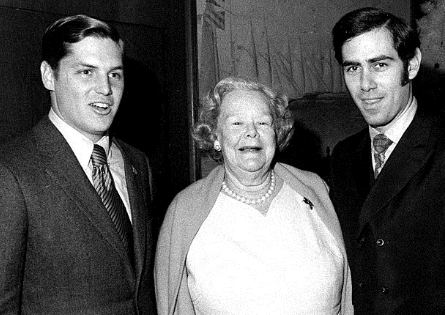
Seaver (left) and Shamsky (right), flanking original Mets owner Joan Payson in 1969.

The group also remembered the ribald prank Koosman hatched with a radio bug and a Mets television director named Jack Simon, the latter impersonating sportscasting legend Howard Cosell so dead on it shook Seaver to flip his radio on and hear he was being traded to the Astros—with Mets chairman M. Donald Grant in earshot. That was a prank, but Grant’s eventual purge of Seaver after a contentious contract renegotiation broke the Mets and their fan base in half eight years later.

They reveled with Seaver in his pride over his vineyard and indulged the one habit former ballplayers can never avoid when they reunite at all, never mind renew such friendships as these and other 1969 Mets share—an out-of-the-dugout version of bench jockeying. Consider this exchange, recalling a tough play for Swoboda on a rare day playing left field, with Harrelson in his customary habit of gunning out from shortstop on any short fly as Swoboda shot forward for it.

Swoboda: “I see Buddy and he ain’t stopping. But I didn’t even have time to make the call to say I had it.”

Seaver: “I remember that, too. I was pitching!”

Koosman: “Yeah. Cheech caught the ball and about three seconds later, you ran over him!”

Swoboda: “I know I did. But you didn’t want the ball to fall in, did you? I didn’t know what to do.”

Seaver: “Did anybody bother to use the English language out there?”

Harrelson today looks as grandfatherly as a former athlete can look and admits to writing notes to himself to help with his stricken memory. Koosman, who credited Hall of Famer Sandy Koufax for teaching him a better and more variable curve ball, resembles a portly rancher rather than the machine designer and pilot he became after baseball. Only Shamsky’s gray betrays his age; he still looks like a tapered ballplayer as well as the broadcaster he was and realtor he still is. Swoboda, a longtime broadcaster post-baseball, looks more like a former footballer now but does colour commentary for the telecasts of the minor league New Orleans Baby Cakes (AAA).

They swapped stories about Berra (a Mets coach from 1965-72, before succeeding Hodges as manager following Hodges’ fatal heart attack) and other coaches, including bullpen coach Joe Pignatano. (“Piggy was Hodges’s spy,” said Koosman about the coach Shamsky describes as having one job: “to keep control of the pitchers out in the bullpen who were out of control.”) And they reminded each other that age’s betrayals didn’t have to obstruct life.

Even as they miss the earthly presences of those among their 1969 fraternity long gone. Hodges, Charles, Berra, and Clendenon. (“Hey, remember the Caesar’s Palace act we had after the Series? Donn Clendenon would have himself paged every five minutes just to hear his name.”)

Outfield acrobat Tommie Agee, veteran pitcher Don Cardwell, spare infielder Kevin Collins, spare relief pitcher Cal Koonce, co-closer Tug McGraw. (“I’ll tell you one thing,” Seaver said of the flaky but effective lefthander, “I want him right here in my foxhole, I’ll tell you that!”) Third base coach Eddie Yost. (“I used to tease him all the time,” Shamsky says, “by saying, ‘Eddie, you really look like a ballplayer. You look like you could still play!”) Pitching coach Rube Walker. (“I’d call him even during the winter,” Koosman says. “He had a way of putting up with our BS and still have a smile on his face—just always glad to see you the next day.”) All long gone to the Elysian Fields.

2019-05-02 TomNancySeaver

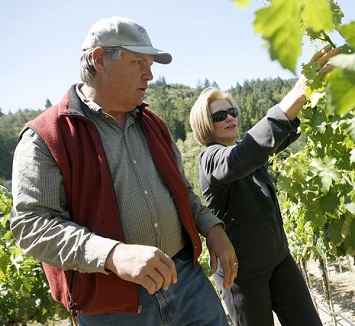
This Bloomberg photo shows Tom and Nancy Seaver amidst their Napa Valley grapevines in 2017.

Seaver now looks the part of a veteran wine grower especially when he’s paired with Nancy, his wife of almost 53 years, to whom age has been a little more kind. When having a private moment among the grapevines with Shamsky, Seaver admitted quietly that he’s had to ward off anxiety attacks since his condition became more acute than when he first battled Lyme disease while still living in Connecticut.

“I was so frightened,” Seaver recalled about such an attack, while with his wife en route visiting a former Mets announcer. (Seaver himself spent a few years as a Yankee announcer, teamed with Phil Rizzuto and Bill White.) “Man, it just made me breathe heavy like this. We turned around and went home. I mean, this Lyme disease ain’t fun. It can be absolutely frightening. The more cardiovascular I do, the better off I am. And drinking wine helps. I drink about half a bottle of wine per night. I haven’t had a beer in about eight years. But the traveling, no. I just can’t anymore.”

Meaning Seaver can’t be present when the Mets commemorate their first World Series winner come June. Or, at the Hall of Fame, in July, when Yankee relief legend Mariano Rivera, Yankee/Oriole ace Mike Mussina, Mariners hitting clinician Edgar Martinez, the late mound marksman Roy Halladay, longtime relief ace Lee Smith, and longtime outfielder Harold Baines will be inducted.

But you can get Seaver’s presence, and the bond of the biggest surprise champions of the 1960s, in this amiable book, mourning those absent, thankful for those still present, and quietly contented that their baseball fellowship melted into something more enduring than the transience of even the most transcendent World Series triumph.