Unknown's avatar

About Jeff Kallman

Member, Internet Baseball Writers Association of America and the Society for American Baseball Research.

A three-run homer bails out a manager’s brain vapor

2019-05-23 CarlosGomez

Usually, you come out of your shoe swinging hard. Carlos Gomez came out of his running hard enough—stealing second in the fifth, before hitting the three-run homer that bailed his manager out.

Leave it to Mickey Callaway to go from two steps from the electric chair to three games worth of resembling a craftsman to tripping over his own sensible change of mind in one harsh top of the eighth. Here was the perfect opportunity to send Edwin Diaz out for one of those four-out saves Callaway formerly quaked over asking, until he either saw the light or felt the heat when his execution seemed nigh.

Diaz wasn’t seen anywhere near a warmup mound in the Mets bullpen, though Tyler Bashlor and Ryan O’Rourke were. Bloody good thing for Callaway that Carlos Gomez bailed him out with a three-run homer. He’d have had a lot of splainin’ to do otherwise.

You guessed it. That’s when Diaz was ordered up and throwing. You take your victories when you can get them, of course, but Callaway didn’t have to make it this hard on himself or his Mets, even though the 6-4 win did consummate a sweep against even the hapless Nats on which nobody would have bet after last weekend’s Miami disaster.

Two outs, Nationals on second and third, Robert Gsellman already having allowed the Nats to cut a hard-pried Mets lead of 3-1 down to a single run. That was after he opened the inning nailing Howie Kendrick on a check-swing strikeout that got both Kendrick and Nats manager Dave Martinez tossed for arguing. So far, so good.

But Diaz wasn’t seen on either warmup mound in the Mets bullpen, though Tyler Bashlor and Ryan O’Rourke were. And Gerardo Parra, pinch hitting for Nats starter Stephen Strasburg, was checking in at the plate. The good news was Gsellman starting Parra in the hole 0-2. The bad news was, after missing with a curve ball and a changeup and a weak foul off, Parra shooting a base hit to right center to overthrow the Mets lead.

Then Gsellman struck out Trea Turner for the side, after the Mets’ possibility of sweeping the otherwise hapless Nats suddenly hovered above an alligator pit. And Diaz still wasn’t seen warming up until the Mets opened the bottom of the eighth with pinch hitter Dominic Smith’s leadoff double.

So at minimum Callaway figured now to bring him in in a re-tied game. Assuming it would be re-tied, after Nats reliever Wander Suero dialed his inner Mariano Rivera and, feeding Todd Frazier and Pete Alonso a diet of cutters, back-to-back strikeouts.

But the Nats inexplicably elected to put Mets catcher Wilson Ramos aboard first. Unless they thought Ramos couldn’t possibly account for a second Met run behind Smith on any base hit, since Ramos runs at paraplegic speed, the move made no sense. It made even less sense when Gomez fell behind 1-2, with Suero continuing to serve up the same strictly cutter diet, before Suero served a cutter that didn’t cut and Gomez sent it on a high line over the left field fence.

Then Callaway brought Diaz in for the conventional ninth-inning save opportunity. First, Diaz struck out Adam Eaton. Then Nats third baseman Anthony Rendon channeled his inner Robinson Cano, sort of, nicking one in front of the plate fair and standing frozen as Ramos picked up the ball fair and tagged him. Then Diaz fought Matt Adams to a tenth pitch and struck him out swinging on a pitch that dove so low a golfer couldn’t have gotten a driver onto it.

Strasburg and Mets starter Steven Matz dueled peculiarly enough. The Mets pried only one run out of Strasburg with a fifth-inning sacrifice fly, but the Nats shoved Matz into and out of trouble with ten hits and nothing to show for them than a sixth-inning run, scoring on a bunt single by Brian Dozier and an error of styling by Mets second baseman Adeiny Hechavarria on a throw, allowing Juan Soto—who missed the cycle by a homer on the day—to score it.

(For those scoring at home, the Mets have been the victims of only three cycles in their entire history, with only one of those three coming at home, in 1965 in Shea Stadium. The last two—to Ray Lankford and Hall of Famer Vladimir Guerrero—came in those players’ home playpens.)

Somehow, the Nats spent the day going 3-for-14 with men on second or farther to the Mets’ going 2-for-6 likewise. The Nats went 6-for-33 in that situation over all four games. Matz and company Thursday only completed the Nats looking guilty of first-degree desertion.

And somehow, Gsellman—who saw his fifteen-inning scoreless streak evaporate with two bad pitches, a fastball down the chute to Parra and a sinker that sank about as much as a 747 on takeoff to Soto—came out alive and with credit for a win. Still believe in the irrevocable supremacy of pitching wins? Explain how Gsellman barfed a Met lead into a Met deficit and won the game.

Oh, yes. Gomez provided all the explanation you needed in the bottom of the eighth. Lucky for Gsellman. And, lucky for Callaway.

For the moment, Gomez—who hadn’t hit one out in a Met uniform in twelve years—made Callaway resemble Hall of Fame manager Earl Weaver. (“The key to winning baseball games,” Weaver liked to say, “is pitching, fundamentals, and three run homers.”) The skipper could look worse, and too often he has.

But what happens the next time the Mets might be in need of a four-out save? Maybe it’s best not to ask just yet. The finish wasn’t quite as pretty as the rest of the series but let the Mets enjoy this sweep. The Nats’ Lucys got a lot more splainin’ to do after this one.

Even doing right can be turned wrong

2019-05-22 RajaiDavis

Can’t find the ballpark, get there in the third, can’t find the clubhouse, don’t see the boss until the fifth—that’s how you pinch hit a three-run homer in the eighth, folks . . .

There are few feelings in baseball worse than making the right move that gets blown up in your face. Especially when you have the league’s shakiest bullpen other than your closer. And you’re thought to be in a seat almost as hot as the one your counterpart in the other Citi Field dugout was thought to occupy.

Unless it’s watching your one genuinely reliable relief stopper surrender a three-run double and a three-run homer within two blinks. The latter hit by a veteran recalled from the minors who almost couldn’t find his way to the park or to his clubhouse.

Dave Martinez’s seat may have gone from toast temperature to broiler in one terrible eighth inning Wednesday night, and he had nobody in the mirror to blame this time. The Mets—including a former World Series almost-hero who couldn’t find Citi Field itself until about the third inning—took care of that with a six-run eighth and a 6-1 win and an omelette all over Martinez’s face.

And Rajai Davis, who was once an Indians icon for tying a seventh World Series game with a mammoth two-run homer, must feel like there was an angel on his shoulder after he could have spent the first night of his new promotion in the proverbial doghouse.

“I was trying to stay short to the ball,” Davis said after he hit a three-run homer to finish the six-run eighth. If he hadn’t, it’s not impossible that his stay as a Met could have ended up a long walk off the shortiest pier along the Gowanus Canal.

Martinez didn’t want to ask Sean Doolittle for a six-out save even though Doolittle is maybe the only Nats relief pitcher this year who refuses to leave himself at the mercy of an opposing lineup. Even with a 1-0 lead as the inning began.

Even with that lead earned the hard way, with the previous two seasons’ Cy Young Award winners, Jacob deGrom and Max Scherzer, dueling hard, fighting through less than their best, and battling despite a plate umpire with an incredibly changing-on-a-dime strike zone that had both pitchers and about half of each side’s hitters fuming.

Martinez opened the Mets’ eighth with Kyle Barraclough. Having two outs but a man on second wasn’t Barraclough’s fault, since in between the outs Mets second baseman Adeiny Hechavarria—in the game after Robinson Cano strained a quad muscle on a baserunning play—shot one high toward the left center field wall on which, inexplicably, both Nats center fielder Victor Robles and left fielder Juan Soto pulled up short, allowing a catchable ball to hit the wall.

Then Barraclough walked Mets third baseman Todd Frazier on four pitches. With two out and the Nats still up by the sole previous run—a first-inning homer by Adam Eaton—Martinez took no more chances. He reached for Doolittle. He had every reason on earth to have faith in Doolittle.

He had no reason to believe Doolittle would hit Carlos Gomez on the first pitch to set the ducks on the pond, right off the elbow guard with a wicked ricochet. He had no reason to believe that Juan Lagares would clear the pond with a drive into the left center field gap. And he had no reason to believe putting late Mets catching insertion Wilson Ramos aboard to get to ancient Davis would telegraph disaster.

Davis signed a minor league deal with the Mets last December and was toiling on their Syracuse farm when Brandon Nimmo hit the injured list and Davis got the call. His age caught up to him in earnest, alas, little by little, after he became an Indians legend by taking Aroldis Chapman deep to tie Game Seven of the 2016 World Series.

When he arrived in New York Wednesday, the 38-year-old Davis had a hard time finding both the ballpark and the Mets’ clubhouse. He didn’t even meet his new skipper Mickey Callaway—the pitching coach for those 2016 Indians—until the fifth inning. Yes, that’s so Mets.

Naturally, then, Davis got the call to bat in the eighth. That, too, is just so Mets. And he fought Doolittle to a ninth pitch on a 2-2 count after several lofty foul offs. Then came pitch nine, the ninth straight fastball of the sequence. And Davis drilled it over the left field fence. There’s nothing like a howitzer shot for three runs to get you off the hook for failing to have your GPS calibrated properly on the first day of your new promotion.

Out in the Mets bullpen, a fully warmed-up Edwin Diaz suddenly knew he’d get the night off, and Tyler Bashlor shook off a one-out single by Juan Soto to strike Matt Adams out and lure Kurt Suzuki into a game-ending force.

Martinez may have had his issues with game tactics and resource management in his first two seasons on the Nats’ bridge, but this one wasn’t on him. He didn’t build this Nats bullpen, and it wasn’t his idea to enter tonight’s game with his pen brandishing a collective ERA over six going in.

If he couldn’t bring himself to ask Doolittle for six outs at least he was sharp enough to know his best chance to keep that 1-0 lead in the Nats’ harried hands was to bring his lefthander in for four outs.

If neither Scherzer nor deGrom expected to have to have a psychological wrestling match with plate umpire Ryan Blakney until they each came out of the game, Doolittle didn’t exactly go to the mound looking to hand Gomez first on the house, never mind a pair of bases-emptying drives that handed him his head on the proverbial plate.

All Nats fans know is someone got some splainin’ to do. Good luck trying to explain Wednesday night’s inexplicable. I’m not even sure the Mets can explain their part in it, and they were the ones doing it.

Martinez fiddled after Callaway burned him

2019-05-21 NewYorkMets

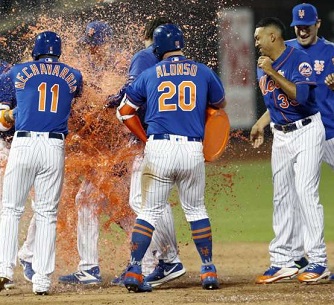
We presume it’s Amed Rosario getting the Gatorade shower from Adeiny Hechavarria (11) and Pete Alonso (20) with Edwin Diaz (39) enjoying the fun. All three figured big in the Mets’ Tuesday night win . . .

You’re not going to believe this. Even I’m not sure I believe it, and I was watching.

The Mets hosting the Nationals. Each team shepherded by a pair of managers about whom saying they’re on the proverbial hot seat is a little like saying the Titanic had a little bump on the starboard hull. Playing the second game of a set that began with Mets manager Mickey Callaway barely dodging a date with the executioner.

As if to give Callaway their own vote of confidence after the front office gave him one Monday afternoon, the Mets beat the Nats 5-3 in ten innings Monday night. And it proved to be nothing compared to how the Mets beat them 6-5 Tuesday night.

And, to how Callaway actually out-skippered Nats manager Dave Martinez when the same situation presented to each skipper. With Martinez having no further to look than across the field as well as the mound to get the hint.

Three times the Mets came from behind in the game and entered the top of the ninth tied at five. And Callaway decided to forget whatever it is his Book told him earlier in the season regarding his closer Edwin Diaz.

Actually, Callaway had decided then that Diaz wasn’t going to be in anything much other than no-questions-asked save situations, even when the Mets needed a stopper before such situations arose, if they arose.

Maybe Callaway saw the light. Maybe he felt the heat. But that was then, this was now, and there was Diaz strolling to the mound to open the top of the ninth in a five-all tie. And he zipped his way around a one-out single with two strikeouts for the side. Then it was Martinez’s turn.

Martinez’s closer Sean Doolittle was nowhere to be seen in the bottom of the ninth. “Martinez considered using Doolittle,” noted the Washington Post‘s Jesse Dougherty, “but wanted to keep him ready for a potential save situation.” Infamous last words?

If you didn’t count Mets rookie Pete Alonso hitting a 1-2 service about 25 feet above the top of the left field foul pole to tie the game at five in the first place with one out in the bottom of the eighth, Martinez liked what he saw from rookie righthander Tanner Rainey. Maybe too much so.

Martinez stayed with Rainey. And at first Martinez looked like a genius when Rainey struck out Carlos Gomez on a climbing 3-2 fastball. Then Rainey walked pinch-hitter Adeiny Hechavarria after a seven-pitch wrestle. After which Rainey walked late game insertion J.D. Davis on seven pitches.

Doolittle was still the invisible Nat, but Kyle Barraclough, one of the Nats’ more notorious arsonists, was very visible warming up most of the inning. In he came. You could hear everyone back in Washington unoccupied with the foibles and follies of government wondering aloud if the game was lost right then and there. You couldn’t blame them.

At first Barraclough looked to keep things in order enough when he got Jeff McNeil to hop one that might have been a extra innings-setting double play, until the ball hopped oddly to second baseman Brian Dozier allowing McNeil, who’d broken out of the batter’s box like a horse busting out of the gate, to make first safe and first and third, period.

And Doolittle remained the invisible Nat.

After McNeil took second on the house, the Nats not even bothering, Barraclough fell behind 3-1 to Mets shortstop Amed Rosario. Then Rosario bopped one off the plate and it two-hopped to his Nats counterpart Trea Turner playing deep enough. Rosario up the line and Hechavarria from third made McNeil resemble a flu-addled mule, Rosario beating Turner’s throw to first by a step and Hechavarria shooting home with the winning run.

To think that the Nats had taken a 3-1 lead off Mets starter Zack Wheeler in the seventh, after Callaway left Wheeler in for one pitch too many, the one-out/one-on/1-1 hanging slider Dozier hung over the left field fence.

To think that Callaway atoned for that mistake in the bottom of the inning when he shifted into all-hands-on-deck mode and got rewarded richly enough. By usually slow catcher Wilson Ramos following a leadoff single by taking second alertly on a passed ball. By Wheeler’s pinch hitter Dom Smith wringing Nats reliever Wander Suero for a four-pitch walk. By Davis catching hold of Suero’s hanging curve on 1-2 and sending it the other way off the top of the right field fence to give the Mets a 4-3 lead.

To think that Turner in the top of the eighth would hit a bizarre RBI double, the liner hitting a concrete sidewall past the left field foul line and then taking the kind of ricochet you’d see throwing a rubber ball to a stoop with the ball hitting the edge of a step, shooting past the oncoming Davis inserted into left field. And, that Juan Soto—who led off the top of the second with a hefty home run off Wheeler to open the game’s scoring—would double to right a walk and a sacrifice bunt later.

And, to think that Alonso would tie the game while breaking the Mets’ rookie record for most pre-All Star break home runs while also hitting the eleventh of his sixteen bombs on the season in or after the seventh inning.

No wonder he’s already in the Rookie of the Year conversation. So far as bullpens are concerned the bulls probably think Alonso might as well check in at the plate in a matador outfit with a big red cape for what he does to those bulls, and a sword instead of a bat.

But Callaway’s bigger test comes Wednesday, when Jacob deGrom squares off against Max Scherzer in the second meeting between National League Cy Young Award winners defending (deGrom) and past (Scherzer, twice). When he has to decide at long last, does he insist stubbornly on running Ramos out behind the plate despite the 5.33 ERA deGrom has throwing to him, or does he wake up and run Tomas Nido—throwing to whom deGrom’s ERA this year is 0.43—out to work?

Callaway showed Monday night that he can be a little on the bold side when the situation demands it. Well, Wednesday night demands it. If the Mets want a shot at sweeping the staggering Nats and maybe postponing Callaway’s execution orders far further while they’re at it, it needs to be Nido catching deGrom. There needn’t be any further debate.

Maybe the Mets need a kangaroo court

2019-02-07 FrankRobinsonKangarooCourt

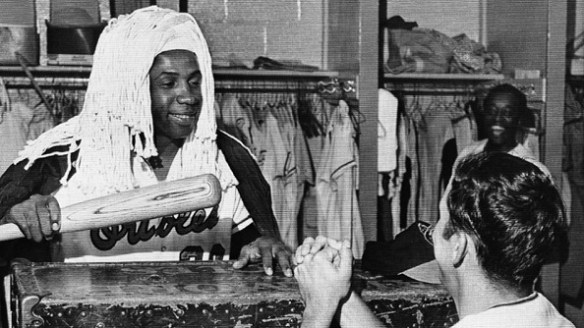
Judge Frank Robinson was the Learned Hand of baseball’s kangaroo courts. The Mets (whose future manager Davey Johnson you see pleading before Judge Robinson) ought to bring the tradition to their clubhouse. Anything would be an improvement over their current lapses . . .

When Robinson Cano loafed on a double play grounder thinking there was one more out than there actually was Friday night, Mets manager Mickey Callaway responded almost with a shrug. Actually, it was closer to the indulgent momma assuring Junior it was no crime to put his foot through the neighbour’s china closet because the china closet had no business being there.

It happened during an 8-6 loss to the Marlins, of all people, the basket case of the National League East. The six runs would be the only six the Mets scored all weekend long against the Fish. With Callaway’s job firmly on the line.

“We talked about it, and he understands that can’t happen again. You don’t just reprimand people to send a message to the rest of the team,” Callaway said after the Friday night folly. “You do things for the right reason. I think the team all understands what happened, and I know Robbie does and he has that expectation that can’t happen again.”

Except that, come Sunday, while the Mets made Marlins starter Sandy Alcantara look like Sandy Koufax, Cano—who had a long enough standing reputation for not always hustling out of the batter’s box when it wasn’t a too-obvious pop fly infield out—struck again. He dropped one in front of the plate in the fourth with J.D. Davis on first. He stood there, as if arguing the ball was foul. It wasn’t, and the Marlins executed a 1-6-3 inning-ending double play.

Junior put his foot through the neighbour’s china closet again.

“I don’t want to say it’s a bad look because, like I said, I thought it was foul, like everybody else,” Cano said after Sunday’s 2-0 loss and the attendant brain vapour. Except that everybody else knew the ball nicked off the plate and sat on the first base line before Marlins catcher Chad Wallach fielded it to start the DP. Cano never left the box other than to plead with plate umpire Jordan Baker. This time, someone’s going to fan Momma’s behind for it, since Momma won’t fan Junior’s behind for it.

There’s never a kangaroo court around when you need one. The Mets need one. Bad. If the manager isn’t going to sit on his players for mental mistakes, the players need to police themselves. Kangaroo courts used to be the perfect method for holding teammates accountable.

Sure, they’d be fun and funny, and often as not a kangaroo court’s chief judge would convict the miscreant and fine him a fair amount over something patently ridiculous. But the kangaroo courts also held players accountable for mental mistakes and deportment violations. The Mets probably aren’t the only team who could use one, but right now they may be the most obvious candidates.

The late Hall of Famer Frank Robinson—who brought the concept from Cincinnati to Baltimore after his infamous trade—was probably the Learned Hand of baseball’s kangaroo jurists. Fail or lapse on the bases and Judge Robinson, wearing a kooky contraption of an unused white string mop glued to a catcher’s helmet and wielding a bat for a gavel, would lighten you in the wallet and maybe hang his Base Running Award from the top of your locker—an old, beat-up spiked shoe. If you were too much of the proverbial red ass, the Judge would also leave you a red-painted toilet seat. If you were caught talking to girls in the seats for too long, it’d cost you a buck, as it often did outfielder Don Buford.

That recollection courtesy of The Hardball Times‘s Alfonso Tura, who wrote last month about the rise and fall of baseball’s kangaroo courts. Tura noted there were some managers who thought them threats to their own clubhouse authority while other managers actually asked certain players to open them. Hank Bauer and then Earl Weaver with the Orioles throve on Judge Robinson’s courts.

In fact, Weaver himself didn’t mind being hauled before Judge Robinson. “I was among the first — and most consistently — fined because my coaches ganged up on me,” the customarily ornery manager once told The New York Times. “In a doubleheader in Cleveland, I rested Mark Belanger in one game, then put him in for defense in late innings. Mark made two errors. In the clubhouse afterward, the kangaroo court was called to order, and Billy Hunter stood up and said: ‘Your honor, I’d like to charge Earl Weaver with misguided managing. He sent in Belanger for defense, and Mark made two errors’.”

Yogi Berra all but begged a Robinson disciple, Don Baylor, to convene one with the Yankees in 1984. “Yogi was like Earl Weaver; he didn’t see the court as a threat for his authority,” Tura wrote. “He thought the court would bring the emphasis back on execution. And he also looked to inject some levity to stop the boredom and frustration. Baylor’s first choice was to name [Hall of Fame pitcher] Phil Niekro as a one-man Supreme Court. Frank Robinson never reported to a higher authority, but Baylor assumed that Niekro’s word would outrank his. To appeal any fine he delivered, players had to consult Niekro. If they lost, the fine automatically doubled. Baylor knew that Niekro was implacable. He never changed a verdict.”

Baylor continued the practise after he left the Yankees. His fines weren’t exactly expensive, either. “If you batted with a man at first or second base and less than two outs, you either advanced the runner or it was five bucks,” Tura wrote. “Fraternization also cost five dollars. Two minutes, no more, were allowed to ask a friend on another team about the family.”

Pitchers may have faced a slightly different scale. “Pitchers were punished for allowing 0-2 base hits, with the severity of the penalty depending on the circumstance. Baylor’s fines were in the five-dollar range. When Niekro surrendered a grand slam to Ken Phelps on a 0-2 pitch, the fine was $100 — $25 for each base.” Baylor’s only other $100 fine was slapped on Red Sox reserve Steve Lyons—for being thrown out at third on what should have been an easy advance.

The custom among teams who convened kangaroo courts was that all the fines paid throughout the season would normally go to pay for a pleasant party at season’s end. Robinson made an exception in 1969: he ordered the money be given to Reds backup catcher Pat Corrales, whose wife died while giving birth to their fourth child.

Someone in the Mets clubhouse needs to convene a kangaroo court. It could be Jacob deGrom, the defending Cy Young Award winner. It could be Noah Syndergaard, who dropped Alcides Escobar with a message pitch to open Game Five of the 2015 World Series after Escobar and the Royals spent the first two Series games batting as if they’d had Barcaloungers in the batter’s box. It could be Wilson Ramos, in his first season with the team but known as a clubhouse leader wherever he goes.

Of course, if Callaway isn’t out of a job before the umpire hollers “Play ball!” Monday, the Mets’ court could probably fine him enough for infractions enough to blow the whole team to dinner at Tavern on the Green the same night.

The Nationals come to town Monday, and they wouldn’t exactly be hurt if they convene a kangaroo court, either. Though in fairness they, like the Mets, could probably haul their manager before the bench a few times. The Nats have looked fundamentally less than sound, too, this season, but then Dave Martinez has tried compensating for their injury list adventures by playing so many people out of position Frank Robinson could probably collect one day’s worth of a Max Scherzer’s salary in a week’s worth of fines.

Scherzer, Anthony Rendon, Stephen Strasburg, and Ryan Zimmerman might be the best Nats candidates to don the wig mop and wield the bat gavel. It’d be worth the price of admission to catch Judge Scherzer pounding a $100 fine on Martinez for playing anyone else out of position or on the bullpen for bringing blow torches instead of pitches to the mound.

At this point, it could almost be anyone on either team. Unless the Mets and the Nats really do have a few too many kangaroos.

Mickey dismantled?

2019-05-19 MickeyCallaway

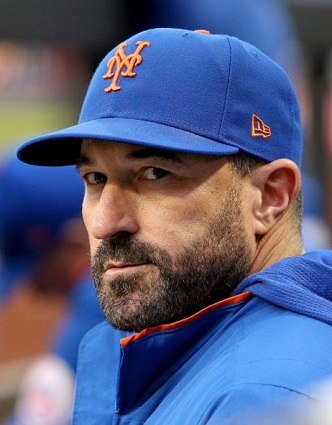
Mickey Callaway, looking here like what he might be on Monday, a man facing a firing squad . . .

If you’re a manager, look at it this way: You have a pitcher who’s top of the line enough to be the league’s defending Cy Young Award winner. You don’t have any of the catchers to whom he threw to win that award. This year, you have one catcher with whom he has a 5.33 earned run average in five starts throwing to him, and another with whom he has a 0.43 ERA in three starts.

You have the data and you’ve seen it in live action. Who do you send behind the plate to give your ace, and your team, the best possible chance to win? Should be the proverbial no-brainer, right? Especially if you were once a well respected pitching coach who should know these things.

And your number one job as a manager, other than navigating assorted clubhouse personalities and tensions, is giving your players and thus your team the best possible chance to win. So you see your ace working to a 0.43 ERA and think to yourself, that’s the catcher who ought to be working with him if you want to win. Right?

If you’re embattled Mets manager Mickey Callaway, apparently, wrong. Even if the ace in question is Jacob deGrom. Even if his ERA with Wilson Ramos behind the plate is 5.33 but his ERA with Tomas Nido behind the plate is 0.43. They’re both new to working with deGrom but Nido’s apparently doing the better job with him. This isn’t the time to double down against the idea of a personal catcher especially for a defending Cy Young Award winner.

DeGrom is too team oriented to think about it, apparently, but the manager’s job includes thinking about things his players might not ponder otherwise. But Callaway insists, and I quote, “Things aren’t going well enough for anybody to demand their own catcher.” Even though deGrom hasn’t asked for one yet.

If he’s actually aware that deGrom is doing better with Nido behind the plate, Callaway ought to reconsider while he still has his job. Which too much speculation says he won’t after this weekend. The Mets pitchers overall have a 4.37 ERA with Ramos behind the plate and a 3.20 with Nido behind the plate. Which part of that difference doesn’t register when Callaway reads the data?

It’s rare for a theoretical contending team to face a must-win series against their division’s saddest sacks, but that’s just about what the Mets faced when they opened this weekend’s set with the Marlins.

And they got swept by the Fish. It might be a little too soon to say, “Season over,” but it’s not exactly unfair to say, “Season has only two fingertips hanging onto the high wire,” either.

On Friday night, even allowing that he hasn’t got the best bullpen in the league to work with overall, Callaway inexplicably left deGrom in to take a seven-run beating in five innings that shouldn’t have gone that far. He had nobody prepared when deGrom looked early enough like he didn’t have it that night. And his catcher was Ramos.

On Saturday, Pablo Lopez and two relievers one-hit the Mets, 2-0. Steven Matz returned from a brief injured list sojourn to work three and two thirds rusty innings surrendering both Marlins runs and three Mets relievers kept the Fish shut out the rest of the way.

Come Sunday, Noah Syndergaard kept the Marlins to a pair of runs they didn’t begin to pry out of him until the sixth, but Sandy Alcantara picked the perfect day to pitch a two-hit shutout with the Mets making it only too easy for the Marlins righthander. Nido caught Syndergaard for the first time this season. Syndergaard’s previous starts saw him throwing to Ramos and posting a 4.02 ERA with him behind the dish.

Calloway had another problem on Friday night when veteran second baseman Robinson Cano jogged up the first base line on a double play grounder in the seventh. Cano admitted he thought there were two outs, partially thanks to a scoreboard error he spotted as he left the batter’s box. The manager handled it not too far removed from the indulgent mother reassuring Junior that it wasn’t his fault he put his foot through the neighbour’s china closet, the china closet had no business being there.

You don’t want Callaway to read Cano the riot act, but you didn’t necessarily expect him to hand Cano a pass, even a veteran’s pass. If anything, you’d think veterans know enough to keep their heads in the game without the scoreboard’s help. Cano was apologetic after that game but, even so, Callaway needed to take a firm enough hand. Cano didn’t face anything like a benching the rest of the weekend.

And it bit Callaway in the wrong possible spot again come Sunday. In the top of the fourth, with J.D. Davis on first, Cano whacked a dribbler in front of the plate and stood there for the most part, arguing the ball was foul (it wasn’t) while the Marlins turned a 1-6-3 inning ending double play.

None of the foregoing, of course, could put anything into the Mets’ mostly feeble bats otherwise this weekend. They scored six times Friday night and those were the only six runs they’d score on the weekend. The Marlins’ pitching took care of them effectively enough.

But why wasn’t deGrom afforded the chance to throw to the catcher with whom he and the Mets’ staff overall, while we’re at it, are getting his best results so far? Nido isn’t much of a hitter and I get that, but if you think a catcher’s number one job is handling his pitchers and calling games, you should be thinking maybe Nido gives you a better chance to help keep the other guys at bay.

At least until you find someone who can catch as well as Travis d’Arnaud did last year while being able to hit the way Ramos once did. D’Arnaud became expendable this year with Ramos’s arrival and his own futile season opening, but last year the Mets’ overall ERA with d’Arnaud behind the plate was 1.85.

And if the Mets are going to be as inconsistent as they’ve been so far at putting runs on the board, they need all the help they can get at keeping the other guys from putting runs on the board.

“If you start allowing somebody to pick their own catcher, then Ramos is not going to start four days in a row and then Nido is going to catch deGrom. That is not something that is going to be helpful to our team,” Callaway said before Sunday’s game. “It’s better to throw to whoever is catching that day and just get it done.”

Uh, no it isn’t. If Jacob deGrom’s working better with Tomas Nido behind the plate, you run Nido out there every time you give deGrom the ball until or unless Nido begins to falter on the job. You don’t have to let every pitcher on the staff pick his catcher, but you give a defending Cy Young Award winner at least some respect enough to let him pick the guy to whom he’s most comfortable throwing.

It’s not exactly unheard of. Ordinarily a team might allow a pitcher a personal catcher on behalf of giving the regular catcher a little rest, and if there’s any fielder who can use it it is the catcher. But otherwise a team might notice a pitcher doing particularly well with one catcher as opposed to others on the roster and make sure that catcher and that pitcher are hooked up regularly.

The point is to win. And if that gives you the best chance to win, go for it. Yogi Berra didn’t become a Hall of Fame catcher by hitting alone. You can look it up: in all his years as the Yankees’ number one catcher, Yankee pitchers not named Hall of Famer Whitey Ford did better with him catching than they did with any other Yankee catcher. And almost all of them pitched better as Yankees than at other times in their career thanks to having Yogi behind the plate.

Nido also can’t help the Mets with other issues. They’re last in the league in defensive runs saved; they’re fundamentally lacking; and, Callaway’s modest response to Cano’s double play misadventures simply added to any perception that he’s not the motivator, never mind tactician, the Mets need. Especially after Junior thanked Mama by putting his foot through the neighbour’s china closet for the second time in three days.

Marry that to this former pitching coach’s inability to keep a defending Cy Young Award winner in a comfort zone and put three other starters into the best conditions to work well, not to mention mal-managing a bullpen that wasn’t exactly great overall but wasn’t exactly full of rag arms, either.

It’s the formula by which a manager whose team was expected to contend this season finds himself facing a possible firing squad. And if the Mets are rounding up the firing squad, they should be pondering who’s going to succeed the fallen. Possibly as soon as Monday. When the Mets come home to open a set against the equally sputtering Nationals, who have issues aplenty of their own.

Incumbent bench coach Jim Riggleman might be a sort-of consensus interim choice despite his less-than-stellar overall record, but currently-exiled Joe Girardi and Dusty Baker may be wishing and hoping. Just don’t cast your lonely eyes upon Mike Matheny or Buck Showalter. When push comes to shove, they’re too wedded to their Books.

The Mets need to think beyond The Books if they’re going to throw the book at Callaway. And, the switch.