The first five days

Stop me if you’ve heard it before: Jacob deGrom pitched like a Hall of Famer, but the new Mets bullpen puked the bed like the old one did.

The fans are back in the stands, however limited by ongoing COVID-19 safety protocols, but the Nationals have yet to play a regular-season game thanks to a few players and a staffer or two testing positive. There went that Opening Day must-see match between Max Scherzer and the Mets’ Jacob deGrom.

With their opening set with the Nats thus wiped out, deGrom had to wait until the Mets went to Philadelphia Monday. Oops. That and everything else seemed to play a support role to the horrid news out of San Diego.

The news that Fernando Tatis, Jr., the Padres’s new bazillion dollar shortstop, suffered a partial left shoulder dislocation on a hard third inning swing at the plate during a Monday loss to the Giants.

Padres manager Jayce Tingler told reporters he thinks team trainers and medical people were able to pop the shoulder back together, but the team isn’t taking chances. At this writing, MRI results aren’t available and nobody knows yet whether Tatis will spend significant time on the injured list.

If it’s more than a small shoulder dislocation, it may not be significant time. If it’s something like a labral tear, Tatis could miss six months—essentially, the rest of the season—according to one doctor who knows such shoulder troubles and spoke to the Los Angeles Times. Don’t fault the Padres if they’re saying to themselves, “Thank God for insurance.”

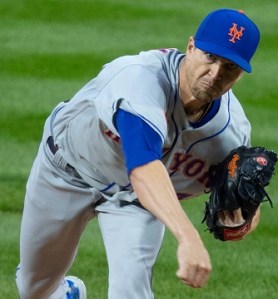
DeGrom could use a little extra insurance himself, alas. The good news for the Mets: deGrom was his usual self Monday night. Six shutout innings, seven punchouts, three hits, three-figure speed on his fastballs. The bad news, alas: the Mets are gonna Met, so far. At least out of the bullpen.

Their on-paper impressive offense found nothing more than two runs to support their ace. They got an inning of shutout relief from Miguel Castro relieving deGrom for the seventh, but the bullpen puked the bed in the eighth—including hitting Bryce Harper with the bases loaded. Not exactly a Rhodes Scholarship move there.

The Old Fart Contingency thundered aboard social media that Mets manager Luis Rojas blew it lifting deGrom after six strong—until they were reminded the added layoff after the Washington postponement put both deGrom and the Mets into caution mode.

“If that was [last] Thursday and I’m on normal rest,” the smooth righthander said postgame of the early hook, “I don’t think there is any chance I’m coming out of that game. We discussed it before what was the right thing to do. Long season and talking to them coming in, it felt like was the right decision.”

It was neither deGrom’s nor Rojas’s fault that, after Garcia took care of the Phillies in the seventh with just one infield hit within a fly out and two ground outs, the Phillies loaded the bases on the Mets’ new relief toy, Tyler May, in the eighth with one out, before Rojas went to another new Met bull, Aaron Loup. And Loup promptly hit Harper to push Miller home, before J.T. Realmuto singled home pinch runner Quinn, Mets late third base replacement Luis Guillorme threw home off line allowing Harper and Rhys Hoskins to score, and Didi Gregorius pushed Realmuto home with a first-pitch sacrifice fly.

The Mets had nothing to answer except a two-out ninth-inning stand that came up two dollars short against Phillies closer Alvarado. Kevin Pillar singled up the pipe, Francisco Lindor—the Mets’ own new bazillion-dollar lifetime shortstop—dumped a quail into shallow right that landed just in front of and then off the glove on oncoming, diving Harper, and Michael Conforto singled Pillar home while setting up first and third.

Pete Alonso, their 2019 Rookie of the Year bomber, hit one to the back of right field that looked as though it had a chance to ricochet off the top of the fence if not clear it. It wasn’t quite enough to stop Harper from running it down, taking a flying leap with his back against the fence, and snapping it into his glove to stop a game-tying extra-base hit and end the game with the Phillies on the plus side, 5-3.

Marry the foregoing to deGrom going 2-for-3 at the plate including an RBI single, and no wonder May himself said post-game, “Jake shouldn’t have to do everything himself. That’s not what teams are, and frankly Jake did almost everything today.”

Just don’t marry that to things such as the Angels’ Shohei Ohtani hitting 100+ mph on the mound and hitting a mammoth home run that flew out 100+ mph in the same inning last Friday night. Ohtani the two way player is an outlier among outliers; deGrom’s merely an outlier.

As of Tuesday morning— with the National League’s pitchers having to bat because Commissioner Nero simply couldn’t bring himself to keep the universal designated hitter this year at least, and Ohtani batting second in the Angel lineup the night he started on the mound, among other things—the pitchers have a .131/.157/.192 slash line and a .349 OPS.

The pitchers at the plate from Opening Day through the end of Monday night collected thirteen hits in 149 plate appearances: nine singles, three doubles, and Ohtani’s Friday night flog a third of the way up Angel Stadium’s high right field bleachers. They also walked three times and struck out 56 times. And the OFC still insists the National League just say no to its own invention.

All around the Show, too, there was one home run hit every 35 plate appearances and fourteen percent of all 928 hits the season’s first five days cleared the fences. It took five outs to create a single run, with 5.3 average runs created per game and 631 runs created while 559 scored.

It was fun to hear the fan noises even in limited capacities, too, though the limits in Angel Stadium made Ohtani’s blast sound even more explosive at the split second he hit it. If only things had been more fun for the home crowds: the many themes for the Show’s first five days could include, plausibly, the blues classic “On the Road Again.”

The home teams’ slash lines: .225/.313/.374/.687 OPS. The road teams: .245/.328/.403/.731 OPS. The road teams drove in fifteen more runs, hit thirteen more home runs, seven more doubles, and had seventy more hits overall. They also took eleven more walks, though they struck out fifty more times and grounded into fifteen more double plays. The road rats also had a +29 batting average on balls in play over the home boys and 108 more total bases while they were at it.

Maybe the shocker among the opening road rats were the Orioles. The Woe-rioles. Taking three straight from the Red Sox in Fenway Park. Out-scoring the Olde Towne Team 18-5, including and especially an 11-3 battering on Sunday afternoon. Even those paranoid about ID cards might want to insist the Orioles show theirs, even after the Orioles got a brief return to earth from the Yankees beating them 7-0 Monday in New York.

Unless it was the Reds, taking two out of three from the Cardinals to open, including and especially a 12-1 battering Sunday afternoon that proved the best revenge against abject stupidity is to slap, slash, scamper, and smash your way to a six-run seventh when you’re already up three runs—thanks to Nick Castellanos ripping Cardinal starter Carlos Martinez for a two-out, three-run homer an inning earlier.

Castellanos got drilled by Cardinals reliever Jack Woodford Saturday . . . two days after he bat-flipped a home run. Then, when he dove home to score on a wild pitch, Castellanos got bumped by Woodford sliding in to bring down the tag Castellanos beat. Castellanos sprung up, barked at Woodford, and began walking away before trouble could arrive. Oops. Trouble arrived—when Yadier Molina shoved him from behind to spark a bench-clearing brawl.

Baseball government myopically suspended Castellanos two games for “provoking” the brawl. Who’s baseball’s official optician? Who couldn’t see what everyone else with eyes saw? And how long has Molina—handed only an “undisclosed fine” along with a few others in the scrum—been so privileged a character that he can get away with the actual kickoff of a brawl that was seeded in the first place because the Cardinals are one of the game’s self-appointed Fun Police precincts?

“I was pleased,” Cardinal manager Mike Schildt told the press after that game. “Our guys came out there. We’re not going to take it. I know Yadi went immediately right at him, got sidetracked by [Cincinnati’s Mike Moustakas]. Woody, to his credit, got up and was like, ‘I’m not going to sit here and be taunted.’ Good for him.”

Taunted? All Castellanos said when he sprang up, by his own admission, was “Let’s [fornicating] go!” Anyone who thinks Woodford lacked intent didn’t see that ball sailing on a sure line up into Castellanos’s shoulder and rib region. Nor did they see Molina very clearly shoving Castellanos without Castellanos having the benefit of a rear-view mirror.

Castellanos appealed the two-game suspension. The final result wasn’t known at this writing. But the Cardinals should be getting a message of their own: Defund the Fun Police. Pronto.

How about the Astros, who went into Oakland and swept four from the Athletics before ambling on to Anaheim and losing 7-6 to the Angels Monday night? That was despite dropping a three-run first on Angel starter Jose Quintana and yanking a fourth run out of him in the top of the fourth, before the Angels finally opened their side of the scoreboard with Mike Trout (of course) hitting Luis Garcia’s 2-2 meatball about twelve or thirteen rows into the left field seats.

The Angels pushed a little further back, the Astros pushed a little further ahead, until the Angels ironed up and tore four runs out of the Astros in the bottom of the eighth with an RBI single (Dexter Fowler), a run-scoring force play (David Fletcher), a throwing error (on Jared Walsh’s grounder to first), an intentional walk (to Trout, of all people), and a sacrifice fly (Anthony Rendon).

Kyle Tucker’s ninth-inning solo bomb turned out more a kind of excuse-us shot than a last stand. The game left both the Astros and the Angels at 4-1 to open the season and what could be very interesting proceedings in the American League West. Now, if only the Astros could finally get past Astrogate.

They’ve been playing and winning through numerous catcalls, howls, and even a few inflatable and actual trash can sightings in Oakland and Anaheim. Jose Altuve—who’s looked more like his old self at the plate so far—seemed mildly amused when an inflatable trash can fell to the warning from those high Angel Stadium right field bleachers.

Astrogate was and remains anything but amusing. The Astros could keep up their torrid opening and overwhelm the AL West this season, but the scandal won’t go away entirely (nor should it) until the absolute last Astrogater standing no longer wears their fatigues. Yes, you’ve heard that before. That doesn’t make it any less painful for Astro fans or less true for everyone else. The Astros, nobody else, wrote the script that made them pariahs. Bang the cans slowly, fans.

Will off-field-based illegal electronic sign stealing disappear at all? Players got same-game video access back this year. There are three security people in every team’s video room at home and on the road. League cameras have been installed in those video rooms. Maybe it wouldn’t hurt to add guard dogs?

The players union agreed last year: there’ll be no more players getting away with murder even in return for spilling the deets—the commissioner can drop a lot more than a marshmallow hammer on the cheaters from now on. All by himself. He can demand answers without plea bargaining. And he doesn’t need a permission slip.

“But one of the prevailing lessons from the electronic sign-stealing era is that even if a scheme sounds far-fetched, someone might give it a whirl if they believe they can get away with it,” writes The Athletic‘s Evan Drellich, one of the two reporters (Ken Rosenthal was his partner) who helped break and burrow deep into Astrogate. “This holds true no matter what MLB does. Even a total ban on electronics, which the players would never agree to, would not be enough. In that case, a player or staffer could simply go rogue.”

In other words, boys will be still be boys, if they can-can.

Dick Allen, RIP: Big stick, bigger man

Dick Allen’s big stick hit home runs that should have had astronauts aboard.

Around noontime Monday (PST), his family announced it on his own Twitter account. I came home from a morning errand to see the news, and I could only open his Twitter and write, without clicking on the heart symbol for a like, “How can you like the passing of a great ballplayer and a good man?”

Dick Allen is dead at 78 after a battle with cancer. There’d been a swell of support for his election to the Hall of Fame in recent years. He might have made it via the Golden Era Committee this year. Except the committee decided that, well, if they couldn’t meet in person to discuss and vote, by God they weren’t going to meet until next year.

When they made that announcement in late August, I zapped the Hall of Fame and the Committee for suddenly discovering their inner Luddism: “Hall of Fame chairman Jane Forbes Clark seems to think, erroneously, that technology mustn’t overcome the coronavirus’s travel confusions and constrictions to compromise Era Committee nominations and elections.”

They never heard of setting up a Zoom remote conference? Trust me, since I just took part in my own first one. They can be set up simply, such a conference is restricted to invited guests via meeting codes and passwords, and none would have compromised the integrity of the discussions and votes.

The Committee pushed the meeting back to winter 2021. They just might elect Allen this time around. (He missed by one vote the last time around, in 2014.) Only he’ll be well serene and happy in the company of the angels and not on earth to accept the plaque I’m sure his family will accept proudly when it’s awarded.

It’s not that my opinion means two figs, but I’ve championed Allen’s Hall of Fame election for long enough now, and I’ve seen nothing to change my mind about it. I was on the fence about it for a good long while before that, alas, but once and for all I took as deep a look into the record as it was as I could and became convinced. Allen has a no-questions-should-be-asked case as a peak value Hall of Famer.

If you consider his peak to be 1964-1972, Allen’s .936 OPS and 164 OPS+ should say most of it, especially considering most of that peak came in one of the toughest hitting eras ever. If you consider the absolutely unfair and out-of-line racism he was forced to face and fight, especially as a Phillie, it’s to wonder and marvel that he could even check in at the plate, never mind play as he did when he was healthy.

Let’s look at Allen and his big stick by way of my Real Batting Average (RBA) metric. When I first examined Allen that way two years ago, I discovered a flaw: I shouldn’t have included sacrifice bunts or excluded times he was hit by pitches. The former’s flaw: you shouldn’t be credited when you’re surrendering outs willingly; outs are precious. The latter’s flaw: if the pitcher’s fool enough to drill you, let it be on his head and to your credit.

The RBA metric otherwise is a bid to atone for the incompleteness of the traditional batting average, one of the single most flawed statistics ever devised. Hits divided by official at-bats treats all hits equally and misses too much of what batters do to create and produce runs on the scoreboard. (You still think all hits are equal? Tell me why a single’s as good as a double, triple, or home run and vice versa. Didn’t think so.)

My RBA adds total bases (which treats hits the unequal way they deserve), walks, intentional walks (one more time: you should damn well get credit when the other guys prefer you take your base than their heads off), sacrifice flies (you didn’t intend to fly out but it scored a run so credit to you!), and times you were hit by pitches, and divides the sum by your total plate appearances.

And, this is Dick Allen’s peak according to RBA:

Years PA TB BB IBB HBP SF RBA
1964-72 5,457 2,592 685 120 11 33 .631
Career 7,315 3,379 894 138 16 53 .612

Rest assured that these numbers helped rank Allen among the top twenty third basemen who ever played major league baseball. They would also show him with the third-highest RBA of all post-World War II/post-integration/night-ball era Hall of Fame third basemen except two: in ascending order, Chipper Jones and Mike Schmidt.

This is before revisiting his breathtaking power or mentioning that Allen was one of the smartest and most effective baserunners of his time. (Did you know Allen took extra bases on followup hits 53 percent of the time he reached base?) And, before lamenting that early enough injuries impacted his defense either at third base or the position to which his injury-weakened throwing arm finally sent him full time, first base.

Allen didn’t just hit home runs. Phrased politely, they didn’t need the proverbial meals and stewardesses aboard. What he hit typically should have had astronauts. When first analysing his performance two years ago, I concluded based on the evidence that, if he’d been far more healthy and uninjured, Allen might have finished his career with 525 home runs or thereabout.

Dick Allen sharing a big laugh with his old Phillies teammate Jim Bunning at an old-timers’ event in Citizens Bank Park.

Hall of Famer Willie Stargell once tried to take the sting out of the Philadelphia boo birds’ booing Allen by suggesting the reason they booed him was that his home runs didn’t always stay in the park to become souvenirs.

That’s putting things too politely. Allen once told a Phillies historian (and an Allen biographer), William C. Kashatus, “I thought of myself as a victim of racism. I was also something of a jerk. There were others who had to deal with racism, and some of them handled it better than I did. But that’s all in the past. I’m at peace with my career, and grateful that the Lord gave me the opportunity.”

A man who grew up in a racially tolerant and accommodating Pennsylvania hamlet, but whom the Phillies sent to 1963 Little Rock with no support system, who once remembered, “Maybe if the Phillies had called me in, man to man, like the Dodgers had done with Jackie Robinson, and said, “Dick, this is what we have in mind. It’s going to be very difficult but we’re with you”—at least I would have been prepared,” has no reason to apologise.

Whether you believe he was a jerk or just immature, some people persist in believing Allen’s career was shortened by it. Not so, argued Rob Neyer when writing The Big Book of Baseball Lineups: “I don’t think his immaturity had much to do with the length of his career. He just got hurt, and so he didn’t enjoy the sort of late career that most great hitters do. It’s that, as much as all the other stuff, that has kept him out of the Hall of Fame.”

Oh, the sad irony. When the Phillies finally traded Allen out of town, to the St. Louis Cardinals, they thought they were getting Curt Flood in return in the package. To Flood, the trade smacked of treating even a $90,000 a year center fielder as a piece of property like a slave. To Allen, who’d been to hell and back almost daily in Philadelphia and rooted for Flood’s reserve clause lawsuit, the trade was his Emancipation Proclamation.

Allen incurred assorted nagging injuries and severe leg injuries after leaving Philadelphia and especially during his otherwise shining time with the Chicago White Sox. (He won the American League’s Most Valuable Player award in his first White Sox season.) “[W]hat he did for us in Chicago was amazing,” said Allen’s White Sox manager, Chuck Tanner.

Dick was the leader of our team, the captain, the manager on the field. He took care of the young kids, took them under his wing. And he played every game as if it was his last day on earth . . . He played hurt for us so many times that they thought he was Superman.  But he wasn’t; he was human.  If anything, he was hurting himself trying to come back too soon.

The best short summary of the hell through which Allen was put so unconscionably in his Philadelphia years—by Little Rock, by a Philadelphia sports press and population uncertain or unthinking about the city’s racial growing pains, by some teammates likewise uncertain or unthinking—belongs to Jay Jaffe, in The Cooperstown Casebook:

[C]hoosing to vote for him means focusing on that considerable peak while giving him the benefit of the doubt on the factors that shortened his career. From here, the litany is sizable enough to justify that. Allen did nothing to deserve the racism and hatred he battled in Little Rock and Philadelphia, or the condescension of the lily-white media that refused to even call him by his correct name. To underplay the extent to which those forces shaped his conduct and his public persona thereafter is to hold him to an impossibly high standard; not everyone can be Jackie Robinson or Ernie Banks. The distortions that influenced the negative views of him . . . were damaging. To give them the upper hand is to reject honest inquiry into his career.

His death before the Hall election he deserves inflicts a final injustice upon a man accompanied by too many injustices too long. It elevates him and reduces his critics further that he eventually found equilibrium in his life and peace with baseball.

Allen knew and survived heartbreak enough outside of the racial buffetings: a painful divorce, the unexpected murder of his daughter, Terri, the electrical-fire destruction of the farm on which he hoped to raise thoroughbred horses. (“If my horse can’t eat it, I don’t want to play on it,” he once cracked about artificial turf.)

He overcame those to re-marry happily, keep friends and family close, become one of the most popular members of the Phillies’ speakers’ bureau under a very different organisation than the one for which he played, and a friendly social media presence who beamed justifiably when the Negro Leagues Hall of Fame inducted him in 2018.

When the Phillies finally retired Allen’s uniform number 15 in September, the Philadelphia Inquirer suggested the timing might have been intended partially to push for Allen’s at-last enshrinement in Cooperstown. Allen himself once told Kashatus, “What I’ve done, I’m pretty happy with it. So whatever happens with the Hall of Fame, I’m fine with it. Besides, I’m just a name. God gave me the talent to hit a baseball, and I used it the best I could. I just thank Him for blessing me with that ability and allowing me to play the game when I did.”

Former Phillies pitcher Larry Christenson, an Allen teammate when the latter returned to Philadelphia in 1975, remembered then a teammate’s teammate who preferred to lead by quiet example and humanness. Allen often invited Christenson to lunch on road trips and once signed a bat for him as a memento: “To L.C., two homers with my bat. How about that? Dick Allen.”

Christenson once borrowed Allen’s once-fabled 40-ounce bat in a game. “Son,” Allen told the pitcher, “if you can swing it, you can use it.” Christenson used it to hit a home run in that day’s game.

Bereft on earth now are Allen’s loving wife, Willa, his family, his friends, and all of those who saw through the cluttering, clattering nonsense and saw the player and the real young man who didn’t deserve his seasons in hell and deserved election to the Hall of Fame. Now that election will have to be posthumous on earth, damn it.

But surely the Lord’s angels escorted Allen kindly and gently to the Elysian Fields, and that was the only other thing we could ask through our own loss.

————————————————————————–

Some portions of this essay have been published by the author previously.

Phillies say phooey to ’93 Series Game Six

2020-04-10 MitchWilliams

Mitch Williams didn’t run and hide after surrendering the 1993 World Series-losing home run. The Phillies threw him under the proverbial bus anyway.

One of the devices by which baseball’s keeping itself alive during the coronavirus shutdown is assorted networks, YouTube, and Twitter linking to classic games. Allowing that “classic” is in the eye of the beholder a little more often than in the eye of history, you were probably right if you thought at least a few such games might anger more than amuse.

The Phillies aren’t amused that Major League Baseball itself tweeted Game Six of the 1993 World Series. Nobody likes to remember their World Series ending with the humiliation of the other guys’ home run sending those guys to the Promised Land, of course. But there’s a little more to that story than just the Blue Jays’s Joe Carter ruining closer Mitch (Wild Thing) Williams and the Phillies that night.

“Oh, not to be Mitch Williams, now that winter’s here,” Thomas Boswell wrote in a Washington Post column republished in Cracking the Show. “For the rest of us, it’s still autumn. But winter came early for Wild Thing . . . does baseball have eighteen goats to match Williams? . . . When the bullpen phone rang with the Phils leading, 6-5, when Williams saw the top of the gaudiest lineup in baseball awaiting him to begin the ninth, did he want to plead nolo contendere?”

Actually, Williams didn’t want to plead any such thing.

The Wild Thing had to deal with death threats over his blown save in Game Four (the Jays won the game 15-14) reaching him as he arrived home from Veterans Stadium. First he admitted he was terrified enough to spend a sleepless night holding his shotgun. Then he he rejected thoughts of handing the closing role to someone else: “No one’s going to scare me that much,” he answered when asked. “No one will make me hide.”

Nobody did, in fact. Not even after he walked Hall of Famer Rickey Henderson to open the bottom of the ninth with the Phillies up a run and three outs from forcing a seventh game. Not even when pitching coach Johnny Podres visited him on the mound and urged him to use a slide step delivery, instead of his normal, right knee bent to his shoulder leg kick, in a bid to keep the Man of Steal from grand theft second base.

Not even after getting Devon White out on a fly to left, a base hit from Hall of Famer Paul Molitor sending Henderson to third, and Carter checking in at the plate—with yet another Hall of Famer, Roberto Alomar, on deck. Not even when Williams stayed with his pitching coach’s suggestion despite its alteration of his delivery and threw Carter a 2-1 fastball when he had Carter, a low-ball hitter, thinking breaking ball.

“The only reason I hit it fair,” Carter eventually said, “was because I was looking for a breaking ball the whole time. I wasn’t way out in front of the ball. I guarantee you, if I was looking fastball, I would’ve swung and missed or hit a foul ball.” He swung instead into Toronto lore, his three-run homer nailing the Blue Jays’ second straight Series win and hammering Williams into Philadelphia infamy.

Not even facing the press gamely and answering every last question sent to him, however stupid or careless, saved the Wild Thing. “Ain’t nobody on the face of this earth who feels worse than I do about what happened,” he said straight, no chaser. “But there are no excuses. I just didn’t get the job done. I threw a fastball down and in. It was a bad pitch. I’ll have to deal with it.”

In due course, Williams gave the real breakdown. “I knew I made a mistake,” he’d say in due course. “That fastball was down and in, right in Carter’s nitro zone. I wanted to throw it up and away, which I could’ve done if I’d gone with my full leg kick. But the slide step altered my delivery and I ended up rushing the pitch.”

2020-04-10 JoeCarterMitchWilliams

Williams walks off the field after Carter (29) begins his romp around the bases. The pair have since become friends and often autograph this photo together.

Williams’s teammates had his back—at first. “We wouldn’t have been here if it wasn’t for Mitch,” said first baseman John Kruk. “He’s not afraid to take the ball and I like a guy like that on my team,” said center fielder Lenny Dykstra, who might have had the 1993 World Series MVP to put on his mantel (or, all future things considered, put up for sale on eBay) if it hadn’t been for Carter.

Phillies historian William C. Kashatus wrote Macho Row about the ’93 Philthy Phillies, particularly a contingency within the team who lived by their own Code (the upper-case C is Kashatus’s) of solidarity inside and insularity from the outside. Clockwise the cover showed Kruk, Dave Hollins, Darren Daulton, Williams, and Dykstra. It took the figurative equivalent of five minutes after the Phillies finally left Toronto after the Series loss for someone to throw Williams under the proverbial bus.

Actually two someones. Both Dykstra and pitching star Curt Schilling—whose gutsy Game Five shutout got the Phillies as far as to Game Six in the first place—talked to the press showing “concern that Mitch Williams not return to the Phillies” after the Carter bomb, Kashatus wrote. “I love the guy,” said Dykstra. “He’s a great competitor and I’m sure he wants to pitch here again, but for his sake I hope he doesn’t have to . . . he’ll probably never be able to pitch in Philly again.”

That was mild compared to Schilling, who’d made a few World Series waves by sitting on the bench with a towel over his head whenever Williams came into a game and now suggested trading the Wild Thing would be a positive.

“What if we win and go to the postseason again next year?” Schilling asked, then answered. “We’d still be going in with the mentality of ‘Can he do it?’ Mitch was tired at the end of the season. It was a question of whether he was able to. Mitch gave his all every time out there, but, in the big leagues, it’s not a matter of giving everything and wanting the ball. It’s a matter of success.”

Nobody, of course, thought even once to question Podres’s judgment in urging Williams to the slide step delivery even with Henderson on the bases ready to commit high crime at the first known opening. Once a Brooklyn hero for beating the Yankees twice to win the only World Series the Dodgers ever won as the Brooklyn Dodgers, Podres served three more seasons as the Phillies’ pitching coach.

If Podres couldn’t make a second mound visit, the rule being a second visit by either coach or manager meaning the incumbent pitcher having to leave, why couldn’t he send Williams a sign to take the slide step off? Even with Henderson on second?

What’s the worst that could happen from there with the slide step taken off—Carter not missing, not fouling, but maybe hitting a soft fly ball on which even Henderson might not score, maybe even whacking into a game-ending double play that forces Game Seven?

Dykstra and Schilling may have insisted as Kashatus wrote, that Williams not take it personally, but then Williams did indeed get traded, to the Astros early that December. He fumed particularly over Schilling’s remarks at first, the two trading insults for a spell until Williams’s career hit the pit in Houston, Anaheim, and Arlington to follow before he retired.

Come 2008, Dykstra gave a radio interview in which he called Williams a barrel-finding joke. It prompted Williams to talk to the same station the following morning and call Dykstra “the most common sense-void person I’ve ever met in my life. He’s a savant with a bat in his hand. You could have a better conversation with a tree.”

Williams even predicted Dykstra’s long-infamous Players Club venture, giving financial advice to professional athletes, would collapse. Which is exactly what happened, along with enough other financial improprieties including bankruptcy fraud to send Dykstra to the calaboose in disgrace.

Not that it taped Dykstra’s mouth shut when it came to Williams. At a 2015 comedy roast, Dykstra told Williams, “Prison was a [fornicating] fantasy camp compared to playing behind you.” Williams wasn’t exactly caught unprepared, retorting that the only real reason Dykstra still burned over the Carter home run was because it cost Dykstra that ’93 Series MVP.

Schilling ended up going from Philadelphia to become a postseason legend in Arizona and Boston, a qualified Hall of Famer who throve when the games were the biggest, until a combination of his 38 Studios’s collapse and his tendency toward political opinions delivered with threatening tones sank his public image.

The harshest part of that isn’t just that Schilling hasn’t been elected to Cooperstown but that he also caused his parallel reputation for philanthropy to become ignored or at least bypassed. He was fired as an ESPN baseball analyst at a time when he needed the income badly enough after the 38 Studios debacle for which he never shirked responsibility.

Compared to all that, Williams’s life became something of a rose garden for a long enough time. His first marriage collapsed but he’d remarried in 1993. He became a Philadelphia baseball broadcaster who attracted MLB Network into hiring him as an analyst.

Then came an incident while he was coaching one of his son’s youth baseball team’s games. A dispute with an umpire, an accusation that he’d ordered a pitcher to throw at a batter, and another claiming he called an opposing player a feline euphemism for a certain part of the female anatomy. MLB Network fired him when he refused to sign a deal barring him from those games.

Williams sued MLB Network over the firing and Deadspin‘s parent Gawker Media for defamation, and eventually won a $1.5 million settlement in 2017. The Wild Thing couldn’t resist a tweet: “To all of the people that have wondered where I have been for 3 years.today that answer was provided by a court of law#justice.”

He never bought the Phillies saying they traded him to the Astros because they “thought the fans would crucify me the next year. But they underestimated me. They didn’t understand that the fans appreciated that I didn’t run and hide after the World Series or during the off-season. The fans knew I was a guy who fit into their city. They knew that every day I walked out there I gave everything I had.”

That standing ovation with which the Veterans Stadium crowd hit Williams when he returned as an Astro proved it.

A decade before Williams won that settlement, the Mitchell Report and other documents named Dykstra, fellow Macho Rowers Pete Incaviglia, Hollins, and reserve catcher Todd Pratt as using or being connected to actual or alleged performance-enhancing substances. “If someone was using steroids on that team,” Kruk insisted, “they were awfully quiet about it. And we talked about everything on that club.”

Speculation abounded, too, about regular catcher Daulton, who eventually admitted during his battle with brain cancer, “Anything I did in the past is my fault. Not my ex-wives’ fault, nor any of my kids’ faults, not baseball, not the media—me, my fault—I did the damage.”

There are indeed reasons why the Phillies today might not be amused to be reminded of Game Six of that ’93 Series. Reasons having almost nothing to do with the standup pitcher who shook off a sleepless, death-threatened night, listened to his pitching coach once too often, and didn’t look for the nearest hideout after one pitch meant disaster.

The guy who’s since forged a pleasant friendship with the man who destroyed his 2-1  fastball and the hope of a Game Seven. The guy to whom Phillies fans gave that standing O his first time back to Philadelphia because he was maybe the only stand-up man in the crowd.

Who’d have thought, when all was said and done, that the Wild Thing was the ’93 Phillie who had the least amount of splainin’ to do?

Troll this, Harper haters

2019-10-17 BryceHarper

Even as they celebrate a stupefying sweep to the National League pennant, the Nationals really would have had 2019 life easier with the departed Bryce Harper. Says who? Says the evidence.

Are we over the false addition-by-subtraction narrative involving a certain former National yet? I don’t want to throw any sand in the eyes of Nats fans delirious over their team’s romp to the World Series, but ask not for whom the bell trolls, it trolls for thee.

The Nats’ previous postseason foul-ups, bleeps, and blunders had little to nothing to do with Harper himself. They went to four postseasons with him and didn’t get past the division series. So Nats fans and observers alike think getting past this year’s division series and into the World Series could only have happened without him.

Maybe it wouldn’t have been quite so ramped up if the Nats hadn’t so happened to finish sweeping the Cardinals out of the National League Championship Series the night before Harper’s 27th birthday. In a season before which Harper committed a Freudian slip during his welcome-to-the-Phillies presser (I want to bring a championship to D.C.) with which nobody could resist trolling him now.

Maybe what even the least-believing Nats fans can’t admit to themselves in the flush of the Nats’ surrealistic achievement is that in their heart of hearts—no matter how many catcalls or signs saying “Snake!” or “M(oney)L(oving)B(ryce)!” or “Bryce Arnold” (pasting Harper’s head atop Benedict’s body) showed up—they may think it would have been easier to do with Harper.

If that’s what they really think, they’re actually right. It’s just a shame that what’s proving a glorious Nats season after all had to begin under another false narrative.

Nats fans who misspelled T-R-A-T-I-O-R before Harper smashed a homecoming home run late in his first return to Nationals Park in enemy fatigues either forgot, or chose to ignore, that the Nats lost him after trying to slip him the proverbial mickey as 2018 wound down.

They offered him ten years and $300 million with $100 million of it to be deferred enabling Harper to collect checks until he reaches five years short of Social Security. The part everyone missed or chose to ignore: Deferred money decreases the actual value because it’s a set figure that doesn’t adjust for inflation. In essence, and with the best intentions, the Nats actually offered Harper below his market value to stay.

And when Harper and the Phillies began talking this past February, with Harper essentially telling his agent Scott Boras to keep his big trap shut while he talked turkey with Phillies owner John Middleton, the Phillies didn’t even think about trying to low-ball him.

Harper previously made no secret of wanting to stay in Washington. He knew how appreciated he was in the ballpark and in the city. But if you tell me you’d rather take what proves less than what your fair market tells you you’re really worth, I’ll tell you you’re lying through your teeth. The Nats as much as told him, “We appreciate you, too, but not as much as you think.”

It wasn’t as though the Nats’ owners were going broke, either. The Lerners are actually the wealthiest owners in baseball; Ted Lerner is recorded being worth $4.9 billion. Middleton is merely the third wealthiest baseball owner at $3.2 billion. But Middleton had no problem showing Harper the real market value and securing, not lowballing him.

And don’t go there about the postseasons to which the Nats went with Harper but without getting past the division series. It wasn’t even close to Harper’s fault. Don’t believe me? Ask NBC Sports’ Bill Baer, who also remembers as I do that:

* It wasn’t Harper who let the Cardinals hang four runs on the scoreboard in the top of the ninth in Game Five, 2012 division series—after the Nats jumped the Redbirds for six in the first three innings (with Harper himself starting the scoring with a first-inning RBI triple off Adam Wainwright, then going on to nail Wainwright with a leadoff home run in the third), and following starting pitcher Gio Gonzalez wild-pitching and then walking the Cardinals back to a three-run distance.

* It wasn’t Harper—whose notorious second home run of the set off then-Giants/now-Nats arsonist Hunter Strickland tied Game Five of the 2014 division series—who wild-pitched Joe Panik home with Pablo Sandoval at the plate to break a two-all tie or who stranded himself after a two-out walk in the top of the ninth to end that game and the Nats’ season.

* It also wasn’t Harper’s bright idea to hook Jordan Zimmermann one out from a Game Two shutout in that set, which would have tied the set at a game each; or to leave the better bullpen arms plus available Stephen Strasburg untroubled in Game Five, either.

* It wasn’t Harper who let the Dodgers hang up a four-spot in the top of the seventh of Game Five, 2016 NLDS, or did nothing much from there to answer back even while Clayton Kershaw pitched the ninth to save it. In his final two plate appearances after that seventh, Harper singled a pinch runner to third and worked Kershaw for a one-out walk.

* It wasn’t Harper who puked the Nats’ bed in the fifth inning of Game Five, 2017 NLDS, when an exhausted Max Scherzer was sent to the mound in relief, surrendered a two-run double, and then watched in horror with everyone else when his catcher committed a run-scoring passed ball and a throwing error on the same play, then committed catcher’s interference to load the bases, before the inning’s fourth run scored when Scherzer plunked Jon Jay.

* Harper did, however, set up the next Nats scoring in the bottom of the sixth, when he doubled Jayson Werth to third right before Werth scored on a wild-pitch walk and Ryan Zimmerman doubled Harper home. And after the Cubs made it 9-6, Harper sent the seventh Nats run home with a sacrifice fly.

But no. Everyone wants to remember he struck out to end the game. Nobody wants to remember he wasn’t the reason the Cubs went forward and not the Nats, or that the Cubs made a still-manageable 7-4 game into an 8-4 game when Addison Russell doubled Ben Zobrist home in the top of the sixth.

What of 2019, after the Phillies signed Harper to a platinum contract making him a Phillie for life? Who replaced Harper in right field for the Nats this season, trolls? Fellow named Adam Eaton. Nice fellow. Wouldn’t harm the proverbial fly, seemingly. Good ballplayer. Didn’t exactly hurt the team. Pitched in big in that seven-run first in Game Four.

And wasn’t as good as Harper in 2019. Not even close.

It only begins in right field itself. For a guy whose defense has been solid one season and not so solid the next, Harper in 2019 was worth nine runs saved above the league average to the Phillies in right. Eaton to the Nats? One. I submit a man who saves his teams nine runs above average is more valuable at that position than a man who saves his team but one.

The sourpusses to whom the incomplete traditional batting average (which should really be considered just a hitting average) is the alpha and omega of hitter measurement will look at Harper’s .260 traditional batting average against Eaton’s .279 and decide right then and there, with no further need to examine, apparently, that you should want Eaton at the plate more than Harper.

Well, no, you shouldn’t.

Harper also had an .882 OPS to Eaton’s .792 this season. Harper’s on-base percentage was .372 to Eaton’s .365. I submit that right then and there the argument ought to have stopped. Bryce Harper would have been more valuable to the Nationals than Adam Eaton was this season and beyond.

And so what if Harper struck out 62 more times than Eaton? Harper on a team that turned out not to be quite as good as the Nats this season produced 219 runs (the sum of his runs scored and driven in) to Eaton’s 152. Since Harper’s Phillies finished 2019 with a .327 on-base percentage and Eaton’s Nats finished with a .352 on-base percentage, I submit that Harper looks even better for seeing his opportunities and seizing them.

On a more advanced examination level, Harper created 115 runs to Eaton’s 95; Harper’s run creation boils down to 7.0 runs created per game to Eaton’s 5.9, and Harper used 3.8 outs per run to Eaton’s 4.5 outs per run. You read it right. Bryce Harper in 2019 used fewer outs than Adam Eaton to account for more scoring.

That’s without observing that Harper delivered 72 out of 149 hits for extra bases overall (that’s a .483 extra base hit percentage) while Eaton delivered 47 out of 158 hits for extra bases overall (a .297 extra base hit percentage). And I didn’t even mention Harper hitting 35 home runs to Eaton’s fifteen until this very second.

By the way, if you want to talk about doings on the bases, you might care to observe that Harper and Eaton had the same number of stolen bases and arrests trying in 2019: fifteen thefts, three caught. That’s about the only way in which the Nats got equal value from Eaton this year.

Now we get to the proverbial nitty gritty, the thing that separates the boys from the men around here: how did these two guys do when they checked in at the plate in the highest-leverage moments, the moments that most mean runs on the scoreboard and/or chances to take leads and even win if these guys are at the plate?

All you people who still think the Nats were better off with Adam Eaton than they would have been with Bryce Harper this season aren’t going to like this:

High Leverage Hitting PA H XBH RBI BA OBP SLG OPS TB
Bryce Harper, 2019 127 35 21 50 .307 .370 .667 1.037 76
Adam Eaton, 2019 87 17 5 16 .236 .305 .333 .638 24

The Nats scored the second-most runs (873) in the National League in 2019 behind the Dodgers (886). I submit that Harper would have made the Nats the most-scoring team in the league by a few runs. And if you wanted someone to get the job done when you had runners on second or better and two outs, Harper’s the one you wanted: he has a 2019 OPS of 1.214 in that situation against Eaton’s .559.

Do you still want to tell me this year’s Nats are better off not having had Harper but having had Eaton? Even remembering the world lamented Harper’s low traditional batting average in the first half, consider Harper’s season-long high-leverage hitting and consider in hand whether that would have helped the Nats to far enough better than that much-discussed 19-31 start.

Without denigrating one degree the Nats’ stupefying October run from the wild card game to the World Series they’re now waiting to play, I think it’s fair to say that Harper would have made the Nats’ off-the-charts postseason pitching breathe that much easier whether in right field or at the plate.

Ain’t I a stinker? And I didn’t even think about wins above a replacement-level player until now.

But being the stinker I am, I have to do it: Harper was worth 4.2 WAR by Baseball Reference‘s measurement, and Eaton was worth 1.6. On the Phillies only catcher J.T. Realmuto (4.4) was worth a feather more than Harper and probably because he played a far tougher field position. On the Nats, five position players were well ahead of Eaton, from Anthony Rendon’s 6.3 to Howie Kendrick’s 2.6.

Think about that for a moment. While it seems like too much of the world thinks the Nats were better off this year without Bryce Harper but with Adam Eaton in right field, an aging, injury-historied veteran Nats infielder was worth one full WAR more than Eaton. (And of course you have to love it that Kendrick, worth that one full WAR more, dropped the bomb that yanked the Nats into their freshly-swept NLCS in the first place.)

Stinker that I am further, I have to measure Harper and Eaton by what I call a real batting average. Once again: the traditional batting average is a false measurement because it accounts for nothing more than your hits divided by your official at-bats and treats all your hits as having equal value.

You don’t need more than a nursery school education to know that all hits do not have equal value. But if you think a single is worth a double, a double is worth a triple, or all the above are worth a home run, maybe you should think about going back to night school. In kindergarten. Failing to account for every trip made to the plate is simply an incomplete measure of a batter’s value at the plate.

A real batting average would add your total bases (which do measure the true value of your hits), your walks, your intentional walks (once again: you deserve extra credit when the other guys decide they’d rather you take first base than their pitcher’s head off), your sacrifices, and the times you got hit by a pitch, then divide that total by all your plate appearances.

So—how do Harper and Eaton account for themselves in terms of a real batting average? Again, the Harper-haters aren’t going to like this one:

Real Batting Averages PA TB BB IBB SF HBP RBA
Bryce Harper, 2019 682 292 99 11 4 6 .604
Adam Eaton, 2019 656 242 65 0 3 9 .486

Would you care to remember that the real reason the Phillies ended up four games under .500 had nothing to do with Harper and everything to do with a) their none-too-good pitching this year, b) the apparent regressions of Rhys Hoskins and Maikel Franco; c) losing Andrew McCutchen for the season to injury after 59 games; and, d) their now-executed manager.

Gabe Kapler may have been deft with analytics, but he seemed blissfully unaware of the best ways to apply the data and seemed clumsy too often in the actual, critical, in-the-game, game-on-the-line moment. He forgot, if he ever knew, that the arguable accidental grandfather of analytics, Casey Stengel, boiled it down to one simple sentence: Baseball is percentage plus execution. Steeped in percentage, Kapler—with or without any string pulling from the front office—seemed ignorant of execution until it wasn’t executed but he finally was.

The Nats aren’t allergic to analytics at all, even if they don’t play it up the way other analytically-inclined teams like the Astros do. But they, like the Astros, execute. That’s the real reason why they finally executed the Dodgers before so thoroughly vaporising the Cardinals to reach the coming World Series. The real evidence says the Nats would have had that much more execution if they hadn’t essentially low-balled Harper last year.

So have your fun, Nats fans and others who still can’t resist trolling Harper over the Nats going there without him. I get that you resent him going to the enemy after everything Washington did for him, and you’re not liable to root for him in enemy fatigues, ever.

I also get that it should make you pray that much harder that the Lerners learned their lesson and don’t compel Anthony Rendon further to test his first free agency market, rather than offering to do him right by his actual market value. And, that they do what it takes to make Stephen Strasburg want to ignore the opt-out clause he can exercise this off-season to come and stay in the Nats family after all.

But I don’t get why you cling to the false narratives that say the Nats’ administration had no responsibility for Harper’s departure and that the Nats really were that much better off without him this year. Yes, they won the pennant without him. But the evidence says winning the pennant would have been a lot easier with him.

Ultimate destruction

2019-08-16 BryceHarper

Hitting the salami that ate the Cubs.

Forget the proverbial meal and stewardess. What Bryce Harper hit in the bottom of the ninth in Philadelphia Thursday night should have had astronauts on board.

A game-ending grand slam hit that vapourises a three-run deficit is called colloquially the ultimate grand slam. There are now 29 such salamis in major league history. Harper’s made “ultimate” seem like an understatement.

One night after he led the Phillies to a blowout of the Cubs with a pair of bombs, with neither team nor the Citizens Bank Park aware of a dangerous standoff between a narcotics suspect that wounded six Philadelphia police officers on the north side, Harper continued defying the 2019 narrative calling his season an absolute bust.

He also defied the ugly 1980s-throwback uniforms the Phillies wore Thursday night. The powder-blue threads with pipings down the sleeves, the sides, and the pant leg sides, the that’s-so-80s P logo with the supposed-to-be baseball seam curve inside the loop, with the maroon trim and caps that looked more like caked dried blood than true maroon.

Well, maybe he didn’t there. Hall of Famer Mike Schmidt hit 583 major league home runs in those threads. Most of his home runs were conversation pieces, too. But even the greatest all-around third baseman ever to play major league baseball never did what Harper did Thursday night.

With the bases loaded, one out, and two Phillies runs already home to close a deficit to 5-3, Harper launched a Derek Holland service into the second deck past the right field foul pole. He stood in the box for a moment, holding his bat downward in front of him, watching the ball fly away.

Some accuse him of just standing and admiring the shot. If they’re right, so what. Show me any one of them who’d say they wouldn’t stop to admire it if and when they might hit such a blast, and I’ll show you people who’d flunk a polygraph before the first question is placed in front of them.

From the batter’s box standpoint, though, it looked more as though Harper needed to be dead last certain the ball would stay fair, since it flew straight over the foul line to begin before it tailed away to the left and landed fair about seven rows up that second deck.

Then he shot around the bases like the Road Runner giving Wile E. Coyote the famous bottle cork-popping tongue razz before hitting the jets and going birdius supersonicus absurdius, right into the crowd of Phillies that waited to mob him as though he were the fifth member of the Beatles.

About the only thing to fear when Harper hit the jets was a possibility of his passing Rhys Hoskins running home from first base ahead of him. Except that Harper’s linger in the batter’s box enabled all three Phillie runners to put enough distance behind them that Harper could afford going beep-beep! and tearing up the ground behind his backwash.

Until that point, Harper spent his Thursday evening getting hit by a Yu Darvish pitch and stealing second only to be stranded in the bottom of the first, striking out to end the bottom of the third, striking out to open the top of the sixth, and hitting a runner-advancing ground out in the bottom of the eight.

Darvish had one of the best outings of his rocky Cubs tenure, striking out ten, and holding a nifty 5-0 lead before Cubs manager Joe Maddon decided it was time to open the bullpen gates. With the Cubs—now tied with the Cardinals for the National League Central lead, and not always looking like division contenders even in their wins of late—having an injury-added-to-insult bullpen that sometimes gets mistaken for those ill pens out of New York, Boston, Washington, and Atlanta, to name a few.

The Phillies snuck one home in the bottom of the eighth on a base hit to right off Brad Wick, spoiling the Cubs shutout, but concurrently spoiling the Phillie rally when Hoskins got himself thrown out trying to score behind Quinn.

But then they chased Wick in the bottom of the ninth, with a little help from Cubs shortstop David Bote—playing there with regular Javier Baez out ill—committing a  throwing error on Cesar Hernandez’s one-out grounder. Scott Kingery singled promptly to set up first and second and pinch hitter Brad Miller promptly singled Hernandez home to set up first and third.

Out came Wick, in came Holland. Into right center went Roman Quinn’s single sending Kingery home, and down to first to load the pads went Hoskins after he was hit by a Holland pitch on 1-2. Here came Harper. There went the ball game. Cubs radio host Julie DiCaro tweeted, “#cubs group therapy tonight.”

“Before I went to the plate, I touched my heart and I was thinking to myself: ‘Why am I not jittery? Why am I not excited?’ But that’s just how I am,” said Harper, whose off-the-charts hitting in some two hundred high leverage situations all season long puts the lie to his starting his mammoth new thirteen-year contract as a high-priced dud.

“I go up there, and each at-bat is the same,” he continued. “I don’t think about bases loaded. I try to get a pitch I can drive and hopefully good things happen. I love those moments. I love those opportunities. I think it helped me a lot from a young age going through those emotions and having those opportunities at 8, 9, 10 years old in big-time games going to different states and cities playing for a lot of teams.

“I just love it. It’s a lot of fun,” he added. “These fans do expect that, and I expect to do that for them on a nightly basis. And if I don’t, they’ll let me know, and I like that too.”

Harper’s blast also meant that, since his premiere in 2012, he’s second only to Atlanta’s Josh Donaldson (seven) for game-ending home runs in the Show. It also left him with seven bombs and fifteen steaks in his past twelve games.

He chopped a Holland sinker foul to open. He fouled off another sinker. He laid off a changeup missing outside by a hair. He chopped another sinker foul. Then he chopped Holland’s and the Cubs’ heads off, when the Chicago lefthander tried yet another sinker and it sailed up to the plate, in the middle and a little inside.

“Knowing his sinker was his best pitch,” Harper said, “(I) kind of cheated the best I could on the inside part of the plate and was able to keep it fair.”

“You have to give credit to where it’s due,” Holland said. “Tip your hat to him.”

It left the Cubs feeling more than just a little abused after being swept in Philadelphia. They’ve felt that way a lot on the road this season. “With the road struggles, being able to win a game here would have been nice,” said Anthony Rizzo, who went two-for-five with a run scored and two driven in Thursday night. “But we didn’t. It’s definitely tough at this part of the season, as opposed to April and May when this happens.”

Darvish continued shaking off his earlier-season struggles to add to a string that now features 26 consecutive innings pitched without surrendering a single walk. He had no problem with manager Joe Maddon lifting him after seven, either. “After the fourth inning I started losing my mechanics,” Darvish admitted. “I think it was a good decision . . . The numbers show good, but I don’t feel that good.”

Nobody in Cubs fatigues or in Cub Country felt that good after Harper shot the moon in the bottom of the ninth. “That one is going to leave a mark,” Maddon said. Leave a mark? More like it blew a hole through the Cubs, whose 23-38 road record to date portends disaster if they reach the postseason. And who have twenty road games yet to play the rest of the season.

With one swing Harper finished yanking the Phillies to a game behind for the second National League wild card. It hasn’t been all fun, fun, fun for these phun-loving Phillies this year, either. But as Thursday night starting pitcher Drew Smyly said, “I think everyone who watches baseball expects him to do that every time he’s up. He’s fun to watch.”

Except when he’s having his fun at your expense.