The Book of Ecdysiastes 1, 3, and 4

Max Scherzer

“I’m so happy I could just strip!”

“In the name of God and His servant Preacher Roe, just what the hell did Joe Girardi think he was doing out there tonight?” That was Gunko Gluedius on the Zoom. He was watching the Phillies play the Nationals Tuesday.

He couldn’t believe Max Scherzer came straight from the injured list and onto the suspect list. Three times in the same game.

“The TSA isn’t this freakazoid when they run you through the airport security checks,” I said, as calmly as I could. I know Gunko. He’s a pitching freak. It’s almost the only part of baseball he really loves. The other part is watching people like Anthony Fauci throw ceremonial first pitches sideways while aiming forward.

“No, they’re not,” Gunko replied. “Not with me, anyway. I had to fly to Seattle last week. I didn’t have the pre-check pass but they still didn’t think I should be peeled like a banana.”

Sometimes Scherzer looks like a fellow who’s spent as much time under the old-fashioned automotive grease rack as he’s spent on the mound. Sometimes he looks like a fellow who spent too much time cleaning the oven so his wife could have a big break.

But that doesn’t necessarily mean he’s given to keeping anything like Goop, Pennzoil, Easy-Off, or pieces of Brillo hidden around his assorted anatomy.

He didn’t have to be thrilled about it, but he knew going in he’d be checked after his first inning’s work. But then Girardi decided to get cute. Especially with the Nats holding a 3-1 lead after three, the lone Phillies run to that point courtesy of former Nat Bryce Harper hitting a down and in cutter up and out into the right field seats in the second.

After a clearly unamused Scherzer stood for his second mandatory random search of the game in the third, Girardi asked the umpires to check Max the Knife again in the fourth.

“I bet that’s the only time in baseball history a manager decided to punish a pitcher for surrendering a bomb to his guy,” Gunko joked. I’m not necessarily sure he’ll win that bet.

As soon as he realised the fourth inning warrant was sworn out and being delivered, any amount of cute left Scherzer’s person at once. He thrust his hat and his glove to the ground. Then he opened his belt with such a savage yank there must have been those fearing for a split second that he was going to peel himself like a banana.

You thought the Citi Field people missed an opportunity by not playing “The Pink Panther Theme” when Jacob deGrom had the honour of first come, first frisked under the Show’s new this-time-we-mean-it-until foreign substance crackdown?

The Citizens Bank Park people should have had that classic from the Book of Ecdysiastes on cue and ready to blast, bump, grind, and growl. Right down to the last trombone.

“I bet you every woman in the house would have coughed up double the price of their tickets to see Scherzer drop trou–and anything else he could think of,” Gunko crowed.

Unless his wife would cough up triple the going price to have divorce papers drawn up on the spot. Grounds? Since Max the Knife isn’t exactly reputed to be one of baseball’s heretofore-unconfirmed cheaters, I’d hazard the guess it would be on the grounds of unaccounted for exhibitionism outside the marital home.

But perhaps Mrs. Scherzer instead would lead the cheers. “Get it, honey, Get it! Show ’em what I know you’re made of!”

Obviously, not even pitching and surviving Game Seven of a World Series with nothing left to throw but meatballs, grapefruits, and canteloupes up to the plate after a neck issue almost took him out showed enough of what Scherzer’s made of.

Remember, the Phillies’ pitchers had to be stopped and frisked, too. Except that Nationals manager Dave Martinez isn’t the kind of guy who’d have had three warrants per pitcher per game sworn out.

He’d better not be. When Scherzer got the third stop-and-frisk order of the night, Martinez looked more ready to file brutality charges than Scherzer did.

Maybe Martinez remembered the night Girardi was managing the Yankees and his starting pitcher Michael Pineda got caught and suspended for suspicious ring around the neck.

“Did you see Scherzer hollering, ‘I got nothing! I got nothing!’ when he got searched the third time?” Gunko hollered to me. Of course I did. It was easier to read Scherzer’s lips than the first George Bush’s.

If you think the pitchers were trying to get away with murder with their new fashioned medicated goo before—and just maybe they were doing it not to be cute but to deal with Commissioner Nero’s incessant ball tinkering the last few years—beware the managers trying to get away with murder for using their newly-conferred freedom to file ball police complaints not to uncover contraband but to live and rattle rent-free in a pitcher’s head.

They can be sent to bed without their supper for it, too. Not just after Girardi got sent there after Scherzer stared him down cold following the fourth-inning flap. It’s in the memo:

Please note that a manager will be subject to discipline if he makes the request in bad faith (e.g., a request intended to disrupt the pitcher in a critical game situation, a routine request that is not based on observable evidence, etc.)

“Oh, that’s cute,” said Gunko when I read that portion to him. “Bad faith, huh? That’s about as clear as a glass of water from the East River.”

“I haven’t had a glass of water from the East River since Bill Clinton was still in the White House, Gunko. But it’s right there. This isn’t supposed to become downright harassment.”

By that time, the Phillies’ Rhys Hoskins made the score 3-2 with a healthy belt on a highball out over the left center field fence off Nats reliever Tanner Rainey. Somehow, another Nats reliever, Brad Hand, survived the bases loaded and one out in the ninth to escape with his and the Nats’ lives.

By that time, too, up in New York, Yankee pitcher Jonathan Loaisiga got frisked on a warrant—after pitching two thirds of the eighth inning and getting battered like a pinata on five hits for four earned Royals runs. Why were those umps patting Loaisiga down—for not using the naughty sauce properly?

And where were the Oakland Coliseum PA people when Athletics relief pitcher Sergio Romo almost did what Scherzer couldn’t quite bring himself to almost do—drop trou after finishing the seventh, but only far enough to let his long jersey keep him covered? Not even two bars of “The Happy Organ.”

“Let’s talk about bad faith,” Gunko urged. “You ever heard of the cop who pulls a driver over for a taillight issue and uses it as an excuse to have the poor sap’s car searched and stripped without a warrant? Don’t tell me there’s a manager alive who wouldn’t dream up a taillight issue for an excuse to have a pitcher stripped, searched, and slammered.”

I wouldn’t dare tell Gunko that. It’s right there, in Ecdysiastes 1, 3, and 4.

There’s plenty unfair about veiling player injuries

Bryce Harper

Bad enough: Bryce Harper—here about to be nose-coned by a Genesis Cabrera fastball—suffered a wrist injury on this pitch that sapped him at the plate in May. Worse: his manager Joe Girardi still thinks it’s fine to lie about player injuries.

Phillies manager Joe Girardi says sharing injury information with the press is “somewhat unfair to us.” It’s not exactly fair to a lot of people, especially the injured player(s). Especially with this season’s injuries seeming to come in multiples, which too many observers feared possible, if not likely, after last year’s pan-damn-ically inspired short, irregular season.

Last Tuesday, Bryce Harper was finally put on the injured list with a wrist injury. His manager was forced to admit he’d lied previously about Harper’s actual condition, saying he gave Harper last Sunday off, maybe to help the right fielder start shaking a slump away.

Never mind for the moment that the Phillies have real player depth problems. The Athletic‘s Matt Gelb isolates a more severe problem: “There might be a larger issue when it reaches this point: The Phillies would rather engage in subterfuge to trick the opposing manager than play with an actual full roster.”

You might recall Harper taking a hard and fast Genesis Cabrera pitch off his nose onto his left wrist leading off the sixth in St. Louis near April’s end. At that moment, between Harper getting dropped and followup Phillies batter Didi Grigorius taking the next pitch off his ribs, the outrage was over both Phillies being injured with those pitches and the abject stupidity of the three-batter minimum rule for relief pitchers.

The rule denied Cardinals manager Mike Schildt the option of getting Cabrera the hell out of there on a night he clearly lacked control of his bullets. The umpires’ refusal to eject Cabrera after Grigorius got drilled outraged the normally mild-mannered Girardi enough to get himself the ho-heave after making a pantomime of ejecting Cabrera himself following the umpire warnings.

But something was clearly wrong with Harper in the month to follow. His April finished with a 1.063 OPS (.448 on-base percentage; .615 slugging percentage). Now his May finishes with a 179-point OPS drop, to .884. His on-base percentage dropped 53 points; his slugging percentage, 126 points. He went from 48 total bases the season’s first month to 13 in May.

The Phillies may have had depth problems most of the season so far, but someone in that organisation should have seen something wrong with Harper. The lefthanded-swinging right fielder was clearly unable since the Cabrera drill to hit hard when making contact, and enemy pitchers figured it out early enough to keep pounding him with fastballs. He should have been send to the injured list far sooner than now.

But no. And Girardi thinks just keeping his mouth shut about who’s hurt where and how badly is going to help? If the other guys’ pitchers figured Harper’s swing was weakened and exploited him accordingly, does Girardi really think he’s doing Harper or anyone else on his team any favours by not talking up?

“There is a distinct advantage to the other manager if I tell you a guy’s wrist is hurt,” Girardi said last Tuesday, after the Phillies finally had to surrender and send Harper to the injured list.

And the idea here is to win games . . . I understand you want to know. But there are distinct advantages that I can give another club if they know everything that’s going on over here. So I’m sorry that I had to do that. But we’re trying to win games, and he’s just not ready to go. I thought he’d be ready on Monday or Tuesday. He’s not.

News flash: The other guys already know who doesn’t look right. Especially if he has an injury history the way Harper does.

Marlins manager Don Mattingly, whose team hadn’t faced the Phillies in April but did so twice this month, figured it out immediately last Sunday, when he saw Harper on the Phillies bench last Sunday wearing a red pullover shirt but not his Phillies uniform top. Mattingly and his Marlins knew Harper wasn’t going to play before Girardi finally had to quit lying his way around the issue.

Harper still has his career-long critics, of course, but even they acknowledge (however begrudgingly) that he hates to sit a game out unless he absolutely must. Baseball men “know to never read too much into Girardi’s words because he was notorious for less-than-truthful injury updates when he managed in New York,” Gelb observed.

Then Harper told Girardi last Sunday morning the wrist still wasn’t right. Come Monday, Girardi fed the press a line about merely deciding Sunday night he’d give Harper an extra day off.

Sure, Joe. Let Joe and Jane Fan think all he needs is an extra day’s rest. Let them think they haven’t seen what their own eyes tell them. Let them think the man’s just slumping. Let them think he’s just struggling as he’s done at times in the past.

Anything except letting the other guys think what they already know because they’ve been in the game long enough to know better. The hell with your guy’s reputation or health. Even if he should have been sent to the injured list and the real doctors long before he finally was. It’s going to do your team how much good now?

It’s not that Joe and Jane Fan always know when a player struggles because his health compels the struggle. They see such a player—whether a replacement-level player or a $300 million dollar gigastar—and assume without knowledge that the man is either having a slump or exposing himself as the overrated bum they always knew him to be.

It gets even better when Joe and Jane start rhapsodising about the Good Old Days of the Grand Old Game. When ballplayers were invariably warriors, real men who played through broken limbs or even tuberculosis. Joe and Jane don’t like to be reminded that in the Good Old Days of the Grand Old Game players had so few choices about things in general and baseball medicine, such as it was, in particular, that baseball medicine could have been hauled before the boards to answer for downright malpractise.

Red Schoendienst

Everyone in the league knew something was wrong with Hall of Famer Red Schoendienst in 1958—then he was diagnosed as having played the year with tuberculosis. Fat lot of good that did him or his Braves.

Even today, you can find a player who finds as much reason to trust his team medical staff about as far as he could throw a subway train, then goes to a more reliable doctor—and gets himself into hot water with the team. It’s hell if you do and hell if you don’t.

Did I say tuberculosis? Joe and Jane love reading about the “guts” it took 35-year-old Hall of Fame second baseman Red Schoendienst to play 106 games in 1958—including stretching a double into a triple on the basepaths during the World Series—despite everyone in the National League including his own team knowing something was badly wrong with the ten-time All-Star, who knew what?

Yankee Hall of Famer Mickey Mantle remembered Schoendienst being exhausted beyond normality after pulling up at third on that hit. Diagnosis after the season: tuberculosis. Missed practically the entire 1959 season. His Braves lost that Series to the Yankees, then lost the 1959 pennant in a playoff against the Dodgers.

Mantle spoke of Schoendienst in his 1964 book (with Babe Ruth/Casey Stengel biographer Robert W. Creamer) The Quality of Courage. Exactly what good did it do his team or himself that Schoendienst “courageously” played through a disease that could have killed him, infected others, and then missed most of the following year?

A player who earned his living as much with his second base defense as his bat, Schoendienst was never the same player again. He hung around for portions of four more seasons before becoming a successful manager, and even his second base abilities drained away before he called it a playing career.

It’s not that Joe and Jane Fan share a particularly acute or enduring memory today, either. They spent more time bemoaning the Jacoby Ellsbury contract with the Yankees for his protracted absences than they did bemoaning the fact that Ellsbury spent so much time in drydock because of assorted injuries he’d actually incurred, you know, playing the game. (Did I mention the manager when Ellsbury first joined the Yankees was Joe Girardi?)

They also tended to forget that teams carry particularised insurance covering those big contracts in the event of injuries. They’d rather carp about such players “stealing” money from their teams as if they went out with premeditation and malice aforethought to get injured during games.

The biggest idiots among the fans still think Albert Pujols “stole” millions from the Angels, rather than stopping to think the reason Pujols dropped so far off the table in the first place was his lower body health, only starting with a frightening recurrence of plantar fasciitis after his first Angels season.

It doesn’t take much to leave a player anything but the player he was until that one particular injury, either. Especially when he’s still only 28 years old. Playing through a wrist injury did Harper no favours at all. In April: he swung and missed 26 percent of the pitches he saw in the strike zone and still posted that 1.063 OPS for the month. After the Cabrera drilling: he swung and missed at 37 percent of what he saw in the zone—and his OPS cratered.

“Beyond the simple fact that no Girardi updates for the remainder of his time as Phillies manager can be taken at face value,” Gelb writes, “there have to be real questions about Harper. Is there more than a sore wrist at play here?”

If there isn’t, it shouldn’t be a shock, either. A single injury can and too often does send a player from the Hall of Fame track to the wrong side of the track. It’s bad enough Joe and Jane Fan couldn’t care less. It’s worse when his own manager thinks the solution includes lying through his teeth about it.

From Genesis to Revelation

Bryce Harper

Bryce Harper, a split second before his nose met Genesis Cabrera’s fastball leading off the sixth Wednesday night.

Eons ago, it seems now, Yogi Berra had a handy response to those who thought he looked like one of the title supporting players in Edgar Rice Burroughs’s Tarzan of the Apes. “It don’t matter if you’re ugly in this racket,” the Hall of Famer said, “All you have to do is hit the ball. And I never saw anybody hit one with his face.”

Berra got a few laughs while he drove home one point. But the flip side is that you can see one hitter too many take one with his face, which is every hitter who ever had to do it.

Thank God and His servant Stengel that it’s still the exception. It still doesn’t erase the fear of longtime watchers and fans that the latest such victim will be the game’s next Tony Conigliaro. Such fears even among his critics struck when Bryce Harper’s face was in the top of the sixth Wednesday night.

Hit one with his face? Harper led off the inning seeing one pitch from Cardinals reliever Genesis Cabrera. The pitch sailed up and into Harper’s nose on the left side while knocking his batting helmet clean off his head and the Phillies’ right fielder crumpling to the ground in the batter’s box.

The man who nearly went from Genesis to Revelation merely picked himself up, dusted himself off, and walked away from the plate under his own power. Rather gutsy for a man who was lucky he wasn’t decapitated by a fastball that veered so far off course it would have inspired “Mayday! Mayday!” calls from the crew if it was an airplane.

What we ought to be hearing now is louder demands that the ridiculous three-batter minimum for relief pitchers unless they ended an inning facing fewer needs to go the way of the Oldsmobile. Faster than the Oldsmobile went away, too.

Phillies manager Joe Girardi anguished for his man but maintained in the moment, sending Matt Joyce out to pinch run. Then Phillies shortstop Didi Gregorius checked in at the plate. He saw one pitch from Cabrera, too. This time, the errant fastball didn’t sail up toward his sight lines but, rather, did a magnificent job of trying to bore a hole in his ribs.

The umpiring crew issued warnings to both sides. Nothing more. Since a manager can’t remove an out-of-control relief pitcher until he’s seen three batters minimum under the current and extremely dubious rule, it should be on their heads as to why Cabrera was allowed to remain in the game despite two pitches dropping two batters dangerously enough.

That was enough to send Girardi sailing out of his dugout in raw fury. As might you if you’d seen the first two of your men scheduled to bat in the inning coned and drilled back-to-back, on two pitches, courtesy of a pitcher who’d just entered the game but shown as much control as a runaway truck.

Raw fury and naked fear. Girardi knows only too well the terror of fastballs reaching your face. He took one in his own pan from then-Padres pitcher Woody Williams in 2000. As happened to Harper Wednesday night, that Williams pitch drew blood from Girardi’s own schnozzola. “It’s extremely scary,” he said of Harper’s drop, “and I can tell you from experience.”

Under normal circumstances, Girardi is one of the more mild-mannered men in baseball, even given his well-known competitiveness. But he was enraged almost as much by the umps not even thinking of sending Cabrera to the rest of the night off as he was by his first two sixth-inning swingers getting hit by those out-of-control fastballs.

“I understand why they give the warnings, right?” he told reporters. “I understand they don’t want things to escalate. They don’t want people to get hit. But if a guy hits a guy in the face and a guy in the ribs with two pitches, he’s got to go, right? If you’re really protecting the players, obviously, he doesn’t have command. He’s got to go.”

So Girardi fumed to the umpires and, rather theatrically, turned to Cabrera and made the gesture umpires usually use when they’re giving someone the ho-heave. If you can think of any precedent for a manager throwing an opposing player out of the game, Girardi might like to know it. The gesture proved only that, lawfully.

But it also proved Girardi’s own departure, when plate umpire Chris Segal promptly did to him what he believed appropriately should have been done to Cabrera. As he walked off the field following the thumb, Girardi barked at Cabrera, “Throw the [fornicating] ball over the plate!” Not an unreasonable demand.

He also exchanged a bark or three from a distance with Cardinals manager Mike Schildt, who spoke after the game like a man who didn’t exactly have in mind trying to beat the other guys by assassination instead of playing baseball.

Schildt also admitted something that flies in the face of the pan-damn-ic inspired three-batter relief minimum rule. If not for that rule, Schildt told reporters, he would have gotten Cabrera out of the game the moment Harper hit the deck.

“That’s a failure of the three-batter minimum,” he told the press. “It absolutely is that. Completely, absolutely, no doubt. But that’s an outlier of it.” He’s right about the hit batsmen issue with one pitcher whose control went AWOL for the evening. But as The Athletic’s Matt Gelb observes rightly enough, “The rule was designed to quicken games (it has not) and has generated unintended consequences (too many to count).”

Schildt won’t hear Girardi complain. This very circumstance—a pitcher brought in with his control missing stuck for three batters even if he hits one, never mind two—has been one of Girardi’s primary exhibits when fuming, as he’s done from the moment it poked its nose out of its hole, against the three-batter minimum.

After Grigorius took his base to set up first and second, Andrew McCutchen singled Joyce home to break the three-all tie and chase Cabrera out of the game. One inning later, Grigorius himself sent Alec Bohm home on a bases-loaded sacrifice fly with what proved to be the final score, 5-3 Phillies.

Then things got a little testy in the bottom of the eighth, after Phillies reliever Sam Coonrod shook off Nolan Arenado’s leadoff single to strike Paul DeJong out and lure Tyler O’Neill—who’d hit a two-run homer in the bottom of the second—into a broken-bat grounder to short that Grigorius might have caught but took on the hop for a step-and-throw, inning-ending double play.

Viewers at home then saw a commercial followed by Coonrod walking off the field, but not without pointing and hollering at the Cardinals dugout. Small wonder. During the commercial break, Coonrod looked as though he wanted nothing more than to bake five and twenty Redbirds in a pie.

Phillies third baseman Brad Miller—whose own two-run bomb tied the game at three in the first place an inning before Harper and Grigorius got coned and drilled—tried to stop Coonrod before inadvertently letting go of the reliever’s hand. But Coonrod, himself a St. Louis product, put all thoughts of one-man demolition out of his mind and settled for a few hollerings, though he knew in his heart of gut Cabrera wasn’t exactly trying to vapourise his two teammates.

“As a teammate, you appreciate the intensity,” Miller told reporters after the game. “The dude came in and got some big outs for us. It’s a close game. And, yeah, he was a little fired up, obviously. Three getting hit like that was pretty scary.” “Three,” of course, refers to Harper’s uniform number.

Cabrera himself was genuinely contrite after the game—wasn’t he? “I want to apologise for all of the action that happened, especially to Harper,” he said through his translator. “I really wish him the best. I hope he has a speedy recovery, in whatever it is that happened, and that he’ll be able to return to baseball activities. The game got away from me at that point. I’m really sorry for everything that happened today. None of it was intentional. And again, I’m sorry for everything.”

Is it just me, or did a lot of Cabrera’s remark sound like prepared boilerplate?

Struggling teams are known to feel more than a little fired back up after confronting near-disaster. Until Wednesday night, the Phillies were a back-and-forth .500 team with inconsistency at the plate and arson out of the bullpen. What they showed after Harper and Grigorius got drilled reminds you that it’s a somewhat sad thing if and when a team rehorses and irons up after coming face to face with near manslaughter.

Paul Lo Duca learns the hard way

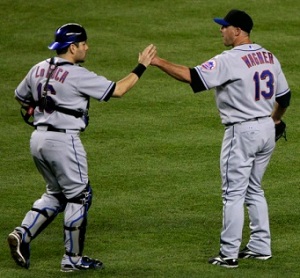
Paul Lo Duca, Billy Wagner

Paul Lo Duca and Billy Wagner share a high-five after nailing down a Mets win. Claiming Joe West’s strikes could be bought with Wagner’s classic Chevy sends Lo Duca from high five to out five hundred large . . .

You can accuse one of baseball’s two most notorious umpires of anything you like. Call him a craven self-promoter. Say his strike zone behind the plate is more flexible than politician’s policy positions. Tell the world he’s a meathead for complaining about the length of a baseball game between two certain teams over whom he appoints himself judge and jury.

Those won’t get you hauled into court to answer for defamation. But say on the air that Joe West’s strikes could be bought for the price of using your pitcher’s classic automobile and it’ll cost you six figures. Especially when West wasn’t even behind the plate in the games in question when you caught that pitcher.

Former major league catcher Paul Lo Duca is learning the hard way after losing a defamation lawsuit West filed in 2019. That year, Lo Duca accused West, the single most notorious umpire this side of Angel Hernandez, of being very generous calling strikes with relief ace Billy Wagner on the mound, after Wagner agreed to let the chunky umpire use the lefthander’s 1957 Chevrolet any old time he chose whenever they were in town together.

That’ll cost Lo Duca $500,000 plus interest paid to West after a decision in Manhattan Supreme Court Monday, during a session to determine damages for which Lo Duca didn’t even show up according to numerous published reports.

Lo Duca claimed on a 2019 sports betting podcast that he talked to Wagner after a game in which Wagner both advised Lo Duca to set up a little more inside on the hitters and suggested West would give Wagner the inside corners a little more generously. Why? Here’s Lo Duca himself aboard that podcast:

We’re playing like a really tight game against the Phillies and Billy Wagner comes in from the bullpen. I used to go to the mound every time and like, ‘What’s going on?’ and he’s like, ‘Hey, Joe’s behind the plate. Set up a couple more inches inside. I was like, ‘Are you kidding me? Joe hates me.’ He’s like, ‘No, no, no, no, no, no. Joe loves me.’

I go, ‘He hasn’t given us the corner all day.’ He’s like, ‘Don’t worry about it.’ He literally throws 10 pitches and strikes out three guys. Joe rings up all three guys. Eight out of the nine pitches were at least three to four inches inside, not even close. Guys were throwing bats and everything. Joe walks off the field.

I get back into the clubhouse and I’m like, “What the [fornicate] just happened just right now?” And Wagner just winks at me. I’m like, “What’s the secret?” He’s like, “Eh, Joe loves antique cars so every time he comes into town I lend him my ’57 Chevy so he can drive it around so then he opens up the strike zone for me.”

I’m like, “This guy’s been throwing me out for the last 10 years of my life and all I needed to do was rent him a ’57 Chevy?”

'57 Bel Air

A 1957 Chevrolet, the kind of car Billy Wagner didn’t use to buy strikes from Joe West.

There were two problems with Lo Duca’s revelation, as things turned out. Problem One: West countered, and the records support him, that he was never behind the plate when Wagner was on the mound with Lo Duca catching in either 2006 or 2007, the two seasons Lo Duca spent with the Mets. Problem Two: Wagner himself submitted a December 2020 affidavit denying he talked to Lo Duca about buying West off with a vintage Chevy or anything else.

Manhattan Supreme Court Judge John Kelley found it too simple to rule in West’s favour when Lo Duca didn’t show up Monday or respond directly to West’s suit otherwise. As of this writing, Lo Duca hasn’t responded to the court ruling and Wagner hasn’t spoken publicly about the case or the critical conversation he denies ever happened.

West remembers working only one Mets-Phillies game behind the plate in the 2006-2007 time frame and Wagner wasn’t on the mound at any time during the game—which ended on a home run, not three straight punchouts. Unlike on a lot of occasions when he calls strikes balls, balls strikes, outs safe, and safes out, West was dead right about that.

You can look it up. In 2006-2007, the Mets played 27 games that ended in walk-offs. Their record in those games: 18-9. (That’s a .667 winning percentage in those games, for those scoring at home.) They included two walk-off games with the Phillies in each year; the Mets won only one of those games:

9 May 2006—Final score: 5-4, Phillies. The walk-off blow: Mets reliever Aaron Heilman’s throwing error on Bobby Abreu’s grounder, allowing David Delluci (two-out triple) to score the winner. Billy Wagner: didn’t pitch. Paul Lo Duca: caught and batted second in the lineup. Home plate umpire: Doug Eddings.

23 May 2006—Final score: 9-8, Mets, sixteen innings. The walk-off blow: Carlos Beltran’s leadoff home run off Phillies reliever Ryan Madson. Wagner: pitched the 11th; fly out, two swinging strikeouts. Lo Duca: caught the entire game and batted second. Home plate umpire: Jeff Kellogg.

28 August 2007—Final score: 4-2, Phillies. The walk-off blow: Ryan Howard’s two-run homer off Guillermo Mota. Wagner: didn’t pitch. Lo Duca: caught and batted seventh. Home plate umpire: Joe West. Most likely, this is the game West himself remembers.

30 August 2007—Final score: 11-10, Phillies. The walk-off blow: Chase Utley’s RBI single through the hole at second, after Tadahito Iguchi singled to tie the game and stole second. Wagner: pitched the ninth and surrendered the tying and winning runs. Lo Duca: entered the game in the eighth taking over for Mike DiFelice and batting eighth. Home plate umpire: Ed Hickox.

Four times the Mets and the Phillies played games ending in walk-off hits in 2006 and 2007. Joe West was the plate umpire for one of those games, in which Wagner didn’t pitch but Lo Duca caught. In the two games in which Wagner did pitch, he struck out two of his three batters in the first game but struck out none of the batters he faced in the second game.

As a matter of fact, Wagner was credited with the pitching wins in three Mets walk-offs in 2006 and two in 2007. So we should have a look at those, too:

9 April 2006, vs. the Marlins—Final score: 3-2, Mets. The walk-off blow: David Wright’s sacrifice fly in the bottom of the ninth. Wagner: pitched the top of the ninth, worked his way out of a two-out jam by inducing a ground out to second base, no strikeouts. Lo Duca: caught the entire game and batted second. Home plate umpire: Ed Montague.

1 May 2006, vs. the Nationals—Final score: 2-1, Mets. The walk-off blow: Lo Duca’s grounder to relief pitcher Gary Majewski on which Majewski’s throwing error trying to start a double play allowed Endy Chavez to score the winner. Wagner: pitched a spotless ninth with two swinging strikeouts and a ground out right back to the box. Home plate umpire: Chris Guccione.

19 May 2006, vs. the Yankees—Final score: 7-6, Mets. The walk-off blow: Wright scoring Lo Duca with a fly single off Hall of Famer Mariano Rivera. Wagner: struck the side out swinging in the top of the ninth. Lo Duca: of course, caught the entire game and batted second. Home plate umpire: Alfonso Marquez.

23 June 2007, vs. the Athletics—Final score: 1-0, Mets. The walk-off blow: Wright’s RBI double. Wagner: shook off a leadoff single in the top of the ninth to get a bunt ground out, a fly out, and a swinging strikeout. Lo Duca: started the game but came out for a pinch hitter in the sixth. Home plate umpire: Marvin Hudson.

21 August 2007, vs. the Padres—Final score: 7-6, Mets. The walk-off blow: Luis Castillo’s RBI single. Wagner: pitched the ninth and surrendered a game-tying run on Kevin Kouzmanoff’s sacrifice fly, during a rough inning in which he surrendered a single, a walk, and a hit batsman to load the bases for Kouzmanoff. Lo Duca: didn’t play. Home plate umpire: Angel Hernandez.

Five times between 2006 and 2007 Billy Wagner ended up the pitcher of record in walk-off wins by the Mets; only once did he get credit for the win when the Mets walked it off after he’d surrendered a tying run. Paul Lo Duca was behind the plate for Wagner in three of the five. Joe West didn’t call balls and strikes in any of those five games, including the one such game in which Wagner did strike out the side—against the Yankees, not the Phillies—with Lo Duca behind the plate.

West plans to retire after this season. Trying to bring Lo Duca to account, West’s legal team pressed his fear that the Lo Duca podcast appearance would injure his chances to be elected to the Hall of Fame, especially considering he stands to break Hall of Fame umpire Bill Klem’s record for games umpired. As The Athletic points out, umps elected to Cooperstown earn a lot more on the rubber chicken and autograph circuits if they have the Hall of Fame on their resumes.

Never mind whether or not you think West belongs in Cooperstown. Lo Duca forgot one of the key lessons we learn at ages younger than Lo Duca’s when he first made the Show: Look before you leap. The tide may have receded.

Don’t blame replay for Bohm staying safe

Travis d'Arnaud, Alec Bohm

Repeat after me: Alec Bohm was out at the plate . . . Alec Bohm was out at the plate . . . (Atlanta Journal-Constitution photo.)

The arguments against using replay to determine close plays included that it would take a big, big, big piece of the human factor out of a game. Well, what the hell was that we saw in Atlanta Sunday night?

It was the human factor getting it wrong despite having what Braves pitcher Drew Smyly called five different angles on a nationally televised game.

It was home plate umpire Lance Barrett missing a call on a bang-bang play at the plate in the top of the ninth but the replay review crew out of New York essentially doubling down on the wrong call, despite how right Smyly was and having five or even more angles to review.

It was Phillies third baseman Alec Bohm colliding with Braves catcher Travis d’Arnaud as he arrived sliding as d’Arnaud with the ball lunged to block the plate, forcing Bohm to slide just offline enough to miss touching the plate even with his lead foot.

It was the Phillies winning 7-6 when the Braves went three-and-three in the bottom of the ninth and Bohm saying almost nothing but, “I was called safe. That’s all that matters.” Note that “I was called safe” isn’t exactly the same thing as saying, “I was safe.”

Even the Mets weren’t that coyly disingenuous about Michael Conforto elbowing his way to a blown call in his favour and a bases-loaded hit-by-pitch walkoff against the Marlins last Thursday.

With one out in the top of the ninth Phillies shortstop Didi Gregorius lofted a fly the other way to left. Marcell Ozuna strode in toward the line to catch it. As Bohm tagged at third, Ozuna fired a two-hop strike down the line that hopped into the crouching d’Arnaud’s mitt. In the same split second d’Arnaud turned right, his folded leg across the plate with the tag on the sliding Bohm’s back leg.

D’Arnaud did bump Bohm in front of the plate for a moment. Bohm’s left foot, his lead foot, never touched the plate, flying just over it, and neither did the rest of his body parts, before he sprang up in a bent-knee pirouette and turned another one upright, waving his arms, including one wave that looked as though he were making a safe call.

If you want to give Barrett a benefit of the doubt you could say plausibly that d’Arnaud sprawling across the plate after the bumping tag on Bohm might (underline that) have obstructed his full view of Bohm’s slide.

“We saw it,” insisted Phillies manager Joe Girardi standing by his man and the review crew at once. “It looked like his big toe kind of hit the corner of the plate is what we saw when we saw a lot of the angles.”

I saw it, too, from a lot of the angles. For Girardi to say that, Bohm’s big toe must have been on his heel. On the angle his foot flew over the plate, his heel was actually a hair or two closer to hitting the plate than his big toe was.

Smyly didn’t pitch all that well Sunday night—he surrendered five runs on five hits in five innings’ work, including a two-run homer to Ozzie Albies in a three-run first and a leadoff solo to Freddie Freeman in the bottom of the fifth. But his perspective on that play at the plate was anything but impaired.

“[I]t’s clear that his foot didn’t touch the plate, that it was on the chalk,” Smyly told reporters post-game. “Everyone saw it and sees it, everyone knows it. And for MLB not to overturn that, it’s embarrassing. Why even have replay if you won’t overturn that? That’s the way I feel about it. I think everybody feels that way. There’s five different angles. It’s clear, he didn’t touch the plate.”

#HeDidntTouchThePlate became a Twitter hashtag almost as fast as the original play went down in the first place. Better that than the Truist Park audience throwing debris down onto the field. They had every right to be outraged, but better chanting (as they did) Bull-[sh@t]! Bull-[sh@t!] than throwing junk and at least one bottle kept from doing damage by, ironically, the netting hoisted to protect fans from bullet-fast foul balls.

Braves shortstop Dansby Swanson, himself native to Atlanta, may have felt his team got jobbed, but he wasn’t too thrilled about the fans’ display, either. “It’s an embarrassing representation of our city because I know from being from here, that’s not how we act,” he said after the game.

And then probably the worst part of it all, I don’t think people realize we have families here. There are kids that are here, kids that are sitting in the front row, and you’ve got bottles whizzing by their heads. Just endangering kids that may not be able to protect themselves is downright embarrassing, and it should never happen again. It just can’t happen, and it never needs to happen again.

It spoiled a night on which both teams brought their bats to town and swung them with authority. From Albies in the first and Freeman in the fifth to Ronald Acuna, Jr.’s fourth-inning sacrifice fly and mammoth seventh-inning home run. From Rhys Hoskins’s leadoff bomb in the fourth and Gregorius’s three-run homer two outs and back-to-back singles later, to Bryce Harper’s opposite-field leadoff launch seven or eight rows into the left field seats in the sixth.

When The Athletic queried the New York replay crew about the Bohm safe call, the journal received an e-mail reply: “After viewing all relevant angles, the Replay Official could not definitively determine that the runner failed to touch home plate prior to the fielder applying the tag. The call STANDS, the runner is safe.” How many angles was “all relevant angles?”

“It makes me not even want [replay review] anymore,” d’Arnaud said. “Honestly, it just slows the game down. It took like five minutes for them to decide that and, to me, they got it wrong. So I’d rather just not have it and get the game going.”

Some plays take a little longer than five minutes to decide, some take a little less. D’Arnaud’s frustration is the most understandable among any Brave. When Conforto was ruled a hit batsman as plate ump Ron Kulpa changed his strike call in the bottom of the ninth last Thursday, Mets broadcaster Ron Darling asked why have replay if the review umpires can’t get it right.

Kulpa admitted his mistake the following day. (He got a lovely ovation from the Citi Field audience Saturday for his admission.) Barrett hasn’t weighed back in at this writing. But the issue isn’t replay itself. The issue is that there’s still a human factor in baseball games, major league or otherwise, and that factor can still get it wrong even with every potential angle showing otherwise.

Even a major league player or two ripped the call. Padres third baseman Will Middlebrooks tweeted, “How do you watch that replay and say he’s safe. Hahaha this is a joke.” Of all people, Angels all-everything center fielder Mike Trout tweeted, “So bad…” followed by an emoji showing a smiley face in tears laughing. D’Arnaud’s brother Chase, himself a former major league utility infielder, tweeted back to Middlebrooks and Trout, “the guy makes that call in New York should be interviewed just like players who get interviewed after games.”

Not just by reporters but by baseball’s government, too.

It’s far too early in the major league season for a game and a call like that to wreak real havoc on a pennant race, of course. If the safe call was overturned as it should have been, it would have meant the Braves and the Phillies each at 5-4 and tied for first in the National League East this morning.

But if a replay review crew can still blow what angle after angle showed them wasn’t a runner safe across the plate in mid-April, how egregiously will they blow a similar call down the stretch in a game that weighs like a bank vault on the races?