La Maquina, al finale?

Albert Pujols

That was last fall: Pujols tying Willie Mays on the all-time home run list. This is Mays’s 90th birthday, today: the Angels announced they designated the sadly-declined Pujols for assignment.

Late in February, Albert Pujols’s wife posted a social media message suggesting that, when his mammoth contract with the Angels expired after this season, so would her husband’s playing career. That option may not belong to him anymore.

The Angels jolted baseball when they announced Thursday that they designated the Hall of Famer in waiting for assignment. Once upon a time, timing was Pujols’s ally at the plate and beyond. Announcing the designation on Willie Mays’s 90th birthday, of all days, just made it sting that much more.

It had to. No less than Mays himself sent Pujols a text message last year saying, “It’s your time now. Go get it.” Meaning, go meet and pass Mays’s 660th lifetime home run. Pujols met 660 last September and passed it with 661 five days later. The Machine had six more bombs in him before the Angels finally gave up his ghost.

Let’s get this out of the way right now: Pujols didn’t ask to have maybe the most heartsickening, prolonged decline in the game’s history.

It wasn’t his idea to have a down season his first time out as an Angel. (Codicil: a down season for Pujols in 2012 was still a career year for more players than you can fit aboard two Dreamliners.) He didn’t ask for plantar faascitis in his heel the following year to begin a punishing series of lower half injuries that drained everything he had left.

ESPN writer Alden Gonzalez, who’s covered Pujols for most of his Angels life, saw up close and personal what Pujols put himself through in what we now know was a futile attempt to find the St. Louis smash buried somewhere inside what was left of him now.

“I’ll remember,” Alden says, “that even though his lower half was shot and he wasn’t quick enough to get around on the devastating stuff pitchers throw these days, he still showed up early, still spent hours in the training room to get ready for games, still took batting practice with intent, still crouched really low on defense and still looked for any opportunity to take an extra base. He might not have been productive, but it wasn’t for lack of effort.”

The stubborn, proud spirit was too willing, but the body was likewise too ready to tell him where to shove it at long enough last. No recent play was more emblematic than the ground ball he hit to the hole at shortstop but didn’t run out—because he couldn’t. He’d have been better off taking a skateboard out of the box up the line; he was thrown out on a lob across the infield before he was even halfway up the line.

The only tool Pujols’s body left alone was his still-devastating long ball power. Gonzalez’s ESPN colleague David Schoenfield is right to observe that’s not enough to stay aboard a major league roster. Not even though Pujols remained mostly as difficult to strike out as he always was. (His average per 162 games: 74; or, a single punchout every other game.)

But he’s all but quit taking walks; he rarely hits for extra bases beyond home runs; and, no matter how ironed up his will is, he hasn’t been the first base defender he once was for what seems eons. His Cardinals era was off the charts enough to keep his lifetime statistics showing him a plus first baseman by 95 runs saved above his league average. Fortunately.

Aside from what it did to him as a man, Pujols’s injury-instigated and perpetuated decline robs him of sitting atop the rest of the Hall of Fame’s post-World War II/post-integration/night-ball era first basemen according to my Real Batting Average. (Total bases + walks + intentional walks + sacrifice flies + hit by pitches, divided by total plate appearances.)

First Base PA TB BB IBB SF HBP RBA
Jim Thome 10313 4667 1747 173 74 69 .653
Jeff Bagwell 9431 4213 1401 155 102 128 .636
Albert Pujols 12486 5955 1334 313 115 111 .627
Willie McCovey 9692 4219 1345 260 70 69 .615
Harmon Killebrew 9833 4143 1559 160 77 48 .609
Orlando Cepeda 8698 3959 588 154 74 102 .561
Eddie Murray 12817 5397 1333 222 128 18 .554
Tony Perez 10861 4532 925 150 106 43 .526
HOF AVG .597

Had his career ended when his years with the Cardinals did, Pujols would have retired with a .708 RBA. Had he not been betrayed by his heels, feet, and most of the rest of his lower body as an Angel, he might still have finished with a higher RBA than Jim Thome did. And none of those Hall of Fame first basemen are as far above their league average for runs saved at the position as Pujols. (Eddie Murray’s +61 are 34 below Pujols.)

Pujols’s berth in Cooperstown is solely a question of when he retires as a player officially. No matter how sad his injury-instigated, protracted decline, he secured that in St. Louis to devastating effect. If the Angels don’t work a trade out now, and there’s no assurance they’d find a trading partner willing to part with viable talent in exchange for a ghost, there’s no guarantee another team would sign him for a pro-rated minimum salary as a free agent, either.

His longtime Cardinals manager Tony La Russa came out of his Hall of Fame retirement to take on the White Sox—but La Russa has already shown trouble handling today’s experimental rules as it is. No matter how much he still respects and loves Pujols, La Russa isn’t going to convince his bosses to take the ghost over young and establishing designated hitter Yermin Mercedes.

The DHs in Tiger uniforms are hitting this year at levels low enough to make Pujols continue resembling his Hall of Famer-to-be old self—but the Tigers have an aging incumbent themselves, named Miguel Cabrera. Hands up to anyone and everyone who thinks that even the current Tiger regime would hold with manager A.J. Hinch sending Cabrera to the pine in favour of Pujols now.

Purely in baseball terms, designating Pujols for assignment makes too much sense. Especially with Jared Walsh standing in for injured right fielder Dexter Fowler but far better suited to play first base. Especially with Shohei Ohtani more than capable of holding a DH slot on the days he doesn’t pitch. Pujols’s designation means the Angels don’t have to let Ohtani bat on his pitching days; they can save him for the final role Pujols can’t handle anymore.

But in human terms, this is a heartbreak. Especially for a man so community and charity oriented that you could believe the Angels well enough, even committing boilerplate, when owner Arte Moreno’s formal statement praised Pujols in character terms, as a man whose “historical accomplishments, both on and off the field, serve as an inspiration to athletes everywhere, and his actions define what it means to be a true superstar.”

If only the announcement didn’t have to happen on the 90th birthday of Mays, a man Pujols respects and maybe even loves almost as much as he loved and respected St. Louis icon Stan Musial. This may have been the worst case of bad timing in baseball since . . .

Maybe since Brad Lidge’s bad timing hanging Pujols a breaking ball to demolish for a National League Championship Series Game Five-tying three-run homer in 2005. Or, the bad timing of Rangers relievers Alexi Ogando, Mike Gonzalez, and Darren Oliver gifting Pujols three meatballs to destroy beginning in the top of the sixth in Game Three, 2011 World Series.

When Hall of Fame pitcher Tom Seaver was traded to the Reds from the Mets, following contract extension talks that went from difficult to scurrilous thanks to Mets management and certain sports columnists smearing him, A. Bartlett Giamatti—then president of Yale University, as opposed to his eventual higher calling as a baseball commissioner—wrote in Harper’s, “[A]mong all the men who play baseball there is, very occasionally, a man of such qualities of heart and mind and body that he transcends even the great and glorious game, and that such a man is to be cherished, not sold.”

If Giamatti had lived to see Pujols, he might have thought likewise, ending with “such a man is to be cherished, period.” Pujols wasn’t sold, but half his body sold him out. Whether you called him El Hombre (the nickname he hated, insisting there was only one Man and his name was Musial) or The Machine (La Maquina in his language), he didn’t deserve having his gears stripped into a long, painful, sad decline.

Appreciating Willie, at 90 and beyond

Willie Mays

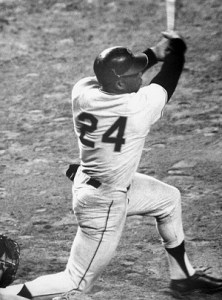
Willie Mays hits his 500th career home run in the Houston Astrodome, 1965.

I started watching baseball in earnest with the 1961 World Series, when I was pushing six, and the almighty Yankees faced the almost all-surprising Reds and beat them in five. Something about the game put a vise grip upon me that hasn’t let go in the years and over the changes good and bad since.

The Reds’ Frank Robinson was named the National League’s Most Valuable Player for 1961. Willie Mays finished sixth. As I would learn in due course, Robinson won the award as much because he had an MVP-type season as because he played on a pennant winner, but there were better MVP cases in the 1961 National League by Mays and fellow Hall of Famer Hank Aaron.

Then they finished inventing the Mets. I was no longer stuck with having to think purely about the Yankees in New York, since the National League was coming back into business there. (Assorted family members, especially my maternal grandfather, began telling me about the former exploits of the Dodgers and the Giants.)

And I’d get to see Willie Mays, even if on television alone. His Giants came to play my embryonic Mets in their former cavern, a big, horseshoe-shaped, rambling wreck of a ballpark known as the Polo Grounds. They played against each other there nine times in 1962. The Giants didn’t visit their former home until 1 June, but it certainly felt like a visit to the old neighbourhood—they swept the Mets in four.

I got to see the first of those four. Mays came exactly as advertised, playing center field as though he were part of a track meet; hitting a home run off future Giants manager Roger Craig the other way in the fifth, about 390 feet from the plate and into the right field seats; taking third from first on a seventh-inning single by another future Giants manager, Felipe Alou.

The bad news is that even a Willie Mays who leaves magnificent first impressions just warming himself up in the on deck circle can have days where someone else makes bigger impressions in the game. Fellow Hall of Famer Willie McCovey hit two bombs for the price of one Mays mash. And even McCovey didn’t steal the day’s headlines.

That theft belonged to Jim Davenport, a left-side infielder who wasn’t quite that serious a plate threat, squareing off against Mets reliever Willard Hunter two batters after Mays scored, with the bases loaded and one out. Davenport hit one not too far short of where Mays’s bomb landed in the right field seats.

It made the score 9-1, the Mets’ lone run to that point courtesy of Rod Kanehl hitting Giants starter Billy Pierce for a leadoff jack into the left field seats. The Mets managed to chase Pierce in the eighth with an RBI double (Charlie Neal) and a two-run single (Frank Thomas) back to back, before Felix (Wrong Way) Mantilla greeted Giants reliever Bobby Bolin rather rudely with a two-run homer.

That was the last of the day’s scoring. I’m reasonably certain that that was not the game during which Mets manager Casey Stengel visited Craig at the mound with McCovey due to hit and asked, “How do you want to pitch him—upper deck or lower deck?”

The Giants banked the 9-6 win. I didn’t get to watch the next three games, alas. Perhaps just as well, since the Giants outscored the Mets over those three games 22-6, including a doubleheader in which the scoring difference was 16-6, Giants.

Mays had himself a grand time playing baseball in New York for the first time since the Giants went west four years earlier. In game one of that doubleheader he opened with an RBI single and a run scored on a sacrifice fly in the first and continued with a two-run homer in the second, though somehow the Mets kept him quiet in the nightcap.

Then, he had one more homecoming message to deliver in the fourth game of the series, taking one of the Mets’ two Bob Millers (the righthanded one) into the left field seats with one out in the sixth.

The Giants met the Mets nine times in New York in 1962 and beat them seven times. Mays had himself an .851 OPS during those nine games. He was a lot more rude a house guest of the National League’s other newborn team in 1962, the Houston Colt .45s: despite Colt Stadium being a whole pitcher’s park, Mays battered the Colts for a 1.214 OPS in 1962.

Mays was 31 years old in 1962. But he still played as though still ten years younger. He had that stance with his feet about half a foot forward and aft of home plate, the stride starting his swing where you saw his front foot step forward about another full foot plus, swinging down and across his midsection, not extending his muscular forearms until a split second before contact, the bat sweeping a little up going around.

The stride and swing that delivered 3,283 Show hits including 523 Show doubles and 660 Show home runs, and leaves open for question even now how many of his 140 Show triples came mostly from his bat or from his legs, considering how relentless a baserunner he really was.

“Willie had great instincts on the bases and he was always aggressive,” Pete Rose has said of him. “I was an aggressive baserunner also. I developed my baserunning skills watching Willie Mays play.” An interesting recollection, that—Mays took extra bases on followup hits 63 percent of the time he reached base, meaning he took more than one base on such a hit. Rose did it 49 percent of the time.

“[O]n a single, it would have been strange if he didn’t go first to third,” Rose’s teammate, Hall of Famer Johnny Bench has said. “He had one of the best turns rounding second or third you could possibly have. With his agility, he made the most perfect turns.”

Mays’s legs did as much for him playing center field as they did on the bases. He thought nothing of starting in as shallow a positioning as he could get away with before reading, hunting down, and snaring a drive. “Curt Flood was the best I’ve ever seen against the wall. He was better than Willie against the wall,” Flood’s Cardinals teammate Tim McCarver has said. “But Curt played deep. Willie didn’t play deep; he played shallow. Willie never went to the wall. Willie was the wall.”

Hall of Fame pitcher Bob Feller had a dugout seat with the rest of the Indians during the 1954 World Series, including and especially for the catch for which Mays remains remembered singularly, the run to the absolute rear of the Polo Grounds’ right center field, some 460 feet from the plate, to haul down Vic Wertz’s drive.

To everyone else in the house—including a writer named Arnold Hano, sitting in the bleachers and writing A Day in the Bleachers about that game and that play—the play seemed God’s next to last miracle. (My last miracle, said George Burns as God in a 1977 film, was the 1969 Mets.)

“That really wasn’t that great of a catch,” the curmudgeonly Feller once said. And why? “As soon as it was hit, everyone on our bench knew that he was going to catch it . . . because he is Willie Mays.”

Willie Mays Hall of Fame

Wouldn’t you love to know even now just whom the meatheads were that denied Mays first-ballot Hall enshrinement?

When Ted Williams was inducted into the Hall of Fame in 1966, he name-checked Mays respectfully. “The other day Willie Mays hit his five hundred and twenty-second home run,” said Teddy Ballgame himself. “He has gone past me, and he’s pushing, and I say to him, ‘go get ‘em Willie’.” Willie went and got 138 more of ’em before his life as a player finally ended.

For me it was baseball fortune to get to see the better of Willie Mays even in his thirties, even if he was on the road team or I had to wait for one of the Giants’ turns on the old national network Game of the Week telecasts. It was worth the wait to see him square off against such Hall of Famers as Sandy Koufax, Bob Gibson, Don Drysdale, the aging Warren Spahn, the young Tom Seaver, the young Steve Carlton.

You might care to note that Mays faced Spahn more than he faced any pitcher, Hall of Famer or otherwise, and had ownership papers on the lefthander who owned a nasty screwball and was a bit of a screwball himself. According to Stathead, Mays faced Spahn 253 times, hitting eighteen home runs among 68 hits, with a slash line pretty close to his overall career slash: .305/.368/.587, and a .955 OPS.

“His first major league hit was a home run off me,” Spahn said often enough, “and I’ll never forgive myself. We might have gotten rid of Willie forever if I’d only struck him out.”

Drysdale might have told Spahn, “Why the hell didn’t you strike him out?” Mays faced Drysdale 243 times and, while he hit a measly thirteen bombs off the Dodgers righthander, the slash line is .330/.374/.604. The OPS is .978. Why the hell indeed.

Having learned more than a shard of baseball history by age 16, and having seen more than enough of Mays even as a road player to know that I was watching greatness that belonged not of this world but about five dimensions beyond it, it was easy to feel a little New York sentimentality when the Giants—entering a somewhat testy reconstruction and no longer able to afford carrying aging players, not even Hall of Famers—sold Mays to the Mets to let him finish where he began.

He only looked resplendent in the Mets’ fatigues, under the blue hat that brandished the same orange interlocked NY which once crowned Mays’s forehead on the old black Giants hat. Sunday, 14 May 1972, was my mother’s 42nd birthday; she was a year older than Mays. The date was also Mays’s first game as a Met.

The Mets took an early four-run lead thanks to Rusty Staub’s first-inning grand salami off erstwhile Indians howitzer Sudden Sam McDowell. The Giants tied the game with a four-run fifth. Leading off the bottom of the fifth came Mays, who’d been 0-1 with a walk and a strikeout when he checked in against Giants reliever Don Carrithers.

Mays hit one about 400 feet over the left field fence to bring the Shea Stadium house to a boil of delight. The fan’s heart prayed it might be an unlikely revival; the analyst’s head knew in its heart that it was only a question of when, not if we’d have to imagine baseball games played somewhere without Mays playing in one of them.

The greats don’t always go gently into that good gray night when they can no longer play the games that made their names. This son of an Alabama industrial league ballplayer  fought a small war in his soul when his age insisted he was no longer able to play the game he loved so dearly at the level on which he’d played it for so many years. Some said he’d become sullen, moody, dismissive in the clubhouse. Some resented him, others felt for him, still others mourned.

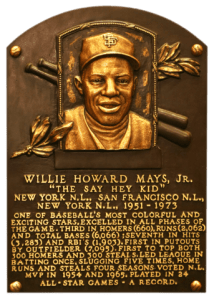
The smiles may have become rare now but when they came he still looked like the Say Hey Kid. But, yes, you can look it up: Mays never said, “Say hey!” His early habit of starting greetings to people with “Hey . . . ” inspired beat writers covering the Giants to tab him the Say Hey Kid.)

When he smiled as a Met, you still saw him in his youth, you didn’t see the manchild who was yanked rudely into manhood by a San Francisco that shocked him with skepticism as a New York import rather than a hero of their own. By a San Francisco that also shocked him, for all its reputation otherwise, when his bid to buy a home with his first wife was obstructed long enough by the sting of neighbourhood racism.

But when he accepted the now-inevitable, you cried the tears he fought to suppress when the Mets gave him a Willie Mays Night, 25 September 1973, and he addressed the Shea Stadium throng and his pennant-aspiring teammates alike, when Mets announcer Lindsey Nelson beckoned him to a microphone:

I hope that with my farewell tonight, you will understand what I’m going through right now. Something that—I never feel that I would ever quit baseball. But as you know, there always comes a time for someone to get out. And I look at the kids over here [pointing toward his Mets teammates], the way they are playing, and the way they are fighting for themselves, tells me one thing: Willie, say goodbye to America.

The game couldn’t possibly love Mays back as deeply as he loved the game, but it did its best with what it had. Today Mays celebrates his 90th birthday as the oldest living Hall of Famer, and someone like me who was there for enough of his best on the field and at the plate wishes almost as much as he must at times that we could take him back to one more day in the prime of his youth and turn him loose.

This sexagenarian and a half who saw more of him than he had a right to expect would love to shake his hand and say thank you for the honour of watching him play the game the way he played, but the fear is that “thank you” would be insufficient.

We’d love to remove the glaucoma that’s caused him to stop driving and playing golf, and take him back eyes wide open to make one more rambling catch in the depth of the Polo Grounds or in the eye of the Candlestick Park hurricane. We’d love to take him back to the day he won a second National League Most Valuable Player award eleven years after he won his first; we’d love to show him the record and get him at least two or three other MVPs he should have won.

We’d love to take him back to hit one more bomb off the Warren Spahn who only thought we’d have gotten rid of Mays if Spahn had only struck him out; to have his way with Spahn, Drysdale, fellow Hall of Famer Robin Roberts, and others; to let him have one more crack at the Bob Gibson who more or less owned him in comparison; to let him have, especially, one more chance in the single most transcendent one-on-one battle between pitcher and hitter you could ever hope to see, Willie Mays facing Sandy Koufax.

We’d also love to bring back his beloved Mae Louise, his second wife, who wept with him that farewell night at Shea Stadium, and whose eventual suffering with Alzheimer’s her loving husband didn’t allow to stop him from tending her, caring for her, loving her until she died a little over eight years ago.

But all we can do is say “Happy birthday, Willie, and here’s to many more,” we Americans who’ve never really said goodbye to the man who transcended the game we’ve loved, and who have no known inclination to do so. America without Willie Mays would feel like England without the Beatles: anything except themselves anymore.

Pete Rose, without the other stuff

Pete Rose

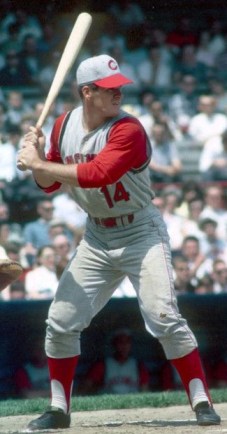
Pete Rose, fresh young Red . . . without Rule 21(d) and the Cobb-chase circus, how was he really as a player?

Is it strange to think of Pete Rose at eighty years old? Of course it is, especially for those old enough to have seen half or better of his playing career. But eighty he is, as of Wednesday past, and he is also freshly employed by UpickTrade—to sell baseball predictions to subscribers for $89 a month.

“Picks provided for MLB, NBA, NHL, NFL, Tennis, Golf and major Horse Races. Grow your sports bankroll with the Hit King.” Thus Upick ballyhoos Rose’s prognostications. During a media conference on his birthday Wednesday, Rose insisted he wouldn’t be betting, merely picking based on his baseball experience and knowledge.

Baseball’s most notorious gambling exile this side of the Black Sox, tying himself to a Website picking events for bettors to bet, giving himself one more dubious look in a life full of them, is purely coincidental. Right? Rose wouldn’t exactly agree.

“For those people who are worried about the Hall of Fame,” he told that Wednesday presser, “you’ve got to remember I got suspended in 1989.”

That’s 32 years ago. I’m not going to live the rest of my life worried about going to baseball’s Hall of Fame.

If I’m ever bestowed that honor, I’ll be the happiest guy in the world. I don’t think me picking games—not betting on games, I have to keep saying that—picking games for customers will not in any way, shape or form hurt my opportunity to get to the Hall of Fame someday. I’m not the only guy that’s ever made a bet in the world of baseball. I probably bet today less than any of them.

“Suspended?” Have it your way, Pete.

I’m not going to re-argue the Rose “suspension” now. The mountain range of evidence, the long and pitiful record of the lies Rose told for decades, and especially the plain language of Rule 21(d) should have put paid to that argument long ago. So should the Hall of Fame itself deciding, quite appropriately, that those ineligible for standing in organised professional baseball had no business appearing on ballots through which they might be conferred baseball’s highest honour.

(To those who insist baseball’s recent agreements with certain legal gambling enterprises mean Rose should be un-banned, remember that just because it’s legal doesn’t mean your employer lacks the right to ban you from doing it when it involves your job.)

But I would like to do one thing. For argument’s sake, I’d like to make as though Rose’s violations of Rule 21(d) never happened, that he was never banished from the game for which he continues professing his deepest love, then ask and answer the following question: How absolutely great was Pete Rose as a player?

The eternal image of Rose the player is that of a junkyard dog clawing his way to whatever he gained on the field, at the plate, on the bases. His lifetime partisans hoist the near-constant image of headfirst slides and praise him irrevocably as evoking all that was once right and proper about the game. But his .375 on-base percentage ranks 215th all-time. And his percentage of extra bases taken on followup hits was yanked down to 49 percent thanks to his six-year decline while still chasing Ty Cobb’s hits record.

Speaking of which, let’s put the Hit King business to bed. Allen Barra tried, in his 2002 book Clearing the Bases: The Greatest Baseball Debates of the Last Century. Rose in his view was “an arrogant, shallow, self-centered jerk who hung around years after he had any value on the field simply to eclipse [Ty] Cobb’s [career hits] record. You’re a fan, you want to pay money to watch that kind of circus junk, then you pay your money. I stopped caring about the so-called record two years before Rose surpassed it.”

Was Barra out of line? From his Rookie of the Year season 1963 through the end of his first regular season with the Phillies, his first eighteen seasons, Rose collected 3,557 hits. He could have retired right then and there, after playing on the 1980 Phillies’ World Series winner, and had himself a very Hall of Fame worthy career, plus a hit total a lot of Hall of Famers might have envied still.

Rose’s most emphatic partisans will find ten 200-hit seasons among those eighteen years and insist that that plus eventually breaking Cobb’s career hit record make him the Hit King indeed. Barra didn’t have the stomach for that, and neither do I. Perhaps audaciously, he asked whom you think is baseball’s greatest hitter, ever, and lo! many of the answers to that turn up . . . well . . .

Many say Ted Williams, but Teddy Ballgame never had one 200+ hit season. Many say Mickey Mantle, and he never had one, either. Many say Willie Mays, and he had only one. Many say Henry Aaron, but he has something else in common with Babe Ruth: only three 200+ hit seasons. (And don’t many still say the Babe?) Many say Stan Musial; he had a measly six. Many say that Mike Trout is in their league—and he is—but the most hits he’s collected in a single season thus far is 190.

Those players one and all were (are, in Trout’s case) better batters than Pete Rose was. Says who? Says my Real Batting Average (RBA) metric: total bases + walks + intentional walks + sacrifice flies + hit by pitches, divided by total plate appearances, says who:

Player PA TB BB IBB SF HBP RBA
Ted Williams 9788 4884 2021 243 57* 39 .740
Mike Trout 5514 2642 838 104 52 84 .675
Mickey Mantle 9907 4511 1733 148 47 13 .651
Stan Musial 12718 6134 1599 298 110* 53 .644
Willie Mays 12496 6066 1464 214 91 44 .631
Henry Aaron 13941 6856 1402 293 121 32 .624
Pete Rose 15890 5752 1566 167 79 107 .483

If you believe a lifetime .483 batter was better than a lifetime .740 batter, be my guest. But you say that doesn’t really prove anything? Well, now. How about the extra base hit percentages for each of these fellows? Be forewarned: Rose is going to come up smelling like a thorn.

Player H 2B 3B HR XBH XBH%
Mike Trout 1,396 264 48 306 618 .44
Ted Williams 2,654 525 71 521 1,117 .42
Mickey Mantle 2,415 344 72 536 952 .39
Henry Aaron 3,771 624 98 755 1.477 .39
Stan Musial 3,630 725 177 475 1,377 .38
Willie Mays 3,283 523 140 660 1,323 .35
Pete Rose 4,256 746 135 160 1,041 .24

By the way, since he spent so much of his late baseball life obsessed with catching and passing Ty Cobb, be advised that Cobb’s extra base hit percentage is three points higher than Rose’s.

Rose also doesn’t look like such a Hit King when compared to two more of his own contemporaries who both belong in the Hall of Fame and may well get there the next time the Golden Era Committee meets later this year:

Player H 2B 3B HR XBH XBH%
Dick Allen 1,848 320 79 351 750 .41
Tony Oliva 1,917 329 48 220 597 .31
Pete Rose 4,256 746 135 160 1,041 .24

There’s a guy whose career overlapped Rose’s by a few years before Rose retired as a player—a guy who’s a match for Rose’s skill set: an early-in-the-order batter with a little power and a near-surrealistic ability to reach base. (Barra once pointed out that, in each player’s fifteen best seasons, this guy reached base more often than Rose and used fewer outs to do it.)

Player H 2B 3B HR XBH XBH%
Tim Raines 2,605 430 113 170 713 .27
Pete Rose 4,256 746 135 160 1,041 .24

Now, let’s look at Allen, Oliva, Raines, and Rose according to RBA. (You may also find yourself breaking the grip longevity alone might have on you, since you’re going to see a very wide difference between Rose’s career longevity and career value.)

Player PA TB BB IBB SF HBP RBA
Dick Allen 7315 3379 894 138 53 16 .612
Tony Oliva 6880 3002 448 131 57 59 .537
Tim Raines 10359 3771 1330 148 76 42 .518
Pete Rose 15890 5752 1566 167 79 107 .483

Remove, too, that business about Rose playing in “more winning games than any player, ever.” Saying it almost implies that his teams absolutely wouldn’t have won without him. His actual offensive winning percentage is 67 percent as a Red through 1978 and 55 percent for the rest of his career. Frank Robinson’s OWP as a Red is 74 percent; Joe Morgan’s as a Red is 76 percent.

Which leads to a point I can’t remember people talking much about: whether Rose was the absolute best player on his teams during his absolute prime, the first eighteen seasons of his playing career during which he played on three World Series winners and several division winners and reasonably high in other pennant races.

I ran down Rose’s wins above replacement-level player (WAR) in each of those seasons, from his Rookie of the Year 1963 through 1980, when he ended the Phillies’ World Series win with that staggering foul catch. Except for two of those seasons, Rose was one of his teams’ top ten players and thirteen times one of his teams’ top five. But my guess is that you’ll have one of two reactions to the deets, disbelief or an overwhelming desire to shoot the messenger:

Year Pete Rose WAR/Rank Team Leader/WAR Team Finish
1963 2.4 (8) Vada Pinson (6.4) 5th
1964 1.3 (15) Frank Robinson (7.9) 2nd
1965 5.6 (2) Jim Maloney (9.0) 4th
1966 4.1 (2) Jim Maloney (7.4) 7th
1967 4.8 (4) Gary Nolan (6.0) 4th
1968 5.5 (2) Tony Perez (5.9) 4th
1969 6.6 (1) – 3rd
1970 4.8 (4) Johnny Bench (7.4) 1st
1971 5.1 (2) Lee May (5.4) 4th
1972 6.1 (3) Joe Morgan (9.3) 1st
1973 8.3 (2) Joe Morgan (9.3) 1st
1974 5.9 (4) Joe Morgan (8.6) 2nd
1975 4.1 (5) Joe Morgan (11.0) 1st **
1976 7.0 (2) Joe Morgan (9.6) 1st **
1977 2.9 (7) George Foster (8.4) 2nd
1978 3.4 (6) George Foster (4.9) 2nd
1979 3.1 (5) Mike Schmidt (7.9) 4th
1980 -0.3 (20) Steve Carlton (10.2) 1st **

Once. Only once did Pete Rose lead his team in WAR for a season, only once was he the absolute best player on his team, and that was a season in which the Reds stood on the threshold of becoming the Big Red Machine despite their third-place finish.

Twice Rose was the best position player on a team where WAR determined the team’s best player period was a pitcher, and those teams finished in fourth and seventh place. And, in five straight seasons of the Big Red Machine’s heyday, Rose finished second twice, third once, fourth once, and fifth once to Joe Morgan, the overwhelming best player the Machine had.

Rose was a well-established, well-seasoned veteran when Morgan came to the Reds, but it’s absolutely arguable that those Reds would not have won without Morgan. Remember that Morgan’s offensive winning percentage as a Red is 76 percent. For the same seven seasons they were Reds teammates, Rose’s OWP is 68 percent. The Big Red Machine had better chances of winning races because of Morgan than because of Rose.

Which reminds me: what was Rose doing winning the 1973 National League’s Most Valuable Player award (the only MVP of his career) when Morgan was that much better? Easy: Rose led the league in “batting average” while playing on a division winner. So help me, if they’d known about and measured according to RBA they’d have seen the pair a lot differently:

Player, 1973 PA TB BB IBB SF HBP RBA
Joe Morgan 698 284 111 3 4 6 .585
Pete Rose 752 297 65 6 0 6 .497

I saw Rose play often enough during his entire career. I saw the headfirst sliding, the running to first base on walks, the hard-nosed style that so often crosses lines to bull headed (or beyond reasonable bounds, as in blasting Ray Fosse at the plate in the 1970 All-Star Game without even thinking of a mere takeout slide) and wasn’t exactly something on which Rose held the franchise.

He was very lucky that playing the game that way didn’t shorten his career by about ten seasons and maybe more. Baseball is littered with similar players who played their bodies right out of the game long before Rose finally did, playing themselves out of providing too much further real value to their teams before their bodies or their brains finally told them to retire or else.

If you remove the issues that sent Rose to organised baseball’s Phantom Zone, and compelled the Hall of Fame to enact a rule denying that men considered persona non grata should be considered for the game’s highest honour, this is how I see him:

Pete Rose would have been a Hall of Famer even if he hadn’t clung to and consummated the pursuit of Ty Cobb’s career hits record, though I also think his 44-game hitting streak in 1978 really kick-started the final discussions about his true or reputed status as a legend. (So did making good on his once oft-stated oath to become baseball’s first million-dollar singles hitter.)

There’s no shame in Rose being a 76 percent singles hitter; so was Tony Gwynn. But I’m going to tell you Tony Gwynn was more valuable at the plate than Pete Rose was. (It isn’t Gwynn’s fault that he lacked the caliber of teammates in his career that Rose enjoyed in his.) Says who? You guessed it: RBA, says who:

PA TB BB IBB SF HBP RBA
Mr. Padre 10232 4259 790 203 85 24 .524
Charlie Hustle 15890 5752 1566 167 79 107 .483

Rose wasn’t close to being the greatest all-around player of his or any era. Yes, he was a multi-position player who played 500+ games each at five different positions. Except for the 673 games he played in left field, he was double-digits below average for run prevention while being worth 52 runs saved above his league average in left field. For nineteen percent of all the games he played.

He was foolish for behaving practically as though he was entitled to take a shot at breaking Cobb’s record despite the fact that, for his final six seasons as a player, his real value to his teams was below that of a replacement-level player. Whether you’re in your prime or a veteran looking to boost your legacy, there’s no such thing as being “entitled” to break a record, revered or otherwise.

Cal Ripken, Jr. put up with a large load of crap pursuing Lou Gehrig’s consecutive games played streak. Yet Ripken didn’t behave as though it was his entitlement, unless you think saying often enough that it was part of his profession to show up and play every day equals entitlement. Ripken also had far more value to his teams while chasing and passing Gehrig than Rose did while chasing and passing Cobb.

Injuries reduced Albert Pujols to barely replacement-level player after his first year as an Angel. It’s been sad to see for anyone who remembers when he was a Cardinal. But Pujols doesn’t seem to behave as though he was entitled to achieve certain milestones,  the last of which was passing Willie Mays on the all-time home run list.

The circus surrounding Rose’s pursuit of and passing Cobb did exactly as Allen Barra described: it “overwhelm[ed] discussion of Rose’s other qualities and deficiencies as a ballplayer.” He’s the Hit King by accumulation alone. He wasn’t close to being the greatest hitter of the post World War II-post integration-night ball era; he wasn’t the best player on his teams in his prime with one exception.

Should I go one step beyond? OK, you talked me into it, and please remember we’re still discussing as though violating Rule 21(d) hadn’t banished Rose to the Phantom Zone. With a  circus-less look at his record as it was, Rose might (underline that, ladies and gentlemen) have had to wait one or even two tries before getting his plaque. He wouldn’t have been either the first or the last of the genuine, Hall of Fame greats to enter as a slightly overrated player.

Remember, too, that slightly beats the living daylights out of being very overrated, or being in Cooperstown despite having little to no business being there in the first place. Just ask Harold Baines, Clark Griffith, Chick Hafey, Waite Hoyt, Travis Jackson, George Kelly, Freddie Lindstrom, Tommy McCarthy, and Phil Rizzuto. (The Scooter does belong in Cooperstown—as a broadcaster. Really.) Among others.

It would have been mad fun to have that discussion involving Pete Rose. Absolutely. I’d imagine the passions on all sides of that argument would have been brought to as much of a boil as those on all sides of the argument about, you know, that other stuff.

Unfortunately, only one man was and remains responsible for that other stuff.

————————————————————————————————–

* Recall if you will from a previous essay: The sacrifice fly wasn’t made an official statistic until the 1954 season. Several Hall of Famers including Ted Williams and Stan Musial played a third or more of their seasons prior to the rule coming on line. I took Williams’s and Musial’s (and the others’) recorded sac flies, divided them by the number of seasons they played after the rule took force, then took that result and multiplied it by the number of Show seasons they actually played.

In simple math, the formula is SF/SRS [sac fly rule seasons] x MLB seasons. It was the best I could develop for getting the total sac flies you could have expected Williams and Musial (and the others) to hit all career long.

** World Series winners.

Paul Lo Duca learns the hard way

Paul Lo Duca, Billy Wagner

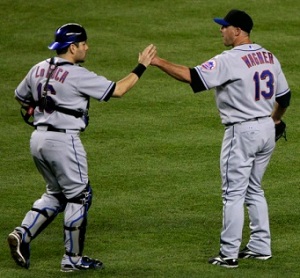
Paul Lo Duca and Billy Wagner share a high-five after nailing down a Mets win. Claiming Joe West’s strikes could be bought with Wagner’s classic Chevy sends Lo Duca from high five to out five hundred large . . .

You can accuse one of baseball’s two most notorious umpires of anything you like. Call him a craven self-promoter. Say his strike zone behind the plate is more flexible than politician’s policy positions. Tell the world he’s a meathead for complaining about the length of a baseball game between two certain teams over whom he appoints himself judge and jury.

Those won’t get you hauled into court to answer for defamation. But say on the air that Joe West’s strikes could be bought for the price of using your pitcher’s classic automobile and it’ll cost you six figures. Especially when West wasn’t even behind the plate in the games in question when you caught that pitcher.

Former major league catcher Paul Lo Duca is learning the hard way after losing a defamation lawsuit West filed in 2019. That year, Lo Duca accused West, the single most notorious umpire this side of Angel Hernandez, of being very generous calling strikes with relief ace Billy Wagner on the mound, after Wagner agreed to let the chunky umpire use the lefthander’s 1957 Chevrolet any old time he chose whenever they were in town together.

That’ll cost Lo Duca $500,000 plus interest paid to West after a decision in Manhattan Supreme Court Monday, during a session to determine damages for which Lo Duca didn’t even show up according to numerous published reports.

Lo Duca claimed on a 2019 sports betting podcast that he talked to Wagner after a game in which Wagner both advised Lo Duca to set up a little more inside on the hitters and suggested West would give Wagner the inside corners a little more generously. Why? Here’s Lo Duca himself aboard that podcast:

We’re playing like a really tight game against the Phillies and Billy Wagner comes in from the bullpen. I used to go to the mound every time and like, ‘What’s going on?’ and he’s like, ‘Hey, Joe’s behind the plate. Set up a couple more inches inside. I was like, ‘Are you kidding me? Joe hates me.’ He’s like, ‘No, no, no, no, no, no. Joe loves me.’

I go, ‘He hasn’t given us the corner all day.’ He’s like, ‘Don’t worry about it.’ He literally throws 10 pitches and strikes out three guys. Joe rings up all three guys. Eight out of the nine pitches were at least three to four inches inside, not even close. Guys were throwing bats and everything. Joe walks off the field.

I get back into the clubhouse and I’m like, “What the [fornicate] just happened just right now?” And Wagner just winks at me. I’m like, “What’s the secret?” He’s like, “Eh, Joe loves antique cars so every time he comes into town I lend him my ’57 Chevy so he can drive it around so then he opens up the strike zone for me.”

I’m like, “This guy’s been throwing me out for the last 10 years of my life and all I needed to do was rent him a ’57 Chevy?”

'57 Bel Air

A 1957 Chevrolet, the kind of car Billy Wagner didn’t use to buy strikes from Joe West.

There were two problems with Lo Duca’s revelation, as things turned out. Problem One: West countered, and the records support him, that he was never behind the plate when Wagner was on the mound with Lo Duca catching in either 2006 or 2007, the two seasons Lo Duca spent with the Mets. Problem Two: Wagner himself submitted a December 2020 affidavit denying he talked to Lo Duca about buying West off with a vintage Chevy or anything else.

Manhattan Supreme Court Judge John Kelley found it too simple to rule in West’s favour when Lo Duca didn’t show up Monday or respond directly to West’s suit otherwise. As of this writing, Lo Duca hasn’t responded to the court ruling and Wagner hasn’t spoken publicly about the case or the critical conversation he denies ever happened.

West remembers working only one Mets-Phillies game behind the plate in the 2006-2007 time frame and Wagner wasn’t on the mound at any time during the game—which ended on a home run, not three straight punchouts. Unlike on a lot of occasions when he calls strikes balls, balls strikes, outs safe, and safes out, West was dead right about that.

You can look it up. In 2006-2007, the Mets played 27 games that ended in walk-offs. Their record in those games: 18-9. (That’s a .667 winning percentage in those games, for those scoring at home.) They included two walk-off games with the Phillies in each year; the Mets won only one of those games:

9 May 2006—Final score: 5-4, Phillies. The walk-off blow: Mets reliever Aaron Heilman’s throwing error on Bobby Abreu’s grounder, allowing David Delluci (two-out triple) to score the winner. Billy Wagner: didn’t pitch. Paul Lo Duca: caught and batted second in the lineup. Home plate umpire: Doug Eddings.

23 May 2006—Final score: 9-8, Mets, sixteen innings. The walk-off blow: Carlos Beltran’s leadoff home run off Phillies reliever Ryan Madson. Wagner: pitched the 11th; fly out, two swinging strikeouts. Lo Duca: caught the entire game and batted second. Home plate umpire: Jeff Kellogg.

28 August 2007—Final score: 4-2, Phillies. The walk-off blow: Ryan Howard’s two-run homer off Guillermo Mota. Wagner: didn’t pitch. Lo Duca: caught and batted seventh. Home plate umpire: Joe West. Most likely, this is the game West himself remembers.

30 August 2007—Final score: 11-10, Phillies. The walk-off blow: Chase Utley’s RBI single through the hole at second, after Tadahito Iguchi singled to tie the game and stole second. Wagner: pitched the ninth and surrendered the tying and winning runs. Lo Duca: entered the game in the eighth taking over for Mike DiFelice and batting eighth. Home plate umpire: Ed Hickox.

Four times the Mets and the Phillies played games ending in walk-off hits in 2006 and 2007. Joe West was the plate umpire for one of those games, in which Wagner didn’t pitch but Lo Duca caught. In the two games in which Wagner did pitch, he struck out two of his three batters in the first game but struck out none of the batters he faced in the second game.

As a matter of fact, Wagner was credited with the pitching wins in three Mets walk-offs in 2006 and two in 2007. So we should have a look at those, too:

9 April 2006, vs. the Marlins—Final score: 3-2, Mets. The walk-off blow: David Wright’s sacrifice fly in the bottom of the ninth. Wagner: pitched the top of the ninth, worked his way out of a two-out jam by inducing a ground out to second base, no strikeouts. Lo Duca: caught the entire game and batted second. Home plate umpire: Ed Montague.

1 May 2006, vs. the Nationals—Final score: 2-1, Mets. The walk-off blow: Lo Duca’s grounder to relief pitcher Gary Majewski on which Majewski’s throwing error trying to start a double play allowed Endy Chavez to score the winner. Wagner: pitched a spotless ninth with two swinging strikeouts and a ground out right back to the box. Home plate umpire: Chris Guccione.

19 May 2006, vs. the Yankees—Final score: 7-6, Mets. The walk-off blow: Wright scoring Lo Duca with a fly single off Hall of Famer Mariano Rivera. Wagner: struck the side out swinging in the top of the ninth. Lo Duca: of course, caught the entire game and batted second. Home plate umpire: Alfonso Marquez.

23 June 2007, vs. the Athletics—Final score: 1-0, Mets. The walk-off blow: Wright’s RBI double. Wagner: shook off a leadoff single in the top of the ninth to get a bunt ground out, a fly out, and a swinging strikeout. Lo Duca: started the game but came out for a pinch hitter in the sixth. Home plate umpire: Marvin Hudson.

21 August 2007, vs. the Padres—Final score: 7-6, Mets. The walk-off blow: Luis Castillo’s RBI single. Wagner: pitched the ninth and surrendered a game-tying run on Kevin Kouzmanoff’s sacrifice fly, during a rough inning in which he surrendered a single, a walk, and a hit batsman to load the bases for Kouzmanoff. Lo Duca: didn’t play. Home plate umpire: Angel Hernandez.

Five times between 2006 and 2007 Billy Wagner ended up the pitcher of record in walk-off wins by the Mets; only once did he get credit for the win when the Mets walked it off after he’d surrendered a tying run. Paul Lo Duca was behind the plate for Wagner in three of the five. Joe West didn’t call balls and strikes in any of those five games, including the one such game in which Wagner did strike out the side—against the Yankees, not the Phillies—with Lo Duca behind the plate.

West plans to retire after this season. Trying to bring Lo Duca to account, West’s legal team pressed his fear that the Lo Duca podcast appearance would injure his chances to be elected to the Hall of Fame, especially considering he stands to break Hall of Fame umpire Bill Klem’s record for games umpired. As The Athletic points out, umps elected to Cooperstown earn a lot more on the rubber chicken and autograph circuits if they have the Hall of Fame on their resumes.

Never mind whether or not you think West belongs in Cooperstown. Lo Duca forgot one of the key lessons we learn at ages younger than Lo Duca’s when he first made the Show: Look before you leap. The tide may have receded.

The Machine is winding down?

Albert Pujols, hitting the 661st home run of his major league career last September to pass Willie Mays. His wife says he’ll call it a career when his contract ends after the 2021 season.

“Since the time he was a child, [he] would eat, sleep, and breathe this sport,” wrote Deidre Pujols on Instagram Monday. Right after she announced that that day would be day one of her husband, Albert’s final season as a major league baseball player. The loving husband responded to his wife’s post with three heart emojis.

The game and those who love it are liable to respond with a lot more than that. Tears included. Not just because of what Pujols was and the no-questions-asked Hall of Fame greatness he personified, but because of what injuries—almost all involving his feet and legs—made of the second half of his career.

But will he retire after this season, really?

Mrs. Pujols subsequently updated the post. “Today is the first day of the last season (based on his contract) of one of the most remarkable careers in sports!” it now reads. Then, she updated it again, saying she wanted only to send him into this season with blessings.

His ten-year, gigabucks Angels contract expires after this season. His tenure has been so injury addled that there came times Angel fans wondered if the Cardinals, who declined to re-sign the first baseman after the 2011 season, hadn’t slipped a whoopee cushion under their tails.

Under normal circumstances nobody likes to see the greats hit their decline phases. Were there more heartbreaking sights than Babe Ruth as a feeble Boston Brave? Walter Johnson, Warren Spahn, Satchel Paige, Robin Roberts, Whitey Ford, and Henry Aaron showing their ages at last?

Those men at least enjoyed the shorter declines. Pujols’s body turned his into a decade. Willie Mays’s kicking-and-screaming decline lasted seven years, heartbroken that he could no longer play the game he loved the way he did for so long. Steve Carlton spent almost half a decade jumping from team to team trying to find the left arm that went AWOL after almost two decades of Hall of Fame excellence. Pujols beat him and everyone else by almost double.

Last year, Pujols finally met and passed Mays on the all-time home run list. Earlier that pan-damn-ically truncated season, Pujols received a text from Mays: “It’s your time now. Go get it.” On 13 September, Pujols finally got it to tie. He turned on Rockies reliever Carlos Estevez’s 1-1 fastball and drove it just the way he did it in the truly glory years, half way up the left field seats on a parabola down the line.

Five days later, Pujols turned on Texas reliever Wes Benjamin’s fastball right down the chute on 1-2 and drove it into the visitors’ bullpen in Angel Stadium to pass Mays.

For a few brief, shining moments, Angel fans were reminded of treasures not really theirs to know, and Cardinal fans from a distance were reminded of what they were so fortunate to see for eleven transdimensional seasons. Watching a transdimensional talent who never stopped believing he absolutely had to get better.

The three-run detonation off Brad Lidge in the 2005 National League Championship Series, kept inside Minute Maid Park only by the retractable roof bracing wall. The reverse cycle of homers in Game Three of the 2011 World Series, every one of them after the sixth inning: the three-run homer, the two-run homer, the solo blast. The deadly lifetime postseason record. All those seasons as the game’s greatest righthanded hitter as well as a very run-preventive first baseman.

And, the sweet way Pujols paid tribute to the Cardinals legend who’d long befriended him, when Hall of Famer Stan Musial died in 2013. “I know the fans call me El Hombre, which means The Man in Spanish,” Pujols insisted, “but for me and St. Louis there will always be only one Man.”

Pujols was so emphatic about it that, when he became an Angel and the organisation festooned southern California with billboards announcing El Hombre‘s arrival, El Hombre blew his sombrero. He insisted very publicly that only one player should ever be called The Man, and his name wasn’t Albert Pujols. It takes longer for mob hit men to disappear their victims than it took the Angels to dispose of those billboards.

You think that was for showing and not for blowing? Few players have had as deep a reverence for baseball’s history as Pujols has had. That depth enabled Pujols to befriend Musial and mentor Mike Trout, “who might be the only position player this century to match [Pujols’s] level of peak greatness,” says The Athletic‘s Fabian Ardaya.

When Pujols said of Trout last year, ““We have the best player in the game, and five or six years from now, he’s going to be making history, too,” he didn’t have to be told Trout’s already made some history of his own. He knows it. He respects it. He mentored Trout into becoming the Angels’ team leader not by way of claiming the role for himself but by what he does on the field and how he lives off it.

Pujols himself lives a well-apportioned life away from baseball. Among other things, when not raising his own family, he and his wife have worked arduously with Down’s syndrome children—among whom is their own daughter, Isabella—and against human trafficking.

His lower body ruined what should have been a kinder, gentler, simpler decline phase. It’s left him prone to as much criticism under ordinary, non-milestone circumstances as he received high praise whenever the vintage Pujols made the periodic cameo. If the Angels looked foolish for signing him long-term and extraterrestrial salary after the injuries began to chip him down, they never once doubted Pujols was giving the best he had with whatever he had left.

““He plays through discomfort,” former general manager Billy Eppler told MLB.com after he tied Mays. “He endures a lot and doesn’t talk a lot about it. But I can tell you that he’s definitely someone that wants to play and fights through a lot of adversity to make sure he’s out there and contributing to the club.”

Even those whose admiration for him didn’t crumple the way his injuries forced him to crumple hoped somewhere, somehow, several times the past few years, that Pujols would swallow his formidable pride, leave the rest of his formidable money on the table, let nothing further tarnish his near-singular legacy, and sink into that ten-year services contract he still has with the Angels following his retirement.

“It has been so hard to watch one of the greatest players in the history of baseball fade like this,” wrote another Athletic scribe, Joe Posnanski, almost a year ago. “Each year, I hope against hope for Pujols to be Pujols one more time. Sadly, that just isn’t how time works. He is 40 now and a decade past his prime. It hasn’t been a sad career, though; far from it. It has been extraordinary. It has been an inspiration.”

It’s not unfair to say Pujols’s contract hamstrung the Angels when administrative tunnel vision didn’t when it came to re-tooling the team back to contention. Neither is it unfair to say that spending that much for a well-established Hall of Famer who hadn’t yet been hit with his physical issues didn’t have to mean the Angels ignoring their other issues, either.

Like his final Cardinals regular season, Pujols’s first Angel season was solid, if below his former standard. His 2011 postseason and how he helped the Cardinals win that outer-limits World Series may have deked people into thinking he’d only had one off year but plenty of petrol left in reserve.

Then plantaar fascitis in his heel kept him to 99 games in 2013 and a staggering enough fall from even that 2012 performance. Further injuries below his waistline made sure he’d look like an imitation of himself from then on, despite a few shining hours, a few significant milestones, a few moments in which he looked exactly the way he did over those impeccable St. Louis years.

But he didn’t hold a gun to the Angels’ heads and tell them to waste their remaining resources, either. The Angels have been an anti-model franchise during most of Pujols’s tour with them. If Pujols calls it a career after the season to come, the Angels, their fans, and their critics won’t have Pujols to blame for what wasn’t his fault in the first place.

This is Pujols according to my Real Batting Average metric (TB + BB + IBB + SF + HBP / PA):

PA TB BB IBB SF HBP RBA
Career 12,394 5923 1331 312 115 108 .628
With the Cardinals 7433 3893 975 251 68 77 .708
With the Angels 4961 2030 356 61 47 31 .509

That’s what the injuries did in turning what should have been a natural decline phase into a hard-lived one.

Albert Pujols was a .708 batter as a Cardinal. His career RBA with a normal decline phase should have lined him up to finish at the top of the heap of Hall of Fame first basemen who played their careers in the post-World War II/post-integration/night-ball era. If his .628 holds by the end of this year, it’ll plant him in between Jeff Bagwell and Willie McCovey, and Pujols was the better all-around first baseman among those three plus first base RBA leader Jim Thome.

Pujols’s other nickname has been The Machine. Unfortunately, even machines have finite lives to do what they were built to do. They don’t all decline as sadly as this one did. Even if this one’s going make what promises to be a singular Hall of Fame acceptance speech in 2027. With Stan Musial smiling broadly upon him from the Elysian Fields, if not blowing him a chorus of “Take Me Out to the Ball Game” on his ubiquitous harmonica.

“Why did he quit?” Joe DiMaggio’s brother, Tom, once said when asked why the Yankee Clipper would call it a career after thirteen war-disrupted seasons and a persistent heel issue that turned into back trouble. “He quit because he wasn’t Joe DiMaggio anymore.”

Maybe the gigabucks Pujols earned as an Angel kept him from quitting precisely when he wasn’t really Albert Pujols anymore. Maybe his pride did it. Maybe both. Maybe, come the next off-season, it’ll be impossible at last for Pujols to tell himself he can be day-in, day-out great again. Maybe he’ll tell himself at last it’s time to let his whole record take him out of the box and into Cooperstown.

And maybe the Angels will find ways to a) make the game’s best player since Pujols joined the team proud; and, b) reach the postseason to send Pujols into retirement in a blaze of glory.

We can dream, can’t we?