A few ways to fix the Hall of Fame vote

This year’s Hall of Fame vote by the Baseball Writers Association of America is troubling, for more reasons than just Curt Schilling falling short by sixteen votes and Schilling’s demand to be removed from the writers’ ballots. Something is wrong, drastically so, with the vote. For the sake of the Hall of Fame, it needs to be fixed. But how?

The answer isn’t simple. But there’s one sub-issue to consider at once: the blank ballots. How many the writers submitted is less relevant than the thought that, perhaps, if you submit a blank ballot, you should lose your Hall vote for a spell.

Voting for the Hall of Fame isn’t exactly a right. The Hall conferred the privilege upon the writers almost a century ago. With privilege comes responsibility, no matter the controversies that do or don’t surround a particular year’s candidates. The responsibility includes the one holding the privilege to do his or her job, think hard, and vote.

If assorted BBWAA members thought it was difficult to impossible to resolve certain questions around certain players while considering their Hall ballots, they don’t always seem to find it too difficult to write magnificent ravings about those questions and players when the occasion arrives.

As a life member of the Internet Baseball Writers Association of America, I cast votes for the IBWAA’s Hall of Fame roll every year since becoming such a life member. Such votes are neither simple, cut, dried, or prenatal surgery. Last November, I voted, citing why I voted for this player or didn’t vote for that player. If a man can do that in what amounts to a symbolic Hall election, surely the BBWAA can do theirs in a real one.

The writers might consider that blank ballots are simply not acceptable regardless of the moment’s controversies. They might also consider that those submitting blank ballots should have their Hall vote privileges suspended. It might convince the blankers to think twice, thrice, as much as it takes.

The Hall of Fame itself should step up, step in, and decide the writers have played enough games for long enough, it’s time to broaden the Hall of Fame vote. You can pick numerous instances if you like, this year and in years past, but perhaps it’s time the BBWAA and the Eras Committees are no longer the only groups privileged to vote for the Hall.

Come to think of it, the former Veterans Committee really put its own foot in it (hardly for the first time) when they enshrined former comimssioner Bud Selig. We should have expected certain ramifications and after-effects, when players indulging actual or alleged performance-enhancing substances pre-testing still tie the BBWAA up in knots but the old Veterans Committee elected the commissioner who let the so-called Wild West Era run wild.

Who else should be invited to vote for the Hall of Fame? I have a few ideas:

1) The living Hall of Fame players themselves. No one should feel funny about allowing such as Jeff Bagwell, Johnny Bench, Craig Biggio, George Brett, Dennis Eckersley, Ken Griffey, Jr., Rollie Fingers, Vladimir Guerrero, Rickey Henderson, Randy Johnson, Chipper Jones, Sandy Koufax, Greg Maddux, Willie Mays, Mike Piazza, Tim Raines, Nolan Ryan, and Ozzie Smith, to name a few, voting for successors worthy of joining their fraternity.

Some of them get to be part of assorted sixteen-member Eras Committees, of course, which also include “executives, and veteran media members” according to the Hall itself. We can adjust that: The Hall of Famers should have to choose whether to vote concurrent to the BBWAA or as members of one or another Era Committee considering overlooked/snubbed BBWAA candidates—but not both.
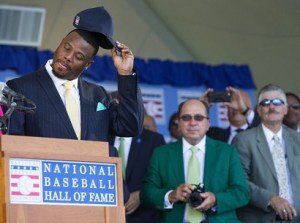
Why shouldn’t such Hall of Famers as Ken Griffey, Jr., Johnny Bench, and Rollie Fingers, among others, have Hall votes?

2) The living Ford C. Frick Award winning broadcasters and those currently working in the broadcast booths. They see as much of the games as the writers do. The Hall would not be disgraced by the like of Marty Brennaman, Chip Caray, Bob Costas, Ray Fosse, Jaime Jarrin, Jim Kaat, Buck Martinez, Tim McCarver, Jon Miller, Vin Scully, Bob Uecker, or Suzyn Waldman, among others, having a vote.

3) The established statistics mavens, since statistics remain the life blood of baseball.  Please tell me you don’t think it would be a travesty for Allen Barra, Bill James, Rob Neyer, or the folks at Baseball Prospectus, Baseball Reference, retrosheet, and The Elias Sports Bureau to be included in the Hall of Fame vote. If much of their work has provoked re-assessments of several subsequent Hall of Famers, they should not be regarded as voting interlopers.

4) Those writers/historians who were never admitted to the BBWAA but who’ve established themselves long and with particular distinctions as blessings to the game. Find us a valid reason for ageless Roger Angell, Peter Golenbock, John Helyar, Donald Honig, Richard Goldstein, George F. Will, or plenty of the fine excavators of the Society for American Baseball Research, just for openers, to be excluded from the Hall vote. You’ll have a simpler time finding Atlantis.

5) Umpires with above-average ratings. (God and His servant Doug Harvey only know you don’t even want to think of bringing Angel Hernandez or Country Joe West into the voting fold.) Those folks had the second-best views of Hall of Fame candidates for themselves. (The first-best is probably a tossup among several.) The best umpires didn’t just call the pitches or the plays, they developed particular appreciation for players who strove for and achieved Hall of Fame-level excellence.

They would not lack credibility as Hall voters if allowed the chance. Should a voting umpire lose his (or her, in due course?) above-average rating, their Hall vote can be suspended for that year.

6) How about the IBWAA? As in, members not concurrent BBWAA members but whom the IBWAA leadership deems by their actual works to be worthy of a Hall of Fame vote to exercise wisely and diligently. (Fair disclosure: I’m not an IBWAA leader or officer yet.) The IBWAA is not just another gaggle of fans ranting our heads off. We’ve got some excellent observers/analysts/commentators among us who have earned the chance.

7) Establish a Pioneer Committee. This would be a group considering and giving due to those people—players, executives, statisticians, others—whom we’d consider to have changed the game profoundly in ways other than how they played or managed or administered the game. (It wouldn’t have let Marvin Miller wait until death did he part for his well-deserved Cooperstown enshrinement, either, if it lived while he did.)

The Pioneer Committee could begin with considering Curt Flood, who kicked the door to free agency open just enough with his reserve clause challenge. And, Andy Messersmith, who shoved the door open all the way by finishing what Flood started and prevailing. And, Tommy John, who enjoyed a long, distinguished second act after undergoing the first of the ligament-replacement elbow surgeries that’s long since borne his name.

They didn’t quite post Hall of Fame playing careers, but they all changed the game profoundly, and irrevocably. There should be a place in the Hall of Fame for all three.

This Pioneer Committee should also consider those such as Allan Roth, arguably the godfather of deep statistics; and, Bill James, who picked up where Roth left off, all but invented sabermetrics, and sired subsequent generations of deeper analysts many of whom came to play key roles in re-developing baseball organisations. If those are unworthy of Hall consideration, remember that my Antarctic beach club has yet to find a buyer.

The BBWAA should also re-consider the ten-vote maximum on the Hall of Fame ballot. The max was imposed in the first place out of concern to do whatever the writers could think to keep those nefarious suspected users of actual or alleged performance-enhancing substance from getting through.

Aside from that jet taking off decades ago (greenies, anyone?), they shot themselves in the foot with the limit. The bullets traveled far enough to delay or torpedo entirely more than a few legitimate Hall of Fame cases thanks among other things to several instances ballot jam. Kenny Lofton surely isn’t the only man wondering why the number ten center fielder ever to play major league baseball can’t be in Cooperstown (pending a future Era Committee consideration) except as a visiting customer.

Raise the ballot max back to fifteen. Maybe that wasn’t perfect, either, but it might return the writers a little more of the proverbial wiggle room to cast thoughtful, reflective votes that, among other things, won’t leave enough of the Loftons as baseball’s wronged men to be done right at some future date if at all.

While they’re at it, they should dump once and for all the prejudice against first-time votes. If you think a player belongs in the Hall of Fame, vote him on the first ballot. You don’t need reminders of how many Hall of Famers you’d assumed Cooperstown locks waited five or more ballots to get their due, or how often you wrote fuming over that very sad fact.

(People still think it’s more than a little surreal, if not insane, that Cy Young, Lefty Grove, Joe DiMaggio, Hank Greenberg, Yogi Berra, Whitey Ford, Craig Biggio, and Vladimir Guerrero aren’t first-ballot Hall of Famers. Even if things worked out well enough for Ford that he got in on his second try, the following year—next to his old running mate Mickey Mantle, on Mantle’s first.)

So why not invite Joe and Jane Fan into the Hall of Fame voting discussion yet? There’s a very good reason not to. They’ve turned All-Star Game voting into ballot box stuffings or gold watch honoraria. (The All-Star Game vote system needs a complete overhaul, but that’s another day’s subject right now.) Do you really want to know how much worse they might make the Hall than did the Today’s Game Committee that decided Cooperstown should be Harold Baines’s gold watch?

On Schilling wanting off the Cooperstown ballot

Why should members of a profession for whose lynching Curt Schilling once called want to vote him into Cooperstown?

The Hall of Fame pitching a shutout in this round of Baseball Writers Association of America voting wasn’t really that big a surprise. Curt Schilling’s post-results tantrum after he fell short by a measly sixteen votes was, somewhat. What to make, then, of Schilling’s demand that the BBWAA remove him from its ballot for what would be his final bid for Hall of Fame election by them?

The bad news, for those who’ve come to consider him poisonous entirely by way of about 95 percent or more of his infamous tweets, is that neither the BBWAA nor the Hall of Fame can just send him off the ballot with a single finger snap. Yet. The BBWAA’s ballot rules enjoin against it, and the Hall of Fame may be likely to reject it on those very grounds, no matter what Schilling has asked of the Hall in that regard.

But perhaps the BBWAA should find a way to amend its rule and grant Schilling his request. Maybe the best thing would be for a future Eras Committee to contend with his candidacy. If Schilling thinks his “peers” would be more likely to elect him, someone might remind the former righthander that one of his own general managers (Ed Wade, Phillies) once called him “a horse every fifth day and a horse’s ass the other four.”

Schilling’s rant included referencing his own having won a few humanitarian awards during his pitching career, but there have also been references over the years to his not quite having been the most popular or respected man in his clubhouses, too. When he teamed with Hall of Famer Randy Johnson on the 2001 World Series-winning Diamondbacks, a member of the organisation told baseball writer Joe Posnanski, “[W]ith Johnson, teammates hated him on the day he pitched, loved him the other four days. And with Schilling, teammates loved him on the day he pitched, hated him the other four days.”

I’m not a member of the BBWAA. I don’t have an official Hall of Fame vote. I am a life member of the Internet Baseball Writers Association of America, however, and every year we, too, conduct votes symbolically for our own Hall of Fame. Sometimes, we’ve elected people before the BBWAA. We pitched a shutout this time around, too.

Back in November I wrote about my own IBWAA ballot choices and what the thinking was behind it. My choices did include Schilling. (For the record, I also voted yes on Todd Helton, Andruw Jones, Jeff Kent, Scott Rolen, Gary Sheffield, and Billy Wagner.) In the passage I wrote on behalf of that vote, I concluded, “I don’t have to love or respect Schilling as a person to respect what he did on the mound. When you take your children to Cooperstown, and you see Schilling’s plaque, just tell them he isn’t the first and won’t be the last to be a Hall of Famer at the ballpark and a Hall of Shamer away from it.”

Immediately preceding that, I cited Jay Jaffe’s essay on Schilling in The Cooperstown Casebook: “I wouldn’t invite Schilling into my own home, and I wouldn’t encourage anyone to view him as a role model, but in my view nothing in his career leaves a doubt that he belongs in Cooperstown. He ranks among the all-time greats via his run prevention skill, his dominance in the game’s most elemental battle of balls and strikes, and his repeated ability to rise to the occasion when the on-field stakes were highest.”

Jaffe has since changed his mind, and not just because he knows that those who think denying Schilling his Cooperstown plaque comes purely from his support for Donald Trump aren’t thinking. Mariano Rivera made no secret of his own support for Trump before his own unanimous election to the Hall, but neither is The Mariano on record as supporting among other Schilling positions the lynching of journalists.

“[A]s a first-time [Hall of Fame] voter,” Jaffe wrote after Tuesday’s Hall shutout, “I avoided invoking the character clause . . . on the grounds that the clause was conjured up by a commissioner (Judge Landis) who spent his entire 24-year term upholding the game’s shameful color line. I viewed my omission of Schilling as a protest against the notion that he’s owed any deference for his hateful post-career conduct; if he’s ever elected, it won’t be in my name. More than ever, I stand by that decision.”

Writing as I am about to write is painful enough. I watched Schilling pitch over many years of his career. I saw how great he was on the mound, I saw the way he dominated batters whether pitching for also-ran teams or World Series champions. I saw the ways he lived for and triumphed in the biggest of the big games, sometimes despite his body attempting sedition. I also knew Schilling had (and has) a love of the game so deep he never forgot being awed at Frank Robinson managing him early, or getting to pick the brains of Hall of Fame pitchers, or admitting he’d watch Randy Johnson and Pedro Martinez when they were teammates “because any day they pitched could be history.”

“He’s a horse every fifth day and a horse’s ass the other four.”—Ed Wade, Schilling’s GM with the Phillies.

I was too willing to overlook too much simply because by the record alone, the eye test and the deepest statistical look alike, Schilling belongs in the Hall of Fame. He may be the greatest or at least the toughest big-game pitcher who ever took the mound. I’ve seen a boatload of pitchers, Hall of Famers and otherwise, who stood tall and delivered big when the biggest of the big demanded it; I’ve seen a boatload of pitchers, Hall of Famers and otherwise, who didn’t. (Conspiracy theorists, if you still believe the Bloody Sock Game was fraud, you can still buy my beach club in Antarctica.)

But I’m familiar, too, with the wisdom projected in 1949 by an essayist not remembered much today outside the intellectual circles of those who believe, as I do, in something not much discussed or pondered over the past decade plus: freedom. The essayist was Frank Chodorov, today unsung often enough as a bellwether of the freedom philosophy. Writing in his one-man broadsheet analysis about the leaders of the Communist Party USA brought to trial under the Smith Act, in May 1949, Chodorov demurred from such a prosecution, despite being a staunch anti-Communist himself:

The danger, to those who hold freedom as the highest good, is not the ideas the communists espouse but the power they aspire to. Let them rant their heads off—that is their right, which we cannot afford to infringe—but let us keep from them the political means of depriving everybody else of the same right.

Schilling’s political opinions are one thing. So is criticising journalism with which he disagrees. His approval of lynching journalists (recanted swiftly enough, but hardly forgotten), and for things that would indeed amount to depriving others of their rights or at least compromising them in broad sweeps, are something else entirely.

There are journalists who dishonour their profession and our intelligence in ways too numerous. I’ve had a career as a journalist in regional daily newspapers, regional daily news radio, and trade journalism. I’m too well aware that there are and have always been such journalists. They didn’t begin or end with, for one grotesque example, Walter Duranty’s notorious use, misuse, and abuse of his New York Times berth to propagate on behalf of one of history’s bloodiest tyrannies.

There’s no such thing as the perfect, fault-free journalist, whether a straight reporter, an analyst, or a commentator. The day I claim to be one now or to have been one then, just shoot me dead. But the flip side to the precept that “fake news” is news someone (usually in authority) doesn’t want to hear or doesn’t want known is that there has been fake news as long as there’s been news at all.

If it was purely a matter of rejecting Schilling’s political opinions that would be simple business. He has the same mere right to be wrong as anyone else, regardless of what today’s “cancel culture” left, right, or over-under-sideways-down would argue to the contrary, regardless even of some of Schilling’s own remarks that imply merely being wrong should be a punishable crime.

“To be sure,” Chodorov also wrote, “our history is not free of political efforts to put limits on what people may think . . . authorities [have] sought to get at ideas by inflicting punshment on those who held them . . . It is to the credit of the American genius for freedom that ultimately the right to think as one wishes prevailed, even though too often some were made to suffer for it.”

Hall of Fame debaters, who are legion, remind others that the Hall itself hardly lacks for honourees of dubious character or thought. Such honourees are not generally known to have called for the execution of the journalists with whom they often disagreed, sometimes appropriately, sometimes inappropriately, sometimes violently. Baseball players have never been immune to testy relations with writers who covered them. Testy relations didn’t exactly equal wanting to speed the writers’ deaths, either.

It’s not just Hall of Famers incumbent or in waiting who’ve found the baseball press equal to a castor oil over the rocks. But even Jason Vargas threatening to knock a writer the [fornicate] out for daring to question then-Mets manager Mickey Callaway over a dubious non-move that cost the Mets a ball game late wasn’t quite threatening to knock the writer the [fornicate] into the cemetery.

Let Schilling rant his head off, wherever he pleases, to whomever he pleases, from whichever forum allows, until or unless he violates that forum’s rules flagrantly enough. That is his right, which we cannot afford to infringe, and his right to rant his head off holds hands with anyone else’s concurrent right to ignore or denounce his rants. Let us just keep from him the political means of depriving everybody else of the same right.

Let us also not insist that a certain group of journalists should yet confer upon him an honour for which they have the privilege of voting since he is on the record as approving their profession’s dates with lynch mobs. Not even if giving him 71 percent of their Hall of Fame vote this time equals their telling him, “Thank you, sir, and may I have another.”

Don Sutton, RIP: Craftsman (har, har)

Don Sutton only looked like a surfer dude.

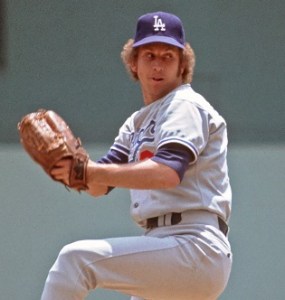
Last year’s sad parade of Hall of Famers going to the Elysian Fields waited at least until spring to begin. This year’s began with the year a mere seven days old and the nation battered by the Capitol riot a day earlier. Tommy Lasorda died of heart failure on 7 January; one of his pitchers, Hall of Famer Don Sutton, died of cancer Tuesday night.

Sutton got to the Hall of Fame by way of his unique durability. In 23 major league seasons he didn’t miss a starting assignment until his last season, 1988. He earned credit for 324 wins despite having a 20-win season only once (in 1976, winning 21). He led his league three times in strikeout-to-walk ratio and four in walks/hits per inning pitched but never led in strikeouts while leading his league in earned run average only once.

That’s despite spending his career in pitcher-friendly home ballparks. Sutton wasn’t too gapingly different on the road; enemy batters hit .247 against him on their home turf and .226 against him on his home turf, with a .606 OPS on his grounds and a .678 OPS on theirs. His forte was workman-like speed changing, smarts, and guile, heh heh heh.

As of this morning, Baseball-Reference lists Sutton as the number 73 starting pitcher of all time with the most-similar pitcher being fellow Hall of Famer Gaylord Perry. Most similar doesn’t exactly mean equal value, of course; Perry is slightly above the peak and career value averages for Hall of Fame pitchers and Sutton is somewhat below those averages.

All aboard for fun time? Like Perry, Sutton was suspected very frequently of, shall we say, extracurricular craftsmanship on the mound. Like Perry, Sutton knew how to ride the suspicions well enough, even if he wasn’t half as dedicated to psychological warfare as Perry was.

Both men had mischievous senses of humour about the suspicions versus the actualities. If Perry titled his memoir Me and the Spitter and went through a famous series of motions from head to torso when he wanted hitters just to think he was going to grease them, Sutton didn’t have any particular trademark suspect gestures.

Perry looked like the Carolinas peanut farmer he was in the off-season; Sutton, despite his Alabama sharecropping roots, resembled the classic California surf rat from his rookie season to his Hall of Fame induction speech. Perry preferred to live rent-free in a hitter’s head; Sutton preferred tweaking the powers that were.

Sutton took to leaving tiny notes in the fingers of his glove for umpires to discover when they or a protesting manager thought it wise to have him patted down and frisked on the mound. A classic: “You’re getting warmer. But it’s not here.”

After frequent enough accusations that “I ought to get a Black & Decker commercial out of it,” Sutton actually got just that. “The only fun I get now,” he once said to Thomas Boswell of the Washington Post, “is hiding dirty notes in my uniform pockets for the umpires to find them when they search me.”

“Sutton has set such a fine example of defiance,” longtime Orioles pitching coach Ray Miller told Boswell, “that some day I expect to see a pitcher walk out to the mound with a utility belt on—you know, file, chisel, screwdriver, glue. He’ll throw a ball to the plate with bolts attached to it.”

Nobody expected Sutton to sue longtime respected umpire Doug Harvey when the latter ejected him over a “defaced” ball in 1978. While pitching against the Cardinals and leading 2-1 in the seventh on 14 July, Harvey gave Sutton the ho-heave. “I’m not saying Sutton was defacing it,” Harvey told reporters. “I’m saying he was pitching a defaced baseball and the rules state that anyone pitching a defaced ball shall be ejected from the park.”

United Press said the “defacement” may have involved Sutton scratching a mark into the ball with his fingernail. “I have one thing to say and then no questions,” he told reporters. “On the advice of my attorney, I’m to say nothing about this. I’m filing suit against Doug Harvey, the National League and whoever runs the umpiring.”

Said Lasorda, who played the game under protest: “[Harvey] is judge and jury, and depriving Sutton of his right to pitch. It’s the first time I’ve ever seen that; it’s the first time he’s ever been ejected.”

“It was not the first confrontation over doctored balls between Harvey and Sutton,” UPI noted. “At other times in his twelve‐year career, the pitcher has been accused of scratching the ball with his fingernail to rough the surface for a better grip.”

Sutton’s lawsuit didn’t exactly set new legal precedent. It didn’t exactly get far enough to set one, let us say. Since the only verified implement he used was his fingernail, you certainly couldn’t accuse him of applying a foreign substance. (“I don’t use foreign substances,” one-time Yankee pitcher George Frazier snarked. “Everything I use is made in the U.S. of A.”)

But about a decade later, when Sutton was an Angel after some traveling from the Dodgers to the Astros, the Brewers, and the Athletics, he squared off in Anaheim Stadium against Tommy John, a former Dodger teammate then with the Yankees, and a pitcher Boswell described as able “to turn a tiny scratch into a double play grounder.”

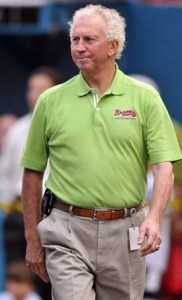
Sutton during his years as a popular Braves broadcaster.

Yankee owner George Steinbrenner, watching from his Tampa home, decided Sutton was being a little too blatant about things, calling the Yankee dugout and manager Lou Piniella. Steinbrenner demanded Piniella have Sutton frisked, arrested, arraigned, bound over, tried, convicted, and executed on the spot. Piniella tried to reason with The Boss.

“George, do you know what the score is?” Piniella asked, according to Bill Madden and Moss Klein’s Damned Yankees, referring to the early 1-0 Yankee lead. “George, if I get the umpires to check Sutton, don’t you know that the Angels are going to check TJ? They’ll both get kicked out. Whatever they’re doing, TJ’s doing it better than Sutton. So let’s leave it alone for now.”

John was lifted after six and a third innings; Sutton pitched seven full. Each man surrendered a pair of earned runs, including Sutton surrendering a bomb to Hall of Famer Dave Winfield. After the 3-2 Yankee win, Madden and Klein recorded, a scout in the press box said, “Tommy John against Don Sutton. If anyone can find one smooth ball from that game, he ought to send it to Cooperstown.”

Sutton may have been puckish about his reputation for baseball carpentry but he often admitted candidly that he took baseball to be serious work perhaps too often. He was described often enough as a kind of blithe spirit but it seems to have been his way of protecting himself against the contradictions of the jock shop.

“[M]ost of us have similar abilities,” he once said, of fellow ballplayers and of people in general. “The differences are mental and emotional and the big thing is mental preparation. That’s where everything starts: the poise, the confidence, the concentration.” It didn’t hurt that Sutton’s rookie 1966 saw him the number four man behind a pair of Hall of Famers named Sandy Koufax and Don Drysdale and a stolid number three in Claude Osteen, either.

Raised a devout Christian, Sutton didn’t buy into Lasorda’s Big Dodger in the Sky routines or the manager’s celebrity style, probably because his first manager Walter Alston was the polar opposite and a man Sutton respected deeply for rejecting celebrity and respecting his players as men. Sutton often called Alston the most secure man he’d ever met in baseball and praised the manager for keeping problems and questions with his players behind closed doors.

Sometimes, Sutton discovered the hard way that a little honesty can get you into a nasty spat. When he was an Astro and admitted he hoped he could finish his career on the West Coast where his wife and children still lived, it provoked Astros general manager Al Rosen—who once ended his playing career early due to injuries and a desire to be more a family man—to spar with him in the press.

When still a Dodger in 1978, Sutton said candidly and somewhat benignly that similarly quiet outfielder Reggie Smith was the actual most valuable Dodger, praising the talented and silent Smith because he wasn’t “a facade or a Madison Avenue image.” Taken as the thinly-veiled poke at popular first baseman Steve Garvey that it was, it triggered a clubhouse argument turned brawl between Sutton and Garvey.

John once said that during the worst of the brawl, an unidentified Dodger hollered to break it up because they might kill each other—to which catcher Joe Ferguson replied, “Good.” The problem was that Sutton was actually right. Garvey’s OPS was .843 and his OPS+ for 1977-78 was 130. For the same two seasons, Smith’s OPS was .974 and his OPS+ was 165. Garvey also hit into 22 more double plays than Smith in that span, too. Garvey was worth 8.5 wins above replacement-level for those two seasons, but Smith was worth 10.6.

“I’ve tried over and over to figure out why this had to happen,” Sutton told reporters subsequently. “The only possible reason I can find is that my life isn’t being lived according to what I know, as a Christian, to be right.” That from the pitcher who once ruffled feathers, especially Lasorda’s, by saying unapologetically, “I believe in God, not the Big Dodger in the Sky.”

“It took a big man to say what Don said,” said Lasorda himself, who didn’t always see eye-to-eye with Sutton, “and it took God to inspire him to say it.”

Sutton’s post-pitching life was mostly as a popular Braves broadcaster, where their fans reveled as much in Sutton’s easygoing repartee as in the turnaround of the Braves from the gutter to greatness. (The Braves elected him to their team Hall of Fame in due course.) He was also an enthusiastic Hall of Fame presence following his own election in 1998.

As a rookie during the once-fabled Koufax-Drysdale joint contract holdout of spring 1966, Sutton took the long view in due course. “Baseball players today,” he told Koufax biographer Jane Leavy, “owe a lot to Curt Flood and Andy Messersmith and Dave McNally. But Flood, Messersmith, and McNally owed a lot to Koufax and Drysdale. Because they were the first guys who really took a stand. This was the first challenge to the structure of baseball.”

At the Hall of Fame Sutton let himself be plain human. In the same speech in which he thanked Koufax for teaching him how to act like a baseball professional, he began by saying, “I’ve wanted this for forty years. Why am I now shaking like a leaf?” Then, he answered his own question: “I think part of it is because I’m standing in front of some of the people who were the greatest artists in a wonderful business that I’ve ever seen before.”

The man who often called himself a journeyman hack appreciated the art of the game, and of his own craft, after all. May the Lord in whom his faith was profound enough have welcomed Sutton home with the same appreciation.

Tommy Lasorda, RIP: “I made guys believe”

Tommy Lasorda (right) shares a handshake with Sandy Koufax near the Dodger clubhouse. “It took a Hall of Famer to get rid of me,” Lasorda loved to boast about Koufax’s bonus signing leading to Lasorda’s spring 1955 cut from the major league roster. (Los Angeles Dodgers photo.)

Last year’s losses of seven Hall of Fame players (eight, if Dick Allen is elected by the Modern Era Committee this year) were bad enough. Please, Lord, let Tommy Lasorda not begin a 2021 trend of Hall of Fame managers departing our island earth.

The odds may not be very good there. There are only four living Hall of Fame managers now that Lasorda is gone at 93: Bobby Cox, Whitey Herzog, Tony La Russa, and Joe Torre. Cox, Herzog, and Torre remain elder statesmen of a sort. La Russa has returned to the game to manage the White Sox, hardly without controversy.

Lasorda took the Dodgers’ bridge from Hall of Fame manager Walter Alston in 1976. Twenty-two years later, he retired as an eight-time division winner, four-time pennant winner and two-time World Series winner. It didn’t exactly come the easy way for a man whose major league life began as the marginal relief pitcher cut for a bonus baby.

Under the 1950s bonus rule mandating players kept on big-league rosters two full seasons if their bonuses were higher than $4,000, the Dodgers had to keep such a green lad after signing him for 1955. The man they cut was Lasorda, who’s said to have taken one look at the kid and said, “He’ll never make it.”

It might have taken six seasons for the kid to come into his own and beyond, but the kid was Sandy Koufax. It wouldn’t be the last time Lasorda gave himself the chance to dine out on an old mistake in judgment.

“I did not have a lot of ability, but I’ll guarantee you one thing,” Lasorda said in 1997 when recalling his own pitching days. “When I stood on that hill of thrills, I didn’t believe that there was any man alive who could hit me. And if they did hit me, which they did, I thought it was an accident.” That from the man who dined out further on Koufax, saying, “It took a Hall of Famer to get rid of me.”

Lasorda’s three major league seasons—eight games with 1954-55 with the Dodgers, then eighteen with the 1956 Kansas City Athletics—show 53 accidents while facing 253 batters and posting a lifetime 6.48 earned run average.

Maybe it depended upon whom you asked. To Dodger fans Lasorda was the second-closest thing to a franchise face behind Koufax himself. To non-Dodger fans, Lasorda was either loved, tolerated, or waved away. Dodger fans loved Lasorda’s “Big Dodger in the Sky” schpritzing. Non-Dodger fans thought it was either sacrilege or malarkey.

Come to think of it, not all Lasorda’s players bought into it, either. “I believe in God,” said Hall of Fame pitcher Don Sutton, “not the Big Dodger in the Sky.”

Lasorda was nothing if not both content to be a Dodger for the rest of his life, after his playing career ended in the minors in 1960, and to be Tommy Lasorda. He wasn’t exactly one of the most modest of men, and he rarely apologised for it.

When Hall of Fame broadcaster Vin Scully asked about the pressure of following Alston—who’d won the only Brooklyn Dodgers World Series and three more to follow in Los Angeles—the reply was almost classic Lasorda: “I’m not worried about the guy I am following. I’m worried about the guy that is going to have to follow me.”

Well, it isn’t bragging if you can kinda sorta do it.

That’s not to say Lasorda couldn’t be humbled when humility was the mandate. Maybe no manager this side of John McNamara was as humilitated in the 1980s as Lasorda was with the Dodgers one out from forcing a seventh National League Championship Series game in 1985.

With two Cardinals on and first base open, Lasorda decided it was absolutely safe to let Tom Niedenfuer pitch to Jack Clark instead of putting Clark aboard to pitch to Andy Van Slyke. And Jack the Ripper decided it was perfectly safe to hit Niedenfuer’s first pitch three quarters of the way up the left field bleachers.

“Lasorda wept in the clubhouse,” wrote Thomas Boswell in the Washington Post several years later, “went to the players to apologise, then went on with his life. At the moment he manages the [1988] world champions. Maybe Lasorda coped so well because he’d already gone to three Series and won one.”

The skipper who looked more like he’d be coming out to chat with you in his neighbourly Italian restaurant (“Two World Series Rings. Ate everything he wanted. Drank everything he wanted. 70 Years in the same work uniform. Lived For 93 Years. Absolute Legend,” tweeted sports business analyst Darren Rovell) loved being Tommy Lasorda almost as much as he loved the Dodgers.

He brought Hollywood back to the Dodgers once he realised the celebrities got as much of a kick out of him as he got out of them, and he wasn’t exactly a shrinking violet when it came to being an occasional pitchman. The problem—particularly remembering his once-familiar spots for Slim-Fast diet drink—was that he didn’t always shrink.

Of course, Lasorda’s celebrity provoked a little friendly mischief aimed his way by players who couldn’t resist tweaking him. His late utility outfielder Jay Johnstone often conspired with teammates Don (Stan the Man Unusual) Stanhouse and Jerry Reuss to swipe Lasorda’s wall of photos with him and various celebrities and substitute photos of themselves in their stead. And those were the more benign pranks at the skipper’s expense.

Which didn’t stop Lasorda from writing the introduction to Johnstone’s first book, Temporary Insanity: “[He] wrote a book? What with, a fire extinguisher? . . . What’s that they say about marching to a different drummer? Johnstone must hear a symphony out there . . . That’s some book title. But I’m not so sure about the temporary part.”

The skipper’s outsize personality sometimes masked that he was as inclusive and unprejudiced as the week was long. It didn’t matter if you were white, black, brown, beige, yellow, or paisley, whether you came from flyover America, urban America, outback Mexico, downtown Tokyo, or the penguins of Antarctica. (Which may be where some people thought the Dodgers found 1970s third base mainstay Ron [The Penguin] Cey.) If you could play to the standard the Dodgers prescribed, Lasorda wanted you in the worst way possible.

He preferred positive reinforcement with his players, which didn’t necessarily keep him from reading the proverbial riot act when necessary. There were times when those players perceived as Lasorda pets enjoyed less than consistently friendly relationships with others in the Dodger clubhouse. Sutton and longtime first baseman Steve Garvey didn’t have a clubhouse brawl once upon a time because Lasorda could make them  bosom buddies.

“I made guys believe; I made them believe they could win,” he said in a 2013 interview. “I did it by motivating them. I was asked all the time, ‘You mean baseball players that make $5 million, $8 million, $10 million a year need to be motivated?’ They do. That’s what I did.”

It’s not unreasonable to suggest Lasorda’s presence at last fall’s World Series had even a little hand in pushing the Dodgers back to the Promised Land they hadn’t seen since Lasorda himself managed Orel Hershiser, Kirk Gibson, and company in 1988.

“He was a fellow with limited ability and he pushed himself to be a very good Triple-A pitcher,” Scully said in a statement upon Lasorda’s death. “He never quite had that something extra that makes a major leaguer, but it wasn’t because he didn’t try. Those are some of the things: his competitive spirit, his determination and above all, this boundless energy and self-belief. His heart was bigger than his talent, and there were no foul lines for his enthusiasm.”

There were if someone went nuclear against his Dodgers with bombs that didn’t sail foul.   Lasorda’s wild postgame rant after then-Cubs outfielder Dave Kingman destroyed the Dodgers with three mammoth home runs starting in the sixth inning of a fifteen-inning marathon in 1979—the Cubs won in the fifteenth after Kingman hit a three-run shot—is considered one of the greatest managerial fly acts in baseball history:

What’s my opinion of Kingman’s performance? What the [fornicate] do you think is my opinion of it? I think it was [fornicating] horseshit. Put that in. I don’t [fornicating] . . . opinion of his performance? Jesus Christ, he beat us with three [fornicating] home runs. What the [fornicate] do you mean what is my opinion of his performance? How can you ask me a question like that? What is my opinion of his p – of his p-p-performance? Jesus Christ he hit three home runs. Jesus Christ. I’m [fornicating urinated] off to lose the [fornicating] game, and you ask me my opinion of his performance. Jesus Christ. I mean that’s a tough question to ask me, isn’t it? What is my opinion of his performance?

Lasorda probably survived only because a) he was the defending National League champions’ manager, b) he had his Dodgers in the thick of the National League West race at the time, and c) he was Tommy Lasorda, liable to go from celebrity pennant winning skipper to everybody’s crazy uncle on the terrazza in the proverbial New York minute.

The hapless Los Angeles radio reporter who asked Lasorda the fateful question was Paul Olden. When Lasorda ran into Olden at a subsequent charity dinner, Lasorda apologised to Olden, even as the reporter admitted it wasn’t a brilliant question in the first place. In due course, Lasorda expanded upon it:

You know Paul said to me he was sorry he did that, I said “Hey, you did your job Paul. Don’t worry about it”. He asked me, ‘What is your opinion of Kingman’s performance?’ Nobody asked me about an opinion. They’ve always asked me, ‘Well, Kingman hit three home runs’, ‘What did he hit’, ‘What did it do to you’, so and so. This guy says, ‘What is your opinion’. So I proceeded to give him what was my opinion of Kingman’s performance. I’d like to have the rights on that, on that tape, because what happened, uh . . . was when it was first played on the Jim Healy show, I guess Gene Autry heard it and he wanted a copy of the real tape. And then all of a sudden, within a two week period, that tape had gone from the west coast to the east coast. Everybody had that tape. Within a month’s time, I couldn’t go anywhere without somebody telling me they had the tape—the real tape of that, uh, opinion. I think it was finally translated into Japanese.

That tells you something right there. Tommy Lasorda may have been one of baseball’s most unforgettable managers, but he had a sense of humour about it, even delayed, if you weren’t always inclined to agree with him.

Which is why he now steps through the gates to the Elysian Fields with the Lord in whom he devoutly believes saying, “For you, I’ll be the Big Dodger in the Sky. Better that than a bum.”

On renaming the J.G. Taylor Spink Award

A Red Smith Award or Wendell Smith Award for Hall of Fame writers?

Did you forget that the Baseball Writers Association of America is thinking of changing the name of another award, too? Much was written and said over taking Kenesaw Mountain Landis’s name off the Most Valuable Player award, and the BBWAA also ponders taking J.G. Taylor Spink’s name off the Hall of Fame award given to a distinguished baseball writer every year.

Being a baseball writer myself if not a member of the BBWAA, I have particular interest in the Spink Award, even if I have more chance of winning the Howitzer Prize for Extinguished Commentary than the Spink. The BBWAA wants to change the name because Spink himself, the longtime publisher of The Sporting News, opposed “organised baseball’s” integration, and they are not wrong.

“In August 1942 [Spink] wrote an editorial saying that baseball did not have a color line, but that segregation was in the best interests of both blacks and whites because the mixing of races would create riots in the stands,” Daryl Russell Grigsby reminded us in Celebrating Ourselves: African-Americans and the Promise of Baseball. ” . . . Spink’s defense of segregation was largely not based on fact but on fear and prejudice.”

Claire Smith, an African-American lady and the first of her gender to receive the Spink Award, has nailed it herself. “If this is the time of introspection,’’ she told USA Today baseball columnist Bob Nightengale last summer, “if Mississippi can change the flag, and Confederate statues can be removed from state capitals, we can do this.” If Landis can be removed from the MVP award because of his active enforcement of baseball’s old and disgraceful colour line, then yes, Spink can be removed from the Hall of Fame honourarium still bearing his name.

The BBWAA is voting on that as I write. Remove Spink’s name, though, and for whom would you re-name the award?

With the MVP the choices may be simpler. You can choose Happy Chandler, the commissioner who refused to disallow Branch Rickey signing Jackie Robinson and breaking the colour line at last; you can choose Rickey himself. You can choose instead the African-American player who remains the only one to win the MVP in each of the National and the American Leagues, Hall of Famer Frank Robinson.

The choices to re-name the Spink Award? One can think of quite the handful, Spink winners all, including a Pulitzer Prize winner or three while thinking.

There’s Red Smith, as close to a poet laureate of daily baseball writing as the game has known from his years with the New York Herald-Tribune and the New York Times. There’s Jim Murray, the Los Angeles Times fixture whose wit made you think he was what Fred Allen might have been if Allen had chosen sportswriting instead of radio comedy. There’s Shirley Povich, the grand old man of Washington baseball, who practically raised the Washington Post‘s sports section by himself. Practically.

There’s Damon Runyon, who wrote eloquently, edgily, and wittily about baseball when he wasn’t celebrating Broadway. (You really should hunt down his anthology, Guys, Dolls, and Curveballs: Damon Runyon on Baseball.) There’s Ring Lardner, baseball storyteller and reporter alike, at least before the Black Sox scandal put the first serious dent into his love of the game. (The live ball era finished what the Black Sox started for Lardner.)

There’s Wendell Smith, whose reporting for the Pittsburgh Courier was a phenomenal pressure point toward baseball’s integration, which also begs the question why the best of his baseball writings haven’t been anthologised for today’s generations who need to know the arguable most powerful black press voice toward Jackie Robinson’s advent.

There’s Smith’s African-American colleague Sam Lacy, who did with the Chicago Defender and the Baltimore Afro-American what Smith did with the Courier. He became one of the first black members of the BBWAA while he was at it. (Lacy published a memoir, but his baseball and sports journalism, too, has yet to be anthologised so far as I know.)

And, especially, there’s Roger Angell, about whom it’s been said (by me, to a fare-thee-well, but tough tarantulas) that he isn’t baseball’s Homer, Homer was ancient Greece’s Roger Angell. He was also the first non-BBWAA member and first non-daily baseball reporter to be honoured with the Spink Award.

Any one of those writers’ names would absolutely grace the award. But I have another dog in the hunt, by way of a journalism legend named Murray Kempton.

Kempton once attended the Meyer Berger Award luncheon at Columbia University. His Newsday colleague Jim Dwyer heard him say, “You know, I never won the Berger Award.” A New York Times honouree, Sara Rimer, said, “Murray, you just won the Pulitzer!” The courtly Kempton reminded her, “The Pulitzer is named for a publisher. The Meyer Berger is named for a reporter.”

In 1993, Kempton told David Remnick for a New Yorker profile (which included the aforementioned tale), during one of New York’s too-frequent tabloid wars, “In the end, my view of this so-called tabloid war is that I just don’t consider the character of publishers. I’m rooting for my friends—the reporters.”

(Harking back to a 1962 issue of Sport, Kempton wrote then of the Polo Grounds’ re-opening with the birth of the Mets: The return of the Polo Grounds to the National League was like the raising of a sunken cathedral. It is a place sacred in the history and hallowed in the memory. Christy Mathewson used to make his home on the bluff above the Polo Grounds. When he was working, Mrs. Mathewson could look out her window at the scoreboard and, when the seventh inning came, put the roast in the oven secure in the knowledge that her husband would be finished and showered and home from the plough in an hour.)

For re-naming the Spink Award, I’m rooting for my kindred, too—the reporters.