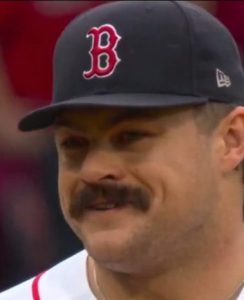
As the Red Sox turn: The Saturday massacre . . .

Not even revenge for a 10-3 blowout loss in Baltimore Friday night could spare Alex Cora. Not even his mixed-up, muddled-up, twisted Red Sox frying the Orioles alive on Saturday with innings of three, one, and three runs before a ninth inning that could have had them hauled before the Hague could do it.
Cora was taken to the guillotine after that 17-1 Saturday afternoon massacre. So were his five coaches. Before you shake your heads pondering why you should take pity upon six men executed for the Red Sox’s 10-17 start (they beat the Orioles with far fewer human rights violations Sunday, 5-3, for win number 11), you might want to ponder how this mess got built in the first place.

It wasn’t by Cora. It sure wasn’t by Jason Varitek, franchise icon as a catcher when the Red Sox broke the (actual or alleged) Curse in 2004 and followed up anchoring another World Series winner three years later, now “reassigned” from game planning coordinator to another, as-yet-identified role in the organisation.

It sure as hell wasn’t put together by now-beheaded hitting coach Peter Fatse, third base coach Kyle Hudson, bench coach Ramón Vásquez, Fatse’s assistant Dillon Lawson, or major league hitting strategy coach Joe Cronin.

This one’s on chief baseball officer Craig Breslow, who once wrestled his way through a twelve-season career as a middling relief pitcher of occasional flashes and flights. And very few people watching the Red Sox closely think otherwise, no matter how the massacre resonates as par for the baseball course when a team thought to be a division or league power isn’t exactly behaving that way on the field.

Maybe nobody put it with quite the nail-driving force of Athletic writer Steve Buckley. “For anyone choosing to cite this as just the latest example of a dead-ass ballclub whose manager is unable to inspire his players to keep performing at a high level regardless of the circumstances, you have just cause to do so,” he began Sunday.

Or you can look at the misshapen roster and the lack of clubhouse leadership and ask who put this mess together.

That would be Craig Breslow, who, believe it or not, once lived in big-league clubhouses. Lots of them. He soldiered on, year after year, with organization after organization. He was released five times. In 2018, at age 37, he pitched at three levels of the Toronto Blue Jays’ farm system as part of one last effort to get back to the big leagues.

How strange that a guy who’s been in so many clubhouses doesn’t seem to know how they work. How strange that a guy who has been on so many rosters hasn’t figured out how to build one.

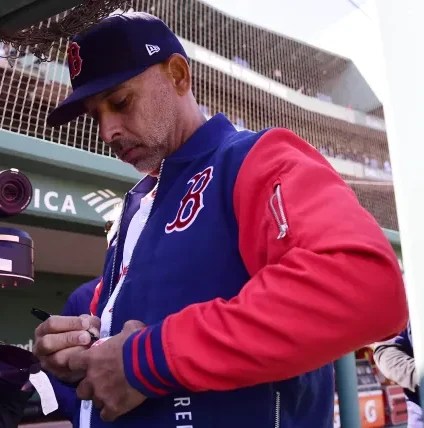
Alex Cora

Alex Cora signing a baseball in the clubhouse. His execution papers were signed Saturday despite the Red Sox nuking the Orioles that day, proving who gets to take the fall for a hot mess starting 10-17.

Remember Alex Bregman? Brought aboard to play third base last year while easing incumbent Rafael Devers into designated hitting and first base. Except that Devers wouldn’t buy in, before he would, before he wouldn’t (easy to get the sequence confused, no?), before he was shipped to the Giants in a “trade” that made the word a euphemism for the Red Sox ridding themselves of the $250+ million left on Devers’s deal.

Fighting injuries, Bregman still endeared himself to the Red Sox clubhouse with leadership and agreeability in hand with accountability. Then he hit free agency. Then Breslow convinced one and all upstairs that, no, of course not, the Cubs weren’t really being serious about offering Bregman a big chunk of the vault, a no-trade clause, and the Van Allen Belt. (That last is a joke, son.)

Except the Cubs were deadly serious. And, oh, by the way: while the Red Sox sputtered, spun, and plunged into the morass that culminated in the Friday night flogging they suffered, the Cubs won ten straight and eleven of thirteen to claim second place in the National League Central.

“I mean obviously, it’s kind of up in the air what the true direction of the franchise is,” said Trevor Story, Red Sox shortstop. “Some of the best coaches in the world didn’t get a fair shot.” The dear boy. Somebody forgot to brief him about Red Sox life under John Henry’s hammer. As another Athletic writer, Ken Rosenthal, wants to remind us, these Red Sox “could win the World Series—unlikely as that might be with the roster Breslow constructed as chief baseball officer—and it would only spare him for so long.”

Ask Dave Dombrowski. Ask Ben Cherington. Ask Theo Epstein, who once escaped the Henry regime in a gorilla suit, only to return, win a second Series and then bolt for the Chicago Cubs. Oh, to hear the honest thoughts of Epstein, back with the Fenway Sports Group as a part-owner and senior adviser, on the latest installment of As The Red Sox Turn.

It’s an endless game of survivor at Fenway Park, only no one ever survives. Not top executives. Not superstars like Mookie Betts, Rafael Devers and Alex Bregman. Not managers like Terry Francona, John Farrell and now Alex Cora . . .

Was Cora perfect? (Pause to stop laughing.) Remember, he had to take time off (ho ho ho) over his role in the Astros’s illegal, off-field-based, electronic sign-stealing operation of 2017-18 that was exposed over a year after he led his Red Sox to a World Series ring in his first year on the bridge. He also couldn’t sell Devers on the DH/1B transition the Giants proved to have little trouble selling, after all.

He wasn’t perfect. But neither were he or his staff going to get too much out of this assemblage, no matter how they looked on Saturday. “At the end of the day, when we take the field, it’s on us,” said outfielder Roman Anthony, currently struggling with back trouble. “It’s not AC’s job to go out there and do the things that we’re expecting to do as players. So, I mean, it’s nobody’s fault but ours.”

Eyes will be upon interim manager Chad Tracy as he tries to find the right pieces from among those bequeathed him. The pieces were random and testy enough that Cora found himself having to play mad scientist searching for the best formulae.

Forget whether Albert Einstein could square this roster’s mass into energy instead of this mess. Meaning Breslow himself could be the next execution. As the Red Sox Turn . . .

Manfred’s just thinking aloud. Isn’t he?

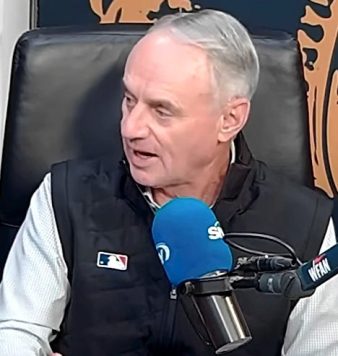
Rob Manfred

Manfred insists he’s done when his contract is. What manner of mischief might he wreak before then?

This is commissioner Rob Manfred’s story and he’s sticking to it. For now. Ask him whether he’s going to want to rethink his previously-enunciated intent to retire when his current contract expires in three years, and he digs in like a batter who knows he’s facing not Bob Gibson but Bobo Garglebargle.

“I’m done at the end of this contract. I’ve told [the owners] that, and I’m gonna stick to it,” Manfred insisted in a WFAN radio interview last week. “I’ll be 70. It is enough . . . You have a certain period of time when you have things that you want to accomplish, you take your best shot, you try to get as much done as possible. And then it’s sort of time for the next guy with his set of things. And I think that’s healthy and good for this.”

So far, so good. So, what does the most inveterate tinkerer who ever held the commissioner’s office want to get done before he moseys off into the sunset?

Without saying he’s committed to it—yet—Manfred mentioned discussions about inflicting a split season and in-season tournaments upon major league baseball. “We do understand that 162 (games) is a long pull,” he said. “I think the difficulty to accomplish those sort of in-season events, you almost inevitably start talking about fewer regular-season games.”

But not fewer postseason rounds and games, of course. Manfred isn’t that sensible. “It is a much more complicated thing in our sport than it is in other sports,” he continued. “Because of all of our season-long records, you’re playing around with something that people care a lot about.”

You’re playing around with a lot more than that, Commissioner Pepperwinkle.

Wait until it gets to the part where he speaks of bringing MLB to 32 teams. And, realigning baseball into eight divisions of four teams each. Presuming it’s going to be one new team in each league, would it do to suggest something a lot more sensible?

You guessed it. I’m going there again. Instead of eight divisions of four teams each, how about four divisions of eight teams each? How about two such divisions in each league? If you wish, you can keep them named the National League East and West, and the American League East and West. Goodbye three-division lunacy and wild-card whackadoodling.

Think of the benefits that would come forth. I’ve made the argument before, but it’s worth making it yet again. Four divisions, eight teams each, and you don’t get to play for a championship unless your butts were parked in first place at season’s end. Let’s not forget to put an end to the farce of regular-season interleague play, either. Save that for where it really belongs, the All-Star Game and the World Series.

And won’t it be fun to have something we haven’t really had in this century—namely, real pennant races again. No more of this Bizarro World nonsense of the thrills, spills, and chills of teams fighting to the last breath to finish the season . . . in second place.

Come to think of it, let’s be done at long enough last with those hideous All-Star and City Connect uniforms. They go from ugly to disgusting and back to repulsive before turning nauseating. Haven’t you missed seeing All-Stars wearing their own uniforms, the fatigues of the teams they represent in the game?

And we haven’t arrived until now at the truly fun part. You want to get rid of postseason saturation as much as I do? You want to make the postseason both meaningful and fun again? You want more World Series such as last fall, when a) the only combatants were teams who finished first in their divisions, anyway; and, b) those two went tooth, fang, claw, and anything else they could think of until somebody finally won it? You want to relieve Manfred’s discomfort over the long season?

Of course you do. So . . .

We’ve simplified the game’s alignment to two divisions each for each league. We’ve made for real pennant races again. Now we get to call for best-of-five League Championship Series. That’s the way they played it from divisional play’s birth in 1969 through 1984. Now, you restore the World Series’s primacy by keeping it a best-of-seven. Did I mention that it also means no baseball under snow or November watch anymore?

You also have postseasons of—maximum—seventeen games under the foregoing back-to-the-future remake/remodel. Meaning you have yearly totals of—maximum, again—179 major league games for each league. You can’t tell me that’s not plenty of baseball. And who says an earlier opening to the Hot Stove League won’t be a little more fun, either?

Speaking of which, beware. Maybe the only thing worse than Manfred pondering in-season tournaments would be landing a hard deadline for free agency signing. Athletics outfielder/designated hitter Brent Rooker called it the most anti-player idea Manfred could have. So, naturally, Commissioner Pepperwinkle started stumping for it harder the day after Rooker spoke against it.

“I think there’s going to be some more conversation about it, because I do believe that there’s a marketing opportunity,” Manfred told WFAN. “Let’s face it, we operate in a really competitive environment. Just put entertainment, generally, to one side—just sports, right? It’s really competitive. And I think that you make a mistake, particularly during the offseason, when you don’t take every advantage to push your sport out in front of your fans during that down period.”

Some think you make more of a mistake taking the fun out of the Hot Stove League. For owners and players alike. The owners aren’t saints, but they’re not wholly brainless. The ones who can (will) spend love the chase. The ones who can’t (won’t) spend love to bitch about the ones who can. Fans who kvetch one moment about swelling player dollars cheer the next when their team lands an Alex Bregman.

(By the way, don’t pity the Red Sox for failing to convince Bregman to stay. Not when they seem to have quaked over including a no-trade clause in his new deal but the Cubs had no problem giving him one. Well, there’s still Bo Bichette to whom the Red Sox might turn, within reason.)

“[W]hat they said back was, they thought that kind of [signing] deadline would work to the disadvantage of the players,” Manfred said of player reaction to the idea. “And you know, I just—I don’t put much credence in this.” Shocker.

At least, Manfred promised that any realignment would not include forcing two-team cities into the same division. But the bad news is that, historically, it was easier for pitchers to hold Hall of Famer Rickey (The Man of Steal) Henderson on base than it is to put most commissioners’s promises in the bank.

The Red Sox Devers-ify . . .

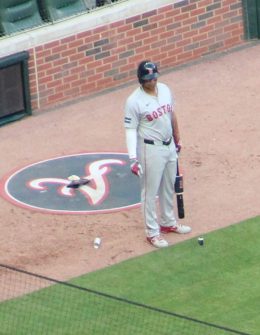
Rafael Devers

Devers in the on-deck circle. He now joins the Giants in a deal that may not bear immediate fruit for the Red Sox but manna at the plate for the Giants.

Even leading the 21st Century in World Series titles (four), the Red Sox haven’t lost their capacity to stun. They can sweep their eternal rivals and neutralize those rivals’ number one hitting threat one moment (they held Aaron Judge to 1 bomb, while striking him out 9 times during the sweep) and trade a slugging three-time all-star the next.

Yes, that sounds too simple. So we’ll flesh it out a big more. A relationship fractured by foolishness on both sides ends with Rafael Devers going to the Giants and left-handed pitcher Kyle Harrison, right-handed pitcher Jordan Hicks, outfield prospect James Tibbs, and minor league right-hander Jose Bello going to the Red Sox.

Almost five years after the Red Sox traded Mookie Betts rather than think much about paying him his true value, they’ve unloaded a far more problematic player than Betts ever was. That won’t make the deal go down any more smooth for a Red Sox Nation too much flummoxed by the team’s front office follies in recent seasons, alas.

The deal also means the last of the Red Sox’s 2018 World Series winners are gone. The Mookie Monster has since been a critical element in two Dodgers world champions; Xander Bogaerts has become a mainstay in San Diego and a few National League pennant races.

Say what you will about Devers, the man can hit. His to-date .858 OPS, his average 33 home runs per 162 games lifetime, both prove it. His batting eye improves with age; he led the American League in walks at the time of the deal. And he took care of the second of two runs the Red Sox needed to finish sweeping the Yankees with a hefty 2-out home run in the bottom of the fifth. The Giants may have a home ballpark nowhere near as hitter-friendly as Fenway Park, but they’re getting a guy to whom the dimensions don’t matter so long as he can tee it up and swing big.

Part of the problem, and a critical reason why things came to Devers’s transcontinental change of baseball address, is that when you play him at third base “poisonous” doesn’t begin to describe it. He led the league in errors in six of his first seven seasons and the entire Show for the first four of those. He was 80 defensive runs below league average. (Fair disclosure: Bogaerts hasn’t exactly been toxin-free at shortstop, not being 27 defensive runs below league average for his career to date.)

That’s a compelling reason why the Red Sox thought signing free agent third baseman Alex Bregman was a smart idea. The problem was that the Red Sox took the clumsy way to handle both that and the little matter of convincing Devers that the longer he stayed at third base the more likely the Red Sox were to declare the area off limits pending a hazmat cleaning.

How would Devers have done at first base? We won’t know, at least regarding the Red Sox, because Devers didn’t exactly pounce on the opportunity when it was offered as Triston Casas hit the injured list. He won’t be taking a new shot on third in San Fran, either, since the Giants have a verified Gold Glover holding it down (Matt Chapman). He may not get a crack at first, either, with the Giants having a willing Wilmer Flores to move over in case former Met Dominic Smith needs a break or can’t hold it down longer-term.

But Devers will provide the Giants with something they haven’t had since their freshman top executive, Buster Posey, was last seen behind the plate for the Giants — a great hitter. Posey may also give Devers what the Red Sox couldn’t for whatever reason, a clear presentation of the “why” behind any move without insulting Devers’s considerable pride. Posey had bloody well better, too, considering the Giants have taken on the remainder of Devers’s contract — running through 2033 and paying him a nifty $250 million plus.

What do the Red Sox get other than out from under Devers’s remaining money and maybe a little more egg on their faces considering they didn’t exactly handle Devers with graceful hands and heads?

Harrison — Considered highly talented and still only 23, so he has time to put things together despite his 4.56 fielding-independent pitching rate to date. Depending on the Red Sox pitching injury picture, Harrison just might be seen in Red Sox silks before the stretch drive arrives. And that might occur next to any pitching the team ponders acquiring at or before the trade deadline now that they have about $250 million to play with.

Hicks — Serviceable relief pitcher whom the Giants tried out of the rotation last year, but when that experiment imploded Hicks went back to the bullpen, and the Red Sox are liable to keep him there.

Tibbs — A first-round pick last June, he’s been showing plenty of upside in the minors, but the Red Sox will likely wait for his AA-level results before thinking of him as Show bound.

Bello — Has bullpen upside to burn, from the look of his minor league life to date.

The rest of the Sox — With Devers gone, it looks as though there will be plate appearances to spare to spread around especially in dispersing an outfield crowd partially. But it’s an open question as to just whom would replace Devers’s plate production. For now. And maybe longer. Which means the Red Sox’s re-entry into the AL East race picture may be an arduous re-entry to sustain.

Published originally by Sports Central.

The continuing ballad of Billy the Kid

Billy Wagner

Billy Wagner stood 5’10” . . . but to the hitters facing him, he must have looked and felt 10’5″.

When Billy Wagner called it a career after a short tour with the Braves, he spoke like a man who wasn’t worried about whether he’d make or endure on a Hall of Fame ballot. “I’m not going to change anyone’s mind about whether I’m a Hall of Famer,” the longtime relief pitcher said. “People are either going to like me or hate me, and I can’t change their minds. Besides, life is about a lot more than this game.”

That was fifteen years ago. Tomorrow should reveal that enough voting members of the Baseball Writers Association of America have changed their minds. Wagner’s first Hall ballot showed him with 10.5 percent of the vote. At this writing, his final appearance on the BBWAA ballot should usher him into Cooperstown with at least 85 percent of the vote, well above the minimum needed.

Thus would Billy the Kid stand on the induction stage with outfielder Ichiro Suzuki (bank on it: he’ll become the first unanimous election among position players on their first Hall ballot), CC Sabathia (another first ballot lock, though a hair over seven points less than Ichiro), and Carlos Beltrán. (80.3 percent.*)

Almost a week ago, Wagner wasn’t sounding as sanguine as he did upon his retirement from the mound. “You’re sitting here and you can’t control [the outcome],” he told The Athletic‘s Tyler Kepner by phone. “It’s tough. I hate it. It’s just not been a very fun experience, especially when it comes down to your tenth and final ballot. It’s not going to be pleasant. It’s a grind, but in a couple of days, this will be over—one way or the other, good or bad.”

That wouldn’t necessarily be true. Wagner could and likely would make an appearance on a future ballot of the Hall’s Contemporary Baseball Era (Players) Committee, perhaps as soon as next December. But it looks as though nobody has to worry about that anymore. Wagner, especially.

Last week you’d have had to go the extra hundred miles to convince him. Last year, he waited and waited only to fall short by five votes. When Kepner asked Wagner if that compared to being spurned for a prom date with his buddies watching live and millions more watching on television, he couldn’t resist laughing. Then, he calmed down again and answered soberly.

“My gosh. You’ve got thirty kids looking at you,” he began.

I’m emotional, I don’t want to be emotional, so I’m fighting it back like, “Well, you know, it’s great.” You’re saying all the things you need to say, but it was awful. So the ballot comes out, they take all their stuff and leave—and you’re still going through practice. There’s no, “Hey guys, we’re going to take a five-minute break here.” You couldn’t do anything. That was rough. I was so embarrassed.

If the current indicators hold, and I’m not sure how you can tumble from 85 percent of the vote to falling beneath the 73 percent line without some very suspect eleventh-hour activity, the man who stood 5’10” as a human being but about 10’5″ to the batters he faced pitching for the Astros, the Phillies, the Mets, the Red Sox, and the Braves, is about to become anything but embarrassed.

Which is more than you can say for those batters over the sixteen-year career that ended in 2010. You might wish to become the proverbial fly on the wall if those batters could round up for a seminar called, “How Not to Hit Billy Wagner—Because You Can’t.” The beginning of Wagner’s Hall of Fame case, and possibly the end, too, is this: Opposing hitters could only hit .187 against him.

.187.

Not even The Mariano himself kept hitters that sharply out of luck. Wagner’s .187 batting average against him will become the lowest BAA of any Hall of Fame relief pitcher. Lower than Rivera and Trevor Hoffman (.211 each), lower than Hoyt Wilhelm (.213), lower than Dennis Eckersley (.225), lower than Goose Gossage (.228), lower than Bruce Sutter (.230), lower than Rollie Fingers (.232), lower than Lee Smith (.235).

Among that group, too, are a mere four who pitched in the most hitter friendly of times: Smith (in the final third of his career), Hoffman, Rivera, and Billy the Kid. That, I’ve written before and don’t mind repeating, should make you wonder what the record would have been if Wagner could have avoided assorted injuries including a late-career Tommy John surgery.

And before you take up carping yet again over his comparatively small number of innings pitched, try to keep these in mind: 1) It wasn’t his idea to finish with 903 innings pitched. 2)  His lifetime walks/hits per inning pitchd (WHIP) rate, as Kepner pointed out, is lower than any pitcher with 900+ innings in the century between the final game of Hall of Famer Addie Joss and Hall of Famer-to-be Wagner. Including The Mariano and Trevor Time.

If it’s numbers you still wish, how about these: The best strikeouts per nine rate (11.92) in baseball history. The best ERA (2.31) by any lefthander in the live ball era (1920 forward). The lowest opposition OPS (.558) in that same century between Joss’s and Wagner’s final games.

All of which are rather surrrealistic for a fellow whose hardscrabble childhood (and “hardscrabble” is phrasing things politely about a kid for whom peanut butter on a cracker was dinner often enough when he was growing up) including driving himself to throw lefthanded because two right elbow fractures made throwing his natural righthanded impossible.

That’s about as close to a self-made Hall of Famer as you can get.

“You’re not supposed to get too high or too low,” Wagner told Kepner about The Wait, “but you just sit with a big pit in your stomach right now, wondering where this thing’s going to go. You’re constantly fighting the buildup to that moment.” Finally, it looks as though Billy the Kid’s going to win his final fight.

——————————————————-

* Seemingly, Beltrán is about to be told about his Astrogate co-masterminding, “All is forgiven.” As if the writers didn’t hear, didn’t see, or chose to ignore, how Astrogate co-exposer Evan Drellich (in Winning Fixes Everything) zinged Beltrán for his post-suspension apology, the one in which he said he wished he’d asked more questions about what the 2017 Astro Intelligence Agency was doing.

Beltrán was as powerful a clubhouse presence as there was on the 2017 Astros, begging the question, what was stopping him from asking those questions? (Emphasis added.)

—————————————————–

This essay was first published at Sports Central.

2024: Taking the Fifth, and Other Lamentations

Aaron Judge

This is not what was meant when the phrase, “I’ve got the drop on you,” was coined . . .

Hands up to everyone who can’t wait for 2024 to depart. Now, hands up to everyone who thinks 2024 was just the most wonderful year of the decade. My, but that’s a barren sea of hands over that second suggestion.

Much like its home country, baseball’s 2024 was . . . well, why don’t we let some of the signature moments, doings, and undoings of baseball’s year speak for themselves. The new flimsy uniforms sucked. The All-Star Game uniforms didn’t suck that badly, but still. Meanwhile, I’m thankful to folks such as Jayson Stark and a few other intrepid sleuths of BBW—that’s Baseball Bizarro World, you perverts—who either unearthed or reminded us about . . .

Take the Fifth—Please Dept.—“Come an’ see my amazin’ Mets,” their manager Casey (I Lost With This Team What I Used to Win with the Yankees) Stengel liked to say of his maiden squad. “I been in this game a hundred years but I see new ways to lose I never knew were invented yet.”

That was the Ol’ Perfesser gazing down from the Elysian Fields, watching the team with whom he won ten pennants and seven World Series perform the single most splendid imitation of the 1962 Mets since . . . the 2024 White Sox finished their sad, sad, sad regular season.

Pace George F. Will, look to your non-laurels, White Sox—the Bronx Bumblers captured 21st Century baseball’s booby prize. You White Sox only out-lost the 1962 Mets this season. You probably never did in one regular season game what only began in a World Series game . . . with a Yankee center fielder who does a credible impersonation of the Leaning Tower of Pisa approaching the plate and Frank Howard at the plate committing his first error playing center field after 538 fly balls hit his way in his entire career to date became outs.

Then . . .

* A Gold Glove-finalist shortstop threw for a force play at third base and saw the ball ricochet off the base instead of reach his third baseman’s glove.

* The arguable best pitcher in the American League got thatclose to escaping a bases-loaded, nobody-out jam when he suffered the brain fart heard ’round the Bronx and the world: he forgot to cover first when Mookie Betts hit a screwdriving ball toward Anthony Rizzo. Oops.

* The Yankee anti-party included a balk and catcher’s interference.

* The Dodgers became the only team in baseball history to score five runs in a World Series game after they were in the hole 5-0.

* The Yankees became the only team in baseball history to serve up five unearned runs in a World Series game since they started counting earned and unearned runs as official statistics. (When did they start? In the same year during which premiered Ford’s moving assembly line, the first newspaper crossword puzzle (in the New York World), and Louis Armstrong’s first cornet. In the New Orleans Home for Coloured Waifs.)

* And the fifth-inning party actually started with everyone from the television announcers to the fans and back pondering whether Gerrit Cole might, maybe, consummate a no-hitter to keep the Yankees alive.

Your Reality Check Bounced Dept.—Too many Yankee fans continue infesting social media with proclamations that the Yankees still have the dynastic history of dynastic histories. And too many baseball fans steeped in reality and not fantasy keep reminding them, Your damn dynasty is just soooooo 20th Century!

Juan Not-So-Small Step for Met World—That’s $765 million the Mets will pay Juan Soto over the next fifteen years. This may or may not mean the end of Pete Alonso’s days as a Met, which may or may not mean . . .

Out with a Bang Dept. . . . that Polar Bear Pete’s final act as a bona-fide Met was the biggest blow on their behalf this century: the three-run homer he blasted in the ninth inning that proved the game, set, and National League division series winner against the Brewers. Which was also the only home run hit by any Met in the set.

Did I Do That Dept.—Alonso’s division series-winning blast came off Devin Williams . . . who’d never allowed a ninth-inning lead-changing bomb in his major leaguer life until then. Then, after some time passed, the Brewers let the Yankees talk them out of keeping Williams, sending them pitcher Nestor Cortes, infielder Caleb Durbin, and cash to take Williams. We still don’t know if the deal was Milwaukee payback for surrendering Alonso’s game-changing/game-swiping bomb.

Out with a Bigger Bang Dept.—That would be Walker Buehler, pitcher. One minute, locking down the Dodgers’ World Series win with a spotless Game Five ninth including two swinging strikeouts. The next, practically (well, give or take a few hours): Signing for one year and $21 million with the Red Sox. Anyone remember the Dodgers making Buehler a qualifying offer for that money and Buehler turning it down? He’s rolling serious dice on himself with this deal.

Shohei-hei Rock and Roll Dept.—You might think anyone can become a member of the 50 home run/50 stolen base club. But you won’t be able to predict who might do it the same way Shohei Ohtani did in September against the Marlins: 6-for-6 at the plate; three home runs; five extra base hits; two stolen bases; ten runs batted in. His own planet? Try realising Ohtani exists in his own quadrant.

A Cut Below Dept.—Pete Fairbanks, Rays reliever. He missed a game in 2024 because of a finger cut. He cut the finger opening a bottle of spring water. Considering his bizarre 2023 injury (incurring a black eye while trying to dunk against his toddler son through a water basketball net), it seems as though Fairbanks just couldn’t cut it anymore.

On Your Knee Dept.—Presented for your consideration: Miguel Sanó, Angel. Aleady on the injured list with an inflamed knee. He put a heating pad over it. He forgot about it just enough to burn the knee and place himself for another month on the IL. Miguel Sanó, who proved he certainly could stand the heat in . . . the Angels’ continuing Twilight Zone.

The King of Pop Dept.—Mookie Betts performs amazing feats at the plate and on the field. At the plate, they usually involve baseballs shot on lines into the outfield, or driven like ballistic missiles over fences. They didn’t involve him popping out for the cycle . . . until 25 September, when, in order, he popped out to: second baseman, third baseman, first baseman, and shortstop.

Don’t do it. Don’t Google “MLB players who’ve popped out for the cycle.” It won’t even call up the Mookie Monster, yet, never mind anyone else who might have had that kind of a day—whether a Hall of Famer, a Hall of Famer in the making, or a guy who’s destined to be forgotten outside such a single singular feat.