Baseball Tease Day

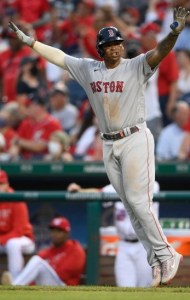
Rafael Devers

Wings and prayers—Rafael Devers’s tiebreaking two-run blast in the ninth Sunday punched the Red Sox’s ticket to the AL wild card game . . .

Crisis addicts of the world, unite. You won’t get the greatest possible fix for your addiction on what might have been Baseball Chaos Day. In fact, you’re getting a day off for reasonably good behaviour.

But at least you get four of the game’s most deeply storied franchises in the wild card games. That’s something, isn’t it?

If major league baseball fans must continue to bear with the thrills and chills of watching teams fight to the last breath to finish . . . in second place, at least you get to see the Cardinals host the Dodgers in the National League wild card game, and the Red Sox host the Yankees in the American League game. Right?

I know. I know. The crisis junkies among baseball’s fans were spoiling for that National League West tie between the Giants and the Dodgers. They wanted that four-way American League wild card tie so badly they could wrap themselves in it like frozen food in Reynolds Wrap.

The Blue Jays did their absolute best to make it happen when they parboiled the Orioles 12-4 Sunday afternoon. But the Mariners let them down by being unable to get past what was left of this year’s Angels.

Maybe we should have had a hint when Shohei Ohtani started the finish of his surrealistic individual season by hitting Mariners lefthander Tyler Anderson’s third pitch of the game about twelve rows into the right field seats.

Home run number 46, RBI number 100, for the guy who also finishes 2021 with a 3.18 ERA and a 10.8 strikeout-per-nine rate on the mound. If you can’t win it, just start playing spoiler. Ohtani’s surreal season could have finished a lot worse than becoming the Angels’ must-see-television in the injury-created absence of their all-universe Mike Trout.

The Mariners let themselves down, too, after a surprise season of playing slightly over their own heads to get thatclose to postseason-opening mayhem. Those were real tears in young outfielder Jarred Kelenic’s eyes as well as veteran third baseman Kyle Seager’s, when their run came one port short in losing two of three to the Angels over the weekend.

“It wasn’t a team where we were just more talented than the other team every single day,” said Seager postgame, after what may yet prove his last game as a Mariner, “but you had a group that just collectively played together and they collectively tried to win every single night.”

Trouble was, the Nationals couldn’t keep the Red Sox down despite opening an early 5-1 lead against them in Nationals Park. They couldn’t stop Red Sox third baseman Rafael Devers from hitting a hefty solo home run to open the top of the fourth and a five-all-tiebreaking two-run shot in the top of the ninth—with former National Kyle Schwarber, who’d reached on an inning-opening infield error—aboard ahead of him.

But two years after the Nats’ staggering World Series win, at least they could bask a little in the home crowd’s applause for possibly-retiring first baseman Ryan Zimmerman, the last truly Original Nat, the franchise’s first first-round draftee to play in their silks after moving from Montreal, when lifted from the game after the seventh. Even the Red Sox joined the applause unapologetically. Aretha Franklin used to spell that r-e-s-p-e-c-t.

Meanwhile, the American League East champion Rays battled the Yankees scoreless until the ninth. The Yankees even flashed something resembling past glories when third baseman Gio Urshela channeled his inner Derek Jeter in the sixth, chasing Austin Meadows’s foul pop 126 feet from an overshift position and catching it on the track, before he fell in a heap onto an empty spot on the Rays’ dugout bench.

But after Rays starter Michael Wacha pitched one-hit ball over five innings and the Yankees threw six pitchers at the Rays, Aaron Judge—the towering, snaggle-toothed, boyish-looking face of the Yankees—picked the right spot to deliver the first walk-off winner of his major league career.

With Rays reliever Andrew Kittredge freshly installed, after Josh Fleming allowed second and third with one out, Judge ripped a liner off Kittredge’s glove toward second, Tyler Wade dove home ahead of a throw from Rays second baseman Brandon Lowe. Thus the Yankees ducked a coming day’s chaos. “I wouldn’t say we exhaled,” Judge said of it postgame. “We still have work to do.”

Meanwhile, in San Francisco, the Padres’ second-half implosion finished when they all but rolled over and played dead for most of an 11-4 loss to the Giants. Enabling the Giants to become the first in Show ever to win their 107th regular season game while clinching a title on the regular season’s final regular day. Leaving the Dodgers, 10-3 assassins over the NL Central-winning Brewers, to deal with the Cardinals in the league’s wild card game.

That ages-old blood feud between the Giants and the Dodgers would just have to wait for a possible showdown in a National League division series, assuming the Dodgers get past a Cardinals aggregation that managed to do what enough teams couldn’t this year—shake off a few serious injuries and a few tough spells to get to at least the postseason’s entry game.

The Padres made life just a little too simple for the Giants Sunday afternoon. They had no answer for Giants starter Logan Webb—who struck out eight and, at the plate, threw in a line drive, insult-to-injury two-run homer in the fifth—until they finally chased him with three straight base hits in the eighth.

Entering the season it sometimes seemed as if the Padres were anointed the lords of the National League West by default and the Giants were anointed lucky to survive the races at all. But while growing pains, internal dissensions, key pitching injuries, and manager Jayce Tingler’s exposure as an inconsistent in-game thinker came more vivid as the Padres season went deeper, the Giants surprised just about the entire baseball world with their ability to hang with the Dodgers and take it literally to the last day.

Veteran or largely-veteran teams don’t work anymore, right? Baseball’s for the young, right? Letting the kids play means the veterans can’t romp, right? The Giants would like a few words with you. Their veterans played up and had just as much fun as the kiddie corps. And the Giants took their remarkable season right down to the wire to beat the Dodgers out for the title by one game.

“I think we all knew at the beginning of the season, or even dating back to the beginning of spring training, what the projections are and what the industry sort of thought of us as a club,” said Giants manager Gabe Kapler, who’d finally figured out what he couldn’t in Philadelphia—analytics hoists and supports you going in, but you’d better marry that to what’s in front of you inning by inning if you want to get the full job done.

“What I realized,” he continued, “is there are some intangibles that those projections and viewpoints failed to take into consideration.” There’s never a thing wrong with having the most possible information to open a game, but when it’s married unsuccessfully to the moments to come while you play, the offspring is usually disaster.

The Giants, the Brewers, the AL Central-winning White Sox, the Astros, and the NL East-winning Braves have to wait to begin their postseason dances. It’s both poetic and problematic that the party begins with the Olde Towne Team hosting the Empire Emeritus in a win-or-be-gone wild card game.

Poetic because of that similarly ages-old Yankee-Red Sox blood feud. Problematic because of . . . that ages-old feud having its script flipped in this century.

Go ahead and point to all those pennants and World Series rings, Yankee fan. You’ve only got one of those rings to show in the 21st Century. You may have the upper hand in division triumphs but that smothering Yankee dominance is just so 20th Century now. That’s the Red Sox sitting with four 21st Century World Series rings now.

If there’s one other thing by which the Yankees hold an edge over the Red Sox this time around, it’s a fan base that clings to “To err is human, to forgive cannot be Yankee policy” like a religious catechism. Calling for the manager’s perp walk and summary execution after a tough loss? Yankee manager Aaron Boone gets it after a tough inning as often as not.

The man who did what no Yankee manager before him could—lead his teams to back-to-back 100-wins-or-more seasons in his first two on the bridge—and has a .601 winning percentage as a Yankee manager must feel fortunate that his boss’s name is Hal, not George Steinbrenner. Hal Steinbrenner doesn’t have his father’s notorious hair trigger. It’s saved New York’s sanitation corps from barrels worth of washing blood from the streets around the House That Ruthless Built.

Maybe their own long-enough and disastrous enough history has finally given Red Sox Nation what some people thought would have been impossible to fathom—the patience of Job—compared to their counterparts turning to the south Bronx. The AL wild card game hasn’t been played yet, of course, but you don’t exactly hear Red Sox fans saying, to themselves and aloud, “OK, when’s it going to happen” and mean disaster over delight before the game actually begins.

Those two fan bases get only one day’s worth of living on the edge. If the Dodgers treat the Cardinals’ grand old man Adam Wainwright like target practise in the NL wild card game, the Dodger-Giant rivalry gets three games minimum, five maximum to go nuclear.

If the Cardinals treat the Dodgers’ cleverly imported grand old man Max (The Knife) Scherzer rudely, Giantland and Cardinal Country get to relive the 2014 disaster—disaster for the Cardinals, that is. This time, though, the Cardinals won’t have Mike Matheny on the bridge to decide The Book was more important than The Moment. Mike Schildt won’t risk paying through the feathers by allowing a Giant pennant to sail into the crowd atop Levi’s Landing behind right field. I think.

It’s enough to make you feel almost sorry for the White Sox facing the Astros in an American League division series. Even their first postseason meeting since the 2005 World Series the White Sox swept—that was before the Astros were traded to the American League, of course—doesn’t have half the blood boil potential. I think.

Baseball Chaos Day? Sunday’s regular season finales amounted more to Baseball Tease Time. It was fun to watch—but it was hell to pay. But as Hall of Fame scribe Jayson Stark would say, because . . . baseball!

No bunts about it

Joey Gallo

This is the way to bunt—not wasting an out to move runners who aren’t as likely to score from there as you think,  but for a base hit . . . especially when you’re handed enough free real estate to build the Ponderosa upon. Pushing a man on third home? Gravy.

If it isn’t in the textbooks yet, it should be. And it was executed by a man considered far and wide enough as maybe the single most classic avatar of the big bomb/big strikeout/ big nothing-much-else hitter seen, often incorrectly, as the typical major league hitter of today.

With the Rays putting a now-classic defensive overshift to the right side, and Giancarlo Stanton on third with one out in the ninth, lefthanded Yankee bombardier-or-bust Joey Gallo faced Rays reliever Andrew Kittredge. The split second Kittredge began to throw the ball, Gallo dropped out of his power stance and showed bunt.

He put the bat on the ball. It shot hopping up the third base line, onto and through that entire unoccupied expanse of yummy free real estate, pushing Stanton home and threatening to leave the American League East-champion Rays with an omelette on their faces en route a potential last-minute loss.

Gallo’s sneak attack cut a Yankee deficit exactly in half, to 4-2. Gio Urshela singled to right almost at once, Brett Gardner singled Gallo home, and it looked for the moment like the Yankees would hang on a little more firmly in the wild card race if they could push just two more in.

Not quite. Kittredge ironed up and struck out Gary Sanchez and Rougned Odor (that little stinker) back to back for the side and for the hard-secured 4-3 Rays win. With the Red Sox holding on to beat the Nationals in Washington, 4-2, the Yankee advantage for the first American League wild card fell back to one over the Red Sox.

But Gallo struck a blow on behalf of every baseball watcher and analyst who’s fed up to the proverbial teeth with the yammering from the Old Fart Contingency demanding what just about amounts to a return to dead-ball baseball. The contingency that forgets, assuming it ever really understood in the first place, that under customary circumstances sacrifice. bunts. waste. outs.

Especially when you’re up against the number one scoring team in the league.

You’d only think that the out-wasting sac bunt would do your team a big favour by pushing a runner or two forward and making it easier to score. But you really have to watch the game more closely to see the actuality. Keith Law (in Smart Baseball) saw it, tabled it, and probably ran a few temperatures up the scale.

There are six common scenarios in which you’d see a sac bunt. Here they are, with the actual result and value, the probability or scoring at least one run or more before the bunt, and the probability of scoring at least one run or more after that bunt. (I’ve indicated it with RP.) Law’s tabulation comes from the 2015 season, but it’s generally applicable—give or take a percentage of a percentage point—in just about any season:

Bunt Situation Pre-bunt RP Post-bunt RP Better/Worse Off?
Man on first, 0 out 0.50 0.45 Worse
Man on first, 1 out 0.36 0.26 Worse
Man on second, 0 out 0.66 0.67 Push
Man on second, 1 out 0.45 0.27 Worse
Men on first and second, 0 out 0.65 0.70 Better
Men on first and second, 1 out 0.45 0.26 Worse

Think about that. Six possible sacrifice bunt situations and four of the six leave a team worse off, one leaves them better off, and one is pick ’em at best. With the best case scenario being a sac bunt with first and second and nobody out.

Gallo wasn’t batting in any of those situations Friday night. He had a man on third with one out—and absolutely no Rays infielder on the left side of second base. The third base ump or the Yankee third base coach each had a better chance of fielding Gallo’s sneaky squirt than any Ray did. The Cartwright boys could have built the Ponderosa with room to spare.

One showing of video from the play says, and I quote, “Joey Gallo singles on a bunt ground ball to third baseman Yandy Diaz. Giancarlo Stanton scores.” It would be accurate if Diaz was actually playing third base proper in the moment.

Diaz was in a fourth-outfielder array for the shift. Second baseman Joey Wendle came running over from about half a mile beyond second base, unable to do anything more than watch the ball pass the infield grass and the infield dirt on the third base side, before he finally caught up to it on the extremely short left field grass. The Feds had an easier time nailing Al Capone than Diaz would have had nailing Gallo at first.

It would have been sweet justice if the Yankees had followed up properly and done right by their too-often-shortfalling import bombardier. (They acquired Gallo from the Rangers at the trade deadline.) And it’s not as though Gallo is exactly virginal with such a play.

He’s done it before. A few times. One was a near-equal to the beauty he nudged Friday night: on 25 April, leading off the bottom of the second, against the Athletics. This time it was Kendall Graveman on the mound and Gallo facing the first pitch of the inning.

Again, Gallo dropped out of his normal stance the moment Graveman actually began to throw. Again, he pushed a bunt the other way, even slower and closer to the third base line. Graveman scampered to get the ball sliding almost onto the line but couldn’t throw Gallo out in time. (The Rangers didn’t score in the inning but went on to win, 4-2.)

Now, Gallo could have tried swinging for the Grand Concourse against Kittredge. He’s only faced him once and made an out; it’s not as though Kittredge owned a particularly fat file against him. But he saw Stanton on third, the entire left side about as crowded as a desert, and a chance to sneak shrink the Yankee deficit by half in a game the Yankees absolutely had to win.

It wasn’t Gallo’s fault the Yankees got only one run to follow his ploy RBI. But it should open the eyes of every batter and manager despairing of reducing the overshifts to periodic elements rather than semi-permanent table options.

The only thing wrong with Gallo’s kind of bunt is that more of those batters and managers don’t think of it more often. But, boy, they’ll still think about wasting outs with those mostly futile sacrifice bunts now and then. You tell me what’s wrong with that picture.

Accountability isn’t dead, entirely

Emilio Pagan

Emilio Pagan, relief pitcher, avatar of self-accountability.

When players hold themselves accountable, not ducking the harder questions, it’s admirable and—to enough people—rare enough. When a player willing to hold himself accountable seeks to do so without being asked first, that’s not just somewhat out of the standard box, it ought to give him some kind of share of some kind of prize.

Case in point: Emilio Pagán, Padres relief pitcher. In a game meaning nothing to the Padres anymore but everything to the Dodgers Wednesday night, the Dodgers bludgeoned Pagán and fellow bullpen bull Nabil Crismatt for five home runs—Pagan for three, Crismatt for two.

All when the Padres entered the bottom of the eighth holding a nice 9-6 lead including battering Max Scherzer, of all people, for six runs in six innings. The inning ended with the Dodgers leading 11-9, holding on to win by that score Wednesday night, and the Padres wondering further just when things like a disconnect between the clubhouse and the front office would be redressed.

Pagán got torn back-to-back by Max Muncy and A.J. Pollock, then by Cody Bellinger one out later, to tie the game. Crismatt got pounded for the one that mattered, Corey Seager’s two-out, two-run shell into the right field bleachers to yank the Dodgers ahead. Some thought that eighth-inning meltdown was too emblematic of the Padres’ seasonal dissipation.

They were supposed to win the West this year, right? They were anointed World Series champions in waiting this year, by enough commentators, right? They had the hottest young star in baseball this side of Shohei Ohtani, a solid pitching staff, and were just itching to lay the division to waste, if not the league, right? That’s what you all heard too much of coming out of spring training, right?

Didn’t happen. And while plenty of teams had to find ways around the ferocious enough injury bugs this year, the Padres couldn’t and didn’t, if not wouldn’t.

They became testy in the clubhouse as the season went forward. Enough players reportedly became more disillusioned with oft-overwhelmed manager Jayce Tingler. Enough became just as dismayed by seemingly half-connected general manager A.J. Preller, whose reputed genius at scouting and building was undermined this year by failures at true fortification at the trade deadline and a sense that he’s out of touch with his clubhouse, willfully or otherwise.

So when Pagán buttonholed San Diego Union-Tribune writer Kevin Acee, Acee was only too willing to listen and write. The righthander who surrendered the home run that just about killed what remained of the Padres’ season in St. Louis—Tyler O’Neill’s two-run blast in the bottom of the eighth on 18 September—had more to say.

He’s said in the recent past how nice it is to be part of a team as talented as the Padres actually are. But now, by holding himself up to task, he implied without saying that such talented teams should be just as accountable above and beyond the real issues beyond their control.

“We scored nine runs in a game that Max Scherzer starts,” Pagán told Acee. “You’ve got to win that game. I mean, plain and simple. I love this game too much to not look at the numbers and not look at the results like I’ve got to take some of this. I can’t just be upset, I’ve got to look at it and grow from it and come into next series, next season a better pitcher.”

Acee indicated the two spoke after Pagán reviewed video of his outing, asked coaches whether he was tipping pitches, pondered trying to develop a third pitch during the offseason, and lamented that he felt his pitches were both getting better in the season’s second half but he was “getting my teeth kicked in. So it hasn’t been a lot of fun.

“I’m going to look at everything because, as laughable as this comment is, I’m just too good for this,” Pagán continued. “I know type of talent that I can be on the mound. Unfortunately for the San Diego Padres organization I haven’t been what I can. And that’ll change. If I’m kept around, I will get better. I don’t know if I’ve been this angry in a long time at my individual performance on a baseball field, so I’ll get better. I care about this game too much to not get better.”

A 2.31 ERA for the 2019 Rays suggests Pagán can still fix whatever went wrong for him this season. An attitude such as he showed in seeking Acee out before the scribe could seek and question him first suggests wisdom beyond his 30 years.

“In these times of pandemic-induced postgame zooms,” Acee wrote, “the media often does not get to immediately speak to players involved in key plays. But Pagán, being both a veteran who has been around when clubhouses have been open and an honorable man, was willing to face questions before I could even ask if he would.”

Preller seems to leave somewhat different and contradictory impressions, according to Athletic writers Ken Rosenthal, Dennis Lin, and Eno Sarris:

The combination of an untested manager, veteran coaches with strong personalities and prominent players with strong personalities has sometimes proven volatile. A pair of confrontations in the dugout two weeks ago . . . attracted national attention, but according to sources, there have been an unusual number of heated moments this season, including when the Padres were well above .500. Some of the same sources have questioned whether front-office executives have enough empathy for those navigating complex situations inside the clubhouse.

“I don’t think (Preller) feels that at all,” said one former coach.

If there’s a further shakeup in the Padres’ offseason to come, it seems as though few would be surprised. If a new, more experienced and attuned manager is on the priority list, it may be easier said than done bringing aboard someone else Preller may or may not think he can command at will.

Whomever it proves to be, he’ll have at least one veteran relief pitcher on board with the concept and the continuing practise of accountability.

The unforgiving wall

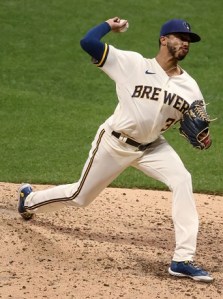
Devin Williams

Devin Williams—to err is human; to forgive is not the policy of a wall attacked by a flying fist.

Baseball is the thinking person’s sport. It requires acute intelligence and mental acuity as much as it requires certain physical skills to play well. For some of the thinking people who play the game, the problem becomes that their brains go to bed when the game is over.

Submitted for your consideration—Devin Williams. Righthanded relief pitcher for the Brewers. Celebrating with his teammates in a champagne soaked, happy noise in the clubhouse after clinching the National League Central title Sunday.

Somewhere after the team revelry, young Mr. Williams left the clubhouse, had a few drinks, and got mad at “something,” nobody seems yet to know just what, on his way home from the party. And he discovered the hard way what too many players of sensitive temperament, elevated frustration, and perhaps a sip of champagne too far must learn, and re-learn.

To err is human, to forgive is not the policy of a solid, inanimate wall.

Young Mr. Williams has been one of the better lights in the Brewers bullpen, for a team that relies on its pitching most of all for this season’s success. In one of the National League’s better bullpens, on one of the National League’s better pitching staffs, he’s arguably the second best relief pitcher in a Brewers uniform, the set-up ace behind designated closer Josh Hader.

He sports a 2.50 ERA, a 2.81 fielding-independent pitching rate, and a 14.5 strikeouts-per-nine-innings rate. His value becomes even more acute when you note that opposing hitters are hitting for a measly .186 average against him in 58 relief assignments this season to date.

But losing his temper for even a single moment leaves Mr. Williams with a broken pitching hand and the Brewers without his deeply needed setup relief services through the end of the National League Championship Series at minimum. Even healing in time for the World Series, should the Brewers get that far, isn’t guaranteed.

Whether or not at the urging or the pressure of team superiors, Mr. Williams met and addressed his Brewers teammates on Tuesday. He’s quoted as saying among other things, perhaps, ““I’m pretty upset with myself. There’s no one to blame but me. I feel like I’ve let my team down, our coaching staff, our fans, everyone. I know how important of a role I play on this team and a lot of people count on me.”

Whatever it was that upset him on the way home, you hope it was grave enough to understand in that moment why thoughts about his team, his role, and those who count upon him performing it might have escaped him while throwing a right cross at a wall that requires no effort to defend itself.

We try not to conceive that professional baseball teams must include lectures on the futility of punching non-living objects as a means to express frustration, rage, or sorrow. Of all the game’s storied, romantic, and multi-coloured history, baseball’s history of injuries upon such futile acts is involved enough, and embarrassing enough.

We present for your further consideration one John Tudor. Frustrated understandably at being slapped silly by the Royals in Game Seven, 1985 World Series, Mr. Tudor left the mound in the third inning. Wrought up in raging disappointment, he punched a moving electric fan.

His fortune in the season being almost over with time to heal was spoiled only by the press box figure who observed, knowing Mr. Tudor’s sometimes testy relations with the press, “Ahhh, the shit hit the fan!”

We present, too, even a Hall of Fame pitcher caught on the wrong side of frustration. It was one thing for Mr. Randy Johnson as a rookie to be sore after trying to stop a line drive back to the box with his bare pitching hand. It was something else to come out of the game at once, then punch the bat rack.

But the future Cooperstown immortal at least showed a degree of sense. If you must take swings at non-living objects, it’s best to do it with the hand that doesn’t earn your keep.

We know how often mortal people are angered by what’s on television. Meet Mr. Jason Isringhausen, relief pitcher. Once a star for the Athletics and the Cardinals, Mr. Isringhausen approaching the end of his fine career fumed after being hit for a three-run homer. Without knowing what on television might provoke him further, Mr. Isringhausen punched a TV set out. Knocking him out for a fifteen-day disabled list visit.

The foregoing three puglists at least took their swings out of specific baseball-related  frustration, rage, sorrow. For young Mr. Williams, however, the swing that ended his season and thwarted his postseason may yet prove to be the swing that helped swing his Brewers’ postseason potential foul.

Better to climb the wall than to punch your way through it. Lesson learned the hard way, reminding Mr. Williams . . .

The Phillies look a gift Brave in the mouth

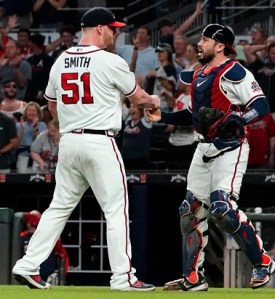
Will Smith, Travis d'Arnaud

Will Smith and Travis d’Arnaud, after the Phillies somehow declined the gift Smith tried to give in the ninth Tuesday.

Until the top of the ninth Tuesday night the Phillies hadn’t scored a single run in their previous twenty innings. Then the Braves all but gifted the Phillies a run in that ninth. They’d even gifted the Phillies the potential go-ahead run and then the bases loaded with one out.

The problem was the Phillies picking the wrong way to say thank you. All that got them was elimination from the National League’s wild card race with a 2-1 loss. It’s win the NL East or wait till next year for them now.

But the ninth-inning high-wire routines of lefthanded relief pitcher Will Smith—with a rather remarkable ability to get himself into hot water—got a little too high on the wire Tuesday night.

It wasn’t so much that he and the Braves escaped as that the Phillies sent a helicopter overhead to lift him to safety when they should have left him and the Braves wiring mad. The Braves won’t always find the opposition that willing to bail them out.

Thanks in large part to their grand old man Charlie Morton’s seven-inning, ten-strikeout, shutout-ball gem, while managing to pry only two runs out of Phillies starter Zack Wheeler in seven otherwise-strong innings, the Braves may have been lucky to take a 2-0 lead into that ninth.

But with Smith having the opening advantage against lefthanded Bryce Harper, the major leagues’ OPS leader, Smith found himself in a wrestling match that ended with Harper wringing himself aboard with a leadoff walk. Phillies catcher J.T. Realmuto now represented the potential game-tying run at the plate.

Realmuto hit one on a high line to right center that ninth-inning center field insertion Guillermo Heredia had to run down long to catch on a high backhand. That spot of Braves fortune lasted just long enough for Phillies pinch-hitter Matt Vierling to hit a high liner to left, where Braves left fielder Eddie Rosario ran over, extended his glove, and watched the ball carom off its fingertips, setting up second and third for the Phillies.

Now the Phillies had veteran Andrew McCutchen—a long way from his days as a center field gazelle and a 2015 NL Most Valuable Player for a better array of Pirates—coming to the plate. McCutchen isn’t the danger he was once seen to be anymore, but he’s a veteran who still knows what he’s doing at the plate, and the Braves had no intention of letting his righthanded bat lay them to waste.

So the Braves ordered McCutchen walked intentionally, putting the potential second go-ahead run aboard, even while it looked as though Smith fooled nobody at the plate. The problem was that putting McCutchen aboard also put the Phillies’ fate into two bats described best as balky.

Phillies shortstop Didi Gregorius continued playing through a bothersome elbow and a shrunken ability to handle pitching from the same side as which he swings, lefthanded. Third baseman Freddy Galvis, lately pressed into everyday service, simply keeps proving why the Phillies unloaded him in the first place four years ago—he’s not truly an everyday player, and though he switch-hits he’s not exactly a game-breaker at the plate.

The Braves now had only to pray that Smith could survive. The Phillies had only to pray that Gregorius and Galvis had a few more unexpected surprises in their bats. Every Braves fan in Atlanta’s Truist Park had to pray that Smith could put his own fire out with a real retardant, not with gasoline.

He served Gregorius a 1-1 offering, and Gregorius hit a high liner that looked for a few seconds as though it would find a way off the right field wall—but Braves right fielder Adam Duvall ambled back in front of the track to haul it in for the critical second out even as Harper was able to tag and score from third.

Now Smith went to work against Galvis. Two balls in the dirt, ball three high, a grounded foul for strike one, a called strike right down the pipe, and a hard line foul down the left field side out of play. Then, Smith threw Galvis a meatball so fat it could have been hit with a cardboard paper towel tube.

Galvis swung right through it. Strike three and the game.

The Cardinals won their seventeenth straight behind the aging arm of their own grand old man Adam Wainwright and a trio of home runs in a 6-2 win over the Brewers Tuesday night. The Phillies’ postseason hopes shrank to a hair in their none-too-formidable division.

“We have to win out,” said Phillies first baseman Brad Miller postgame. Easier said than done. They have to beat the Braves tonight and tomorrow and hope the Mess (er, Mets) beat the Braves over the coming weekend.

That’s what happens when you open a game the way the Phillies did, with back-to-back singles in the top of the first, but you can’t cash them in after a force out, a swinging strikeout, and an infield ground out—two days after the Phillies were shut out by the NL Central bottom-feeding Pirates, of all people.

That’s what happens when Morton—the last man standing on the mound when the Astros won their now-tainted 2017 World Series title—all but toyed with them the rest of the way, the 37-year-old righthander making the Phillies’ lefthanded lineup stack look silly in going 2-for-15 with a walk before his evening ended.

“The moment doesn’t get too big for him, I know that,” said Braves manager Brian Snitker about Old Man Morton, who kept the Phillies off-balance on a deftly blended diet of curve balls, changeups, and fastballs. “I think he does a really good job of just staying with the next pitch and doesn’t get caught up in the big picture. And it’s just about making the next pitch, which is really, really good. That was, gosh, seven really good innings.”

That’s what happens when Wheeler, the National League’s strikeout leader among pitchers entering Tuesday, could manhandle the more formidable portion of the Braves’ lineup but couldn’t quite contain their lower-leverage bottom of the order in the bottom of the third—a leadoff double (Travis d’Arnaud, hitting seventh), an immediate first-pitch single (Dansby Swanson, hitting eighth) put Braves on the corners with nobody out.

Morton then bunted a high chop off the plate that pushed Swanson to second on the out, but Jorge Soler, the Braves’ leadoff hitter in the lineup, ripped a hard single down the left field line to send both runners home easily enough, before Wheeler retired Freddie Freeman and Ozzie Albies on grounders to second baseman Jean Segura.

That was the game until that too-close ninth. But the game put the Phillies’ core flaws into stark light, too. Even before the Phillies and the Braves squared off, The Athletic‘s Matt Gelb isolated the point: “[T]hey have too many holes right now.”

Didi Gregorius is tough to play against lefties. Andrew McCutchen is tough to play against righties. They love what Brad Miller has done, but he won’t start against lefties. Matt Vierling has provided a surprise boost for the Phillies in September, but he hasn’t gained the full trust of [manager] Joe Girardi.

The Phillies also lack the one thing that’s enabled the Braves to hang in and stand now on the threshold of wrapping an NL East that wasn’t exactly a division of baseball terrorists in the first place. Sure, the Mets spent 103 days leading the division—deceptively, as things turned out—but nobody in the NL East looked that much like a powerhouse.

What the Phillies lack that the Braves proved to have in abundance is depth. Their Harpers, Realmutos, and Wheelers all but willed them to stay in the race in the first place, but it may not have been enough. They just weren’t deep enough to hang in without major effort. A coming off-season overhaul may not shock anyone.

The Braves were deep enough in system and in the thought process of general manager Alex Anthopoulos that they withstood the full-season loss of their best young pitcher (Mike Soroka) and the rest-of-season loss of franchise center fielder Ronald Acuna, Jr. to serious injuries.

But they still have to find ways to neutralise that ninth-inning high-wire act.

Don’t let the 36 saves fool you. Smith’s 3.55 ERA and 4.28 fielding-independent pitching (FIP) should tell you the real story. So should 28 walks against 84 strikeouts in 66 innings’ work so far, not to mention 3.8 walks per nine innings. He seems too much to play with matches.

Snitker has two far-superior pen men to send forth when the game gets late and dicey, Luke Jackson (1.90 ERA) and Tyler Matzek (2.66 ERA). Between them, Jackson and Matzek pack a 3.34 FIP, a lot more comfortable than Smith’s. They should be considered more than in passing as viable ninth-inning options.

If these Braves want to get past postseason round one, they may want to consider how much less Jackson and Matzek like to tempt fate or challenge for baseball Darwin Awards. The last thing the Braves need now is to be the cobra with its own ninth-inning mongoose.