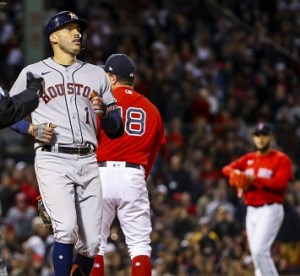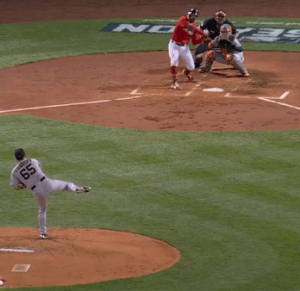
As the Red Sox turn: The Saturday massacre . . .

Not even revenge for a 10-3 blowout loss in Baltimore Friday night could spare Alex Cora. Not even his mixed-up, muddled-up, twisted Red Sox frying the Orioles alive on Saturday with innings of three, one, and three runs before a ninth inning that could have had them hauled before the Hague could do it.

Cora was taken to the guillotine after that 17-1 Saturday afternoon massacre. So were his five coaches. Before you shake your heads pondering why you should take pity upon six men executed for the Red Sox’s 10-17 start (they beat the Orioles with far fewer human rights violations Sunday, 5-3, for win number 11), you might want to ponder how this mess got built in the first place.

It wasn’t by Cora. It sure wasn’t by Jason Varitek, franchise icon as a catcher when the Red Sox broke the (actual or alleged) Curse in 2004 and followed up anchoring another World Series winner three years later, now “reassigned” from game planning coordinator to another, as-yet-identified role in the organisation.

It sure as hell wasn’t put together by now-beheaded hitting coach Peter Fatse, third base coach Kyle Hudson, bench coach Ramón Vásquez, Fatse’s assistant Dillon Lawson, or major league hitting strategy coach Joe Cronin.

This one’s on chief baseball officer Craig Breslow, who once wrestled his way through a twelve-season career as a middling relief pitcher of occasional flashes and flights. And very few people watching the Red Sox closely think otherwise, no matter how the massacre resonates as par for the baseball course when a team thought to be a division or league power isn’t exactly behaving that way on the field.

Maybe nobody put it with quite the nail-driving force of Athletic writer Steve Buckley. “For anyone choosing to cite this as just the latest example of a dead-ass ballclub whose manager is unable to inspire his players to keep performing at a high level regardless of the circumstances, you have just cause to do so,” he began Sunday.

Or you can look at the misshapen roster and the lack of clubhouse leadership and ask who put this mess together.

That would be Craig Breslow, who, believe it or not, once lived in big-league clubhouses. Lots of them. He soldiered on, year after year, with organization after organization. He was released five times. In 2018, at age 37, he pitched at three levels of the Toronto Blue Jays’ farm system as part of one last effort to get back to the big leagues.

How strange that a guy who’s been in so many clubhouses doesn’t seem to know how they work. How strange that a guy who has been on so many rosters hasn’t figured out how to build one.
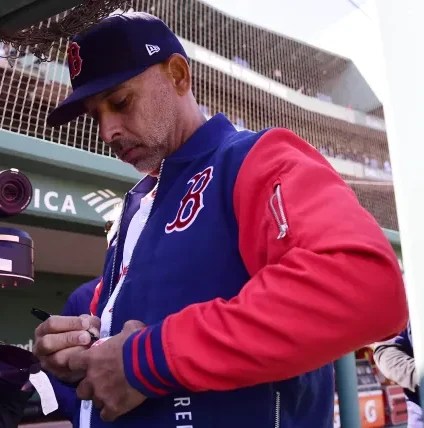
Alex Cora

Alex Cora signing a baseball in the clubhouse. His execution papers were signed Saturday despite the Red Sox nuking the Orioles that day, proving who gets to take the fall for a hot mess starting 10-17.

Remember Alex Bregman? Brought aboard to play third base last year while easing incumbent Rafael Devers into designated hitting and first base. Except that Devers wouldn’t buy in, before he would, before he wouldn’t (easy to get the sequence confused, no?), before he was shipped to the Giants in a “trade” that made the word a euphemism for the Red Sox ridding themselves of the $250+ million left on Devers’s deal.

Fighting injuries, Bregman still endeared himself to the Red Sox clubhouse with leadership and agreeability in hand with accountability. Then he hit free agency. Then Breslow convinced one and all upstairs that, no, of course not, the Cubs weren’t really being serious about offering Bregman a big chunk of the vault, a no-trade clause, and the Van Allen Belt. (That last is a joke, son.)

Except the Cubs were deadly serious. And, oh, by the way: while the Red Sox sputtered, spun, and plunged into the morass that culminated in the Friday night flogging they suffered, the Cubs won ten straight and eleven of thirteen to claim second place in the National League Central.

“I mean obviously, it’s kind of up in the air what the true direction of the franchise is,” said Trevor Story, Red Sox shortstop. “Some of the best coaches in the world didn’t get a fair shot.” The dear boy. Somebody forgot to brief him about Red Sox life under John Henry’s hammer. As another Athletic writer, Ken Rosenthal, wants to remind us, these Red Sox “could win the World Series—unlikely as that might be with the roster Breslow constructed as chief baseball officer—and it would only spare him for so long.”

Ask Dave Dombrowski. Ask Ben Cherington. Ask Theo Epstein, who once escaped the Henry regime in a gorilla suit, only to return, win a second Series and then bolt for the Chicago Cubs. Oh, to hear the honest thoughts of Epstein, back with the Fenway Sports Group as a part-owner and senior adviser, on the latest installment of As The Red Sox Turn.

It’s an endless game of survivor at Fenway Park, only no one ever survives. Not top executives. Not superstars like Mookie Betts, Rafael Devers and Alex Bregman. Not managers like Terry Francona, John Farrell and now Alex Cora . . .

Was Cora perfect? (Pause to stop laughing.) Remember, he had to take time off (ho ho ho) over his role in the Astros’s illegal, off-field-based, electronic sign-stealing operation of 2017-18 that was exposed over a year after he led his Red Sox to a World Series ring in his first year on the bridge. He also couldn’t sell Devers on the DH/1B transition the Giants proved to have little trouble selling, after all.

He wasn’t perfect. But neither were he or his staff going to get too much out of this assemblage, no matter how they looked on Saturday. “At the end of the day, when we take the field, it’s on us,” said outfielder Roman Anthony, currently struggling with back trouble. “It’s not AC’s job to go out there and do the things that we’re expecting to do as players. So, I mean, it’s nobody’s fault but ours.”

Eyes will be upon interim manager Chad Tracy as he tries to find the right pieces from among those bequeathed him. The pieces were random and testy enough that Cora found himself having to play mad scientist searching for the best formulae.

Forget whether Albert Einstein could square this roster’s mass into energy instead of this mess. Meaning Breslow himself could be the next execution. As the Red Sox Turn . . .
26 minutes and other Opening Day salvos

Rafael Devers

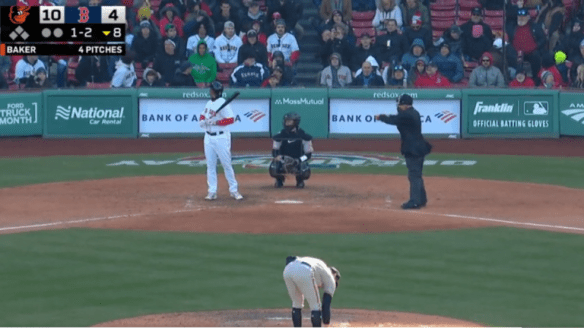
Rafael Devers (Red Sox), the Show’s first ever to strike out without a pitch thrown, taken, or swung on and missed—on a pitch clock violation.

So. After encyclopædic volumes worth were said and done, the average shortening of games on Opening Day was a whopping . . . 26 minutes. The new rules, don’t you know?

I may be on board with the pitch clock, but I’m not on board with cheers about the shortening when a fourth grade math student can tell you they’d have been shortened more by eliminating half the broadcast commercials. That’s accounting for the spots before each half inning and during any inning jam in which a pitching change was made.

But it didn’t stop the Blue Jays and the Cardinals needing three hours and 38 minutes to finish with a 10-9 Blue Jays win, paced by George Springer’s five hits for the Jays and opened with Cardinals pitcher Adam Wainwright warbling “The Star Spangled Banner” to just about everyone’s surprise in Busch Stadium.

Two players made history under the new rules. Rafael Devers (third baseman, Red Sox) became the first in Show to strike out on a pitch clock violation. Marcus Stroman (pitcher, Cubs) became the first in Show to be assessed a ball on a clock violation.

Leading off the eighth, Devers was rung up on 2-2 with Bryan Baker on the mound for the Orioles and the Red Sox in a 10-4 hole. “This doesn’t make sense to me,” said an announcer, “because he’d already looked at the pitcher. The pitcher’s not even ready to throw.”

Devers had checked back into the box with a few seconds remaining after stepping out to knock dirt out of his cleats. Even as Baker wasn’t quite ready to throw, plate umpire Lance Barksdale bagged him. It didn’t stop the Red Sox from posting a three-spot in the inning. “There’s no excuse,” said manager Alex Cora. “They know the rules.”

Knowing them and being able to maneuver within them for the first time in regular-season play are not exactly common. But it’s entirely possible that Devers not being dinged might have made a small difference. Led by Adley Rutschmann becoming the first catcher in Show history to have a five-hit Opening Day, the Orioles out-lasted the Red Sox, 10-9, after almost handing the game all the way back to the Olde Towne Team in the bottom of the ninth.

Remember: I’m also on board with turning the damn clock off in the eighth and later. Devers may yet prove evidence on behalf of that.

Stroman got his while checking Brewers runner Brice Turang at second with Christian Yelich at the plate in the third. The pitch clock expired about a hair before Stroman turned to pitch from the stretch. “It’s tough, this pitch clock,” Stroman told reporters postgame. “It’s a big adjustment. I don’t think people really realize it. It just adds a whole other layer of thinking.”

Yelich finally worked a walk out. The Brewers didn’t score then or the rest of the game. The Cubs won it, 4-0.

Jeff McNeil became the first Met to be hung with a pitch clock violation strike—for waiting for Pete Alonso to get back to first on a foul ball. Oops. Manager Buck Showalter was unamused that the clock began to tick before Alonso returned to the pad. McNeil remained mad just long enough to nail a base hit.

That was in an Opening Day game the Mets won, 5-3, beating the Marlins, but they might have had one more, at least, if not for someone whacking Brandon Nimmo with the stupid stick in the third. With first and third, Nimmo dropped a bunt—and hit into an inning-ending double play despite the run scoring. Thus the risk the wasted out, which is exactly what the sac bunt is, carries against defenders alert enough.

The good news there was Max Scherzer holding on despite all three Miami runs charged to his account and the Mets making simple enough work against a still not quite ready Sandy Alcantara. The bad was Justin Verlander having to miss a week while dealing with a muscle strain in his upper back near his throwing shoulder.

Perhaps it was miraculous that Aaron Judge picked up right where he left off from last season and hit one out in his first plate appearance against the Giants. That launched a 5-0 Yankee win that saw both starting pitchers, Gerrit Cole and Logan Webb, nail eleven and twelve strikeouts, respectively—the first opposing Opening Day starters to do that since Max the Knife (then a National, with twelve) and Jacob deGrom (then a Met, with ten) in 2019.

Speaking of deGrom, alas, the good news was, the Rangers got him a small truckload of runs. The bad news was that deGrom, still not all the way ready after a spring training disrupted by a side strain, also surrendered five before the Rangers unloaded for a nine-run fourth and held on to win, 11-7. They became the first Opening Day team to have a nine run-or-better inning since the Padres dropped 11 in the sixth against the Mets in the 1997 opener.

And Shohei still gonna Shohei. The Angels’ two-way unicorn struck ten Athletics out before his day’s work was finished. He even ripped a 110 mph base hit and threw a 101 mph pitch before he was done. And what did it prove worth in the end? Squatski. The Angels lost, 2-1. It put Ohtani onto a dubious record book page: the only pitcher to punch ten out and surrender no runs in his team’s Opening Day loss.

Meanwhile, the Rockies are still gonna Rockie, alas, even when they win. With a pair of home runs by first baseman C.J. Cron leading the way, the Rockies battered the Padres for seventeen hits—despite striking out at the plate seventeen times against four Padres pitchers. Making them the first team since 1900 to deliver that dubious 1-2 punch in a nine-inning game. Ever.

I’ve said it before, but I’ll say it once more. This is baseball. Where anything can happen—and usually does. With or without rule changes running the bases from the sublime to the ridiculous and back to the absurd. And wish though Commissioner ADD and his minions might, 26 minutes isn’t exactly that big a difference from even last year’s average.

ALCS Game Five: Nuts to that

Chris Sale

“I was good for five, then sucked for one. I left my nuts out on that mound.”—Chris Sale, after ALCS Game Five.

It’s bad enough when the move you make gets turned into disaster. It’s worse when the move you don’t make explodes in your face—and puts you on the threshold of postseason elimination.

Red Sox manager Alex Cora, more creative and fearless than many managers in baseball today, learned the hard way in the top of the sixth in American League Championship Series Game Five Wednesday evening.

He needed to keep the Astros to a 1-0 lead on a night the usually formidable, tenacious, but suddenly feeble Red Sox bats had nothing to show against Astros starting pitcher Framber Valdez.

Valdez would carve them like turkeys over most of his eventual eight innings’ work other than one seventh-inning slice. But it was Astros left fielder Yordan Alvarez who stuffed the Red Sox birds first and almost foremost.

With Jose Altuve opening the sixth with a walk, Michael Brantley aboard when Red Sox first baseman Kyle Schwarber couldn’t hold onto Xander Bogaerts’s throw from shortstop, and second and third when Alex Bregman was thrown out at first on a clunking grounder back to Red Sox starting pitcher Chris Sale, up stepped Alvarez.

The same Alvarez responsible for the game’s only scoring with a first-pitch leadoff home run into the Green Monster seats in the top of the second. The same Alvarez who nailed a long one-out single off the top of the Monster sending Bregman to third in the top of the fourth, before Sale struck Carlos Correa and Kyle Tucker out swinging to end that inning.

This was one time today’s version of Casey Stengel might have been served far better if he’d decided no way would Alvarez get a third crack at Sale, and ordered the intentional walk to load the bases, setting up a prospective inning-ending double play.

Cora would have had far better odds letting Sale pitch instead to Correa, whom he’d struck out twice on the day already. But he let Sale pitch to Alvarez first. And Alvarez shot a line drive the other way down the left field line, sending Altuve and Brantley home with the second and third unanswered Astro runs.

Cora lifted his stout starter—who’d pitched five innings of one-run, seven-strikeout, two-hit baseball until he walked out for the sixth. Sale wouldn’t blame Cora, though. “I was good for five, then sucked for one,” said the lefthander still getting his wings back into tune after recovering from Tommy John surgery. “I left my nuts out on that mound tonight, that’s for sure.”

You have to give Sale credit for a somewhat unique way to express his self-verdict. You may yet end up giving him the blame for writing the Red Sox’s 2021 postseason epitaph.

Whatever Sale left on the mound, the Red Sox bullpen had enough of their nuts handed to them, coarsely chopped, for six more runs and a 9-1 Astros win that sends the ALCS back to Houston, with the Astros having two chances to go to the World Series and the Red Sox needing to beg, borrow, steal, sneak themselves two. Whatever works.

Ryan Brasier relieved Sale to let an RBI single tack a fourth run onto Sale’s jacket before allowing two of his own, on Jose Siri’s shallow floating single to right sending Tucker and Yuli Gurriel home.

Hansel Robles’s throwing error on a pickoff attempt in the top of the seventh let Altuve have second on the house and set Brantley up to fire an RBI single up the pipe, before getting Bregman to dial Area Code 6-4-3 and stepping aside for Darwinzon Hernandez.

Hernandez dropped a called third strike in on Alvarez, of all people, to end the inning. He yielded to Hirokazu Sawamura after a one-out walk to Tucker in the eighth. Sawamura surrendered a single to Gurriel and wild-pitched him to second but bumped his way out a first-and-second jam striking Siri out and getting Altuve to line out to left for the side.

But Martin Perez came on for the ninth and found himself with two on, nobody out, when Alvarez bounced sharply right back to the box and Perez knocked the ball down, chased briefly, grabbed it, and threw Alverez out.

Then Cora ordered the free pass—to Correa, who hadn’t exactly bedeviled the Red Sox on the night. And when Red Sox second baseman Christian Arroyo took Tucker’s grounder on the dead run in and threw home to force a sliding Brantley out at the plate, it was impossible to forget the intentional walk that wasn’t back in the sixth. Especially when Gurriel promptly punched a base hit to center, sending Bregman and Correa home too handily.

The only Red Sox answer for any of that mayhem was Rafael Devers sending a one-out, none-on tracer into the Monster seats in the bottom of the seventh. Otherwise they spent the evening doing what the Astros did earlier in the set, showing futility with men in scoring position (0-for-4) while the Astros looked more like the earlier-set Red Sox. (6-for-15.)

What compelled Cora to send Sale back out for the sixth? The Red Sox manager to his credit has rarely if ever shown an allergy to hooking a starter before that starter can get hooked.

“I understand how people think,” Cora said postgame, “but there were two lefties coming up too in that pocket, right? Brantley, who he did an amazing job early on, and we had Alvarez. Still, he is Chris Sale. He is a lefty. He has made a living getting lefties out.”

Sale did strike Brantley out twice before the sixth. But it couldn’t and shouldn’t have escaped Cora’s usually fine-tuned eye that Alvarez was manhandling Sale entirely on his own before the sixth.

Nor should it have escaped Cora’s analytically-inclined eye that, since Alvarez showed up in the Show at all, the Astros left fielder has .580 slugging percentage against lefthanded pitching—the highest lefthander-on-lefthander slugging percentage in the majors over that span.

Cora may also think twice before using Perez in high leverage again. The lefthander’s regular-season 4.82 fielding-independent pitching rate should have been flashing “danger, Will Robinson” as it was. But Perez only appeared in high leverage 32 percent of his season’s assignments. In the Game Four ninth, Brantley tore a three-run double out of him to put the game beyond reach at last.

We’ll learn the hard way, too, whether using his Game Six starter Nathan Eovaldi to open the Game Four ninth in relief will end up hurting, not helping. Especially with Eovaldi now going out to pitch not to send the Red Sox to the World Series but to stay alive at all.

Sure, the Red Sox got jobbed when plate umpire Laz Diaz called ball two on what should have been inning-ending strike three, enabling the Red Sox a better shot at coming back to win. But giving the Astros an unnecessarily extra look at the tenacious righthander may yet burn Cora and the Sox.

First things first. If the Red Sox want a little extra inspiration and moral support, Cora can’t afford to outsmart himself again. Then, they ought to dial the 2019 Nationals.

Winning that World Series, the Nats proved you can wreck the Astros in their own house even once back-to-back, never mind twice in the biggest set of them all. To get to that biggest set this time, the Red Sox now need all of that kind of help that they can get.

ALCS Game Three: Rock and troll

Carlos Correa, Eduardo Rodriguez

Rodriguez (right) couldn’t resist trolling Carlos (It’s My Time!) Correa as the top of the sixth ended . . .

Carlos Correa grounded out to end the Astros’s sixth Tuesday night. Red Sox starter Eduardo Rodriguez couldn’t resist pointing to his wrist, trolling Correa’s becoming-more-familiar “It’s my time!” gesture whenever nailing a key Astros hit. There was a birthday boy in the house who wasn’t necessarily amused.

“No, no,” Alex Cora hollered, as Rodriguez returned to the dugout during the sides changing. “Don’t do that!” The last thing the manager wanted on his 46th birthday was any of his Red Sox poking the Houston bear they were taking down, before the bear could even think about stealing their picnic baskets.

Not even the pitcher who’d just pitched six solid innings the only blemish of which was a three-run homer two innings earlier. Not even while the Red Sox still held a six-run lead that finished in a 12-3 demolition giving the Red Sox a 2-1 American League Championship Series advantage and the Astros a monumental migraine.

An inning and a half worth of three-up, three-down baseball that looked to shape into a pitching duel between Rodriguez and Astros starter Jose Urquidy got ripped into a Red Sox demolition in the bottom of the second after starting as a mere tear. Two walks sandwiching a J.D. Martinez one-out double merely loaded the bases for Christian Vazquez’s line single the other way to right field and kept them there.

Oops. Christian Arroyo ripped one off the mound and off Astros second baseman Jose Altuve to send Martinez home with a second Red Sox run. Falling into an early 2-0 hole with ducks still on the pond against these Astros still seemed surmountable. Until Kyle Schwarber told them otherwise.

After taking ball one inside, ball two downstairs, and ball three just inside, Schwarber took Urquidy’s fastball around the middle halfway up the right field seats. It was the third salami slice for the Red Sox in three ALCS games. As if slicing two in Game Two wasn’t precedent enough, the Schwarbinator’s blast made the Red Sox the first ever to slice three in any postseason series.

Kiké Hernández followed Schwarber at once with a base hit pulled up the left field line, and Xander Bogaerts ripped a single up the pipe one out later, and finally Astros manager Dusty Baker got Urquidy out of there before the Red Sox could cover his grave. Yimi Garcia shook off a second-and-third-making wild pitch to dispatch Alex Verdugo for the side at last, but aftershocks were still to come.

They started an inning later, when Hunter Renfroe drew a one-out walk, stole second, then took third when Astros catcher Martin Maldonado’s throw to second bounced away from Altuve, before coming home on Vazquez’s floating base hit into short center. Then Arroyo drove Garcia’s slightly hanging slide into the rear row of the Green Monster seats.

The Astros may have punctured the impenetrable when Astros center fielder Kyle Tucker parked one into the right field seats with Michael Brantley (leadoff single) and Yordan Alvarez (one-out single banged off the Monster but played perfectly by left fielder Verdugo to hold him) aboard in the top of the fourth.

Two innings and three Astro pitchers later, Rafael Devers took a leadoff walk and the Astros got two outs quick enough to follow, especially center field insertion Jose Siri’s sliding catch running in long to take Verdugo’s floater into shallow center. Phil Maton then relieved Brooks Raley for the Astros, and he arrived just in time to feed Martinez something to hit into the Monster seats about as deep as Arroyo’s blast traveled.

Kyle Schwarber

The Schwarbinator slicing salami in the second to start the Red Sox romp in earnest . . .

Before this ALCS ends, the Red Sox may need to put new tires on the laundry cart into which they dump their home run hitters to celebrate the blasts in each moment. They’re already down to the last millimeter of tread as it is.

As if making sure the sealant on the first puncture held fast, Devers turned on Astro relieve Ryan Stanek’s first one-out pitch in the bottom of the eighth and sent that into the Monster seats, too. Renfroe’s diving catch on Correa’s two-out, opposite-field drive in the top of the ninth must have felt like the first mercy shown the Astros all night long.

Astros pitching coach Brent Strom wondered aloud whether his charges might be tipping pitches. Not willing to commit to that quite all the way, he acknowledged that—between the Red Sox’s postseason plate discipline and all-fields approaches and Astro pitchers falling behind in counts so often now—he’s more than a little concerned.

“This is a very good hitting team,” Strom said of the Red Sox, “and they’re very adept at picking up little things, much more so than most teams,” Strom said. “We need to be very cognizant of the little things, tipping-type things, things like that, that they’re very astute at. We’ve just gotten behind hitters.”

Cora said the Red Sox approach began changing when Schwarber came aboard in a July trade with the Nationals. “We were expanding,” Cora said, meaning the strike zone. “We didn’t walk too much, and when he got here and when he started playing, it was different. It’s a different at-bat, and other guys have followed his lead, and right now, like I said, this is the best I’ve seen this team this season offensively.”

Correa thinks the Red Sox aren’t picking up Astro pitch tips so much as they’re just doing their jobs at the plate when the Astros’ pitchers aren’t doing theirs on the mound. As an Astro, it’s murder for Correa. But as a baseball fan, pardon the expression, it’s a blast.

“It’s fun to watch as a fan of the sport, see how everybody in the lineup has the same approach,” the shortstop said. “They’re not chasing. They’re staying in the zone. They’re not swinging at borderline pitches. It’s beautiful what they’re doing. We’ve got to find a way to throw more strikes and keep the ball in the ballpark.”

But as much talk came about Rodriguez giving Correa a taste of his own celebratory medicine as about the Red Sox’s thorough dismantling of the Astros’ balky pitching staff and shaky offense—particularly their big three of Altuve, Brantley, and Alex Bregman now standing a combined 5-for-36 in the set so far—after the game finally ended.

Cora didn’t exactly hold it against Rodriguez, making a point of embracing his pitcher when Rodriguez returned to the dugout. But he still didn’t want Rodriguez or any of his players re-awakening the suddenly sleeping Astro giants.

“We don’t act that way,” he said postgame. “We just show up, we play, and we move on, and he knows. I let him know. We don’t have to do that. If we’re looking for motivation outside of what we’re trying to accomplish, we’re in the wrong business. The only motivation we have is to win four games against them and move on to the next round.”

Correa didn’t exactly mind. The way he spoke postgame, you’d have thought the Astros forgot about such concepts as bulletin-board fodder. “He did my celebration,” said the shortstop liable to command a nice free agency deal this winter, no matter his Astrogate past.

“I thought it was kind of cool,” continued Correa, who’d done his “It’s my time” wrist-tap in Game One after breaking a three-all tie with an eighth-inning bomb. “It’s just the way baseball should trend. I loved it personally . . . I keep it real all the time and say how it is.”

Rodriguez admitted he was caught up in the moment after getting Correa to end the sixth. Cora was stern but not exactly harsh with his pitcher back in the dugout. His embrace fit perfectly with Rodriguez’s previous insistence that Cora was like a father or older brother to his players as well as a manager.

“He understands that we’re not that way.” said Cora, whose Red Sox almost got humbled out of the races in the second half between injuries, COVID sufferings, and a bullpen remake. “We talk about humble approach and humble players, and that’s who we are. We like to grind, and we like to play, but we don’t do that.”

Well, good Lord, a team hammering and blasting its way to a rout can’t be faulted for being just a little less than humble in the moment here and there. Can they?

“Whatever it takes to win”

Kike Hernandez (center, hatless) surrounded by Red Sox teammates after his walk-off sacrifice fly sealed their trip to the American League Championship Series.

Well, the Rays only thought their rather decisive first-game win in this now-concluded American League division series meant the beginning of another deep postseason trip. Who knew it would prove to be just the last win of the year for the American League’s winningest regular season team?

Come to think of it, a lot of people only thought the Red Sox’s apparent disarray in enough of the regular season, including their final home set while the Yankees swept them, and in losing two of three to the Orioles before sweeping the also-ran re-tooling Nationals to finish the schedule?

The Rays won the AL East decisively, and with the best regular-season record in franchise history. The Red Sox had to wrestle their way into the wild card game before beating the Yankees in a game featuring the sort of thing happening to the Empire Emeritus that used to mean surrealistic disaster for the Olde Towne Team.

Lovely way to send the Yankees home, many must have thought, but oh, are they going to feel it when the Rays get hold of them.

The only thing the Red Sox must feel now is that their postseason work has only just begun. But if the ways they shook off that Game One 5-0 loss to take the next three from the Rays are any indication, they’re about as up to the task as any formerly buffeted team awaiting their American League Championship Series opponent can be.

They live by the team play motto to such a fare-thee-well that you can suggest any given one will sacrifice for the good of the team—which makes it so appropriate that they finally won this division series with . . . a sacrifice fly.

Lose a 2-0 top of the first Game Two lead to a grand salami in the bottom of that inning? “No panic,” said manager Alex Cora. No panic—and allow only one more Tampa Bay run while turning that quick-as-you-please 5-2 deficit into a 14-6 blowout.

Lose a 6-2 Game Three lead on an eighth-inning leadoff homer by Rays rookie star Wander Franco and a two-out RBI double by not-too-young Rays rookie star Randy Arozarena, then have to ride a Phillies throwaway named Nick Pivetta for four extra innings? No sweat—just let Christian Vazquez rip a one-out two-run homer into the Green Monster seats in the bottom of the thirteenth and win, 6-4.

Blow a 5-0 Game Four lead off a five-run third crowned by Rafael Devers sending a three-run homer over Fenway Park’s second-highest wall and into the center field seats? We do this kinda stuff to them all through the picture. Just let Kike Hernandez say thank you to the nice Rays for not putting him on to load the bases for an any place/any time/extra-innings ticket double play—by banging the game and set-winning sacrifice fly short of the left center field track.

“I mean, here we are surprising everybody but ourselves,” said Hernandez post-game, once he escaped drowning in the Red Sox celebration. “We knew in spring training we had the team to make it this far and here we are.”

Well, the Red Sox did lead the entire Show in comeback wins during the regular season. They also managed a rather impressive .591 winning percentage in one-run games. But they also suffered a 12-16 August that wasn’t necessarily as disastrous as some other Augusts by some other teams this year. (Hello, Mess—er, Mets.) Between injuries, COVID-19 illnesses, and assorted other mishaps. nobody else seemed to remember if they knew what Hernandez said the Red Sox knew last spring.

Surprising everybody but themselves? Sure. Let’s buy into that despite the Red Sox trailing in three of these four division series games. Let’s buy into that despite the Red Sox having to win twice in their final plate appearances. Let’s buy into that despite an ankle-compromised designated hitter, a second baseman getting his first daily plate appearances in around three months, and pulling a hutch of rabbits out of their hats.

Well, guess what? You’ve probably bought into more improbabilities than those in your lives as baseball fans, observers, writers. If you speculated on the Red Sox’s apparent pitching goulash out-pitching the Rays’ more obvious pitching depth going in? You ought to think about buying lottery tickets in every state that offers them.

If you bought into Garrett Whitlock, a find on the Rule 5 minor league draft heap, pitching no-hit, no-run relief for the final two Game Four innings and becoming the Red Sox’s highest-leverage bullpen bull, forget the lottery? You ought to be investing on Wall Street. You can’t lose. Yet.

If you bought into Jordan Luplow doubling and scoring in the fifth, Franco abusing Red Sox reliever Tanner Houck for a two-run homer in the sixth, and Kevin Kiermaier whacked an RBI double ahead of Arozarena whacking a two-run double to tie things at five in the eighth? You ought to seed the advent of Jetsons-style flying cars.

But if you bought into Game Three hero Vazquez leading off the Red Sox ninth with a base hit, Christian Arroyo sneaking a sacrifice bunt to the short right of the first base line, pinch hitter Travis Shaw slow bouncing a tough hopper toward third that wouldn’t get him in time at first, then taking second on defensive indifference with Hernandez at the plate? That’s beyond my pay grade, too.

Why didn’t Cash put Hernandez on with one out? He wasn’t really about to load the pads for Devers and be forced to prayer that he could get away with it. Devers already had three hits on the night. With the winning run already ninety fee from scoring, putting Hernandez aboard would have meant only the possibility of having put the insult-adding-to-injury run on base.

So Cash trusted his reliever J.P. Feyereisen to take care of Hernandez. The first pitch tied Hernandez up by sailing up and in tight on the Red Sox center fielder. The next pitch sailed into Austin Meadows’s glove in left center, too far back to keep pinch-runner Danny Santana from sailing home with the Red Sox’s ALCS tickets punched.

“It was quick,” Feyereisen said postgame, and he could have been talking the series as well as the end of Game Four. “I think that’s one of the main things when we sat down, like, ‘Wow, I didn’t think it was gonna be over this quickly’. We felt good. We played some good games. You come in here, especially with this atmosphere with these [Fenway] crowds and two walk-off wins, that’s tough.”

What was even more tough for the Rays is that, all series long, they struck out 46 times at the plate to the Red Sox’s 23—and that includes 20 Rays strikeouts in Game Three’s thirteen-inning theater. By contrast, the Red Sox picked up from being shut out in Game One to hit .364 with nine home runs in Games Two through Four and delivered 56 hits the entire set.

The Rays’ wounding offensive flaw, being Three True Outcomes enough all year long, bit their heads off in the division series. They hit seven homers and ten doubles but had a collective .211 team batting average all set long. They’ll have to figure out how to improve their overall contact without sacrificing their impressive power.

They’re young, they’re deep, they’re they’re tenacious, they’re a model of resourcefulness despite their limited dollars. Their championship window isn’t being boarded up just yet.

Their farm is considered deep and still promising. They’ve got their own kind of guts, playing and pitching rookies in the postseason as if it was the natural thing to do. Even if it was borne of the unpleasant necessities delivered by injuries, near-habitual turnover, and in-season moves that didn’t work. The rooks—shortstop Franco, pitchers Shane McClanahan and Luis Patino in particular—showed heart beyond their years even in defeat.

Yes, it’s tough to remember Arozarena was still a rookie this season, technically. His coming-out part last postseason took care of that, and he shone like a well-established veteran this time around. From homering and stealing home in Game One through two hits and that Game Four-tying hit in the eighth, Arozarena was a rookie in name only this year.

Losing righthander Tyler Glasnow to Tommy John surgery was probably the key blow to the Rays in the end. Free-agent veteran Michael Wacha took a 5.05 regular season ERA into the postseason . . . and allowed a mere two-run deficit to turn into that 14-6 Game Two blowout in two and two thirds innings. One more veteran other than Game Four opener Collin McHugh might have made a big difference.

The Red Sox are just as conscious of analytics as any other team so advanced, including the Rays who practically live by it. But they’re a lot better in balancing analytics to the moment. Cora is as much an advance information maven as any skipper in baseball, but he’s also unafraid to shift his cards and play to what’s in front of him when it’s demanded of him.

He doesn’t play October baseball like the regular season. If he did, he wouldn’t have gone to eight postseason series as a manager or a bench coach and been on the winning side in each of them. He’s not afraid to take risks, he doesn’t sweat it if and when they backfire.

“That’s our motto right now: Whatever it takes to win,” said Hernandez. “Just win today, and we’ll worry about tomorrow, tomorrow. Lineup, bullpen, starting rotation, like, it doesn’t matter. We’re a team, and we’re one. We’re not 26 dudes, we’re just one.” Lucky for them the Red Sox aren’t out of tomorrows just yet.

Cora’s Game Four starting pitcher, Eduardo Rodriguez—lifted after an inning and two thirds in Game One following that first-inning disaster, but pitching shutout ball until Luplow scored on a ground out in the fifth, then coming out after Kiermaier doubled to open the sixth—calls Cora “like a father, brother, manager, whatever. He trusts us. He trusts everybody in that clubhouse. He gives you the chance every time that he hands (the ball) to you, and you’ve just got to go out there and do your job.”

“He’s a guy you’d run through a wall for,” said Whitlock. “If he told me to run through that wall, I’d believe that he had something there to make sure it would fall for me.”

It turned out the Rays wall wasn’t quite as sturdy as everyone else thought going in. The Red Sox have sturdier walls to face going forward. Walls that won’t be as friendly to them as the Green Monster seems to be.