
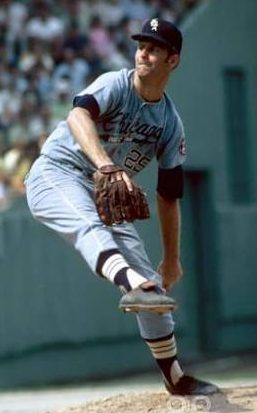
Tommy John, near the end of his White Sox tenure.
The symbolism was impossible to dismiss. A young Tigers pitcher named Jobe, making his first major league start since undergoing the surgery his namesake pioneered. On the same day that surgery’s namesake said farewell to baseball world as he entered into hospice care.
Jackson Jobe’s first start after the long road back from Tommy John surgery ended with five splendid shutout innings: two Giants baserunners (Drew Cavanaugh, third inning walk; Willy Adames, base hit in the fourth), four strikeouts, one hit, one walk. On a day the Tigers needed a big start following the trade deadline loss of Tarik Skubal, Jobe gave it.
The game ended in a shutout with two Tigers relievers keeping the Giants to a single hit the rest of the way of an 8-0 win. But on the day one Jobe kept the Giants quiet, the other Jobe’s Patient Zero (as Jay Jaffe once called him) issued a jarring public statement.
Tommy John has gone into hospice care. He was unable to make the Yankees’s Old Timers Day festivities Saturday because of health issues that have included a battle with bladder cancer. (Irony of sad ironies: the starting pitchers between the Yankees and the Braves Saturday—Gerrit Cole, Yankees; Chris Sale, Braves—were Tommy John surgery patients themselves.)
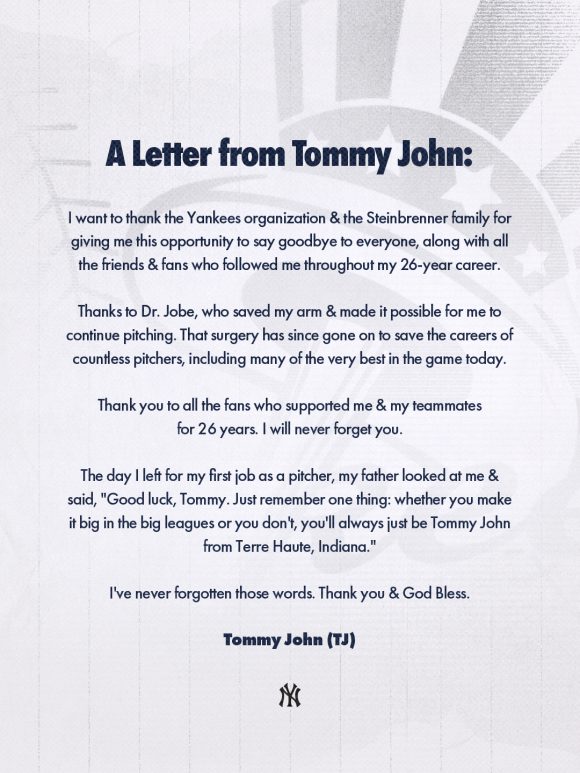
His formal statement was a simple and direct thank you to the Yankees, the Steinbrenner family, and pioneering orthopædic surgeon Dr. Frank Jobe:
Just how much time he has before he goes to the Elysian Fields is unknown. What is known is that John has a unique Hall of Fame case. It would be a grand gift from the Lord in whom he believes devoutly to delay his departure until the Classic Baseball Era Committee meets in December 2027.
The Classic committee considers those whose primary contributions occurred prior to 1980. Taken strictly as a pitcher, Tommy John’s career went eighteen seasons, including a) the year he missed rehabbing from his eponymous surgical procedure; and, b) 1980 itself. Considering that and that pioneer season, it would fall to the Classic committee’s purview.
Taken strictly as a pitcher, too, John doesn’t quite have a Hall of Fame case. Stop screaming and hear (well, read) me out. Here’s the elementary look at his career pre- and post-surgery.

What I said once still holds: that gaudy-looking 2.97 ERA before the surgery masks a modest peak value. He had all or parts of twelve seasons on his arm when he underwent the surgery; he had an unexpected and brief peak in the first five seasons following the operation.
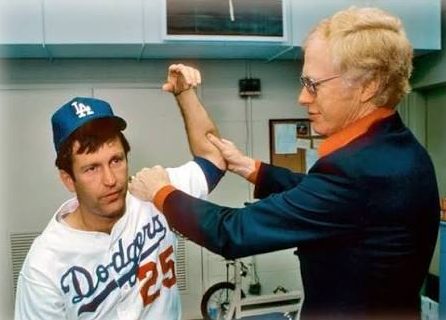
Dr. Frank Jobe (right) with Patient Zero. “Let’s do it,” said TJ when Jobe proposed it.
TJ was no strikeout machine, as his pre- and post-surgery K/9 numbers indicate. He was a brainy sinkerballer (some said the true heir to the ancient crafty-lefty tradition) with a couple of, shall we say, other offerings in his repertoire. (More anon.) He depended more on the fielders behind him to get his outs, which you’d expect from a fellow with his repertoire.
His ERA (by a long enough shot) and his fielding-independent pitching (FIP, by not so long a shot), and his WHIP (likewise), were lower before the surgery. He struck fewer out per nine after but walked about the same on both sides of it. He had only one seasonal ERA under 2.00 in his career. (1968’s 1.98, during the Year of the Pitcher, when he tied with Gary Peters for the lowest FIP among the White Sox starting rotation at 2.83.) He had five sub-3.00 FIPs but achieved it only once after the surgery.
Wins above replacement (WAR) doesn’t particularly help him, either. TJ averaged 2.6 WAR per season before the surgery and 2.8 after it. He had three 5.0+ WAR seasons (considered All-Star level minimum) pre-surgery, one post-surgery, and was chosen for only one All-Star team among those (1968) while making three All-Star teams post-surgery only one season of which was 5.0+. He totaled 31.1 WAR pre-surgery and 31.0 after. The average Hall of Fame starting pitcher has 73.0 career WAR and 49.8 peak WAR. (John’s peak WAR: 34.6.)
By the way, John was a good-fielding pitcher with outstanding range factors at the position. (Sinkerballers have to be, but not all of them are.) All you’d have had to do was remove Jim Kaat and a couple of others, and John might have won six Gold Gloves or more.
What makes John a Hall of Famer, then, especially if he shakes out as the number 79 starting pitcher of all time? He fell twelve shy of the magic 300 pitching wins, but you might as well say a fellow as dependent as John was on his fielders fell twelve shy of 300 credits for everyone else’s work.
It’s longevity that makes TJ most similar (according to Baseball Reference) to ten consecutive Hall of Famers. In order: Kaat, Robin Roberts, Bert Blyleven, Ferguson Jenkins, Early Wynn, Tom Glavine, Burleigh Grimes, Tony Mullane, Don Sutton (more anon, too), and Eppa Rixey.
Tommy John was a good pitcher who was great now and then over 26 seasons. More to the point: he not only proved that there could be a baseball life at all for pitchers whose UCLs blew out, he pitched fourteen seasons of major league baseball after he underwent the surgery when nobody, including TJ himself, knew for certain how much more major league life he’d have on the mound.
(John has also been very vocal against the rising trends of Tommy John surgeries in kids between 15 and 19, indicators that they’re being pushed past their natural limits before their times. He has more skin in the game than you’d suspect, too: his son, Tommy III, is a chiropractor whose patients have included perhaps too many teen athletes.)
As a good and sometimes great pitcher plus a bona-fide pioneer, John belongs in the Hall of Fame. So does Jobe. That “recognition” given both Jobe and his first Tommy John surgery patient at the Hall in 2013 isn’t sufficient. (Jobe passed to the Elysian Fields a year later.) Pray the Lord keeps John among us long enough to get the Classic committee’s enshrinement as the pitcher/pioneer he was.
Even if you have to place a dirt- or grass-scuffed ball next to his plaque. Sorry, I’m going there once more: my favourite Tommy John story.
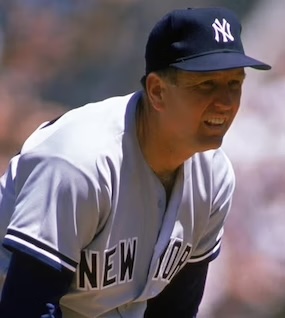
“Tommy John and Don Sutton. If anyone can find one smooth ball from that game, he ought to send it to Cooperstown.”
Thomas Boswell once described TJ as “the elegant Rhett Butler of outlaws. In the fine Whitey Ford tradition of mudballers and scuffballers, the gentlemanly John can turn a tiny scratch into a double-play grounder.” Orioles pitcher Mike Flanagan once cut three straight lines into the meat of a fresh ball, showed it to Boswell, declared “Any time I need four new pitches, I got ’em,” then said, “My God, Tommy John could make this ball sing ‘The Star Spangled Banner’.”
John wasn’t a ball doctor himself so much as he used what was handed to him, namely a ball not yet thrown out of play at once after a ground or fly out or a base hit. Imagine the fun, then, when John as a Yankee was matched against ex-Dodgers teammate and fellow scuff-and-ready pitcher Don Sutton as an Angel, in Anaheim, in August 1987.
The Yankees won the game in eleven innings, 3-2. It’s what happened in the first few innings when the Yankees opened with a 1-0 lead that provided more than a little mirth. Mercurial (har har) Yankee owner George Steinbrenner, watching the game from his Tampa digs, called the Yankee dugout and began bawling manager Lou Piniella out. I demand Sutton’s immediate arrest, frisking, arraignment, trial, conviction, and execution!
“George,” Piniella replied, “do you know what the score is? If I get the umpires to check Sutton, don’t you know that the Angels are going to check TJ? They’ll both get kicked out. Whatever they’re doing, TJ is doing it better than Sutton. So let’s leave it alone.”
Neither John nor Sutton was awarded the pitching decision in the game. Each came out after surrendering two earned runs apiece. (John after six and a third innings; Sutton after seven.) The Yankees pushed what proved the winning run home in the eleventh on a ground out; the Angels threatened in the bottom, before Yankee closer Dave Righetti pitched out of his own self-inflated jam (he walked Wally Joyner to load the bases) by getting a game-ending pop out to the infield.
“Tommy John and Don Sutton,” said an unnamed scout in the press box. “If anyone can find one smooth ball from that game, he ought to send it to Cooperstown.”

