Some of us tried to warn you

Shohei Ohtani

Torn UCL. Possible Tommy John surgery. Baseball’s unicorn is only human, after all. What will be Ohtani’s most sensible future?

I was thisclose to dining on a full crow dinner and saying I was wrong two years ago. About what? About the sustained viability of Shohei Ohtani as a two-way player, an above-average pitcher and above-average hitter.

That was then: the New York Post‘s Joel Sherman and MLB Network’s Brian Kenny argued loud enough over Shohei Ohtani’s likely life as a two-way player who was above average in both directions. Kenny said it was time to think of keeping Ohtani in one way (as a hitter) and Sherman went apoplectic.

“Why would you stop him from doing one or the other?” Sherman all but demanded. “[Because] one could damage the other,” answered Kenny, the author of Ahead of the Curve: Inside the Baseball Revolution.

“So, you would like one of the fifteen to twenty best starting pitchers in baseball to stop starting because you’re worried about something that could happen?” Sherman rejoined, perhaps bypassing for the moment that Ohtani had already had Tommy John surgery and missed all of 2019 on the mound—and missed the final half of September that year as a designated hitter after surgery on his bipartate patella.

This is now: what could happen has happened. What began with his pitching arm “bothering” him awhile since the All-Star break has turned into a second ulnar collateral ligament tear and a very possible second Tommy John surgery to come. Waiter, cancel that crow dinner. Just bring me a bourbon and Coke Zero, light ice, and a reuben sandwich.

And forget about what Wednesday night’s devastating revelation means for Ohtani’s open market. Forget the babillion dollars he was likely to command in the off-season to come. Maybe that was the season’s biggest story, especially after the Angels rolled a pair of hollowed-out dice and declined to trade him for a rebuilding beginning at this year’s deadline. Now, that story’s on ice. For how long, who knows?

I’ve said it before. The split second you hear about a pitcher dealing with “arm fatigue,” you can bet your mortgage on it being something a lot more serious. Ohtani dealt with it in the preceding few weeks. “[I]t’s possibly fair to second guess whether the Angels should have proactively reined Ohtani in more at times,” writes The Athletic‘s Sam Blum.

“Possibly fair?” People who first-guessed whether the Angels should have reined Ohtani in proactively at times had their heads handed to them. Sherman tried to do that to Kenny. I took a few in the chops myself for my own similar suggestion.

Go ahead, say the “arm fatigue” didn’t stop Ohtani from throwing his first major league shutout at the Tigers on 27 July.  But then you must acknowledge that the Angels pushed it for three straight years. In one way you couldn’t blame them. They had so little else to offer, and had already so wasted the prime of future Hall of Famer Mike Trout, the no-questions-asked best position player of the 2010s, that they couldn’t resist pushing their and baseball’s greatest unicorn to the most outer of his outer limits.

He won the American League’s Most Valuable Player award in 2021. He was leading the league in home runs as he went down and the talk kept up that he might be able to bust Aaron Judge’s single-season AL home run record just a year after Judge set it in the first place. On the mound, he kept up his 11.4 strikeouts-per-nine rate and his 3.04 strikeout-to-walk rate.

Let’s not forget, too, that the only one having more fun watching Ohtani has been Ohtani himself having more fun doing it than we’ve had watching it. You’ve heard of a smile that could get a city through a power blackout? Ohtani’s is a smile that could get half the country through one. Even when Clayton Kershaw picked him off almost by mistake in last year’s All-Star Game, Ohtani’s smile out-shone the lights in Dodger Stadium when both he and Kershaw laughed their fool heads off.
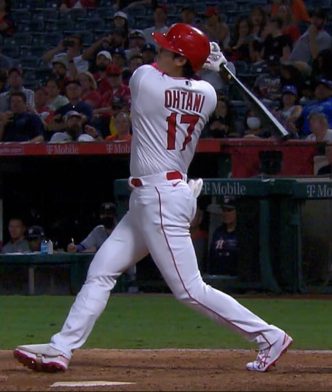
Shohei Ohtani

He found love on a two-way street. Will he lose it on the Tommy John highway?

Was it that easy to be blinded by the light? Even allowing that Angels owner Arte Moreno has long been far more concerned with putting fannies in the Angel Stadium seats than putting sensibly-built winning baseball teams on the field in front of those seats, was it that simple to be blinded by the Ohtani light?

All those delicious comparisons of Ohtani to Babe Ruth tended to omit two key elements: 1) Ruth was never a full-time two-way player except in one season (1919); Ohtani’s done it almost his entire major league life. 2) When Ruth was a fuller-time pitcher, it was in an era where hard-throwing pitchers were outliers and Ruth wasn’t exactly the type to try throwing the proverbial lamb chop past the proverbial wolf.

There was always the concurrent risk that Ohtani could be injured at the plate or on the bases, too. Once upon a time, he fouled one off his foot that rebounded to hit his surgically-repaired left knee—on the leg that’s his landing leg when he pitches. Any time Ohtani incurred a bang, a bump, or a cramp on the mound or at the plate, Anaheim, America, and the world lit up.

This isn’t just a bang, a bump, or a cramp. Not even if Ohtani did complain about a few finger cramps in recent days. This is a young man’s career and what remains of his team’s credibility on the line now. This is also a scrambler for the rest of the Show. Teams calculating just how much they could afford to seduce Ohtani this winter and start making their 2024 pennant race plans accordingly now must remake/remodel those calculations.

Especially if Ohtani must undergo his second Tommy John surgery. If so, he won’t be seen on the mound all next year as well as the rest of this season. If the Angels have any brain cells left to rub together, they’ll shut him down fully the rest of this year. He can’t afford to do further damage with even one hard swing at the plate or one hard slide on the bases.

I’m not going to deny it. It’s been mad fun watching Ohtani the unicorn doing things even the Babe himself didn’t do, or at least didn’t do quite as well as Ohtani has done them. Until Wednesday night, Ohtani threatened to join Ruth as the only man to set a single-season home run record while pitching full time as well. Ruth did that with the 1919 Red Sox—with 29 home runs. Nobody was really betting against Ohtani hitting maybe 63 this year.

Maybe the most surreal of his uncornery this year was Ohtani receiving four intentional walks as a pitcher. Ruth only ever had that happen twice in a season. (1919.) Schoolboy Row (1947) and Chad Kimsey (1931) are the only other pitchers to get four free passes at the plate in a season. And Ohtani was the first pitcher to get even one free pass at the plate since Hall of Famer Jim Kaat (1970).

On the mound, Ohtani was leading the entire Show with a 5.8 hits-per-nine average and the American League with a 143 ERA+. At the plate, he was leading the entire Show with those 44 bombs and a 183 OPS+, a 1.069 OPS, and a .664 slugging percentage. According to my Real Batting Average (RBA) metric (total bases + walks + intentional walks + sacrifice flies + hit by pitches, divided by total plate appearance), Ohtani this year is batting Boeing: .737. That, folks, is Ted Williams territory: the Splinter’s lifetime RBA is .740.

The problem with all that kind of mad fun is that it takes a toll. Either we didn’t really stop to think about it; or, we didn’t give two tinkers’ damns while watching it, dropping our jaws over it, imagining the language on his eventual Hall of Fame plaque over it, you name it. Joe and Jane Fan forget baseball players are only human and not machinery. They thought Ohtani was Superman with an immunity to kryptonite.

The money? Ohtani’s already earned enough in the Show to have no money worries the rest of his life. (When this season ends, it’ll be $39.6 million.) He’s never been about the money, anyway. What he’s been about was the pleasure in overachievement. One way or the other, he’ll get his money when he recovers, even if it may not be as ionospheric as thought before Wednesday. Even if he has to begin with a one-year, Sho-us deal to start over.

But if he has to undergo his second Tommy John surgery, would Ohtani accept a life as a one-way player that might mean a longer baseball career than he might have if he continues his two-way thrust? It may take more time to know that answer than it would take for him to recuperate from the second TJ.

On last year’s Opening Day, I got to watch up front with my son in Angel Stadium when Ohtani launched the season by pitching four-and-two-thirds, one-run, four-hit, one-walk, nine-strikeout (including Astros face JosĂ© Altuve thrice) ball. I’ve seen enough otherwise on the screen (am I really that old that I almost wrote “the tube?”) to know this guy was a unicorn even among unicorns.

Those of us who feared disaster in the offing should take no pleasure in what’s happened now. No matter how hard we took it up the tailpipes when we warned about it a few years ago. Now we ask just how much of his baseball future Ohtani may have sacrificed on behalf of pitching weekly, batting nightly, for a team whose maladministration didn’t deserve him any more than they deserved Mike Trout’s prime.

Who cares now whether Ohtani will throw a no-hitter and hit four home runs in the same game eventually? He’s already performed a nasty sacrifice on behalf of thrilling the living you-know-what out of us and sustaining what little credibility his team has left.

Shut him down fully the rest of this season. Don’t even let him swing the bat. Let the still-young man (29) regain his health properly. For everything he’s done on behalf of a franchise that doesn’t deserve him, if not a game whose administration doesn’t, Ohtani should get every consideration possible now.
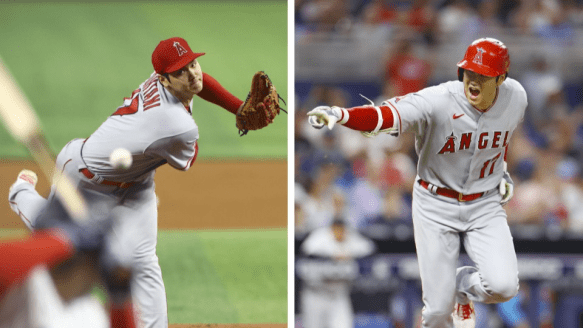
Moreno won’t trade Ohtani? Let it be on his head

Shohei Ohtani

Shohei Ohtani could bring back a trade deadline haul that might push the Angels (and their trading partner, depending) into the postseason at last. But it would serve their owner right for failing to deal him and then letting him walk as a free agent bringing back . . . nothing.

Unless there is something festering in the deep background that nobody can expose, I have a contrarian thought for everyone insisting Angels owner Arte Moreno absolutely must trade Shohei Ohtani. I ask only that you save your ammunition until you read whole.

If Moreno’s that insistent upon keeping Ohtani until that very day when he becomes a free agent for the first time after the season ends, let him.

If Moreno insists upon remaining the kind of owner whose sense of marketing is more acute to the tenth power than his sense of baseball and of his team’s true competitiveness, let him.

If Moreno is that bent upon receiving nothing in return for Ohtani by letting him walk this coming winter, rather than receive the kind of value whose terms his baseball people can all but dictate, considering the prize Ohtani is, let him.

It would serve him right, even if it might serve long-enough-suffering Angel fans not so right.

Remember, this is the owner who was “exploring options” to sell the Angels almost a year ago. When that news broke, the sigh of relief from Angel fans could be felt from the Newport Beach coast to the farthest-planted lighthouse in Maine.

Moreno even let it slip that he had a pair of offers that would have eclipsed what Steve Cohen paid to buy the Mets. The problem was, Moreno let that slip this past March, when he also announced he simply couldn’t bear to part with the Angels just yet. Not while there was (ahem) “unfinished business” to tend.

“[We] feel we can make a positive impact on the future of the team and the fan experience,” he said in a formal statement when announcing his sale plans were done for who knew how long. “This offseason we committed to a franchise record player payroll and still want to accomplish our goal of bringing a World Series championship back to our fans. We are excited about this next chapter of Angels baseball.”

As of this morning, the Angels had gone from a season-opening 18-14 to a dead-even 48-48. The last time they had a four-or-more-games-over-.500 standing was when they were nine games over following a two-out-of-three winning stand against the Royals in mid-June. They’ve been 7-15 since.

The culprits have been the usual ones for this team—inconsistent pitching by one and all not named Ohtani; inconsistent hitting by one and all not named Ohtani (or Mike Trout); and, a near-consistent parade of patients for the injured list. Somehow, the Angels are four and a half games back in the American League wild card race, and nine out of first in the AL West.

That’s close enough for a major trade deadline deal to maybe make a difference, for the wild card hunt if not the division hunt. Right now, the biggest deal of deadline season could be Ohtani for whatever prime enough talent he’ll bring back, even if the acquiring team knows he might be just a rental for the rest of the way. (Even if that means a division, a pennant, maybe even a World Series ring.)

For a contending team loaded in surplus, that rental could still mean a deep postseason dive. For the Angels, it might mean surviving into the postseason, even through the back door, but just enough to give Ohtani (and Trout) a taste of postseason action neither has been granted to see since Ohtani became an Angel in the first place.

No, Ohtani won’t return a whole qualified starting rotation, a whole bullpen full of more than bull, or an entire additional lineup of Ohtanis (or Trouts). But he would return pieces solid enough to keep the Angels in this race and maybe, just maybe, a race or two to come.

“Ohtani is a once in a lifetime player, and moving off of him is akin to trading Babe Ruth,” writes Deadspin‘s Sean Beckwith. “You hold onto that kind of talent for as long as possible, and hope for the best.” And that last part, Beckwith knows, is the most problematic part:

Considering “hoping for the best” is the Angels’ entire organizational strategy — it’s why they’re in this current predicament — they will inevitably be crippled by indecision, or disillusioned by the “LA” on the hat, and stand semi-firm that Ohtani will stand by them.

This is, of course, an asinine strategy, and antithetical to the thinking of front offices, and sports media. The pleas for trade destination slideshows are being heeded everywhere you click, and all the big market teams are tallying their assets to see how much they could offer in a trade, because [general manager Perry] Minasian said he’s not going to trade Ohtani if they’re still in contention.

The thing is, contention is subjective, and four-and-a-half games back of the final wild card spot is more than enough for the Angels to grasp onto the belief that Shohei Ohtani will stay regardless of no tangible reason to do so.

It’s more than enough, too, to prevent Moreno—an owner who thought (erroneously) that his life’s success in marketing qualified him as a baseball man, when it only meant he could put (the old George Steinbrenner creed) “name guys who put fannies in the seats” on the field first and worry about rhyme, reason, cohesion, and performance (an awful lot of which his own capriciousness obstructed) second—from doing the sensible thing. Or, from letting Minasian do the sensible thing.

So let him cling to Ohtani until the two-way unicorn’s Angels deal expires this winter. Let him get less than nothing in return for the unicorn if that’s the way he wants it. Ohtani has been at least as sensational a baseball talent as Mike Trout was before the injuries became a near-annual thing for him. He (and Trout) deserve better than to be kept prisoners to merely hoping for the best.

Let Moreno explain why clinging to his unicorn to the very last was more important than letting his unicorn bring back what just might have pushed the Angels into their first postseason since they were swept out of a division series by the Royals, in the first of Mike Trout’s three Most Valuable Player Award seasons. Nine years ago, if you’re scoring at home.

That explanation should prove the funniest and saddest monologue since the Marvelous Mrs. Maisel first wandered onto the stage of a fleabag nightclub to schpritz about her husband dumping her for his secretary. Mrs. Maisel got laughs and a brilliant career out of it. It would serve Moreno right to get nothing back for the unicorn to whom he sold an illusion.

The All-Scar Game

Austin Riley, Pete Alonso

Austin Riley’s (Braves, left) kneeling throw to kneeling scooper Pete Alonso (Mets, right) ended the bottom of the All-Star Game eighth with a double play . . . (MLB.com photo) . . .

The best thing about Tuesday night’s All-Star Game? Easy. That snappy eighth inning-ending double play into which Athletics outfielder Brent Rooker hit. He shot one up the third base line to Braves third baseman Austin Riley, who picked and threw on one knee across to Mets first baseman Pete Alonso, who scooped on one knee to nail two outs for the price of one, doubling Blue Jays second baseman Whit Merrifield up.

That play preserved what proved the National League’s 3-2 win over the American League in Seattle’s T-Mobile Park. They got the second and third runs in the top of that eighth, when Elias DĂ­az (Rockies) pinch hit for Jorge Soler (Marlins) with Nick Castellanos (Phillies) aboard after a nine-pitch leadoff walk and nobody out. DĂ­az sent Orioles righthander FĂ©lix Bautista’s 2-2 splitter off a bullpen sidewall, then off an overhang into the left field seats.

It meant the first NL All-Star win since 2012. It also meant DĂ­az becoming the Rockies’s first-ever All-Star Game Most Valuable Player award winner. Otherwise? It meant almost nothing. Because the worst thing about this year’s All-Scar Game was . . . just about everything else.

Mr. Blackwell, call your office. All-Star Game specific threads have been part of it for long enough. They began ugly and devolved to further states of revulsivity. But Tuesday night took the Ignoble Prize for Extinguished Haberdashery. The only uniforms uglier than this year’s All-Star silks are those hideous City Connect uniforms worn now and then during regular season games. Both should be done away with. Post haste. Let the All-Stars wear their regular team uniforms once again.

Who are those guys? They sort of anticipated long ovations for the hometown Mariners’ All-Star representatives. But they didn’t anticipate they’d be longer than usual. To the point where two Rays All-Stars—shortstop Wander Franco, pitcher Shane McLanahan—weren’t even introduced, when they poured in from center field among all other All-Stars. (Rays third baseman Yandy DĂ­az, an All-Star starter, did get introduced properly. But still.)

Maybe the two Rays jumped the gun trotting in while the ovation continued, but they should have been announced regardless.

While I’m at it, what was with that nonsense about bringing the All-Stars in from center field instead of having them come out of the dugouts to line up on the opposite base lines? Some traditions do deserve preservation. Not all, but some. What’s next—running the World Series combatants’ members in from the bullpens? (Oops! Don’t give the bastards any more bright ideas!)

Down with the mikes! In-game miking of players has always been ridiculous. But on Tuesday night it went from ridiculous to revolting. When Rangers pitcher Nathan Eovaldi took the mound miked up, the poor guy got into trouble on the mound almost at once. He had to pitch his way out of a two-on, one-out jam in the second inning. He sounded about as thrilled to talk while working his escape act as a schoolboy ordered to explain why he put a girl’s phone number on the boys’ room wall.

What’s the meaning of this? We’ve got regular-season interleague play all year long now. The National League All-Stars broke a ten-season losing streak? Forgive me if hold my applause. So long as the entire season is full of interleague play, the All-Star Game means nothing. Wasn’t it bad enough during those years when the outcome of the All-Star Game determined home field advantage for the World Series?

The road to making the All-Star Game mean something once more is eliminating regular-season interleague play altogether.

Elias DĂ­az

. . . saving the lead (and, ultimately, the game) Elias DĂ­az gave the NL with his two-run homer in the top of the eighth. (And, yes, the All-Star uniforms get uglier every year. Enough!) (AP Photo.)

Tamper bay. Sure it was cute to hear the T-Mobile Park crowd chanting for Angels unicorn star Shohei Ohtani to come to Seattle as a free agent. The problem is, he isn’t a free agent yet. He still has a second half to play for the Angels. I’ll guarantee you that if any team decided to break into a “Come to us!” chant toward Ohtani, they’d be hauled before baseball’s government and disciplined for tampering.

I get practically every fan base in baseball wanting Ohtani in their teams’ fatigues starting next year. If they don’t, they should be questioned by grand juries. But they really should have held their tongues on that one no matter how deeply you think the All-Scar Game has been reduced to farce. Lucky for them the commissioner can’t fine the Mariners for their fans’ tamper chants. (Not unless someone can prove the Mariners put their fans up to it, anyway.)

Crash cart alert. Cardiac Craig Kimbrel (Phillies) was sent out to pitch the ninth. With a one-run lead. The National League should have put the crash carts on double red alert, entrusting a one-run lead to the guy whose six 2018 postseason saves with a 5.90 ERA/6.74 fielding-independent pitching still felt like defeats. The guy who has a lifetime 4.13 ERA/4.84 FIP in postseason play.

Kimbrel got the first two outs (a fly to right, a strikeout), then issued back-to-back walks (six and seven pitches off an even count and a 1-2 count, respectively) before he finally struck Jose Ramirez (Guardians) out—after opening 0-2 but lapsing to 2-2—to end the game. Making the ninth that kind of interesting should not be what the Phillies have to look forward to if they reach the coming postseason.

Sales pitch. How bad is the sorry state of the Athletics and their ten-thumbed owner John Fisher’s shameless moves while trying and failing to extort Oakland but discovering Nevada politicians have cactus juice for brains? It’s this bad—when the T-Mobile crowd wasn’t chanting for Ohtani to cast his free agency eyes upon Seattle, they were chanting “Sell the team!” when Rooker whacked a ground rule double in the fifth.

Can you think of any other All-Star ballpark crowd chanting against another team’s owner in the past? Not even George Steinbrenner’s worst 1980-91 antics inspired that. That’s more on Fisher, of course, but it’s still sad to think that a team reduced to cinder and ashes with malice aforethought captured an All-Star Game crowd’s attention almost equal to the attention they might have paid the game itself.

26 minutes and other Opening Day salvos

Rafael Devers

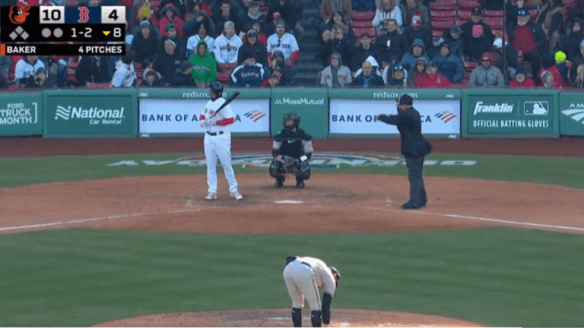
Rafael Devers (Red Sox), the Show’s first ever to strike out without a pitch thrown, taken, or swung on and missed—on a pitch clock violation.

So. After encyclopædic volumes worth were said and done, the average shortening of games on Opening Day was a whopping . . . 26 minutes. The new rules, don’t you know?

I may be on board with the pitch clock, but I’m not on board with cheers about the shortening when a fourth grade math student can tell you they’d have been shortened more by eliminating half the broadcast commercials. That’s accounting for the spots before each half inning and during any inning jam in which a pitching change was made.

But it didn’t stop the Blue Jays and the Cardinals needing three hours and 38 minutes to finish with a 10-9 Blue Jays win, paced by George Springer’s five hits for the Jays and opened with Cardinals pitcher Adam Wainwright warbling “The Star Spangled Banner” to just about everyone’s surprise in Busch Stadium.

Two players made history under the new rules. Rafael Devers (third baseman, Red Sox) became the first in Show to strike out on a pitch clock violation. Marcus Stroman (pitcher, Cubs) became the first in Show to be assessed a ball on a clock violation.

Leading off the eighth, Devers was rung up on 2-2 with Bryan Baker on the mound for the Orioles and the Red Sox in a 10-4 hole. “This doesn’t make sense to me,” said an announcer, “because he’d already looked at the pitcher. The pitcher’s not even ready to throw.”

Devers had checked back into the box with a few seconds remaining after stepping out to knock dirt out of his cleats. Even as Baker wasn’t quite ready to throw, plate umpire Lance Barksdale bagged him. It didn’t stop the Red Sox from posting a three-spot in the inning. “There’s no excuse,” said manager Alex Cora. “They know the rules.”

Knowing them and being able to maneuver within them for the first time in regular-season play are not exactly common. But it’s entirely possible that Devers not being dinged might have made a small difference. Led by Adley Rutschmann becoming the first catcher in Show history to have a five-hit Opening Day, the Orioles out-lasted the Red Sox, 10-9, after almost handing the game all the way back to the Olde Towne Team in the bottom of the ninth.

Remember: I’m also on board with turning the damn clock off in the eighth and later. Devers may yet prove evidence on behalf of that.

Stroman got his while checking Brewers runner Brice Turang at second with Christian Yelich at the plate in the third. The pitch clock expired about a hair before Stroman turned to pitch from the stretch. “It’s tough, this pitch clock,” Stroman told reporters postgame. “It’s a big adjustment. I don’t think people really realize it. It just adds a whole other layer of thinking.”

Yelich finally worked a walk out. The Brewers didn’t score then or the rest of the game. The Cubs won it, 4-0.

Jeff McNeil became the first Met to be hung with a pitch clock violation strike—for waiting for Pete Alonso to get back to first on a foul ball. Oops. Manager Buck Showalter was unamused that the clock began to tick before Alonso returned to the pad. McNeil remained mad just long enough to nail a base hit.

That was in an Opening Day game the Mets won, 5-3, beating the Marlins, but they might have had one more, at least, if not for someone whacking Brandon Nimmo with the stupid stick in the third. With first and third, Nimmo dropped a bunt—and hit into an inning-ending double play despite the run scoring. Thus the risk the wasted out, which is exactly what the sac bunt is, carries against defenders alert enough.

The good news there was Max Scherzer holding on despite all three Miami runs charged to his account and the Mets making simple enough work against a still not quite ready Sandy Alcantara. The bad was Justin Verlander having to miss a week while dealing with a muscle strain in his upper back near his throwing shoulder.

Perhaps it was miraculous that Aaron Judge picked up right where he left off from last season and hit one out in his first plate appearance against the Giants. That launched a 5-0 Yankee win that saw both starting pitchers, Gerrit Cole and Logan Webb, nail eleven and twelve strikeouts, respectively—the first opposing Opening Day starters to do that since Max the Knife (then a National, with twelve) and Jacob deGrom (then a Met, with ten) in 2019.

Speaking of deGrom, alas, the good news was, the Rangers got him a small truckload of runs. The bad news was that deGrom, still not all the way ready after a spring training disrupted by a side strain, also surrendered five before the Rangers unloaded for a nine-run fourth and held on to win, 11-7. They became the first Opening Day team to have a nine run-or-better inning since the Padres dropped 11 in the sixth against the Mets in the 1997 opener.

And Shohei still gonna Shohei. The Angels’ two-way unicorn struck ten Athletics out before his day’s work was finished. He even ripped a 110 mph base hit and threw a 101 mph pitch before he was done. And what did it prove worth in the end? Squatski. The Angels lost, 2-1. It put Ohtani onto a dubious record book page: the only pitcher to punch ten out and surrender no runs in his team’s Opening Day loss.

Meanwhile, the Rockies are still gonna Rockie, alas, even when they win. With a pair of home runs by first baseman C.J. Cron leading the way, the Rockies battered the Padres for seventeen hits—despite striking out at the plate seventeen times against four Padres pitchers. Making them the first team since 1900 to deliver that dubious 1-2 punch in a nine-inning game. Ever.

I’ve said it before, but I’ll say it once more. This is baseball. Where anything can happen—and usually does. With or without rule changes running the bases from the sublime to the ridiculous and back to the absurd. And wish though Commissioner ADD and his minions might, 26 minutes isn’t exactly that big a difference from even last year’s average.

Emphasis on “classic”

Shohei Ohtani

Baseball’s great unicorn struck baseball’s greatest all-around position player out to end the WBC in Japan’s favour. Who says baseball’s gods don’t know how to script classics anymore?

Well, now. Japan walked it off against Mexico, earning the chance to face the United States in Tuesday’s World Baseball Classic final, and those who hadn’t been driven away by the harrumphing over Edwin Diáz’s season-ending injury after closing out a win by Puerto Rico last week got the most dreamy of dream matches.

Teammates on the Los Angeles Angels, Mike Trout and Shohei Ohtani squared off in the WBC final. It was Japan’s third trip to that final dance and first since 2009. It was Trout’s first appearance in any kind of championship or championship-aiming game since his third full major league season.

The game’s greatest all-around position player, still, against its unicorn of a virtuoso two-way player. Anyone who says this was what Trout and Ohtani really signed up for when Ohtani joined the Angels and Trout extended with them is fooling him or herself. But it slammed an exclamation point down upon this WBC in ways that would have been ridiculed as corny in a Hollywood treatment.

There was Trout, with Mets jack-of-most-trades Jeff McNeil aboard on a leadoff walk and two out—thanks to Mookie Betts dialing Area Code 4-6-3—for the United States. There was Ohtani on the mound for Japan. There was Cardinals first baseman Paul Goldschmidt on deck. And there was Ohtani throwing a slider just away from Trout’s swing. Strike three. 3-2, Japan. Third WBC title for Japan in three trips to the penultimate game.

“I was hoping,” Goldschmidt said postgame, “when Jeff got on base, that if Mike hit a two-run homer to win the game, that everyone was going to go bananas, that the world was going to end.”

“Great pitch,” said Cardinals third baseman Nolan Arenado. “If Mike Trout’s not hitting it, I don’t think anybody else is.”

“It sucks it didn’t go the way I wanted it to,” Trout said postgame. Then, he tipped his fins to his Angels teammate in Japan’s silks. “He won Round One.” Suggesting there might be yet one more showdown between the pair in another WBC a few years hence. Might. Who knows? Both Angel teammates say they’ll be back for the next one.

Teammates and friends in MLB, Trout and Ohtani (and everyone else partaking) knew this one had the potential of immortality. After Ohtani ignited the rally that pushed Japan past Mexico at the eleventh hour, with a leadoff double, he let the world know just how aware of it he really was.

“Obviously, it’s a big accomplishment to get to the championship series,” he told reporters, “but there’s a huge difference between getting first and second. I’m going to do all I can to get to first place.” He made good on it.

Dream makers loved nothing more than to see Ohtani on the mound with Trout at the plate. Ohtani said he’d be available for bullpen duty in the title game. If brought in and Trout was on his inning’s menu, there wouldn’t really be words to describe the moment’s electricity.

That wouldn’t stop assorted observers and pundits from hunting those words. They wouldn’t all be hosannas, either. From the moment Diáz went down with a patellar tendon tear that put paid to his 2023 season for the Mets while celebrating a Puerto Rico win, the volume of screaming bloody murder has equaled that of reminding one and all that freak injuries—which is precisely what Diáz’s was—can happen any old time.

In spring training. En route a spring training camp. In your own home or driveway. At the supermarket or the mall. Even playing with your children at home or on the beach or in a park. Celebrating after MLB wins regular, postseason, or postseason-sending alike. Or, suffering a non-contact anterior cruciate ligament tear just prior to the WBC’s beginning in the first place—as happened to Dodgers middle infielder Gavin Lux to put paid to his 2023 season, too.

My, but the lack of bleating about canceling spring training because of its dangers was enough to leave you with a bad case of tinnitus, wasn’t it? But the Mets’ top relief pitcher incurring an absolute freak injury that can happen—and has happened—any old time during an MLB season or postseason caused what seemed like half the world demanding the WBC’s demise, post haste.

Trout probably spoke for his teammates, the players on all competing WBC teams, and the fans watching those games in the ballparks and on television where possible, when he said, “It was probably the funnest ten days I’ve ever had. I can’t really express what’s different about it. You can just feel it in your veins. It’s a special, special feeling.”

Baseball was fun to play again. The WBC was fun to watch. Three trainloads of MLB players entered the WBC representing their home countries or countries to which their families have powerful enough ties. They had the time of their lives playing games that meant something to them personally. In a tournament that looked more sensibly arrayed than MLB’s competition-diluting postseason array. Jumpstarting renewed interest in baseball in the countries whom they represented.

Maybe Mets pitcher Max Scherzer’s onto something when he says move the WBC out of springtime and into the All-Star break’s time frame.

Maybe with the All-Star Game meaningless, after all, what with the infestation and continuing pestilence of regular-season interleague play, it ought to be dumped once and for all and the WBC should take center stage in mid-July.

Maybe MLB’s lords should think twice before signing off on any more Rob Manfred rule tinkerings, time-of-game twistings, and postseason maneuverings. Then, maybe they should tell him to either think of remaking MLB’s postseason as truly meaningful as the WBC proved or find another line of work. (While they’re at it, they can tell him they’ve had it with broadcast blackouts, just the way fans have had it. It hurts the lords, too.)

Maybe MLB’s lords should just think, period. Or would that be asking them to behave beyond their competence?