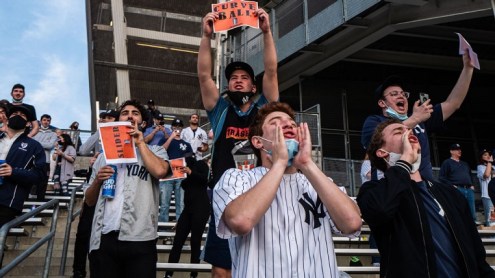
Two champion Series finishers move on

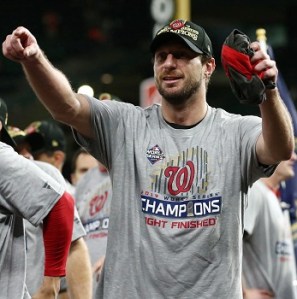
Max Scherzer

Max the Knife celebrates the World Series triumph he helped author with his on-fumes Game Seven start. Can he help the Dodgers go back to the Series?

The author of maybe the single most uplifting game in Nationals history is a Nat no more. The fellow with one blue and one brown eye who forced his way past a neck issue to keep the Nationals in line to win their first World Series has gone west.

That was hours after the Cubs finally said goodbye to the man who snapped into his mitt the final out of their first World Series win since the premieres of cellophane, the Geiger counter, and the Model T Ford.

Trade deadlines don’t often feature two or more signatures of two off-the-charts World Series champions changing addresses and wardrobes. When they’re men identified that tightly with their teams, even those with no rooting skin in their games can’t help thinking that the world just got knocked more out of order than it seemed going in.

This year’s Nats don’t have a staggering rise from the dead in them just yet, if at all. This year’s Cubs were bent on selling while the selling was good, with their National League Central chances this year anything but. “Go Cubs Go,” that rollicking anthem of the 2016 conquerors, now has another meaning.

Max Scherzer goes west for a better chance at a postseason return with the Dodgers. That was just moments, seemingly, after the entire world thought the splash-happy Padres had him all but loaded on the plane west. Ouch.

Anthony Rizzo goes east in a Yankee hope that a couple of heretofore missing lefthanded bats—they’d landed all-or-nothing portside slugger Joey Gallo from the Rangers just prior—might turn their season from somewhat lost to yet another shot at the Promised Land.

The Nats hope the package of prospects Scherzer and shortstop Trea Turner brought back from Los Angeles mean this season proves a hiccup on their way back to the races to come. The Cubs hope the pair Rizzo brought back from the Bronx means likewise, especially depending on what they can bring back in any deal for Rizzo’s partner in 2016 World Series crime, third baseman Kris Bryant.

But ending eras is never pleasant. And these two deals ended a pair of eras that’ll live as long as Washington and Chicago live. The Rizz speared Bryant’s herky-jerky on-the-move throw over to secure the Cubs’ World Series winner. Max the Knife’s empty-tank performance of sheer will kept the Nats alive enough to pull just enough lingering rabbits out of their hats to nail Game Seven in 2019.

Chicago and Washington won’t forget as long as those cities and those men live. The feeling is very mutual with the players involved.

“This city,” Rizzo said when the deal to the Yankees was done, “will be ingrained in my heart for the rest of my life.” Told he was as transformational a figure in Wrigley Field as anyone who ever wore a Cub uniform, Rizzo accepted the idea with no small pride. “That’s what matters most—leaving this place better than when I found it. I can say the mission was accomplished.”

Scherzer still wasn’t sure whether he’d still be a Nat after he pitched Thursday and threw three-hit, one-run ball at the Phillies, in a start that was as much a showcase for his renewed health (he’d missed a start with a triceps strain a few days earlier) as for the trading floor. But he wanted to think about what Washington meant to him from the moment he’d signed that mammoth seven-year deal due to expire after this season.
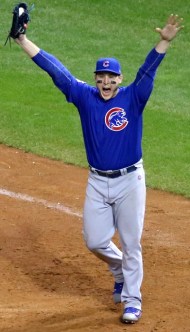
Anthony Rizzo

Nobody beats The Rizz: Clutching the final out of the Cubs’ 2016 World Series conquest.

First, there were the purely baseball considerations. “I signed a seven-year deal here and we won a World Series. That’s the first thing I said when I signed, that I was here to win. And we won. We won a World Series,” he said. “That’s a lifelong dream come true and something I’ll always be proud of with these guys here, to be part of a championship team, looking forward to reunions and stuff like that.”

Then, there came the familial and community considerations. Scherzer arrived childless in Washington with his college-sweetheart wife, Erica. They’re going to Los Angeles with two of Scherzer’s three Cy Young Awards and three daughters.

“I’ve watched my girls grow up here,” Max the Knife said. “Living in Virginia in the DMV area, I’ve really gotten used to it, all the politics that are going around. Being in the nation’s capital has been kind of fun as well, driving by the monuments every day . . . What can you say about the fans? That championship will always mean something to all of us and we’ll always have that flag.”

Parting with uber prospects Keibert Ruiz (catcher), Josiah gray (righthanded pitcher), Gerardo Carillo (righthanded pitcher), and Donovan Casey (outfielder) made sense only if the Dodgers were going to bring in something well above average. They brought in the best pitcher and the best position player—a still-young shortstop with a live bat—on the trading floor.

If the Dodgers want to close the brief distance between themselves and the uber-surprising Giants in this year’s National League West, they couldn’t have done better if they’d gone to the lab and mixed the right ingredients in the test tubes and beakers.

The Nats aren’t exactly leaving themselves helpless. They have have pushed the plunger on this year, but with Juan Soto around whom to remodel they’re looking at 2022 and beyond. Particularly with a returning Stephen Strasburg and who knows what off-season deals or signings to come.

Mostly, Scherzer relieves the pressures on the Dodger starting rotation, what with Dustin May lost for the season recovering from Tommy John surgery and Trevor Bauer persona non grata when all is said and done, in the wake of a police investigation into a couple of turns of rough sex crossing the line from consensual to downright unwanted sexual assault.

Whether he proves a rental or whether the Dodgers want to keep him for the rest of his baseball life remains to be seen. Don’t bet against the Dodgers deciding to make the latter happen.

The Yankees should be so lucky with Rizzo and Gallo. Yes, they sent out a lineup full of raw power until those deals, but that lineup lacked consistency and lefthanded hitting, the long-traditional fuel of that long-vaunted, long-legendary Yankee power.

Rizzo is the far more balanced hitter between the two newcomers as well as a multiple Gold Glover at third base. Gallo is so all-or-nothing despite his ability to work walks that he actually lets you imagine Mario Mendoza as a power hitter, but he is a solid defensive outfielder with range and arm enough to maybe make the Yankees forget about Brett Gardner at long enough last. Maybe.

So where was the pitching help the Yankees really needed? Why weren’t they all-in yet on someone like Scherzer? Despite his expressed preference for going west, the Yankees have been nothing if not able to persuade such determined men otherwise in the past.

Why not all-in on resurgent and available Cubs closer Craig Kimbrel? Especially with other teams trailing him including now the Rays, rumoured to be pondering a package of Kimbrel and Bryant coming aboard? Or resurgent and available reliever Daniel Hudson, the 2019 World Series finisher whom the Nats dealt to Seattle before the trading floor really began bristling with prize packages?

Or Jose Berrios, the formidable Twins starter whom the Blue Jays have snapped up for a pair of prospects and who’ll have him through the end of 2022 at minimum pending their ability to sign him longer-term from there?

The Yankees are still in the race, technically. The problem is, they’re three games plus behind the Athletics in the American League wild card picture and eight and a half games behind the Red Sox in the American League East.

And while Dodgers mastermind Andrew Friedman may be taking bows enough for Max the Knife and Trea Chic, Yankee general manager Brian Cashman—whose questionable at minimum construction of the current Yankee roster should take the heat Yankee fans heap upon hapless manager Aaron Boone—may yet have some very serious splainin’ to do.
Can’t we teach the thugs a real lesson?

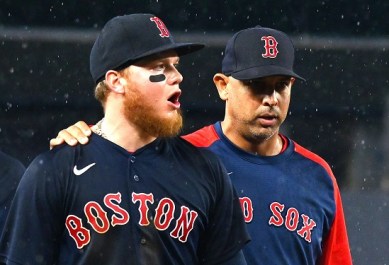
Alex Verdugo, Alex Cora

Alex Verdugo’s (left) generosity turned into a particularly nasty piece of Yankee fan foolishness.

If you want to know why baseball players come to see baseball fans with contempt, as some always have and always will, you can point to the Yankee Stadium doings Saturday night. Even knowing the eternal rivalry between the Empire Emeritus and the Olde Towne Team, this was above and beyond the call of insanity.

All Red Sox left fielder Alex Verdugo did before the bottom of the sixth started was see fit to toss a practise ball to a young Red Sox fan in the bleachers. The ball didn’t quite reach that young fan’s hands, but it did reach a Yankee fan to whom Red Sox generosity might just as well have been a home invasion leaving none alive.

That Yankee fan threw Verdugo’s should-have-been gift ball back to the field and hit Verdugo squarely in the back. Verdugo was anything but amused. He turned toward the bleachers hollering to the fans. Highly-touted Red Sox prospect Jarren Duran hustled over to pull Verdugo away. Umpires, stadium security, and Red Sox coaches sought only to find the miscreant.

Miscreant found. And ejected from the ballpark posthaste. Eliciting a few cheers and a few more boos among the fans in that section. Red Sox manager Alex Cora wasted no time pulling his team off the field after coach Tom Goodwin urged still-steaming Verdugo out of the outfield and toward the Red Sox dugout.

Cora even had to debate with the umpires over letting Verdugo have a few minutes to compose himself in the dugout. It shouldn’t even have been a debate point. This time, it was only Verdugo’s back. It could have been his head.

“I know my left fielder, I know Alex,” Cora said post-game. “He needed time to breathe and to get his thoughts.” Tell that to the umpires, as Cora ultimately did.

It seemed like nobody was listening to me. Like, imagine getting thrown at with an object in a sport and you’ve got to be out there right away because we have to continue to play the game — that part I didn’t agree. But Alex was OK with it. But you never know. What if he jumps the fence? What if he goes out there and attacks somebody? Whatever. That’s what I was telling them, just give us a chance to collect our thoughts, breathe a little bit and we’ll go out and play the game. That was the whole thing.

Verdugo knows the score only too well. Talk all the trash you want. Hammer all the family members you can think of. Chant your little heads off. Even holler “[Fornicate!] Verdugo” until your throat resembles a pair of sand blocks rubbing together. Throw a ball or other debris? Not so fast.

[T]he moment somebody throws — as players, we’re throwing balls in the stands to try to give people souvenirs, try to make little kids’ days and things like that. Just to hear people saying, ‘Throw it back’ and then someone actually throws it back and it felt like it was targeted towards me, it doesn’t sit right with me.

Throwing enemy home run balls back is a tradition almost as old as the live ball in some ballparks. Wrigley Field’s storied Bleacher Creatures have made it so much so that if you happen to watch a Cubs home game without a Creature throwing back an enemy home run ball (unless, of course, it’s a particular milestone mash with dollar value attached) it’s one step short of breaking-news bulletin time.

But no such Creature has ever been known to try separating an enemy outfielder from his assorted anatomy or his brains throwing a ball back. And not even the worst, most bombed out of his or her trees fan was ever been known (unless it just hasn’t been reported, until Saturday) to throw back a ball an opposing player tried to give a visiting fan as a souvenir.

Things weren’t hard enough between the Red Sox and the Yankees with the scheduled series opener last Thursday postponed after several Yankees—including right field star Aaron Judge—turned up COVID-positive? Things weren’t testy enough already Saturday, with a near-hour rain delay before the game and continuing rain during it?

Red Sox Nation should know that they now have an ally in Yankee manager Aaron Boone, who made no secret of his hope that the bleacher idiot ended up behind bars. Cora should also know that Boone would have acted the same as he did if the game had been in Fenway Park and a particularly brain-damaged Red Sox fan did likewise to one of his players.

It’s awful, embarrassing, unacceptable. My understanding is they did catch the guy. Hopefully he’s in jail right now. That’s just a bad situation. If I was Alex Cora, I would have done the same thing as far as going out and getting his guys off the field. There’s zero place for that in this great game, and in this great rivalry. Players should never feel like they have to worry about anything like that. I already reached out to Alex Cora, just to apologize, and to Alex Verdugo that, you know, that’s just a terrible, bad, sad situation. And sorry about that.

This during a season in which Reds first baseman Joey Votto—after getting ejected early in a game over an argument with an umpire, then learning a little girl named Abigail was heartbroken that she wouldn’t get to see her favourite Red play for just about all game long—reached out and sent Abigail a ball he signed, “I’m sorry I didn’t play the entire game. Joey Votto.”

Saturday’s game was supposed to be about Duran’s major league debut. (He went 1-for-2 with a base hit and a run scored, both in the top of the second.) And, about a pitching duel between Nathan Eovaldi (five innings, one earned run) and Gerrit Cole (six innings, one earned run, eleven punchouts).

The nasty weather ended the game after six in a 3-1 Yankee win. (Back-to-back solo bombs from Gary Sanchez and Gleyber Torres in the bottom of the sixth took care of that, on Red Sox reliever Hirokazu Sawamura’s dollar.) The nasty weather in the left field bleachers became the story of the game, unfortunately.

The Yankees travel to Boston for a set in Fenway Park starting this coming Thursday. Red Sox Nation, beware: don’t even think about trying any similar stupidity if any Yankee decides to toss a practise ball to a visiting Yankee fan before an inning begins.

Maybe the thing for baseball government and the players union to consider together is mandating a forfeit to the opposing team, when a team’s own fans get as thuggish as the thug who thought Verdugo’s reward for generosity to a visiting young fan should have been a ball attack upon the left fielder’s back.

Once upon a sad October 1971 time, umpires awarded the Yankees a forfeit after heartsick Washington Senators fans—with Second Nats reliever Joe Grzenda one out from saving what should have been a win, and the Senators playing their final game before moving to Texas—stormed the RFK Stadium field. Grzenda never got to throw a single pitch to Yankee second baseman Horace Clarke.

Those fans didn’t blame the Yankees or try to mangle, bangle, or dismember anything in a Yankee uniform. They’d have preferred decapitating duplicitous Senators owner Bob Short. (Banners with his initials proliferated in the stands.) Absent that, they took it out on RFK Stadium.

If you can forfeit to the visitors over breaking an entire ballpark, you ought to be able to forfeit to the visitors when a home fan decides a baseball offered a visiting fan should be the instrument for spontaneous back surgery upon the visiting player who offered it. Maybe (big maybe) that’ll teach the jackasses a few lessons.

Be careful what you wish for, Yankee fans

Bill Gallo's "Baron von Steingrabber"

There were reasons why the late great New York Daily News cartoonist Bill Gallo portrayed George Steinbrenner as a Prussian autocrat. Today’s Yankee fan demanding “What would George do?” seems almost clueless. Almost.

Steven Goldman is a Baseball Prospectus writer whose Forging Genius: The Making of Casey Stengel should be required reading for anyone clinging to the myth that anyone short of a trained seal could have just wandered in and managed the 1949-60 Yankees to greatness. (Ten pennants, seven World Series rings.)

Goldman also thinks Yankee fans today need to get over the “What would George have done?” syndrome like five minutes ago.

Yes, the Yankees are 5-7 in their last twelve games and dropped two out of three to the Mets in holiday weekend interplay. Yes, they often seem like fish flopping on the dock or the boat deck, after being reeled in following an arduous battle.

And, yes, principal owner Hal Steinbrenner isn’t exactly his father’s son. Not if you consider a hair trigger pro-active leadership. Prince Hal would never have dismissed a promising but struggling prospect as the horse that spit the bit. It’s almost (underline that) to wonder how Prince Hal was a Steinbrenner in the first place.

On Sunday, the Mets nuked Yankee reliever Aroldis Chapman in the seventh of game one of a doubleheader made necessary by a Friday night rainout. Handed a 5-4 lead to protect, Chapman threw a 1-2 pitch to Pete Alonso that got sent over the left center field fence to tie. Oops.

He hit Michael Conforto with an 0-2 pitch, he walked Jeff McNeil on a full count, then watched his relief Lucas Luetge surrender a bases-loading single (Kevin Pillar), get the first Met out of the inning (James McCann, swinging strikeout), but then . . . two-run double (pinch hitter Jose Peraza), two-run single (Brandon Nimmo), RBI single (Francisco Lindor), before Luetge finally escaped the fire with Mets reliever Seth Lugo dispatching the Yankees too quietly in the bottom to end it.

Any team doing that to the Yankees that late in the game would have had The Boss going rogue. The Mets doing it would have had him going so far beyond that “rogue” would have seemed a relief.

“[B]oth social media and the Yankees broadcasters wondered how ‘George’ would have reacted had he been alive to see the resultant defeat. He would have reacted poorly,” Goldman writes.

During his lifetime, which ended 11 years ago, long after he had subsided into senescence, [The Boss] had placed a disproportionate emphasis on beating the Mets during meetings that, prior to the advent of interleague play in 1997, were restricted to meaningless exhibition games.

“He goes crazy if we lose to the Mets, even if it’s spring training,” said five-time Steinbrenner manager Billy Martin in his 1980 memoir Number 1. “He feels we’re going to lose fans to them if they beat us. It’s ridiculous, and it makes the players laugh at him.” Sometimes their reaction was a bit harsher than laughter. “The more we lose, the more he’ll fly in here,” third baseman Graig Nettles said in the last 1970s, “and the more he flies in, the better chance there’ll be a plane crash.”

George Steinbrenner was an awful lot more than just the man who threw out the first manager of the year, before his 1990 banishment over engaging a street hustler to help him soil the reputation of his Hall of Fame right fielder Dave Winfield. When things got a little dicey before then, The Boss left you surprised only that he hadn’t traded his entire organisation for that of the Mariners.

“[W]e know what George would have done were he alive today,” Goldman writes:

He would have flailed spasmodically, he would have made a lot of people unhappy to be Yankees employees, and he would have ordered Jasson Dominquez traded to the Tigers for Matthew Boyd, had Gleyber Torres and Anthony Volpe sent to the Rangers for Kyle Gibson and David Dahl, and taken whatever was left over and given it to the Royals for Mike Minor. And nothing would have changed except that in the short term the team’s record might have gotten even worse and in the longer term it definitely would have gotten worse. Anyone old enough to remember Steinbrenner’s immortal words of July 13, 1987 can tell you how that worked, words that should be emblazoned on Steinbrenner’s grave and the monument to him at Yankee Stadium in burning letters 15 stories high: “Lou, I just won you the pennant. I got you Steve Trout.”

Maybe today’s Yankee fan is typically someone who wasn’t alive when the depth of George Steinbrenner’s act hit depths possibly unseen among baseball owners—whose penchant for hitting depths is only slightly younger than the nation that loves the game to its soul—since the day William B. Cox was forced to sell the Phillies when manager Bucky Harris discovered Cox was betting on his own team.

“Here is a pretty judicial pickle,” wrote George F. Will, on the threshold of Steinbrenner’s suspension, in Newsweek. (The essay was called, “A One-Man Error Machine.”) “Imagine trying to assemble an impartial jury of New Yorkers to hear Steinbrenner’s case. ‘Tell the court, Mr. Prospective Juror, do you have any strong opinions about the owner who masterminded the trade of Fred McGriff from the Yankees to the Blue Jays in exchange for a couple of no-names? Stop snarling, Prospective Juror’.”

Maybe today’s Yankee fan forgets, if he or she really knew, what happened the night the news broke of Steinbrenner’s suspension over l’affaire Winfield: The Yankees hosted the Tigers. Yankee Stadium fans clung to portable radios. The news broke as the Tigers came up to bat. Cheering began at one end of the ballpark and swelled to cover the entire stands. The Tigers had no idea why they were coming up to hit to a loud standing ovation.

Goldman knows the what-would-George-have-done faction among Yankee fans (and broadcasters) either forget or ignore that Steinbrenner’s wholly-earned suspension did what more people than you might think thought would have been impossible during the 1980s. It kept The Boss from continuing his King of Hearts act (Don’t be nervous or I’ll have you executed on the spot!) and enabled general manager Gene Michael to rebuild the Yankees back to greatness.

Michael’s salient quality was the diametric opposite of Steinbrenner’s. Michael knew what he was doing. Michael would never have thought he could make Tommy John or Hall of Famer Phil Niekro into young sprouts again. He never would have traded McGriff. He never would have tried to make Ozzie Smith out of Bobby Meacham. He never would have had twelve managers and seventeen pitching coaches in two decades.

The what-would-George-have-done contingent would have unloaded Derek Jeter, Mariano Rivera, Andy Pettitte, Jorge Posada, and Bernie Williams at the drop of a four-game losing streak. To err is human; to forgive is not Yankee policy. Goldman knows that, too.

To ask what he would have done now or to wish that he were still around to do it is a fundamentally masochistic wish that suggests just how many toxic fathers have damaged their kids along with passing on their baseball fandom. How else to you explain this perverse prayer for an abusive, incompetent papa who, because we grew up to the sounds of his yelling and breaking the furniture, left us longing to experience the same chaos again? It’s the same wish that brought us Donald Trump (he and George were patrons of “Bully/Coward/Victim” Roy Cohn). Please, dear dead daddy, claw your way out of whatever Hell you reside in and show us your impotent love by saying something crude about a player who’s trying his best and then trading a top prospect for Merrill Kelly. You so crippled us that this is the only kind of love we can understand.

Who was Merrill Kelly? Don’t ask. Just thank God and His servant Stengel that Michael’s cooler head prevailed and The Mariano wasn’t traded for Felix Fermin—by a hair.

Did analytics turn this year’s Yankees into an inconsistent mess? Not quite, Goldman says. Analytics, sabermetrics, whatever you wish to call it, is nothing more and nothing less than objective information. “Facts themselves are not slanted; it’s what decision-makers do with them that leads to good or bad outcomes,” he writes.

If analytics exists to supply team leadership with a set of facts, then the opposite of being “weighted 90-10” towards analytics would mean a 90-10 bias in favor of—what? Just going with your gut regardless of what the facts might direct you to do? Well, that’s what George Steinbrenner did. If that’s what Yankees fans are asking for then they deserve what they’re going to get—a whole lotta nothing, just as was the case from 1979 through 1995. Better to shout, “Down beast! Down!” and drive the creature back to the place from whence it came.

“Some kids want to join the circus when they grow up,” said Graig Nettles, who often fenced with The Boss himself over trivialities great, small, and surreal. “Others want to be big league baseball players. I feel lucky. When I came to the Yankees, I got to do both.”

There was no better epitaph for the depths of The Boss’s reign than the late-80s Banner Day winner dressed as a monk, holding a scythe from which hung the sign, “Forgive him, Father, for he knows not what he does.” (The poor fellow got his prize—and was ejected from the ballpark on The Boss’s orders.)

Letting the kids play is one thing. Yankee fans demanding their team be allowed to party like it’s 1980-90 all over again are something else entirely. Forgive them, Father, for they know not what they really want.

On self-appointed Yankee security censors

Yankee Stadium

Yankee fans let the Astros have it Tuesday night. Did stadium security eject some protesting fans under false pretenses?

The worst kept secret in baseball opening this week was Yankee fans liable to let the visiting Astros have it, but good, when they visited Yankee Stadium for the first time since the 2019 American League Championship Series. The second-worst thing about that worst-kept secret was Yankee Stadium censorship.

The first-worst thing was this not-so-little red flag raised in the account by Sports Illustrated writer Stephanie Apstein, about a fan costumed like Oscar the Grouch in a trash can, and who only thought he’d gotten assurance from stadium personnel that there’d be no issue with him wearing it at Tuesday’s game:

When [David Taub] arrived wearing the costume and carrying a sign reading YOU AIN’T STEALING THIS COSTUME TRASHTROS, he drew laughs and cameras. Unfortunately, he also drew attention from security. “Our policy changed,” he said the guard told him. He said the guard added that the Astros had complained to MLB about fans in other cities, and MLB had told the Yankees to tighten their rules. (Officials from the Astros and the commissioner’s office said they were unaware of any such complaints or directives.)

Censorship at Yankee Stadium isn’t exactly virgin territory. Ask any frustrated Yankee fan present in the 1980s who had an anti-Boss placard or sheet banner confiscated under George Steinbrenner’s orders. Or, such frustrated Yankee fans who had their placards and banners confiscated before they were ejected from the stadium themselves.

Ask especially the Yankee fan who won a Banner Day contest by wearing the garb of a monk and carrying a Grim Reaper’s scepter from the scythe of which hung a large placard pleading, “Forgive him, Father, for he knows not what he does.”

If Yankee Stadium personnel purging David Taub for a non-destructive demonstration against Astrogate and its most questionable net result (no players disciplined in return for spilling about the scheme) is bad enough, what would you suggest we call the possibility that stadium security lied through their teeth while censoring him and other fans?

“I hope the Yankees fans smell blood tonight,” Taub told a reporter. “I hope we don’t do anything irresponsible, but I hope we give our shares of boos and let them hear it. We definitely got robbed of a World Series. There’s no question about that.”

Other fans brought inflatable trash cans to the park, similar to the one that fell onto the right field warning track at Angel Stadium when the Astros played a set there last month. Two of them were confiscated by stadium security, too.

Apparently, Astros manager Dusty Baker is a little more sanguine and a lot less censorious about the reception he knows his team can expect when they’re on the road this year. “It sounded like a packed house tonight even though it wasn’t,” he told reporters after the Yankees trashed the Astros, 7-3. “We kind of expected that reception. We’ll probably get more of that tomorrow and the next day.”

“I wouldn’t want to be on the other side of that,” said Yankee outfielder Giancarlo Stanton of the fans’ night-long booing, catcalling, and occasional swearing (F– Altuve! F–Altuve!) after the game. “They brought some heavy.” (And, a lot of funny, including a placard depicting Altuve the Grouch in a somewhat battered metal trash can.)

Stadium security brought heavier. This was a look no better than that ancient Banner Day ejection.

Last year’s pan-damn-ically inspired, cutout-occupied stands kept legions of fans from letting the Astros know just how they felt about the Astro Intelligence Agency’s singular take on sign stealing. Unless they bought cutouts showing imagery against it, there was little they could do other than whoop, holler, and catcall if they saw the Astro team bus pulling up to the ballpark.

But fans are back at the ballparks now to whatever limited extent continuing safety protocols allow. Unless their racket includes true violence, or throwing debris on the field (as a few reckless Angel fans did throwing a real, not inflatable trash can onto the right field warning track), or attacking Astro players or personnel physically, Yankee Stadium’s security was way out of line.

Whether they like it or not, the right to protest comes with the purchase of a ticket. Fans can boo truly bad plays, truly bad plate appearances, truly bad umpiring to their hearts’ content. They can even boo visiting teams verified for all time as barely-apologetic illegal  high-tech cheaters.

Even if their own team got caught trying a little high-tech hijacking once upon a time? Not so fast. The Yankees got caught only with someone in the dugout using an AppleWatch to steal signs. They weren’t accused of or proven to have either a) altered an existing camera off its mandatory eight-second transmission delay, or b) installed another, illegal, real-time camera to steal signs.

Realistically, the Yankee fans made one mistake that everyone else continues to make. There are only five actual Astrogate team members left on this year’s edition: Altuve, Alex Bregman, Carlos Correa, Yuli Gurriel, and Lance McCullers. Chanting “Mother Tucker!” at hapless outfielder Kyle Tucker isn’t fair to a guy who wasn’t even there to be part of the 2017-18 can can.

Unfortunately, if it isn’t fair to hold the entire 2021 Astro roster responsible for what the 2017-18 edition did, it’s also unlikely that the Astros will be done hearing the protests until the last man standing from the Astrogate team doesn’t wear their uniform any longer.

Not every security force in every ballpark practises fan censorship at all. Never mind claiming the visiting team complained to baseball’s government and baseball’s government told the home team “to tighten their rules.” I suspect Apstein meant that to mean, “to quash the anti-Astrogate protests.”

The Astros have had enough bad looks since Astrogate’s exposure and official consequences. Would they really be stupid enough to compel baseball government to strong-arm road teams into censoring road fans bent on letting them have it over a script they and nobody else wrote in the first place?

It was one thing when the worst Yankee fans rained nasty upon Astros pitcher Zack Greinke during the 2019 ALCS—based on Greinke’s very well known battle with clinical depression. Those fans were ejected properly for assaulting a human being verbally over an illness for which he takes prescribed medication and through which he works and lives with courage his assailants probably lacked.

Ejecting fans protesting a team’s well-exposed and (in more ways than one) institutionalised cheating? That demands a formal MLB investigation. Post haste. No waiting. The Yankees themselves should have no issue with cooperating. If they do, they should be sanctioned heavily.

The House That Ruthless Built isn’t private property. The ballpark’s official ownership is listed as the New York Industrial Development Agency, a subsidiary of the city’s Economic Development Corporation whose board is appointed by the city’s mayor. Government or government-overseen agencies at any level, from the village up to the nation, have no business trucking with or allowing censorship.

If Yankee Stadium security people spoke out of line while confiscating Yankee fans’ properties and/or ejecting them from the stadium, because they took it upon themselves to neutralise or silence Astrogate protests, they need to be held accountable. Strictly.

Sixty springs later

Roger Maris, driving Babe Ruth to one side, 1 October 1961.

Met fans since the day they were born, among whom you’ll find me, may forget they had Roger Maris to thank for one-third of the Mets’ original broadcast team. When Maris teed off against future Met pitcher Jack Fisher to hit his 60th home run in 1961, nineteen thousand fans in Yankee Stadium were joined by one grandmotherly society matron listening at home over her radio.

Bob Murphy was behind the Orioles microphone to call the blast. Hearing Murphy call Maris tying ruthsrecord (yes, that’s really how they said it in 1961), Joan Payson invited him to join Lindsey Nelson and Hall of Famer Ralph Kiner as the broadcast team for her embryonic Mets. Bless his soul, Maris may or may not have had a clue. It was probably the least important thought on his mind as that season wound to its finish.

Exactly sixty years ago, there was Maris in spring training, his first as the defending American League Most Valuable Player and his second as a Yankee. It may have been the simplest time of the season to come for the plainspoken right fielder who suffered few fools gladly and broke a revered sports record to earn the violent lash of the superstardom he never sought.

It took Maris eleven games and 42 plate appearances before he faced Tigers reliever Paul Foytack in the top of the fifth, with the Yankees holding a three-run lead, and hit one into Tiger Stadium’s right field seats.

If you want to get technical about it, let’s re-set Maris’s 1961 home run clock to begin with that 26 April game, and he broke ruthsrecord in two games less than a commissioner with a conflict of interest—and a New York sportswriter who ignored the conflict while offering as disgraceful an idea as baseball ever broached—proclaimed must be done for the new record to be “legitimate.” (Maris also needed five fewer plate appearances than Ruth did to hit number 60. Yes, you can look that one up, too.)

I grew up hearing the controversies and arguments around Maris even though I wasn’t a Yankee fan. Then and now, the Yankee fan’s sense of entitlement put me off. I respected what the team accomplished. I admired particular Yankees. (Not just Maris and Mickey Mantle but Yogi Berra, Whitey Ford, and pre-ruthsrecord manager Casey Stengel, whose final baseball act was managing the early, calamitous Mets.)

But we Met fans knew straight from the crib what too many non-Yankee fans knew for otherwise full lives. You’re entitled to nothing, no matter how deep in resources, no matter how broad in reach. Even the Almighty Yankees proved only human (every American League season from 1903-1920; 1923-25; 1929-31; 1940; 1944-46; 1948; 1954; 1959) in at least 31 seasons prior to Maris’s season in the broiling sun.

You’re certainly not “entitled” to break a revered sports record, either, though with different intentions that’s just about what then-commissioner Ford Frick and enough Yankee fans believed in 1961.

Frick would rather have been caught en flagrante indicto with Medusa than see the man for whom he once ghostwrote knocked out of the record book in any way, shape, or form. Dick Young—the longtime New York Daily News sports emperor, who would do his level best to help run Tom Seaver out of New York a decade and a half later—would rather have been caught likewise than fail to suggest the infamous asterisk that Frick had no power to impose* except in the public imagination, when he spoke of it on 17 July.

Yankee fans believed that, if Babe Ruth’s single-season home run record must fall in due course (and they couldn’t bear to utter those final three words), it was nothing less than Mickey Mantle’s birthright.

Because, you see, among other things, Mantle was the face of the Yankees and had been since just about the beginning of the Korean War, even if he wasn’t always beloved. Mantle’s pre-1961 was one of grand achievement and the concurrent sense—inadvertently provoked by Stengel, who always thought and said aloud that Mantle’s raw talent should have made him Superman (Can you imagine what John McGraw would have said if he could have seen this kid? Stengel once mused)—that he wasn’t quite great enough, and the fans let him know it.

But in 1961, Mantle could and did tell reporters at last, “It’s a new feeling and it’s nice. Those fans, they’ve changed.” By mid-summer, abetted by Frick, Young, and others, they’d had a new Yankee to despise. To them, Mantle earned his stripes. He was a “true Yankee,” born and bred.

Who was this interloper from the Kansas City Athletics (from whom Maris was traded near the end of 1959) and where did he get off horning in on Mantle’s entitlement? Maris had the inadvertent effect of making Mantle as beloved at last as he’d always been impossible to miss.

Even Maris’s particular hitting style became part of the outrage. He didn’t hit the Ruthian or Mantlesque parabola. He had in common with Ruth being a powerful lefthanded pull hitter but the similarity ended there. Maris’s specialty was the booming line drive, not the outrageous ICBM, made to order for reaching the Yankee Stadium short right field porch that was built on behalf of Ruth in the first place.

(The porch didn’t quite do Maris so many favours in 1961. Yes, you can look it up: Maris hit one more bomb on the road than at home.)

You almost didn’t want to know what those people would have thought if any one of such concurrent baseball bombardiers not in Yankee pinstripes—Henry Aaron, Rocky Colavito, Eddie Mathews, Jim Gentile, Frank Howard, Willie Mays, Willie McCovey, Frank Robinson—had smashed ruthsrecord. Which was set in the first place by the “true Yankee” who became a Yankee in the first place following a controversial purchase from the Red Sox.

I don’t know if Maris actually said, commiserating with Mantle in a hotel conversation on the road, “Why can’t they have room for two heroes?” as portrayed in Billy Crystal’s film about the 1961 ruthsrecord chase, 61*. It would have been a very valid question if he had.

But we do know that another long-time myth has long been debunked: Mantle and Maris weren’t exactly mortal enemies, either. “Mickey liked and admired his shy, reserved teammate,” wrote Mickey and Willie author Allen Barra in The Atlantic, “and the two actually shared an apartment in Queens with reserve outfielder Bob Cerv. Late in the season, Mantle, suffering from an abscess in his hip joint, pulled hard for Maris to beat Ruth from his hospital bed.”

After ten seasons of making his bones and coming to terms with New York’s somewhat capricious sports press, Mantle learned how to be glib and let his own wit (mulcted by his odd-couple, Astoria Queens-bred running mate Whitey Ford) join his matinee-idol looks to make him a media star. “Maris was in all ways pronounced deficient,” Thomas Boswell wrote, upon Maris’s death. (First in the Washington Post; it was republished in his 1989 anthology The Heart of the Order.)

With his flattop haircut, he looked more Hessian than handsome. At twenty-six, the introverted, proud young man from Fargo, North Dakota, did not have a fraction of the charm, sophistication, or patience to deal with becoming one of the most famous and controversial figures in America.

It might help our sleep to believe Maris was a reclusive oddball figure, uniquely ill-suited to fame. For years he was portrayed as an antisocial grouch. With time, a contrary profile emerged. Now, as eulogies roll in, he’s painted as a family man, a loyal friend, a modest down-to-earth guy proud of his unselfishness as an all-around ballplayer.

The idea of cultivating and managing fame existed long before Maris began taking his swings at ruthsrecord and cringing at the idea that he’d become any kind of star.

Ruth himself mastered the earliest art of public relations, even if it was as much self-preservation as anything else. (The Babe wasn’t exactly a model citizen, something today’s fans fuming over athlete malfeasance forget or ignore.) Mantle learned how to accommodate it. Until his early off-field San Francisco experiences seared him, Willie Mays all but basked in it.

When another Daily News writer, Joe Trimble, broke the ice and asked Maris in June 1961 (when he had 27 home runs already) whether he could break ruthsrecord, Maris answered, “How should I know?” It was a blunt, honest answer. Exactly the answer even those who’d rather have had a castor oil cocktail than see ruthsrecord fall didn’t want to hear.

Maris had at least one fan who didn’t mind him breaking ruthsrecord—in the White House.

Aaron would experience far different, far more grotesque furies when he approached, met, and passed Ruth on the career home run list. Maris in all fairness didn’t require the FBI’s attention over the kind of hate mail he received in 1961. The racists came out in force to try driving Aaron off the course. The merely brain-damaged tried with Maris.

The product of a difficult childhood himself (his parents’ marriage was described most politely as “turbulent”; they divorced a year before the ruthsrecord chase), Maris found one way to relieve some of the pressure: he started refusing to answer non-family mail unless it came from children.

With his own children, Maris did his best to be the father his own parents’ incendiary marriage often denied him. His trade to the Yankees from Kansas City meant longer separation from his young family because he didn’t want to uproot them. (The family eventually moved to Florida.)

Saying so honestly didn’t exactly endear him to Yankee fans, either. To his teammates, and numerous sources back it up, Maris was straight, no chaser, more articulate and accommodating with those he considered friends. “He had been burned too often,” Peter Golenbock wrote in Dynasty: The New York Yankees 1949-1964, “to trust any strangers.”

“I was extremely proud of my father, in every way,” his oldest child, Susan, told a reporter fifty years after the chase heard ’round the world. She remembered the man who was away a little too often for comfort but who did his best to make life special for his children when he was home. “He was a good ballplayer, a great man, a great father . . . The ’61 season meant more to me in later life.”

It was a stricken child who inadvertently provoked one of Maris’s uglier mishaps that season, one that was interpreted vividly but with too much missing in 61*. The film showed New York Post reporter Milt Gross (named Milt Kahn in the film) bawling out Yankee PR leader Bob Fishel over Maris standing him up for a promised interview and, for once, showing Maris little of the empathy he’d been one of the only reporters to show that season.

Mantle’s best biographer, Jane Leavy, uncovered the actuality: Maris spent the morning of Game 154 visiting the son of a former teammate, a boy dying of cancer. Doing so meant standing up Gross. The furious Gross ripped Maris a few new ones in the next day’s editions; the boy died two days after the rip job.

Mantle dropped out of the home run chase after a “vitamin” shot from a doctor named Max Jacobson left him with a hip abscess that ended his regular season days before Maris broke ruthsrecord. (Jacobson would be run out of the medical profession in 1972, after The New York Times exposed his dubious at best drug-making practises.)

After Maris hit the big one at last, he and his wife, Pat, went to a Roman Catholic mass—and walked out within minutes, when the priest told the congregation Maris was there. From there, they visited Mantle in Lenox Hill Hospital and then went to dinner with Maris’s friend Julius Isaacson. And, with Gross, burying the hatchet over the Baltimore snub.

“A little girl approached their table [Leavy wrote] to ask Maris for an autograph.”

“Would you put the date on it too, please?” she asked.

“The date?” Maris asked. “What is today’s date?”

“The date is the one you did what nobody else ever did,” Big Julie replied.

From 1960-1962, Maris played like a Hall of Famer, even if the numbers raw and deep suggest Mantle and not Maris should have been named the American League’s Most Valuable Player in 1961. In 1963 began the injuries that would sap Maris’s line drive power and reduce him to a journeyman-level player who’d finally find some baseball peace (plus two more pennants and another World Series ring) when he was traded to the Cardinals for 1967.

After two seasons in St. Louis, where he was long past his prime power seasons but still a study in right field (he’d retire with 39 defensive runs saved above his league average and had only two seasons that showed him a run or two below the average), Maris retired to Florida and a lucrative Anheuser-Busch distributorship until his death of lymphoma at 51 in 1985.

The injuries ruined his chances of making a full Hall of Fame case. The insanity battering him regularly in 1961 kept him from consistent pleasure in breaking baseball’s most revered single-season record. Nobody really stopped to ponder the raw guts it took for Maris to survive long enough—and he had moments enough where he wanted to surrender—to hit Red Sox pitcher Tracy Stallard’s fastball into the right field seats.

When Golenbock actually got Maris to talk for Dynasty, outside a club where he was enjoying drinks with his old teammate and longtime friend Clete Boyer, a woman asked Boyer to pose for a photo. Boyer assented gladly and invited Maris to join them. “Do you know who Roger is?” Boyer asked the lady. When she said she never heard of Maris, Maris replied with a smile, “That’s just the way I like it.”

“Heaven protect us,” Boswell wrote, “from achieving a greatness that the world decides we do not deserve . . . Mortal men can be crushed by immortal deeds. Wasn’t that the moral of Roger Maris’s career?”

His career, not his life.

—————————————

* (pun intended) From Allen Barra:

Amazingly, the mythical asterisk has survived even Ford Frick’s denial. Practically no one remembers that Frick wrote an autobiography published by Crown in 1973, Games, Asterisks and People. “No asterisk,” he wrote, “has appeared in the official record in connection for that accomplishment.” Frick, though, couldn’t resist reminding us in his book that “[Maris’s] record was set in a 162-game season. The Ruth record of 60 home runs was set in 1927 in a 154-game season.” Since practically no one read Frick’s book, his denial of the asterisk did nothing to erase it from the collective memory of American baseball fans.

In a bizarre postscript to the asterisk story, in 1991 Commissioner Fay Vincent issued a statement indicating that he supported “The single record thesis,” meaning that Maris held the record for most home runs in a season, period. The Committee on Statistical Accuracy, appointed by Vincent, then voted to remove the asterisk from Maris’s record. Thus, a commissioner of baseball voiced his support for removing an asterisk that a previous commissioner denied ever having put there in the first place. Probably nothing did more to enhance the myth of the existence of the asterisk as Vincent’s “removal” of it.

When Billy Crystal made 61*, the final scene shows an overhead shot of Maris (portrayed by Barry Pepper, whose physical resemblance to Maris remains astonishing) hitting the Big One out, then fading with Red Sox catcher Russ Nixon and home plate umpire Bill Kinnamon (actors uncredited) into slow invisibility.

Over it, near-eternal Yankee public address announcer Bob Sheppard—immortalised by Reggie Jackson as “the voice of God”—referenced Vincent’s statement before finishing: “Roger Maris died six years earlier . . . never knowing . . . that the record . . . belonged to him.”