One more grip of Jim Bouton

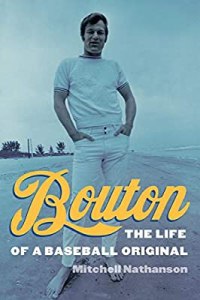
Wasn’t it true, Don Vito Corleone wondered while commiserating with a fellow Mafia chief in The Godfather (the novel, not the film), that great misfortune often led to unforeseen reward? It proved to be for the late pitcher/writer Jim Bouton, whose sometimes deceptive but nearly-incurable optimism was finally smashed when his youngest child was killed in August 1997.

Driving home in New Jersey, Laurie Bouton stopped short to stay out of an accident in front of her, but a driver behind her didn’t do likewise, smashing into her car. The 31-year-old an uncle described as “Jim all over again” for her free spirit died hours later. It destroyed Bouton’s generally sunny view of life—until it reconciled him to the New York Yankees.

In fact, as biographer Mitchell Nathanson also notes in Bouton: The Life of a Baseball Original, Bouton struggled for months to follow until Laurie’s oldest brother, Michael, wrote an op-ed in The New York Times urging the Yankees to do what had never yet been done and invite his father back for an Old Timers Day. (Father once revealed his son’s essay moved him to tears.)

What nobody including Bouton knew was that his decades-long blackballing from the Yankees—for whom he once starred as a pitcher, before his too-hard throwing style ruined his arm and shoulder, reducing him to the margins and back to a knuckleball he abandoned earlier in his career—had absolutely nothing to do with Bouton’s own longtime prime suspect.

Mickey Mantle was hardly thrilled at Bouton’s Ball Four revelations about him, but six years before Laurie’s death the death of one of Mantle’s sons provoked a sympathy letter from Bouton. That prompted Mantle to call his old teammate to say yes, he was ok with Ball Four at last and, no, he wasn’t the reason for Bouton’s Old Timers Day freeze-outs.

The freeze-outs turned out to be courtesy of former Newark Star-Ledger writer Jim Ogle, whom Bouton zinged in Ball Four for treating players “purely on how much they were helping the Yankees to win. Charm, personality, intelligence—nothing counted. Only winning. Ogle didn’t have even the pretense of objectivity . . . in fact, Ogle’s ambition was to work for the Yankees. But they would never give him a job.”

Until they did. The Yankees hired Ogle to direct their club alumni association in 1975, his duties including, as Nathanson writes, “keeping the Yankees in the good graces of their most iconic alumni and organizing Old Timers Days. In his mind both responsibilities could be best discharged by blackballing Jim Bouton.”

Nathanson’s book unfurls Bouton’s story with both affection and the kind of candor Bouton himself would have appreciated. (And in fact insisted upon, when he and his wife agreed to let Nathanson have access to everything from family doings and undoings to the still-preserved Ball Four notes and tapes that ended up sold to the Library of Congress during Bouton’s final illness.)

It’s the story of an intelligent and sensitive young man who didn’t become a pitcher because he looked to turn sacred cows into steak or to write the book that secured his name and sent baseball and about half the world of sports journalism to the rye bottle, either.

Nathanson’s Bouton is a pitcher who had eyes to see, ears to hear, and a conscience to heed, with no malice aforethought but flying in the face of an establishment unwilling to concede the great and glorious game (A. Bartlett Giamatti’s phrase) was only too human. He couldn’t deny the caprices he saw in front of him, whether front office people engaging one-sided, lopsided, deceitful contract talks with players to players themselves proving unheroic often enough while letting the fans in the stands or with their morning after newspapers worship them as gods.

The fun-loving Bouton loved the game but hated its business and duplicities. The longer his pitching career went despite the arm issues, the less Bouton could turn the blind eye. Unlike most players even then, Bouton talked freely when interviewed and didn’t try to hide the sides of him that were unlike the typical jock of his time. Some respected him for it, others rejected him for it.

When his established sportswriting friend Leonard Shecter suggested he keep a kind of running diary on his 1969 season with the expansion Seattle Pilots, Bouton revealed he’d already begun taking notes. Anyone could do it regarding the old imperial Yankees; who else would have thought about doing it among an expansion team of fellow outcasts just trying to keep their jobs and their sanity?

Many Bouton teammates weren’t sympathetic to his final product. The embarrassments of some kept them from seeing that Bouton humanised them and thus elevated them. He was as observant of their field or mound struggles as their off-field shenanigans, sorrows, and oft-ignored or mistreated injuries. He told the world these were human men when it seemed often enough that baseball ignored or denied their humanness.

Bouton had already stepped beyond the bounds of baseball’s proprieties before starting his Ball Four season. He’d supported publicly a threatened American boycott of the 1968 summer Olympics if South Africa’s then whites-only teams were allowed to compete. He spoke against the Vietnam War whenever asked.

Bouton’s original notes, tapes, and the pages shaped by his editor/friend Leonard Shecter for Ball Four now repose in the Library of Congress.

But with Ball Four he was considered either a revelator by those who loved the book or a traitor by those including then-baseball commissioner Bowie Kuhn who tried to suppress it. (Or, in the case of the San Diego Padres, leaving a burned copy of it on the Astros’ dugout steps.) It was enough to seed a followup, I’m Glad You Didn’t Take It Personally, about the controversy, his final pitching days before his first retirement, and his early days as a New York sports reporter.

That book wasn’t quite the hit Ball Four was, of course, but it offered a few more insights into what Bouton thought and felt about becoming an unexpected literary star. Not to mention his further thoughts on the real reason the old guard sportswriters resented him: he’d told the stories they thought they should have told but, for assorted and not always edifying reasons, couldn’t or wouldn’t.

Some saw themselves as keepers of the proverbial baseball flame. Others saw themselves as club adjuncts. Jim Brosnan, whose from-the-inside books Nathanson called “tell-some” books, had annoyed them enough. This was too much of enough already.

But Ball Four proved in due course as significant as any other evidence, when it was introduced at the arbitration hearings through which pitcher Andy Messersmith finished what outfielder Curt Flood’s brave but failed prior lawsuit (begun the same year in which Ball Four first appeared) started, ending the reserve era and its suppressions of player pay and rights. Well after its literary stature was affirmed.

The book inspired a rash of further tell-alls from baseball’s insides, from players and collaborators who lacked Bouton’s wit and Shecter’s sensibilities. They hardly understood  that Ball Four‘s success lay as much in Bouton’s ability to show baseball’s humanness as in the, shall we say, steamy revelations on which those subsequent books leaned most heavily. (“More outrageous than Ball Four” was a tellingly typical cover blurb.)

Nathanson goes into fine detail Bouton’s years as a sports reporter, his head-buttings with those who thought sports reporting equaled promoting their teams instead of, you know, real reporting. He also goes deeper into the truest conflict inside Bouton’s psyche and life—the guy who achieved beyond his own expectations but couldn’t resist a challenge because he had something to prove past the challenge itself.

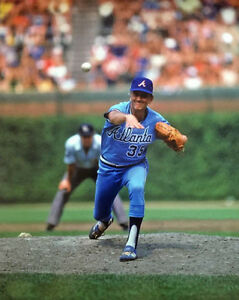
His love of baseball the game prompted him toward a comeback bid in the mid-to-late 1970s, including a spell with the minor league legend Portland Mavericks. He eventually made it back with the Atlanta Braves for a September 1978 spell—he once went mano-a-mano with Houston’s ill-fated howitzer J.R. Richard, pitching him to a draw—then walked away feeling for the first time that he didn’t have to prove a thing anymore.

His first baseball retirement led to the crumpling of his first marriage; Bouton and his first wife, Bobbie, had simply grown apart, though Bouton wasn’t immune to the occasional extracurricular activity, with the emphasis on occasional. (They divorced in 1981.) He didn’t really move to do something about it, though, until he met an attractive academic named Paula Kurman unexpectedly at a fundraiser to which both were invited.

Jim Bouton and second wife Paula Kurman, at a Ball Four retrospective.

It was Kurman (a speech therapist with Ph.d in interpersonal communications) who showed Bouton most of all what even his own family couldn’t, that he no longer had to take up quixotic challenges to prove himself to himself. The deception in his optimism until then was that it masked a man who had a difficult if not sometimes impossible time believing in his own worthiness. They married in 1982.

Bouton promoted Big League Chew (his Mavericks teammate Rob Nelson came up with the idea but Bouton sold and promoted it to buyer Wrigley), became a motivational speaker, helped to renovate an old but somewhat storied minor league ballpark, joined his wife learning and becoming a competitive ballroom dancer, continued writing, and eventually also became a stonemason who’d build walls and other supplementing fixtures for their home in the Berkshires.

In other words, this unfairly reputed miserable smasher of icons for its own sake was as normal, life-affirming, and human a man as his critics didn’t or couldn’t see. (Well, not everyone gets dance lessons from stage and film legend Marge Champion.) That 1998 Old Timers Day appearance simply began Bouton’s return from the ranks of the living dead into which his daughter’s senseless death plunged him.

“Looking up in the stands, at all of the family and friends who were there . . . ,” Nathanson writes (they included a contingent of friends bannering themselves “Laurie’s Girls!”), “[Bouton] understood that life could and would go on. It was what he needed to know at the precise moment he needed to know it most.”

The only thing that could and did knock Bouton out permanently enough was the 2012 stroke he suffered on the fifteenth anniversary of Laurie Bouton’s death. It exposed a condition of cerebral amyloid angiopathy and presented him the first and only challenge he couldn’t take on as successfully as he had others. It didn’t rob his intelligence, but his intelligence made him too aware of what he’d lose.

The most famous single line in Ball Four is the one that closed it: “You see, you spend a good part of your life gripping a baseball, and it turns out that it was the other way around all along.” On the day of Bouton’s death in 2019, his ability to speak gone, “in the netherworld between life and death,” his wife put a baseball into his right hand.

In his final act of life on earth, Bouton did with that ball what Nathanson’s biography will do to you once you open the covers and start reading. He gripped it tight.

Kim Ng, inside the box

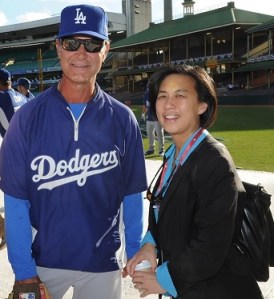
Kim Ng (right) with Don Mattingly, when Mattingly managed the Dodgers and Ng was their assistant GM. Ng is now, among other things, Mattingly’s new boss in Miami.

Whatever you do otherwise, please don’t call Kim Ng’s hiring as the Miami Marlins’ new general manager “outside the box” thinking. It’s an insult to hers and the Marlins’ intelligence, and it should be to anyone else’s, too.

Yes, Ng is the first woman and the first Asian-American to hold such a job. But yes, she also has three decades worth of experience in baseball operations which only began when she joined the White Sox as a front office intern and worked her way to becoming the team’s assistant director for baseball operations.

The Marlins hired her away from baseball government itself, where Ng just finished her ninth year as the Show’s senior vice president for baseball operations, focused specifically on tightening up and administering MLB’s international baseball reach and operations, working with MLB front offices and international organisations alike, and enforcing international signing rules.

In between her term with the White Sox and in the Show’s government, Ng became the youngest assistant GM (at 29) ever when she took that job with the Yankees, then joined the Dodgers as an assistant GM, her performances of which jobs plus her performance in MLB’s organisation itself put her on several team radars as a GM to be.

Outside the box? Ng is about as inside the baseball box as you can get with her experience and reputation. The only thing outside the box about her is that, well, she’s a lady, and she’s the daughter of a Chinese American father who worked as a financial analyst and a Chinese Thai mother who worked as a banker.

She’s Indianapolis born but New York raised, and she grew up among other things playing stickball on the Queens streets before going to the University of Chicago, earning a degree in public policy, and, oh yes, winning a Most Valuable Player award as an infielder on the university’s softball team.

“[I]t is the honor of my career to lead the Miami Marlins as their next General Manager,” Ng says in a formal statement. “We are building for the long term in South Florida, developing a forward-thinking, collaborative, creative baseball operation made up of incredibly talented and dedicated staff who have, over the last few years, laid a great foundation for success.”

When was the last time you heard terms like “forward-thinking” or “collaborative” or “creative baseball operation” applied to the Marlins? OK, so that might be outside-the-box—the Marlins’ box, that is.

“This challenge is one I don’t take lightly,” she continues. “When I got into this business, it seemed unlikely a woman would lead a Major League team, but I am dogged in the pursuit of my goals. My goal is now to bring championship baseball to Miami. I am both humbled and eager to continue building the winning culture our fans expect and deserve.”

It’s a recent enough expectation, of course, but one that doesn’t lend itself to gags now that manager Don Mattingly was named the National League’s Manager of the Year for shepherding the Fish to a second-place irregular season finish in the National League East and as far as a division series in the postseason.

Ng has knocked on history’s door more than a few times in her career. With the White Sox, she was the first woman and youngest human to present and win a salary arbitration case, for pitcher Alex Fernandez. When the Yankees hired her as an assistant GM, Ng became one of only four women ever to hold the position, joining Elaine Weddington Steward and Raquel Ferreira of the Red Sox and fellow Yankee Jean Afterman.

She started showing up on team radars as GM material in 2005, when the Dodgers interviewed her. They handed the GM job to Ned Colletti, but Colletti almost immediately kept her as an assistant GM. She’s since been interviewed for such jobs by the Angels, the Giants, the Mariners, and the Padres.

When she left the Dodgers to take her MLB job, there were those pondering aloud whether Ng had a chance to become the first woman ever named as baseball commissioner. So much for that idea, so far. She’s content to have gotten where she is now. But would you really object to the idea down the road apiece?

Ng won’t exactly be wading into virgin territory with the Marlins. Chief executive officer Derek Jeter was en route his Hall of Fame career as a Yankee shortstop while Ng worked in their front office. Mattingly’s playing career ended a few years before the Yankees made her an assistant GM, but he was a coach for them while she was there. And, he managed the Dodgers while Ng was still their assistant GM.

Jeter’s own formal statement cites Ng’s “wealth of knowledge and championship-level experience.” The Yankees won three straight World Series while she worked there; the Dodgers challenged for or won a few NL Wests while she worked in their front-office brain pool. As a front-office executive Ng has gone to eight postseasons total.

“Her leadership of our baseball operations team will play a major role on our path toward sustained success,” Jeter continues. “Additionally, her extensive work in expanding youth baseball and softball initiatives will enhance our efforts to grow the game among our local youth as we continue to make a positive impact on the South Florida community.”

The lady is a champ who just might deliver when it comes to making the Marlins champs. Just don’t accuse the Fish of going that far outside the box by hiring her in the first place.

The Yankees, only human after all

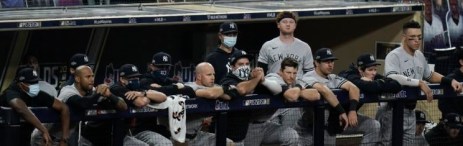
The Yankees watch their season dissipate in the three-up, three-down top of the ninth Friday night.

“Man,” tweeted a Yankee fan of my acquaintance after Friday night’s arms race between the Yankees and the Rays ended. “So sad. Every. single. year.”

Did you ever think you’d see the day when Yankee fans finally tasted what baseball’s hardest of hard luck franchise fans tasted for about as long as the Yankees once ruled the earth? Neither did I.

Did you ever think you’d hear Yankee fans talking the way Chicago Cub and Boston Red Sox fans spoke for decades before the 21st century arrived? Never mind the Red Sox—the Red Sox—owning more 21st century Series rings than the Yankees?

The team that owned most of the 20th century is finding the 21st century impossible to navigate. If it comforts Yankee fans any, their 20th century ancestors found the first two decades of that century tough to navigate, too.

From the birth of the American League through the end of 1919, the franchise finished as high as second place three times. The closest they got to a World Series then was finishing a game and a half behind (imagine that!) the Red Sox, then known as the Americans. When, you ask? The same year New York experienced a pair of firsts: its first underground subway, and its first New Year’s Eve blowout in Times Square.

The 21st century Yankees are actually a little more fortunate. They’ve been to sixteen postseasons, two World Series, and won one Series. Their ancestors of a century ago would have killed to take that kind of jacket into 1920.

Telling that to today’s Yankee fan might amount to wasted energy. There are more cliches attached to the Yankees for better or worse than to any other major league team, and the truest of those are 1) they don’t like to lose; and, 2) they define failure as any season in which they don’t win the World Series.

In most of the 20th century, once they got their bearings for keeps, it was a lot easier for the Yankees to live up to those type of self-imposed pressures. They owned the bulk of the reserve era, when they scouted the deepest of the deep bushes, traded or sold from strength, and plucked jewels suspected and unsuspected alike from the mere mortals.

The free agency era hasn’t been as kind to them as their adversaries thought at first. Turns out that buying pennants—which the Yankees haven’t been the only ones to accomplish, no matter what their riches and resources and Joe and Jane Fan lead you to believe—wasn’t going to be an annual Yankee accomplishment.

Since the Messersmith decision at the end of calendar 1975, the Yankees have been to 27 postseasons, won eleven pennants, and won seven World Series. That’s not exactly the same as their dynastic reserve era, but even the Yankees know there are 29 other major league franchises who’d sell their mothers and grandmothers to show even half that kind of success.

I haven’t heard of any groups of Yankee fans gathering yet to burn Aaron Boone or Aroldis Chapman in effigy after Game Five of the division series freshly lost. But any to come wouldn’t shock. If the truest cliche about the Yankees is that they don’t like to lose, the truest cliche about their fans this century is, “To err is human, to forgive is not Yankee fan policy.”

They’re not even burning longtime general manager Brian Cashman in effigy just yet. Not even if they’re fuming wrongly that Cashman invited too much analytics into the Yankee mindset. The only wonder about that might be what took the Yankees so long to dip into those waters in the first place.

Too much analytics? They just got shoved out of the postseason by a Rays team that lives on analytics. Analytics and assembling competitive teams out of painfully average players on annual budgets that don’t equal a third of Gerrit Cole’s entire nine-year Yankee contract.

Too much dependence on the home run? Well, now. They didn’t become the Bronx Bombers in the first place because they established a tradition of slap-hitting, scratch-hitting basepath pests. The Hitless Wonders, the Gas House Gang, the Go-Go Sox, and the Runnin’ Redbirds they ain’t.

News flash: When pitching doesn’t win postseasons, home runs do, more often than not. The Yankees lived and died by the bomb on the irregular season and hit fourteen more than the Rays. They just hit one fewer than the Rays in Game Five. (And, one fewer than the Rays all ALDS long, incidentally.)

Until Mike Brosseau ended a ten-pitch wrestling match with Chapman with a dramatic one-out home run in the bottom of the eighth Friday night, the Yankees and the Rays were enjoying and wrestling with their own Night of the Pitchers.

A game like that was the most appropriate way to honour the memory of Whitey Ford, the Yankees’ witty and popular Hall of Fame lefthander, who died at his Long Island home Thursday night while watching the Yankees and the Rays tangle.

Cole did exactly what the Yankees are paying him $324 million for nine years to do. The Rays’ and the Yankees’ bullpens did what top of the line bullpens are supposed to do, even though the key Yankee relievers weren’t quite as rested as the key Rays’ bulls.

Until the eighth those pitching staffs had only one run each torn out of them, both solo bombs. The pitching on both sides even shook off a few scattered defensive miscues on both sides.

What the Yankees missed all year—aside from a near-repeat injured list performance akin to 2019’s making the New England Journal of Medicine into the Yankee yearbook—was pitching depth.

They chugged, slugged, and bulled their way to second place in the AL East, blasted the Cleveland Indians to one side in the wild card round, but bumped into the AL East champion Rays. Discovering the Rays could take everything they could dish out from the comfort of their better-rounded bullpen depth and deployment.

The Yankees missed Luis Severino recovering from Tommy John surgery, they lost James Paxton to a flexor strain, and they lost Domingo German to a domestic violence suspension. They worked around Adam Ottavino’s fall from what’s considered the Yankees’ inner circle of bullpen trust.

And it blew up in their faces in Game Two, when Boone deciding to try out-Raying the Rays with an opener and a bullpen game blew up in the Yankees’ faces. That was the first of Boone’s two most egregious series mistakes.

The second was pinch hitting for Kyle Higashioka—establishing himself as the best Yankee option behind the plate—with slumping Mike Ford to open the top of the eighth, then sending Gary Sanchez out to catch the rest of the game. Sanchez’s bat was faltering and his plate work more so.

It was Sanchez who didn’t think that maybe Chapman should have served Brosseau a tenth-pitch splitter instead of a down-and-in fastball. It was Sanchez who may have forgotten that Chapman’s vaunted speed-of-light fastballs get more hittable the longer he works because they don’t climb the ladders or go out on the limbs as well as when he works his first few hitters.

And it was Sanchez and Boone who forgot Chapman nearly let that Game Seven thriller in the 2016 World Series get away from those Cubs with an RBI double and a game re-tying two-run homer. Not to mention failing to put Houston’s Jose Altuve aboard with two outs, George Springer on base, and a spaghetti bat on deck, the better to finish pushing last year’s ALCS to a seventh game.

Sanchez and Boone’s memory vapours disappeared over the left field fence. The only Yankee manager ever to lead his charges to back-to-back 100-plus win seasons in his first two seasons on the Yankee bridge has become Sisyphus in pinstripes.

Sooner or later, the jubilant Rays trolling the Yankees by singing along with Frank Sinatra’s version of “New York, New York” had to call it a night after a hard-earned hearty party. The questions around this Yankee edition won’t call it a night, or a day, too soon this winter.

Neither will the continuing humbling of Yankee fans, who are seen only too often, with too much justification, as among baseball’s most singularly arrogant. Their absolute lowest of the low might have been the subset who trolled Astros pitcher Zack Greinke over his longtime battle with clinical depression last October.

Their forebears were spoiled rotten by all those 20th century decades of Yankee imperialism but never that disgraceful. Now the sons and daughters of those old imperial Yankee fans have to learn, little by little, to live with the idea that the Yankees may be only human, after all.

The boundless world of Rays imagination

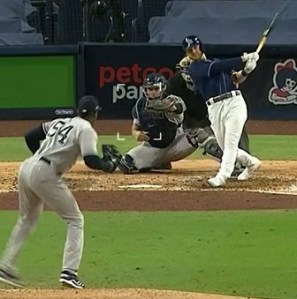
A TBS screen capture (including strike zone) as Michael Brosseau demolished Aroldis Chapman’s tenth-pitch fastball Friday night.

“The world of reality has its limits; the world of imagination is boundless,” wrote the French philosophe Jean-Jacques Rousseau. Baseball is so often like that. His near-namesake Tampa Bay Rays utility man re-proved that Friday night.

You’ve heard of the Year of the Pitcher, right? Until Michael Brosseau squared off against recent near-executioner Aroldis Chapman in the bottom of the eighth, Friday was the Night of the Pitchers.

Neither the Yankees nor the Rays wanted to hear any nonsense about re-juiced postseason baseballs. They made Game Five of their American League division series into an arms race. With only three rude interruptions and Brousseau delivering the one that mattered most.

Brosseau. The guy Chapman nearly beheaded with a 101 mph fastball late in the regular season. The guy facing now facing Chapman after entering the game as a sixth-inning pinch hitter. The guy Thomas Boswell says was “undrafted, bypassed 1,216 times–is a ‘utility man’ who played every position except SS & C this year (including pitcher).”

The guy who wrestled Chapman to a ten-pitch plate appearance, after beginning with an 0-2 count, and hit that tenth pitch over the left field fence. Meaning, ultimately, game, set, and a Rays date with the Houston Astros in the American League Championship Series to come.

“I was just trying to get a runner on and get the next guy up,” Brosseau said after the game. “We knew the hits were coming not very often tonight . . . Obviously, going up there, trying to find a barrel, thankfully it happened.”

Brosseau may not have to buy his own steak in Tampa Bay for a very long time to come.

These Rays and these Yankees threw the kitchen, bathroom, and laundry room sinks at each other from the mound and got through seven and a half innings tied at one, with both runs on home runs and twenty strikeouts between them. And the Rays managed practically to sneak a 2-1 win.

That’s the number 28 payroll in all the Show taking down the number one payroll, if you’re scoring at home. (The Yankees actually hadn’t been the number-one payroll since 2011.) The barely no-name Rays, full of excrutiatingly average major league baseball players, taking down the Empire Emeritus and its usual pack of high-priced, high-profile spreaders.

The Rays, who survived Gerrit Cole’s first short-rest outing in his major league life, who got no-hit by Cole until Austin Meadows found the screws on a 1-1 fastball and sent it over the right field corner fence in the bottom of the fifth.

The Rays, whose first reliever on the night, Nick Andersen, didn’t let Aaron Judge’s fourth-inning leadoff launch to about the same region over the same fence knock him into praying to find the nearest available mouse hole into which to crawl in anguish. He shook it off and worked two full innings’ shutout relief from there. Nothing to it, folks.

The Rays, who withstood everything Zack Britton threw at them, pried one base hit and reached on one abnormal error by Yankee third baseman Gio Urshela but cashed neither of them in, until Brosseau won that showdown with Chapman.

“I knew it felt good,” Brosseau said about the immediate contact with that triple-digit-speed fastball. “I haven’t had much playing time [in Petco Park], so it’s kind of hard to read the dimensions, to see from daytime to nighttime, but it felt good off the bat.”

Just don’t ask him about payback. Everyone else noted poetic justice and karma turning superbitch. Not Brosseau. “No revenge,” he said. “We put that in the past. We came here to try and win a series. We came here to move on, do what we do best, and that’s play our game.”

Re-juiced postseason baseballs took about more than a third of postseason talk with all the home runs interfering in bunches with airline flight patterns until Friday night. The Yankees and the Rays must have drained them before getting started. Three hits all night long, and all three were home runs that almost barely cleared the top of the fences.

On normal rest Cole has a 2.74 earned run average. On five or more days rest, it’s 3.73. On short rest, it could have gone either way Friday night. Especially with the Rays having won the ten straight previous games in which Tyler Glasnow was their starting pitcher, or opener if you prefer. Not to mention the Rays’ key bullpenners entering the game rested slightly better than the key Yankee bulls.

It didn’t start brilliantly for Cole. He walked Brandon Lowe after striking Meadows out impressively, then drilled Randy Arozarena on the first pitch—days after Arozarena took Cole over the fence—which he didn’t likely mean to do, but good luck convincing the Rays, who’ve been waging bad-blood war against the Yankees all year as it is.

The punchout of Meadows made Cole the fastest pitcher to reach a hundred postseason strikeouts, in 79 innings. He nudged the Los Angeles Dodgers’ Clayton Kershaw to one side with it. But he walked the bases loaded around a ground out before catching Joey Wendle looking at strike three for the side.

Cole struck out the side swinging in the second, with fastballs hitting just a hair’s breadth short of 100 mph and a generous helping of late movement, and off-speed breakers maybe two hairs’ breadth short of 90 but diving like paratroopers. And then, he struck out two out of three in a 1-2-3 third.

Why, he even made early mincemeat of a hitter who usually does likewise to him. He got rid of Ji-Man Choi twice on ground outs, after the husky Rays first baseman came into the game hitting .526 off Cole including four home runs.

Himself starting on two days’ rest, Glasnow could have ended up with two on and no outs to open the game if Choi hadn’t made a pair of acrobatic plays to turn a pair of bad throws into tight outs. Glasnow himself threw D.J. LeMahieu’s leadoff grounder back to the box offline, and shortstop Willy Adames did likewise with Judge’s followup hopper, before Aaron Hicks lined out to deep center for the side.

Pete Fairbanks and Diego Castillo finished what Glasnow and Andersen started. Castillo finished in reasonable style, striking Giancarlo Stanton and Luke Voit out before Urshela’s nasty liner up the third base line got snapped by third baseman Wendle as if having to catch a baby shot out of a cannon to save the little one’s dear life.

This wasn’t exactly the way the Yankees wanted to honour the memory of their Hall of Fame pitcher Whitey Ford, who died Thursday night at home while watching the Yankees and the Rays tangle in Game Four. (Both teams honoured a moment of silence in Ford’s memory before the game began.)

It was almost a year since Chapman surrendered Jose Altuve’s ALCS-winning two-run homer. When not burning up social media calling for manager Aaron Boone’s head post-game, Yankee fans wasted little time calling for Chapman’s. Determining whom to rage against more was tough enough.

What wasn’t tough was to remind yourself that to err is human but to forgive is not fan policy. The good news is that, even with social-distancing considerations, no groups of Yankee fans have opened street parties at which they can run over Boone, Chapman, or other shortfalling Yankees’ jerseys. Yet.

The Yankees probably wish Ford and his Hall of Fame battery mate Yogi Berra had brewed a little mad chemistry from their Elysian Fields positions Friday night. The Rays only hope that, whatever mad science of their own got them through the Empire Emeritus will be enough for them to turn the Astros aside in the coming week.

“They’ve been the team to beat the last few years,” said Brosseau of the team the Rays got thatclose to knocking out in another tight full-five division series last year. “They knocked us out last year so it will be fun to face them again.”

Don’t bet against these Rays just yet. If they could get rid of the Yankees and their bomb squad, they won’t exactly let the thought of the Astros’ suddenly revived long distance callers shake their gill slits.

Whitey Ford, RIP: The Chairman takes his leave

“A couple of New York kids who made good,” Sandy Koufax’s biographer said of Koufax (Brooklyn-born) and Whitey Ford (Manhattan-born, Queens-raised), here sharing a handshake before Game One of the 1963 World Series.

When Jane Leavy researched and interviewed for her splendid biography of Hall of Famer Sandy Koufax, she discovered something about then-U.S. poet laureate Robert Pinsky. Pinsky had an animus against Koufax’s fellow Hall of Fame pitcher Whitey Ford.

Ford, who died Thursday at 91, was Leavy’s girlhood hero. Pinsky’s poem “Night Game” addresses Ford and Koufax, who met twice in the 1963 World Series with Koufax beating Ford twice. But over a decade earlier, Pinsky as a boy waited at Fort Monmouth, New Jersey to get Ford’s autograph.

Ford then was an emerging Yankee hero, a second place 1950 American League Rookie of the Year finisher who’d rolled a 2.51 ERA after his June call-up and beat Hall of Famer Robin Roberts to finish the Yankees’ World Series sweep of the Philadelphia Phillies’ “Whiz Kids” pennant winner.

Now, Ford pitched for the Army Signal Corps to fulfill his military obligation of the time. When Pinsky finally got to face Ford and asked for the autograph, Ford replied, “Not now, kid.”

When Pinsky told the story to Leavy while talking about “Night Game,” she called Koufax the morning after. After a couple of moments’ silence on the other end of the line, she noted, Koufax asked her, “Do you think he’d like a ball?” Two weeks later, Pinsky received the ball, autographed by Koufax and accompanied by a small, handwritten note saying, only, “Whitey’s really a good guy.”

“Ford subsequently redeemed himself in Pinsky’s estimation,” Leavy wrote, “with a plaintive, if belated, explanation for his youthful rudeness: ‘Soldiers don’t give autographs.’ (And in mine by asking for a copy of Pinsky’s poem. ‘He wrote nice about Sandy?’ Whitey said. ‘I’d like to see that.’)”

This was the same Whitey Ford who had a classic reaction when Koufax, winner of a spanking new Corvette as the 1963 World Series’s Most Valuable Player, left the awards banquet to discover the car parked on the sidewalk . . .with a $15 parking ticket attached to the windshield. “Sandy has only two flaws,” Ford cracked. “He can’t hit, and he can’t park.”

That from the pitcher who once cost the Yankees a run in a World Series game when he tagged and left third base too soon on what should have been a sacrifice fly by his Hall of Fame battery mate Yogi Berra.

The Los Angeles Times‘s Hall of Fame sportswriter Jim Murray handed Ford his enduring nickname, when he wrote rooting for the 1950s Yankees was like rooting for U.S. Steel with Ford—whose eight World Series Game One starts is a major league record—the chairman of the board.

A compact lefthander at 5’10”, Ford was most renowned for two things. Thing One: the likewise compact delivery that relied as much on his brains as his repertoire, an assortment of off-speed pitches he threw all around the strike zone, since he couldn’t even throw the proverbial lamb chop past a snail. Batters hit .235 off him lifetime.

“If it takes 27 outs to win,” his longtime manager Casey Stengel once said of him, “who’s going to get them out more ways than Mr. Ford?”

“He was like a master chess player who used his brain to take the bat right out of my hands,” recalled one-time Boston Red Sox outfielder Walt Dropo. “You’d start thinking along with him, and then Whitey had you because he never started you off with the same pitch in any one sequence.”

Thing Two: Mr. Ford’s sense of humour. A man who spends the bulk of his career cleaning up after his Yankee bestie Mickey Mantle’s messes almost as often as he befuddles hitters and pitches in the World Series (his 33 consecutive scoreless World Series innings remains a record) needs a sense of humour. And maybe a healthy supply of anti-migraine medication.

Ford wasn’t exactly allergic to the night life in his native New York (he was Queens-born), but he wasn’t exactly allergic to knowing when to shut it down, either. “His fellow rogues, Mickey, Billy [Martin], and Toots [Shor, the legendary New York sports restauranteur], were all gone,” New York Daily News writer Bill Madden wrote in his 2003 book Pride of October: What It Was to Be Young and a Yankee, “but he had survived, still the same wisecracking, self-assured son of the city.”

Wisecracking and practical joking. When Yankee infielders Joe Pepitone and Phil Linz were still barely past rookie status, according to teammate Jim Bouton in Ball Four, Ford and Mantle told the pair they’d finally arrived and were ready to go out on the town with the big boys. In Detroit, Ford and Mantle instructed Pepitone and Linz to dress to kill, hail a cab, and head to the Flame where they were to ask for Mantle’s table.

Pepitone and Linz did as instructed. They dressed to kill. They hailed their cab. And discovered the hard way that the Flame—once a legendary Detroit jazz and rhythm and blues hot spot (among others, assorted future members of Motown’s legendary Funk Brothers house band had played the place)—was now a ramshackle wreck with the glass blown out and maybe two surviving toasted tables remaining.

Ford’s playful side extended to making sure the Yankee bullpen didn’t get bored when members weren’t called upon to warm up and get ready to go into a game. “I think it should be known,” Bouton wrote on 5 April, in the journals he kept to compose Ball Four, “that when Whitey Ford was pitching for the Yankees he set up a table with a checkered tablecloth in the bullpen. On the table there was an empty wine bottle with a candle in it. Also hero sandwiches. Whitey Ford had style.”

Ford was a thinking craftsman on the mound and a practical joking, fun-living fellow off it.

And influence. A month and a half later, Bouton had to record: “Hot flash! Whitey Ford’s Italian restaurant in the bullpen has a real rival in the Baltimore bullpen: wienie roasts.”

When Whitey and Joan Ford married in April 1951 in Long Island City’s St. Patrick Church, Stengel arranged a little surprise for the couple: he loaded the entire Yankee team, including Joe DiMaggio, onto a bus following an exhibition game to hit the church. One Yankee was too nervous to get off the bus, like his fellow rookies, so the newlywed Fords went out to greet him.

That’s how he met Mickey Mantle for the first time. The friendship that must have made Ford wonder often enough whether the devil was punking him started on a bus outside his wedding church. “Years later,” Ford said, “Mickey told me the highlight of that day for him was meeting Joan, not me.”

The ever-quick Ford got a measure of vengeance when his first grandchild was born. When his son-in-law phoned in the dead of night to announce the birth to Grandpa, Ford called Mantle—who went into the Hall of Fame with him in 1974—first thing in the morning. “You’re not going to believe this,” he said. “Last night for the first time in my life I slept with a grandmother.”

In Pride of October Madden wrote that Ford wasn’t always comfortable having been the sole survivor among the little night-owl group of himself, Mantle, and Martin. The only time Ford was ever uncomfortable with Stengel—who judiciously managed him as an every-fifth-day pitcher to save him for the bigger games of Yankee races and the Series—was when Casey neglected to align his 1960 Series rotation to let Ford pitch more than twice, which probably did cost them that Series as much as Bill Mazeroski’s winning home run.

Ford was also uncircumspect about his late-career ball doctorings. Admitting he turned to chicanery in a bid to hang on as long as he could until elbow and arm miseries forced him to call it a career in 1967, Ford swore he never did it during his Cy Young Award-winning 1961 or his likewise 20 game plus-winning 1963.

“Well,” he added puckishly, “maybe a little.”

“For a long time,” Bouton revealed, “Whitey got away with throwing a mud ball that was positively evil.” If the grounds crews wetted the infield or the mound a little too generously, or he and/or his late-career catcher Elston Howard could mix saliva and dirt surreptitiously, Ford would get a tiny mud load on balls. One-time Los Angeles Angels pitcher/flake Bo Belinsky once said, “If a mud ball was left for me on the mound, I had two outs waiting right there.”

“Ford could make a mud ball drop, sail, break in, break out, and sing ‘When Irish Eyes are Smiling’,” Bouton continued.

Eventually the opposition, particularly Bill Rigney, the manager of the Angels, got wise to him and he had to quit using the mudder.

Then he went to his wedding ring. He gouged such sharp edges into it that we used to kid him about having lost the diamond out of it. He’d scuff up the ball with the ring and make it do all the things the mud ball did, except maybe now the song was different. He got by with the ring for a couple of months . . .

After that, Ellie Howard sharpened up one of the buckles on his shin guard and everytime he threw the ball back to Whitey he’d rub it against the buckle. The buckle ball sang two arias from Aida.

Madden convinced Ford to show him around the Astoria, Queens neighbourhood where he grew up as the son of a Con Edison electrical worker. Ford pointed to a yellow-bricked apartment building where he’d lived ten years and adjacent to where his wife-to-be lived as a girl. “I was sixteen and she was twelve,” Ford said. “She had great legs. That’s what attracted me most about her. We moved three or four times when I was growing up there. I guess every time the rent was due.”

Some of Ford’s boyhood acquaintances and friends in that predominantly Irish, Italian, and Polish neighbourhood grew up to go into baseball as he did, including future coaches Tony and Al Cuccinello and future Minnesota Twins pennant-winning manager Sam Mele. One who didn’t go into baseball was a kid named Anthony Benedetto, whose family owned a nearby beauty salon.

“It wasn’t until he after he left the neighbourhood,” Ford said, “that he changed his name to Tony Bennett. Kind of like me, going from Eddie to Whitey, only I think his new name did a lot more for him than mine did for me.”

Baseball-Reference shows ten major league players (including two who eventually became managers) named Whitey. Be assured that if you just say “Whitey” in any gathering, they’ll remember Ford first. But neither they nor even longtime Yankee fans will remember him as quickly as his widow, two of his three children (his son, Thomas, died in 1999), and his grandchildren.

Once during an Old-Timers Day ceremony, Ford and Berra watched the Yankee Stadium video board display a tribute to Yankees past who had passed away that year. Yogi turned to Whitey and said, “Boy, I hope I never see my name up there!”

Ford can now tell Berra in the Elysian Fields, “Yogi, I never wanted to see your name up there, either!” Even at 91, Ford’s family and baseball fans alike weren’t quite ready to see his name up there, either.