Rickey Henderson, RIP: Baseball’s grandest larcenist

Rickey Henderson

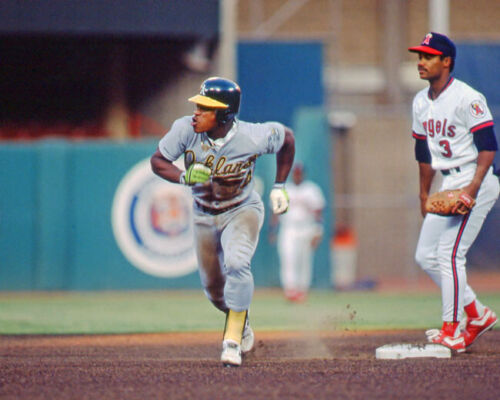
The Man of Steal gets the jump in a 1990 game, as then-Angels infielder Johnny Ray looks as though the right move was premeditated surrender.

“To me,” Hall of Famer Rickey Henderson once said, “the most important thing was stirring things up and scoring some runs so we could win a ballgame.” In more ways than one, he was a virtuoso at both. He made a cliché of the maxim that when he led off his team had a man on second going in. He also had to have the uniform torn off his back after slightly more than a quarter century of professional baseball.

On Friday night, at age 65, pneumonia plus asthma tore the Man of Steal from earthly life. Rest assured that even the Elysian Fields might be hard pressed to contain him, though God and His servant Stengel might be entertained above and beyond expectations.

Once upon a time, the Yardbirds’ drummer Jim McCarty wrote in an album liner note, “It’s been said that Jeff Beck is one of the world’s leading guitarists and I’m inclined to agree with him.” Well, now. It was (and is) said (and how!) that Henderson is the greatest leadoff hitter in major league history, and I’m inclined to agree with him.

So was just about all of baseball world, and it didn’t wait until his death to say it, either. But with the news of his death, here was Howard Bryant, a Henderson biographer, writing for ESPN: “He wasn’t as good as he said he was. He was actually better.”

“Rickey Henderson,” said Hall of Fame catcher Mike Piazza, “was a dream to hit behind as teammate and a nightmare for a catcher as an opponent.” And, a joy to fans who loved watching him turn baseball games into Olympic track and field meets.

Henderson was so prolific at reaching base you almost thought he’d become the first to steal first legitimately. Once he did get aboard, you could pretty much bank the run scoring by hook, crook, and anything else Henderson could think of, short of shooting the infielders and the catchers with tranquiliser darts.

The basics would be his 3,118 major league hits, his 1,406 stolen bases, his 298 major league home runs, scoring fifty runs more than Ty Cobb, and stealing about five hundred more bases than Hall of Famers Cobb, Lou Brock, or anyone else making his living with basepath theft. Not to mention the batting stance—damn near a catcher’s crouch, prompting baseball writing legend Jim Murray to suggest his strike zone was the size of Hitler’s heart.

This wiry guy who sometimes checked into hotels using Negro Leagues legend and Hall of Famer Cool Papa Bell’s name as an alias is thought of first for breaking both the single-season and lifetime stolen base records, each held then by Brock. But neither Brock nor anyone else walked 796 times leading off any inning.

The Man of Steal’s 394 game-opening walks is staggering enough. You can think of players who didn’t or won’t walk that often in their entire baseball lives. But 796 walks leading off innings? That’s as surrealistic as a Dali painting, a Kafka novel, or an extremely early Pink Floyd composition. Cobb did it a mere 153 times.

“I’m 69 years old,” dance and film legend Bill (Bojangles) Robinson told an Ebbets Field crowd on Jackie Robinson Day in 1947, “but never thought I’d live to see the day when I’d stand face-to-face with Ty Cobb in Technicolour.” Mr. Bojangles should have lived to see Henderson. He’d have beamed about standing face-to-face with Funkadelic in spikes.

Henderson’s 81 lifetime game-opening home runs and his 293 bombs batting first in the order were (and remain) impressive enough. His 142 inning-opening home runs might be even more so. Whomever else Henderson had behind him in the lineup, it might have been most true that to beat those teams you had to get through him first, last, and always.

He went to eight postseasons with five teams and posted an .831 OPS. You guessed it: there have been and there are players thought to be heftier hitters who didn’t and won’t post .831 OPSes in their whole careers. By any measure, his 1989 postseason was his personal best, winning the American League Championship Series MVP and posting a 1.514 OPS over that ALCS and the (Earthquake) World Series.

The intentional walk is usually handed to a fellow whose bat should be registered as a lethal weapon. Henderson had 61 free passes in 25 major league seasons, an average of three per year. He didn’t lack long ball power, of course, but neither was he guaranteed to lead off every inning he checked in at the plate beyond the first inning.

Simple enough answer: No pitcher who hadn’t yet lost his marble (singular) wanted to hand Henderson a premeditated base because they knew it meant guaranteeing him three bases on the house before the inning ended. Henderson had 5,356 plate appearances in which he led off an inning and he was never handed an intentional walk in those.

He got his walks the old fashioned way: he earned them. No player was better at reading pitchers and catchers preparing for a day’s larceny. He averaged only 89 strikeouts a season at the plate but 115 walks. Keeping the Man of Steal off base and off the top of baseball’s ten most wanted grand theft suspects compared to keeping a politician from putting his or her foot in his or her mouth.
Rickey Henderson

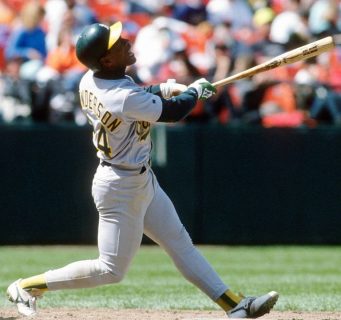
Henderson was more than a base thief—he hit 81 lifetime game-opening home runs, 142 inning-opening homers, and 293 bombs when listed in the lineup at the number one spot.

No player or man is perfect, and Henderson’s imperfect sides could and did drive players and managers on his own teams as well as the opposition to drink or thoughts of manslaughter, whichever came first. His tendency to whine and fume when he thought he was being underpaid steamed his front offices. His tendency to think of sitting it out when he wasn’t feeling a hundred percent physically caused too many to think he was a born goldbrick or worse.

Just ask Tony La Russa, the Hall of Fame manager who managed against him before getting to manage him. Once when managing the White Sox the first time around, La Russa had to bear Henderson getting in his face and telling him the next time his White Sox decided to brawl with Henderson’s A’s, Henderson was coming for him first.

“Rickey knew his body better than anybody else,” La Russa later told Bryant. “I have to admit I was wrong about him.”

As a manager, I would ask him how he felt and he would tell me, ’70 percent.’ Seventy percent wasn’t good enough for him to play, but I’d tell him 70 percent of Rickey Henderson was better than 100 percent of anybody else I had on the bench. There were times he did not play even when that 70 percent, I thought, could have benefited the team, but when you look at the end results of what he did, the totality of his career achievements cannot be argued.

When Henderson re-joined La Russa, re-joining the A’s for a third tour after winning a World Series with the 1993 Blue Jays, the A’s team bus passed a Toronto billboard showing Joe Carter’s jubilant tour around the bases after hitting the ’93 Series-winning three-run homer. (Henderson and fellow Hall of Famer Paul Molitor were on base when Carter connected.) Bryant wrote that only one voice came from the rear of the bus.

The voice was Henderson’s. “I was on second base!” the Man of Steal crowed.

Yes, he was as funny as he could be infuriating. But as Hall of Fame pitcher Dennis Eckersley told Bryant, “Rickey was great, sure, but when Rickey put his nose in it—those days when he really wanted to play —there was nobody better.”

“It ain’t bragging if you can do it,” the ancient saying goes. Henderson on the field was the braggart who backed it up. When he spoke to the crowd after busting Brock’s record, he made people fume as well as cheer when he said, “Lou Brock was the symbol of great base stealing. But today I am the greatest of all time.” It turned out that Brock himself helped Henderson write his day’s remarks. Well.

Henderson even proved at least once that one Hall of Famer had to one-up another Hall of Famer to set an all-time record as unlikely (at this writing) to be broken as his 1,406 stolen bases. He proved it when he turned up as Nolan Ryan’s 5,000th strikeout victim, with then-commissioner A. Bartlett Giamatti in the house, “ticking off at least one Oakland player who thought he detected Giamatti rooting for Ryan.” (So said the New York Times‘s George Vecsey.)

That was the summer in which the bulk of Giamatti’s too-brief term in office was consumed with the Pete Rose investigation, which didn’t allow him as much time at the ballparks as he would have loved. But bank on this: Had Giamatti lived to be in the house the day Henderson stood to pass Brock, two years later, there’d have been a Brewer or three carping that they thought they detected Giamatti rooting for Henderson.

Even the larger-than-life need anchorage. Henderson had his wife. “Pamela Henderson never received the credit,” wrote another ESPN scribe, Bradford Doolittle. “While he was building his masterpiece, some players didn’t even know Rickey was married, but she was both the anchor and the captain of the yacht.” You don’t stay together since high school and stay married 41 years without a captain and an anchor. It was as if Henderson’s wife and the mother of his three children reassured herself, “Let him have his fun. When he gets home, we’ll remind him who’s on this bridge.”

Maybe one of Henderson’s true problems was that he really did love the game too much to let it go. After a quarter century plus, most players are long retired to their post-playing lives. At age 45, he was busy stealing 37 bases for the independent Newark Bears. When it all shook out, he probably deserved more than two decades plus a near-year more of life after the batter’s box and the basepaths.

He died five days before his 66th birthday. Somehow, it’s appropriate that he should have been a Christmas baby. At his best, the Man of Steal made every game he played feel like Christmas to his teams.

First published at Sports Central.

“I loved every challenge of playing third base”

Adrián Beltré

He hit home runs on one knee, he was a human highlight reel at third base. Welcome to Cooperstown!

Of all the stories that abounded this weekend about Adrián Beltré, on the threshold of his induction into the Hall of Fame, there’s one which may be forgotten except by Angel fans left (as almost usual) to ponder what might have been. It’s the story of the Angels pursuing Beltré as a free agent after he spent five often injury-plagued seasons in Seattle.

Essentially, Angels owner Arte Moreno wanted Beltré in the proverbial worst way possible, after the Dodgers who reared him were willing to let him escape to the Mariners in free agency—despite Beltré having just led the Show with 48 home runs in 2004—because then-owner Frank McCourt didn’t want to pay what the Mariners ultimately did.

Beltré went from the Mariners to the Red Sox on a one-year, prove-it kind of deal. When that lone Boston season ended in October 2010, Moreno kept Beltré in his sights. But nothing the Angels presented Beltré impressed him enough to sign with them. He opted to sign with the Rangers instead. Moreno was so unamused he ordered his then-general manager Tony Reagins to deal for Blue Jays outfielder/slugger Vernon Wells.

Well. The Angels learned the hard way (don’t they always?) that Wells was damaged goods. The fellow they sent the Jays to get him, bat-first catcher Mike Napoli, would join Beltré for a hard-earned trip to a World Series that would break their hearts, before moving on to help Cleveland to a pennant and the Red Sox to the 2018 World Series triumph.

Meanwhile, before leaving Seattle for a one-year, show-us deal with the Red Sox, Beltré by his own admission finally learned he could have a shipload of fun playing baseball without losing the focus, the discipline, or the outlying durability that were going to make him a Hall of Famer in the first place. With the Rangers, he finished his ascent into what Baseball-Reference calls the number four all-around third baseman ever and, concurrently, built and secured a reputation as a team-first Fun Guy.

Nail his 3,000th lifetime major league hit? Party time—for the whole team and then some. “After he got 3,000 hits he had a party,” says Rangers in-game reporter Emily Jones to The Athletic‘s Britt Ghiroli and Chad Jennings. “It was like our clubhouse moved to this place. Every clubbie. Every trainer. Every massage therapist. He was extremely inclusive.”

“He was the oldest guy on the field,” says his former Rangers teammate Elvis Andrus, “but acted like the youngest.”

Beltre’s fun-loving rep went hand in glove with being a veteran clubhouse leader to whom even his manager often deferred. “If he stared at you some kind of way,” says Ron Washington, now managing the Angels but then managing the Rangers, “you knew he meant business. A couple of times, I got off my perch to go get (on a player). He would stop me and say, ‘Let me get it, skip’.’

“I saw him chew veterans,” says one-time Rangers batting coach Dave Magadan, “like they were 19-year-old rookies.”

But he also never forgot teammates, even after he retired. Lots of players can make their teammates go with the flow during arduous seasons. Beltré made them friends. Even if he might chew them out one day, he’d re-cement the friendship side by asking, “You know why I did that, right?”

Former Rangers teammate Mitch Moreland remembers taking a group of later Athletics teammates to a Seattle restaurant to which Beltré had taken a host of Rangers once upon a time. “I called (Beltré) and I was like, ‘Hey, what was the guy’s name at Metropolitan? I’m going to take the boys there’.”

He goes, “Oh, I got you.” So, he called the guy up, set it up. I took the whole team over there, we ate, and I got ready to get the bill, and Adrián had picked it up. For the Oakland A’s. After he was retired.

What of the once-familiar running gag involving Beltré’s real distaste for having his head touched and teammates—usually spearheaded by Andrus—going to great lengths to touch it and get away with it? “I still do,” Andrus says. “He still doesn’t like it. That’s what I am going to try to do at Cooperstown . . . I need to touch his head. I need to touch his head while he’s talking!”

He didn’t get anywhere close to that. Hall of Famer David Ortiz did, right smack at the podium.

But no matter. The third baseman who declined a grand farewell tour didn’t need any further validation for his place in the Hall of Fame. Those who do, however, should marry his 27.0 defensive wins above replacement level player (WAR) to his Real Batting Average (total bases + walks + intentional walks + sacrifice flies + hit by pitches, divided by total plate appearances) among Hall third basemen whose careers were in the post-World War II/post-integration/night-ball era:

HOF 3B PA TB BB IBB SF HBP RBA
Mike Schmidt 10062 4404 1507 201 108 79 .626
Chipper Jones 10614 4755 1512 177 97 18 .618
Eddie Mathews 10100 4349 1444 142 58 26 .596
Scott Rolen 8518 3628 899 57 93 127 .564
George Brett 11625 5044 1096 229 120 33 .561
Ron Santo 9397 3779 1108 94 94 38 .544
Wade Boggs 10740 4064 1412 180 96 23 .538
Adrián Beltré 12130 5309 848 112 103 97 .533
Paul Molitor 12167 4854 1094 100 109 47 .510
Brooks Robinson 11782 4270 860 120 114 53 .458
HOF AVG .555

He’s not higher there because a) he drew far less unintentional walks than most of the men on that list; and, b) that aforementioned durability led him to playing through injuries insanely enough to cause him a few so-so seasons that pulled his numbers down somewhat. But as a defensive third baseman he’s the second-most run-preventive player (+168) who ever worked that real estate . . . a mere 125 behind a guy named Robinson.

“I loved every challenge of playing third base,” said the first third baseman in Show history to nail 400+ home runs and 3000+ hits. “I was hooked. Those hot shots, slow ground balls, double plays, I couldn’t get enough of them.” Come Sunday, the Cooperstown gathering almost couldn’t get enough of Beltré, either.

Orlando Cepeda, RIP: “Winter always turns to spring”

Orlando Cepeda

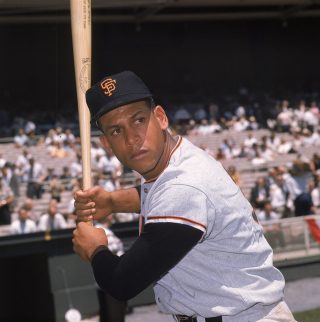
Cepeda was the Giants’ first San Francisco idol from the moment he emerged in 1958.

It took the late Hall of Famer Willie Mays more time than he deserved to become a San Francisco treat as a New York import. It took the now-late Hall of Famer Orlando Cepeda, who died Friday at 86, five minutes during the Giants’ first season by the Bay.

OK, that’s only a slight exaggeration. But having no tie to the Giants’ New York past, having a blast against the Dodgers in the Giants’ first San Francisco regular season game (a home run against Don Bessent with one out in the fifth), and posting a Rookie of the Year season with 25 bombs and a National League-leading 38 doubles, Cepeda became a Giants’ matinee idol at once.

It didn’t hurt that this son of Puerto Rican baseball legend Pedro (The Bull) Cepeda found San Francisco a treat from the word go, either. “Right from the beginning,” the Baby Bull would remember to Sports Illustrated‘s Ron Fimrite in 1991.

There was everything that I liked. We played more day games then, so I usually had at least two nights a week free. On Thursdays, I would always go to the Copacabana to hear the Latin music. On Sundays, after games, I’d go to the Jazz Workshop for the jam sessions. At the Blackhawk, I’d hear Miles Davis, John Coltrane . . . I roomed then with [outfielder] Felipe Alou and [pitcher] Rubén Gómez, but I was the only one who liked to go out at night. Felipe was very religious and quiet, and Rubén just liked to play golf, so he wasn’t a night person. But I was single, and I just loved that town.

Show me a ballplayer who loves a good jazz jam and I’ll show you my kind of ballplayer, folks. The only thing that would make my jazz heart go pitty-pat a little more would be discovering Cepeda in the Blackhawk audience on the April 1961 nights that produced the classic Miles Davis In Person Friday and Saturday Nights at the Blackhawk.

Imagining the smiling Cepeda at the Blackhawk raptly listening to a Davis quintet running the range from Miles’ modal classic “So What” to Thelonious Monk’s equally classic “Well, You Needn’t” and back to, say, Johnny Mercer’s “Autumn Leaves” or Miles’s own blues, “No Blues,” is an imagining worth securing.

The sole sore spot was Cepeda’s early tussle with fellow Giants comer/Hall of Famer Willie McCovey for playing time at first base. Cepeda won the early battles when McCovey, an equally likeable soul, struggled to find consistency, compelling Giants manager Bill Rigney to switch the pair off between left field and first base, a switchoff that didn’t always sit right with Cepeda.

“I know I could’ve played left field if I’d put my mind to it,” he’d remember to Fimrite, “but I was only 21 years old and very sensitive. Friends and other players kept telling me I should demand to play first. It was all pride with me. And ignorance.”

A 1961 knee injury left Cepeda to play in pain for most of the rest of his Giants tenure, but it didn’t stop him from leading the National League with 46 home runs and finishing second to Hall of Famer Frank Robinson in the league’s Most Valuable Player Award vote. Somehow, Cepeda would manage to post performances through age 26 that would make him a rival to Hall of Famers Jimmie Foxx and Lou Gehrig (and, retroactively, Hall of Famer in waiting Albert Pujols) for first basemen.

The knee pain was nothing compared to the psychic pain of playing for Rigney’s successor manager Alvin Dark. Dark was known too well to mistake Cepeda and his fellow Latinos’ effervescence for indifference, to say nothing of Dark despising their speaking Spanish among each other. The manager also thought Cepeda was exaggerating the extent to which his knee bothered him.

“Some people think that because we are Latins — because we did not have everything growing up — we are not supposed to get hurt,” he told another SI writer, Mark Mulvoy, in 1967. “But my knee was hurt. Dark thought I was trying not to play. He treated me like a child. I am a human being, whether I am blue or black or white or green. We Latins are different, but we are still human beings. Dark did not respect our differences.”

Dark’s successor, Herman Franks, suspected Cepeda of loafing in spring 1965 when in fact Cepeda found it difficult to put his full weight on the bothersome knee. He’d spend May through August on the disabled list, have surgery on the knee in the offseason, and lose the first base job to McCovey at last. In May 1966, after another spell in left field and despite hitting reasonably, Cepeda was traded to the Cardinals for pitcher Ray Sadecki.

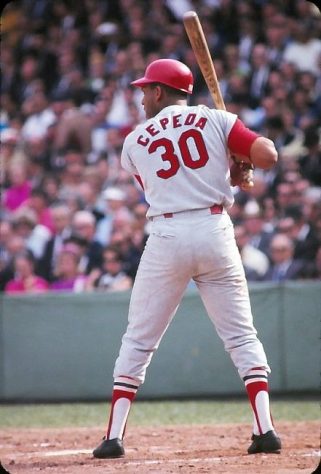
Shocked at first, Cepeda welcomed the deal quickly when he made two discoveries. The Cardinals needed a first baseman in the worst way possible, and his new teammates plus manager Red Schoendienst took a quick liking to his upbeat personality and his equal loves for jazz and Latin music. They nicknamed him Cha-Cha; he returned the favour by nicknaming the 1967 Cardinals El Birdos.

Orlando Cepeda

He nicknamed his 1967 Cardinals El Birdos, and they went on to win that World Series while he won the NL’s MVP.

Well, now. El Birdos would go all the way to winning the World Series and Cha-Cha would go all the way to winning the NL’s MVP. Inexplicably, though there’s always the chance that his repaired right knee might still have tried to rebel, Cepeda went from first to worst of his career to date, sort of, in 1968. Hoping to make a 1969 comeback, he was dealt to the Braves for catcher/third baseman Joe Torre before spring training ended.

Leery about the South (he’d learned the hard way about Jim Crow as a minor leaguer in Virginia over a decade earlier), Cepeda relaxed when reunited with former Giants teammate Felipe Alou and making a new friendship with Hall of Famer Henry Aaron. His regular season was a struggle, but in the new divisional play format with the Braves winning the NL West, Cepeda hit a ton in a losing cause (1.448 OPS) as the Braves got swept in the best-of-five by the Miracle Mets.

He hit a ton in 1970 (34 bombs; .908 OPS) as the Braves fell to fifth place otherwise, but in 1971 his good knee gave out on him. He’d never be the player he once was again other than a surprise 1973 in which he became the Red Sox’s first official designated hitter. Released for youth in 1974, he tried a comeback in the Mexican League and a brief spell with the Royals before calling it a career at last.

Hall of Famer Roberto Clemente’s tragic death in 1972 led Puerto Rico to anoint Cepeda a hero, but in December 1975 his astonishing arrest for accepting a delivery of 170 pounds of marijuana (he claimed he was expecting a smaller amount, for himself) sent him from hero to poison. There wasn’t a jazz performance alive that could save him from that.

“He and his family received death threats,” observed his Society for American Baseball Research biographer Mark Armour. “He lost all of his money on his legal case, which caused him to miss child-support payments and led to more legal trouble. He finally stood trial in 1978, was found guilty, and was sentenced to five years in prison. He served ten months in a minimum-security facility in Florida.”

Cepeda struggled further after his release, losing a job as a White Sox minor-league hitting coach and his second marriage. Somehow, he took up Buddhism and there lay the key to changing his life permanently. “It allowed him to take responsibility for the mess he had made of his life,” Armour wrote, “to get control of his shame and his anger, and to help him find a path forward. He also met Mirian Ortiz, a Puerto Rican woman who eventually became his third wife. He and Mirian moved to the Bay Area, close to where his baseball journey had begun 30 years earlier.”

“Buddhism cleared the air for me,” Cepeda said. “I discovered that winter always turns to spring.”

In time, Cepeda re-established ties with the Giants, first with fantasy camps, then with scouting and roving instruction, and finally as a humanitarian ambassador. He was also elected to the Hall of Fame by the 1999 Veterans Committee, the second Puerto Rican (behind Clemente) to be elected, five years after he missed Baseball Writers Association of America election by seven votes in his final year of eligibility.

Shy of a decade later, Cepeda became the fourth Giant to be immortalised in bronze outside what’s now Oracle Park, joining Mays, McCovey, and Hall of Fame pitcher Juan Marichal, shown standing tall with his customary smile, wearing a first baseman’s mitt and holding a baseball inches from the webbing. It was a long, hard enough road for the man who’d had to use his Giants signing bonus to pay for his father’s funeral.

Let’s pray his widow and five sons find comfort in his eternal serenity in the Elysian Fields. And, that they can’t resist saying, “It figures,” if they discover one of the first things he did upon arrival was seek out a Miles Davis Quintet here, a John Coltrane Quartet there, a Mongo Santamaria group yonder, and engage the only swinging that ever engaged him above and beyond his own with a bat.

Willie Mays, RIP: Loss, but Gratitude

Willie Mays

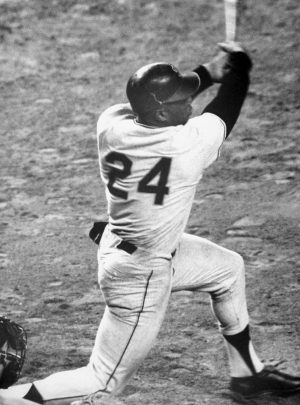
Mays hitting his 500th career home run, in 1965. “He has gone past me,” Ted Williams would say at his own Hall of Fame induction, after Mays hit number 522, “and he’s pushing, and I say to him, ‘Go get ’em, Willie’.”

Seeing Willie Mays in my boyhood when he was a Giant still in his prime was as transcendent as seeing him in his baseball dotage, as a late-career Met, was heartbreaking. Having Mays at all back in the city where he really made his baseball bones was as much a belated blessing as having him too much less than his best was sorrow. But . . .

“What do you love most about baseball?” asked Joe Posnanski, in The Baseball 100. (He ranked Mays number one.) Then, he answered. “Mays did that. To watch him play, to read the stories about how he played, to look at his glorious statistics, to hear what people say about him is to be reminded why we love this odd and ancient game in the first place.

“Yes, Willie Mays has always made kids feel like grown-ups and grown-ups feel like kids. In the end, isn’t that the whole point of baseball?”

But having Mays say farewell the way he did in Shea Stadium on 25 September 1973, with the Mets still yanking themselves back to take a none-too-strong National League East, brought tears not just of loss but of gratitude. If so few of the greats retire before the game retires them, fewer than that retire with Mays’s soul depth:

I hope that with my farewell tonight, you will understand what I’m going through right now. Something that—I never feel that I would ever quit baseball. But as you know, there always comes a time for someone to get out. And I look at the kids over here [pointing toward his Mets teammates], the way they are playing, and the way they are fighting for themselves, tells me one thing: Willie, say goodbye to America.

America never really said goodbye. Now America must say a reluctant au revoir. Mays left this island earth at 93 Tuesday. “I want to thank you all from the bottom of my broken heart for the unwavering love you have shown him over the years,” said his son, Michael, in a statement. “You have been his life’s blood.”

We’ve been his life’s blood? The younger Mays had it backward. His father was the lifeblood of every objective and appreciative baseball fan of his time. He didn’t have to wear the uniform of the team for which I rooted since their birth (not right away, anyway) to be that for me, in hand with Sandy Koufax, and believe me when I tell you that watching Koufax going mano a mano against Mays was something precious to behold.

(For the record, Mays faced Koufax 122 times and nailed 27 hits. Five were home runs, eight were doubles, one was a triple, for 33 percent extra bases off the Hall of Fame lefthander. Mays also wrung 25 walks out of him while striking out 20 times.)

Before Mays’s Giants and Koufax’s Dodgers high tailed it out of Manhattan and Brooklyn for the west coast, the most bristling debates in New York involved not politics, finance, or rush-hour traffic, but baseball. As in, whom among the three Hall of Fame center fielders patrolling the territory for each team was The Best of the Breed.

I was born in the Bronx and raised there and on Long Island; I heard the debates for years to follow after the Dodgers and the Giants went west. I had skin enough in that game long before Terry Cashman wrote and recorded his charming hit, “Willie, Mickey, and the Duke (Talkin’ Baseball).” Well, now. Let’s look at the trio during their New York baseball lives two ways, for all the seasons they played in New York together. (Snider was a four-year major league veteran by the time Mays and Mantle arrived in 1951.)

First, according to my Real Batting Average metric (total bases + walks + intentional walks + sacrifice flies + hit by pitches, divided by total plate appearances):

Together In New York PA TB BB IBB SF HBP RBA
Mickey Mantle 3493 1648 524 34 11 5 .636
Willie Mays 3299 1718 362 70 23 11 .662
Duke Snider 2629 1305 283 42 6 7 .625

Mays has a 26-point RBA advantage over Mantle and that’s with Mays losing over a season and a half to military service. (Mantle’s osteomyelitic legs kept him out of military service; Snider served in the Navy before his major league days began.) Mays also landed 70 more total bases and was handed 36 more intentional walks.

Mantle may have been a powerful switch hitter, but just from one side of the plate Mays outperformed him while they shared New York even with precious lost major league time between ages 21-23. Mantle also had a .756 stolen base percentage to Mays’s .738, but a) Mantle’s already compromised legs kept him from trying more often; and, b) Mays led his league in thefts twice during the period under review. (Snider? Even a hobbled Mantle left him behind: for their shared New York years, his stolen base percentage was .586.)

Sometimes Mantle gets the props as the best of the trio purely because his Yankees were far better teams than the others’. Actually, Snider’s Dodgers were almost as good as Mantle’s Yankees. It was no more Snider’s fault that his Dodgers couldn’t get over those Yankee humps until 1955 than it was Mantle’s sole doing that his Yankees won seven pennants and five World Series (three consecutively) while they shared the Big Apple.

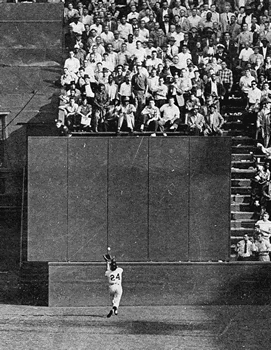
And it was hardly Mays’s fault that his Giants won a mere two pennants in the same shared span, even if Mays’s Giants got squashed by the Yankees in five in the 1951 Series but swept the far better Indians in the 1954 Series. You may have heard of a little play known as The Catch from Game One of that Series, happening when it seemed the Indians had a shot at taking the opener. (Mays would play on two more pennant winners, too, the 1962 Giants—who beat the Dodgers in another memorable pennant playoff—and the 1973 Mets.)

Willie Mays

“The Catch,” of course—460+ feet from home plate in the ancient Polo Grounds.

“That really wasn’t that great of a catch,” harrumphed curmudgeonly Indians pitcher Bob Feller, nearing the end of his own Hall of Fame career. What made him think not? “As soon as it was hit, everyone on our bench knew that he was going to catch it . . . because he is Willie Mays.” (But did they know Mays would also keep Hall of Famer Larry Doby from scoring with an equally staggering throw in to the infield off The Catch?)

Which brings me to the titanic triumvirate in center field. We’re going to look at them according to total zone runs, the number of runs their play in center field turned out above or below their leagues’ averages. Baseball-Reference begins measuring total zone runs with the 1953 season, so we’ll have five solid Big Apple seasons to review for each of the trio:

Willie Mays: +45.
Mickey Mantle: +22.
Duke Snider: +25.

Once again you see where Mantle’s physical health issues got in his way despite his supernatural talent and skill. But it might not have mattered. Mays and Mantle both played in unconscionably deep home center fields before the Giants and the Dodgers left the Apple for 1958. You can fantasise all you like how many runs Mantle might have prevented on good legs, but if you guess that he might have proven just about even you’re making a solid guess.

“Willie Mays going after a fly ball was cotton candy and a carousel and fireworks and a big band playing all at once,” Posnanski wrote. “His athletic genius was in how every movement expressed sheer delight.”

When Mays got to San Francisco, he and Mantle continued their top of the line play. When he got to Los Angeles, Snider had two decent seasons followed by a decline phase that actually took him back to New York for a round with the early Mets before finishing his career in 1964 as . . . a Giant, of all things.

Mantle managed to remain Mantle through the end of 1964. Mays managed to remain Mays through at least 1971. Even if his home run power had dissipated somewhat in the previous four seasons, he spent 1971—at age 40—leading the National League in walks and on-base percentage. Mantle’s body took him out at last at age 36; Mays’s, at age 42; Snider’s, at age 37.

And here is how the trio finished career-wise. First, how they sit among the Hall of Fame center fielders whose careers covered the post-World War II/post-integration/night-ball era, according to RBA:

Center Field PA TB BB IBB SF HBP RBA
Mickey Mantle 9907 4511 1733 148 47 13 .651
Willie Mays 12496 6066 1464 214 91 44 .631
Ken Griffey, Jr. 11304 5271 1312 246 102 81 .620
Duke Snider 8237 3865 971 154 54 21 .615
Larry Doby 6299 2621 871 60 39 38 .576
Andre Dawson 10769 4787 589 143 118 111 .534
Kirby Puckett 7831 3453 450 85 58 56 .524
Richie Ashburn 9736 3196 1198 40 30 43 .463
HOF CF AVG .588

But now, how they sit among center fielders for run prevention above their league averages, showing the top ten:

Andruw Jones +230
Willie Mays +176
Paul Blair +171
Jimmy Piersall +128
Kenny Lofton +117
Devon White +112
Carlos Beltrán +104
Willie Davis +103
Curt Flood +99
Garry Maddox +98

Thanks to his leg and hip issues, Mantle finished his career at -10. Snider finished his at -7; his late career was compromised by knee, back, and arm injuries. (Richie Ashburn, their great Hall of Fame contemporary, finished his career +39.) Two such talented center fielderss who’d had excellent throwing arms and range deserved far better than such physical betrayals.

Mays stood alone as the complete, long-enough uncompromised, all-around package. He was blessed with a body that wasn’t in a big hurry to betray him, but no blessing means a thing if you don’t take it forward. Good luck stopping Mays from doing so. Should-be Hall of Famer Dick Allen once advised Hall of Famer Mike Schmidt to play the game as though he were still the kid who’d gladly skip supper to play ball. Mays played the game precisely that way until age began to say “not so fast,” after all.

“The greats don’t always go gently into that good gray night when they can no longer play the games that made their names,” I wrote when Mays turned 90.

This son of an Alabama industrial league ballplayer fought a small war in his soul when his age insisted he was no longer able to play the game he loved so dearly at the level on which he’d played it for so many years. Some said he’d become sullen, moody, dismissive in the clubhouse. Some resented him, others felt for him, still others mourned.

. . . When he smiled as a Met, you still saw him in his youth, you didn’t see the manchild who was yanked rudely into manhood by a San Francisco that shocked him with skepticism as a New York import rather than a hero of their own. By a San Francisco that also shocked him, for all its reputation otherwise, when his bid to buy a home with his first wife was obstructed long enough by the sting of neighbourhood racism.

Willie Mays

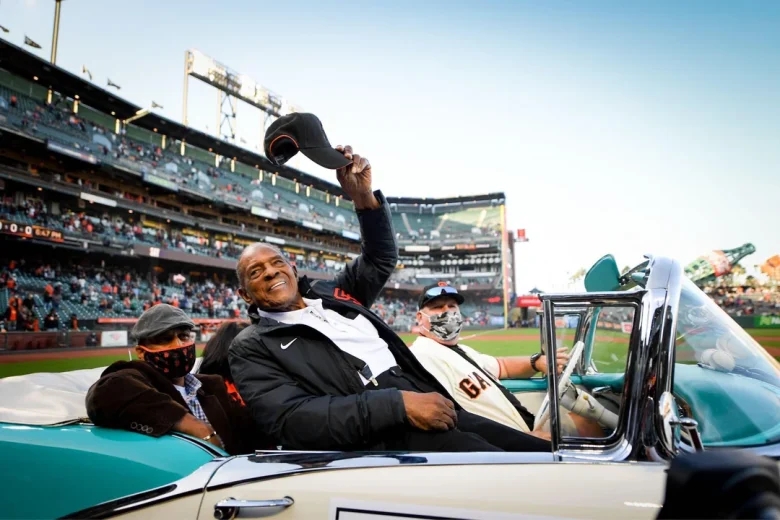
Mays taken for a drive around PacBell Park in a 1956 Oldsmobile to celebrate his 90th birthday. San Francisco came to love him as New York did, but not without growing pains.

After his first marriage ended in divorce and in his son living across country with his mother, Mays dated Mae Louise Allen for about a decade before marrying her after the 1971 season. His happiness there was compromised by her premature Alzheimer’s diagnosis; his caring for her until her death in 2013 is the stuff of true love stories.

A welcome presence at the Hall of Fame’s induction ceremonies following his own in 1979 and at various Giants events (and numerous home games) in the years that followed, Mays wouldn’t be able to attend this year’s Field of Dreams game at Birmingham’s Rickwood Field, the field where he first played with the Birmingham Black Barons of the old Negro American League.

“I’d like to be there, but I don’t move as well as I used to,” he said in a statement on Monday. “So I’m going to watch from my home. But it will be good to see that. I’m glad that the Giants, Cardinals and MLB are doing this, letting everyone get to see pro ball at Rickwood Field. Good to remind people of all the great ball that has been played there, and all the players. All these years and it is still here. So am I. How about that?” A day later, sadly, he was gone.

Mays never apologised for making the game look fun with his fabled basket catches in front of his belt, his winging turns running the bases as his deliberately oversized hat flew off, his high-pitched voice sounding like a kid getting to play yet another inning.

“That’s what his idea was,” said one-time Giants relief pitcher Stu Miller, “to please the crowd.”

“I’m not sure what the hell charisma is,” said Ted Kluszewski, the musclebound Reds first baseman of the 1950s, “but I get the feeling it’s Willie Mays.”

“The only thing Willie Mays could not do on a baseball diamond,” Posnanski wrote, “was stay young forever.”

May his entry into the Elysian Fields, where it’s Willie, Mickey, and the Duke once again,  and especially his reunion with his beloved Mae, have been as joyous for him as the way he played the game was joyous to us for as long as we were honoured to see him play.

Mickey Mantle, as he actually was

Mickey Mantle

Even now it’s impossible to see discussions of Mickey Mantle without unfair laments over what the Hall of Famer wasn’t.

It’s almost three decades since Mickey Mantle’s death and it is a half century since he was elected to the Hall of Fame. Wouldn’t you think by now that the lamentations over what could have been, should have been, would have been, might have have been for Mantle had ceased and desisted? Isn’t what been been far more than enough?

Could have been one of the truly greats. Never quite lived up to his potential. Squandered so much of his enormous talent. Variations on those themes and more. All patent nonsense. I began getting that a-ha! when reading Allen Barra’s 2002 book, Clearing the Bases: The Greatest Baseball Debates of the Last Century.

Barra devoted a chapter to an in-depth comparison between Mantle and his transcendent contemporary Hall of Famer Willie Mays. Near the end of it, he ran down the foregoing laments, sort of, then asked, “But what about what Mantle did do?” to finish the chapter:

We spent so much of Mantle’s career judging him from [his longtime manager] Casey Stengel’s* perception as the moody, self-destructive phenom who never mastered his demons, and we spent much of the rest of Mantle’s life listening to a near-crippled alcoholic lament over and over about what he might have been able to accomplish. For an entire generation of fans and sportswriters who saw their own boyhood fantasies reflected in Mantle’s career and their worst nightmares fulfilled by his after-baseball life, Mantle’s decline became the dominant part of the story.

It’s time to dispel this myth . . . He was one of the most complete players ever to step on a big league field, a hitter with a terrific batting eye . . . spectacular power, blinding speed, and superb defensive ability. He could do things none of his contemporaries could do . . . He could switch-hit for high average and power, and he could bunt from either side of the plate, and no great power hitter in the game’s history was better at stealing a key base or tougher to catch in a double play . . . That his life is a cautionary tale on the dangers of success and excess can not be argued, but as a player he has a right to be remembered not for what he might have been but for what he was.

Of course Barra was and remains right. Even Mantle’s most unapologetically cynical observers buy that of course he’d have smashed Babe Ruth to smithereens, of course he’d have out-run Willie Mays in center field, of course he’d have out-stolen Ty Cobb first, of course he’d have left an impossible bar to clear, if only his lifelong-troublesome legs and a less young-death-present upbringing had left him the whole body and fully sound mind do it.

(For a contrast, hark back to Jim Bouton’s original lament in Ball Four: “Like everyone else on [the Yankees], I ached with Mantle when he had one of his numerous and extremely painful injuries. I often wondered, though, if he might have healed quicker if he’d been sleeping more and loosening up with the boys at the bar less. I guess we’ll never know.” Critics crucified Bouton over that, written in 1969-70. Whoops.)

If only. Enough.

When Barra wrote, no player—not Hall of Famers Lou Gehrig, Yogi Berra, Babe Ruth, nobody—played more games as a Yankee than Mantle’s 2,401. Hall of Famer Derek Jeter got to play two more seasons and 346 more. Jeter’s the only Yankee to suit up in the fabled pinstripes for more games than Mantle did.

If you want to lament what couldawouldashouldamighta been for Mantle, you should keep it to his center field play. That’s where his notorious legs really cost him. Sure, he could run a fly ball down with the best (he saved Don Larsen’s World Series perfect game with just such a running stab), but he finished his career ten fielding runs below his league average in center field—and only once was good for ten or more above it. (In 1955.)

Mantle had an excellent throwing arm but his legs kept his range factors at his league’s average as long as he played center field. He had twenty outfield assists in 1954 . . . and ten or more only twice more his entire career, both in the 1950s. His legs also hurt him on the bases: he did finish with an .801 stolen base percentage, but playing in the time when the running game returned he never stole more than 21 bases in a single season.

But . . . he did take extra bases on followup hits 54 percent of the time he reached base in the first place. Willie Mays out-stole him (and led the entire show annually from 1956-58), yet Mays finished with a slightly lower lifetime stolen base percentage. (.767.) In center field? No contest. Mays was worth +176 fielding runs lifetime.

So who was really better at the plate? I’m going to repeat a table I posted as a footnote a few days ago, when I assessed where Mike Trout sits among Hall of Fame center fielders who played all or most of their careers in the post-World War II/post-integration/night-ball era. The table looks at those center fielders according to my Real Batting Average metric: total bases + walks + intentional walks + sacrifice flies + hit by pitches, divided by total plate appearances:

Player PA TB BB IBB SF HBP RBA
Mickey Mantle 9907 4511 1733 148 47 13 .651
Willie Mays 12496 6066 1464 214 91 44 .631
Ken Griffey, Jr. 11304 5271 1312 246 102 81 .620
Duke Snider 8237 3865 971 154 54** 21 .615
Larry Doby 6299 2621 871 60 39** 38 .576
Andre Dawson 10769 4787 589 143 118 111 .534
Kirby Puckett 7831 3453 450 85 58 56 .524
Richie Ashburn 9736 3196 1198 40 30** 43 .463
AVG .576

Mantle’s RBA is twenty points higher than Mays. (Trout, I repeat, is 21 points higher than Mantle at this writing, believe it or not.) You might notice that he took almost two hundred more walks than Mays despite playing several seasons fewer. They actually finished with the same average home runs per 162 games (36), but Mays was the far more difficult strikeout: 66 per 162 games, compared to Mantle’s 115.

So where would Mantle finish with an RBA twenty points higher than Mays. Look deeper. Mantle hit into far fewer double plays than Mays did. Even with his badly-compromised legs, which you might think would get him thrown out at first a little more often in such situations, Mantle hit into 138 fewer double plays than Mays did.

Here’s a couldashouldawouldamighta for you: Imagine how many fewer double plays Mantle might have hit into if he had healthy or at least less-frequently-injured legs. Today’s blowhard fans, writers, and talking heads love to yap about the guys who strike out 100+ times a year. Ask them whether they’d take Mays’s 66 against 11 GIDPs a year . . . or Mantle’s 115 against six.

Try this on for size. Mantle was seen so often as lacking compared to the Hall of Famer he succeeded in center field, Joe DiMaggio. Yet, and Barra himself noted this in the aforementioned book, Mantle averaged 83 more strikeouts than DiMaggio . . . but DiMaggio hit into seventeen more double plays even playing five fewer seasons. When last I looked a strikeout was a single out. (Unless, of course, you swing into a strike-‘im-out/throw-’em-out double play, and we don’t know how many of those were involved in Mantle strikeouts.)

Here’s another: In the same era, only three players have win probability added numbers above 100. In descending order, they are: Barry Bonds (127.7), Ted Williams (103.7), and Mays (102.4). Henry Aaron’s 99.2 is just behind Mays; Mantle’s 94.2 is right behind Aaron. Those are the only five players from the same era with WPAs 90 or higher. (Did I forget to mention Teddy Ballgame whacked into 197 double plays?)

If you still want to tell me that a guy with a 94.2 win probability added factor “didn’t live up to his potential,” go right ahead. But then I’m going to tell you that we don’t have to wonder what couldawouldaashouldamighta been if Mantle’s physical and mental health allowed.

They didn’t calculate wins above replacement-level player [WAR] when Barra wrote Clearing the Bases, alas. Mays (156.1) has Mantle (110.2) beaten by ten miles. Mantle was 36 when he retired. Mays from 36-40 was still worth an average 5.0 WAR a season, which is actually still All-Star caliber. It’s not Mantle’s fault Mays’s body allowed him a longer useful baseball shelf life. Any more than it was Mays’s fault he didn’t get to play on more than four pennant winners and one World Series champion.

I don’t know if the foregoing will put a lid on the couldawouldamightashoulda stuff around Mantle once and for all. But I can dream at least as deeply as all those fans and sportswriters did when Mantle was in pinstripes doing things nobody else save one in his time did, and doing it for teams that won twelve pennants and seven World Series rings while he did them.

For me, I haven’t cared about how great he couldawouldamightashoulda been since I first read Barra’s book. I still don’t. Pending the final outcome of Mike Trout’s career (Trout, too, has had injury issues enough the past three seasons, and he’s right behind Mantle as the number five center fielder ever to play, according to Baseball Reference), Mantle and Mays remain the two single greatest all-around position players who ever suited up.

It’s still heartbreaking to remember Mantle apologising for and owning what he wasn’t in life itself not long before his death. But he owes nobody any apology for what he was on a baseball field in spite of his compromised health. Barra remains right: “as a player he has a right to be remembered not for what he might have been but for what he was.”

———————————————————————————-

* My personal favourite story about Mickey Mantle and Casey Stengel: When Mantle first became a Yankee, the team was scheduled to play an exhibition with the Dodgers in Ebbets Field before the regular season began. Stengel took Mantle to the once-fabled Ebbets Field wall from right field to center field, bisected by a giant scoreboard and beveled to create an angle toward the field in its lower half.

Stengel wanted to show Mantle the tricky angles made by the scoreboard and the bevel. “Now, when I played here,” Stengel began. He was cut off by Mantle exploding into laughter, hollering, “You played here?!?” (Stengel did, as a contact-hitting, base-stealing  outfielder with the Dodgers from 1912-1917, then with three other National League teams including the Giants from 1918-1925.)

“Boy never saw concrete,” the Ol’ Perfesser told a reporter who happened to overhear the exchange. “He thinks I was born sixty years old and started managin’ right away.”