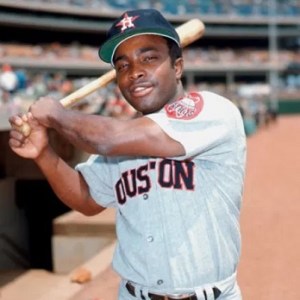
Dick Allen, RIP: Big stick, bigger man

Dick Allen’s big stick hit home runs that should have had astronauts aboard.

Around noontime Monday (PST), his family announced it on his own Twitter account. I came home from a morning errand to see the news, and I could only open his Twitter and write, without clicking on the heart symbol for a like, “How can you like the passing of a great ballplayer and a good man?”

Dick Allen is dead at 78 after a battle with cancer. There’d been a swell of support for his election to the Hall of Fame in recent years. He might have made it via the Golden Era Committee this year. Except the committee decided that, well, if they couldn’t meet in person to discuss and vote, by God they weren’t going to meet until next year.

When they made that announcement in late August, I zapped the Hall of Fame and the Committee for suddenly discovering their inner Luddism: “Hall of Fame chairman Jane Forbes Clark seems to think, erroneously, that technology mustn’t overcome the coronavirus’s travel confusions and constrictions to compromise Era Committee nominations and elections.”

They never heard of setting up a Zoom remote conference? Trust me, since I just took part in my own first one. They can be set up simply, such a conference is restricted to invited guests via meeting codes and passwords, and none would have compromised the integrity of the discussions and votes.

The Committee pushed the meeting back to winter 2021. They just might elect Allen this time around. (He missed by one vote the last time around, in 2014.) Only he’ll be well serene and happy in the company of the angels and not on earth to accept the plaque I’m sure his family will accept proudly when it’s awarded.

It’s not that my opinion means two figs, but I’ve championed Allen’s Hall of Fame election for long enough now, and I’ve seen nothing to change my mind about it. I was on the fence about it for a good long while before that, alas, but once and for all I took as deep a look into the record as it was as I could and became convinced. Allen has a no-questions-should-be-asked case as a peak value Hall of Famer.

If you consider his peak to be 1964-1972, Allen’s .936 OPS and 164 OPS+ should say most of it, especially considering most of that peak came in one of the toughest hitting eras ever. If you consider the absolutely unfair and out-of-line racism he was forced to face and fight, especially as a Phillie, it’s to wonder and marvel that he could even check in at the plate, never mind play as he did when he was healthy.

Let’s look at Allen and his big stick by way of my Real Batting Average (RBA) metric. When I first examined Allen that way two years ago, I discovered a flaw: I shouldn’t have included sacrifice bunts or excluded times he was hit by pitches. The former’s flaw: you shouldn’t be credited when you’re surrendering outs willingly; outs are precious. The latter’s flaw: if the pitcher’s fool enough to drill you, let it be on his head and to your credit.

The RBA metric otherwise is a bid to atone for the incompleteness of the traditional batting average, one of the single most flawed statistics ever devised. Hits divided by official at-bats treats all hits equally and misses too much of what batters do to create and produce runs on the scoreboard. (You still think all hits are equal? Tell me why a single’s as good as a double, triple, or home run and vice versa. Didn’t think so.)

My RBA adds total bases (which treats hits the unequal way they deserve), walks, intentional walks (one more time: you should damn well get credit when the other guys prefer you take your base than their heads off), sacrifice flies (you didn’t intend to fly out but it scored a run so credit to you!), and times you were hit by pitches, and divides the sum by your total plate appearances.

And, this is Dick Allen’s peak according to RBA:

Years PA TB BB IBB HBP SF RBA
1964-72 5,457 2,592 685 120 11 33 .631
Career 7,315 3,379 894 138 16 53 .612

Rest assured that these numbers helped rank Allen among the top twenty third basemen who ever played major league baseball. They would also show him with the third-highest RBA of all post-World War II/post-integration/night-ball era Hall of Fame third basemen except two: in ascending order, Chipper Jones and Mike Schmidt.

This is before revisiting his breathtaking power or mentioning that Allen was one of the smartest and most effective baserunners of his time. (Did you know Allen took extra bases on followup hits 53 percent of the time he reached base?) And, before lamenting that early enough injuries impacted his defense either at third base or the position to which his injury-weakened throwing arm finally sent him full time, first base.

Allen didn’t just hit home runs. Phrased politely, they didn’t need the proverbial meals and stewardesses aboard. What he hit typically should have had astronauts. When first analysing his performance two years ago, I concluded based on the evidence that, if he’d been far more healthy and uninjured, Allen might have finished his career with 525 home runs or thereabout.

Dick Allen sharing a big laugh with his old Phillies teammate Jim Bunning at an old-timers’ event in Citizens Bank Park.

Hall of Famer Willie Stargell once tried to take the sting out of the Philadelphia boo birds’ booing Allen by suggesting the reason they booed him was that his home runs didn’t always stay in the park to become souvenirs.

That’s putting things too politely. Allen once told a Phillies historian (and an Allen biographer), William C. Kashatus, “I thought of myself as a victim of racism. I was also something of a jerk. There were others who had to deal with racism, and some of them handled it better than I did. But that’s all in the past. I’m at peace with my career, and grateful that the Lord gave me the opportunity.”

A man who grew up in a racially tolerant and accommodating Pennsylvania hamlet, but whom the Phillies sent to 1963 Little Rock with no support system, who once remembered, “Maybe if the Phillies had called me in, man to man, like the Dodgers had done with Jackie Robinson, and said, “Dick, this is what we have in mind. It’s going to be very difficult but we’re with you”—at least I would have been prepared,” has no reason to apologise.

Whether you believe he was a jerk or just immature, some people persist in believing Allen’s career was shortened by it. Not so, argued Rob Neyer when writing The Big Book of Baseball Lineups: “I don’t think his immaturity had much to do with the length of his career. He just got hurt, and so he didn’t enjoy the sort of late career that most great hitters do. It’s that, as much as all the other stuff, that has kept him out of the Hall of Fame.”

Oh, the sad irony. When the Phillies finally traded Allen out of town, to the St. Louis Cardinals, they thought they were getting Curt Flood in return in the package. To Flood, the trade smacked of treating even a $90,000 a year center fielder as a piece of property like a slave. To Allen, who’d been to hell and back almost daily in Philadelphia and rooted for Flood’s reserve clause lawsuit, the trade was his Emancipation Proclamation.

Allen incurred assorted nagging injuries and severe leg injuries after leaving Philadelphia and especially during his otherwise shining time with the Chicago White Sox. (He won the American League’s Most Valuable Player award in his first White Sox season.) “[W]hat he did for us in Chicago was amazing,” said Allen’s White Sox manager, Chuck Tanner.

Dick was the leader of our team, the captain, the manager on the field. He took care of the young kids, took them under his wing. And he played every game as if it was his last day on earth . . . He played hurt for us so many times that they thought he was Superman.  But he wasn’t; he was human.  If anything, he was hurting himself trying to come back too soon.

The best short summary of the hell through which Allen was put so unconscionably in his Philadelphia years—by Little Rock, by a Philadelphia sports press and population uncertain or unthinking about the city’s racial growing pains, by some teammates likewise uncertain or unthinking—belongs to Jay Jaffe, in The Cooperstown Casebook:

[C]hoosing to vote for him means focusing on that considerable peak while giving him the benefit of the doubt on the factors that shortened his career. From here, the litany is sizable enough to justify that. Allen did nothing to deserve the racism and hatred he battled in Little Rock and Philadelphia, or the condescension of the lily-white media that refused to even call him by his correct name. To underplay the extent to which those forces shaped his conduct and his public persona thereafter is to hold him to an impossibly high standard; not everyone can be Jackie Robinson or Ernie Banks. The distortions that influenced the negative views of him . . . were damaging. To give them the upper hand is to reject honest inquiry into his career.

His death before the Hall election he deserves inflicts a final injustice upon a man accompanied by too many injustices too long. It elevates him and reduces his critics further that he eventually found equilibrium in his life and peace with baseball.

Allen knew and survived heartbreak enough outside of the racial buffetings: a painful divorce, the unexpected murder of his daughter, Terri, the electrical-fire destruction of the farm on which he hoped to raise thoroughbred horses. (“If my horse can’t eat it, I don’t want to play on it,” he once cracked about artificial turf.)

He overcame those to re-marry happily, keep friends and family close, become one of the most popular members of the Phillies’ speakers’ bureau under a very different organisation than the one for which he played, and a friendly social media presence who beamed justifiably when the Negro Leagues Hall of Fame inducted him in 2018.

When the Phillies finally retired Allen’s uniform number 15 in September, the Philadelphia Inquirer suggested the timing might have been intended partially to push for Allen’s at-last enshrinement in Cooperstown. Allen himself once told Kashatus, “What I’ve done, I’m pretty happy with it. So whatever happens with the Hall of Fame, I’m fine with it. Besides, I’m just a name. God gave me the talent to hit a baseball, and I used it the best I could. I just thank Him for blessing me with that ability and allowing me to play the game when I did.”

Former Phillies pitcher Larry Christenson, an Allen teammate when the latter returned to Philadelphia in 1975, remembered then a teammate’s teammate who preferred to lead by quiet example and humanness. Allen often invited Christenson to lunch on road trips and once signed a bat for him as a memento: “To L.C., two homers with my bat. How about that? Dick Allen.”

Christenson once borrowed Allen’s once-fabled 40-ounce bat in a game. “Son,” Allen told the pitcher, “if you can swing it, you can use it.” Christenson used it to hit a home run in that day’s game.

Bereft on earth now are Allen’s loving wife, Willa, his family, his friends, and all of those who saw through the cluttering, clattering nonsense and saw the player and the real young man who didn’t deserve his seasons in hell and deserved election to the Hall of Fame. Now that election will have to be posthumous on earth, damn it.

But surely the Lord’s angels escorted Allen kindly and gently to the Elysian Fields, and that was the only other thing we could ask through our own loss.

————————————————————————–

Some portions of this essay have been published by the author previously.

How I vote on this year’s IBWAA Hall of Fame ballot

(Photo of the Hall of Fame by the Hall of Fame.)

The Internet Baseball Writers Association likes to vote for the Hall of Fame, too, even though it’s purely a symbolic vote, and never mind that some IBWAA members are also voting members of the Baseball Writers Association of America. As an IBWAA life member myself, the exercise is exhilarating and only occasionally frustrating.

Most of the time, the frustration is because there are those candidates still on the BBWAA Hall ballot whom the IBWAA previously “elected.” When an IBWAA vote into the Hall coincides with a BBWAA vote into the Hall, though, it’s a pleasant exhilaration. When we choose a Hall of Famer before the BBWAA does, we get to claim bragging rights for foresight and insight. (Don’t we?)

As I do pretty much every year, I vote in the IBWAA election and give my most reasonable explanations for my vote. Even knowing as I do that my opinion means three things (jack, diddley, and squat) in the big picture, and even knowing it would be easier to glean right reason from a politician’s fustian than to get me an official Hall of Fame vote, we of the IBWAA count for more than something so far as I’m concerned.

So, with six “yes” votes to be submitted to the IBWAA tally this time around—and equal support for the same voting transparency among the BBWAA—this is how I marked my IBWAA Hall ballot. First, my “yes” votes:

Todd Helton—Helton may be hurt by the Coors Canaveral factor even more than Larry Walker was for long enough. Unlike Walker, The Toddfather never got the chance to show what he could do with a park other than Coors as his home park. Even with the width of his home/road splits, though, Helton hit respectably enough on the road that you’d have a hard time convincing anyone that he wasn’t as Hall of Fame as a first baseman gets.

Helton also crosses the average Hall of Famer’s batting threshold according to Bill James’s Monitor and Standards measures, and his peak value is a few points above the average Hall of Fame first baseman.

One of those rare birds who walked more often than he struck out, Helton also struck fear enough into opponents with 185 intentional walks to prove it. He was an on-base machine (.414 lifetime OBP) with power to boot. And he was something else you can look up: he was deadlier at the plate with men on and/or in scoring position than he was with the bases empty.

Defensively, Helton wasn’t quite the second coming of Keith Hernandez, but he was an excellent defensive first baseman, too. All the above sound like a Hall of Famer to me.

Andruw Jones—His too-staggering decline phase, beginning in his final, injury-marred season in Atlanta, turned Jones into a punch line he didn’t exactly discourage when he came across as indifferent as well as ill-conditioned in Los Angeles and ended up being bought out of his deal.

So what makes Jones a Hall of Fame candidate? His peak through age 29. He was an above average hitter whose late-career health issues might have kept him from hitting 450 or even 500 lifetime home runs, but even more is that he was off the charts as a run-preventive center fielder.

Jones had a solid throwing arm and a genius for finding the right routes to balls despite his tendency to more shallow positioning. It might have cost him highlight-reel time but it elevated him where it matters most. The only player with more defensive runs above league average than Jones at any position is Brooks Robinson: +293 for Robinson, +253 for Jones, who’s also +80 ahead of Willie Mays.

Read carefully: I’m not calling Jones a better player than Mays, I’m not even calling him a better player than Ken Griffey, Jr., and I saw all three of them play in or while still in their primes. (Don’t ask about Griffey’s run prevention numbers alone—trust me when I say you’ll be embarrassed.) But I am saying Jones was the most run-preventive center fielder who ever hit the yard.

By wins above replacement-level player, Jones’s seven-year peak WAR is above the peak value of the average Hall of Fame center fielder. There is a large enough contingency of Hall of Famers who got to Cooperstown by their peak value. If the Hall really is giving defense more attention than in the past, Jones would not disgrace it by being there.

Jeff Kent—Yes, he’s the best-hitting second baseman of the expansion era. But despite his late settling-in (traded three times before he found a home with the Giants at 29), Kent was also product enough of a high-scoring era. For middle infielders, defense looms large enough, and Kent wasn’t a particularly great-fielding second baseman despite his deftness on the double play: -42 defensive runs below league average doesn’t bode well.

He was his own worst enemy with a personality often described as “prickly,” but a lot of his issues come down to his health. He incurred enough injuries later in his career that, married to his early-career mishandlings before reaching San Francisco, it puts him just outside the top twenty second basemen of all time.

Still, less crowded Hall ballots may give Kent a jump before his time on the BBWAA ballot ends. So might his 351 home runs as a second baseman, the most for any player playing that position. So might his overall fine postseason record. The question becomes whether Kent’s once-notorious attitude problems remain enough to keep the writers from putting him in no matter the ballot crowd.

I wasn’t exactly Kent’s biggest admirer myself for long enough, but I won’t object if he’s elected to the Hall in due course. If he doesn’t survive on the BBWAA ballots yet to come, a future Era Committee may give him a second and deeper look and elect him.

Scott Rolen—Why on earth would a player who was Rolen’s kind of near-perfect balance between an excellent hitter and a top-of-the-line fielding third baseman be villified and sullied?

If you were the Phillies with whom Rolen came up, and you were the kind of fellow who spoke softly, carried yourself likewise, and let your preparation and play do your talking for you, you just weren’t Loud Larry Bowa’s and Drill Sgt. Dallas Green’s type. They were fool enough to dismiss Rolen as an indifferent player when every teammate he had knew better.

And Rolen’s propensity to hustle himself into injuries actually added to the sullying. After the Phillies shipped him to the Cardinals, Rolen played the same kind of hard, delivered the kind of performances that helped the Cardinals to some postseasons including one ending in a World Series ring, but he ran afoul of Tony La Russa over, you guessed it, injuries.

It galled Rolen no end that his manager might sour on him for being injured in honest competition, and La Russa likely forced Rolen’s trade to Toronto, a trade then-Cardinals GM John Mozeliak publicly came to regret making. Former Cardinals GM Walt Jocketty knew better—hearing that Rolen wanted to play closer to home, he pried Rolen out of the Blue Jays for the Reds and Rolen helped them to a couple of postseasons, too.

The injuries might have kept Rolen from putting up fireworks-spectacular numbers at the plate but he was a great third baseman. Then-Brewers manager Ned Yost wasn’t blowing smoke when he called Rolen “the perfect baseball player. It’s his tenacity, his preparation, the way he plays. He tries to do everything fundamentally sound. And he puts the team first—there’s no fanfare with him.”

He wasn’t the hitter Chipper Jones was, but Jones wasn’t the defender Rolen was, either. (Rolen’s 122 OPS+ is ninth among third basemen all time.) Rolen won eight Gold Gloves and they weren’t given to him by reputation alone; among third basemen, only Hall of Famers Brooks Robinson and Mike Schmidt have more. He had eleven seasons of averaging ten or more runs saved and three in which he averaged twenty or more; his 140 total defensive runs above league average is the nineteenth-highest of any defender at any field position anywhere and tied for sixth among third basemen.

Rolen’s number one problem his entire career was that he didn’t present himself as a star. He preferred to leave it on the field and at the plate; he wasn’t a publicity hound and never really tried to become one.

His Hall candidacy has received more traction each year he’s been on the ballot. Considering this year’s absolute paucity of first-time candidates who really belong in the Hall of Fame, Rolen’s vote could jump even more profoundly than it did last year. A third baseman whose number one selling point is strong hitting and top of the line defense deserves better.

Curt Schilling (with prejudice)—On the mound: no-questions-asked Hall of Famer. One of only four pitchers to strike 3,000+ out and walk less than 1,000, and he did it in a glandular time for hitting. (The others: Hall of Famers Ferguson Jenkins, Greg Maddux, and Pedro Martinez.)  He all but demanded the big-game heat and delivered when he got it most of the time.

Off the mound: no-questioned-asked jerk. It only begins with eleven words: “Rope. Tree. Journalist. Some assembly required,” on a T-shirt; “OK, so much awesome here,” in a tweet Schilling deleted swiftly enough when the you-know-what hit the you-know-what and he pleaded sarcasm. He also said of it in due course, “Gotta own the times you go off the rails.”

Let’s let Jay Jaffe have the ultimate word, from The Cooperstown Casebook:

I wouldn’t invite Schilling into my own home, and I wouldn’t encourage anyone to view him as a role model, but in my view nothing in his career leaves a doubt that he belongs in Cooperstown. He ranks among the all-time greats via his run prevention skill, his dominance in the game’s most elemental battle of balls and strikes, and his repeated ability to rise to the occasion when the on-field stakes were highest.

I don’t have to love or respect Schilling as a person to respect what he did on the mound. When you take your children to Cooperstown, and you see Schilling’s plaque, just tell them he isn’t the first and won’t be the last to be a Hall of Famer at the ballpark and a Hall of Shamer away from it.

Gary Sheffield—Strictly by his counting statistics Sheffield has a Hall of Fame case. His talent was as outsized as his reputation for self-centricity.

He was a study in pending destruction at the plate and he had a one-for-one-and-all-for-Gary reputation. He also had a very strange problem for a guy whose career came largely in a high-offense era and who could invoke terror with one swing: he played too much in home parks that didn’t really favour righthanded hitters. (His time in Dodger Stadium was an exception; he hit very well there.)

That plus the nagging injuries he battled for much of his career land Sheffield in a strange position. For all his home runs (509), for all that he sits in the top 25 for walks and runs created, his offensive winning percentage (.687) puts him just inside the top one hundred. A player that talented with his kind of stats should have pulled up a lot higher.

Sheffield played on several pennant contenders and won a World Series ring with the 1997 Marlins. (He also got dumped among the many in the notorious fire sale following that triumph.) His home runs may make you (and him) think he’s a no-questions-asked Hall of Famer, but taken all around his paucity of black and gray (top-ten finishing) ink leaves him at pronounced tweener status. He looks as borderline as borderline gets.

If you look at him according to WAR, Sheffield’s defensive deficiences slaughtered him: he had a fine throwing arm but his -195 fielding runs below league average left him the second lowest of all time. It’s the reason why his peak and career WAR are well below the Hall of Fame standard for right fielders.

In some ways Sheffield was a wronged man. When the Brewers sent him down early in his career after accusing him of faking an injury, he wanted out and badly. He tended to nuke more than burn bridges when he felt he was done wrong. He was also accused falsely of tanking plays with the Brewers after a hard wild throw in the minors caused a rift with a manager who subsequently apologised to him.

He got dinged by the BALCO case when it turned out he really might have been tricked into using an actual or alleged performance-enhancing substance. It’s also important to know that that occurred before baseball finally faced the issue and implemented testings and penalties, and Sheffield didn’t exactly make it his life’s indulgence. Even the hardest-line writers against actual or alleged PEDs inclined to give Sheffield the benefit of the doubt.

So do I. There are worse men in the Hall of Fame than Sheffield, and there are Hall of Famers who were their own worst enemies to a far greater extent. He may end up having to wait for an Era Committee to send him there, but Sheffield wasn’t just a study in likely destruction at the plate, he has a real Hall of Fame case.

And he won’t be even a hundredth as controversial a Hall of Famer as Harold Baines (for his record, not his person) is or Curt Schilling (for his person, not his record) may yet become.

Billy Wagner—Maybe the most underrated relief pitcher of his and just about any time. He was as lights out as relief pitchers got and then some, even allowing that nobody yet has really figured out a final objective and definitive way to rate relief pitchers of any era.

He yanked himself to a pinnacle following a childhood about which “hard scrabble” might be an understatement. (Too-frequent home changes; poverty so profound that peanut butter on a cracker equaled dinner often enough.)

Billy the Kid was a small guy who made himself into a lefthanded assassin (two right arm fractures during his impoverished childhood compelled him to go portside); he finished his fifteen-year career with a 0.99 walks/hits per inning pitched rate; and, when it comes to win probability added, Wagner has only four relievers ahead of him, Hall of Famers all: in ascending order, Trevor Hoffman, Goose Gossage, Hoyt Wilhelm, Dennis Eckersley, and The Mariano.

He was also on his own planet when it came to missing bats. In fifteen full major league seasons (he had a cup of coffee with the 1995 Astros), his strikeouts-per-nine innings rate fell below 10.0 only once; he retired with a lifetime 11.9 rate. Nobody could hit this guy too often: the lifetime batting average against him is .187. Here’s how the hitters did against the other Hall of Fame relievers:

Lee Smith—.235.
Rollie Fingers—.232.
Bruce Sutter—.230.
Goose Gossage—.228.
Dennis Eckersley—.225.
Hoyt Wilhelm—.213.
Trevor Hoffman—.211.
Mariano Rivera—.211.

Would you like to be reminded whom among those men pitched in the most hitter-friendly time? That would be Smith (in the final third of his career), Hoffman, The Mariano, and Billy the Kid. It’s to wonder how much more stupefying the record might be if Wagner could have avoided assorted injuries including late-career Tommy John surgery.

If Wagner had any flaw, it was his almost Sheffield-like tendency to nuke bridges once he left town, though for very different reasons. Neither player came up the easy way before entering baseball, but Wagner waged war against those he thought didn’t share his competitiveness and determination.

When the Astros traded him to the Phillies and subsequently remade their roster for their run to the 2005 World Series, Wagner lamented publicly that he wished they’d done it the year they traded him. With the Phillies in 2005, he questioned the team’s commitment publicly and ripped them after leaving for the Mets.

In due course, though, Wagner admitted in his memoir, A Way Out, “I learned a lot about criticism and how not to be a leader when I was traded,” he wrote, specifying leaving the Astros but applicable to the rest of his career, too. When he walked away after 2010, he decided his family was a lot more important to him than whatever else he could accomplish as a pitcher.

“There’s nothing left for me to do in baseball,” Wagner admitted thinking the final time he drove away from the ballpark but into retirement. “I’m not going to change anyone’s mind about whether I’m a Hall of Famer. People are either going to like me or hate me, and I can’t change their minds. Besides, life is about a lot more than this game.”

His Hall vote from the BBWAA jumped from 16.7 percent in 2019 to 31.7 percent last January. The guy from whom The Mariano swiped “Enter Sandman” as his entrance music just might have a surprise or three left that just might finish with him standing where he belongs in Cooperstown.

Now, the no votes. First-time ballot entrants are marked with an asterisk.

Bobby Abreu—When Abreu retired, I noticed that he was a lot closer to being a Hall of Famer than people thought. He was a five-tool player; he was one of the most disciplined hitters of his time; he had power and speed to burn together; and few players in his time were as good at wearing pitchers down as he was.

He didn’t quite cross the thresholds to Hall of Fame performance in the end, unfortunately, even if he managed to remain an on-base machine. Defensively, he was the least appreciated top-of-the-line right fielder in his first eight seasons, yet he didn’t win a Gold Glove until 2005 when his defense already turned to the negatives for run prevention.

Abreu’s career deserves second, third, even fourth looks regardless. He may not quite be a Hall of Famer after those, either, but he was a terrific player.

Mark Buehrle*—A no-hitter and a perfect game enhance his career, and he was a fine pitcher who was excellent on more than a few occasions. (He was also a pretty sharp fielder at his position.) But neither the traditional nor the advanced analyses get him through the door, nor does his postseason record overall enhance him. Buehrle shakes out as the number 90 starting pitcher of all time.

He might linger a little past the five percent threshold in year one of his Hall eligibility, but I can’t see him going past that.

A.J. Burnett*—It’s not a stretch to guess that the injury-prone Burnett reached the Hall of Fame ballot purely because he’s retired five years. He had a seventeen-year career that landed him number 352 on the all-time starting pitching survey, and it’s to wonder whether his injuries—including Tommy John surgery that cost him most of 2003 and a third of 2004—kept him from performing equal to his talent.

Burnett’s career was also stained when the Marlins asked him to leave the team down the stretch in September 2005, after he ripped the faltering Fish to reporters saying, “We played scared. We managed scared. We coached scared,” after a 5-3 loss to the Braves. He apologised in due course, but he went on to the Blue Jays, the Yankees, the Pirates, and the Phillies. The injuries continued.

Michael Cuddyer*—Dependable hitter, a fan favourite in Minnesota, but nowhere within rear-view visual distance of a Hall of Famer. He has a place in baseball history, though: he’s the only major leaguer to hit for the cycle and hit two home runs in the same inning during the same season. (He turned that trick in 2009.)

Dan Haren*—Sure looked like a Hall of Famer in the making early in his career. It didn’t stay that way, although the oft-traveled pitcher did post a fine career in the end.

LaTroy Hawkins*— A Hall of the Gold Watch candidate, but that’s all. He was good enough to be in bullpens for sixteen major league seasons after spending his first five as a fifth starter. The enemy batters hit .257 off him lifetime when he came out of the pen, though with 78 home runs against him lifetime as a reliever he wasn’t a pushover for the long ball out of the pen, either.

Tim Hudson*—He looked even more like a Hall of Famer in the making when he was making his bones in Oakland, but he didn’t look that much like one after leaving Oakland. But he could be and often was a terrific pitcher who worked in quite a bit of hard luck.

Torii Hunter*—He looked more like a Hall of Famer at the peak of his career than he really was, and he might survive a ballot or three before falling away. But Hunter was a terrific player who hit well and played center field around the league averages on the plus side, though not well enough to save as many runs as his skills and Gold Gloves suggested. He was also well respected in his clubhouses.

Andy Pettitte—Turn away permanently from the actual or alleged performance-enhancing substance issue and face the fact once and for all: Pettitte used human growth hormone briefly and to recover from an elbow injury. He wasn’t looking for another edge on the mound.

In 2002 I was injured. I had heard that human growth hormone could promote faster healing for my elbow. I felt an obligation to get back to my team as soon as possible. For this reason, and only this reason, for two days I tried human growth hormone. Though it was not against baseball rules, I was not comfortable with what I was doing, so I stopped.

Everybody with me? Good. Now hear this: Pettitte was practically the same pitcher in the regular season as he was in the postseason—what Jaffe has called a plowhorse rather than a racehorse. Regular-season ERA: 3.85. Postseason ERA: 3.81. World Series ERA: 4.06. He was durable and dependable, and that was all.

The lefthander was famous for his look of peering out over his upraised glove while taking his signs, while living on the ground ball with his sinkers and cutters. But he piled Hall of Fame-looking win totals as much on high run support as his own ability (his run support was 10 percent better than the park-adjusted league average before his first attempt at retirement, Jaffe has recorded), and he wasn’t as good at missing bats as a lot of contemporaries who won’t be seen in Cooperstown except among the guests.

Pettitte’s a classic example of truly tenacious competitor who was really an above-average pitcher and occasionally great. But the Hall of Fame isn’t just about “above average,” unfortunately. Which is a shame because Pettitte was one of those Yankees who earned respect even from those to whom just the mere mention of the team’s name is enough to send them through the ceiling.

He ends up at this writing as number 91 among all-time starting pitchers. Didn’t I mention Mark Buehrle is number 90?

Aramis Ramirez*—He looked most like a Hall of Famer during his first five seasons with the Cubs. For an eighteen-season career that’s not even close to enough. He actually out-homered a few Hall of Fame third basemen in the end, but he played in a higher-offense time and he wasn’t that good a defensive third baseman.

Manny Ramirez—His Hall of Fame case is entirely in his bat. He’s got the numbers at the plate for enshrinement. No questions asked. He also has the attitude history (Manny Being Manny) and issues that made him as big a pain in the butt to his own teams as he was to opposing pitchers.

The amusement factor of Manny Being Manny died long before his career did. He was deadly in the regular and the postseason (and a World Series MVP for the 2004 Red Sox, where he said memorably through his exhaustion, “I don’t believe in curse, I believe you make your own destiny”); he was arguably the worst such enemy of any player who was his own worst enemy.

There’s also that little matter of his using actual or alleged PEDs after the so-called Wild West Era during which the rules were that there were no rules. Ramirez got suspended  twice for them after baseball’s belated crackdown, and the second drove him out of the majors once and for all. And, away from reaching the Hall of Fame.

Sammy Sosa—Does it seem at times as though he’s baseball’s forgotten man? Sure it does. It seems surreal to those who saw Sosa in his prime becoming one of the game’s most popular players. Even to those who saw him turn into a player divisive enough to alienate his clubhouse before his time with the Cubs, where he became a gigastar in the first place, was done.

Remove every suspicion you ever had about Sosa and actual or alleged PEDs, every moment of his infamous Congressional appearance, every doubt the leaked 2003 test results planted even if you, too, suspect he might have been a false positive as some of those results turned out. Look at Sosa the player objectively.

His biggest claims to fame and the Hall of Fame are his home run prowess. If you assumed the PED thing inflated his numbers, reasonable analysis says Sosa might have joined the 500 home run club without them, whether or not he’d have run with Mark McGwire in the 1998 home run chase.

That would put him in the Hall of Fame regardless, until you consider that when Sosa blossomed at last as a power hitter he shrank in just about all other aspects of his and the game—and I once saw him hit a pair of monstrous home runs in one game at Dodger Stadium.

And he’s still the only player in history to hit 60+ homers in three out of five seasons without leading the league while leading it twice hitting 50 and 49, respectively. That’s surreal no matter how you look at it.

If he’s not the best player on the ballot, he’s not getting a Hall of Fame vote. (Defensively, Sosa flipped entirely: he’d been an above average right fielder before his power plant finally went online and a below-average one after it.) And his time on the BBWAA ballot is running out.

Sosa’s career WAR are 1.4 below Bobby Abreu. Believe it or not. If anything, that makes more of a case that Abreu was better than we think than that Sosa’s a Hall of Famer. I’m not voting for them now, but I could be persuaded in the other direction in the future, even if it means Sosa’s case going to an Era Committee’s consideration and Abreu really was the kind of Hall of Famer who sneaks up on you.

Nick Swisher*—He was useful enough, well liked in his clubhouses, and had good power while switch hitting. He had a career year in 2005 and was useful enough as a Yankee to win his only World Series ring in 2009. But he’s not going to the Hall of Fame. Some think it might be a shock if he gets even one sentimental vote, but such a vote wouldn’t surprise me.

Shane Victorino*—He played at elite or near-elite levels when he could play. The Flyin’ Hawaiian was something of a late bloomer, and late-career injury issues took care of his Hall of Fame prospects. But when he could play Victorino was something to behold.

Tell me that you didn’t also love Victorino’s contributions to the Phillies’ 2008 World Series triumph or (especially) what he did for the 2013 Red Sox—the Game Six grand slam in the ALCS; the three-run double off the Monster in World Series Game Six to start the Red Sox toward the Promised Land. And he has his place in baseball history: one of only two players (the other: Hall of Famer Jim Thome) with two postseason salamis.

Omar Vizquel—I sketched a rather elaborate take recently on why you should vote for him if you’re going to vote for him. It hooked mostly around a) he wasn’t as close to being the second coming of Ozzie Smith as people remember him being though he looked that way; but, b) he was the outstanding defensive shortstop of the 1990s.

He was just that—if you’re talking about players whose major or sole selling point is defense and enough of it and have the highlight reels to back them up. He was a highlight reel often enough to convince lots of Gold Glove voters in those years. But the bad news is that Hall of Famer Cal Ripken, Jr. was better with the glove in that decade . . . and he didn’t play the position past 1996 except for three games in 1998.

Even playing less of the decade than Vizquel, Ripken was worth a lot more defensive runs above the league average. He wasn’t the acrobat Vizquel often was, but Ripken in the field did the job very well above league average. Vizquel was worth +128 fielding runs lifetime; Ripken was worth that just from 1990-96.

If you want to put a defense-first lineup out there, take the shortstop worth +181 lifetime fielding runs (third in history behind Mark Belanger and Ozzie Smith) over the one worth +128. Now, think of the two-way lineup. Who are you going really to choose at shortstop—the guy with the 112 OPS+ (Ripken) or the guy with the 82 OPS+ (Vizquel)?

Vizquel turned up a few hits shy of 3,000 in 22 seasons, but it isn’t just milestones or totals that make a Hall of Famer. His real other apparent selling point is his longevity, and I’ve bumped into only too many people around the baseball forums who want to put him in on the Harold Baines factor: that the Hall of Fame won’t be soiled if it’s the Hall of the Gold Watch.

Well, yes it will, and yes it is. That argument doesn’t fly. Just because one Era Committee was foolish enough to elect Baines it doesn’t mean Baines should be a Hall of Fame standard. It’s rare enough for a player to get two decades in the big leagues, but by itself that isn’t and shouldn’t be enough for the Hall of Fame.

The Hall of Fame is supposed to be about greatness, not time in service, other than the ten-season minimum for eligibility. Greatness, not mere acrobatics. (Anyone who thinks Brooks Robinson or Ozzie Smith got to Cooperstown merely by being acrobats on the left side of the infield doesn’t know their actual run-prevention records.) Greatness, not merely showing up for work every day. (Once and for all: there was a lot more to Cal Ripken, Jr. than just breaking Lou Gehrig’s consecutive games streak.)

Vizquel shakes out as the number 42 shortstop of all-time. Ripken, in case you wondered, shakes out as number three. Alex Rodriguez shakes out as number two, but bank on it: he’s there strictly because of his hitting—he wasn’t anywhere near Vizquel or Ripken defensively. I’m not entirely convinced that being just inside the top fifty by eight equals a Hall of Famer.

Even if I believe the Hall should pay a lot more attention to run prevention, and I do, I’m not settled firmly on either side of yes or no regarding Vizquel. And if I’m not firmly on the plus side of yes, I can’t vote for him.

Barry Zito*—Did any pitcher of his time have a sadder-looking story? (Maybe Tim Lincecum and Dontrelle Willis.) He looked like a no-questions-asked Hall of Famer in the making in Oakland, pitching like one with his array of off-speed breaking balls (and a Cy Young Award in the bargain), and with a delightfully quirky personality to match. Zito was many things, but boring wasn’t one of them.

Then he signed his notorious big deal with the Giants . . . and collapsed with no apparent reason or rhyme. He didn’t look anything like what the Giants paid for until the 2012 postseason, when he pitched 7.2 shutout innings in NLCS Game Five and (with a lot of help from Pablo Sandoval’s three home runs) out-pitched Justin Verlander in Game One of the World Series sweep-to-be.

Remarkably, Zito kept his head up, offered no excuses, and carried himself like a professional during his Giants seasons. If there was a Hall of Fame where class and musical pedigree alone matter—he’s a self-taught guitarist who’s had his music turn up in film; he’s the son of a one-time arranger for Nat King Cole—Zito would be elected in a walk.

Yadier Molina, talking through his sombrero

Does Molina (here getting an attaboy from Cardinals ace Jack Flaherty) also think the annual Gold Glove should be a lifetime achievement award?

You thought Yadier Molina was too intelligent to play a race card? You didn’t hear him when the Gold Glove finalists were announced and the longtime St. Louis Cardinals anchor didn’t make the cut.

“Respect to all the finalists in the 2020 National League catcher!” Molina began a furious Instagram post during the week. “Now . . . I see an injustice to those who decide or not . . . I don’t know if it’s @mlb or whoever but it’s clearly that they don’t want this Boricua Jibarito to draw with the great @johnnybench_5 . . . or me at 38 years I’m still the best.. ask every catcher in the mlb and they’ll tell you!!!”

The problems with Molina’s fury only begin with his apparent forgetfulness that another Boricua Jibarito—English translation: Puerto Rican little yokel—hold the major league record for catchers with thirteen Gold Gloves. You may have seen his Hall of Fame plaque: Ivan Rodriguez.

Molina has nine Gloves. Hall of Famer Johnny Bench has a National League record ten. If there’s a move among Gold Glove voters to deny a Puerto Rican little yokel a tenth Glove, it’s not as apparent as Molina thinks.

Under normal circumstances, the Gold Gloves would be chosen by about 75 percent managers and coaches and 25 percent statistics, surface and sabermetric alike. In pandemic-pressed 2020, the Gloves candidates were chosen by statistics (surface and sabermetric alike) alone. And they say Molina at 38 years old isn’t the best behind the plate this year, and maybe anymore.

Specifically, Rawlings, who present the Gloves every year, elected to use strictly the Society for American Baseball Research’s Defensive Index. This has only been a decade or so overdue, unless you’d like to continue seeing Gold Glove winners chosen past their primes on reputation more than real results or by highlight reels over hard season-long truth by managers and coaches with familiarity bias.

The National League’s Gold Glove catching finalists are Tucker Barnhart (Cincinnati Reds), Willson Contreras (Chicago Cubs), and Jacob Stallings (Pittsburgh Pirates). Molina thinks he’s still better than the rest of the National League pack when he didn’t even make the top five Glove candidates in a year the numbers alone picked the contenders.

The numbers say Molina committed five errors in 42 games, the five being his most in a season since 2017, a year in which he won the Glove. They also say three passed balls in 42 games equaled his full-season total from 2014, another year in which he won the Glove. They say Molina tied for the fifth-most wild pitches escaping him this year with fourteen and finished seventh in the league in defensive runs saved.

He may take this as adding insult to injury, but Molina was easier for baserunners to commit crime against than Austin Nola (Philadelphia Phillies) and Austin Hedges (Cleveland Indians) this year. He hasn’t been as high as second among arresting officers behind the plate since 2010, and he hasn’t been as high as the number four handcuff clapper since 2017.

What Molina seems to have wanted—especially becoming a free agent hoping for one more, maybe two-year payday—is a Lifetime Achievement Gold Glove. As if there haven’t been too many Gold Gloves awarded on just that basis when all else was said and done. At this writing he’s the number one active catcher for games caught, catching putouts, catching assists, total zone runs for catchers, and fielding percentage.

Handling pitching staffs? The pitchers who’ve thrown to Molina lifetime have a 3.68 overall ERA teaming with him. That puts him ahead of Rodriguez; the pitchers who threw to I-Rod lifetime had a 4.68 overall ERA teaming with him. It puts him behind freshly-minted Hall of Famer Ted Simmons (3.65), Bench (3.52), Berra (3.41), and Carter (3.31). Essentially, he’s handled pitching staffs the way you should expect a Hall of Fame catcher to handle them.

Unfortunately for him, the Gold Glove doesn’t reward lifetime achievement. That’s what the Hall of Fame is for. (For all we know, maybe Rawlings strikes a Palladium Glove for lifetime achievement one of these days.) And Molina knows exactly what we know, that his Hall of Fame case rests entirely on his work behind the plate. As a hitter, Pudge, Simba, the Little General, Yogi, and The Kid he ain’t and never was. (And why didn’t someone think to give Bench his own nickname and not make him share with Gene Mauch?)

If Molina wants to play another couple of years and a team thinks he can do so—most likely as a solid veteran presence and the shepherd of its next generation behind the plate—let him have that one more payday. But when he says the Gold Glove people just don’t want some Puerto Rican little yokel meeting the great Bench while some other Puerto Rican little yokel has more Gold Gloves in his trophy case than even the great Bench, Molina is talking through his sombrero.

Joe Morgan, RIP: The Machine’s main man

A portrait of the artist as a young Astro.

In terms of watching and following and loving baseball, I went back a very long way with Joe Morgan. In the early years of the Houston franchise, from the Colt .45s to the Astros, Morgan was one of the three Astros I knew immediately, the others being his middle infield partner Denis Menke and pitcher/eventual manager Larry Dierker.

At the plate Morgan was already something of an on-base machine whose smarts with a bat, not to mention unusual power for middle infielders in the 1960s, got challenged only too often by the cavernous-enough Astrodome. Around second base Morgan and Menke were as sleek and coordinated a double play team as you ever saw.

The Hall of Famer who’s widely considered the greatest all-around second baseman ever to play the game died Sunday at 77 in his Danville, California home after a long battle with leukemia developed from myelodysplastic syndrome and with a form of polyneuropathy.

We don’t know yet whether Morgan died watching his one-time, long-time Astros opening the American League Championship Series with a loss to the Tampa Bay Rays, as Hall of Fame pitcher Whitey Ford died at home watching his Yankees tangle with the Rays last Thursday.

But one thing we do know is that the Astros handed the Cincinnati Reds the keys to the kingdom, not to mention two leases in the Promised Land, when they included Morgan—the final but most important gear in the Big Red Machine—in an eight-player swap with the Reds after the 1971 season.

The question is, why. The answer is, most likely, Harry Walker, the last Astros manager for whom Morgan played.

Aside from Walker tending to treat his non-white players like children with the brains of turnips, Harry the Hat had a habit from hell. He fancied himself a great hitting guru (he wasn’t) who’d had one unlikely success that he couldn’t live without trying to lather, rinse, repeat, repeatedly, in the years to come of his managing career.

The unlikely success was Matty Alou. He let Walker—newly installed to manage the Pittsburgh Pirates for 1966—convince him to marry a heavier bat to choking up and slap-and-tickling his way on base. Just the way Walker himself did in his own playing career. Then Alou made a huge mistake. He won the 1966 National League batting title with one of the emptiest .342 hitting averages you ever saw. He’d finish his career as one of the emptiest .300 hitters you ever saw.

Alou also finished his career with practically the same average run production per 162 games lifetime as Walker did: 120 for Harry the Hat, 117 for Alou.

When Walker took the Astro bridge, he went to work at once. He saw a pack of smart, solid hitters with decent power and able to reach base reasonably enough and failed to see them. Because what he really wanted to see was a lineup full of Matty Alous. He wanted to repeat his striking success with Alou (his batting average in ’66 was 82 points higher than his lifetime average going into that season) in the worst way possible.

And the worst way possible is exactly what Harry the Hat got for his trouble.

He tried to convince Morgan to channel the inner Matty Alou he didn’t have. He tried turning Bob Watson into the all-fields hitter he wasn’t and, while he was at it, turning Watson from a first baseman (which he was, more than capably) into a catcher (which he wasn’t, less than capably). He also tried to convince Jimmy Wynn to barrel up less and worry about his batting average more, never mind Wynn being one of the National League’s most consistent power hitters.

The fact that Wynn was an on-base machine himself by way of his smarts working out walks when need be didn’t turn up on Walker’s limited radar. Walker seemed to believe being smart enough to take the base on balls when the pitches didn’t look too hittable equaled laziness, lack of hustle.

Morgan was self-assured enough to stand athwart Walker regardless. Wynn couldn’t convince Harry the Hat that his strikeouts were an awful lot better than hitting into double plays. And neither Little Joe nor the Toy Cannon were exactly shy about letting the skipper know just that.

They tangled with Walker. (Jim Bouton, whose Ball Four covered his short stint with the 1969 Astros, remembered Wynn holding an empty rifle to Walker’s hotel room door just to blow off steam.) They lost.”The pruning of ‘troublemakers’ is a yearly project with the Astros,” snarked The Sporting News in 1971, “particularly so since Walker has been manager.”

More important, when Reds general manager Bob Howsam offered Lee May, Tommy Helms, and Jimmy Stewart to the Astros for Morgan, Menke, Ed Armbrister, Jack Billingham, and Cesar Geronimo, Astros GM Spec Richardson pounced. Richardson couldn’t yet admit that his malcontents had good reason for their malcontent and that his manager’s inveterate search for a lineup of Matty Alous did the Astros exactly one favour: none.

It did the Reds the biggest favour in their history. For the first five seasons of Morgan’s life as a Machinist, the Reds won four National League Wests, back-to-back pennants, and back-to-back World Series. The back-to-back Promised Land leases were accompanied by Morgan’s back-to-back National League Most Valuable Player awards. For the first five seasons of Morgan’s all-around, elbow-flapping, nail-driving tenure as a Machinist, he was the absolute best player on the team.

He was worth 47.8 wins above a replacement level player in just those five years. No other Red was close. Not Johnny Bench (32.4), not Pete Rose (31.4), not Tony Perez (18.3). The pain in the neck opponents saw at the plate or playing second base wasn’t just in their eyes. The objective and deeper measurements say the Big Red Machine would not have been at peak efficiency and would not have won without him.

Morgan even got to make a return engagement with the Astros after the Reds began dismantling the Machine rather than accommodate to the new free agency era. The Astros brought Morgan home on a free agency signing and he got to be part of the Astros’ surprise but engaging run to the 1980 National League Championship Series.

He even got to help the 1983 Philadelphia Wheeze Kids into the postseason. Not to mention joining the Giants and hitting the season-killing blow for the Dodgers, a two-out, three-run homer in the bottom of the seventh putting the game out of reach and assuring the Dodgers of a second-place NL West finish.

In later life Morgan became a popular and respected baseball announcer, providing insight astride Jon Miller’s play-by-play for years of ESPN’s Sunday Night Baseball. He also became a member of the Hall of Fame’s board of directors. He was friendly and open, talking to anyone with a brain and discouraging people from calling him anything more formal than Joe, especially fellow former players.

His aplomb could be disarming, such as when he and Miller were at the mikes when the Loma Prieta earthquake rudely interrupted the 1989 World Series. “Well, I grew up in the Bay Area,” he said dryly, “so I’ve been in earthquakes before.” He wasn’t exactly bragging about it.

He was engagingly candid and realistic about his on-air presence and style. “I don’t see myself as a Larry King or somebody,” he once said. “When you do interviews, sometimes it turns to interrogations. I’m more of a conversationalist, not throwing hardball questions.”

Yet even he could never entirely avoid the mistreatment to which black people remain subject. He was once detained roughly in 1988, at Los Angeles International Airport, by undercover police assuming him a drug courier.

“Over the next hours, the nightmare deepened, and it was all because I was just another black man,” he wrote in his memoir. “No longer a celebrity, as anonymous as any other black man, I was exposed to whatever fury was going to be meted out.” He proved his identity at police headquarters and was also exposed to a $796,000 settlement in his favour by the Los Angeles City Council.

Morgan’s most wounding flaw as an analyst was his war against sabermetric analysis. This engaging man, with one of the finest minds his sport has ever known, dismissed the very idea of deep analysis of his sport, of which statistics are the very life blood, in the kind of shrillery and incoherence you’d sooner expect of an office seeker rejecting what was plain to see in front of him as an illusion, if not fake news.

Even when sabermetrics rated Morgan the greatest second baseman ever to play the game, ahead of Hall of Famer Rogers Hornsby. To Morgan, Hornsby’s .358 lifetime batting average reigned supreme. Hornsby’s lackings as an all-around second baseman, and his compiling outrageous batting stats in a heavily hitter-friendly, all-daytime, non-integrated game, didn’t even register.

This was the same man whose gracious Hall of Fame acceptance speech included, “I take my vote as a salute to the little guy, the one who doesn’t hit 500 home runs. I was one of the guys that did all they could to win. I’m proud of my stats, but I don’t think I ever got on for [those].”

So let us remember Morgan the strong-willed little big man, flapping his left arm in the batter’s box before ripping a screaming line drive or a high-lining home run, turning basepaths into guerrilla warfare turf like his hero Jackie Robinson, making second base a place for the death of an enemy rally, the field lieutenant absolutely sure he’ll clear out the thickets for himself and his troops to neutralise all opposing weapons.

Let’s also remember Morgan the family man, raising two daughters who became college athletes, divorced when he and his first wife drifted apart but remarrying happily and having twin daughters with his second wife. Morgan makes the sixth Hall of Famer we’ve lost to the Elysian Fields this surrealistic season, but their loss can only be deeper.

Whitey Ford, RIP: The Chairman takes his leave

“A couple of New York kids who made good,” Sandy Koufax’s biographer said of Koufax (Brooklyn-born) and Whitey Ford (Manhattan-born, Queens-raised), here sharing a handshake before Game One of the 1963 World Series.

When Jane Leavy researched and interviewed for her splendid biography of Hall of Famer Sandy Koufax, she discovered something about then-U.S. poet laureate Robert Pinsky. Pinsky had an animus against Koufax’s fellow Hall of Fame pitcher Whitey Ford.

Ford, who died Thursday at 91, was Leavy’s girlhood hero. Pinsky’s poem “Night Game” addresses Ford and Koufax, who met twice in the 1963 World Series with Koufax beating Ford twice. But over a decade earlier, Pinsky as a boy waited at Fort Monmouth, New Jersey to get Ford’s autograph.

Ford then was an emerging Yankee hero, a second place 1950 American League Rookie of the Year finisher who’d rolled a 2.51 ERA after his June call-up and beat Hall of Famer Robin Roberts to finish the Yankees’ World Series sweep of the Philadelphia Phillies’ “Whiz Kids” pennant winner.

Now, Ford pitched for the Army Signal Corps to fulfill his military obligation of the time. When Pinsky finally got to face Ford and asked for the autograph, Ford replied, “Not now, kid.”

When Pinsky told the story to Leavy while talking about “Night Game,” she called Koufax the morning after. After a couple of moments’ silence on the other end of the line, she noted, Koufax asked her, “Do you think he’d like a ball?” Two weeks later, Pinsky received the ball, autographed by Koufax and accompanied by a small, handwritten note saying, only, “Whitey’s really a good guy.”

“Ford subsequently redeemed himself in Pinsky’s estimation,” Leavy wrote, “with a plaintive, if belated, explanation for his youthful rudeness: ‘Soldiers don’t give autographs.’ (And in mine by asking for a copy of Pinsky’s poem. ‘He wrote nice about Sandy?’ Whitey said. ‘I’d like to see that.’)”

This was the same Whitey Ford who had a classic reaction when Koufax, winner of a spanking new Corvette as the 1963 World Series’s Most Valuable Player, left the awards banquet to discover the car parked on the sidewalk . . .with a $15 parking ticket attached to the windshield. “Sandy has only two flaws,” Ford cracked. “He can’t hit, and he can’t park.”

That from the pitcher who once cost the Yankees a run in a World Series game when he tagged and left third base too soon on what should have been a sacrifice fly by his Hall of Fame battery mate Yogi Berra.

The Los Angeles Times‘s Hall of Fame sportswriter Jim Murray handed Ford his enduring nickname, when he wrote rooting for the 1950s Yankees was like rooting for U.S. Steel with Ford—whose eight World Series Game One starts is a major league record—the chairman of the board.

A compact lefthander at 5’10”, Ford was most renowned for two things. Thing One: the likewise compact delivery that relied as much on his brains as his repertoire, an assortment of off-speed pitches he threw all around the strike zone, since he couldn’t even throw the proverbial lamb chop past a snail. Batters hit .235 off him lifetime.

“If it takes 27 outs to win,” his longtime manager Casey Stengel once said of him, “who’s going to get them out more ways than Mr. Ford?”

“He was like a master chess player who used his brain to take the bat right out of my hands,” recalled one-time Boston Red Sox outfielder Walt Dropo. “You’d start thinking along with him, and then Whitey had you because he never started you off with the same pitch in any one sequence.”

Thing Two: Mr. Ford’s sense of humour. A man who spends the bulk of his career cleaning up after his Yankee bestie Mickey Mantle’s messes almost as often as he befuddles hitters and pitches in the World Series (his 33 consecutive scoreless World Series innings remains a record) needs a sense of humour. And maybe a healthy supply of anti-migraine medication.

Ford wasn’t exactly allergic to the night life in his native New York (he was Queens-born), but he wasn’t exactly allergic to knowing when to shut it down, either. “His fellow rogues, Mickey, Billy [Martin], and Toots [Shor, the legendary New York sports restauranteur], were all gone,” New York Daily News writer Bill Madden wrote in his 2003 book Pride of October: What It Was to Be Young and a Yankee, “but he had survived, still the same wisecracking, self-assured son of the city.”

Wisecracking and practical joking. When Yankee infielders Joe Pepitone and Phil Linz were still barely past rookie status, according to teammate Jim Bouton in Ball Four, Ford and Mantle told the pair they’d finally arrived and were ready to go out on the town with the big boys. In Detroit, Ford and Mantle instructed Pepitone and Linz to dress to kill, hail a cab, and head to the Flame where they were to ask for Mantle’s table.

Pepitone and Linz did as instructed. They dressed to kill. They hailed their cab. And discovered the hard way that the Flame—once a legendary Detroit jazz and rhythm and blues hot spot (among others, assorted future members of Motown’s legendary Funk Brothers house band had played the place)—was now a ramshackle wreck with the glass blown out and maybe two surviving toasted tables remaining.

Ford’s playful side extended to making sure the Yankee bullpen didn’t get bored when members weren’t called upon to warm up and get ready to go into a game. “I think it should be known,” Bouton wrote on 5 April, in the journals he kept to compose Ball Four, “that when Whitey Ford was pitching for the Yankees he set up a table with a checkered tablecloth in the bullpen. On the table there was an empty wine bottle with a candle in it. Also hero sandwiches. Whitey Ford had style.”

Ford was a thinking craftsman on the mound and a practical joking, fun-living fellow off it.

And influence. A month and a half later, Bouton had to record: “Hot flash! Whitey Ford’s Italian restaurant in the bullpen has a real rival in the Baltimore bullpen: wienie roasts.”

When Whitey and Joan Ford married in April 1951 in Long Island City’s St. Patrick Church, Stengel arranged a little surprise for the couple: he loaded the entire Yankee team, including Joe DiMaggio, onto a bus following an exhibition game to hit the church. One Yankee was too nervous to get off the bus, like his fellow rookies, so the newlywed Fords went out to greet him.

That’s how he met Mickey Mantle for the first time. The friendship that must have made Ford wonder often enough whether the devil was punking him started on a bus outside his wedding church. “Years later,” Ford said, “Mickey told me the highlight of that day for him was meeting Joan, not me.”

The ever-quick Ford got a measure of vengeance when his first grandchild was born. When his son-in-law phoned in the dead of night to announce the birth to Grandpa, Ford called Mantle—who went into the Hall of Fame with him in 1974—first thing in the morning. “You’re not going to believe this,” he said. “Last night for the first time in my life I slept with a grandmother.”

In Pride of October Madden wrote that Ford wasn’t always comfortable having been the sole survivor among the little night-owl group of himself, Mantle, and Martin. The only time Ford was ever uncomfortable with Stengel—who judiciously managed him as an every-fifth-day pitcher to save him for the bigger games of Yankee races and the Series—was when Casey neglected to align his 1960 Series rotation to let Ford pitch more than twice, which probably did cost them that Series as much as Bill Mazeroski’s winning home run.

Ford was also uncircumspect about his late-career ball doctorings. Admitting he turned to chicanery in a bid to hang on as long as he could until elbow and arm miseries forced him to call it a career in 1967, Ford swore he never did it during his Cy Young Award-winning 1961 or his likewise 20 game plus-winning 1963.

“Well,” he added puckishly, “maybe a little.”

“For a long time,” Bouton revealed, “Whitey got away with throwing a mud ball that was positively evil.” If the grounds crews wetted the infield or the mound a little too generously, or he and/or his late-career catcher Elston Howard could mix saliva and dirt surreptitiously, Ford would get a tiny mud load on balls. One-time Los Angeles Angels pitcher/flake Bo Belinsky once said, “If a mud ball was left for me on the mound, I had two outs waiting right there.”

“Ford could make a mud ball drop, sail, break in, break out, and sing ‘When Irish Eyes are Smiling’,” Bouton continued.

Eventually the opposition, particularly Bill Rigney, the manager of the Angels, got wise to him and he had to quit using the mudder.

Then he went to his wedding ring. He gouged such sharp edges into it that we used to kid him about having lost the diamond out of it. He’d scuff up the ball with the ring and make it do all the things the mud ball did, except maybe now the song was different. He got by with the ring for a couple of months . . .

After that, Ellie Howard sharpened up one of the buckles on his shin guard and everytime he threw the ball back to Whitey he’d rub it against the buckle. The buckle ball sang two arias from Aida.

Madden convinced Ford to show him around the Astoria, Queens neighbourhood where he grew up as the son of a Con Edison electrical worker. Ford pointed to a yellow-bricked apartment building where he’d lived ten years and adjacent to where his wife-to-be lived as a girl. “I was sixteen and she was twelve,” Ford said. “She had great legs. That’s what attracted me most about her. We moved three or four times when I was growing up there. I guess every time the rent was due.”

Some of Ford’s boyhood acquaintances and friends in that predominantly Irish, Italian, and Polish neighbourhood grew up to go into baseball as he did, including future coaches Tony and Al Cuccinello and future Minnesota Twins pennant-winning manager Sam Mele. One who didn’t go into baseball was a kid named Anthony Benedetto, whose family owned a nearby beauty salon.

“It wasn’t until he after he left the neighbourhood,” Ford said, “that he changed his name to Tony Bennett. Kind of like me, going from Eddie to Whitey, only I think his new name did a lot more for him than mine did for me.”

Baseball-Reference shows ten major league players (including two who eventually became managers) named Whitey. Be assured that if you just say “Whitey” in any gathering, they’ll remember Ford first. But neither they nor even longtime Yankee fans will remember him as quickly as his widow, two of his three children (his son, Thomas, died in 1999), and his grandchildren.

Once during an Old-Timers Day ceremony, Ford and Berra watched the Yankee Stadium video board display a tribute to Yankees past who had passed away that year. Yogi turned to Whitey and said, “Boy, I hope I never see my name up there!”

Ford can now tell Berra in the Elysian Fields, “Yogi, I never wanted to see your name up there, either!” Even at 91, Ford’s family and baseball fans alike weren’t quite ready to see his name up there, either.