The former Dark Knight, retiring with grace

Matt Harvey

Matt Harvey, young, a Met, and a Dark Knight.

Few baseball surges of the 2010s were as electrifying as Matt Harvey’s. Few baseball shrinkages were almost that electrifying. And, after a few years of trying and getting not even close to back to where he once belonged, Harvey elected to call it a career Friday.

The former Dark Knight, who’d provoked Mets fans to declare “Happy Harvey Day!” on the days he started, announced his retirement on Instagram. “With all the amazing memories came a lot of injuries and tough times,” the 34-year-old righthander wrote.

The realization that those amazingly powerful moments that make me thrive as a pitcher and help my teammates and city win are no longer possible. Believe me I wish I could have done more and brought more of those amazing moments back to life. I have to say this is my time to say thank you, and goodbye.

Asking Harvey to retire with no regrets would be asking him to be superhuman. That’s an ask he can’t possibly satisfy. He’d tried that earlier and too often in his career, on the mound and off it, and he nearly fried himself alive trying.

In the Show, Harvey was last seen trying a comeback with the Orioles two years ago. He started with three shutout innings followed by a dicey fourth in his first Oriole start. He went on to post for the season a modest 4.60 fielding-independent pitching (FIP) rate, a ghastly 6.27 earned run average, a 2.57 strikeout-to-walk rate, a 1.54 walks/hits-per-inning pitched rate (WHIP), and was hittable for 11.3 hits per nine innings.

That was double the transcontinental distance from his staggering second Mets season, 2013, when he led the Show with a 2.01 FIP, posting an 0.97 WHIP and a 6.16 K/BB rate, good enough to finish fourth in the National League’s Cy Young Award voting.

Those were the days when Harvey embraced New York and its white-hot heat as ardently as the city embraced him. “To the fans, most importantly the NY Mets fans: you made a dream come true for me,” he wrote in his retirement post. “A dream I never could have thought to be true. Who would have thought a kid from Mystic, [Connecticut] would be able to play in the greatest city in the world, his hometown. You are forever embedded in my heart.”

He’s had worse than that embedded in his heart. Harvey’s early ability to pitch like an executioner on the mound was equaled only by his ability to find and dwell among the demimonde as though it had his name on it.

He electrified the country when he started the 2013 All-Star Game and—having to shake off a leadoff double from future Hall of Famer Mike Trout followed by hitting Robinson Canó with a pitch—struck three out in two innings’ work and surrendering not a single run. (The American League went on to win, 3-0.)

He missed 2014 recovering from Tommy John surgery, but he electrified the country further when he all but ordered his manager Terry Collins to leave him in to pitch the ninth in Game Five of the 2015 World Series.

Uh-oh. Collins went with Harvey’s heart while misreading his fuel tank. He walked Kansas City’s Lorenzo Cain to open, then surrendered Eric Hosmer’s RBI double. Then Collins lifted him for Jeurys Familia. Two ground outs, one of which provoked Hosmer’s daring dash home while Mets first baseman Lucas Duda threw what should have been an easy double play ball offline to the plate (Hosmer would have been dead on arrival if the throw was accurate), tied a game the Royals won with a five-run twelfth as the rest of the Mets bullpen lost its wheels.

The Royals had bypassed Harvey in the 2010 draft. The guy they took instead, infielder Christian Colón, sent what proved the Series-winning run home. “I still have nightmares over that,” Harvey would tell the New York Post about the game. “One thing I’m most angry about is not getting it done.”

He’d have better reason to be angry the following season: he was hit with thoracic outlet syndrome in July 2016 and gone for the season. And, never again the same pitcher. TOS occurs when blood vessels and/or nerves between your collarbone and your first rib compress. That causes shoulder and neck pain and finger numbness.

“I had TOS,” Harvey’s former fellow Mets pitcher Dillon Gee once said. “I know how much that sucks. It definitely changes you. You start trying to tinker with things. It’s not natural anymore. You start being robot-ish. You start not trying to hurt one area and totally hurt another area. Your whole body is out of whack.”

Harvey’s body wasn’t the only thing going out of whack. Between TOS and a 2017 season interrupted nastily by another shoulder injury, Harvey melted down almost completely. The mound no longer elevated him; the city’s bright lights and demimonde no longer seemed to comfort him entirely.

Very publicly, he found himself dropped by a Brazilian supermodel with whom he thought a real romance was seeded—until she elected to return to her former beau, an NFL wide receiver, leaving a glittering party with the man. That was the night before he showed up late for a game against the Marlins claiming a migraine that was translated to mean a hangover.

Harvry had had such a big-timing attitude prior that now, when he needed empathy, aid, and comfort most, he had none. A year later, after refusing to try it out of the bullpen, perhaps out of stubborn lingering pride, Harvey’s days as a Met ended in a trade to the Reds. “Besides life on his fastball and bite on his slider, you know what was missing with Matt Harvey?” asked Joel Sherman of the New York Post after the deal. The answer:

Compassion. There was no empathy from a teammate or member of management for Harvey’s plight. They wanted him to rebound and do well, but that was about the team and their own selfish desire for success.

Matt Harvey

Humbled, Harvey pitched respectably for the Reds following his trade from the Mets. But he couldn’t reimagine his form successfully in stops at Anaheim, the Oakland system, Kansas City and Baltimore (above). 

Tom Verducci, the Sports Illustrated writer who first handed Harvey the Dark Knight nickname (picking up on Harvey’s boyhood love of Batman), advised one and all that Harvey’s taste for New York’s night life wasn’t the reason he’d collapsed on the mound. “The truth is, for all the times he wound up in the tabloids other than the sports section, Harvey failed because his arm failed him,” Verducci began.

. . . His arm likely failed him because of how he threw a baseball. And when his arm failed him, he knew no other way. He couldn’t pitch without an A-plus fastball, he couldn’t embrace using a bullpen role as a way back, and he couldn’t believe in himself again.

. . . The Mets cut Harvey because his once-fearsome fastball became the almost exact definition of a mediocre fastball (MLB averages: 92.7 mph, 2,261 rpm). Because he couldn’t find another way to get hitters out, because he could not change his mechanics and because he could not buy into the bullpen, the Mets could not keep sending [him] out to the mound as a starter.

The decline in his stuff was obvious. And there was no way his fastball was coming back with the way he throws.

As a Red, Harvey finished his walk year into free agency with a respectable if unspectacular enough performance that the Angels were willing to take an $11 million flyer on him for 2019. He lasted long enough to be designated for assignment that July. The Athletics signed him but he never saw Show action. The Royals took a chance on him for pan-damn-ically shortened 2020.

A free agent again, the Orioles took a chance on Harvey for 2021. He re-signed with the organisation for 2022 but he spent the season at three minor league levels around a sixty-day suspension after testifying in the Eric Kay trial that he’d used painkillers provided by Kay while with the Angels.

Kay was tried, convicted, and sentenced to 22 years in federal prison, having been the man who provided the drugs that killed popular Angels pitcher Tyler Skaggs. On the stand, Harvey admitted he’d given Skaggs (who was likely addicted to painkillers following early-career Tommy John surgery and subsequent other injuries), a few Percocets, perhaps unaware of the depth of Skaggs’s addiction. He didn’t shrink from it, he didn’t try to excuse it.

Harvey pitched in this year’s World Baseball Classic—for Italy, posting a 1.29 ERA in two starts before Team Italy lost to Japan and eventual WBC most valuable player Shohei Ohtani in the quarterfinals. It tempted him to try one more major league comeback. But it was just a temptation. Maybe the most important temptation Harvey resisted. He got to leave the mound permanently on a very high plane, at any level.

(For the record, his Team Italy manager, Hall of Fame catcher Mike Piazza, saluted Harvey upon his retirement announcement: “Look forward to teeing it up with you man..I want to Thank You for your awesome effort in the @WBCBaseball, You’re a warrior on the bump.”)

Back in 2020, he offered the Post something few who knew him as a Met might have accused him of having: introspection. “There are a lot of things I’d do differently,” he began, “but I don’t like to live with regret.”

There were just things I didn’t know at the time. Now, obviously, I’ve struggled the last few years. And what I know now is how much time and effort it takes to stay at the top of your game. I wouldn’t say my work ethic was bad whatsoever, but when you’re young, it’s not like you feel invincible, but when everything is going so well, you don’t know what it takes to stay on the field. It’s definitely more time consuming and takes more concentration.

Too many sports party boys don’t learn until their sports say goodbye to them first. Harvey learned soon enough, if sadly enough, that the party doesn’t always end on your terms. The Dark Knight who crashed and burned off the mound while his body betrayed him on it became something far more important before he retired: a man.

The swath of Kwan

Steven Kwan

Against easy pickings, Kwan owned the season’s first weekend. The competition to come isn’t liable to be that agreeable.

The baseball team formerly known as the Indians launched their season against the Royals in Kansas City. Though the launch began with a pair of low-scoring losses (3-1, 1-0), it concluded with a 17-3 blowout win and a 10-7 three-run win. Meaning that the Guardians out-scored the Royals 30-9 for their trouble.

Meaning, too, that they, like every American League Central team not named the White Sox, opened 2-2. But the Guardians opening was important for things that didn’t happen almost as much as things that did, including:

The Hope Memorial Bridge, whose Guardians of Traffic sculptures inspired the team’s new name, didn’t collapse. No known tidal wave arose from Lake Erie to flood or drown the city. No crash of thunder, lightning, and rain poured onto the city. The Rock and Roll Hall of Fame didn’t induct Lawrence Welk, as an early influence or otherwise.

But a Guardians prodigy made nineteen trips to the plate during the four-game season-opening series without striking out even once, without missing the chance to send runners home in three such plate appearances, and with extra base hits in 15.8 of those season-opening plate appearances.

The only mistake center fielder Steven Kwan made during those first four games of his life, and of his team’s life as the Guardians, happened in the bottom of the seventh Monday, when Kwan saw himself throwing Royals outfielder Andrew Benintendi out at the plate on a bases-loaded liner by Royals third baseman Hunter Dozier.

Kwan’s foresight forgot to inform him the ball actually needed to be in his glove before he could make the throw he saw in advance. Rookies make such mistakes all the time. The ball hit the heel of the glove instead, allowing Benintendi to score before Kwan’s outfield partner Myles Straw threw Royals first baseman Carlos Santana out on a tight play at second base.

The Guardians escaped further damage by inducing an inning-ending double play, then loaded the bases on the Royals in the top of the eighth on a leadoff double and a pair of walks alternating with two air outs. Like any rookie, Kwan was more than anxious to atone for his seventh-inning slip, particularly because it allowed the Royals back to within a run. Unlike many rookies, Kwan performed the perfect atonement.

He slashed a 1-2 hanging curve ball into the right field corner for a bases-cleaning triple  and put the Guardians up 9-5, a lead they’d pad by a run with a ninth-inning run-scoring ground out. Good thing, too, because Benintendi thanked Kwan for the seventh-inning miscue enabling his run when he batted in the bottom of the ninth and, with touted-enough Royals rook Bobby Witt, Jr. aboard with a leadoff walk, planted one over the right center field fence.

Guardians relief pitcher Emmanuel Clase retired the next three Royals in order to secure the 10-7 win. But who needed him? Kwan finished the game and awoke the next morning as the talk of about 98 percent of baseball and its watchers, many of whom were only too well prepared to name him this season’s American League Rookie of the Year, Most Valuable Player, and Silver Slugger awards, and to the Hall of Fame, post haste.

Not so fast.

Yes, Kwan reached base fifteen times during the four-game set. No player ever did that in his first four major league games. Yes, Kwan is also the first major league player since the Great Depression to have a five-hit game in only his third major league game. Yes, too, he faced 82 pitches in his first four games and never once swung on and missed a single one of them.

And, yes, especially, Kwan seems as grounded as the day is long, the product of agreeably down-to-earth parentage, a young man unlikely to let something like smashing precedents go to his head and find room aplenty to bounce around.

But, as Akron Beacon-Journal columnist Ryan Lewis warns, there’s more likelihood that the grounded Kwan returns to earth than there is for him making Ted Williams resemble Ted Cruz. “Kwan is obviously not going to continue to hit .692 forever,” Lewis writes.

But until his fortunes reverse just as severely as what he’s shown so far, he has his place in the No. 2 spot in the lineup. It means that for the time being, the Guardians have Myles Straw locked into center field and Kwan in one of the corner outfield spots. That leaves the other spot to Oscar Mercado, Amed Rosario and Josh Naylor, once he’s able to return from an injury—though Naylor could also time at first base with Bobby Bradley struggling to get going. All of a sudden, at least in the short run, the Guardians’ outfield has some answers.

USA Today writer, Steve Gardner, is even more cautious, handing Kwan an award . . . a “Tuffy Award,” named facetiously in honour of a 1994 Cub, Tuffy Rhodes, a modest journeyman who opened that season immodestly, becoming the first in Show to smash three home runs in his first three season’s plate appearances, and off a former child prodigy named Dwight Gooden.

From there, Rhodes hit only five more bombs the rest of that season. He finished his Show career with thirteen home runs and 45 extra-base hits total over 675 lifetime Show plate appearances. Then he went to play in the Japan Pacific League—and hit 464 home runs in thirteen seasons (including tying Sahaharu Oh’s single-season JPPL-record 55 in 2001) before retiring after the 2009 season.

“[W]hat’s not to like about someone with an .800/.857/1.000 slash line?” asks Gardner, the slash line combining Kwan’s short-spring training performance to his regular season premiere? Then, Gardner answers:

Playing time certainly doesn’t seem to be an issue for Kwan in the near future. And with that kind of on-base percentage, he should remain near the top of the lineup. The question is how much else he will be able to provide over the long haul.

Kwan hit twelve homers and stole just six bases last year in the minors. And at 5-9, 175 pounds, there’s still doubt about how much power he’ll ever have. It’s not impossible, of course, but it’s more likely that he’s a closer comp to Nick Madrigal than Jose Altuve.

Beating up on Royals pitching to start the season is the tide that lifts all boats along the shores of Lake Erie. At the risk of incurring the wrath of Kwan (and the rest of the Guardians), the journey is about to become much more difficult.

The Guardians get to slap Cincinnati pitching silly for their next two games, the Reds having said—after the owners’ lockout and the eventual new collective bargaining agreement was supposed to have started putting a big dent in tanking—“That’s what you think,” dumping key parts of their pitching staff, outfield, and infield alike.

But then the Guardians get to tangle with the defending National League West champion Giants, the defending American League Central champion White Sox, and the tied-for-second-in-the-AL-East-finishing Yankees. One after the other. No team or its most immediate rookie star gets to face the pushovers all the time.

In The Godfather (the novel, not the film), Don Vito Corleone mused how true it was that great misfortune sometimes led to unforeseen reward. There’s always the chance, for Kwan and his Guardians, that great immediate reward leads to too-often-foreseen misfortune, if not disaster. But his opening act was incomparable, invaluable fun.

Appreciating Wade Davis

Wade Davis

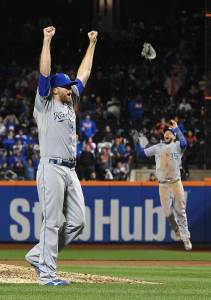
As leaping Eric Hosmer (35) flung his first baseman’s mitt skyward, Wade Davis launched the Royals’ party after he froze the Mets’ Wilmer Flores on a 2015 World Series-ending called strikeout.

The H-D-H intials usually register in the public mind with the great Motown songwriting and production trio Holland-Dozier-Holland. For a few years in the middle of the previous decade, H-D-H stood for a very deadly Royals bullpen trio.

Wade Davis was the D. They had their own Holland (Greg) plus also-retired Kelvin Herrera. But Davis wasn’t just the best of the trio, he was one of the absolute deadliest relief pitchers in the solar system for four years, three with the Royals and one with the Cubs.

Perhaps his most indelible moments were getting the last five outs when the Royals clinched the 2015 American League pennant in Game Six of that American League Championship Series; and, freezing the Mets’ Wilmer Flores to secure a 2015 World Series the Mets’ porous defense all but handed the Royals on a platter.

He looked and acted stoic on the mound, the emotionless assassin, but his exuberance after catching Flores completely stiff with that third-strike cutter is as eternal an image of Royals baseball as Hall of Famer George Brett’s “Pine Tar Game” and Game Seven of the 1985 World Series.

Things began fading after Davis signed as a free agent with the Rockies. After year one in Colorado Davis’s shoulder began barking relentlessly enough. When he returned to the Royals for 2021, any nostalgia for those 2014-2015 runs to the World Series in which Davis loomed large dissipated under continuing shoulder plus forearm issues.

They reduced him to being a mentor to the Royals’ younger relievers while he came to see his former form was in an increasingly distant past. So at 36 Davis calls it a career. But how good was he, really, during that 2014-2017 run? Have a gander:

2014-2017 FIP K/BB K/9 BB/9 HR/9 WHIP
Wade Davis, RP 2.23 3.60 11.7 3.2 0.3 0.95

His number-one flaw seemed a small propensity for walks. By far his deadliest of the four seasons was 2014, when he struck 109 batters out in 72 innings’ work, and though he surrendered 4.9 hits per nine innings that season nobody hit one out against him. Davis was also impossible to hit one out against in 2016 (zero); he surrendered three in 2015 and six in 2017.

If you were going to beat him, in other words, you had to either wait him out for the walk or wait for him to make a mistake you could plant some place in the outfield.

Davis pitched in nine postseason series over those four seasons. Except for 2017, when he pitched for the Cubs and got slapped around a bit in the division series and the National League Championship Series, Davis is a little different:

2014-2017 FIP K/BB K/9 BB/9 HR/9 WHIP
Wade Davis, Postseason 0.70 7.6 14.1 1.9 0.0 0.57

He was more deadly in those postseason series than in those regular seasons. And this is without discussing the four saves with which he was credited in the 2015 postseason. That’s because I’ve changed my mind about the save statistic. It’s as nebulous and deceptive as such analysts as Anthony Castrovince, Keith Law, and Brian Kenny have argued.

As a matter of fact, Castrovince—writing in his book, A Fan’s Guide to Baseball Analytics—mentioned Davis in his full chapter about the save, “Save Us From the Save.” Castrovince thinks the retired relievers giving Greg Holland the 2014 American Reliever of the Year Award had it dead wrong:

To be sure, Holland had a fantastic season—a 1.44 ERA in 62 1/3 innings across 65 appearances, with 90 strikeouts, 20 walks, and a .170 opponents’ average. And yes, he also had 46 saves.

But Holland wasn’t even the best reliever on his own team. That was Wade Davis, who had an even 1.00 ERA in 72 innings across 71 appearances with 109 strikeouts, 23 walks, and a .151 opponents’ average. As the setup man, Davis had only three saves. But he was the Royals’ most dominant bullpen force and should have won the award.

Think of it this way: How valuable are “saves” when Craig Kimbrel could—and did—pitch 10.2 postseason innings in 2018, allow nineteen baserunners, post a 5.90 ERA . . . and still show a perfect six-for-six in those “save” situations? Kimbrel was like the psychopathic teenage noodnik in Endless Love working his way back to his girlfriend’s family’s good graces by torching their house so he could save their lives heroically.

“The save . . . tells us nothing we couldn’t already glean from the box score,” wrote Law in Smart Baseball, “and gives people the illusion of meaning by its mere existance, which has contributed to overspecialised relief usage and a perverse system where teams often reserve their best relievers for the ninth inning even if those aren’t the toughest outs to get.”

Davis was made into a relief pitcher after starting didn’t suit him or his teams best. For four years he was as lights out as any reliever in the business. And I’m still willing to bet that Joe and Jane Fan think the season after that four-year run—2018, after he signed big with the Rockies—is his “best” season because, made their closer, he was credited with 43 “saves” while rolling a 4.13 ERA and a 3.65 fielding-independent pitchiing rate.

The Royals traded Davis to the Cubs after the 2016 season for Jorge Soler, before that Colorado deal that set a record for average annual value paid to a relief pitcher. All things considered, Davis was traded so Soler could end up being traded to the Braves last July—and end up their World Series MVP this year.

Nice delayed synergy in that, one World Series behemoth being traded for a World Series behemoth to be, six years removed. You could say, then, that Davis contributed to two world champions, one indirectly, but still. That’s as nice a baseball legacy as that four-year run when his name was synonymous with piledriving relief pitching.

Reality check: He’s not the catchers’ bomb king—yet.

Salvador Perez

I don’t want to bust your bubble, Salvy, but you ain’t the single-season home run champ among actual catchers just yet. You still have a shot at it, though . . .

I don’t want to spoil the party, but the American League’s current home run leader hasn’t really broken the single-season record for home runs by a catcher. Yet.

Come to think of it, neither, really, did the Hall of Famer he’s being lauded for surpassing, Johnny Bench.

Perez teed off on Indians starter Triston McKenzie in the top of the fifth Monday, with Nicky Lopez aboard, and sent his 46th homer of the season into the Progressive Field bleachers to send home the sixth and seventh Royals runs. (The Royals won, 7-2, and went on to sweep the doubleheader.) And, yes, Perez was the catcher at the time he hit the blast.

ESPN made a note that Perez topped Bench’s 45 in 1970 “for the most by a player who played at least 75% of his team’s games at catcher.” Well, there are two Hall of Famers who did hit 40 home runs in a season as catchers. One of them did it twice. Both of them played ninety percent or better as their teams’ catchers in those seasons. So did the non-Hall of Famer who hit 41 as a backstop one fine season.

But nobody thought about mentioning Roy Campanella or Mike Piazza while Perez approached Bench’s 1970 season total. They didn’t say a single word about Piazza hitting 40 each in 1997 and 1999, hitting every one of them strictly when he was his team’s catcher in both seasons.

Perez this season has actually hit 31 homers when he was the Royals’ catcher and fifteen when he was the Royals’ designated hitter, on those days the Royals elected to keep his fat bat in the lineup while giving his 31-year-old, well-enough-worn knees a break.

When Bench hit his 45 in 1970, he hit 38 of them as the Reds’ catcher. He also hit one each when he played first base and right field, and five when he played left field. Bench hit an even forty homers total in 1972, and he hit 34 of those as the Reds’ catcher. He hit two playing third base and four playing right field while he was at it.

The previous catcher with the most big bops was Campanella, hitting 41 in 1953. But what do you know: Campy hit forty of those as the Dodgers’ catcher. (He hit the other as a pinch hitter.) Piazza’s pair of 40-homer seasons as a catcher really tied Campanella, then. He’s still the only catcher in Show history to do that twice.

Never mind “the most by a player who played at least 75 percent of his team’s games at catcher.” How about recognising Piazza playing 91 percent of his 1997 games at catcher when he hit forty homers as the Dodgers’ catcher? How about recognising Piazza playing 96 percent of his 1999 games behind the plate when he hit forty homers as the Mets’ catcher? How about recognising Campanella playing 93 percent of his 1953 games behind the plate when he hit forty as the Dodgers’ catcher?

How about that non-Hall of Famer who hit 41 as a catcher in 1996—hitting every one of those as a catcher while playing 94 percent of his games behind the plate? Todd Hundley, anyone? There’s your real single-season homers-by-catcher record holder. My guess is that Hundley not being a Hall of Famer slips him through the proverbial cracks; I’d forgotten him myself until a friend of good standing reminded me.

Various breeds of fans and analysts love to nit-pick and cherry-pick when a player seems to knock a predecessor out of the record book. I didn’t hear a lot of nit-picking and cherry-picking about Perez approaching Bench.

But if you’re going to continue crowning Bench the now-dethroned single-season home run king among catchers, you really ought to see what he actually hit when he actually strapped the tools of ignorance on. He came up two short of Campanella as a catcher in 1970 and six short of Campy behind the dish in 1972. Not to mention three short of Hundley.

Piazza actually matched Campanella for power while actually catching, dead-even, in 1997 and 1999, though he still fell one short of Hundley. But you didn’t hear that in the middle of the hoopla preparing to anoint Perez the new single-season home run champion among catchers, either.

Yet when Bench broke Hall of Famer Yogi Berra’s record for career homers by a catcher (you may remember hearing that Berra sent Bench a congratulatory telegram saying, “I always thought that record would stand until it was broken”), they mentioned the 327 Bench hit specifically as a catcher (overall, he sent 389 over the fences) and the 293 Yogi hit while actually behind the plate.

And when Piazza broke the total of the man who broke Bench’s lifetime homers-by-catcher total, fellow Hall of Famer Carlton Fisk, they mentioned the 396 Piazza launched specifically as a catcher, too.

But they didn’t talk that way when Perez approached Bench’s overall 1970 season total. I couldn’t possibly predict how many more home runs Perez has in his bat with eleven games left on the Royals’ season schedule. I’m not sure anyone else can, even with the Royals closing out against the Indians, the Tigers, the Indians again, and the Twins.

He’s hit eight this month so far. But he needs to hit seven more while catching if he wants to tie Bench’s actual 1970 bombs as a catcher; and, he needs nine more to tie, ten more to pass Piazza and Campanella, and eleven more to pass Hundley, the real record holder.

Then, again, with the way he’s hit this season, and assuming the Royals let him continue catching with their season lost long enough, it’s not necessarily out of bounds to think Perez still has a real shot.

The wheeling, dealing, maybe stealing Padres

Mike Clevinger, from Cleveland outcast to the star of the San Diego Shuffle.

Entering the pandemic-truncated regular season, some thought the Show was going to be somewhere between dull and duller, not just by way of the rules experiments alone. They didn’t reckon with the San Diego Padres, of all people.

When not producing a youthful shortstop (Fernando Tatis, Jr.) who takes “let the kids play” to heart (and runs the boring old farts’ temperatures up the scale in the bargain), or hitting grand slams as if they’re going out of style, the Padres took what some presumed would be a sleepy trade deadline period and turned it into a bit of a thriller approaching Monday’s 1 p.m. Pacific time cutoff.

Landing Cleveland Indians pitcher/protocol violator Mike Clevinger and outfielder Greg Allen for a package including pitcher Cal Quantrill, infielder Gabriel Arias, outfielder Josh Naylor, and catcher Austin Hedges on Monday merely seems like what Duke Ellington once called “the cherries-and-cream topping to our sundae morning.”

Especially after the Friars already made four trades in a 24-hour period prior. The fourth of those trades looked like something of a nothingburger: on Sunday, the Padres sent a fringe relief pitcher from their 60-man roster (28 in Show; 32 at alternate camp), Gerardo Reyes, to the Los Angeles Angels for veteran catcher Jason Castro, who’s set to hit free agency after this season. And, who’s not much of a hitter but is respected for his abilities at pitch framing and new-rules plate blocking.

Now, look at what that deal followed doing the Slam Diego Shuffle:

* On Saturday, the Padres cast for and reeled in resurgent relief pitcher Trevor Rosenthal, sending the Kansas City Royals an outfield prospect (Edward Oliveres) and the proverbial player to be named later.

* On Sunday morning, the Padres more or less confirmed that the beleaguered Boston Red Sox were about to push the plunger on their season if not much of their roster, landing designated hitter/first baseman Mitch Moreland, a 2018 World Series hero, for a pair of prospects. (Hudson Potts, Jession Rosario.)

* And, a little later on Sunday, the Friars dealt big to the Seattle Mariners, sending two of their highest-rated prospects (pitcher Andres Munoz, outfielder Taylor Trammell) plus a pair of young sprouts with Show experience (catcher Luis Torrens, infielder Ty France) to land the Mariners’ best catcher, Austin Nola, plus relief pitchers Austin Adams and Dan Altavilla.

The Mariners were thin enough in the backstop ranks that nothing could have pried Nola out of their hands unless it was enough to think they might finally, maybe, possibly begin building a real future, as a good number of published reports suggest. When the Padres landed Clevinger Monday morning, what started as jaw-dropping hope turned into jaw-dropping actuality: They’re going all-in to win now as well as later.

How surreal is this season already? The Indians put Clevinger on ice when it turned out he’d made a team flight after violating coronavirus safety protocols with fellow pitcher Zach Plesac but said nothing about it—even after Plesac got bagged—until after that team flight. The Tribe sent both to their Eastlake, Ohio alternate site.

And all of a sudden Clevinger—who had a sterling 2019 season but had a struggle or two in four starts this season before his night out of dinner and cards with Plesac and other friends—became the most coveted starting pitcher on a weird trade market that figured to feature such arms as Lance Lynn (Texas Rangers), Trevor Bauer (Cincinnati Reds), and maybe Josh Hader (Milwaukee Brewers relief act) moving to fresh territory.

This must be heady stuff for Clevinger, who’s just gone from a Cleveland outcast to the star of the Slam Diego Shuffle.

One minute, Clevinger and Plesac were still recovering in Eastlake over the denunciations of their selfishness for sneaking out after dark no matter what Mom and Dad ordered. The next, he, at least, has moved from one pennant contender on the banks of Lake Erie to another down by that glistening San Diego waterfront. Where he gets to reap the pleasures and benefits of having one of the left coast’s two true marquee talents having his back at shortstop and lightening his loads at the plate.

It was enough for the Padres to swing and fling their way into the postseason picture, sitting five games behind the Los Angeles Dodgers in the West but tied with the Chicago Cubs at three and a half games up in the wild card picture. They’re not just making noise, they’re making memories of the kind San Diego hasn’t seen in a very long time.

These are fun days to be a Padre. And, a Padre fan. So much so that a Twitter wag couldn’t resist wondering if their trade deadline wheeling, dealing, and possible stealing didn’t set at least one weird record: most players sharing the name Austin (including Moreland: it’s his middle name) moving to one team or another in a series of trades made by one team in the same deadline period.

Well, what’s baseball, too, if not the still-singular repository for silly records? Now the Padres hope their wheeling, dealing, and possible stealing produce the kind of record that’s not so silly, if you don’t count the semi-Mad Hatter style postseason to come. The kind of record that gets them to the postseason in the first place.

All they have to do is make sure Clevinger can’t be too seduced by that delicious waterfront to break the safety protocols again.