Pete Ward, RIP: The un-cover boy

Pete Ward

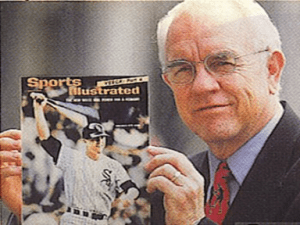
Pete Ward hoists the Sports Illustrated cover on which he would have appeared if not for some guy named Muhammad Ali in 1965.

Trivia time: Name the only major league third baseman who ever got knocked out by Muhammad Ali. The answer: Pete Ward. With a real phantom punch.

No, Ward wasn’t foolish enough to step into the ring against Ali. Ward was supposed to be a 1965 cover star when Sports Illustrated planned a cover story on the White Sox’s pennant hopes. Until he wasn’t.

“They just got the pictures there in time to do it,” said Ward—who died at 84 on 16 March—to interviewer Mark Liptak in 2003. “Sports Illustrated did send me some of the covers that were supposed to have me on it though.”

Ali-Liston II put paid to that idea. Ward eventually kept one of the covers’ prints in his office at his post-baseball travel agency, signing another and giving it to the magazine’s vice president for communications, Art Berke.

When a story about Ward’s death was posted to a Facebook baseball group, one commenter made a remark about “nobodies” being hoisted. Well, now. A guy who finishes a tight second to a White Sox teammate in the 1963 American League Rookie of the Year voting is many things. A nobody isn’t one of them.

Ward was a slick third baseman who was actually worth more wins above replacement level than the infielder who bagged the 1963 National League Rookie of the Year award—a kid named Pete Rose. (Ward: 4.1; Rose: 2.4.) If only his teammate Gary Peters hadn’t led the American League with his 2.33 ERA that season.

If it hadn’t been for an April 1965 auto accident that left him with neck and back trouble, Ward might have put up better than a nine-season playing career otherwise. Over his first two full seasons, Ward averaged 33 doubles, five triples, 24 home runs, and a .478 slugging percentage; over his final six: eighteen, two, thirteen, and .364.

The accident that changed the trajectory of Ward’s career happened after the White Sox returned to Chicago following a rainout in Washington. As Ward told Liptak, he managed to score tickets for a Chicago Blackhawks hockey game for himself and pitching teammate Tommy John. It was after the game that the accident occurred:

[A]s we were leaving, I was in the front seat on the right side and Tommy was in the back seat on the left when a car rear-ended us. At the time I didn’t think that much about it, it wasn’t really that hard of a hit but the next day I woke up with a stiff neck and was sore all over. I went to see a doctor and he told me I had a case of whiplash and it bothered me the rest of the year. It just caused a lot of problems for me. Tommy also had neck problems.

As Ward told SI in due course, “I was never comfortable from that point on.” More than his batting numbers bear him out. He’d been worth eighteen defensive runs above his league average in 1964; he remained a plus defender at third in 1965 but he was worth eight such runs above league average for that season. He divided defensive time between the outfield, third base, and first base the rest of his career.

“I preferred third base,” Ward told Liptak, laughing, “because I was a bad outfielder!”
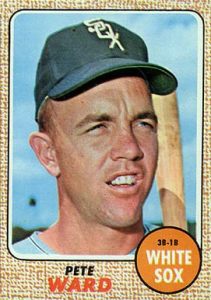
Pete Ward

As a boy, your chronicler usually opened packs to find several Pete Ward baseball cards a year during Ward’s White Sox years; this was Ward’s 1968 card.

Chicagolander though I wasn’t, I’d had a particular affinity for Ward when I was growing up in the 1960s. It seemed that his baseball cards were almost ubiquitous; I could guarantee that out of my first three packs of Topps cards on the year, there’d be at least one and maybe three Ward cards among the bunch.

Ward was an Orioles discovery with a 1962 cup of coffee for Baltimore, before he was traded to the White Sox prior to spring training 1963. Quite a trade. The White Sox sent the Orioles Hall of Fame shortstop Luis Aparicio and veteran outfielder Al Smith; the Orioles sent Ward, Hall of Fame relief pitcher Hoyt Wilhelm, shortstop Ron Hansen (the American League’s 1960 Rookie of the Year), and spare outfielder Dave Nicholson.

In his memoir Safe By a Mile, then-White Sox scout/coach Charlie Metro remembered pushing then-White Sox manager Al Lopez that Ward be included or there’d be no deal:

I insisted on Pete Ward coming over to the White Sox in a deal with Baltimore because I had worked with Pete out in Vancouver. He was a pretty good hitter. He was very aggressive. He loved to play, quite a cocky kid. When the White Sox had a chance to make the trade, I said, ‘Make them throw Pete Ward in the deal. He can play, he can hit.’ Al Lopez said, ‘Well, what kind of fielder is he?’ I said, ‘Well, he’s not too good a fielder, but if you hit him a thousand ground balls at third base, he’ll do pretty fair. But he can hit, and he can drive in runs and has some power. Don’t make the deal unless you get Pete Ward.

Ward’s White Sox life ended when he was dealt to the Yankees in December 1969. Then in the middle of their Lost Decade (1965-75), the Yankees got only a shell of Ward’s former ability and released him in March 1971. But they respected Ward’s baseball mind enough to make him the manager of their Fort Lauderdale (A) farm team; he managed them to the league championship in 1974.

Ward managed two other Yankee farm teams, plus a White Sox farm team, before he left baseball to work for Miller Brewing before he opened his own successful travel agency in the Pacific Northwest, to which his family had originally moved during his childhood. The Montreal native—and son of 1935 Stanley Cup-winning Montreal Maroons right wing Jimmy Ward—was elected to the Canadian Baseball Hall of Fame in 1991.

Known as much for a good sense of humour as anything else, Ward proved sanguine about his missed SI cover. “You know,” he said to SI writer Richard Deitsch at the turn of the century, “Ali was on something like forty covers. It would have been nice if he could have let me be on just one.”

God willing, Ward met Ali in the Elysian Fields and said, “You knocked Liston out with your fist, but you knocked me out with a phantom punch!” Ward’s otherwise bereft wife, children, and grandchildren surely settle proudly for knowing Ward was always their cover guy.

One cheer for the White Sox

Yermin Mercedes

Hitting this home run on a 3-0 count in the ninth in Target Field got Yermin Mercedes a target on his back in May—placed by his own manager.

Somewhere among the legion of September call-ups this year, there was one missing conspicuously from the now American League Central champion White Sox. A fellow having a splendid time of things overall at Charlotte (AAA-East), considering he’s a catcher at a somewhat advanced age. A fellow who exploded out of the box in the Show this year but ran into an unforgivable hiccup near the end of May.

The hiccup wasn’t his, but his manager’s.

Yermin Mercedes’s 2021 in Charlotte was respectable enough to finish with a .782 OPS, a .502 real batting average (RBA: total bases + walks + intentional walks + sacrifice flies + hit by pitches, divided by total plate appearances), but a September snub and a likely absence from the White Sox’s postseason roster.

It may or may not be because he stumbled a moment after his manager threw him under the proverbial bus in May, for reasons described most kindly as brain damaged. In a season during which there were controversies politely called dumb, this one may yet confer upon Tony La Russa the Ignoble Prize for Extinguished Achievement.

But it defies baseball sense that Mercedes shouldn’t earn another shot with the White Sox while they carry one backup to Yasmani Grandal who carries a .616 OPS. and isn’t exactly a run-stifler defensively.

Mercedes hit the road swinging right out of spring training, going 8-for-8 right through the sixth inning of a game against the Angels. He was the only Show player since 1900 to open a season that way. It looked as though his only flaw was that, unlike the cars with whom he shares a marque, he can’t go 0-60 in three seconds flat.

But then came that fine May day when Mercedes checked in at the plate in the ninth inning  against a Twins position player on the mound, first baseman Willians Astudillo. Yes, the White Sox were blowing the Twins out, 15-4. But, yes, the Twins still had five legitimate relief pitchers available for duty.

Astudillo threw Mercedes yet another meatball, on a 3-0 count, and watched it sail over the center field fence. So did La Russa, who turned out to be distinctly unamused at his own player. Mercedes had just broken one of the Sacred Unwritten Rules, and the Hall of Fame manager considered him a heretic with No Respect for the Game.

La Russa probably swore he gave Mercedes a take sign on 3-0, though CBS Sports’ Matt Snyder was hardly the only one who thought that might have been either disingenuous or downright false. If true, Snyder wrote, it’s worth a stern talk—in the dugout, in the clubhouse office, anywhere except in the press where La Russa took it.

“I heard [Mercedes] said something like, ‘I play my game’,” La Russa was quoted as saying. “No he doesn’t. He plays the game of Major League Baseball, respects the game, respects the opponents.”

Oh. As though the opponent showed so much respect for the game that they simply rolled over, played dead, and sent a first baseman/catcher to the mound to pitch an inning, even the ninth? We’re supposed to respect an opponent when they all but tank the rest of the game?

(Don’t even think about telling anyone you can’t possibly overcome a 15-4 deficit. The 1925 Philadelphia Athletics would love to prove you wrong. After closing twelve-run deficits twice in a game against the Indians, they closed an eleven-run deficit in the eighth and went on to win, 17-15. They upheld Berra’s Law [it ain’t over until it’s over] decades before Yogi gave it a formula.)

The following day, Twins relief pitcher Tyler Duffey threw behind Mercedes the moment after coming into the game. La Russa said in the press he had no trouble at all with Duffey doing that. His pitcher (and Cy Young Award conversation member) Lance Lynn demurred: “The way I see it, if a position player is on the mound, there are no rules. And if you have a problem with whatever happened, then put a pitcher out there.”

One up for Sir Lancelot. Perhaps Lynn was somewhat amazed that a skipper who admitted a fortnight earlier that he didn’t know the written rules could now be called a strict constructionist about the unwritten ones.

For all anyone knows, the La Russa-inflated dustup with the Twins knocked more than a little air out of Mercedes, who finished May with a .311/.366/.480 slash line, fell to .271/.328/.404 by the end of June, and was sent down to Charlotte. The frustrated Mercedes first threatened retirement, then reported to Charlotte after all.

Who’s to say La Russa’s foolish mishandling of that 3-0 home run, to say nothing of all but encouraging the Twins or anyone else to throw at his batters if they swing on 3-0 against a position player on the mound, didn’t deflate Mercedes inside no matter how he tried not to let it show?

Exhumed from retirement, La Russa’s Hall of Fame resume of thirteen division championships, six pennants, and three World Series rings, I wrote after the 3-0 homer, “won’t save him, if he costs himself his clubhouse and the White Sox turn from early-season surprise to season-closing bust.”

Well, the White Sox didn’t exactly turn from early-season surprise to regular-season closing bust. They were fun to watch as often as not, particularly playing and winning the Field of Dreams Game against the Yankees in mid-August. (“Hey, Dad—want to pitch me a walk-off?”)

They didn’t exactly overwhelm an American League Central that has underwhelmed just about all season long, either. This wasn’t entirely their fault. It’s not easy to lose impact players or significant pitchers to injuries for varied lengths of time. It’s also not easy to play the game with the occasional but nagging suspicion that your manager can hang you out to dry at any moment, for any reason, even (especially?) a foolish reason.

They’d lost eight of eighteen before opening a Thursday doubleheader with a 7-2 win over the Indians in Cleveland. Their .561 winning percentage entering today is lower than last year’s short-season .583.

It doesn’t get all that much better from there. They’ve been a .500 team since the All-Star break. They entered that Cleveland set Thursday with a 25-29 record against all .500-or-better teams. They’ve swept only one season series this year—all seven against the .323-winning Orioles. They may or may not have surprises in store for their likely round-one postseason opponent—the Astros, who took their season series against each other 7-2.

La Russa hasn’t always resembled the genius he’s cracked up to be, still. Oh, he was about as clever and attentive as he could be in keeping his oft-wounded charges from dissembling even in a weak division. La Russa and his White Sox endured where others haven’t after the injury bugs became a plague.

But look to the unwisely missing backstop among their reserves. To his credit, La Russa offered Mercedes a show of support—last month, at a time Mercedes pondered aloud whether his next baseball stop might be in Japan. It took La Russa a mere four months to pull him back out from under that bus.

“As you probably know, if you are paying attention, several times he said how close we are,” La Russa said then. “He knows I’m a supporter of his. So I’ll reach out to him and see what’s going on. It could be he’s just feeling frustrated. I’ll try to explain to him he’s got a big league future.”

Four months after La Russa treated his Mercedes like a rustbucket Trabant, that might be a bit of a tough sell.

“Hey, Dad? Want to pitch me a walk-off?”

Tim Anderson

Tim Anderson, finishing the hype-busting Field of Dreams Game with a two-run homer in the bottom of the ninth Thursday night.

The game finished by crossing its original protagonist, Field of Dreams, with The Natural. The most poetically inclined screenwriting/directing team in film couldn’t imagine climax that surreal.

A pair of two-run homers in the top of the ninth to yank the Yankees back into the lead at 8-7. A two-run homer in the bottom of the ninth to win it for the White Sox, 9-8. This wasn’t the way they won ballgames during the 1910s evoked by the special uniforms the two teams wore for the occasion.

Hey, Dad? Want to pitch me a walk-off?

It was as jolting a climax as ever provided by David Freese, Aaron Boone, Joe Carter, Kirk Gibson, Chris Chambliss, Bill Mazeroski, or Bobby Thomson. Even if it didn’t win a World Series, push a Series to a seventh game,  send a team to a Series, or put them in the postseason at all in the first place.

It defied the game’s subtexts. The ones not spoken often if at all in the hype. The ones involving Field of Dreams‘s unlikely turning of baseball’s worst gambling scandal into a fantasy of reconciliation; and, The Natural‘s study of a live young prospect shot Eddie Waitkus-like, into long, long wandering, into a haunted elder returning to prove neither he nor his old dream died, for however long it still had to live.

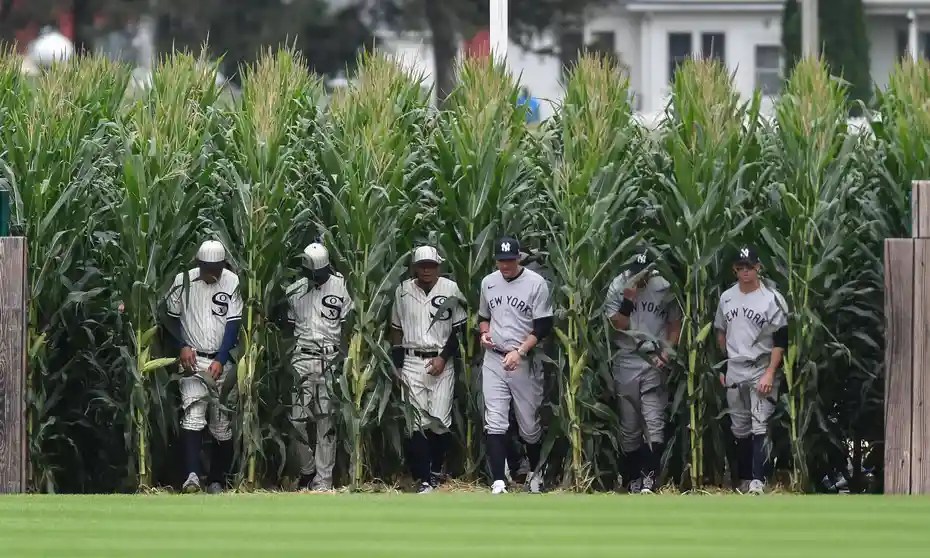
No volume of pre-game hype—this game’s tribute to artifices of fantasy was as hyped as any sports event could be—could have promised and delivered that kind of a ninth inning. Even Field of Dreams star Kevin Costner, escorting both teams onto the field from the corn beyond the wall, asking the crowd, “Is this heaven?” with the crowd hollering back, “No, this is Iowa,” wouldn’t have dared demand that in a script.

But there was Liam Hendricks, the engaging White Sox relief pitcher, looking made for wraparound sunglasses thanks to being endowed with wraparound eyes, working the top of the ninth, shaking a leadoff single off to strike Yankee veterans D.J. LeMahieu and Brett Gardner out swinging on four pitches each.

Then there was Hendricks at 2-1 to Aaron Judge. He threw Judge a high fastball and watched it sail far enough into the right field corn. Following which Hendricks wrestled Joey Gallo—the former Ranger whose stock in trade is either home run feast or strikeout famine, but who has the odd discipline of working walks (he averages 94 per 162 games lifetime)—into a walk after starting him 1-1 without throwing another strike.

Up to the plate stepped Giancarlo Stanton, a former National League Most Valuable Player and one of the game’s more formidable bombardiers until injuries began to grind away at him in earnest. Stanton hit Hendricks’s first service into the left field corn.

Even the somewhat partisan, small audience—savouring a game on the field built adjacent to the famous Field of Dreams farmhouse field, many paying through the nose secondarily for tickets with face values of $375 or $425, Iowa fans and White Sox season ticket-holders, the latter by special lottery—roared when that fabled Yankee power detonated in the top of the ninth.

It was nothing compared to what happened in the bottom, when Yankee reliever Zack Britton, himself having been in the top tier of his particular profession before injuries began shaving him down, too, took the role normally assigned to the injured Aroldis Chapman. He opened by luring White Sox pinch hitter Danny Mendick into a ground out to first but walking White Sox catcher Seby Zavala—who’d hit one into the corn himself in the bottom of the fourth.

Up stepped Tim Anderson, the lively White Sox shortstop. Britton pumped and pitched, a fastball right down the pipe. It was too fat a pitch to resist. If the White Sox have a classic kangaroo court in their clubhouse, Anderson would have been fined for malfeasance.

It didn’t win a pennant. It was more out of The Natural than Field of Dreams, whose co-protagonist by default Shoeless Joe Jackson had only one known walk-off hit in his entire career. (For the White Sox, against the Yankees, in July 1919.) But when Anderson hit it out, it won a ball game keeping the Yankees from gaining on the second place Red Sox in the American League East and fattening the White Sox’s AL Central lead to eleven and a half. Slamming an exclamation point down for baseball itself.

What began with Field of Dreams star Kevin Costner escorting the Yankees and the White Sox through the corn and down across the field ended with an African-American man from Alabama, who wouldn’t have been admitted to the 1910-1919 Show because of his race, channeling his inner Roy Hobbs, The Natural‘s psychically-buffeted protagonist.

Hobbs in the film version was down 0-2 and struggling mightily with an ancient bullet lodged in his insides, causing him to bleed through his lower stomach, when he hit the pennant-winning bomb that also shot the ballpark lights out. Anderson had no such encumbrance when he sent Britton’s canteloupe into the left field corn.

Until that ninth inning viewers at home and the fans who’d paid into the field saw a very reasonably played game. They saw White Sox first baseman Jose Abreu hit the first major league home run ever hit in Iowa in the bottom of the first. They saw Judge become the first Yankee to go long in Iowa when he hit a three-run homer in the top of the third.

Chicago White Sox, New York Yankees

Wearing 1910s style uniforms, the White Sox and the Yankees entered the Field of Dreams Game through the corn Thursday evening.

They saw White Sox starter Lance Lynn nail the first major league strikeout in Iowa when he froze Gardner on a high called strike, on a night when plate umpire Pat Hoberg was as generous with the strike zone ceiling as he was skinflint about proper strikes on the sidewalls of the zone.

They saw the early 3-1 Yankee lead disappear in a four-run White Sox third, when Anderson doubled center fielder Adam Engel home with one out, and recently-restored-from the-injured-list designated hitter Eloy Jimenez cracked a three-run homer into the right field corn.

They saw Gardner put a number on Lynn’s pitching evening when he hit the second pitch of the top of the sixth not too far from where Jimenez’s bomb landed. They saw Yankee infielder Tyler Wade, one of a host of spare parts coming into regular service thanks to the Yankees’ ongoing shuttle back and forth from the injured list, drop one of the only bunts that should be allowed in a game.

With one out, nobody on, and the non-shifting White Sox infield playing deep enough to prompt calls for sending a search party out to find them, the lefthanded Wade saw enough delicious open real estate to push a bunt to the left side, just enough to the middle to keep third baseman Yoan Moncada from doing anything more than grabbing the ball on the run in.

No wasted out. Nothing but a versatile enough utility infielder, who inclines toward hitting line drives (he has four doubles out of 24 hits this season), not feeling he was going to get something to hit on a line, seeing a free gift and pouncing on it before the supply expired.

Then, Wade stole second while LeMahieu occupied himself with working his way into a walk. Then, a ground out pushing second and third and Judge accepting a walk from White Sox speed reliever Michael Kopech after opening with strike one but seeing four straight balls, including a ball four which should have been called strike two.

No matter, far as the White Sox were concerned. Up stepped Gallo, flashing his usual all-or-nothing style at the plate, swinging mightily enough but whacking a pitch a little up out to shortstop to force Judge for the side.

From the moment Lynn started the game with ball one to LeMahieu and LeMahieu nailed the first major league base hit in Iowa baseball history, to the moment Anderson sent everyone home with his corn ball, the game told the hype to take a shower. Even if the live Fox Sports telecast referenced Field of Dreams to a fare-thee-well.

“I knew it wasn’t over,” Anderson said post-game. “The game’s never over. And once Britton walked (Zavala), I knew there was a chance to start something real dope.” So he finished something real dope with something as dope as it gets. In the immortal words of Hall of Fame baseball writer Jayson Stark, “Because . . . baseball!“

Of fathers, sons, dreams, rapproachment, and baseball

Kevin Costner, Dwier Brown

Kevin Costner and Dwier Brown play extraterrestrially reconciled son and father, respectively, in Field of Dreams.

So the Yankees and the White Sox will play the so-called Field of Dreams Game Thursday. They’ll play on the Iowa field rolled out and planted inside an eight thousand feet grandstand, adjacent to the field-in-the-cornfield that was actually built and used to make the film after which the game’s named.

“How,” asks Athletic writer Richard Dietsch, “do you capture the essence of a famous film on a live broadcast between Major League Baseball teams? That’s the question Fox Sports production staffers have been contemplating for months.” The answer may well depend on how you define the essence of Field of Dreams.

I read the original short story, “Shoeless Joe Jackson Comes to Iowa,” turned into the novel Shoeless Joe, by W.R. Kinsella, back when both first appeared. I saw the 1989 film when it first appeared and a few times to follow when it was delivered on videotape, then DVD. The fantasy in print and on film had a particular resonance for me.

What began as an Iowa farmer lured to plow two-thirds of his corn, to build a major league-size field onto which Jackson and his fellow Eight Men Out might return to the game from which they were banished eternally, concluded (spoiler alert, to those few who haven’t seen it) with an estranged son (the farmer) and father (presented as a one-time New York Highlanders player) reconciling as time, illness, and death once denied.

Just like any son first misinterpreting a heavenly voice’s instructions to welcome Shoeless Joe Jackson, kidnap a renowned but reclusive J.D. Salinger stand-in, then do likewise to the elderly doctor turned eager youth who’d once been a single-appearance New York Giants right fielder. Then, bringing the latter two to his fresh field to witness games between the Black Sox and assorted deceased baseball stars

(Don’t bother. IMDb lists those cast members only as “additional ballplayers.” It’s up to you whether you think you see Walter Johnson, Babe Ruth, Lou Gehrig, Honus Wagner, or Cy Young—though the young Moonlight Graham points to and mentions Smokey Joe Wood and a pair of live-ball legends, Mel Ott and Gil Hodges.)

The story has its charms above and beyond capital crime on behalf of the greater good of the game. Above and beyond the very idea that you could turn into heroes eight men who disgraced the game with their World Series tanking for fun and profit or (in the case of infielder Buck Weaver) refusing to blow the whistle on the tank when it might have made a truly significant difference.

And, above and beyond the implication that there but for the grace of the gamblers to whom two or three of the Eight Men Out reached would the White Sox have steamrolled the inferior 1919 Cincinnati Reds. The actual record shows that implication as false as the still-holding idea that Jackson was entirely innocent, to say nothing of whether Jackson really did play to win in that Series. (Says the actual record: he didn’t, quite.)

For me, the film’s climax is the charm that hits too close to home. The adult, fictional Kinsella gets to reconcile with his father on the field, the father frozen by death in his young adulthood, wearing a Highlanders uniform, with a catcher’s chest protector and shin guards.

Father and son in Field of Dreams were estranged by disputes including the one in which the son chastised the father for worshipping a badly tainted baseball hero. Father and son in my case were estranged by contradictions that would be called child abuse today, followed by the ten-month battle against cancer that my father lost in 1966, when I was ten and he, thirty-nine.

My parents were foolish enough to believe nothing but physical discipline, with no concurrent attempt at real teaching, applied to mere human childhood mistakes the same as to real misbehaviour or disobedience. Confirmed decades later by an unimpeachable source (my father’s sister), my parents wanted children in the worst way possible—only to have no patience for children merely being children.

My father, alas, was even more foolish for believing the way to teach a son who didn’t know how to fight was to beat him even more violently, accompanied by every demeaning insult he could throw. The thought that a son needs to be taught to defend himself, that it isn’t knowledge with which you’re born, was never programmed into his software.

My father’s death stole any hope of eventual rapproachment in this world from me. Fantasy thought it is, the rapproachment between John and Ray Kinsella to conclude Field of Dreams was and remains something I envied every time I watched the film. The few things I had in common with my father included baseball. (And, in fairness, music, my interest in and facility for which my father encouraged but my mother rejected.)

I don’t remember whom he declared to be among his baseball heroes, other than his having been a Dodgers fan since their Brooklyn years. He spoke of various players without singling one out as a particular favourite, at least within my earshot, while I had as heroes assorted hapless 1962-66 Mets plus Sandy Koufax, Willie Mays, Juan Marichal, Henry Aaron, and Bob Gibson, among others.

But I do remember numerous catches, a few trips to the Polo Grounds and then Shea Stadium to see those embryonic Mets, and, in one fathers-and-sons game, my ripping a line drive off his crotch when he deliberately lifted his glove above it because (he admitted it later) he didn’t want to be the reason I made a hard out.

For all the contradictions and abuse, whenever I watch the Field of Dreams climax I’d give whatever I have to give to see my father walk toward me one more time, whether or not he wore a baseball uniform, and slip a baseball glove onto his left hand when I slip mine on and say, “Dad, want to have a catch?”

How do you capture the essence of a famous film on a live broadcast between Major League Baseball teams? Asking demands we ask just what that essence really is.

Is it giving eight disgraced baseball players a new home and a chance to recover by the gods what their misbehaviours—ranging from the morally criminal to the complicit to the willfully silent—stripped from them in the mortal world’s furies?

Is it the old, long-gone fans who refused to believe those men could have been anything other than victims of their own caprices, married to those of a purportedly unscrupulous baseball owner (and that theory has been debunked, too) and the professional gamblers a few sought to finance their intended subterfuge?

Is it re-discovering a truth enunciated in short form and long double-negative by Hall of Fame manager Sparky Anderson? We try every way we can think of to kill this game, but for some reason nothing nobody does never hurts it. Or in long form by James Earl Jones as Salinger’s stand-in Terrence Mann?

People will come . . . they’ll walk out to the bleachers; sit in shirtsleeves on a perfect afternoon. They’ll find they have reserved seats somewhere along one of the baselines, where they sat when they were children and cheered their heroes. And they’ll watch the game and it’ll be as if they dipped themselves in magic waters . . . America has rolled by like an army of steamrollers. It has been erased like a blackboard, rebuilt and erased again. But baseball has marked the time. This field, this game: it’s a part of our past . . . It reminds of us of all that once was good and it could be again.

The author's son

Photographed by his father through a fence, my son ends his first-ever national Special Olympics plate appearance with a home run. (Yes, he back-flipped his bat away!) My fortune includes that we will never require reconciliation.

Is it an otherwise composed, ordinary Iowa farmer compelled to restore an un-restorable purity to men who could have destroyed baseball but engaged his lost father enough to return to earth, fostering the rapproachment too many fathers and sons—including mine, wherever he is in the Elysian Fields, with me—wish with each other but never find?

My own fortune includes being a father myself. By marriage and mutual engagement, not biology. The marriage is long past; my fatherhood, never. We made each other father and son. I did my best with whatever I had, for a son whose intelligence and will overcomes his compromise by a speech and language impairment, and whose heart is too large to be contained.

He joined his southern California softball team winning silver at the national 2018 Special Olympics. (His first plate appearance in that event: a healthy home run.) During the tournament, his coach told me and he affirmed: he credited me with teaching baseball and softball to him. There was no one more proud of my son at that Special Olympics (except his mother, surely) than his father.

All I ever did was observe, see what he had beyond the love of baseball we shared at the outset, then let him develop what he had on his time, through his eyes, ears, and hands, through his heart, never once imposing mine upon him. (He imposed one of his own: his boyhood heroes were Shawn Green and Vladimir Guerrero.) I’d learned the hardest way how damaging the other ways around could be.

The pan-damn-ic has prevented in-person time with my son since last year. We’ve missed the pleasures of going to Angel Stadium, sharing a game, sharing an atmosphere, with accompanying talk, theory, and hopes of catching a foul ball. It may well do so again before this season ends. I’ll talk to my son on the phone and in instant messages, as always we do. No one needs to tell either of us it isn’t quite the same as direct human engagement.

Neither of us are Yankee or White Sox fans. My son is a die-hard Angel fan. His father is a Met fan since the day they were born, a Red Sox fan since the 1967 pennant race, an Angel fan since the first day I took him to an Angel game. (They beat the Yankees and The Mariano in extra innings.)

We will probably each watch the Field of Dreams Game, thinking our own thoughts while the Yankees engage the White Sox, adjacent to where a novel was made into a film of fantasy that raises questions not always simple to answer. When not contemplating the good, the bad, the excellent, the dubious, about the play of the actual game.

Far simpler to replay the fictional Ray and John Kinsella reconciling with a simple game of catch. Even more simple to remind myself how much more fortunate I am, for having overcome my own parental estrangement and bereavement. For knowing I can still talk to, counsel, listen to my now-adult son, and play catch with him when conditions allow—for pleasure, not atonement.

Genius playing with mental blocks?

Tony La Russa

Even Hall of Fame managers aren’t always the geniuses they’re cracked up to be.

No baseball manager is a perfect specimen, whether he lucks into the job, performs it long enough and well enough, or gets himself elected to the Hall of Fame because of his actual or reputed job performance. Many have been the managers whose reputations for genius are out of proportion to their actual performances.

Even the certified geniuses made their mistakes. Maybe none was more truly egregious than Casey Stengel’s failure to set up his rotation so his Hall of Fame lefthander Whitey Ford could start three 1960 World Series games instead of two. Unless it was Tommy Lasorda deciding it was safe to let Tom Niedenfeuer pitch to Jack Clark, with first base open and the Dodgers one out from forcing a seventh 1985 National League Championship Series game.

Maybe it was Dick Williams, placing public perception ahead of baseball to start gassed ace Jim Lonborg instead of a better-rested arm in Game Seven, 1967 World Series. Unless it was Gene Mauch, the Little General panicking down the 1964 stretch (with the Phillies, using his two best pitchers on too-short rest and blowing a pennant he had in the bank), or in Game Five (with the Angels) when he was an out away from winning the 1986 American League Championship Series.

Regardless of his foibles since what proved his first retirement, Tony La Russa still has an outsize reputation as one of the most deft ever to hold the manager’s job. He’s been called a genius. He’s been called one of the smartest baseball men of the last half-century. They point to his Hall of Fame plaque, the 33 years he managed prior to returning to the White Sox this season, eleven division titles, six pennants, and three World Series rings.

Those plus his longtime reputation for volumnious pre- and post-game thinking and analysis (observed perhaps most deeply in a chapter of George F. Will’s Men at Work: The Craft of Baseball) still allow La Russa absolution from his most egregious errors.

He threw his 2021 White Sox star Yermin Mercedes under the proverbial bus, and maybe even invited the Twins to retaliate the following day, after Mercedes swung on 3-0 (violating La Russa’s fealty to the Sacred Unwritten Rules) in the eighth inning of a White Sox blowout, and hit a home run . . . off a middle infielder sent to the mound.

La Russa is still considered one of the smartest of the Smart Guys whatever they think of Mercedes’s homer or La Russa’s definition of “sportsmanship.” (They don’t always stop to ponder what La Russa thought of the Twins’s “sportsmanship” in giving up the ghost with two innings left to close even a fat deficit and sending a position player to the mound with real pitching still available to them.)

Perhaps they haven’t read Keith Law, writing in The Inside Game last year: “Sometimes you do all the right things and are stymied by bad luck. Other times you do everything wrong and are subsequently rewarded for it. That’s outcome bias.” There’s a case to be made that La Russa’s reputation, and maybe even his Hall of Fame case, is a little more than half a product of such outcome bias.

It’s hard to argue against a manager with three decades plus on his resume plus those division titles, pennants, and three Series rings. But maybe it’s easy to forget or dismiss how often La Russa either outsmarted or short-sighted himself when the games meant the absolute most.

“Tony, stop thinking,” Thomas Boswell wrote, after La Russa’s Athletics were swept out of a 1990 Series they could have tied in four and gone on to win, instead of being swept by a band of Reds upstarts who didn’t know the meaning of the words “shrink under pressure.”

If the A’s had picked an usher at random to manage them in this Series, they’d have been better. The usher would have brought in [Hall of Fame reliever Dennis] Eckersley to start the eighth inning of Game Two with a 4-3 lead. The usher would have brought in Eckersley to start the eighth inning of Game Four with a 1-0 lead. And this Series would be two-all.

La Russa could write a book on why did he did what he did. But the bottom line is that every manager in the Hall of Fame would have brought in the Eck. Twice Tony didn’t and twice the A’s lost. This time, the goat’s horns stop at the top.

Outcome bias didn’t help La Russa then, a year after he’d won his first Series. But it sure helped him after a 2011 Series he won despite himself. Because smart baseball men don’t do even half of what La Russa did to make life that much tougher for his Cardinals than it should have been.

Tony La Russa

La Russa’s 2011 Cardinals won a World Series despite the skipper’s missteps.

Smart baseball men don’t take the bats out of the hands of future Hall of Famers with Game One tied at zero. La Russa took it out of Albert Pujols’s hands by ordering Jon Jay to sacrifice Rafael Furcal, guaranteeing the Rangers wouldn’t let Pujols swing even with a swimming pool noodle, walking him on the house. (The next batter got lured into dialing Area Code 5-4-3.)

Smart baseball men don’t lift better clutch hitters (especially those shaking out as Series MVPs) with late single-run leads for defensive replacements who might have to try a lot harder to do the later clutch hitting with insurance runs to be cashed in—and fail. La Russa did that lifting David Freese (after he scored a single tiebreaking run) for Daniel Descalso (grounded out with two in the eighth) in Game Two.

Smart baseball men don’t balk when their closers surrender two soft hits in the Game Two ninth with a groin-hobbled bopper due up and a double play possibility very distinct. La Russa balked. He lifted Jason Motte for Arthur Rhodes with Josh Hamilton coming up. Rhodes gave the lead away and Lance Lynn gave the game away—on back-to-back sacrifice flies.

Smart baseball men don’t look past three powerfully viable and available bullpen options with their teams down a mere 1-0 and reach for . . . a known mop-up man, with the opposition’s hottest Series bat due up. La Russa learned or re-learned the hard way in Game Four. Mike Napoli thanked him for offering Mitchell Boggs as the sacrificial lamb—Napoli hit the first pitch for a three-run homer. (Final score: Rangers 4, Cardinals 0.)

Smart baseball men don’t snooze for even a moment and forget to flash the red light when their batter (Pujols, in this case) signals their baserunner Allen Craig to try for a steal in the Game Five seventh.  Craig got arrested by half a mile, inviting another free pass to the bopper and—following a base hit setting up second and third when the batter advances on the throw to third—another free pass and an inning-ending fly out.

Smart baseball men also don’t let a little (ok, a lot of) crowd noise interfere with getting the pen men up that he wants to get up in the bottom of the Game Five eighth—after ordering one relief pitcher tough on righthanded hitters to put a righthanded hitter aboard on the house, yet, instead of getting the second out—then try sneaking a lefthanded pen man past a righthanded danger who sneaks what proves a game-winning two-run double.

They don’t try to make the Case of the Tangled Telephone out of it, either, after they end up bringing in the wrong man when nobody claimed to hear them ordering the guy they really wanted to get ready. (La Russa wanted Motte but got Lynn. Oops.)

Neither do smart baseball men drain their benches in the eighth of even a do-or-die Game Six. La Russa did. It compelled his Cardinals to perform their still-mythologised ninth and tenth inning feats of down-to-their-final-strike derring-do without a safety net beneath them. Freese took one and all off the hook with his eleventh-inning, full-count, game-winning, Richter scale-busting leadoff bomb.

The Cardinals won that Series despite their skipper. (And, because they pinned the Rangers in Game Seven, after allowing a 2-0 first-inning lead on back-to-back RBI doubles. They made it impossible for La Russa to overthink/mis-think/mal-think again after they tied in the bottom of the first and scored four more from there.) La Russa was thatclose to blowing a Series his Rangers counterpart sometimes seemed to do everything within reach to hand him.

Fairness: La Russa did plenty right and smart winning those division titles. He did plenty right and smart winning the 2006 Series in five. (It didn’t hurt that he knew what he had turning his resident pest/Series MVP David Eckstein loose.) That was two years after nobody could have stopped the Red Sox steamroller from plowing the Cardinals in four, following their self-yank back from the dead to take the last four ALCS games from the Empire Emeritus.

But the 2011 Series got La Russa compared in the long term to . . . Bob Brenly, the Diamondbacks manager who won the 2001 World Series in spite of his own mistakes, too. Batting his worst on-base percentage man leadoff; ordering bunts ahead of and thus neutralising his best power threat; overworking and misusing his tough but sensitive closer, even throwing him out a second straight night after the lad threw 61 relief pitches the night before. (You’re still surprised Scott Brosius faced a gassed Byung-Hyun Kim and tied Game Five with a home run?)

Lucky for Brenly that he had one Hall of Fame pitcher (Randy Johnson) and another should-have-been Hall of Fame pitcher (Curt Schilling, his own worst enemy) to bail him out. Brenly hasn’t managed again since the Diamondbacks fired him during a 2004 skid to the bottom of the National League West.

When La Russa retired three days after that 2011 Series ended, he didn’t announce it until after the Cardinals’ championship parade and after he called a meeting with his players. “Some grown men cried,” he said of the meeting, adding, “I kind of liked that because they made me cry a few times.”

The smartest men in baseball with even half La Russa’s experience don’t invite comparisons to comparative newcomers who trip, tumble, and pratfall their way to World Series rings. Three Series rings keeps him a Hall of Fame beneficiary of the outcome bias Law described. It’ll probably keep La Russa cushioned with the White Sox for now, despite his early tactical mistakes.

And, despite the perception the Mercedes incident leaves that he’d rather burn his players in the public eye than handle real or alleged issues the mature way. (Name one manager who ever invited the other guys to retaliate for a real or alleged rookie mistake.) All that previous outcome bias won’t save him, if he costs himself his clubhouse and the White Sox turn from early-season surprise to season-closing bust.