Song for my father

I’m more than certain I have other things about which to write. Such things as the season-long plate of interleague games, right down to the regular season’s final days, begging the question of why beside the sponsorship dollars and contracted-for participants’ bonuses are we still bothering with the All-Star Game at all?

Such things as, if we must have the All-Star Game still amidst the protracted gimmickry of in-season interleague play, why do the fans still have an All-Star vote they’ve proven time and again to cast wrongly? Why has the Game all but become what FanSided‘s Zachary Rotman describes, “which fan base has the strongest labor organization?”

Such things as, why is every approach to every season’s trade deadline an exercise in exposing just which teams simply refuse to even try keeping their best players in honest efforts to compete? (And, concurrently, why isn’t the Major League Baseball Players Association being as stubborn in demanding the owners open their books to prove their financial hardships as the owners are demanding salary caps?)

Such things as, why do we continue tolerating the ridiculous free cookie on second base to begin each extra half-inning of play, as if the better rule changes such as the pitch clock (yes, I was wrong to oppose that) and the universal designated hitter (I’ll die on the hill once identified by George F. Will, a convert long before I: “Only serious batters shall hit”) haven’t turned elongated game times into exceptions?

(If not that hill, then I’ll die on the hill claimed by Thomas Boswell in February 2019: “It’s fun to see Max Scherzer slap a single to right field and run it out as if he thinks he’s Ty Cobb. But I’ll sacrifice that pleasure to get rid of the thousands of rallies I’ve seen killed when an inning ends with one pitcher working around a competent No. 8 hitter so he can then strike out the other pitcher. When you get in a jam in the AL, you must pitch your way out of it, not ‘pitch around’ your way out of it.”*)

But today it’ll be a song for my father. Today is sixty years since my father passed to the Elysian Fields. (Don’t ask what he thought of the Horace Silver vintage which lent its title to mine here. My father was so sternly vanilla he made Lawrence Welk resemble Lawrence Ferlinghetti.)

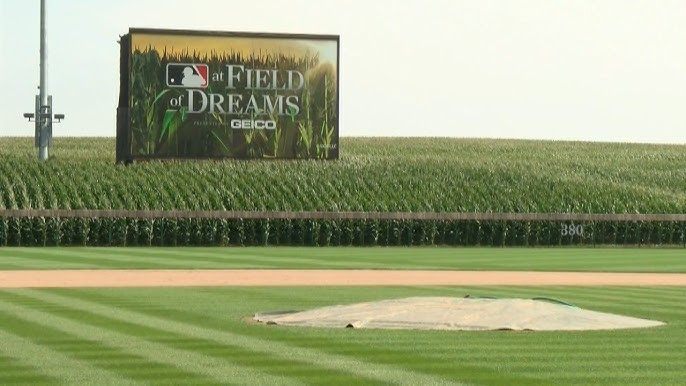
The last time I addressed him was five years ago, approaching the first Field of Dreams Game between the Yankees and the White Sox. This year’s game, 13 August, will feature the Twins against the Phillies. Didn’t I just wonder why on earth we still bother with an All-Star Game when regular-season interleague play now goes down to the season’s final weekend?

That was then: I wrote the following . . .

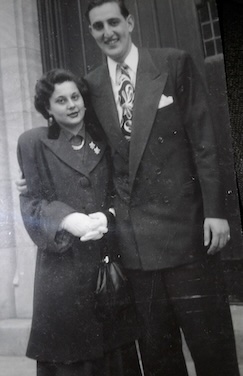
The author’s parents, presumably around the time of their marriage in 1950.

Father and son in Field of Dreams were estranged by disputes including the one in which the son chastised the father for worshipping a badly tainted baseball hero. Father and son in my case were estranged by contradictions that would be called child abuse today, followed by the ten-month battle against cancer that my father lost in 1966, when I was ten and he, thirty-nine.

My parents were foolish enough to believe nothing but physical discipline, with no concurrent attempt at real teaching, applied to mere human childhood mistakes the same as to real misbehaviour or disobedience. Confirmed decades later by an unimpeachable source (my father’s sister), my parents wanted children in the worst way possible—only to have no patience for children merely being children.

My father, alas, was even more foolish for believing the way to teach a son who didn’t know how to fight was to beat him even more violently, accompanied by every demeaning insult he could throw. The thought that a son needs to be taught to defend himself, that it isn’t knowledge with which you’re born, was never programmed into his software.

My father’s death stole any hope of eventual rapproachment in this world from me. Fantasy thought it is, the rapproachment between John and Ray Kinsella to conclude Field of Dreams was and remains something I envied every time I watched the film. The few things I had in common with my father included baseball. (And, in fairness, music, my interest in and facility for which my father encouraged but my mother rejected.)

I don’t remember whom he declared to be among his baseball heroes, other than his having been a Dodgers fan since their Brooklyn years. He spoke of various players without singling one out as a particular favourite, at least within my earshot, while I had as heroes assorted hapless 1962-66 Mets plus Sandy Koufax, Willie Mays, Juan Marichal, Henry Aaron, and Bob Gibson, among others.

But I do remember numerous catches, a few trips to the Polo Grounds and then Shea Stadium to see those embryonic Mets, and, in one fathers-and-sons game, my ripping a line drive off his crotch when he deliberately lifted his glove above it because (he admitted it later) he didn’t want to be the reason I made a hard out.

For all the contradictions and abuse, whenever I watch the Field of Dreams climax I’d give whatever I have to give to see my father walk toward me one more time, whether or not he wore a baseball uniform, and slip a baseball glove onto his left hand when I slip mine on and say, “Dad, want to have a catch?”
This is now:

Before he passed, Dad managed to find and give me my first guitar. I try to believe it was his way of saying he was sorry for the damage he did. Enough so that I don’t know what I’d love to do first, if he could walk toward me again: Pick up a guitar and play for him now . . . or slip my Rawlings glove onto my left hand and say, “Dad, want to have a catch?”


* When I sat down to write this morning, the designated hitters entered Monday’s play with a cumulative .746 OPS and a .244 batting average. From the end of the dead ball era’s final decade through the last day a pitcher not named Shohei Ohtani batted in a major league game, the pitchers posted a .344 OPS and a .162 batting average.

Of fathers, sons, dreams, rapproachment, and baseball

Kevin Costner, Dwier Brown

Kevin Costner and Dwier Brown play extraterrestrially reconciled son and father, respectively, in Field of Dreams.

So the Yankees and the White Sox will play the so-called Field of Dreams Game Thursday. They’ll play on the Iowa field rolled out and planted inside an eight thousand feet grandstand, adjacent to the field-in-the-cornfield that was actually built and used to make the film after which the game’s named.

“How,” asks Athletic writer Richard Dietsch, “do you capture the essence of a famous film on a live broadcast between Major League Baseball teams? That’s the question Fox Sports production staffers have been contemplating for months.” The answer may well depend on how you define the essence of Field of Dreams.

I read the original short story, “Shoeless Joe Jackson Comes to Iowa,” turned into the novel Shoeless Joe, by W.R. Kinsella, back when both first appeared. I saw the 1989 film when it first appeared and a few times to follow when it was delivered on videotape, then DVD. The fantasy in print and on film had a particular resonance for me.

What began as an Iowa farmer lured to plow two-thirds of his corn, to build a major league-size field onto which Jackson and his fellow Eight Men Out might return to the game from which they were banished eternally, concluded (spoiler alert, to those few who haven’t seen it) with an estranged son (the farmer) and father (presented as a one-time New York Highlanders player) reconciling as time, illness, and death once denied.

Just like any son first misinterpreting a heavenly voice’s instructions to welcome Shoeless Joe Jackson, kidnap a renowned but reclusive J.D. Salinger stand-in, then do likewise to the elderly doctor turned eager youth who’d once been a single-appearance New York Giants right fielder. Then, bringing the latter two to his fresh field to witness games between the Black Sox and assorted deceased baseball stars

(Don’t bother. IMDb lists those cast members only as “additional ballplayers.” It’s up to you whether you think you see Walter Johnson, Babe Ruth, Lou Gehrig, Honus Wagner, or Cy Young—though the young Moonlight Graham points to and mentions Smokey Joe Wood and a pair of live-ball legends, Mel Ott and Gil Hodges.)

The story has its charms above and beyond capital crime on behalf of the greater good of the game. Above and beyond the very idea that you could turn into heroes eight men who disgraced the game with their World Series tanking for fun and profit or (in the case of infielder Buck Weaver) refusing to blow the whistle on the tank when it might have made a truly significant difference.

And, above and beyond the implication that there but for the grace of the gamblers to whom two or three of the Eight Men Out reached would the White Sox have steamrolled the inferior 1919 Cincinnati Reds. The actual record shows that implication as false as the still-holding idea that Jackson was entirely innocent, to say nothing of whether Jackson really did play to win in that Series. (Says the actual record: he didn’t, quite.)

For me, the film’s climax is the charm that hits too close to home. The adult, fictional Kinsella gets to reconcile with his father on the field, the father frozen by death in his young adulthood, wearing a Highlanders uniform, with a catcher’s chest protector and shin guards.

Father and son in Field of Dreams were estranged by disputes including the one in which the son chastised the father for worshipping a badly tainted baseball hero. Father and son in my case were estranged by contradictions that would be called child abuse today, followed by the ten-month battle against cancer that my father lost in 1966, when I was ten and he, thirty-nine.

My parents were foolish enough to believe nothing but physical discipline, with no concurrent attempt at real teaching, applied to mere human childhood mistakes the same as to real misbehaviour or disobedience. Confirmed decades later by an unimpeachable source (my father’s sister), my parents wanted children in the worst way possible—only to have no patience for children merely being children.

My father, alas, was even more foolish for believing the way to teach a son who didn’t know how to fight was to beat him even more violently, accompanied by every demeaning insult he could throw. The thought that a son needs to be taught to defend himself, that it isn’t knowledge with which you’re born, was never programmed into his software.

My father’s death stole any hope of eventual rapproachment in this world from me. Fantasy thought it is, the rapproachment between John and Ray Kinsella to conclude Field of Dreams was and remains something I envied every time I watched the film. The few things I had in common with my father included baseball. (And, in fairness, music, my interest in and facility for which my father encouraged but my mother rejected.)

I don’t remember whom he declared to be among his baseball heroes, other than his having been a Dodgers fan since their Brooklyn years. He spoke of various players without singling one out as a particular favourite, at least within my earshot, while I had as heroes assorted hapless 1962-66 Mets plus Sandy Koufax, Willie Mays, Juan Marichal, Henry Aaron, and Bob Gibson, among others.

But I do remember numerous catches, a few trips to the Polo Grounds and then Shea Stadium to see those embryonic Mets, and, in one fathers-and-sons game, my ripping a line drive off his crotch when he deliberately lifted his glove above it because (he admitted it later) he didn’t want to be the reason I made a hard out.

For all the contradictions and abuse, whenever I watch the Field of Dreams climax I’d give whatever I have to give to see my father walk toward me one more time, whether or not he wore a baseball uniform, and slip a baseball glove onto his left hand when I slip mine on and say, “Dad, want to have a catch?”

How do you capture the essence of a famous film on a live broadcast between Major League Baseball teams? Asking demands we ask just what that essence really is.

Is it giving eight disgraced baseball players a new home and a chance to recover by the gods what their misbehaviours—ranging from the morally criminal to the complicit to the willfully silent—stripped from them in the mortal world’s furies?

Is it the old, long-gone fans who refused to believe those men could have been anything other than victims of their own caprices, married to those of a purportedly unscrupulous baseball owner (and that theory has been debunked, too) and the professional gamblers a few sought to finance their intended subterfuge?

Is it re-discovering a truth enunciated in short form and long double-negative by Hall of Fame manager Sparky Anderson? We try every way we can think of to kill this game, but for some reason nothing nobody does never hurts it. Or in long form by James Earl Jones as Salinger’s stand-in Terrence Mann?

People will come . . . they’ll walk out to the bleachers; sit in shirtsleeves on a perfect afternoon. They’ll find they have reserved seats somewhere along one of the baselines, where they sat when they were children and cheered their heroes. And they’ll watch the game and it’ll be as if they dipped themselves in magic waters . . . America has rolled by like an army of steamrollers. It has been erased like a blackboard, rebuilt and erased again. But baseball has marked the time. This field, this game: it’s a part of our past . . . It reminds of us of all that once was good and it could be again.

The author's son

Photographed by his father through a fence, my son ends his first-ever national Special Olympics plate appearance with a home run. (Yes, he back-flipped his bat away!) My fortune includes that we will never require reconciliation.

Is it an otherwise composed, ordinary Iowa farmer compelled to restore an un-restorable purity to men who could have destroyed baseball but engaged his lost father enough to return to earth, fostering the rapproachment too many fathers and sons—including mine, wherever he is in the Elysian Fields, with me—wish with each other but never find?

My own fortune includes being a father myself. By marriage and mutual engagement, not biology. The marriage is long past; my fatherhood, never. We made each other father and son. I did my best with whatever I had, for a son whose intelligence and will overcomes his compromise by a speech and language impairment, and whose heart is too large to be contained.

He joined his southern California softball team winning silver at the national 2018 Special Olympics. (His first plate appearance in that event: a healthy home run.) During the tournament, his coach told me and he affirmed: he credited me with teaching baseball and softball to him. There was no one more proud of my son at that Special Olympics (except his mother, surely) than his father.

All I ever did was observe, see what he had beyond the love of baseball we shared at the outset, then let him develop what he had on his time, through his eyes, ears, and hands, through his heart, never once imposing mine upon him. (He imposed one of his own: his boyhood heroes were Shawn Green and Vladimir Guerrero.) I’d learned the hardest way how damaging the other ways around could be.

The pan-damn-ic has prevented in-person time with my son since last year. We’ve missed the pleasures of going to Angel Stadium, sharing a game, sharing an atmosphere, with accompanying talk, theory, and hopes of catching a foul ball. It may well do so again before this season ends. I’ll talk to my son on the phone and in instant messages, as always we do. No one needs to tell either of us it isn’t quite the same as direct human engagement.

Neither of us are Yankee or White Sox fans. My son is a die-hard Angel fan. His father is a Met fan since the day they were born, a Red Sox fan since the 1967 pennant race, an Angel fan since the first day I took him to an Angel game. (They beat the Yankees and The Mariano in extra innings.)

We will probably each watch the Field of Dreams Game, thinking our own thoughts while the Yankees engage the White Sox, adjacent to where a novel was made into a film of fantasy that raises questions not always simple to answer. When not contemplating the good, the bad, the excellent, the dubious, about the play of the actual game.

Far simpler to replay the fictional Ray and John Kinsella reconciling with a simple game of catch. Even more simple to remind myself how much more fortunate I am, for having overcome my own parental estrangement and bereavement. For knowing I can still talk to, counsel, listen to my now-adult son, and play catch with him when conditions allow—for pleasure, not atonement.