Anatomy of an execution

2019-09-09 DaveDombrowskiDavidOrtiz

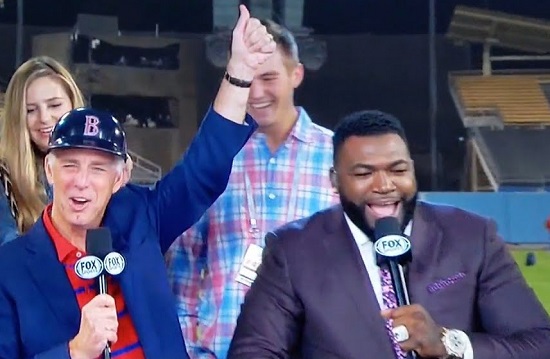
Just shy of eleven months ago, Dave Dombrowski wore a Red Sox helmet and let former Red Sox superstar David Ortiz interview him right after the Red Sox nailed a World Series. After midnight last night, Dombrowski went to the Red Sox guillotine.

Watch and ponder a 10-5, home run heavy Red Sox loss to the Yankees on national television Sunday night. Awaken Monday morning to discover the Red Sox threw out the first president of the season just after midnight. Down the stretch. With the Red Sox down to little if any hope of really defending their 2018 World Series championship.

Every once in awhile not even a World Series appearance or conquest is enough to save someone’s baseball job. It wasn’t for Dave Dombrowski. The GM-made-president of baseball operations, who finished what his predecessor Ben Cherington started and steered the Red Sox back to the Promised Land for the fourth time since the 21st Century began, is finished.

And the questions include the price the Olde Towne Team will pay for last year’s conquest. Dombrowski spent big with dollars and with prospects to make last year’s triumph happen. Now the Red Sox farm system is parched, and a lot of the dollars that finished constructing last year’s conquerors could prove a prison as much as a parade.

Forgotten at times during last year’s triumph was that Cherington built the core of the team. Dombrowski took the bows with everyone else after the Red Sox finished stunning the Dodgers last fall but all he did was finish what Cherington started. And everyone who remembered Dombrowski’s years of trying but failing to get the Tigers to the Promised Land and mortgaging the farm several times couldn’t resist asking how long before Dombrowski’s accomplishment with the Red Sox would endure before he’d be nudged out of Boston, too.

It’s unfair to Dombrowski in a few ways, of course. But running a team whose in-house culture is win/win-now/keep-us-winning isn’t simple business. And men who mortgage the farm on its behalf often have lower survival rates than men who know how to remake/remodel without tanking or without letting the farm become a dust bowl.

Cherington got four years. Dombrowski didn’t survive a fourth. Both were hired seemingly out of nowhere. Except that for one of them, “nowhere” was right under the Red Sox’s noses. Cherington was part of the Red Sox baseball operations offices since 1999 and built himself a solid player development background when he was hired to succeed Theo Epstein in 2011.

Cherington’s first order of serious business, alas, was to take it like a manperson when the powers above made him look like a fool after the infamous 2011 Red Sox collapse. He’d promised numerous players that whomever would take the bridge, after Terry Francona quit before he could be fired, it wouldn’t be the rumoured Bobby Valentine. The powers above hired Valentine (specifically, it may have been Larry Lucchino’s call); Cherington’s choice was almost anyone but. (Actually, at the time, it was Dale Sveum.)

Poor Cherington. He found himself having to keep his back door open to help one after another Red Sox player keep his marble (singular) during the Valentine nightmare. Then, he executed the daring August 2012 trade that sent the Dodgers Josh Beckett, Adrian Gonzalez, and Carl Crawford and concurrently blew open a small tonnage of financial headroom while giving himself the space to hatch and execute a post-Valentine plan.

Cherington spent the 2012-13 offseason buying or dealing for a group of more than useful availables and spare parts—Mike Napoli, Jonny Gomes, Shane Victorino, David Ross, Stephen Drew, Brock Holt, and (especially) sleeper reliever Koji Uehara—and bringing home former Sox pitching coach John Farrell to take the bridge and dissipate the Valentine toxins.

That effort, plus the returns to health of such key men as John Lackey, often-injured (and oft-unfairly alienated) Jacoby Ellsbury, and especially future Hall of Famer David Ortiz, got the Red Sox 2013 World Series rings for Cherington’s efforts. It also got Cherington named as the third Red Sox executive ever named by The Sporting News as Executive of the Year.

Concurrently, he devised and executed a longer-range plan that rebuilt the Red Sox farm without even thinking about tanking, which is never an option for a team whose owner John Henry learned what not to do and how not to do it watching the similarly win-now-or-be-gone thinking of the late Yankee owner George Steinbrenner.

Mookie Betts, Xander Bogaerts, Rafael Devers, Andrew Benintendi, Eduardo Rodriguez, and apparently defense-first Jackie Bradley, Jr.—all of whom factored large enough in last year’s conquest—were Cherington’s handiwork, either by in-house development or trade such as the deal that brought Rodriguez to the Red Sox in late 2014.

Where the earnest Cherington mis-stepped was with some of his subsequent free agency signings, including Pablo Sandoval, Hanley Ramirez, A.J. Pierzynski, and Grady Sizemore. When the Red Sox executed him in favour of Dombrowski, Cherington still left them a solid nucleus that didn’t go unnoticed by the incoming Dombrowski.

It didn’t take Dombrowski long to sign such nuggets as David Price and Craig Kimbrel, and watch as the Red Sox went from last to first in the 2016 American League East, though they were shoved out of the postseason by the eventual pennant-winning Indians. Dombrowski traded for Chris Sale, signed Mitch Moreland, and basked in the 2017 AL East title despite another postseason exit short of the Promised Land.

Then he answered Farrell’s apparently losing his clubhouse at last by canning Farrell and hiring Astros bench coach Alex Cora—while the Astros were still advancing toward their 2017 World Series conquest. And Cora let his new players know immediately how they fell short enough: “You guys were easy to game plan against. Too many bad takes [at the plate].”

Dombrowski also landed J.D. Martinez at almost the eleventh hour of last year’s spring training, then watched Benintendi, Bogaerts, Devers, and Betts especially come into their own, Betts almost running away with last year’s American League Most Valuable Player award. Marry that to Price and Sale shaking away whatever problems they might have had otherwise, and the Red Sox turned the 2018 postseason into a thrill that climaxed when Sale struck out the side to end the World Series hoisting the trophy in Dodger Stadium.

Except that there were a few serious cracks in the structure Dombrowski finished atop Cherington’s foundation:

* Almost typical of a Dombrowski administration, the Red Sox didn’t just empty the farm, they took a torch to it. Assorted observers say the farm’s being rebuilt little by little, though.

* Dombrowski ignored the Red Sox bullpen almost entirely both last offseason and approaching this year’s new single mid-season trade deadline. Some say it’s outperformed its expectations this year; others say it became taxed too heavily as one after another Red Sox starter faltered for assorted reasons—especially after they were barely worked in spring training and looked like spring-training pitchers in April.

* Betts has one more season coming under Red Sox control and, unless something happens between now and October 2020 to constitute an offer he can’t refuse, it looks as though he’s going to play the market for the first time then. The Red Sox may have ideas about trading him this winter, but if they go there they won’t get that solid a return for a one-year rental.

* Martinez is posting another magnificent season at the plate, but he has an opt-out clause he can exercise at season’s end and enough observing the Red Sox fear he’s liable to try playing hardball. For more money? For a longer commitment? Nobody knows just yet, but the Red Sox have to brace themselves for either.

* With Nathan Eovaldi, a postseason hero out of the bullpen last fall, missing too much time to injury this year and then having to shake away rust in a return to the rotation, it leaves the Red Sox with him, Sale, and Price as underperformers among the walking wounded and on long-term contracts while they’re at it.

In fact, Sale—who’s now done for the season thanks to pitching elbow inflammation—won’t even see his contract extension begin until 2020, but some argue Dombrowski signing him to that extension might have seeded Dombrowski’s end. Sale swore when signing that his shoulder troubles were behind him. Everyone wanted to believe it. Then his inconsistent 2019—brilliance here, battery there—ended prematurely when his elbow immolated. Uh-oh.

But there’ve been enough bright lights in Red Sox fatigues to make you confident they can win next year. Betts, Bogaerts, and Devers still make for a powerful threesome at the plate, though the Red Sox may want to think hard and start thinking now about keeping Betts in the family. Even if Henry wants to trim payroll up the street, he can’t afford to let his franchise player leave the family.

Benintendi shook away his first half inconsistencies and is having a magnificent second half, and he should be ready for a full season’s high-level production in 2020. Rodriguez is having a breakout season. Matt Barnes and Brandon Workman have become late-inning godsends out of the bullpen.

And rookie reliever Darwinzon Hernandez’s bullpen performance in his first 25 gigs (2.83 ERA; 2.17 fielding-independent pitching [FIP]; 17.0 K/9) in addition to his widely enough reported early maturity may mean the Red Sox’s late-game/ending-game wipeout option of the future is preparing for that future already, even if Cora isn’t anxious to smother the kid with hype.

But Jhoulys Chacin, whom the Red Sox signed after the Brewers parted ways with him late last month, has no such fear. In a perfect position to know, Chacin isn’t afraid to compare Hernandez to Josh Hader, the Brewers’ bullpen assassin. “He reminds me of Hader,” Chacin tells MassLive.com’s Christopher Smith. “He throws that raised fastball that some guys just can’t catch up.

“I’ve talked to him a lot since I’ve been here,” Chacin continued. “I want him to stay healthy and keep doing what he’s been doing. I played with Hader and to see his fastball just raise up, (Hernandez’s) fastball does pretty much the same, too. Like I said, he just needs to stay healthy and take his approach every day to the field and I think he can be a pretty good pitcher.”

It isn’t just Hernandez’s fastball. He’s developed a solid slider and has a curve ball with wipeout potential. Any way you look at him, Hernandez at 22 may hold the Red Sox bullpen’s future in his left hand.

The Red Sox won’t talk publicly about Dombrowski’s execution just yet. Give them credit, sort of, for doing it almost stealthily. The NFL’s New England Patriots hogged the weekend headlines, first signing controversial wide receiver Antoine Brown, after he wriggled his way out of Oakland, then blowing the Pittsburgh Steelers out 33-3 Sunday night to open their season. The Red Sox dropped the guillotine on Dombrowski almost noiselessly.

They left Cora to be the public face of the putsch. It’s not exactly Cora’s most comfortable position, as he made clear after Sunday night’s loss when he was told the blade sliced  through Dombrowski’s neck. “I’m surprised and shocked, obviously,” the manager said. “Right now, I don’t have too much to say. This is the guy that gave me a chance to come here and be a big-league manager. They just told me so I’m not ready to talk about it.”

Martinez and Rick Porcello have said they were all but blindsided over executing Dombrowski, to whom both players were close going back to their Detroit days. Porcello had enough on his plate apologising publicly to Red Sox fans for his, shall we say, modest performance this season, without losing a man he considered a friend.

“At the end of the day” the righthanded former Cy Young Award winner said, “we’re the players who are on the field and we’re the ones who can make or break a lot of things. Ultimately, the onus comes on us. I’m still processing everything. Processing myself, too. It’s really hard to reflect on it, too. I’ll have potentially a better answer for you in a couple days. You never like to see anybody lose their job over what we’re doing on the field.”

As peculiar as it might sound to read in print, the Yankees have had little but front office stability with Brian Cashman as their general manager since 1998—and only one World Series title to show since the turn of the century. The Red Sox have had five full-time general managers since 1998 (Dan Duquette, Mike Port, Epstein, Cherington, and Dombrowski)—and four World Series titles to show since the turn of the century.

A lot of teams would kill for the Red Sox’s 21st Century track record—four World Series rings in fifteen years—even with the extremes of maximum success and (thanks to three dead-last division finishes) maximum recess. And a lot of GMs or baseball ops presidents would kill for Dombrowski’s overall resume: two World Series rings (his other ring: the 1997 Marlins), two American League pennants (the Tigers), in a little over two decades.

But a lot of them wouldn’t turn the farm into the dust bowl to get there, either.

The Red Sox for now will be run by a trio of assistant GMs, Brian O’Halloran, Eddie Romero (the son of 1986 pennant-winning Red Sox spare part Ed Romero), and Zack Scott. Several reports say Romero among the three is most considered to be a full GM/baseball ops president in waiting. Maybe the Red Sox won’t wait too long to make it happen.
Greinke makes the ‘Stros trade winners

2019-08-01 ZackGreinke

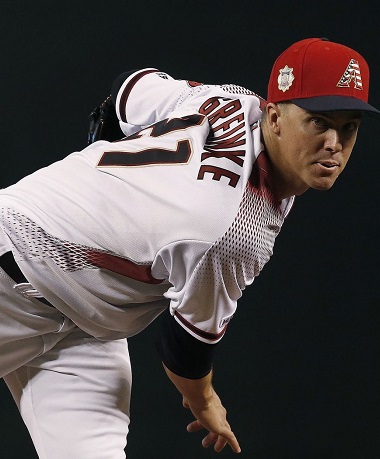
Zack the Knife makes the Astros the big trade winners. Will he help make them World Series winners?

No questions asked. The Astros slipped in at the eleventh minute, practically, and not only stole the new single trade deadline show but they did the absolute most to fortify themselves for the postseason run nobody doubts is theirs this season. Barring unforeseen disaster, of course.

With Gerrit Cole looking at free agency after the season it made sense for the Astros to seek a top-of-the-line starting pitcher with at least another full season of team control to line up with (don’t doubt it) future Hall of Famer Justin Verlander, so far the new ageless wonder of baseball.

So it came forth after the deadline passed that the Astros sent a quartet of prospects—good, promising, but not quite platinum-rated prospects—to the Diamondbacks for Zack Greinke, who isn’t exactly a slouch on the mound and who’s having a solid season in his own right so far.

They’ll get the rest of this season plus the final two seasons on the gigadeal Greinke signed with the Diamondbacks. The Snakes also sent the Astros a reported $24 million to help cover the rest of Greinke’s contract, on which the Astros will be responsible for the other $53 million. They’re not exactly complaining.

General manager Jeff Luhnow knew only two things about Greinke before he pulled the trigger on the big deal of the day: Zack the Knife has been a consistent pitcher who’s on the borderline of a Hall of Fame case; and, the righthander isn’t exactly one of the most combustible personalities in baseball.

“I don’t know him personally,” Luhnow told reporters, “but I think he’s not a guy that seeks the limelight, and that actually works well for us here in Houston. And slotting in with Verlander and Cole, he’s gonna not have to be the guy that’s in front of the camera the whole time.”

The Astros weren’t exactly over-occupied on doing the Greinke deal. Before that deal hit the news running Wednesday, they did a little bullpen fortification, getting Aaron Sanchez and Joe Biagini from the Blue Jays. The Jays also sent the Astros minor league outfielder Cal Stevenson. The Astros sent the Jays outfielder Derek Fisher.

Greinke was last seen striking out seven Yankees in five innings Wednesday. He left the park without talking to reporters, which may or may not have been an indication that he suspected or was told it was time to re-pack his bags.

On the same day, the Astros got flattened by the Indians, 10-4, in Cleveland; they finish with the Tribe Thursday before a weekend hosting the Mariners, but Greinke may not have his first Astros start until the Rockies hit town starting Monday.

“I know he’s really good. I don’t know him personally, but I’m going to get to know him,” said Astros manager A.J. Hinch. “We acquired him because of how good he is. Certainly we expect him to be a big part of our push to win the division and keep winning into October. He’s an incredible pitcher.”

He has been, and he still is when all is said and done. His new teammates won’t disagree. “What a pickup!” Cole himself crowed. Referring to the front office, he added, “They nailed it. They did a fantastic job.”

Landing Greinke shot the Astros into being World Series co-favourites with the Dodgers at Caesar’s Palace Sports Book. But the Astros are smart enough to know Berra’s Law is immutable. Zack the Knife increases their odds of a return to the Series, but so is Andujar’s Law, as uttered by a long-ago Astro, the late Joaquin Andujar: “In baseball, there’s just one word—you never know.”

What we do know, though, is who were really the big winners and the big losers of major league baseball’s first single mid-season trading deadline.

THE WINNERS

Braves—Another starting pitcher wouldn’t have hurt them, necessarily, but what the National League East leaders really needed was a back-of-the-bullpen retooling. And, they got it, in an almost rapid fire series of deals.

They landed Shane Greene from the Tigers. They landed Chris Martin from the Rangers. They landed Mark Melancon from the Giants. As CBS Sports’s Matt Snyder observes, if the prices were too high for such reported availables as Edwin Diaz (Mets) and Felipe Vasquez (Pirates), the Braves did well enough shopping the sale aisle.

None of the new pen trio are anything near the most glittering names in the relief world, but neither are they slouches or pushovers. Changes of scenery from nowhere land to pennant contention do wonders for such pitchers, and it would be absolute gravy if the Braves get something out of Melancon resembling his final years in Pittsburgh and his only spell in Washington.

Greene, of course, was an All-Star this year and was wasted on a Tigers team in the middle of a rebuild. When the Braves can turn to him near the end of a game, either as the sure ninth-inning option or if things get a little dicey in the eighth, the sight of Greene warming up with his 1.18 ERA should be enough to make their division and the rest of the league quake.

Throw in Martin’s 10+ strikeout-to-walk ratio and 10.2 K/9 rate, and all of a sudden the Braves’ bullpen doesn’t look like it’s full of bull anymore.

Indians—So Trevor Bauer turned out to be a bigger pain in the you-know-where than his otherwise solid pitching was worth. Doesn’t mean the Indians dealt from weakness. Not with Corey Kluber on the threshold of returning from the injured list.

And the Tribe managed to address their biggest weakness in the deal: their corner outfielders weren’t hitting anywhere near the same area code as their new toys Yasiel Puig (from the Reds) and Franmil Reyes (from the Padres) put together. Add Puig’s mostly plus throwing arm in right field, and all of a sudden the Indians outfield isn’t just going to roll over and play dead.

The Indians also landed lefthanded pitching youth Logan Allen (also from the Padres), and when you consider how well they develop or re-tool starting pitching this is an upside acquisition for them, too.

But the real key was the impact bats. Puig secures them in right field for the rest of the season, and perhaps if he continues doing well enough the Indians would think of pursuing him when he hits free agency in the fall. Reyes, though, secures a DH spot for them for the foreseeable future while giving them an outfield platoon option in the bargain.

Suddenly it’s not to laugh about the Tribe’s outfield anymore.

Mets—Don’t laugh. Not only are they on a six game winning streak at this writing, the formerly left for dead Mets—and even I thought they were just awaiting the nails to be hammered into their coffin after that terrible weekend in San Francisco—are 12-7 since the All-Star break.

And maybe it’s an illusion since, aside from the Giants, they faced only real contender during the string. But they did take both games against the Twins in Minnesota, including a 14-4 blowout. All of a sudden, these Mets can play as well as they can pitch.

And while the world seemed to be sure only that either Noah Syndergaard or Zack Wheeler would have a change of address after Wednesday’s deadline, it took the Astros landing Greinke to knock the Mets’ landing Marcus Stroman well enough before the deadline out of the park.

Maybe Stroman wasn’t thrilled at first to go to what he thought was a non-contender. And maybe someone ramped up for kicks a rumour that the Mets had ideas about flipping Stroman to the Yankees post haste for some of the Yankees’ top farm produce. But the Mets wasted no time ridding themselves of Jason Vargas—who should have been cashiered over a month earlier—sending him to the Phillies almost as soon as Stroman’s acquisition was a done deal.

The Mets rotation now looks like Jacob deGrom (who pitched brilliantly against the White Sox Wednesday night only to get his almost-usual no-decision, the poor guy), Stroman, Syndergaard, Wheeler, and Steven Matz. And with Matz putting on a deadly off-speed clinic shutting out the Pirates last Saturday night, looking as though he’s finally found the secret to pitching without the power of a deGrom or a more disciplined Syndergaard, it gives the Mets a rotation with two number-ones, a two, and a pair of threes.

Nationals—Like the Mets, the Nats were left for dead a few times before the All-Star break. Like the Mets, too, the Nats are riding resurgent, sort of: 10-9 since the break. And the Nats needed a bullpen remake in the worst way possible.

Not at the absolute rear end, where closer Sean Doolittle remains effective when he has something to save. It’s getting the games to Doolittle that caused one after another National migraine. But then the Nats landed Jays reliever Daniel Hudson and Mariners reliever Roenis Elias.

All of a sudden, the Nats seemed to find relief in the best way possible for that beleaguered bunch of bulls. And then they got really surreal—it turned out that they also got an old buddy (ho ho ho) from the Mariners, Hunter Strickland.

Strickland—who carried an almost three-year grudge over then-Nat Bryce Harper taking him deep twice in a division series, the second time awaiting whether his fresh blast straight over the foul line would leave the yard fair but misinterpreted as admiring the shot. (It flew fair into McCovey Cove.)

Strickland—then a Giant, who somehow hadn’t gotten the chance to face Harper until 2017, then entered a game with Harper leading off an inning and threw the first pitch right into Harper’s hip. Triggering Harper’s charge to the mound and the very delayed Giants pouring out of their dugout, during which pour former Nat Michael Morse’s career ended up being sealed when he collided with Jeff Samardzija and suffered a concussion.

Harper, of course, now wears the Phillies’ silks. But it would have been intriguing if Harper was still a Nat with Strickland coming aboard. Strickland’s coming back from a lat strain that disabled him for almost three months. And the Nats don’t see hide nor hair of the Phillies again until a four-game home set beginning 23 September.

By which time, the Nats may or may not be in the thick of the NL East race (the Braves suddenly started looking human enough the past couple of weeks), securing a wild card berth, or hoping they’ve got a leg up on 2020. A lot rides on the new bulls. But for now, the Nats took their number one need and addressed it respectably enough.

THE LOSERS

Red Sox—Like the Braves and the Nats, the Red Sox needed bullpen help badly. Unlike the Braves and the Nats, the Red Sox landed nothing. Not even a calf, never mind Diaz, whom the Mets were making available and who probably could have been had for a little less than they were said to have demanded for Syndergaard and Wheeler.

The Red Sox bullpen ERA in June: 4.92. The Red Sox bullpen ERA in July: 5.18. Letting some reasonably effective pieces make their ways to Atlanta and Washington instead does not portend well for the Olde Towne Team.

Dodgers—I know, it sounds funny to apply “losers” in any context to the National League’s 2019 threshing machine. But the threshing machine has one monkey wrench looming: the Dodger bullpen isn’t as formidable as it used to be.

Kenley Jansen isn’t really pitching like the Kenley Jansen of old this year. What’s behind him in the pen depends on whose description you read: mess, disaster, toxic waste dump, landfill, take your pick.

If the Mets and the Pirates were asking the moon for Diaz and Vasquez, the Dodgers if anyone had the moon to give in return. They’re loaded with prospects on the farm, and money in the vault, enough to have dealt a package of them for either reliever and still have a bountiful harvest to come.

Good luck holding leads against postseason lineups with that kind of pen. And the Dodgers won’t be able to hit themselves beyond their pen’s capability eternally. They won’t lose the NL West, necessarily, not with a fifteen-game lead at this writing, but their chances at a third consecutive World Series appearance and just one Series ring since 1988 just got a lot more thin.

Brewers—The pre-season favourites to defend their NL Central title aren’t exactly that good anymore. Losing Brandon Woodruff and Jhoulys Chacin to the injured list has left their rotation in tatters, and with the Giants yanking themselves back into the wild card play there went their ideas of maybe adding Madison Bumgarner for a stretch drive.

But they also needed some pen help, and what they brought aboard (Ray Black, Jake Faria, Drew Pomeranz) is serviceable but not quite as serviceable as what the Braves and the Nats brought aboard. The Brew Crew is liable to spend the rest of the season watching the Cardinals’ and the Cubs’ rear ends, but then with the NL Central as it’s been this year there could be a surprise in store. Could. Remotely.

Because the Brewers can’t live by Christian Yelich alone.

Twins—The AL Central leaders have gone from a double-digit division lead to looking only human at three games up on deadline day. They needed a little rotation help and a little bullpen help.

And they got only a little in the pen. Sam Dyson (from the Giants) and Sergio Romo (from the Marlins) are solid but not overwhelming. Maybe not for lack of trying, but the Indians’ blockbuster suddenly puts the Twins close enough to the Tribe’s mercy to make for a too-interesting stretch drive for them when they once looked like the division’s runaway train.

They can hit all the home runs they want, but if their pitching is compromised the Twins have a big problem coming. Like the Yankees, the Twins should have been more aggressive trade deadline players. Like the Yankees, they weren’t, for whatever reasons. And it could come back to haunt them down the stretch.

Yankees—Even Yankee haters won’t understand this one. The number one need for the injury-battered Bombers was rotation help. Especially after they’d just been flattened by the Twins and the otherwise-troubled Red Sox. And they did nothing to fix it.

The question may be why, or why not. If Bumgarner was off the market, they could have played for Stroman or for Mike Minor, even allowing for Minor’s rough July after a sterling June. They didn’t seem to play for any of the above. They didn’t even seem to be a topic if the Diamondbacks—knowing their own chances were still none and none-er—were looking to move Greinke to a contender.

And since their number one American League competition overall did land Greinke, the Yankees may ride a weakening AL East into October but they’re not liable to get past round one again, even if it may not be the Red Sox shoving them to one side this time.

Marcus Stroman and other trade deadline thoughts

2019-07-30 MarcusStroman

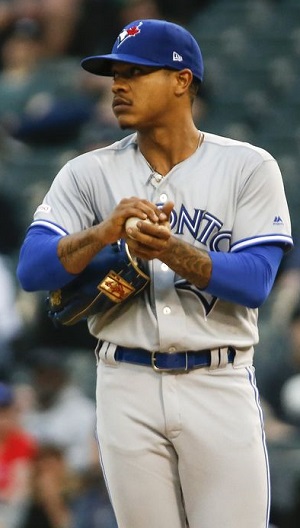
Marcus Stroman to the Mets—method to madness or madness to method?

As regards the Mets dealing a pair of mixed-reviews pitching prospects to the Blue Jays for their staff ace Marcus Stroman, and the coming trade deadline in general a few observations. Beginning with the one that tells me it seems at least three-quarters of baseball never saw this Stroman deal coming.

Anyone who thought Stroman’s new address would be New York by this year’s new single trade deadline figured it would involve the Yankees, leaders in the American League East, and not the Mets, strugglers to stay within reasonable sight of even the second National League wild card.

Or, if Stroman was going to move on from Toronto, he’d be more likely to land with one or another viable 2019 competitor—say, the Braves, where I seem to recall some observers thought he’d make a better mutual fit if the Yankees really were convinced Stroman was good enough to pitch but not necessarily fit.

But Stroman, who makes his living largely by way of his ability to lure ground balls, is now a Met. So where do we and they go from here?

1. Former major league general manager Jim Bowden, who now writes for The Athletic, says the Mets have no intention of landing Stroman just to flip him for a better package by the close of trade business Wednesday. And the two pitching prospects going to the Jays—Anthony Kay and Simeon Woods-Richardson—are considered solid but not elite prospects, but the Jays believed they weren’t going to get better than them for Stroman when all was said and done.

2. The Mets aren’t a team of elite defenders especially around their infield this year, and yet Steven Matz—returning to the rotation after a brief spell in the bullpen to re-horse—pitched a complete-game 3-0 shutout Saturday night in which his calling cards were a deft blend of breaking and off speed stuff and putting his fielders to work, which for a change they did rather admirably behind him.

3. Matz’s performance may well have had a firm impact on the Mets’ pitching thought. May. They’ve tried since 2013 to cultivate an arsenal of power arms in the rotation and seen, when all is said and done, only Jacob deGrom live up to any expectations. They watched Matt Harvey’s injuries collapse him from a power pitcher to one in search of a new cause and, now, a new team. They’ve seen Noah Syndergaard and Zack Wheeler bring the power without delivering the consistent results.

If the Mets had eyes for Stroman before Matz took the mound Saturday night, Matz’s performance had to have told them it wouldn’t be a terrible idea to add another arm to the rotation that belonged to a young man who uses more than his arm to survive on the mound. Stroman isn’t a strikeout machine; he has the second highest ground ball rate among all Show starting pitchers.

4. Maybe acquiring Stroman begins to get the Mets re-thinking their incumbent defense, too, especially marrying him to Matz in their rotation. Rookie of the Year candidate Pete Alonso forced Dominic Smith off first base, but Smith in the outfield looks almost exactly like the un-natural he is out there even though he hits with authority. Rookie general manager Brodie Van Wagenen’s willingness to take aging Robinson Cano if he wanted closer Edwin Diaz from the Mariners last winter forced Jeff McNeil, their obvious second baseman of the future, likewise into an outfield where he’s about as comfortable as an elephant in front of a mouse much of the time.

5. Diaz has been a mess not entirely of his own making this season, mishandled, sometimes mis-deployed, and while the raw talent is still there the Mets are now rumoured to be shopping him. Cano has four years left on the contract the Mets took on from the Mariners, making him almost an immovable force. Whether the Mets’ contradictory ownership might be willing to take a bath on the deal in order to start moving defensive parts back where they belong is anyone’s guess.

6. With Stroman off the market eyes turned not just upon Syndergaard but the rest of this trade deadline’s pitching market.

The Giants’ unexpected resurgence means Madison Bumgarner isn’t likely to go anywhere the rest of the season, compared to a month ago when the observers and speculators pondered where, not if he’d move on. The Yankees need whatever starting pitching help they can get but the market now seems more constricted—and as much as they’re wary of dealing with the Mets, Syndergaard now might look like an attractive Yankee target. Might.

And the Nationals, like the Giants but at a higher level, have had an unexpected resurgence of late after they were all but written off as dying as late as early June. They ran into a buzzsaw in Los Angeles this past weekend, needing Stephen Strasburg to pitch the masterwork he did in seven Sunday innings to escape with even a single win, but now Max Scherzer—whom all the Smart Guys said had to go on the trade deadline block once upon a time, in large part to bring them badly needed bullpen relief—may find his barking back barking well enough into August.

At first glance, then, it would seem the Nats have a big problem as they prepare to square off against the National League East-leading Braves Monday night. Except that the Braves, who ran roughshod over the league before the All-Star break and still lead the Nats by five and a half games, have suddenly regressed to being only human. Not only have they lost seven of their last eleven, they’ve lost two critical elements—shortstop Dansby Swanson, resurgent veteran right fielder Nick Markakis—to the injured list. The Nats won’t have Strasburg or Scherzer to throw at the Braves this week but the Nats might still gain key ground, anyway.

7. The bullpen dominos began falling over this past weekend, too. Veteran Sergio Romo, once a key to a couple of Giants World Series winners, just went from Miami to Minnesota where the Twins, this year’s American League surprise, just bumped their bullpen up several notches by bringing him aboard. Jake Diekman went from Kansas City to Oakland, a sign the Athletics are gearing up for another wild card run. There are contenders aplenty who need help in the pen and few more than the Nats.

8. If the Jays are rebuilding in earnest, bullpen-longing eyes may be cast upon the surprising Ken Giles. After his 2017 World Series mishap (which wasn’t entirely his sole responsibility) and subsequent personal and mound meltdowns, Giles has rehorsed completely in Toronto. As in, a career year: a 1.54 ERA and a 1.60 fielding-independent pitching rate. Not to mention a 5+ strikeout-to-walk rate and a 14.9 strikeout-per-nine rate.

Yes, the Nats have eyes upon Giles and his Jays pen mate Daniel Hudson. But so may the Red Sox and any other contender who needs a bump among the bulls. Even the Twins, despite landing Romo, might still make a play for Giles at least or, if Giles eludes them, Norman, whose 2.87 ERA and June-July of only four earned runs in 21 innings’ work yanked his trade value up accordingly.

Bowden rates the Stroman deal a B+ for the Mets and a B- for the Jays. It wouldn’t hurt the Jays’ standing to try prying a slightly better haul back for Giles and/or Hudson. And although Giles is dealing with a slight nerve issue in his pitching elbow, wiping out the side as he did in a Saturday night assignment should make his suitors breathe a little easier, assuming they don’t fall tempted to overwork him while he works through it.

9. The Mets may or may not yet have a wild card long shot this year, but don’t kid yourselves: they were thinking as much about 2020 as now when they made their play for Stroman. And since Stroman is under team control through the end of 2020, don’t be surprised if they like what they see from him the rest of this season and start talking extension with him before 2020 begins.

Which might also mean that Syndergaard at minimum, and Wheeler at maximum, may yet have changes of address coming by Wednesday afternoon. And with whisperings that the Red Sox have eyes upon Diaz for their pen, which needs a little help but isn’t as badly mismanaged as the Mets pen has been this year, the Mets should be thinking smart and looking very closely at that Red Sox farm system.

Because the Mets could also use a third base upgrade from veteran Todd Frazier, who’s reliable but beginning to show his age. And as thin as the Red Sox system is for now, AAA third baseman Bobby Dalbec was named both the offensive and defensive player of the year for 2018 in the Red Sox’s minor league award valuations. If the Olde Towne Team wants Diaz for their pen that much, the Mets should all but demand Dalbec in the return haul.

10. Too many teams never quite do what they should when it counts. The Mets, alas, are notorious for that. Even when they’re winning.


Pumpsie Green, RIP: The modest pioneer

2017-07-19 PumpsieGreen

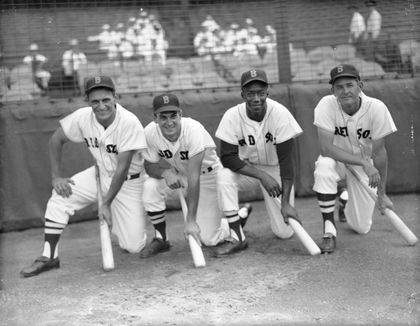
Pumpsie Green poses with three Red Sox who helped make his integrating the team that much more bearable. From left: third baseman Frank Malzone, shortstop Don Buddin, and first baseman Pete Runnels.

For those whose hobbies include forging off the wall trivia questions, here’s a beauty.  What does Pumpsie Green have in common with Jackie Robinson and Lou Brock? The answer is two parts: 1) Green, too, was the first black man to play on a particular major league baseball team. 2) He was also a teammate of the now-late Ernie Broglio, traded most notoriously for Hall of Famer Brock in 1964.

Part two is the far less problematic, of course: Green and Broglio were teammates for El Cerrito High School in California. Part one, alas, is the more so: Green was the first black man admitted to the ranks of the Red Sox, who were, alas, the final team in major league baseball to admit a black player and one of the first, alas far further, to reject Robinson, Willie Mays, and others over a decade earlier.

A catcher/first baseman in high school, Elijah Jerry Green, Jr., who died at 85 Wednesday morning, two years older and the morning after cancer claimed Broglio, became a middle infielder who wasn’t as well endowed with baseball gifts as Robinson and wasn’t built to blow the walls down. Pioneers—reluctant (a word so often used to describe Green) and otherwise—are quiet as often as they are vibrant. And Green, a handsome young man with a smile that said “Hello, my friend,” was as quiet as the season was long.

He was the son of an Oklahoma transplant who’d farmed in the Sooner State before moving his family to California. The old man became a sanitation worker and mother worked on the Oakland docks as a welder during World War II before becoming a convalescent nurse. It was Mom who gave Green his nickname, calling him Pumpsie from when he was a toddler. He had no idea what inspired it.

But loving baseball as he did, he had a fine idea what inspired him to set his sights on a possible major league life. The tough old Pacific Coast League integrated in 1948, and when the Oakland Oaks hosted a barnstorming team of all-stars led by Jackie Robinson himself, the teenage Green—who attended as many Oaks games as he could—wasn’t going to miss the game.

“I scraped up every nickel and dime together I could find,” Green told Herb Crehan for Red Sox Heroes of Yesteryear. “And I was there. I had to see that game . . . I still remember how exciting it was.” Green’s ambition then was to play for the Oaks, whose shortstop Artie Wilson was their first black player, and Green modeled his own playing style on Wilson, who once led the PCL in batting average and stolen bases.

The Oaks did sign Green but assigned him to an A-level affiliate in Washington state. By 1955, he was Red Sox property, but when they wanted to send him to their affiliate in Montgomery, Alabama, Green was only too understandably reluctant. Young black men were about as anxious to go to Alabama then as a cobra might be to go on a dinner date with a mongoose.

By spring 1957 Green impressed the Red Sox’s farm system administrators, including then-system director Johnny Murphy, the former Yankee relief pitcher and future Mets general manager. He was assigned to the Oklahoma City Indians in the AA-level Texas League, where he discovered he was good for a break whenever the Indians had to play the Shreveport (Louisiana) Sports.

“When the team went to Shreveport,” Green recalled, “I didn’t go, because they didn’t allow blacks to play in Louisiana. So I had a three- or four-day vacation.” Some vacation. But he played well enough with the Indians to earn a promotion to the Minneapolis Millers, whom the Red Sox made their AAA affiliate after the New York Giants moved to San Francisco and surrendered their rights to Minneapolis, where they first planned to move.

Every major league team except the Red Sox had integrated by the time Green became a Miller in 1958. Green didn’t play particularly well on the regular season but, in the American Association postseason, he went 5-for-12 with four runs scored and three batted into help the Millers win it.

The good news is that Green was finally invited to spring training with the Red Sox themselves in Scottsdale, Arizona, in 1959. The bad news is that spring training was the only place the Red Sox broke the colour line at first. They refused to do as some of the other integrated teams did, forcing Green to stay at a hotel seventeen miles from camp because the team’s regular spring hotel near camp refused to admit black guests.

Green finally found spring training lodging at the hotel where the Giants trained in Phoenix, the Giants having been integrated since 1949 and compelled the hotel to accept the entire team long since. And despite being considered the best rookie in camp, the Red Sox officially seemed ambivalent about him. Their manager at the time was Pinky Higgins, a former infielder known as a close buddy of owner Tom Yawkey but also known to be rather a bigot.

Even in Howard Bryant’s magnificent study of the Red Sox’s and Boston’s racial growing pains, Shut Out: A Story of Race and Baseball in Boston, it’s not entirely clear whether it was Yawkey or Higgins who declared, a decade earlier, “There’ll be no niggers on this ballclub as long as I have anything to say about it.”

Most notoriously in the mid-1940s, the Red Sox worked out Robinson, Mays, and other black players in sessions long since shown to have been shams for show after enough in the Boston press (particularly Boston Record columnist and Ted Williams nemesis Dave Egan) and the increasingly influential black press (such as the Pittsburgh Courier) pressured the team to do it.

While the rest of the Show caught on, little by little, to the good the black talent pool could do their teams, the Red Sox remained clueless. And, futile. The black talent pool didn’t suddenly make winners of all the teams, of course (we mean you, Cubs, for one example), but choosing to remain in the paleozoic era did the Red Sox no favours, either.

Higgins left room for further ambivalence when he sent Green back to Minneapolis to begin the 1959 season. “The Red Sox won no prizes this spring for the way they treated Pumpsie Green,” fumed Boston Globe baseball columnist Harold Kaese. “From a strict baseball point of view they may have been doing the wise thing when they optioned their first Negro player to the Minneapolis farm club yesterday. From every other point of view, they undoubtedly have pulled a colossal boner.”

All this blew around the head of a soft-spoken 25-year-old middle infielder who had no intention of fomenting revolution and who could never grok—even four decades after the fact—why such men as Higgins and other Boston racists had to be as they were. “Sometimes,” he told Bryant for Shut Out, “when I think of the things people like me had to go through, it just sounds so unnecessary. When you think about it, it is almost silly, how much time and energy was wasted hating.”

2017-07-19 PumpsieGreenMets

Pumpsie Green finished his major league career with the early Mets, though he missed the insanity of the original edition of the team.

“His,” Bryant wrote, “is the outsider’s story of life in a very insular city.” Today it seems somewhat difficult to remind yourself that the Jim Crow South wasn’t the only part of the country that couldn’t decide whether, as Malcolm X once phrased it, it should be, “Let’s keep the niggers in their place” or “Let’s keep the Knee-grows in their place.”

“I want to be judged like any other ballplayer,” Green said after his return to Minneapolis. “I don’t want to be a crusader. I just want to play ball.” He finally got his chance with the Red Sox after Higgins—whose alcoholism was almost as notorious around baseball as his racism—was canned in favour of Billy Jurges.

Jurges welcomed Green with open arms, as did such teammates as Hall of Famer Ted Williams plus Pete Runnels and Frank Malzone, the splendid third baseman who had Hall of Fame talent but had been buried in the minors a little too long before he finally made the Red Sox in 1955.

“I used to love to talk to Ted Williams, once of the nicest guys I ever met,” Green once told the Globe. Williams took enough of a liking to Green personally, too, that the Splinter made Green his regular for playing catch to exercise both their throwing arms during spring training and later.

As things turned out, Williams proved far more. His 1966 Hall of Fame induction speech jolted the Hall:

The other day Willie Mays hit his five hundred and twenty second home run. He has gone past me, and he’s pushing, and I say to him, ‘Go get ’em, Willie.’ Baseball gives every American boy a chance to excel. Not just to be as good as someone else, but to be better. This is the nature of man and the nature of the game. I hope that some day Satchel Paige and Josh Gibson will be voted into the Hall of Fame as symbols of the great Negro players who are not here only because they weren’t given the chance.

Pumpsie Green was the reluctant Red Sox pioneer, but his pal Williams instigated the moves that finally brought the best of the Negro Leaguers, including Paige and Gibson, into the Hall of Fame.

Green had other allies among his Red Sox teammates, including pitcher Bill Monbouquette. When coach Del Baker and then Higgins both dropped the N bomb, according to the Society for American Baseball Research, Monbouquette told coach and skipper alike he didn’t want to hear that. “[T]hen [Baker] started to give me a bunch of crap, and I said, ‘I’m going to tell you something. I’ll knock you right on your ass. I don’t care if you’re the coach or not.’ I said, ‘You don’t do things like that!’”

It would be wonderful to say that, when Green was finally brought to the Red Sox, he knocked the team’s and the leagues’ record books for the proverbial loop. He wasn’t that talented, unfortunately. He was good enough for the Show but it wasn’t going to make him a baseball star, never mind a Hall of Famer, on purely baseball grounds.

He has a respectable .357 lifetime on-base percentage and walked a little more often than he struck out, but he was used preponderantly as a pinch swinger and defensive replacement. And by his own admission he probably pressured himself far more than need be to produce in his unique circumstances.

In 1962, Green hit the headlines in one of the most peculiar ways imaginable, when he joined pitcher Gene Conley and walked off the team bus on a hot New York day, after a tough set with the Yankees, looking for refreshment. And, while moseying in and out of assorted watering holes, Conley invited Green to join in heading for Bethlehem in Israel “to be nearer to God.”

The astonished Green elected instead to return to the Red Sox immediately. Conley made his way as far as Idlewild Airport in Queens (not yet renamed for the assassinated President John F. Kennedy) before rejoining the team two days later. “We were just crying in our beer,” Green once remembered.

After that season Green was traded to the embryonic Mets, along with Tracy Stallard, the pitcher known best as the one who served Roger Maris his 61st home run at the end of the 1961 season. The Mets sent the Red Sox third baseman Felix Mantilla, once a comer with the Braves, who’d devolved into a player whose most amazing gift was for going the wrong way when batted balls came his way.

Green needed to knock himself back into shape in spring 1963. The Mets sent him to AAA Buffalo and recalled him in September. He had only 66 plate appearances as a Met but showed a very respectable .278/.409/.426 slash line, even hitting the last of his thirteen lifetime major league home runs off Philadelphia’s Ray Culp on 17 September. He began suffering hip issues, played two more seasons in Buffalo, was released in July 1965, then gave it one more try with the Syracuse Chiefs and retired.

The quiet man called Pumpsie had a fine life after his playing days. He went to college and earned a degree in physical education from San Francisco State, then ran baseball programs in the Berkeley Unified School District and coached the game for a quarter century. Some of his charges eventually made the major leagues, including Glenn Burke, Ruppert Jones, and Claudell Washington.

2019-07-18 PumpsieGreen

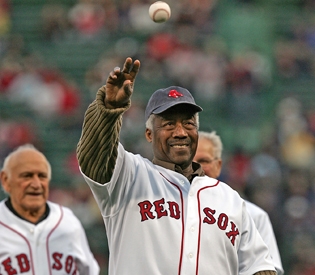
Pumpsie Green, serene and happy, throwing out a ceremonial first pitch in Fenway Park.

Green also taught mathematics and helped oversee school security while he was there. When not doing all that, he and his wife, Marie, raised two children, one of whom became a high school teacher and principal herself. And despite his quiet struggle for acceptance with the Red Sox, the years passing by made Green appreciative of just what he achieved there.

“There’s really nothing that interesting about me,” he once told Danny Peary. “I am just an everyday person happy with what I did. I take a lot of pride in having played for the Red Sox. I would like to be remembered in Red Sox history as just another ballplayer.”

One then remembers reading often enough that the Robinsons and Mayses and Larry Dobys and Frank Robinsons were one thing, but the real test would be whether and when black men could be accepted when they were as ordinary as the most ordinary white player, too. Green, however, was ordinary only as a baseball player. As a man, he wasn’t as ordinary as he liked to describe himself. Not even close.

“He laughs bitterly that the Red Sox humiliated Jackie Robinson, that it slept when it could have acquired Willie Mays, and that these twists of fate left it to unassuming Pumpsie Green to integrate the Red Sox,” Bryant wrote.

It is a fact that he is proud of, even if during those days he wanted little to do with the attention that came with being at the epicenter of a moral drama within a franchise and a city. He harbours no bitterness toward the Red Sox or the city of Boston for any reason. He wanted an opportunity to play baseball and they gave him that chance. If he does not rage at being set apart from the Red Sox in those early Scottsdale days, it is this personality that allows him not to be devoured by the past, and that makes him healthier today. It is, he says evenly, what healing is all about.

Green followed the Red Sox for the rest of his life. You may rest very assured that he was among those pumping his fists and cheering at home when the Red Sox—long past their 1950s shame, long enough removed from the Yawkey era, in which the real curse on the team was boneheaded administration, and as well integrated as the day was long—returned at last to the Promised Land, for the first of four such returns after the turn of this century.

“In 1997, they asked me to come back for opening day and throw out the first pitch,” Green told Bryant. “[Then-general manager] Lou Gorman was very friendly. They brought a limousine for me and my wife. We had a hell of a time.” A very different hell of a time than the one he had to make the Red Sox in the first place.

Bird of prey or prey itself?

One of America’s most famous airport architectures was the TWA international terminal at New York’s Kennedy Airport. Designed by architectural legend Eero Saarinen, the terminal—eventually occupied by JetBlue as part of its terminal complex, but converted since May 2018 into the TWA Hotel—depicted the cleverly stylized image of an eagle’s majestic landing.

When you see Craig Kimbrel on the mound in a baseball game, he assumes a set position taking his catcher’s signs that causes him to perform the single most near-perfect depiction of Saarinen’s masterpiece any human being can perform. Arms bent and elbows up, chest down, the pitcher as bird of prey about to land in or atop the target’s head.

2019-06-26 KimbrelTWA

Craig Kimbrel–will the Cubs have the bird of prey he depicts a la Saarinen or the prey itself?

From all appearances, it looks as though Kimbrel will come up to the Cubs either Thursday or Friday, after pitching at their Iowa (AAA) affiliate since 16 June to finish rounding himself into game shape. The question before the house is which version of the 31-year-old righthander the Cubs will get.

Will they get the no-questions-asked shutdown reliever of 2010-2015 and 2017? Will they get the one whose 2016 looked like a single comparatively down season against that body of work? Will they get the 2018 version whose ERA as of that 23 July was 1.90 but swelled to a 2.74 by season’s end?

Or will they get the Kimbrel whose postseason helped inspire Worcester Telegram-Gazette writer Bill Ballou to resist submitting his Hall of Fame ballot—rather than send one without a vote for Hall of Famer Mariano Rivera (ultimately, he sent it anyway with a vote for The Mariano)—because Kimbrel exposed the worthlessness of the save as now defined, since when he pitched “Boston’s victories felt like defeats”?

Beneath the surface of six saves, Kimbrel allowed nineteen baserunners, posted a ghastly 6.18 ERA, and put the Red Sox on so high a tension wire that they didn’t dare think of him when they had the chance to put the World Series away once and for all.

Kimbrel’s misfortune was to enter free agency after the World Series rings the Red Sox reached almost in spite of him. With the memory of his meltdowns still too fresh despite the Red Sox getting to the Promised Land for the fourth time since the turn of this century. With the Red Sox either in Fenway Park or on the road that postseason needing to keep mobile crash cart units standing by.

Against the Yankees in Game One of the division series, Kimbrel suffered only what you might expect to suffer when the Yankees need a big blast, Aaron Judge leading off the top of the ninth with a launch into the right field bullpens, before striking out the side post haste.

He didn’t appear in the Yankees’ Game Two win or, back in Fenway Park, in the Red Sox’s 16-1 Game Three bludgeoning of the Empire Emeritus, but in Game Four the crash carts went from yellow to red alert. Kimbrel went out for the top of the ninth with a 4-1 lead to protect. That’s the last simple thing you can say about it.

He walked Judge to open and surrendered a single to Didi Gregorius almost immediately to follow. He struck out Giancarlo Stanton but walked Luke Voit to load the bases. He plunked pinch hitter Neil Walker on the first pitch to send Judge strolling home and keep the ducks on the pond. He may have been fortunate that Gary Sanchez hit nothing worse than a sacrifice fly, pulling the Yankees to within a run, and that Gleyber Torres grounded out to end it before the paddles had to be charged.

Against the Astros in the American League Championship Series, Kimbrel wasn’t a Game One thought when the Astros took a one-run lead to the top of the ninth and it fell to Brandon Workman to let the Astros put the game out of reach, thanks to a leadoff homer by Josh Reddick and a three-run bomb by Yuli Gurriel.

But Cardiac Craig came out to play in Game Two. He was asked to nail down a 7-4 Red Sox lead, and he ran Red Sox Nation’s temperatures into the life-threatening zone yet again.

He got two swift outs to open, getting Evan Gattis to pop out behind second base and striking out Reddick swinging. Then 2017 World Series MVP George Springer shot one through the hole at shortstop that ended up a double. With Jose Altuve at the plate Kimbrel wild-pitched Springer to third, before Altuve lofted what turned out a high single down the line and toward the Monster to score Springer. Alex Bregman flied out to end it.

The collective sigh of relief had enough thrust to qualify as a potential hurricane.

The Red Sox didn’t need Kimbrel to nail down an 8-2 Game Three win in Houston, but Kimbrel should buy Andrew Benintendi’s steak dinners for five years at least after Game Four. This time, Red Sox skipper Alex Cora asked Kimbrel for two innings. That was almost like asking a suicide bomber to get away with two attacks.

Cardiac Craig opened the eighth with: a single to right that turned into an out when Tony Kemp tried and failed to stretch it into a double; another plunk (Bregman); a double to right (Springer); and, a run-scoring ground out to the hole adjacent to third. (Altuve.) Then he shook off a steal of third to strike Marwin Gonzalez out swinging.

And that was just the overture to the ninth. When Gurriel popped out over the line behind first. When Reddick and Carlos Correa walked back-to-back. When Reddick took third on Brian McCann’s fly to right. When Kemp walked to set up the ducks on the pond. When Bregman sent a line drive to the deeper reach of the left field corner that might have tied the ALCS at two each if Benintendi hadn’t scampered in like a puppy spotting a toy in the short distance and taken the dive that resulted in the catch of the season, if not the decade, saving both Kimbrel’s and the Red Sox’s hides.

Game Five, in which Red Sox starter David Price re-discovered his changeup and pitched himself six scoreless, masterful innings while his mates found Justin Verlander’s vulnerabilities just often enough, saw Kimbrel on the mound yet again in the ninth. Call it defiance of the Red Sox gods if you must. But Cardiac Craig let them off easy this time, with only a one-out walk, two strikeouts, and the ALCS-winning fly out, almost appropriately, to Benintendi in left.

Those may not have been your grandfather’s Red Sox of outrageous misfortune. But the box scores alone say Kimbrel saved four in those first two sets while leaving you entirely on your own to remember or revisit the gory details behind the saves. Be still, your hearts and stomachs.

In the first two World Series Games against the Dodgers, he was the classic, not the cardiac Kimbrel, striking out two of three hitters in the former and, in the latter, retiring the side in order on a fly out and back-to-back ground outs. Then came Game Three—which ended up going to the bottom of the eighteenth before his Game One strikeout victim Max Muncy ended the marathon with a blast into the left center field bleachers.

Kimbrel shook off a walk to end the bottom of the eighth with a foul pop out behind the plate before getting two outs on a pop and a grounder to open the ninth, then shaking off a ground-rule double before ending the ninth with an infield pop. It may not have been enough to ring an alarm, but it wasn’t exactly calm and peaceful, either.

And in Game Four, brought in for the ninth despite a five-run Red Sox lead, Cardiac Craig came home to roost yet again. He opened with a walk to Brian Dozier before Enrique Hernandez hit a 1-1 service not far from where Muncy’s Game Three finisher landed. He got Muncy to ground out before Justin Turner singled on a dying liner to short left field, but Manny Machado grounded out and Cody Bellinger flied out to end the game before the Red Sox needed to call in the crash carts.

If the Red Sox let Kimbrel get anywhere near Game Five with the chance to slip on the rings, they would have been tried by jury for attempted mass murder. They turned instead to Chris Sale, normally a starting pitcher, to finish the Dodgers off. And Sale gave the Red Sox what they once thought Kimbrel was guaranteed to deliver, striking out the side for game, set, and their fourth return to the Promised Land in the new century.

Kimbrel still thought he had a decent chance at making himself baseball’s first $100 million reliever regardless. Baseball apparently thought through its none-too-discreet laughter that someone spiked his Series-celebratory champagne with one or another controlled substance.

It took him seven months and the June draft, after which any new employer wouldn’t have to surrender anything but his salary to sign him, before the Cubs did just that, for three years and a measly $45 million. He won’t exactly be heading for the welfare office any time soon.

It’s not that the Cubs don’t need a late-game reliever with Kimbrel’s overall flight jacket. Since losing Brandon Morrow after he looked to be posting a magnificent 2018, the Cubs’ bullpen this season has been an inconsistent presence. Steve Cishek, Brandon Kintzler, and Kyle Ryan have overall numbers that won’t make you reach for the rye bottle, but Cishek and Pedro Strop have received most of the game-finishing assignments, and Strop hasn’t been the same pitcher he’d been in the recent past, and they’re both suited better for setup duties.

The good news is that the Cubs right now are at the top of the National League Central heap. The bad news is that they’re there by a thread, a game ahead of the Brewers who still don’t know the meaning of the word “quit.” The worse news is that they’re 5-7 in twelve games including splitting a pair with the Braves in a four-game set.

When Kimbrel joins the Cubs, either for the set final with the Braves at Wrigley Field Thursday or against the Reds in Great American Ballpark to start a weekend series Friday, the Cubs can be forgiven if they ask which Kimbrel comes out to play.

Will it be the Kimbrel who resembles a stylized eagle landing after a majestic flight and pitched like one for a long enough time? Or will it be the bird of prey who becomes the prey itself? The Cubs’ season may turn considerably on the answer.