Now it’s Soxgate, too?

2020-01-07 AlexCora2018RedSox

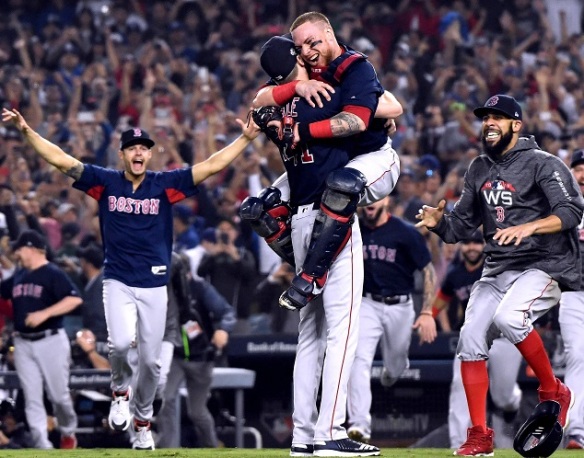
2017 Astros bench coach turned 2018 Red Sox manager Alex Cora hoists the 2018 World Series trophy. The ’18 Sox are now believed having used their replay room for off-field sign-stealing, amplifying suspicions around Cora himself.

Long before he became a major league coach then manager, Alex Cora endeared himself to me when he was a Dodger hitting a seventh-inning home run on 12 May 2004. It wasn’t the home run itself but what led to it—Cora hit the eighteenth pitch of a plate appearance against Cubs pitcher Matt Clement into the right field bullpen. The Iliad, The Odyssey, and Ben-Hur weren’t that epic.

I watched that game live on television from my then-home in Huntington Beach, California. Cora wasn’t exactly a power hitter, of course; Sammy Sosa hit as many home runs in 2004 (35) as Cora hit in his entire fourteen-season playing career. He was a clever utility infielder whose best work was with his glove on either side of second base and his brains otherwise, and he was valuable enough as a utilityman to play on the Red Sox’s 2007 World Series winner.

As Cora checked in at the plate on that May night, the Dodgers’ still-very-much-missed voice Vin Scully noted he’d hit a couple of fly balls earlier in the game, “but if you don’t have power, a couple of fly balls is wasted opportunity.” He batted with nobody out in the bottom of the seventh and a short-career left fielder named Jason Grabowski aboard with a leadoff walk.

Cora looked at ball one up and away to open. He took a strike near the outside corner, then took ball two away, then fouled one off. And then the fun really began without once going to ball three. Cora fouled eleven more off. We’ll let Scully take it from there:

. . . The crowd now is really into the pitches . . . and still two and two. Nobody out. Big foul . . . wow! . . . It’s a sixteen-pitch at-bat, and the crowd loves it, and look at Dave Roberts. They’re all enjoying this battle. Matt Clement and Alex Cora. Coming into the game, Cora was hitting .400 against Clement, he is oh for two tonight. So the game within the game here. So here’s the sixteenth pitch. What an at-bat! . . . [foul ball] . . .  Seventeen pitches . . . it is the rare time that you can be in the ballpark and everyone is counting the pitches, and it’s gonna be a seventeen-pitch at-bat, now, at least. We, I don’t know, you know, they don’t keep records of pitches in at-bats, but it’s kind of special. This will be the seventeenth pitch. Grabowski’s exhausted, and Mike Ireland reminds me how about if Grabowski had been running on every pitch? Time . . . ohhh, the crowd is loving it . . . Ever see so much excitement? And nothing’s happened, that’s what’s really funny about it. All right, here’s the seventeenth pitch—and, it’s foul. Foul ball by a hair! So that means that it will be at least an eighteen-pitch at-bat . . . Clement has made more pitches to Alex Cora right now than he has made in any inning but the third . . . the eighteenth pitch—high fly ball into right field, back goes Sosa, way back to the gate, it’s gonnnne!! Home run, Alex Cora, on the eighteenth pitch, and the Dodgers lead, four to nothing. What a moment! 9:23 on the scoreboard if you want to write it down for history . . . what an at-bat! And Dusty Baker says, “We’re gonna stop the fight.” And Dusty’s going to bring in a fresh horse. That’s one of the finest at-bats I’ve ever seen. And, then, to top it off with a home run, that is really shocking. Yeah, take a bow, Alex, you deserve it and then some. Oh, by the way, that also means the Dodgers have homered in six straight, but it took a whale of a job to do it. Stay where you are, four-nothing Dodgers, and look at the ball club.

Cora would have been remembered for that surrealistic plate appearance if nothing else had his baseball career ended when his playing days did. Even if the Los Angeles Times didn’t remember; their game coverage the following day said not a lick about Cora’s seventh-inning stretcher.

The paper called it the way you see it now in the box scores: Cora, home run. Baseball Reference, bless them, gives you a little more: it notes the pitch count up to and including Cora’s loft just into the right field bullpen. An edited YouTube video clip from the original Dodger broadcast including the Scully call is preserved by MLB, the editing dropping out in favour of the full coverage as Cora was about to face his fifteenth pitch.

Brainy as he was it was no wonder Cora parlayed himself into coaching and, in due course, managing. Except that now it appears more certain than suspected that Cora—whose inaugural season as the Red Sox manager finished with beating his former Dodgers (managed by his May 2004 Dodger teammate Dave Roberts) in the 2018 World Series—knows something more about fouls than just whacking them away to set up an unlikely two-run homer.

Cora was the Astros’ bench coach during their run to the 2017 World Series conquest. Before that postseason ended he’d agreed to become the Red Sox’s next manager. And one of the first things he was quoted as telling his new team, whom the Astros pushed aside in the 2017 division series, was, “You guys were easy to game plan against. Too many bad takes.”

Those were nothing compared to the bad take now surrounding Cora. Because Ken Rosenthal and Evan Drellich, who seem to be for The Athletic with Astrogate what Carl Bernstein and Bob Woodward were considered to be to the Washington Post for Watergate, now say the 2018 Red Sox had a little espionage operation of their own in play during that year’s regular season. And, that unlike the Astros’s engagement of an off-field live-feed camera for sign-stealing, the Red Sox thought of something they could try at home and on the road:

Three people who were with the Red Sox during their 108-win 2018 season told The Athletic that during that regular season, at least some players visited the video replay room during games to learn the sign sequence opponents were using. The replay room is just steps from the home dugout at Fenway Park, through the same doors that lead to the batting cage. Every team’s replay staff travels to road games, making the system viable in other parks as well.

Rosenlich (well, the combination worked for Woodstein, right?) are careful to clarify that nobody including whomever the Red Sox three might be thinks the Red Sox tried it during that postseason, if only because they would have been caught as red-handed as the original five Watergate burglars:

Red Sox sources said this system did not appear to be effective or even viable during the 2018 postseason, when the Red Sox went on to win the World Series. Opponents were leery enough of sign stealing — and knowledgeable enough about it — to constantly change their sign sequences. And, for the first time in the sport’s history, MLB instituted in-person monitors in the replay rooms, starting in the playoffs. For the entire regular season, those rooms had been left unguarded.

This wasn’t exactly as “egregious” (Rosenlich’s word) as the Astro Intelligence Agency’s underground television network, contravening baseball’s rule mandating eight-second camera feed delays to send stolen signs to a monitor near the dugout steps from where someone, who knows whom just yet, sent the stolen opposition signs to the batter with bang-the-can-slowly. But it’s no less beyond the ordinary bounds of on-the-field gamesmanship, even if the Red Sox system did involve at least one man on the field.

The Red Sox operation was workable only with a runner on base. They simply took the burden of catch-and-release away from the baserunner who’s usually the one who engages the on-field gamesmanship of sign stealing. Someone, who knows whom, would be in the Red Sox replay room at home or on the road, catch the sign from catcher to pitcher, and send it to the runner to send to the hitter. You’ve got to be a lot more swift to do it that way, and apparently the 2018 Red Sox were during the regular season.

Not that Rosenlich lack for a caution or two. “It’s impossible to say for certain how much this system helped the Red Sox offense,” they write. “But their lineup dominated in 2018, when they led the league in runs scored.” And, like the Astros, the Red Sox—who got caught flatfoot in 2017 when one of their people was caught using an AppleWatch to try stealing Yankee signs—were convinced enough that others were doing likewise that they weren’t above a little creative against-the-rules espionage themselves.

“You got a bunch of people who are really good at cheating and everybody knows that each other’s doing it,” Rosenlich quote “one person with” the ’18 Sox. “It’s really hard for anybody to get away with it at that point . . . If you get a lion and a deer, then the lion can really take advantage of the deer. So there’s a lot of deers out there that weren’t paying attention throughout the season. In the playoffs, now you’re going against a lion.”

Using the replay room for sign-stealing didn’t exactly begin with the 2018 Red Sox. “It was also similar,” Rosenlich write, “to one the Yankees and other teams had employed before MLB started its crackdown. (Hitters can legally visit the replay room during games to study some video.)” The trick was to be swift enough afoot to make it work without using further electronic devices.

Rosenlich also exhume a three-page March 2018 memo to team presidents from MLB’s chief baseball officer, Joe Torre (himself a former major league catcher), in which he emphasised just how much against the rules high-tech off-field sign-stealing is: “To be clear,” the memo said, “the use of any equipment in the clubhouse or in a Club’s replay or video rooms to decode an opposing Club’s signs during the game violates this Regulation.”

And sometimes the replay room monitors weren’t always immune to being compromised themselves, with Rosenlich observing, “Some would stay in the video replay room the entire game, while others would disappear for periods of time.” The duo go on to cite an unnamed video scout, not with the Red Sox, directly:

Some acted like they were your best friend, root you on. Others would tell on you for the littlest things that weren’t even real,” the scout said. “It was very inconsistent how each person took their job and what they were actually doing . . . You knew this guy was a stickler, and with this guy you could get away with some stuff. How does it stop cheating? The teams that were going to cheat were going to cheat, no matter what.

Whither Alex Cora? Rosenlich are already on record as reporting that Cora and new Mets manager Carlos Beltran (a designated hitter with the ’17 Astros who was often approached by teammates as having the mind of a coach himself) had an as-yet-undetermined hand in at least devising the Astro Intelligence Agency. Nobody knows yet just how Cora and Beltran helped devise it if indeed they did.

But Cora going from the Astros’ world champion as their bench coach to the ’18 Red Sox as their first-year manager taking them all the way to a 108-win regular season preceding a World Series triumph now looks a little too suspect. Did he know about and/or sanction the ’18 Red Sox’s replay room rompering? Did he suggest, based on any direct knowledge of the Astros’ slightly more arduous technique, that the replay room just might be a slightly simpler way to steal signs and get away with it?

No, Astroworld. The Red Sox’s replay room rompering doesn’t get the Astros off the hook. The everybody’s-doing-it defense isn’t going to wash for the Astros, and it won’t for the Red Sox, either. Red Sox Nation, of which I’ve been a member since that thriller of a 1967 pennant race in hand with being a Met fan since the day they were born (ask not my October 1986 pharmaceutical bills), is about to join Astroworld in having to come to terms with at least some of their heroes being cheaters.

“The issue . . . extends beyond individual teams, encompassing the league’s enforcement and upkeep of its own rules,” Rosenlich write. “Many inside the sport believe there is cheating and then there is cheating-cheating. In this view, the Astros undertook the latter, while more indirect video-room efforts—at least before late 2017—counted as the former.”

If and when the actual Astrogaters are revealed in full, Astroworld will be anything but amused, just as I wasn’t amused to discover that a team whose reconstruction into a powerhouse I admired turned out to be riddled with a human factor-challenged front office and field personnel who weren’t above extralegal espionage. According to ESPN’s Jeff Passan, the Astros should learn within the next two weeks just who’s going to be taken to the Astrogate woodshed and whether they come out bruised, battered, or broken.

It doesn’t amuse me that Alex Cora, a player whose tenacity I cheered one fine May 2004 evening and whose intelligence I always admired, may well have gone from helping to devise one elaborate cheat to at least fostering a second that was less elaborate if not less egregious. It amuses me even less that the Red Sox had to do it the new old fashioned way, too.

Short of posting armed Pinkerton guards inside the replay rooms, how baseball’s government handles Astrogate, Soxgate, and any other -gates yet to be affirmed should prove at least as intriguing as Cora’s once-upon-a-plate-appearance foul mastery. The kind he’s suspected of now, involving two teams, is more liable to end not with a two-run homer but a called strikeout.

The pangs of the Yankee reaper

2019-11-21 JacobyEllsburyRundown

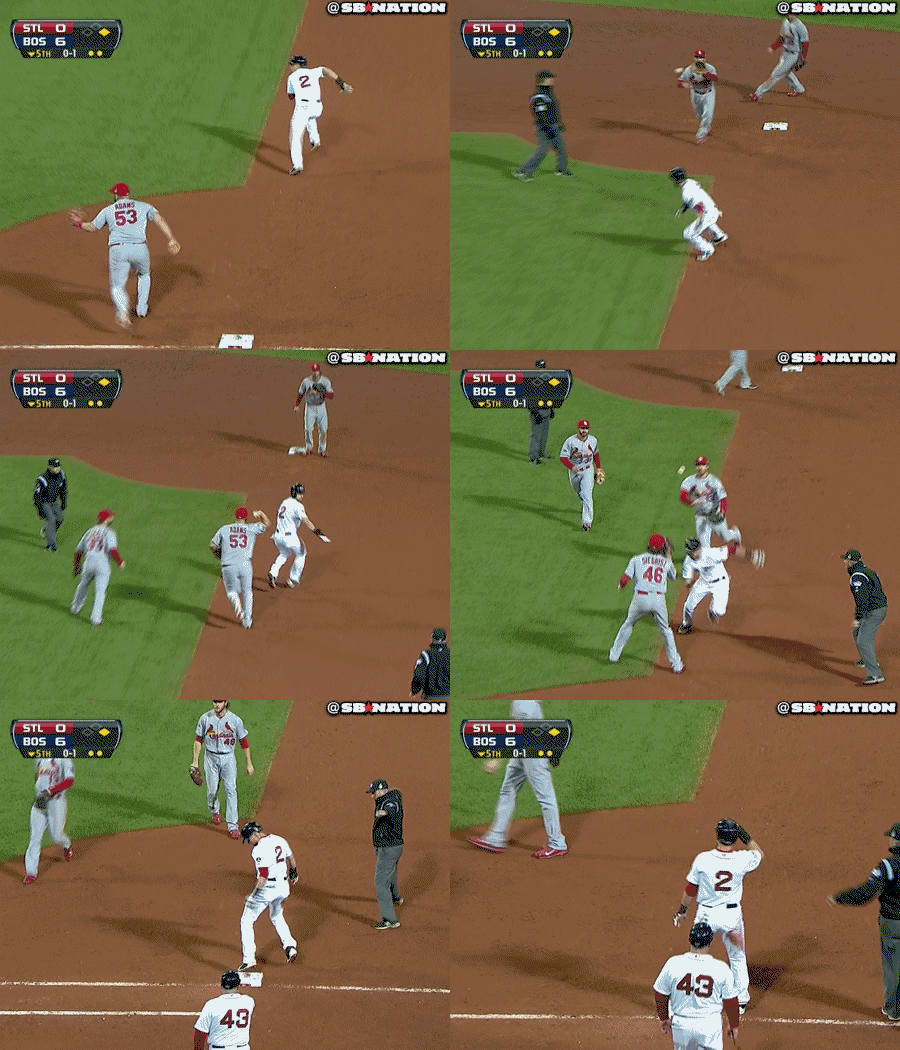
Jacoby Ellsbury (2), here Houdini-ing a rundown in the 2013 World Series, before the injuries finally started sapping the talent. (SBNation gif.)

Things got this bad for Jacoby Ellsbury: when he announced his daughter’s birth on the Fourth of July, on Instagram, he got hammered by Yankee fans indignant over the big contract to the too-often-injured outfielder. Well, nobody said Joe and Jane Fan were immunised completely against the stupid virus.

Such Yankee fans can breathe now. Ellsbury is still the first of Navajo descent (courtesy of his mother) to play major league baseball, but  he isn’t a Yankee anymore. The Yankees finally decided to cut him loose and eat the remaining $26 million Ellsbury’s owed on his original seven-year, $153 million deal. Contrary to what too-popular belief still says, neither side is to blame for Ellsbury’s none-too-fantastic voyage.

What does it do to a man to know that not only could he not perform his duties at his line of work because his body kept telling him “not so fast, dude,” but that people observing his particular company made him a hate object for no crime worse than the injuries he incurred on the job?

It’s as if being injured on the job at all equals a character flaw, especially if you happen to be paid a phenomenally handsome salary. On the flip side, it’s as if being paid a phenomenally handsome salary equals some sort of immunity to earthly harm. Here’s a bulletin for you: Handing Clark Kent a nine-figure payday doesn’t make him Superman.

And one of the reasons Ellsbury wouldn’t even think about listening to the Red Sox about staying in the family when he reached free agency after the 2013 World Series conquest was because he was alienated in the clubhouse after he heard one too many whisperings that he wasn’t exactly in a hurry to get back on the field after previous injuries.

It’s hell if you do and hell if you don’t for a professional athlete. Return too soon from an injury and you risk re-injury; return not soon enough (in whose medical opinion?) and you risk being dismissed as a fragile goldbrick.

The 2019 Yankees were so injury riddled that it was easy to joke that their yearbook was probably The New England Journal of Medicine, but Ellsbury was probably one Yankee who wasn’t laughing. Not even like Figaro that he might not weep. He’d been so often injured for so long that he might be tempted to name his memoir, should he write one, The Pangs of the Yankee Reaper.

Sooner or later, too, you suspected injuries would sap Ellsbury’s baseball talents even before he became a Yankee. Red Sox Nation at least had the pleasures of Ellsbury’s talents helping them noticeably enough to a pair of World Series rings including in his rookie season. Including but not limited to his magnificent Game Six rundown dodge in the 2013 Series.

Maybe that’s why Yankee fans showed as much empathy for his on-the-job slings, arrows, and whatever other medicals he had to bear as the empathy a barracuda shows for its prey. But now, let me count the ways Ellsbury didn’t get injured on the job.

He didn’t get a bite in the ass sliding into second thanks to having left the false teeth he doesn’t have in his back pocket. (An otherwise nondescript pitcher, Clarence Bethen, thought of that in 1923.)

He didn’t turn his knee into bone meal chasing Jill St. John down the ski slopes. (Freshly-crowned Cy Young Award winner and chairman of baseball’s Future Dentists of America, Jim Lonborg, was rumoured to have done just that when he tore his knee apart in a winter skiing accident after the 1967 season.)

He didn’t get the brilliant idea to demonstrate his slam-dunk technique on a storefront awning, catch his ring in the mechanism, and cost himself a season with shredded hand ligaments for his trouble. (Braves relief pitcher Cecil Upshaw slam dunked his way out of the 1970 season that way.)

He didn’t adopt an exercise routine that included running backwards and thus running into a gopher hole causing himself a back injury. (Pitcher Jamie Easterly did, however, in the 1980s.)

He didn’t break a toe running from his kitchen back to his living room because he couldn’t bear to miss watching a buddy at the plate on television. (Hall of Famer George Brett was so desperate not to miss a Bill Buckner at-bat that he ran from his kitchen and busted his toe.)

He didn’t strain or shred his back pulling his cowboy boots up. (Hall of Famer Wade Boggs once did.)

He didn’t fall asleep with a bitter-cold ice bag on his foot and awaken with a case of frostbite causing him to miss a few games—in August. (Hall of Famer Rickey Henderson stone cold did.)

He didn’t get his face badly sunburned on a tanning bed. (Marty Cordova was the genius who forgot the Coppertone.)

He isn’t known to have attended motivational speeches, necessarily, but if he did he probably had too much sense not to think after hearing one that he could tear the world’s thickest telephone book in half without dislocating his shoulder. (Relief pitcher Steve Sparks had to learn the hard way.)

He never once thought, we think, that he could haul a full heavy side of deer meat up a flight of stairs until the venison-to-be won the weight division by sending him flying downstairs and into a broken collarbone. (Clint Barmes, alas, lost that fight in 2010.)

He was part of no few on-field celebrations, we’re sure, but he never tore his left meniscus by smooshing a pie in a teammate’s face during a postgame interview. (Not the way Marlins utilityman Chris Coghlan did nailing Wes Helms in 2010.)

He’s not the genius who forgot to look all ways while reaching for a fallen sock before the suitcase his wife fiddled with fell over and landed on his hand, causing the injury he tried to hide until even the blind saw he couldn’t grip his bat right. (Jonathan Lucroy was such a genius, in 2012.)

And, he didn’t dislocate his ankle while trampolining with one of his children. (Joba Chamberlain jumped into that while with his then five-year-old son in 2012.)

Ellsbury once broke the Red Sox’s consecutive-game errorless streak record. He also once scored on a wild pitch—from second base. He was once so swift on the bases and in the outfield that he could have challenged the Road Runner to a foot race and won by a neck. He hit four doubles and stole a base in the 2007 World Series; he looked like he’d secure himself as one of the Red Sox’s all-time greats.

At least, he did until he ran into a human earth mover named Adrian Beltre at third base in an April 2010 game. He came back too soon from four hairline rib fractures, felt enough soreness to see a thoracic specialist who recommended more rest and rehab, rejoined the Red Sox early that August, and re-injured the ribs on a play against the Rangers later that month.

Then Ellsbury won the American League’s Comeback Player of the Year for 2011, not to mention both a Gold Glove and a Silver Slugger and a second-place Most Valuable Player finish, while being practically the only Red Sox player who didn’t collapse during that September and thus invite the Bobby Valentine nightmare of 2012.

Ellsbury smashed his shoulder up trying to break up a double play early in the nightmare. He returned in July, then almost made it injury free through 2013. Oops. Compression fracture in his right foot from fouling a ball off the hoof in late August. Returned in time to shine in that run to and through the World Series.

Fed up enough with the false whispering that he just didn’t like to rehab his injuries fast enough (for whom, folks?) that when the Yankees reached out to him with a yummy contract he couldn’t possibly say no.

In Year One of his Yankee tenure he performed, well, the way Jacoby Ellsbury was supposed to perform, including leading the American League with his 22.7 power/speed number. And it was the last season in which being injury free enabled him to perform that well.

Injuries, unfortunately, sap and catch up to players little by little. The Ellsbury Dough Boy had more than his share before becoming a Yankee. And then . . . and then . . . and then . . . and then along came:

2015—Right knee sprain on 20 May; out two months, rest of the season nothing to brag about, unfortunately.

2016—Uninjured but production falling further, including his lowest total stolen bases to that point during a healthy season.

2017—Smashed his head against the center field wall while making a highlight-reel catch. Concussion. Missed 29 games and lost his center field job to Aaron Hicks, but somehow managed to break Pete Rose’s career record for reaching base on catcher’s interference, doing it for the thirtieth time on 11 September, which also happened to be his 34th birthday.

2018—Strained his right oblique at spring training’s beginning. Turned up in April’s beginning with a torn hip labrum. Missed the entire season (and underwent surgery in August) because of it.

2019—Started the season on the injured list with a foot injury; also turned up with plantar fasciitis in the foot (the same injury plus knee issues that reduced Albert Pujols as an Angel to a barely replacement-level designated hitter) and another shoulder injury. Took until September for the Yankees to admit Ellsbury was lost for the year.

Not one of those injuries was caused by anything other than playing the game or performing other baseball-related activity. Remember that before you continue condemning Ellsbury the man or the Yankees as a team over him. He didn’t come to the Yankees believing his previous injuries began draining the talent that was once so electrifying, and he didn’t put on the pinstripes expecting to become an orthopedic experiment, either.

The 36-year-old is said to be finishing rehab and preparing to play in 2020 if there’s a team willing to have him. Ignore the jerk brigades and wish him well. Maybe even wish that he decides at last that his spirit may still be willing but his body’s already had notarised, “Don’t even think about it.”

It’s not easy for baseball players to get the game out of their systems, but if Ellsburry chooses to retire at last, instead of offering up any further sacrifices to the Elysian Field gods, who can blame him?

“Some people give their bodies to science. I gave mine to baseball,” Ron Hunt once said after a career in which his most notable accomplishment was teaching himself to be hit by pitches and taking every one of his 243 plunks. (Hunt led the Show in such plunks six straight during his twelve seasons.)

Ellsbury gave a lot more of his body to baseball than even Hunt did. He has three stolen base championships (two of which led the Show), one total bases championship (364 in 2011), one triples championship (ten in 2010), and a few million dollars in the bank for it. It’s the least he could have gotten for his sacrifices.

But if they ever come up with a surefire immunity to the stupid virus, fans who think on-the-job baseball injuries equal character flaws or teams whose brain trusts have suffered aneurysms should be first to get the shots.

Eyes on Cherington from Pittsburgh?

2019-11-09 BenCherington

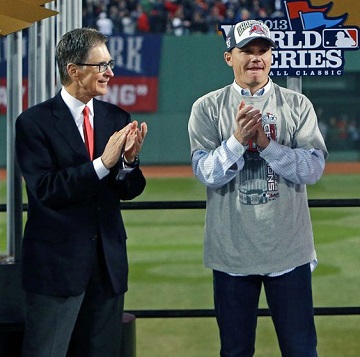
Ben Cherington (right), with Red Sox owner John Henry and the proof that Cherington knows how to raise shipwrecks: the Red Sox’s 2013 World Series triumph, for openers.

Few baseball fans are as frustrated as Pirate fans. Few deserve even a small ray of hope more. Pirate fans got one such ray when longtime Clint Hurdle was purged at last after a season in which he lost a clubhouse that seemed hell bent on destroying itself when it wasn’t pursuing silly field feuds.

They got another such ray of hope when the Pirates decided Hurdle’s execution was merely the wick lighting the powder keg of a near-complete front office house cleaning, which only began when pitching coach Ray Searage was pinked after a season during which the Pirate staff became too-much-reputed headhunters.

They got a third such ray when the house cleaning continued when president Frank Conolly and general manager Neal Huntington were purged, after a couple of years in which reputedly blockbuster deals blew up right in the Pirates’ faces even despite a warning sign or two.

And now comes a fourth such ray, in the word that candidates to be the Pirates’ next president of baseball operations include former Red Sox GM Ben Cherington.

Currently second in command to Blue Jays president Tony Lacava, Cherington is one man in baseball if there’s any such man who knows what it means to actually be able to raise and reconstruct the Titanic. He did it in New England, maybe the second most arduous baseball market for turning shipwrecks into cruises to the Promised Land.

The Red Sox hired Cherington in the first place after the 2011 season ended with the iceberg hitting the ship. His job only began when he was overruled at the top and the Red Sox hired Bobby Valentine to skipper the ship after Terry Francona—and Cherington’s predecessor Theo Epstein—abandoned it before they could be made to walk the plank.

Hiring Valentine proved the equivalent of removing Captain Smith from the bridge when the iceberg hit and installing Captain Queeg in his stead. Valentine took a clubhouse already full of noxious gases from the 2011 sinking and threw one after another lighted match into it. He was probably lucky that all he got was canned just days after the regular season ended.

Somewhere during the worst of that nightmare Cherington figured out that just because someone else dumped Smith for Queeg was no reason for him to go J. Bruce Ismay. He began repairing the ship even underwater, masterminding the August 2012 deal with the Dodgers that sent Josh Beckett, Adrian Gonzalez, and Carl Crawford out of Boston.

Major payroll surgery, that, the kind bringing the rookie GM what he’d need to augment his still-very-much-serviceable veterans with what I observed after the Valentine firing: “pieces that weren’t exactly top of the line but weren’t exactly losers, either.”

Cherington also got to dump Valentine, which could only have been his due after the rookie GM found himself as much company psychiatrist as boss when one after another player went to him seeking to keep their marbles—singular—during the depths of the Valentine nightmare. And he was the epitome of grace in throwing the switch:

Our 2012 season was disappointing for many reasons. No single issue is the reason, and no single individual is to blame. We’ve been making personnel changes since August, and we will continue to do so as we build a contending club. With an historic number of injuries, Bobby was dealt a difficult hand. He did the best he could under seriously adverse circumstances, and I am thankful to him.

You’d be hard pressed to find any other baseball general manager who could have been that diplomatic about a man who was lucky to escape with his life. It’s true the 2012 Red Sox were bedeviled by 27 trips to the disabled list, but it’s also true that four other 2012 teams (the Athletics, the Braves, the Orioles, the Yankees) were battered by injuries and still either won divisions (the A’s, the Yankees) or went to their leagues’ wild card games. (The Braves, the Orioles.)

The season recently ended gave further object lessons in how to navigate troubled waters when crews hit sick call almost en masse. Managed intelligently, they were the Yankees, the Astros, and (doesn’t it just roll off the tongue, Washington?) the world champion Nationals. Managed like several flew over the cuckoo’s nest, they were the 2012 Red Sox.

Then Cherington swung the deal that brought former Red Sox pitching coach John Farrell back from Toronto to manage the team for 2013. He imported such inexpensive pieces as Stephen Drew, Jonny Gomes, Joel Hanrahan, Brock Holt, Mike Napoli, David Ross, Koji Uehara, and Shane Victorino.

He also picked up where Epstein left off in rebuilding the Red Sox farm. He watched Hall of Famer in waiting David Ortiz rally a team, a town, and a region after the Boston Marathon bombing. (This is our [fornicating] city!!) He re-fortified when injuries hit, and watched Uehara—whom he’d thought would be a perfect sixth- or seventh-inning relief option—step up as a lights-out closer.

And, he watched his freshly repaired team of savvy vets, comeback kids, and young sprouts refuse to lose more than three straight on the season and march all the way to the Promised Land for the third time since the new century began. It also made Cherington only the third Red Sox executive ever to be named The Sporting News‘s Executive of the Year.

The rebuild, which Cherington picked up and ramped up without even thinking about tanking? (Tanking’s never an option for a team whose owner learned what not to do and how not to do it watching the win-or-be-gone George Steinbrenner style, anyway.) Mookie Betts, Xander Bogaerts, Rafael Devers, Andrew Benintendi, Jackie Bradley, Jr., all of whom loomed large in the 2018 World Series triumph, were Cherington recruits.

It was just a shame Cherington wasn’t around to savour it.

His only missteps were some free agency signings that blew up in the Red Sox’s faces: Pablo Sandoval, Hanley Ramirez, A.J. Pierzynski, Grady Sizemore. When Dave Dombrowski accepted his Detroit walking papers and the Red Sox walked Cherington out to walk Dombrowski in, Cherington still left the Red Sox a solid nucleus that didn’t exactly escape Dombrowski’s sights in 2015.

Dombrowski signed and dealt for several nuggets of his own. He watched the Red Sox go last-to-first in 2016 and repeat in the East in 2017, both of which ended in early postseason exits. Then, after hiring Astros bench coach Alex Cora to manage the crew following Farrell losing the clubhouse at last, Dombrowski watched Cherington’s seeds flower fully as the Red Sox won last year’s World Series.

But Dombrowski reverted to form and drained McCherington’s Navy while ignoring the under-constructed, over-taxed bullpen as one after another 2019 Red Sox starter was hit by either injury or inconsistency bugs. Thus did the Red Sox execute Dombrowski in early September, when their season was too long lost.

And since the Red Sox didn’t reach out and bring Cherington back (they hired former Rays vice president Chaim Bloom), though it wouldn’t necessarily be either untenable or unheard-of (reference the 1967 Cardinals, who brought Bing Devine back successfully after canning him in mid-1964) the Pirates might want to give a long, serious, thoughtful look at him.

The Pirates’ sunken ship makes the Red Sox upon Cherington’s advent resemble a sturdy aircraft carrier by comparison. And if ever a team needed a man who can prove he knows how to raise a wreck from the bottom of the sea, the Pirates do.

Minor subterfuge

2019-09-27 MikeMinor

Mike Minor nailed his 200th strikeout with a little sneaky help from his friends Thursday night.

Let me put it right on the table for you. What the Rangers did Thursday in a bid to fatten Mike Minor’s shot at 200 strikeouts on the season isn’t exactly the first time someone’s resorted to a little subterfuge in order to enable a particular milestone. And if you still believe that boys will be boys, it won’t be the last, either.

So the Red Sox are a little p.o.ed over Rangers first baseman Ronald Guzman charging Chris Owings’s one-out popup then pulling his mitt back to let the ball hit the foul grass in the ninth? The Rangers weren’t exactly thrilled at the Red Sox swinging on first pitches in the eighth, either.

“Mike Minor’s 200th strikeout should have a big asterisk. That was bush. Chasing a milestone that way is unprofessional,” fumed Boston Globe writer Pete Abraham in a tweet. “Ask me if I care, Pete,” Minor fumed back.

“I didn’t love the idea that we dropped the popup at the end,” said Rangers manager Chris Woodward to reporters after Minor nailed number 200 and, while they were at it, won the game 7-5. “But on the other side of that, they swung at three pitches in a row in the eighth inning down by two. If they have any beef with that — obviously I’m pretty sure [Red Sox manager Alex] Cora did — they chose to not try and win the game as well. They were trying to keep him from striking a guy out.”

The very nerve of the Red Sox. Trying to keep a pitcher from striking them out. What’ll they think of next? Their pitchers trying to keep hitters from hitting?

Good thing Minor wasn’t going for a no-hitter and the Rangers didn’t put the shifts onto the final Red Sox batters. The Red Sox might have been ornery enough to look at all that yummy open expanse gifted them, decided, “You’re stupid enough to give us that much room to hit, we’re not going to look a gift horse’s ass in the mouth,” and whacked a grounder or two into that gifted meadow.

But then Cora had something to say about the Guzman play. “I’m just happy our guys are playing the game the right way,” he told reporters himself. “We’re playing hard until the end. It’s been two weeks we’ve been eliminated, but we’ve been going at it the right way. That’s all I ask. I don’t manage the Rangers.”

I don’t want to be the wise guy, here, but stuff such as Guzman did to help his mate keep a shot at a milestone alive goes on more often than you think. Actual or alleged.

One of baseball’s oldest legends is the 1910 race to the American League batting title between Hall of Famers Ty Cobb and Nap Lajoie. The legend included Cobb sitting out the last two games to protect his average and the St. Louis Browns willing to give Lajoie, then with the Indians, his hits by hook, crook, and anything else they could get away with.

The Browns and the Tribe played a season-ending doubleheader while Cobb sat idle. Browns manager Jack O’Connor ordered his rookie third baseman Red Corriden to play on or at the edge of the outfield grass. Lajoie went 8-for-8 in the twin bill to win the title technically. American League president Ban Johnson declared Cobb the batting title winner after the shenanigans were taken to him.

The Chalmers Automobile Company, which awarded a car to the batting champion in those years, gave Cobb and Lajoie a new car each, pretty much deciding they were tied. Then, they changed the award the following season, giving the car to the league’s most valuable player, not the batting champion.

And O’Connor and his coach Harry Howell were banned from baseball for life over the scandal. (Lajoie’s ninth plate appearance of the day resulted in him reaching on an error; Howell tried to bribe the official scorer into changing the ruling to a base hit, but the scorer declined.)

Decades later, Denny McLain had his 31st win of 1968 in the bag when he decided he’d help Hall of Famer Mickey Mantle secure the last milestone he wanted in his career, retiring past Jimmie Foxx on baseball’s all-time home run list. Mantle was already at 534, tied with Foxx and in third place on the list.

When Tiger catcher Bill Freehan greeted Mantle checking in at the plate, with one out in the top of the eighth, Freehan told Mantle he’d be told what was coming because McLain really wanted him to do it. Sure enough, Mantle got one where he wanted it and sent it into the upper deck, making the score 6-2, Tigers. Thanks, Denny. Mantle sweetened his own retirement pot the next day when he took Red Sox righthander Jim Lonborg deep for number 536.

Almost a decade earlier, Mantle’s far less controversial teammate was offered a season-ending gift. Bobby Richardson was a sharp defensive second baseman who was often made the Yankees’ leadoff hitter. How did a guy with a .299 lifetime on-base percentage become a leadoff hitter? For one reason only: Richardson was almost impossible to strike out. (His lifetime average strikeouts per 162 games: 28.)

Richardson was also a devout Christian then and now. His usual Yankee running mates were fellow clean-livers, shortstop Tony Kubek and pitcher Bobby Shantz, and the trio was nicknamed the Milk Shake Kids. The only skirts they ever chased were the ones wrapped around their own wives; the strongest drink they probably ever took was fresh lemonade.

In fact, they inadvertently helped expose the Great Yankee Private Detective Agency in the late 1950s. When GM George Weiss hired a firm in hopes of throttling some of the randier Yankees’ off-field pursuits, the joy boys shook the dicks but the dicks still latched onto a group of Yankees anyway, tailing them around town until discovering it was the Milk Shake Kids . . . and the vice to which they were in such hot pursuit was (wait for it!) ping pong.

On the final day of the 1959 season, Richardson stood with an excellent chance of becoming the only Yankee to hit .300 or better on the year. As Richardson remembered to New York Daily News writer Bill Madden for Pride of October: What It Was to Be Young and a Yankee, he was supposed to get two gifts that day. Manager Casey Stengel would lift him from the game if he got a hit his first time up, and the Orioles were willing to do anything to let him have his hit.

The Orioles’ scheduled starting pitcher Billy O’Dell, a friend of Richardson who shared quail hunting trips with him, told him before the game he’d be “throwing one right in there for you.” Hall of Famer Brooks Robinson said he’d play deep at third in case Richardson felt like a bunt. Even the day’s plate umpire, Ed Hurley, was in on the little fix: “If you hit it on the ground, just make it look close at first.”

Richardson and Madden would make you believe that, first time up, Richardson smacked a line drive to right—and Orioles right fielder Albie Pearson made a diving catch on it. Richardson laughed to Madden recalling it. “Pearson was one of my closest friends in the game—we’d spoken together at church! He must have been the only person in the ballpark who didn’t know I was supposed to get my hit!”

Richardson is as honest as the day is long; if he ever told a lie in his life his jaw would probably dislodge from his skull. But precise memory fails even the most honest of men. Because the record actually shows that Richardson got his hit leading off the bottom of the first . . . and Pearson was nowhere near the ball: it was a line double to left center field.

And Stengel didn’t lift Richardson from the game. In the third inning Richardson hit the liner on which Pearson dove for the catch, and he also smacked a one-out single in the bottom of the sixth. Richardson didn’t leave the game until the Yankees were in a 3-1 hole with one out in the bottom of the eighth (the score would hold for a season-ending Orioles win), and Stengel elected to pinch hit for him.

The pinch hitter: the future superstar of Original Mets calamity, Marv Throneberry, who wasn’t yet nicknamed Marvelous. And O’Dell struck him out. Which was less embarrassing than what happened to the next Yankee hitter after Mantle hit McLain’s gift out.

Joe Pepitone watched the Mantle-McLain comedy from the on-deck circle and concluded McLain wouldn’t quit feeling generous when he checked in at the plate. So, just as Mantle did during his at-bat, Pepitone waggled the barrel of the bat over the plate to say where he’d like some service. And McLain knocked Pepitone on his ass with the first pitch.

Anatomy of an execution

2019-09-09 DaveDombrowskiDavidOrtiz

Just shy of eleven months ago, Dave Dombrowski wore a Red Sox helmet and let former Red Sox superstar David Ortiz interview him right after the Red Sox nailed a World Series. After midnight last night, Dombrowski went to the Red Sox guillotine.

Watch and ponder a 10-5, home run heavy Red Sox loss to the Yankees on national television Sunday night. Awaken Monday morning to discover the Red Sox threw out the first president of the season just after midnight. Down the stretch. With the Red Sox down to little if any hope of really defending their 2018 World Series championship.

Every once in awhile not even a World Series appearance or conquest is enough to save someone’s baseball job. It wasn’t for Dave Dombrowski. The GM-made-president of baseball operations, who finished what his predecessor Ben Cherington started and steered the Red Sox back to the Promised Land for the fourth time since the 21st Century began, is finished.

And the questions include the price the Olde Towne Team will pay for last year’s conquest. Dombrowski spent big with dollars and with prospects to make last year’s triumph happen. Now the Red Sox farm system is parched, and a lot of the dollars that finished constructing last year’s conquerors could prove a prison as much as a parade.

Forgotten at times during last year’s triumph was that Cherington built the core of the team. Dombrowski took the bows with everyone else after the Red Sox finished stunning the Dodgers last fall but all he did was finish what Cherington started. And everyone who remembered Dombrowski’s years of trying but failing to get the Tigers to the Promised Land and mortgaging the farm several times couldn’t resist asking how long before Dombrowski’s accomplishment with the Red Sox would endure before he’d be nudged out of Boston, too.

It’s unfair to Dombrowski in a few ways, of course. But running a team whose in-house culture is win/win-now/keep-us-winning isn’t simple business. And men who mortgage the farm on its behalf often have lower survival rates than men who know how to remake/remodel without tanking or without letting the farm become a dust bowl.

Cherington got four years. Dombrowski didn’t survive a fourth. Both were hired seemingly out of nowhere. Except that for one of them, “nowhere” was right under the Red Sox’s noses. Cherington was part of the Red Sox baseball operations offices since 1999 and built himself a solid player development background when he was hired to succeed Theo Epstein in 2011.

Cherington’s first order of serious business, alas, was to take it like a manperson when the powers above made him look like a fool after the infamous 2011 Red Sox collapse. He’d promised numerous players that whomever would take the bridge, after Terry Francona quit before he could be fired, it wouldn’t be the rumoured Bobby Valentine. The powers above hired Valentine (specifically, it may have been Larry Lucchino’s call); Cherington’s choice was almost anyone but. (Actually, at the time, it was Dale Sveum.)

Poor Cherington. He found himself having to keep his back door open to help one after another Red Sox player keep his marble (singular) during the Valentine nightmare. Then, he executed the daring August 2012 trade that sent the Dodgers Josh Beckett, Adrian Gonzalez, and Carl Crawford and concurrently blew open a small tonnage of financial headroom while giving himself the space to hatch and execute a post-Valentine plan.

Cherington spent the 2012-13 offseason buying or dealing for a group of more than useful availables and spare parts—Mike Napoli, Jonny Gomes, Shane Victorino, David Ross, Stephen Drew, Brock Holt, and (especially) sleeper reliever Koji Uehara—and bringing home former Sox pitching coach John Farrell to take the bridge and dissipate the Valentine toxins.

That effort, plus the returns to health of such key men as John Lackey, often-injured (and oft-unfairly alienated) Jacoby Ellsbury, and especially future Hall of Famer David Ortiz, got the Red Sox 2013 World Series rings for Cherington’s efforts. It also got Cherington named as the third Red Sox executive ever named by The Sporting News as Executive of the Year.

Concurrently, he devised and executed a longer-range plan that rebuilt the Red Sox farm without even thinking about tanking, which is never an option for a team whose owner John Henry learned what not to do and how not to do it watching the similarly win-now-or-be-gone thinking of the late Yankee owner George Steinbrenner.

Mookie Betts, Xander Bogaerts, Rafael Devers, Andrew Benintendi, Eduardo Rodriguez, and apparently defense-first Jackie Bradley, Jr.—all of whom factored large enough in last year’s conquest—were Cherington’s handiwork, either by in-house development or trade such as the deal that brought Rodriguez to the Red Sox in late 2014.

Where the earnest Cherington mis-stepped was with some of his subsequent free agency signings, including Pablo Sandoval, Hanley Ramirez, A.J. Pierzynski, and Grady Sizemore. When the Red Sox executed him in favour of Dombrowski, Cherington still left them a solid nucleus that didn’t go unnoticed by the incoming Dombrowski.

It didn’t take Dombrowski long to sign such nuggets as David Price and Craig Kimbrel, and watch as the Red Sox went from last to first in the 2016 American League East, though they were shoved out of the postseason by the eventual pennant-winning Indians. Dombrowski traded for Chris Sale, signed Mitch Moreland, and basked in the 2017 AL East title despite another postseason exit short of the Promised Land.

Then he answered Farrell’s apparently losing his clubhouse at last by canning Farrell and hiring Astros bench coach Alex Cora—while the Astros were still advancing toward their 2017 World Series conquest. And Cora let his new players know immediately how they fell short enough: “You guys were easy to game plan against. Too many bad takes [at the plate].”

Dombrowski also landed J.D. Martinez at almost the eleventh hour of last year’s spring training, then watched Benintendi, Bogaerts, Devers, and Betts especially come into their own, Betts almost running away with last year’s American League Most Valuable Player award. Marry that to Price and Sale shaking away whatever problems they might have had otherwise, and the Red Sox turned the 2018 postseason into a thrill that climaxed when Sale struck out the side to end the World Series hoisting the trophy in Dodger Stadium.

Except that there were a few serious cracks in the structure Dombrowski finished atop Cherington’s foundation:

* Almost typical of a Dombrowski administration, the Red Sox didn’t just empty the farm, they took a torch to it. Assorted observers say the farm’s being rebuilt little by little, though.

* Dombrowski ignored the Red Sox bullpen almost entirely both last offseason and approaching this year’s new single mid-season trade deadline. Some say it’s outperformed its expectations this year; others say it became taxed too heavily as one after another Red Sox starter faltered for assorted reasons—especially after they were barely worked in spring training and looked like spring-training pitchers in April.

* Betts has one more season coming under Red Sox control and, unless something happens between now and October 2020 to constitute an offer he can’t refuse, it looks as though he’s going to play the market for the first time then. The Red Sox may have ideas about trading him this winter, but if they go there they won’t get that solid a return for a one-year rental.

* Martinez is posting another magnificent season at the plate, but he has an opt-out clause he can exercise at season’s end and enough observing the Red Sox fear he’s liable to try playing hardball. For more money? For a longer commitment? Nobody knows just yet, but the Red Sox have to brace themselves for either.

* With Nathan Eovaldi, a postseason hero out of the bullpen last fall, missing too much time to injury this year and then having to shake away rust in a return to the rotation, it leaves the Red Sox with him, Sale, and Price as underperformers among the walking wounded and on long-term contracts while they’re at it.

In fact, Sale—who’s now done for the season thanks to pitching elbow inflammation—won’t even see his contract extension begin until 2020, but some argue Dombrowski signing him to that extension might have seeded Dombrowski’s end. Sale swore when signing that his shoulder troubles were behind him. Everyone wanted to believe it. Then his inconsistent 2019—brilliance here, battery there—ended prematurely when his elbow immolated. Uh-oh.

But there’ve been enough bright lights in Red Sox fatigues to make you confident they can win next year. Betts, Bogaerts, and Devers still make for a powerful threesome at the plate, though the Red Sox may want to think hard and start thinking now about keeping Betts in the family. Even if Henry wants to trim payroll up the street, he can’t afford to let his franchise player leave the family.

Benintendi shook away his first half inconsistencies and is having a magnificent second half, and he should be ready for a full season’s high-level production in 2020. Rodriguez is having a breakout season. Matt Barnes and Brandon Workman have become late-inning godsends out of the bullpen.

And rookie reliever Darwinzon Hernandez’s bullpen performance in his first 25 gigs (2.83 ERA; 2.17 fielding-independent pitching [FIP]; 17.0 K/9) in addition to his widely enough reported early maturity may mean the Red Sox’s late-game/ending-game wipeout option of the future is preparing for that future already, even if Cora isn’t anxious to smother the kid with hype.

But Jhoulys Chacin, whom the Red Sox signed after the Brewers parted ways with him late last month, has no such fear. In a perfect position to know, Chacin isn’t afraid to compare Hernandez to Josh Hader, the Brewers’ bullpen assassin. “He reminds me of Hader,” Chacin tells MassLive.com’s Christopher Smith. “He throws that raised fastball that some guys just can’t catch up.

“I’ve talked to him a lot since I’ve been here,” Chacin continued. “I want him to stay healthy and keep doing what he’s been doing. I played with Hader and to see his fastball just raise up, (Hernandez’s) fastball does pretty much the same, too. Like I said, he just needs to stay healthy and take his approach every day to the field and I think he can be a pretty good pitcher.”

It isn’t just Hernandez’s fastball. He’s developed a solid slider and has a curve ball with wipeout potential. Any way you look at him, Hernandez at 22 may hold the Red Sox bullpen’s future in his left hand.

The Red Sox won’t talk publicly about Dombrowski’s execution just yet. Give them credit, sort of, for doing it almost stealthily. The NFL’s New England Patriots hogged the weekend headlines, first signing controversial wide receiver Antoine Brown, after he wriggled his way out of Oakland, then blowing the Pittsburgh Steelers out 33-3 Sunday night to open their season. The Red Sox dropped the guillotine on Dombrowski almost noiselessly.

They left Cora to be the public face of the putsch. It’s not exactly Cora’s most comfortable position, as he made clear after Sunday night’s loss when he was told the blade sliced  through Dombrowski’s neck. “I’m surprised and shocked, obviously,” the manager said. “Right now, I don’t have too much to say. This is the guy that gave me a chance to come here and be a big-league manager. They just told me so I’m not ready to talk about it.”

Martinez and Rick Porcello have said they were all but blindsided over executing Dombrowski, to whom both players were close going back to their Detroit days. Porcello had enough on his plate apologising publicly to Red Sox fans for his, shall we say, modest performance this season, without losing a man he considered a friend.

“At the end of the day” the righthanded former Cy Young Award winner said, “we’re the players who are on the field and we’re the ones who can make or break a lot of things. Ultimately, the onus comes on us. I’m still processing everything. Processing myself, too. It’s really hard to reflect on it, too. I’ll have potentially a better answer for you in a couple days. You never like to see anybody lose their job over what we’re doing on the field.”

As peculiar as it might sound to read in print, the Yankees have had little but front office stability with Brian Cashman as their general manager since 1998—and only one World Series title to show since the turn of the century. The Red Sox have had five full-time general managers since 1998 (Dan Duquette, Mike Port, Epstein, Cherington, and Dombrowski)—and four World Series titles to show since the turn of the century.

A lot of teams would kill for the Red Sox’s 21st Century track record—four World Series rings in fifteen years—even with the extremes of maximum success and (thanks to three dead-last division finishes) maximum recess. And a lot of GMs or baseball ops presidents would kill for Dombrowski’s overall resume: two World Series rings (his other ring: the 1997 Marlins), two American League pennants (the Tigers), in a little over two decades.

But a lot of them wouldn’t turn the farm into the dust bowl to get there, either.

The Red Sox for now will be run by a trio of assistant GMs, Brian O’Halloran, Eddie Romero (the son of 1986 pennant-winning Red Sox spare part Ed Romero), and Zack Scott. Several reports say Romero among the three is most considered to be a full GM/baseball ops president in waiting. Maybe the Red Sox won’t wait too long to make it happen.