Unknown's avatar

About Jeff Kallman

Member, Internet Baseball Writers Association of America and the Society for American Baseball Research.

Eyes on Cherington from Pittsburgh?

2019-11-09 BenCherington

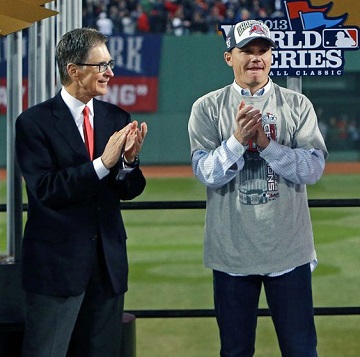
Ben Cherington (right), with Red Sox owner John Henry and the proof that Cherington knows how to raise shipwrecks: the Red Sox’s 2013 World Series triumph, for openers.

Few baseball fans are as frustrated as Pirate fans. Few deserve even a small ray of hope more. Pirate fans got one such ray when longtime Clint Hurdle was purged at last after a season in which he lost a clubhouse that seemed hell bent on destroying itself when it wasn’t pursuing silly field feuds.

They got another such ray of hope when the Pirates decided Hurdle’s execution was merely the wick lighting the powder keg of a near-complete front office house cleaning, which only began when pitching coach Ray Searage was pinked after a season during which the Pirate staff became too-much-reputed headhunters.

They got a third such ray when the house cleaning continued when president Frank Conolly and general manager Neal Huntington were purged, after a couple of years in which reputedly blockbuster deals blew up right in the Pirates’ faces even despite a warning sign or two.

And now comes a fourth such ray, in the word that candidates to be the Pirates’ next president of baseball operations include former Red Sox GM Ben Cherington.

Currently second in command to Blue Jays president Tony Lacava, Cherington is one man in baseball if there’s any such man who knows what it means to actually be able to raise and reconstruct the Titanic. He did it in New England, maybe the second most arduous baseball market for turning shipwrecks into cruises to the Promised Land.

The Red Sox hired Cherington in the first place after the 2011 season ended with the iceberg hitting the ship. His job only began when he was overruled at the top and the Red Sox hired Bobby Valentine to skipper the ship after Terry Francona—and Cherington’s predecessor Theo Epstein—abandoned it before they could be made to walk the plank.

Hiring Valentine proved the equivalent of removing Captain Smith from the bridge when the iceberg hit and installing Captain Queeg in his stead. Valentine took a clubhouse already full of noxious gases from the 2011 sinking and threw one after another lighted match into it. He was probably lucky that all he got was canned just days after the regular season ended.

Somewhere during the worst of that nightmare Cherington figured out that just because someone else dumped Smith for Queeg was no reason for him to go J. Bruce Ismay. He began repairing the ship even underwater, masterminding the August 2012 deal with the Dodgers that sent Josh Beckett, Adrian Gonzalez, and Carl Crawford out of Boston.

Major payroll surgery, that, the kind bringing the rookie GM what he’d need to augment his still-very-much-serviceable veterans with what I observed after the Valentine firing: “pieces that weren’t exactly top of the line but weren’t exactly losers, either.”

Cherington also got to dump Valentine, which could only have been his due after the rookie GM found himself as much company psychiatrist as boss when one after another player went to him seeking to keep their marbles—singular—during the depths of the Valentine nightmare. And he was the epitome of grace in throwing the switch:

Our 2012 season was disappointing for many reasons. No single issue is the reason, and no single individual is to blame. We’ve been making personnel changes since August, and we will continue to do so as we build a contending club. With an historic number of injuries, Bobby was dealt a difficult hand. He did the best he could under seriously adverse circumstances, and I am thankful to him.

You’d be hard pressed to find any other baseball general manager who could have been that diplomatic about a man who was lucky to escape with his life. It’s true the 2012 Red Sox were bedeviled by 27 trips to the disabled list, but it’s also true that four other 2012 teams (the Athletics, the Braves, the Orioles, the Yankees) were battered by injuries and still either won divisions (the A’s, the Yankees) or went to their leagues’ wild card games. (The Braves, the Orioles.)

The season recently ended gave further object lessons in how to navigate troubled waters when crews hit sick call almost en masse. Managed intelligently, they were the Yankees, the Astros, and (doesn’t it just roll off the tongue, Washington?) the world champion Nationals. Managed like several flew over the cuckoo’s nest, they were the 2012 Red Sox.

Then Cherington swung the deal that brought former Red Sox pitching coach John Farrell back from Toronto to manage the team for 2013. He imported such inexpensive pieces as Stephen Drew, Jonny Gomes, Joel Hanrahan, Brock Holt, Mike Napoli, David Ross, Koji Uehara, and Shane Victorino.

He also picked up where Epstein left off in rebuilding the Red Sox farm. He watched Hall of Famer in waiting David Ortiz rally a team, a town, and a region after the Boston Marathon bombing. (This is our [fornicating] city!!) He re-fortified when injuries hit, and watched Uehara—whom he’d thought would be a perfect sixth- or seventh-inning relief option—step up as a lights-out closer.

And, he watched his freshly repaired team of savvy vets, comeback kids, and young sprouts refuse to lose more than three straight on the season and march all the way to the Promised Land for the third time since the new century began. It also made Cherington only the third Red Sox executive ever to be named The Sporting News‘s Executive of the Year.

The rebuild, which Cherington picked up and ramped up without even thinking about tanking? (Tanking’s never an option for a team whose owner learned what not to do and how not to do it watching the win-or-be-gone George Steinbrenner style, anyway.) Mookie Betts, Xander Bogaerts, Rafael Devers, Andrew Benintendi, Jackie Bradley, Jr., all of whom loomed large in the 2018 World Series triumph, were Cherington recruits.

It was just a shame Cherington wasn’t around to savour it.

His only missteps were some free agency signings that blew up in the Red Sox’s faces: Pablo Sandoval, Hanley Ramirez, A.J. Pierzynski, Grady Sizemore. When Dave Dombrowski accepted his Detroit walking papers and the Red Sox walked Cherington out to walk Dombrowski in, Cherington still left the Red Sox a solid nucleus that didn’t exactly escape Dombrowski’s sights in 2015.

Dombrowski signed and dealt for several nuggets of his own. He watched the Red Sox go last-to-first in 2016 and repeat in the East in 2017, both of which ended in early postseason exits. Then, after hiring Astros bench coach Alex Cora to manage the crew following Farrell losing the clubhouse at last, Dombrowski watched Cherington’s seeds flower fully as the Red Sox won last year’s World Series.

But Dombrowski reverted to form and drained McCherington’s Navy while ignoring the under-constructed, over-taxed bullpen as one after another 2019 Red Sox starter was hit by either injury or inconsistency bugs. Thus did the Red Sox execute Dombrowski in early September, when their season was too long lost.

And since the Red Sox didn’t reach out and bring Cherington back (they hired former Rays vice president Chaim Bloom), though it wouldn’t necessarily be either untenable or unheard-of (reference the 1967 Cardinals, who brought Bing Devine back successfully after canning him in mid-1964) the Pirates might want to give a long, serious, thoughtful look at him.

The Pirates’ sunken ship makes the Red Sox upon Cherington’s advent resemble a sturdy aircraft carrier by comparison. And if ever a team needed a man who can prove he knows how to raise a wreck from the bottom of the sea, the Pirates do.

The hardware times

2019-11-05 GerritColeJustinVerlander

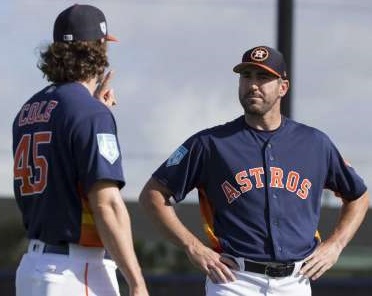
The AL Cy Young Award race is really between Gerrit Cole and Justin Verlander—but could they end up co-Cyners?

Just call this baseball’s True Value season—hardware time. Even if you suspect that this year, like many years, the hardware may not match the true value. And since baseball’s oldest professions include arguing, the hardware should provoke a decent few.

Here are my looks, in order of when the winners will be revealed. (11 November for the Rookies of the Year; 12 November for the Managers of the Year; 13 November for the Cy Young Award winners; 14 November for the Most Valuable Players.)

Rookie of the Year

National League—Pete Alonso (Mets) has a decent shot at running away with the prize, particularly for smashing the Show’s rookie home run record and leading the Show with his 53 bombs. Especially since Fernando Tatis, Jr. (Padres) missed about half the season on the injured list. A full season for Tatis might have made the ROY race a squeaker.

Pitcher Mike Soroka (Braves) is the third finalist, and he’ll get some votes for that 2.68 ERA and for being the stingiest pitcher in the league for surrendering home runs in homer-happy 2019. (0.7 HR/9 inning.) But with Tatis missing too much time the prize is probably Alonso’s.

American League—No contest, even with the 9 June callup. It’s Yordano Alvarez’s (Astros) award. He was just that dangerous even in only 87 games. Brandon Lowe (infielder, Rays) and John Means (pitcher, Orioles) were good, very good, but not even close.

Which is why Eloy Jimenez (White Sox) not making the finalists’ list is a small surprise. Two outfield injuries didn’t stop him from hitting 31 out. He wasn’t really close to Alvarez when all was said and done, but he did have a better season than Lowe.

Manager of the Year

National League—At first you wouldn’t think this’ll be an easy call between finalists Craig Counsell (Brewers), Mike Schildt (Cardinals), and defending MOY Brian Snitker (Braves). All three took their teams to the postseason; two (Snitker, Schildt) won divisions; one (Snitker) wants to be the first back-to-back MOY winner since Hall of Famer Bobby Cox. And one (Counsell) was last year’s second-place finisher.

Snitker’s Braves improved seven games over 2018; Schildt’s Cardinals improved five games over 2018; Counsell’s Brewers showed a seven-game deficit over 2018. And the Cardinals needed every one of their 162 games plus Jack Flaherty’s monster second half to win the NL Central.

Schildt looks to shake out as the winner, though it’s a bloody good thing the votes are voted before the regular season ends. His ugly postgame rant after winning the division series and the Cardinals’ NLCS humiliation at the hands of the Nationals left him a very bad look.

American League—For me, no contest. Whatever happened to the Yankees in the ALCS, they may have been lucky to win 103 regular season games in the first place, with a team resembling a M*A*S*H post-op ward most of the season and a manager who wasn’t sure if he was running baseball games or an urgent care unit.

Rocco Baldelli (Twins) masterminded his team’s remarkable turnaround and AL Central conquest, though it’s possible some voters thought it was as much a product of the Twins’ strategic bombing as anything else. Kevin Cash (Rays) continued doing his share to prove less is more in winning 96 and snatching a wild card entry.

But I suspect the MOY is Aaron Boone’s. If so, don’t be surprised if the hardware comes embedded with a music box—playing the theme to St. Elsewhere.

Cy Young Award

National League—It looked like it would be a near photo-finish between Jacob deGrom (Mets) and Max Scherzer (Nationals) until Scherzer’s neck and back issues rudely interrupted him down the stretch. Before that, there was a time Hyun-Jin Ryu (Dodgers) looked almost as much like the runaway winner in the making as deGrom proved to be at the finish in 2018.

Then Ryu’s season got interrupted by neck trouble, too, unfortunately. He still managed to lead the Show with his 2.32 ERA . . . but his fielding-independent pitching rate (ERA minus defense) checked in higher (3.15) than deGrom’s (2.67). DeGrom also led the league with 255 strikeouts and with 7.3 wins above replacement-level (WAR).

It may not be the runaway triumph it was in 2018, but deGrom probably has the 2019 Cy Young Award, too. He remained an elite pitcher in 2019, got stronger as the season went onward, and it’s likely that his durability as well as his performance papers give him the edge past Scherzer and Ryu. And they didn’t have to fight as many of their teams’ other problems as deGrom did.

It could be deGrom by maybe a nose and a cheek. And if it is, it would make him and Scherzer an anomaly: no pair of pitchers has been back-to-back with each other in winning back-to-back Cy Young Awards since Roger Clemens (1997-98) and Hall of Famer Pedro Martinez (1999-2000) in the American League.

Could deGrom and Scherzer become co-Cy Young Award winners this time? It’s not exactly unheard-of: Mike Cuellar (Orioles) and Denny McLain (Tigers) were co-winners in 1969 for the American League. It’s never happened in the National League yet.

American League—The given: one or another Astros righthander will win it. (And one ex-Astro, Charlie Morton [Rays], is the third finalist.) The question: which one? The answer: It should be Gerrit Cole. But you never know until you get there.

Because Cole led the American League in ERA (2.50), the Show in strikeouts (an Astros franchise-high 326), the league in fielding-independent pitching (2.65), and the Show in ERA+ (park adjustment factor; 185).

But Verlander punched out an even 300, led the Show with his 0.80 walks/hits per inning pitched rate, 7.14 strikeout-to-walk rate, and nailed both his 3,000th career strikeout and his 300th season’s strikeout in the same game. Both against the same victim. (Kole Calhoun, freshly non-optioned by the Angels, though not for that reason.)

Milestones appeal to award voters. Always have. And they may have been awful tempted to make Verlander only the sixth man in history—and the first ever in the American League—to win a Cy Young Award the same year he pitched a no-hitter. (Milestones, continued: it was Verlander’s third career no-hitter.)

This much is certain: Cole and Verlander are likely to become the first rotation mates to finish 1-2 in the Cy Young voting since Hall of Famer Randy Johnson and Curt Schilling in 2001. We just don’t know which order yet.

My own call is that yes, Verlander hit some significant milestones while having a season for the ages in his own right, but yes, too, Cole was just enough better to win the Cy by a nose and a cheek, too. Of course, they, too, could end up co-Cyners, making them the first American League pair to do it since Cuellar and McLain.

Most Valuable Player

National League—Christian Yelich (Brewers) probably had a hammerlock on the award until his knee injury killed his season. It left room for Cody Bellinger (Dodgers), who’d already yanked his own game to another plateau entirely, to look like the heavy favourite when the season ended. Bellinger was no questions asked the best player on a runaway train team.

Anthony Rendon (Nationals)? He made a case that would probably give him the award if neither Yelich nor Bellinger happened to be in the league this year. The only other flaw in Rendon’s game: He saved his absolute biggest moments for the Nats’ staggering postseason run and triumph, and the votes are cast right after the regular season. His next contract should atone for that.

Now let me be a real stinker. Let me look at Yelich and Bellinger (and, just for fun, Rendon) in terms of what I call a real batting average. I’ll say it again: the traditional batting average underrates what you do at the plate. It treats all your hits equally and takes only those divided by your official at-bats.

A real batting average (RBA) would take your total bases (which count your hits the way they should be counted—all hits are not equal), your walks, your intentional walks (one more time: you deserve extra credit if the other guys would rather you take first base than their heads off), your sacrifices (bunts and sac flies), and the times you got hit by a pitch, and divides the sum of those by all your plate appearances and not just your official at-bats.

Drumroll, please . . .

2019 PA TB BB IBB SAC HBP RBA
Christian Yelich 580 328 80 16 3 8 .750
Cody Bellinger 661 351 95 21 4 3 .717
Anthony Rendon 646 326 80 8 9 12 .673

Well, now. If the MVP voters looked that deep, Yelich might still shake out as the National League’s MVP. Might. If they’re not, either Bellinger wins the prize outright or Yelich and Bellinger could become co-MVPs. Could. It’s only ever happened once before: in 1979, when Keith Hernandez (Cardinals) and Hall of Famer Willie Stargell (Pirates) did it.

American League—Mike Trout (Angels) had the award in the vault, with armed guards outside the doors, until he, too, was taken down for the season with an early September injury. Did it leave enough room for Alex Bregman (Astros) to claim the prize?

Trout missed just about the entire final month of the season and still almost managed to lead the league in home runs with his career-high 45. (The Royals’ Jorge Soler beat him out and Soler had to hit three over the season’s last two days to do it.) He also still led the Show in on-base percentage (.438), the league in slugging percentage (.645) and OPS (1.083), and the Show in OPS+ (park adjustments; 185).

Bregman just edged out Trout for the league’s overall WAR lead—8.4 for Bregman, 8.3 for Trout. But Trout still led the league in offensive WAR (8.3) and was .6 ahead of Bregman that way. Bregman’s slash line is his own career high, by the way, not to mention his leading the league with 119 walks.

Marcus Semien (Athletics) is the third finalist for the award, and while it was a joy to see him improve his game that much, he’s not yet in either Trout’s or Bregman’s league. And unless voters look for something else beyond what I’ve just discussed, the award’s going to be between Trout and Bregman.

Now I’ll be a real stinker again, this time looking at Trout and Bregman according to RBA. Drumroll, again, please . . .

2019 PA TB BB IBB SAC HBP RBA
Mike Trout 600 303 110 14 4 16 .745
Alex Bregman 690 328 119 2 8 9 .675

The RBA difference between Trout and Bregman (.070) is greater than that between Yelich and Bellinger (.033). Now ponder how Trout and Yelich would have looked if their injuries didn’t end their seasons when September was barely born. (Ponder, too, the intentional walks all six MVP finalists were handed this year. Teams didn’t fear Rendon and Bregman quite as much as they feared Bellinger, Trout, and Yelich.)

The AL MVP voters still might have pondered co-MVPs between Trout and Bregman, after all. And there is that Hernandez-Stargell precedent.

Still, the voters may yet have concluded that Bregman swung that well (especially in the season’s second half) and played excellent third base for a 107-winning team but Trout still shouldn’t be penalised because he doesn’t have a team its and baseball’s still-best all-around player can be proud of. He’s the reason the Angels drew over three million fans despite their fourth straight losing season.

My nickel would probably go to Trout in the American League and Yelich in the National League. Trout’s RBA difference from Bregman is just too vivid, and so is Yelich’s over Bellinger. And my nickel isn’t worth a dime. (Sorry, Yogi.) But it wouldn’t be the end of what’s left of the free world if 2019 proved also to be the year of the co-Cy Young Award winners and the year of the co-Most Valuable Players. Would it?

On the Modern Era Committee HOF Ballot

2019-11-04 TommyJohn

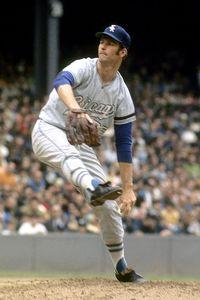
Tommy John, pitching in his final season with the White Sox–he should be a Hall of Famer as a pioneer.

One of the successor committees to the old and too-often discredited Veterans Committee is deciding upon Hall of Fame candidates. Specifically, nine players and one non-player. The Modern Era Committee will announce their results a day after Pearl Harbour Day.

Are they Hall worthy? As wags on Twitter have cracked already, all the players in question are better than Harold Baines. But that’s not necessarily enough to make a Hall of Famer out of you. I’ll review them them here alphabetically:

Dwight Evans—Evans was a better player than a lot of people remember. In The Cooperstown Casebook, Jay Jaffe writes that he was “[a]n underappreciated cornerstone of Boston’s 1970s and 1980s contenders . . . helping the team to four division titles and two pennants.”

Evans won eight Gold Gloves in right field, averaged 24 home runs per 162 games lifetime, and had a remarkable batting eye averaging 86 walks per 162 games while walking 90 times in six seasons. But Evans also has an odd dichotomy Jaffe points out: “His defensive value peaked early . . . while his offense peaked late.”

He was one of those players you enjoyed watching even on his bad days. But he also had only two top-ten Most Valuable Player award finishes and five (including those two) top fifteen finishes, and I don’t see any season in which you could say he truly deserved the award over those who finished higher.

Objective metrics rate Evans as the fifteenth-best right fielder of all time, while he comes in somewhat below the Hall of Fame averages for hitting. (His number-one Baseball Reference comp is Luis Gonzalez with a slightly-below borderline Hall case himself.) That doesn’t exactly look like a Hall of Famer to me, but it doesn’t exactly look far away from a Hall of Famer, either.

It’s a tricky call in his case, but Dwight Evans one helluva player.

Steve Garvey—Garvey’s the opposite of Evans in some ways: he wasn’t as good as he’s remembered despite being the first base end of that long-running Dodgers infield of the 1970s and early 1980s. And he was moved to first base in the first place because he had a terrible throwing arm at third.

That’s not a disqualifier, of course. Garvey can be called a plausible underachiever because, as Bill James observed in The New Historical Baseball Abstract, he was one of the most self-programmed players ever; James called him a “Clockwork Baseball Player”—allowed himself only certain times to swing, take, try to kill a pitch, try just to get the bat on the ball, etc., etc., almost regardless of the immediate game situation. Almost.

Garvey was also maybe the most self-conscious player of his time, with almost a monomania about presenting himself as an unsullied baseball hero. But Steven, we hardly knew ye: it turned out, many years later, that his appealing on the outside/appalling on the inside (in his clubhouses, where his perfectionism drove teammates nuts) came almost entirely from a boyhood in which too much was heaped upon him too young.

He was forced heavily to help heavily in caring for his invalid grandmother; he was the son of perfectionist parents driven too harshly to out-perfect them. “[W]hat you had,” wrote Sports Illustrated‘s Rick Reilly, “was a 10-year-old going on 28, a short kid with amazingly wide shoulders.” Never allowed and thus never allowing himself to be a boy.

Many such children go on to walk through much of their adult lives in a self-immolating funk. Garvey went on to play baseball like the next best thing to an android. His self-immolation began with his marital collapse and ended with his immediate post-career paternity scandals. (The gags were even more tacky. “I haven’t seen this many beautiful girls since I spent Father’s Day at Steve Garvey’s house,” cracked comedy legend Bob Hope.)

In some ways, surviving those was Garvey’s greater achievement: “Some people have a midlife crisis,” he told Reilly. “I had a mid-life disaster.” He survived it to re-marry happily and pull through several financial disasters while he was at it. He’s raised a new family successfully. And has fun. We should all have the chance to remake ourselves so well. No matter how far along in life.

For all that, Garvey was a good player, often an excellent one, who might have been great but fell short enough. The objective metrics say there are 26 better first basemen all time than Garvey who aren’t in the Hall of Fame, including Paul Goldschmidt, whose career is far from over. They also rank Garvey at number 51 all time at his position. That doesn’t sound like a Hall of Famer.

Tommy John—He was a good pitcher for long before the surgery that bears his name; he was a good pitcher for long after he underwent the first such procedure. Often he was terrific; once in awhile he was great.

John was a classic sinkerballer—when he wasn’t, ho ho ho, throwing stinkerballs, shall we say—who knew what he was doing on the mound and could induce ground balls and double plays almost at will. There were times you thought that all he had to do was wink toward the plate and a ground ball would come whether or not he threw a pitch.

Would he be a Hall of Famer without the surgery? He was good and often terrific but he was never considered a staff ace. Unlike his contemporary Jim Kaat, re-arranging John’s best seasons a little bit won’t present you a Hall of Famer.

But John’s place in Cooperstown should be as a pioneer. He did have the good fortune to be the first such patient when Dr. Frank Jobe invented the idea of the ulnar collateral ligament reconstruction, but he did show—after an initial spell of doubt—that what was once a career ender for pitchers didn’t have to be one.

Harold Baines notwithstanding, this should not be the Hall of the Gold Watch. Tommy John’s career longevity by itself isn’t enough to put him in the Hall of Fame. But he had twelve serviceable-and-better seasons before his elbow blew; he had fourteen after the surgery.

They don’t call it Herb Score Surgery, never mind that it might have saved Score’s career if available then. That makes Tommy John a pioneer Hall of Famer in my book.

Sorry, but I have to tell my favourite Tommy John story one more time: Once, as a Yankee, he tangled with Hall of Famer Don Sutton, then with the Angels. Sutton was probably even better known for throwing, shall we say, stinkerballs. It took Yankee manager Lou Piniella to talk owner George Steinbrenner out of demanding the umpires frisk and arraign Sutton, because they’d be likely to do likewise to John.

The game result—a 2-1 Yankee win—wasn’t half as good as the scout in the press box who cracked, “Tommy John and Don Sutton? If anyone can find one smooth ball from that game, he ought to send it to Cooperstown.”

Don Mattingly—The arguable heart and soul of the 1980s Yankees, about whom it’s said most politely that they were the subjects of baseball’s very own King of Hearts, Donnie Baseball’s Hall of Fame case really was done in by injuries, especially his bothersome back.

Until his back began betraying him in earnest, Mattingly was one of those players about whom you said there goes everything solid about the game. He was a pain in the ass as a hitter from 1984-1989; he was a solid defensive first baseman who was slick turning Area Code 3-6-3; he was a smart lefthanded hitter who knew how to use Yankee Stadium’s deep left center for a lot of extra doubles.

Does he have a peak value case? No. He’s too far below the average peak of a Hall of Fame first baseman. Does he have a career value case? No. The objective metrics rate him the number 39 first baseman of all time. He was a great player who should have been Hall of Fame-great, but his back said, “Not so fast, Slick.”

Thurman Munson—His fatal plane crash in 1979 had the effect of elevating Munson above and beyond his real playing value. The grumpy personality Munson showed the public—which belied the genuinely sensitive and loving man he was despite his own coarse upbringing—had the effect of deflating it as often as not.

(How coarse? Munson’s father raised him with bitter persecution, so much so that when Munson married his father-in-law became his best friend. At Munson’s funeral, the father—who’d held an impromptu press conference saying he had the real talent while his son just got the breaks—so enraged the father-in-law, when saying at Munson’s casket, “You always thought you were too big for this world, well, look who’s still standing, you son of a bitch,” that the father-in-law had to be restrained by police from tearing him apart on the spot.)

But Munson actually died having made a peak value Hall of Fame case. He was a Rookie of the Year, an MVP, and he was dangerous in the postseason. In his final couple of seasons he didn’t swing as potent a bat but still found ways to reach base enough that he remained above the league averages for catchers, anyway.

Munson was an expert handler of pitching staffs as well as a strong plate presence in his eleven seasons. The objective metrics call him the twelfth best catcher who ever set down behind the plate, and his peak value is above the average Hall of Fame catcher.

I once underrated Munson’s peak myself, but having reviewed the evidence on my own and seeing, too, that he was as strong at preventing runs against his teams as he was creating runs for them, I’m convinced he has a place in Cooperstown.

Dale Murphy—I’ve said it before, dozens of times, but like Mattingly Murphy would have been a Hall of Famer long enough ago if all you needed was character. He was Steve Garvey untainted by an impossibly imposed perfectionism from childhood and likewise unblemished by even a mild compulsion to make himself the perfect player and hero.

It showed at the plate, too. For eight seasons after the Braves wisely moved him to center field, Murphy had an admirable peak, with two back-to-back Most Valuable Player awards to prove it. That eight-season peak, however, still fell several points below the Hall of Fame peak averages.

Then his knees proved to have too much in common with Don Mattingly’s back. And thanks to them, after 1987, Murphy’s career cratered too vividly. There may have been few sadder sights in baseball than Murphy’s decline.

For a long enough time, too, Murphy was considered too much a product of his home environment; he played the bulk of his career with Atlanta Fulton County Stadium (a.k.a. the Launching Pad) as his home park, and that contributes to Murphy having one of the most vivid home/road splits of his time.

But that’s only part of his dilemna. The objective metrics name him the 25th best center fielder of all time; they also show his peak value several points below the Hall of Fame averages. If his knees obeyed his orders just a couple of years longer, Murphy might well have crossed into the land of the peak-value Hall of Famer at least.

Murphy does have a new career, now, though—he’s one of the most engaging players-turned-analysts to be found among the scribes at The Athletic.

Dave Parker—The Cobra’s career should have been better. Injuries got in the way sometimes. His admitted cocaine use (he was one of the Pittsburgh Drug Trials witnesses in the 1980s) did, too. So did his penchant for playing baseball like a Sherman Tank on high test. Sometimes, so did his periodic ability to out-Ali Muhammad Ali as sport’s version of Ogden Nash.

Parker had jaw dropping power; that prankish-looking face with the wisenheimer smile made him look as if he couldn’t wait to carve his autograph into a pitcher’s rump roast and make the poor sap laugh his fool head off while being carved.

Parker also thought catchers were mere papier mache walls to run through at the plate, not living, breathing humans who were liable to stand as strong against him as the linebackers against whom he’d once played as a high school running back.

He had an unapologetic self-worth, and he shook off even the most severe injuries as mere nuisances. Until now. When he’s two years into a battle with Parkinson’s disease that causes him to wonder whether it’s his own fault he hasn’t or won’t be awarded a plaque in Cooperstown.

Parker wouldn’t miss by as much as you think, considering his objective peak value isn’t as far below the Hall of Fame average as his objective career value is.

But for all his self-worth and ego (It wouldn’t take much to make me look good, he puckishly told a fan trying to get the best angle for a cell phone camera shot), Parker was also a respected team leader wherever he played. Enough so that Thomas Boswell once thought the Athletics letting him go in favour of a cheaper option helped get them swept in the 1990 World Series:

Where is Dave Parker when you need a clubhouse enforcer? The A’s always knew, sooner or later, they’d need Big Dave to quell a cell-block riot, just as the ’77 Reds desperately missed Tony Perez after they traded him. In ’88 [Jose] Canseco popped off about beating the Dodgers in five games. The Dodgers won in five. In ’89 Parker promised to clean, stuff, and mount Jose if he spoke above a whisper. The A’s swept. Now Dave’s gone, Jose predicted a sweep. General manager Sandy Alderson makes a lot of good moves, but saving money on Parker may have cost him a world title.

Ted Simmons—You may not remember this, but at the beginning of his career Simmons got thatclose to making a reserve clause test case, long enough before Andy Messersmith finally took the post-Curt Flood plunge, played without a 1975 contract, then tested it and caused it to flunk.

Simmons refused to sign his 1972 contract unless he got a $30,000 salary for that season, just a year after he first became the Cardinals’ hard-hitting regular catcher at $14,000. GM Bing Devine said not so fast, kid, and offered a low-$20,000s salary. Simmons broke a precedent from there: he opened the season without having signed a contract.

Though it violated the rules of the time to play without a contract, Simmons had no fear. For one thing, the Cardinals renewed him under their right to renew him unilaterally. For another thing, he had Marvin Miller watching over him carefully, especially when Simmons pondered taking it to court.

Miller actually feared for Simmons, especially since Flood’s case still pended at the U.S. Supreme Court (where Flood would lose), but Simmons played on and kept ripping line drives. At the All-Star break he had 33 extra base hits including ten bombs and was named the National League’s backup catcher for the Game in Atlanta.

That’s where Devine called him. And offered him $75,000 for two years—the $30,000 he wanted for 1972 in the first place and $45,000 for 1973. Simmons jumped to sign the deal, but he handed Miller a crucial piece of intelligence, as The Lords of the Realm author John Helyar observed: the owners would rather let a second-year-regular pocket $75,000 than let any arbitrator get near the reserve clause itself just yet.

The iconoclastic Simmons went from there to become one of the best-hitting catchers ever to play, amplified especially because he was a rarity at the position, a switch hitter. He had his defensive shortcomings especially as his career entered its final third, especially (but not as severely as critics had it) stopping a more prevalent running game then compared to now.

But a look at his entire game turns into the objective metrics holding Simmons as the tenth best catcher ever to strap it on. Not only does that describe a Hall of Famer, but he’s the best catcher eligible for the Hall of Fame who isn’t in it.

Classic quote from the articulate, cultivated Simmons, who was once a trustee of the St. Louis Art Museum during his playing days: Curt Flood stood up for us. [Hall of Famer Catfish] Hunter showed what was out there. Andy [Messersmith] showed us the way. Andy did it for everybody.

Lou Whitaker—Few whom I’ve seen play baseball made it look as simple as Whitaker made it look. The bad part is that he was so good at making it look easy that people mistook him, as Jaffe noted in The Cooperstown Casebook, for lacking effort, passion, or work ethic. His lack of self promotion hurt, too.

But he played nineteen years, forged the longest-running double-play combo with his Hall of Fame teammate Alan Trammell, shook out as of this writing as the seventh best second baseman ever to play the game, and lasted only one year on the Baseball Writers Association of America Hall of Fame ballot.

Jaffe cited Detroit News writer Lynn Henning, who covered the Tigers for Whitaker’s career, with Henning observing, “It wasn’t that people didn’t appreciate him, but if ever I’ve seen a case where every voter figured, ‘Someone else will put him on, I’ve got other fish to fry,’ that was it—a perfect storm. I’ve never seen anything so utterly flukish in the Hall of Fame voting.”

Whitaker is a kind of reverse of Bobby Grich, another second baseman who deserves a long second look and a plaque. Grich’s peak value makes him a Hall of Famer (he, too, is overdue for the honour); Whitaker’s career value makes him one. Alan Trammell wasn’t the only one hoping on his own inauguration day that it wouldn’t be long before Whitaker joined him in Cooperstown.

And, the non-player:

Marvin Miller—If you really have to ask why the MLBPA director who re-shaped the formerly dormant union into the force that helped bury the reserve clause and allowed baseball players to be paid their true market values and have a right to hit a fair and open job market like any other American employee in the first place . . .

My picks: Dwight Evans—big maybe. Steve Garvey—no. Tommy John—yes, as a pioneer. Don Mattingly—no, with regret. Dale Murphy—no, with regret likewise. Thurman Munson—yes. Dave Parker—no. Ted Simmons—yes. Lou Whitaker—yes. Marvin Miller—yes, yes, a thousand times yes.

Fields of gold

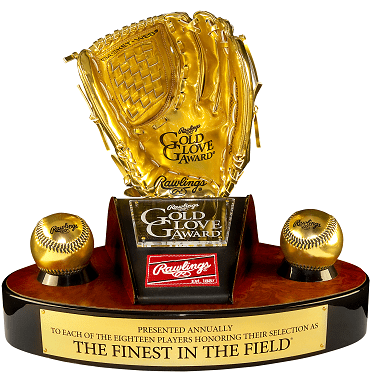
2019-11-04 GoldGloveLet the award debates begin. The Gold Gloves have been awarded. And, the good news is that there wasn’t as much fool’s gold mined this year as in seasons past.

That won’t stop the debates, of course. Almost nothing in baseball ever really does, which keeps the fun going when the games are over.

I’m as much a lover of the highlight reel plays as anyone, just the way we love the acrobatics of Cirque du Soleil, but the real name of the game behind the plate or in the field is saving runs against your team.

The better news this year: there was only one Gold Glove winner who could really be called a legacy pick alone. If only we could get that kind of success when the All-Star Game teams are chosen.

Catchers—The National League winner: J.T. Realmuto (Phillies). The should-have-been National League winner: Austin Hedges (Padres). Why? Realmuto’s throwing arm looked only too obvious (as it should have), but Hedges saved more runs defensively—the margin is 22 for Hedges and 11 for Realmuto.

Hedges also has another advantage: neither he nor Realmuto had particularly great pitching staffs to handle, but Padres pitchers throwing to Hedges had a collective 4.10 ERA and Phillies pitchers throwing to Realmuto had a 4.61. I get Realmuto’s throwing arm making him look more obvious, but Hedges was better.

Yadier Molina, you say? He was one of the NL’s three Glove finalists, but he simply wasn’t as good as Hedges and Realmuto behind the plate this year. His career-long work behind the plate will probably make him a Hall of Famer in due course.

And he still handles pitching staffs well enough, even allowing that the Cardinals had a better staff than the Padres and the Phillies this year: the Cardinals had a 3.82 team ERA with Molina behind the plate but also with Jack Flaherty coming into his own in the second half.

But in 2019 Molina was worth only two defensive runs saved and he threw out only 27 percent of those trying to steal on him—13 below his career average and one below the league average for his career. Age begins getting all of us sooner or later.

The American League winner: Roberto Perez (Indians). The should-have-been American League winner: Perez. No contest. Perez was worth the second-most defensive runs saved (29) ever since the statistic became accepted in 2003. (Molina had 30 in 2013.) He also saved his pitchers 11 runs with his pitch-framing skill and saved them a nice volume of wild pitches, leading the league with seven pitch-blocking runs saved.

First base—The National League winner: Anthony Rizzo (Cubs). The should-have-been winner: Christian Walker (Diamondbacks). Why? Forget that Walker had a tough job of replacing Paul Goldschmidt. Nobody in the National League was better this season when it came to getting balls most first basemen don’t reach, especially ranging to his right.

Walker was also worth nine runs saved in the field to Rizzo’s three. He also had 99 assists to Rizzo’s 87. Rizzo had a solid season but Walker was far enough better at the pad. With only two Gold Gloves coming into 2019 it’s not really fair to call Rizzo a legacy choice this time. (See Alex Gordon in due course.)

The American League winner: Matt Olson (Athletics). The should-have-been winner: Olson. He’s very much on his own plane, especially the manner in which he handled offline throws knowing the Oakland Coliseum has foul territory comparable to Central Park. Nobody in the league was better at saving throwing errors and runs at first base.

Second base—The National League winner: Kolten Wong (Cardinals). The should-have-been winner: Wong. No contest. He didn’t just lead the league in defensive runs saved at his position, there was no second baseman in the league less likely to crumple or misstep playing in the shifts than Wong. If Hall of Famer Bill Mazeroski had a contemporary equal for virtuosity at second base, it was Wong this season.

The American League winner: Yolmer Sanchez (White Sox). The should-have-been winner: Tossup. Sanchez played more games at second base than D.J. LeMahieu (Yankees) but saved only one more run in the field. Sanchez probably nailed the Glove because he played 149 games at second base to LeMahieu’s 75 at the position. Either would have been a respectable Glove winner.

The third finalist for the Glove, Jose Altuve, was probably hurt in the field as well as at the plate by his early-season health issues: he was worth -2 defensive runs saved in 2019.

Shortstop—The National League winner: Nick Ahmed (Diamondbacks). The should-have-been winner: Tossup. There was barely a hair’s difference between Ahmed and Trevor Story (Rockies) in 2019, but Ahmed was just a little better at ranging to his right to get balls and make assists on difficult-to-impossible throws going that way.

They’ll both have tough competition in 2020, though, now that Javier Baez (Cubs) looks to be entrenched as a full-time shortstop.

The American League winner: Francisco Lindor (Indians). The should-have-been winner: Andrelton Simmons (Angels). He may only have played 102 games in the field in 2019 but he was far enough ahead of the league pack when it came to saving runs that it should have been no contest.

My guess: the Gold Glove voters noted Simmons reaching the minimum innings required at just about the last minute, and they also saw that while Lindor is an excellent fielding shortstop he also out-hit Simmons on the season. Right or wrong, there probably remain those voters who presume a solid bat equals a Gold Glove.

Third base—The National League winner: Nolen Arenado (Rockies). The should-have-been winner: Arenado. Taken cumulatively, it could have been a tossup between Arenado and Josh Donaldson (Braves); taken from there to difficult plays, Arenado takes it by a finger. He was simply that much better at the toughest plays.

Note: Arenado now has the fourth-most Gold Gloves of any third baseman ever, behind Scott Rolen; and, his seven straight are behind only Hall of Famers Mike Schmidt (ten) and Brooks Robinson (sixteen) for consecutive Gloves among third basemen.

The American League winner: Matt Chapman (Athletics). The should-have-been winner: Chapman. If Schmidt and Robinson have a contemporary equal for highlight-reel plays it’s Chapman. If you’re looking for the third baseman who’s going to save you the most runs at the hot corner, it’s Chapman. Still.

Left field—The National League winner: David Peralta (Diamondbacks). The should-have-been winner: Peralta. He tied for the Show lead among left fielders with ten defensive runs saved, and only Robbie Grossman of the Twins was his equal for running balls to the deepest regions on his side of the outfield and catching them.

The American League winner: Alex Gordon (Royals). The should-have-been winner: Tossup between Grossman and Michael Brantley (Astros). Peralta, Brantley, and the Yankees’ pleasant surprise Mike Tauchman each had ten defensive runs saved—the best in Show in left field. The voters didn’t look deep enough to make Brantley a finalist, alas; and Tauchman didn’t play enough innings to rate for the Glove.

Gordon had one defensive run saved in 2019. He may still be a solid man in left field, but this looks like a legacy pick: Gordon had six Gold Gloves on his mantel coming into 2019.

Center field—The National League winner: Lorenzo Cain (Brewers). The should-have-been winner: Victor Robles (Nationals). Both were consistent throughout the season but Robles finished first in the league with 22 defensive runs saved and twelve assists while Cain robbed five home runs (tying the record he shares with Carlos Gomez and Josh Reddick).

I’m guessing the Gold Glove voters also had in mind that Cain should have won a Glove or three in the past and thought it was time to give him what was overdue in some ways. But Robles was better. Cain isn’t exactly a legacy pick, but you can call him a makeup pick. It could have been worse.

The American League winner: Kevin Kiermaier (Rays). The should-have-been winner: Kiermaier. He’s been thinned a little by the injury bug but he still saved the most defensive runs of any American League center field Glove finalist in 2019. (Thirteen.) But Byron Buxton (Twins) was shaved worse by the injury bug; if he’d played just 21 more innings, he might have beaten Kiermaier.

Right field—The National League winner: Cody Bellinger (Dodgers). The should-have-been winner: Bellinger. He edged out the league’s two other Glove finalists, Bryce Harper (Phillies) and Jason Heyward (Cubs) in defensive runs saved; his throwing arm improved enough that runners advanced on base hits to right less against Bellinger than the other two.

The American League winner: Mookie Betts (Red Sox). The should-have-been winner: A healthier Aaron Judge (Yankees). Judge was one of the Yankees who made the team’s yearbook the New England Journal of Medicine and that kept him out of the 2019 Glove running, but he still had more defensive runs saved than Betts.

But Betts without Judge was still ahead of the American League right field pack. And in case you were wondering, the right fielder who had the single biggest improvement in the majors in defensive runs saved in 2019 was . . . Harper. (2018: -29. 2019: +9.) It wasn’t even close.

Pitchers—The National League winner: Zack Greinke (then with the Diamondbacks). The American League winner: Mike Leake (Mariners). The should-have-been winner: Greinke in both leagues.

He was that good fielding his position, both before and after his trade to the Astros. He was as good as having an extra second baseman or shortstop on the field. He led pitchers in the entire Show for starting double plays coming off the mound. Pitchers not named Greinke started five tops; Greinke started twelve.

Greinke got only half his due winning the National League award. Leake was a solid defender off the mound this year and has a career-long reputation as one of his league’s best-fielding pitchers. Leake’s other AL competition came up short of qualifying by seventeen innings: Marcus Stroman, traded to the Mets before the new single-season trade deadline.

But since Leake has never won a Gold Glove before, I can’t exactly call his winning it this year a legacy pick. Greinke had five Gold Gloves entering this year, and he certainly earned his Glove this year.

The defensive index of the Society for American Baseball Research (fair disclosure: I’m a member and have had work published by them in the recent past) was used in Gold Glove voting for the first time this year, applied to 25 percent of the vote with Show managers and coaches doing the rest.

According to that SABR index, the absolute best Gold Glove qualifiers in the leagues with the leather and arms were:

NL—C: Realmuto. 1B: Christian Walker. 2B: Wong. 3B: Arenado: SS: Ahmed. LF: Peralta. CF: Robles. RF: Bellinger. P: Max Fried. Note that three SDI champions (Walker, Robles, Fried) didn’t win Gold Gloves.

AL—C: Perez. 1B: Olson. 2B: Sanchez. 3B: Chapman. SS: Simmons. LF: Grossman. CF: Kiermaier. RF: Betts. P: Tie between Leake and Lucas Giolito. Note that three SDI champions here (Simmons, Grossman, Giolito) didn’t win Gold Gloves, either.

Let the debates begin. Or continue, depending. And you can take a little more active part in it: fans get to vote for the Platinum Glove winner, which Rawlings began in 2011. The bad news: you can only vote for someone in each league who actually won one of this year’s Gold Gloves. You can’t vote for the guy who should have won the Gold Glove but didn’t.

That said, my own Platinum Glove picks would be Roberto Perez and Nick Ahmed. Perez led all American League Gold Glove eligibles with a 17.0 SDI rating and Ahmed led the National League Gold Glove eligibles with a 15.7. That looks like platinum work to me.

Ron Fairly, RIP: See ya later

2019-11-03 RonFairly

Ron Fairly. (Seattle Mariners photograph.)

There’s plenty to be said for a fellow whose baseball life involves over seven thousand games, as a player and a broadcaster. There’s more to be said for Ron Fairly, who died at 81 on the morning the Nationals—for whom Fairly once played when they were the infant Montreal Expos—won the World Series last week.

Fairly was a solid first baseman and outfielder who studied the game as attentively as he played it. When he became a broadcaster, his habits included calling walks by saying, “Those bases on balls, they’ll kill you every time.” Fairly should have known if anyone did: his playing statistics include 1,022 walks to 877 strikeouts. That’s a 0.83 strikeout to walk ratio, .84 below the Show average in his 21 seasons.

A lefthanded hitter with more than a little power, and blessed with almost the perfect surname for a major league hitter, Fairly was killed at the plate by his two Dodger home parks, the Los Angeles Coliseum (the baseball field shoehorned into the football emporium was hell on portsiders who didn’t always hit the other way) and Dodger Stadium (heaven for pitchers, hell for hitters) from 1959 (his first full season) through 1968 (his final full year as a Dodger).

And he knew it.

“I played in an era— the 1960s—that might have been the most difficult in which to make your living, as a hitter, of any in the history of the game of baseball,” said Fairly to FanGraphs interviewer David Laurila in 2011. “I played in Dodger Stadium, which was a big ballpark where the ball didn’t carry very well. It doesn’t take many [lost] hits during the course of a season for your average to drop a little bit, and you weren’t going to have as many home runs or RBIs there.”

He probably had the one of the most quiet instances of World Series shining of them all. Seven Dodger position players played all seven games of the 1965 Series and Fairly out-hit all of them, including Maury Wills, first base mainstay-to-be Wes Parker, the season’s super-sub Lou Johnson, and veteran Jim (Junior) Gilliam, who’d come out of retirement to play most of the season at third base and made a key play to save Hall of Famer Sandy Koufax’s Game Seven shutout.

Fairly’s 1.069 OPS for that Series was the tops among the Dodgers by far, well enough beyond Johnson’s .914. He went 11-for-29 with three doubles and two home runs against the Twins and drove six runs home while he was at it. It was a Series that threatened to become an all-home-team-winning set before Koufax’s Game Seven shutout.

“We started Sandy instead of [Hall of Famer Don] Drysdale, and the reason is that Sandy was more muscular and it would have taken him too long to warm up,” Fairly remembered to Laurila of that game. “Drysdale could warm up a lot faster if Sandy got into trouble.”

Koufax did struggle in the early innings, finding his vaunted curve ball unreliable and deciding to go strictly fastball the rest of the way. “It wasn’t until about the sixth or seventh inning that Sandy started to settle down, loosen up and get it going,” Fairly said. “On two days’ rest, he probably threw 140 pitches—maybe 160—and he was throwing better in the seventh, eighth and ninth innings than he was in the first three innings.”

(Don’t go there: before you start lamenting that today’s pitcher’s haven’t got the kidney to work like that, be reminded that Koufax would pitch only one more season to come, then retire after it, at thirty, beyond the top of his game. Among other things, continuing to be a human medical experiment to keep him pitching despite a then-unfixable arthritic pitching elbow was liable to compromise something a little more important to Koufax—like the rest of his life.)

Fairly also scored the only Dodger run in Game Two (which Koufax pitched after declining Game One because of Yom Kippur); he scored the first Dodger run in Game Three; he sent the first of four Dodger insurance runs home off Twins relief mainstay Al Worthington; his RBI double off Jim Kaat in the third gave Koufax a 4-0 Game Five cushion.

And he followed Johnson’s fourth-inning Game Seven homer with a double before coming home when his first base successor Parker bounced one over Twins first baseman Don Mincher’s head immediately to follow. Said Fairly, “[T]hat was it. Sandy took care of the rest.”

Fairly also remembered the ugliest moment of that 1965 season, the Candlestick Park brawl that climaxed a weekend of tensions between the Dodgers and the Giants, kicked off when Dodger catcher John Roseboro threw a return pitch to Koufax that zipped right past Hall of Fame pitcher Juan Marichal’s head in the batter’s box—when Marichal was still looking ahead of and not behind himself.

Marichal had knocked Fairly down at the plate in the third inning, a little pushback after Koufax—who generally preferred domination over intimidation, but answering for a knockdown of Maury Wills in the first—sent one sailing over Hall of Famer Willie Mays’s head in the second. Marichal was less than thrilled, too, that Wills opened the game bunting for a base hit and Fairly drove him home two outs later.

When Marichal eventually came up to hit leading off the bottom of the third, Fairly was stationed in right field and occupied mostly by the wind that afternoon when Koufax threw Marichal a strike inside that Roseboro let get past him.

“After the pitch was made to Juan,” Fairly told Laurila, “I looked down because the wind was blowing so much, and all of a sudden I heard this roar. I looked up and here was Juan swinging the bat and both teams were running out of the dugout.” The return throw tripped Marichal’s trigger when he realised how close he’d been to a hole in the head.

As John Rosengren (in The Fight of Their Lives) and others have attested, both Marichal and Roseboro were buffeted by off-field events. Marichal was haunted by that year’s civil war in his native Dominican Republic, where his cousin was a presidential running mate; Roseboro was haunted by the Watts riots in Los Angeles.

And when Marichal wheeled around screaming “Why you do that??” he saw Roseboro advancing toward him, knowing Roseboro was karate trained, and in one sickening instant was overcome by fear. That’s when he brought his bat down on Roseboro’s head; it didn’t catch Roseboro’s head flush on but struck enough to open a gash over the catcher’s eye.

“Mays and Len Gabrielson were the two guys on the Giants who tried to break that fight up,” remembered Fairly. “Keep in mind, there wasn’t a lot of love between the Giants and Dodgers. We didn’t even like their uniforms. They didn’t like ours.”

Fairly knew how completely out of character the brawl was for both the normally genial, prankish Marichal (whose wife swore he never awoke on the wrong side of the bed) and the quiet but attentive Roseboro. Indeed, Roseboro eventually forgave Marichal, the two became friends, and Roseboro campaigned for Marichal after the great pitcher was denied first-ballot Hall of Fame enshrinement.

“When you talk about all of the great pitching staffs the Dodgers had, keep in mind that Roseboro was the guy putting the fingers down,” Fairly told Laurila. “John was really good at calling games. He was one of the quietest guys I was ever around, but also one of the nicest. His locker was next to mine for years.”

Fairly remained with the Dodgers until 1969, when he was traded to the maiden voyaging Expos in a deal that brought Maury Wills (exiled to Pittsburgh after he walked away from the Dodgers’ winter ’66 tour of Japan) back to the Dodgers. He spent six seasons with the Expos before they traded him to the Cardinals; now already a part-time player, he also spent time with the Athletics (after their ’70s glory seasons), the Blue Jays, and the Angels before calling it a career.

The trade to Montreal affected Fairly negatively. He wasn’t a cold weather fan as it was, he didn’t like losing after those years of Dodger success, and he was haunted, says a Society for American Baseball Research biography, when he showed his then four-year-old son where Montreal is and the boy replied, “Does this mean I don’t have a daddy anymore?”

When he finished with the Angels it didn’t mean the end of his baseball life. Owner Gene Autry offered him a three-year deal in 1979 to broadcast Angel games on television with Dick Enberg and his old Dodger teammate Don Drysdale. Fairly stayed in the Angel booth until 1987, when came the crowning irony of his broadcast life: the Giants, of all people, invited him to take over for play-by-play man Hank Greenwald.

Try to imagine the Dodgers replacing Vin Scully with Russ Hodges (the legendary longtime voice of the Giants) and you have an idea how popular Fairly wasn’t in San Francisco. At least, not until the Giants brought Greenwald back to pair with him. “[We] had a lot of laughs,” Fairly said of their time together, which ended when Fairly moved up the Pacific to step into the Mariners booth. Where he stayed, very popular, until he retired in 2006.

He was known wherever he was on the air for “See ya later” calling home runs (including Hall of Famer Ken Griffey, Jr.’s in an eighth consecutive game) and as a raconteur steeped in baseball history and borne of a fine wit.

A favourite among Mariners fans was Fairly’s recollection of Koufax manhandling Hall of Famer Mickey Mantle in the 1963 World Series. As the sides changed and Mantle passed Fairly at first on the way back to centerfield, Mantle cracked, “Hey, Red, tell the bastard to lighten up, he’s making me look bad.”

Fairly made one more return to the broadcast booth, when the Mariners’ Hall of Fame announcer Dave Niehaus died unexpectedly after the 2010 season and Fairly filled in for a third of 2011. After that, it was home to Palm Springs and a quiet life of grandchildren and golf until esophageal cancer invaded and at last overtook him. “He had seemingly beaten the disease,” writes Spokesman-Review (Spokane, Washington) columnist Larry Stone, “but friends say it was the radiation that did him in.”

As a hitter, Fairly looked on the surface as though he cratered almost completely after Koufax’s retirement. He told an interviewer it was sort of Drysdale’s fault:

Drysdale told (general manager) Buzzie (Bavasi) that we should lengthen the grass and slow down the infield. I thought that was crazy. We were a ground ball/line drive team. We didn’t hit the ball in the air. Well, Buzzie lengthened the grass and it killed me. I didn’t have the speed to beat out infield hits and ground balls that had been getting through for me were winding up in infielders’ gloves.

Obviously, as a baseball theoretician Don Drysdale was one helluva pitcher.

Early in his career, Fairly had the distinction of rooming with Hall of Famer Duke Snider, a California native who also became a broadcaster after his playing days. Snider loved to regale the kid with tales from Ebbets Field where Snider’s prodigious power hitting and handsome looks earned him the nickname the Duke of Flatbush.

According to Laurila, Fairly remembered Snider saying he was batting in Ebbets Field with Hall of Fame catcher Roy Campanella on deck—with his chest protector and shin guards still strapped on. Campanella apparently didn’t think Snider could hit the pitcher in question with two out.

“Duke wouldn’t get in the batter’s box until Campy took them off,” Fairly said. “A few pitches later, Duke popped the ball up in the air. As he was running to first base, he was hollering at Campy, and Campy was laughing at him.”

I hope Fairly is giving them all a little friendly hell about it while they share a drink in the Elysian Fields now. Then, I hope Campanella gets to horn in with some jokes, and Mantle asks them to tell some bastard to lighten up, when Fairly, Drysdale, and Snider get to call some more games together up there.