Phil Garner, RIP: Two sides of scrap iron

Phil Garner

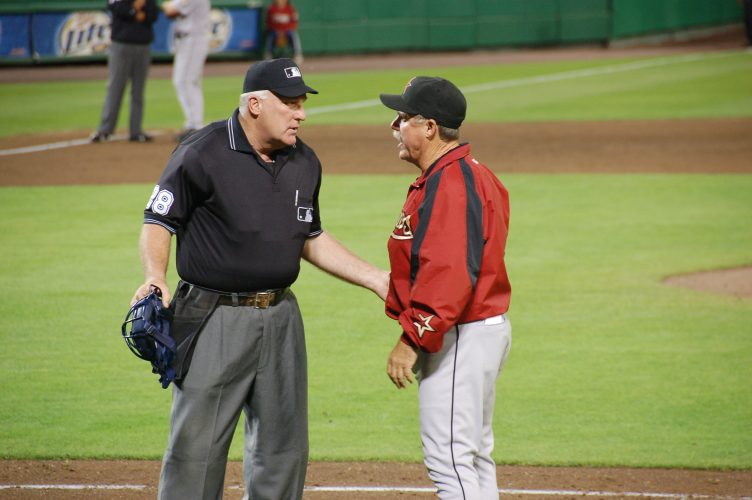
Phil Garner debates with umpire Larry Young in 2006. He didn’t always act like his Scrap Iron nickname.

Phil Garner was nicknamed Scrap Iron for his feisty side but had a side gentle enough that he once promised his wife to hit a grand slam for her when she missed the first one he hit as a major leaguer. Don’t make promises you can’t keep. Unless you can. And he did.

Garner was a rough-and-ready second baseman whose fortés did not include power hitting. (He averaged nine homers a year lifetime.) So, after Mrs. Garner missed him taking Cardinals pitcher Bob Forsch in the bottom of the sixth on 14 September 1978, the loving husband promised her another salami slice ASAP.

Naturally, it came the next day, against the Montreal Expos. And neither Garner had to wait beyond the bottom of the first, when hubby squared off against Woodie Fryman with the pads padded and hit one over the left field fence. It was the first time a National League player sliced salami in back-to-back games in 77 years.

That was the guy who’d grow up to manage the Astros to their first pennant in 2005, when they were still a National League club. The bad news was the Astros grappling their way to it through the Cardinals only to get swept by the White Sox.

And, the who’d go from there to the Athletics’ front office as an advisor, to the team who once traded him after the guy they traded to manage the Pirates, Chuck Tanner, told his new team to trade for the second base slasher. In that advisory role, Garner proved invaluable to an old teammate named Bob Melvin, when both were Giants and Garner was near the end of the line.

Maybe that was also because, when managing the Brewers and the Tigers once upon a time, Garner made Melvin his bench coach at both stops, and Melvin appreciated Garner talking to him in terms of actualities and not what-ifs.

“When he would talk to me,” said Melvin to The Athletic‘s Tyler Kepner about Garner, who died of pancreatic cancer Saturday night, “he would always say, ‘When you manage …’ Not one time did he ever say, ‘If you manage …’ And it just resonated with me that he had that much confidence in me. Obviously, I did end up managing, and a lot of my philosophies and a lot of my values in baseball come from him. There’s no more impactful guy in my career than Phil Garner.”

Garner did that in a lot of places. When he became a Pirate, he engaged in some good-natured jousting with Hall of Famer Dave Parker, who’d first been astonished that his team sent six players to Oakland in the swap that made Garner a Pirate in the first place.

Parker zinged him, Garner zinged back, and the new guy’s “initiation was complete,” as Parker remembered in his memoir, Cobra, “and I had a new sparring partner.” He also had an almost immediate appreciation for Garner one spring training afternoon after Garner’s arrival.

“In the twilight,” the Cobra wrote, “ol’ Scrap Iron was still out there, hours later, taking extra fielding practice at third base. As pissed as I was about the trade, I knew it was the smart move and we got ourselves a winning player.” A guy to win a World Series with, as they did with the Fam-I-Lee Pirates of 1979.

And, a guy who knew how to help bring a roster together, as the team’s relief ace Kent Tekulve told Kepner. “Our team was known to be, oh, a little rowdy, a little cocky, and nobody was safe in the clubhouse,” Tekluve began.

It didn’t matter where you stood in the pecking order, everybody was fair game, and a lot of that was Gar. It was hilarious every day when we’d come in. Whichever one got there first—Parker or Gar—you were waiting for the second one, because it was going to start. You’ve got this 6-foot, 5-inch, huge Black guy and this 5-foot, 9-inch little redneck, and they’d just start in on each other, and that spread. Everybody’s involved now.

And he knew what was going on. I mean, Phil was a smart guy. He knew if he got on Parker, then everybody else would get on him, too. And Parker liked that, because that gave him a reason to prove you wrong.

That’s the man whom Tigers pitcher C.J. Nitkowski once ripped publicly after “a frustrating game,” as Kepner phrased it. Garner bawled him out for it in a clubhouse meeting the next day . . . but accepted the pitcher’s apology privately. Garner even tried to acquire Nitkowski when managing the Astros later on.

“It really spoke to me and made me reflect on how I want to handle myself,” said Nitkowski, who went from the mound to the broadcast booth in due course. “He showed what professionalism looks like, and what forgiveness looks like.”

Another of his pitchers, Steve Sparks, remembered a tough loss that stirred Garner to “shredding us in the locker room” and turning the postgame food spread into a miniature landfill. If Garner couldn’t cool himself off, his lady could—and did.

“At the end of [the tirade],” Sparks remembered, “his wife Carol has a Harley-Davidson wheeled into the clubhouse for his birthday—and right away he turns into Jerry Seinfeld in the ‘schmoopie’ episode, from one character to another in the blink of an eye. He was so relatable. He knew how to laugh at himself.”

Hopefully some of that laughter will come through the tears when they lay the body to rest and wish the man a safe journey home to the Lord. Where Dave Parker’s just liable to be waiting for him with a cold beer in hand and a mouthful of wisecracks with which to serve it.

First published by Sports-Central.

Dave Parker, RIP: Presence

Dave Parker

The Cobra had a blast playing baseball–and he leveled a few blasts, too . . .

Dave Parker almost lived long enough to take the Cooperstown podium for his Hall of Fame induction. A long-enough battler with Parkinson’s disease, there had been a time when Parker wondered whether it was his own fault he hadn’t or wouldn’t be elected to the Hall.

The Classic Baseball Era Committee elected him last December. The Cobra died at 74 Saturday, 29 days before he’d have been up on that stage. Not fair.

Even before his notoriety during the 1985 Pittsburgh drug trials, Parker could have caused a lot of people to wonder the same thing. Power hitter though he might be, he also played with the attitude of scrappy little middle infielders.

On the bases he thought infielders plus catchers were nothing more than papier mache walls through which to run. not living breathing humans liable to stand just as strong against him as the linebackers against whom he played as a high school running back. Describing him as a Sherman tank running on high test would not have been inaccurate.

Those caused him injuries that got in the way of his performance more often than not as time went on. His admitted cocaine use at the drug trials surely did, too. He might apologise for having been a fool, but Parker never once shied away from taking responsibility for his own self.

That classic prankish-looking face and that classic wisenheimer smile—invariably, Parker resembled a man unable to mask that he’d just detonated a ferocious prank somewhere within the vicinity—married his jaw-dropping power at the plate to make the Cobra look as though he couldn’t wait to carve his autograph into a hapless pitcher’s cranium and make the poor sap laugh his fool head off over it.

His self-worth was bottomless and unapologetic. He wasn’t even close to kidding when he told a fan trying to get the best possible angle for a cell phone camera shot, “It wouldn’t take much to make me look good.” But what made him look better was his reputation for team leadership wherever he played.

In Pittsburgh and in Oakland he was part and parcel of World Series winners. In between, he had a memorable stop in Cincinnati, where his manager was Pete Rose and he sat on deck one fine day in Wrigley Field, about to close a road trip out, awaiting manager Rose’s decision on what player Rose would do at the plate—and whether player Rose would take a final shot at passing Ty Cobb on the all-time hit list in the bargain.

Parker’s presence helped Rose make his decision. Manager Rose knew his Reds had only the slimmest shot at staying in the 1985 pennant race and that nobody batting behind Parker was liable to deliver the clutch hit. A sacrifice bunt would have left first base open and the Cubs liable for malpractise if they pitched to Parker rather than put him on to go for the weaker pickings behind him.

Never mind every Red fan on the planet plus their (shall we say) mercurial owner Marge Schott demanding Rose bunt and save the big hit for the home folks. Manager Rose ordered Player Rose to swing away knowing that would give his team just enough more chance to win—but he struck out. It was the most honourable strikeout of Rose’s life. Maybe the most honourable play of it, too. Imagine if Parker wasn’t on deck.

Once he cleaned up from his cocaine issue, Parker’s clubhouse leadership came back to the fore. Making him the kind of guy who had big value to his team even when he slumped. Your clubhouse might be a lot more fun but it would also become a lot more baloney-proof.

As a matter of fact, that clubhouse value shone brightest when the Cobra left Oakland after their 1989 Series triumph, but the Athletics got swept out of the 1990 Series—by a Reds team picking itself up and dusting itself off after Rose’s violations of Rule 21(d) cost him his professional baseball career.

Stop snarling and let Thomas Boswell (who will be in Cooperstown that July weekend accepting his Career Excellence Award induction) explain, as he did in a sharp post mortem analysing just how those mighty A’s could have been humbled by those underdog but hardly modest Reds:

Where is Dave Parker when you need a clubhouse enforcer? The A’s always knew, sooner or later, they’d need Big Dave to quell a cell-block riot, just as the ’77 Reds desperately missed Tony Perez after they traded him. In ’88 [Jose] Canseco popped off about beating the Dodgers in five games. The Dodgers won in five. In ’89 Parker promised to clean, stuff, and mount Jose if he spoke above a whisper. The A’s swept. Now Dave’s gone, Jose predicted a sweep. General manager Sandy Alderson makes a lot of good moves, but saving money on Parker may have cost him a world title.

Dave Parker

“Where is Dave Parker when you need a clubhouse enforcer?” The A’s missed Parker more than they thought when they let him escape after 1989.

“He’s one of the greatest teammates I’ve ever had,” said Parker’s Oakland teammate, pitcher Dave Stewart, a man who looked like six parts commando and half a dozen parts assassin on the mound. “He had such a presence when he walked into the room.”

“He used to say, ‘When the leaves turn brown, I will be wearing the crown’,” said Keith Hernandez, who played against Parker as a Cardinal and a Met and saw Parker win the National League batting title back to back. “Until I usurped his crown in ’79. He was a better player than me. RIP.”

Until his illness made it difficult if not near impossible, Parker’s post-playing days included working as a special batting instructor for the Pirates. Longtime Pirates star Andrew McCutchen was one of those who learned a few things from the Cobra.

“It was rough to see him go through that,” said McCutchen in a formal statement. “I just hope now he’s in a better place and not having to worry about that stuff anymore . . . He was probably Superman to a lot of people when he played.”

Parker’s kryptonite turned out to be Parkinson’s. “I’m having good days, bad days, just like everybody else,” he told a Pennsylvania radio station four years ago. “My bad days, you just got to play the hand that’s dealt. And I know that it’s something that I got to deal with for the rest of my life.”

One of his ways of dealing with it was setting up the Dave Parker 39 Foundation (39 was his uniform number), raising money to continue research into finding a cure for the disease whose other famed victims have included actor Michael J. Fox, boxing legend Muhammad Ali, singer Linda Ronstadt, and Pope John Paul II.

Pirates middle infielder Nick Gonzales wears Parker’s old number 39. He said Saturday, learning Parker had just passed, “It just meant a little more playing today with that number. Personally, I think it should be retired. I think I should get a new number, honestly.”

That kind of tribute would be one of two Parker might appreciate from his new eternal perch in the Elysian Fields. The other was the Pirates doing just what they did Saturday, thumping the higher-flying Mets 9-2 a day after they thumped them 9-1. And the Cobra didn’t have to promise to clean, stuff, and mount anyone to make it happen, either.