
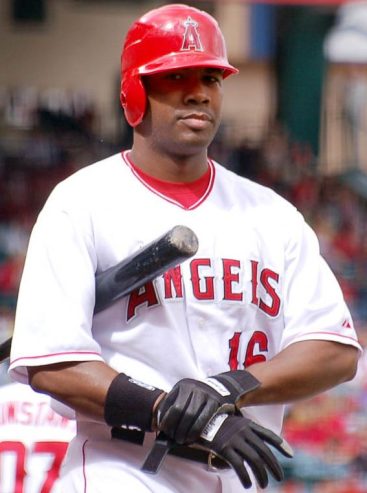
All business in the batter’s box or left field, Garret Anderson was liable to break into an infectious smile and good baseball and life talk with teammates otherwise.
“Maintaining an even strain” was a way of life for legendary military test pilots and often a way of anguish for their wives. It’s also a way of life for enough baseball players, and often a source of anguish for enough of their fans. Show me the player who maintains an even strain, and I’ll show you the fans who mistake it for indifference.
Garret Anderson, whose death of a heart attack at 53 Thursday shocked his sport, was such a player. At least, until his Angels shocked his and their sport and won the 2002 World Series in seven rather thrilling games.
“I used to be called lazy,” he told one reporter, after his three-run double in the fifth inning of Game Seven put the Angels ahead to stay. “Now that we win a World Series, I’m called graceful.”
Anderson at the plate was a sight more likely to inspire engineers than artists. He didn’t look at pitchers as though he wanted to carve his initials into their foreheads. He didn’t look or act like an ogre measuring up his next meal or a junkyard dog finding intruders under every wreck. He swung methodically but attentively, line drives a specialty, even if he did win the 2003 Home Run Derby.
“So stoic was Anderson in the box,” wrote Sports Illustrated‘s Tom Verducci in tribute, “that he came to the plate 9,177 times and saw 30,503 pitches and was hit by only eight of those pitches, the fewest ever by anyone who came to the plate 9,000 times. There was no filigree to Anderson. No self-promotion. Nothing extraneous. How he played happened to be exactly how he lived his life.”
“That swing that I was using tonight is not a swing that I try to use during the season,” he said after he won that Derby. “It was just strictly for trying to hit balls over the fence. During the season, mentally and physically, I don’t do that. I look for mistakes and try to hit them hard.”
Pitchers, other opponents, and even teammates understimated or dismissed Anderson at their own peril. In a seventeen-year career, all but two seasons of which were with the Angels, Anderson was as reliable as the day or night was long. He led the American League back-to-back in doubles; he averaged 21 home runs per 162 games; he didn’t walk much but only ever struck out 100 times once; he finished with his play in left field worth 95 total zone runs above his league average, fourth on the all-time list.
Still, there were those who assumed Anderson too benign to make the Big Plays. They assumed incorrectly. “He doesn’t dive for balls because he gets there quicker than most guys,” said Darin Erstad, Anderson’s longtime Angels outfield partner, and a classic junkyard dog type of player. If that type holds Anderson in high esteem, best listen.
Not that Anderson was allergic to diving or lunging. He simply thought it meant he’d been caught unawares for a very rare moment. “I never should have had to dive for that ball,” Anderson once said after making a diving catch against the Twins. “I got a bad jump. I study hitters. I have an idea of where the ball is going. I don’t dive because I don’t have to.”
Somewhere in the Elysian Fields, Joe DiMaggio must be grinning, if not ready to mix Anderson a tall, cold one.
So the 2003 All-Star Game MVP didn’t resemble the offspring of a secret in vitro union between Rickey Henderson and Robin Williams. The laugh tillers still need the straight men.
“His passion to play this game was very real, and although maybe it didn’t manifest itself the way it did with some other players, Garret played hard, he wanted to win,” said his longtime Angels manager Mike Scioscia, when Anderson was inducted into the team’s Hall of Fame. “He’s got that internal competitive nature that every great player has to have, and he was really the foundation of our championship run back in 2002 and for many other years. He just was a terrific talent and a terrific person.”
Teammates were also among the first to get tastes of Anderson’s dry, disarming wit. Midwest-born former first baseman Scott Spiezio learned the hard way when his fashion sense, or lack thereoff, came into Anderson’s sights. “I’d get on the [team] plane, he’d be like, ‘Spiez, you got on a horse blanket? You’re giving me allergies’,” Spiezio said. “Before you know it, I’m buying Canali, Hugo Boss and Armani.”
Like George Harrison’s reputation as the “Quiet Beatle,” Anderson’s reputation as the Quiet Angel was often deceptive. And, like Harrison, in a good way.
Win or lose, by blowout or by single run, Anderson prided himself and his best teammates on consistency, whether fellow stoics or class clowns alike. “You can’t get wrapped up in one game,” he said in April 2002, after the Angels blew Cleveland out 21-2 one fine day.
Guys’ personalities on this team are the same day-to-day. Guys are walking around the clubhouse the same way they were last week when we were getting our butts kicked. That’s good to see. We have a lot of games to play.
“Yes, he was quiet, but let me tell you that if you entered his inner circle, he was deeply, deeply engaging, even loquacious,” said Joe Maddon, eventually a World Series-winning manager himself but then the Angels’s bench coach. “I so enjoyed our conversations. He was just a sweetheart of a guy. All of us who knew him are just broken up about [his death]. We all loved him. This is really, really hard.”
Maybe the hardest hit might have been Tim Salmon, drafted by the Angels a year before Anderson. A pair of southern California guys, one from Los Angeles (Anderson) and one from Long Beach (Salmon), who forged a deep brotherhood out of opposites, but also out of a few common threads (each married their high school sweethearts, for one), Anderson’s even strain somehow finding its neatest complement in the far more outgoing Kingfish.
“I mean, it’s devastating. As devastating as anything can be in your life,” Salmon began when reached by a reporter.
We’ve pretty much been in this game together at the same time the whole time. I just remember seeing this kid driving this really nice Mustang [in their instructional league days]. He must’ve spent his entire signing bonus on it. Here comes this tall, lanky kid. I was like, ‘Oh, what kind of attitude we’re gonna have here?’ And it was the complete opposite. He was just so mild-mannered and quiet, and you had to draw it out. But he was infectious. He became a favorite of his teammates from the beginning.
“When I first got drafted,” said Angels outfielder/DH Mike Trout, long enough The Man in Anaheim before the injury bug rudely interrupted him, and the only Angel to score more runs lifetime than Anderson, “[Anderson] was the guy. He meant a lot to this organization . . . I don’t think I’ve ever heard anything bad said about him. It’s just a tough, tough loss.”
Anderson’s impact wasn’t just on his own team. He made a big impression on another southern California kid who grew up making Anderson—who was also respected for signing autographs for kids for long periods daily while he played—his baseball hero.
“You always hear, ‘Don’t meet your heroes’,” said Freddie Freeman, the Dodgers’s Hall of Fame-bound first baseman. “But then I got to meet him, and I was like, ‘I’m glad I did.’ Because he was a beautiful man. And I wish he was still here. He meant a lot to so many people … I’m at a loss for words really.”
The only people to whom he could mean more were his wife, Teresa; their daughters, Brianne and Bailey; and, their son, Garret (Trey) Anderson III. As great as baseball’s grief is, theirs is greater. Lord watch over them as You welcomed him home, a little bit early, but no less safe and sound.

