Can the American League wild card game possibly beat the National League’s for surrealism?
An Athletics fan of my acquaintance in a Facebook baseball group told me this morning that, even in the dump of a Coliseum, the American League wild card game between the A’s and the Rays looked to be an absolute sellout. This is good.
Whether the A’s and the Rays come up with anything such as happened in the National League game Tuesday night is anybody’s guess until they play. And, hopefully, each team’s fans pray devoutly, it won’t be the kind of late twist of fate that squirted the Nationals to overthrow a win the Brewers looked to have in the safe.
Until Tuesday night it was the Nats who tended to suffer on wrong side of the pennant race’s or the postseason’s slings, arrows, slapsticks, anguishes, and surrealities. Then one unexpected skip on the grass of a bases-loaded eighth-inning single gave the Nats a deep taste of how it feels to be on the winning side of even one of those.
Maybe the Elysian Fields demigods decided at long enough last that, considering the toxic surreality that is Washington’s number one business—also known as the nation’s largest organised crime family—the nation’s capital and those who live there and root for the Nats deserved even a brief reprieve.
The history minded in the capital could see the ghosts of the last time a bad hop won something big for Washington baseball. Two bad hops in fact, both on the dime of Giants third baseman Freddie Lindstrom, one enabling the ancient Senators to tie and the other enabling them to win Game Seven of the 1924 World Series.
These Nats haven’t yet reached that close to World Series rings, of course. But after Juan Soto’s liner skipped surrealistically beyond the otherwise well positioned glove of rookie Brewers right fielder Trent Grisham, you might forgive the Nats and their fans if they permit themselves thoughts that, this time, they just might not get kicked to the rocks below after being led up the mountain to gaze upon the Promised Land.
The A’s and the Rays have a next-to-impossible act to follow Wednesday night. The Nats merely have a division series date with the Dodgers starting Friday in Los Angeles. They’ve crossed the Red Sea. Now comes the trek across the desert. As the man on the radio used to say, it won’t be easy, Clyde.
Some star-crossed teams can say at least that their signature transdimensional disasters were spread out over decades. The Nats have gotten theirs within just sixteen years of life adjacent to the Potomac. Their Montreal forebears never knew even a sixteenth of that. Maybe the 1994 strike costing them a clear postseason path.
Why, those Montreal forebears were even managed by Gene Mauch in their infancy and never had the chance to endure the kind of thing that sketched Mauch’s name into unfair infamy with the 1964 Phillies and the 1986 Angels. Lucky them.
But those now-ancient Expos never looked like the walking dead after a 19-31 season start, resurrected themselves after an embarrassing series loss to this year’s equally self-resurrected Mets, then romped to at least the first league wild card until they nearly blew it in September, either.
Those Expos never had the chance to go to four winner-take-all games before Tuesday night and lose every last one of them.
Those Expos were never betrayed by jumping out to a 6-0 lead in the first three innings of one of those games only to start swinging like they were trying to hit six-run homers on every pitch thrown to them or start pitching like they were trying to strike out the side on single pitches and enabling the Cardinals to overthrow them. The 2012 Nats thought of that.
Those Expos were never betrayed by their own manager hooking a sharp young pitcher with reserves still in the tank and two outs from a complete-game division series shutout, then failing to reach for Stephen Strasburg on call in the pen with the season absolutely on the line in another division series. Matt Williams dreamed that one up in 2014.
Those Expos didn’t get bastinadoed out of the race by the Mets when their skipper absolutely refused to betray The Book, whatever the hell it was at the time, and finally got caught completely out of the loop when his half-crazed closer tried to choke his right fielder in the dugout the weekend they were eliminated mathematically from the race. Williams conjured that one up, too, in 2015.
Those Expos didn’t out-score the Dodgers 24-19 in a division series only to lose Game Five on a four-run Dodger seventh and a slightly surrealistic Clayton Kershaw save. That brilliant idea came to the 2016 Nats.
Those Expos didn’t push a division series to a Game Five and then watch in horror when their catcher committed a passed ball, then threw wild past first, then got caught in catcher’s interference before the next batter up got hit by a bases-loaded pitch to finish a four-run fifth against them. 2017 Nats.
They may or may not miss baseball in Montreal but they probably don’t miss having avoided those kinds of disasters, either. Until Tuesday night, moving them to restore Washington baseball began to resemble the capital’s only known non-government-involved case of being careful what you wished for.
Long, long ago, it used to be said with only partial actual accuracy: “Washington—First in war, first in peace, and last in the American League.” Prior to Tuesday night it looked an awful lot like “Washington—First in war, first in peace, and first to disaster in the National League.”
For seven innings Tuesday it looked like they were going to get chaperoned right off the grounds of the postseason dance before they could even present their tickets, never mind get that last dance with the prettiest girl. And the odds looked reasonable that Brewers closer Josh Hader would make damn sure their tickets would be voided when he opened by striking out Victor Robles on a full count.
Except that Hader didn’t bring his customary authority to the door. Then, it was hitting pinch hitter Michael A. Taylor (for Strasburg, who’d pitched three scoreless relief innings in the Nats’ all-hands-on-deck bullpen plan) with a pitch that got his hand and bat one after the other in a split nanosecond. Then, Hader found enough to strike Trea Turner out and set the Brewers a mere four outs from going to Los Angeles, instead.
But venerable veteran Ryan Zimmerman pinch hit for Adam Eaton and slashed a broken-bat base hit right up the pipe, with Andrew Stevenson, a far more swift set of legs, sent out to run for him. Then, after forcing him back from 3-0 to a full count, with “M-V-P!” chanting pouring down from the stands, Hader walked Anthony Rendon to load up the pillows for Soto.
Then it was Soto’s frozen rope into right. It was Grisham, whose leadoff walk preceded Yasmani Grandal’s two-run homer in the top of the first that the Nats back onto their heels too early, hustling in from deep positioning to pick it off. It was the ball taking that odd skip away from Grisham’s otherwise well positioned glove. It was Taylor and Stevenson driving home at the speed limit and Rendon right behind them before Grisham’s relay throw hit his cutoff man.
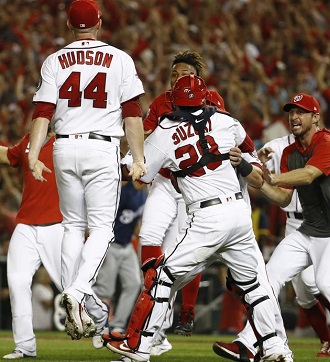
And it was Brewers third baseman Mike Moustakas taking the relay throw just ahead of Soto’s arrival at third and starting the brief rundown that bagged Soto at second for the side. And what proved the end, when Nats manager Dave Martinez—who almost mismangaed himself right out of a job in May—reached for Daniel Hudson, who shook off a one-out single to get two air outs for the game.
These Brewers ironed up and fought hard enough after Christian Yelich inadvertently kneecapped himself for the rest of the year that even Nats fans ached for them for just a moment. They’d gotten a sad taste of the kind of thing that used to bedevil the Red Sox before the turn of the century, the Dodgers in Brooklyn from pre-Pearl Harbour through 1955, and the Cubs from the (Theodore) Roosevelt Administration until 2016.
The kind of thing, too, that usually happened to the Nats, not by them.
The realist may say, “Don’t count your Dodgers before they’re hatched,” but the optimist, given a license renewal Tuesday night, has a day and a half window to tell the realist to sit the hell down, shut the hell up, and stop spoiling the fun. Even if the Dodgers end up keeping the fun to a day and a half window, it’s a window Nats fans wouldn’t dare to close, and you can’t blame them one lick.
The A’s and the Rays may feel like the Rolling Stones tasked with trying to follow James Brown on television’s legendary The T.A.M.I. Show in 1965. Come to think of it, by comparison to following the Nats, the Stones may have had it easier. May.