Retirement, Verlander style

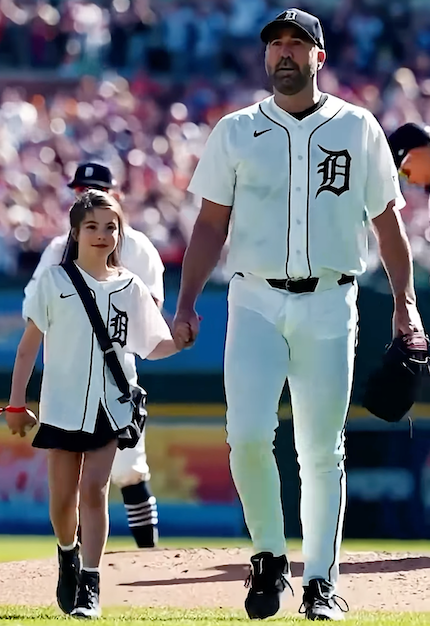
Genevieve Verlander, Justin Verlander

Daughter escorts father from the mound without a dry eye in the Comerica Park house Saturday.

The games meant nothing and everything at once. Nothing in the big picture of the Tigers’s season or the postseason they’re going to miss, but everything to their retiring Hall of Famer in waiting and his family. Especially his seven-year-old daughter.

Genevieve Verlander—that’s Vivi to her family and friends, as seen on the Tigers jacket she wears—highlighted the Tigers’s commemoration of Justin Verlander Friday night with a ceremonial first pitch curve not necessarily unlike the ones her father threw in his heyday.

Daddy himself squatted down to take the pitch. The split second it hit his glove, Verlander thrust his arms skyward and galloped out to sweep her up as she leaped into the arms she’s going to feel far more now than in her first years.

“It’s been awesome,” Verlander told MLB.com’s Jason Beck about their preparations. “We’ve been practicing. She’s all pumped up about it. We actually came out here to the field and practiced off the mound one day. I asked her, ‘Where do you want to go? You want to go to the mound?’ And she’s like, ‘The mound.’ I’m like, ‘That’s my girl’.”

The lack of dry eyes in the Comerica Park house could be equaled by one thing only, and it happened on the following afternoon. At the end of a season Verlander lost to injury in April, willing his way back to make a final stand before beginning the retirement he announced in July.

That’s when Verlander took the mound for the final time in his major league life, against the Pirates. When he pitched almost like a reasonable facsimile of his classic self, surrendering a measly two runs, both on solo home runs, then got the first out of the sixth and a surprise unlike any his career had brought him before.

This time, Vivi had more help. From mother Kate Upton and Tigers manager A.J. Hinch, who’d once also managed her father in Houston. They’d plotted this very moment. Verlander had no clue what would happen after he lured Brandon Lowe into a pop out to catcher Dillon Dingler.

Hinch walked out to plate umpire Laz Diaz to inform him of the pitching change. Then he motioned to the first base side. Vivi ran out toward the mound wearing an even bigger grin than the one behind which she threw the Friday night curve. Father and daughter hugged even harder this time around.

And Verlander—one of the most composed pitchers who ever stood on the mound before tying lineups into knots; a competitor who married power to smarts and feel to analytics; a lion so intense that it took marriage and fatherhood to let him look more human than he looked in his bristling younger seasons; a lancer who’d spent his final innings on the mound ironed up for work as always—lost it.

He wept. Unashamedly, unapologetically. Even Hinch looked as though he might shed a few tears as he joined father and daughter for a quick mini-group hug. “It hit me like a ton of bricks,” Verlander admitted after the game. He also admitted he hoped Vivi would understand he wept for joy, not sorrow.

This beat any father-daughter dance on record so far.

“He’s a really hard guy to surprise,” acknowledged Finch, who attests to numerous conversations with Verlander about fatherhood and family life. “He’s as planned out and mapped out as any human I’ve ever been around. And so I contacted Kate a little while ago and just tried to think about ways that we could create a special moment for him.”

It must have hit the Tigers like a ton of bricks that Verlander walked off the mound with Vivi in his arm and into the arms of her mother and her younger brother, Bellamy, with the Tigers in a 2-0 hole. (Lucky Pirate boys Lowe and Jacob Gonzalez. They get to brag that they took a Hall of Famer yard on his final day in the bigs.)

Lucky for them they could wrestle back to where a 3-1 deficit in the bottom of the ninth was, for once, just a simple hurdle.

First, Kevin McGonigle pushed Max Clark (one-out single) across the plate and Hao-Yu Lee (double) to third. Then Eduardo Valencia won it with a clean blast into the left field seats. Verlander wouldn’t get credit for a pitching win, but nobody questioned he and his family had won the day. And the weekend.

Detroit probably won’t remember Saturday’s final score as heavily as they’ll remember Vivi racing out to make sure her father wouldn’t step off the mound alone. In baseball terms, they’ll have far older memories to hold, as The Athletic‘s Cody Stavenhagen noted:

Electric strikeouts in the playoffs. Thrilling feats of dominance on so many summer days. He is best known throughout the sport for his longevity and his durability, a near-unbreakable force who lived to see an era where starters are coddled rather than pushed, where battles are won through algorithms and optimization just as much as they are heart and grit. The way he embraced it all, the old and the new, is part of what helped him outlast so many of his peers.

The family embraced again in front of the dugout and in front of Verlander’s teammates, with whom he’d share some final handshakes. Comerica Park rocked in tribute to the big righthander. He’d pitched for his heart and soul Saturday, and they knew it.

“It felt very storybook,” Upton said after the game. “And it was so Justin. That’s the most Justin Verlander thing I’ve ever seen.” She could have been referencing his pitching and his paternal vulnerability at once.

Then, the family disappeared through the dugout to the clubhouse and toward the rest of their lives.  Suddenly, you forgot the grizzled veteran resembling a prospector in the mountains too long, saying goodbye to the game he enhanced, stepping full time into the family life that didn’t unmake the three-time Cy Young Award-winning, 3,560-strikeout pitcher, but remade the man.

“I never wanted to retire because of a milestone, a number or a date on the calendar. I wanted the game to tell me it was time,” wrote the 43-year-old in a social media post.

Baseball has given me more than I could have imagined. It taught me discipline, resilience and the value of continuing to adapt and evolve. I’ve been fortunate to play with and against incredible players, for outstanding organizations and compete in front of fans who deeply appreciate the game.

Don’t waste your time pondering that Saturday’s quality start might portend Verlander rethinking retirement. He knows his body would laugh and bark, “That’s what you think.”

One day, perhaps Vivi Verlander will come to understand that she did a lot more than just charm the living daylights out of Detroit and baseball nation with her Friday night pitch and Saturday afternoon escort. God and her parents willing, she’ll see she helped her father do what too many of the greats fail to do. Hell, she helped him do what too much of this regular season failed to do.

She helped him leave baseball fans wanting more. But the only thing more her father can give fans from here is a speech on the Cooperstown stage in five years.

ALCS Game One: Bad Astro looks, sharp Ranger pitching

Evan Carter

Evan Carter’s running-and-leaping catch of an Alex Bregman drive that had extra bases stamped on it otherwise ended with doubling up José Altuve in the Game One eighth—on Altuve’s own baserunning mistake.

This was not a good look for the Astros. When Justin Verlander keeps the arguable best remaining postseason offense to the weakest postseason game it’s had this time around but the Astros still don’t win, it’s not a good look.

When Jordan Montgomery scatters five hits in six and a third innings with no Astro scoring against him, before handing off to a bullpen whose regular season was an indictment for arson but has been a challenge to pry runs out of this postseason, it’s not a good Astro look.

When José Altuve, one of baseball’s smartest players, makes an eighth-inning baserunning mistake more to be expected of a raw rookie than a thirteen-year veteran with a Most Valuable Player Award in his trophy case, it’s not a good Astro look.

Astroworld should only be grateful that the Rangers didn’t even think about trolling Altuve the way a certain Brave trolled Bryce Harper on a similar but different play in the National League division series out of which the Phillies shoved the Braves.

Harper didn’t miss second scrambling back to first when Nick Castellanos’s long ninth-inning drive in Game Two was caught on the run and leap by Braves center fielder Michael Harris II, but he was thrown out at first by a hair and a half to end the game and the only Braves win of the set.

Altuve didn’t end American League Championship Series Game One Sunday night, but he did put the kibosh on the Astros’s final scoring opportunity in the 2-0 loss. He’d drawn a leadoff walk against Rangers reliever Josh Sborz, who yielded at once to Aroldis Chapman—a relief pitcher whose best fastball can still out-fly a speeding bullet, but who once surrendered a pennant-losing homer to Altuve himself and is still prone to hanging his sliders.

Then, somehow, Astros third baseman Alex Bregman sent a 2-1 slider off the middle of the zone to the rear end of Minute Maid Park, toward the chain-link fence beneath a Bank of America sign. The Rangers’ rookie left fielder Evan Carter ran it down and still had to take a flying leap to catch it one-handed just before it might have hit the fence and spoiled the Ranger shutout.

“Everybody,” said Astros catcher Martín Maldonado, who probably meant both the Astros themselves and the Minute Maid crowd, “thought that ball was going to hit the wall.”

Carter threw in to shortstop Corey Seager, who tossed right to second baseman Marcus Semien with third baseman Josh Jung pointing to the base emphatically. Semien stepped on the base just as emphatically. It took a replay review to affirm what Seager, Semien, and Jung spotted at once. Second base umpire Doug Eddings rung Altuve up. Altuve never touched second en route back to first.

Ouch!

“I didn’t think he was going to make the play he made—it was a great play,” said Altuve, a man who excels at just about everything you can ask of a veteran except baserunning, what with leading the entire Show with sixteen outs on the bases during the regular season. “You just try to come back to first base (and) that’s what I did.”

“That’s a play,” Semien said, “where I always watch to see what the runner does. Sometimes the umpires are looking at the ball, and that’s exactly what (Eddings) told me. He said he was looking at the ball. He didn’t see it. I tried to remind him. He still called it safe, but luckily that’s a play we can review. I’ve made that mistake before on the bases, so it’s one that we kinda go over in spring training, and all of a sudden in the ALCS, it showed up.”

Carter had also run down and caught leaping a Bregman drive down the left field line in the first. Then he himself accounted for the first Rangers run in the second inning, when he shot a base hit right past diving Astros first baseman José Abreu and gunned his way to second ahead of a throw that was dropped almost inexplicably at the base. Rangers catcher Jonah Heim then singled back up the pipe and Carter, reading the ball almost as a Biblical scholar parses the Beatitudes, scored.

“They always preach to us, especially the ones that can run a little bit, just, ‘Hey, it’s a double until it’s not’,” said Carter, who didn’t play his first major league game until 8 September. “So that’s kind of my mindset. I’m going to get a double until the outfielder tells me that I need to stop. I didn’t feel like I was told I needed to stop, so I just kept going.”

Three innings later, the Rangers’ number nine lineup batter, center fielder Leody Taveras, caught hold of a hanging Verlander sinker and lined it right over the right field fence. That was the second and final blemish against Verlander, the veteran who walked to the Mets as a free agent last winter but returned to the Astros in a trade deadline deal in August.

Altuve’s eighth-inning misstep was only the final among several opportunities the Astros missed all game long. They wasted Abreu’s second inning-opening single almost at once when Michael Tucker forced him at second on a followup ground out, then stranded Tucker on a pair of fly outs.

They wasted first and second with two outs in the third when Yordan Alvarez struck out for the second of three times on the night.

They pushed the bases loaded against Montgomery in the fourth, the only inning in which the Rangers’ 6’6″ tall, free agent-to-be lefthander truly struggled, and Montgomery ironed up and struck Maldonado out swinging on 1-2.

It was only when Astros utility player Mauricio Dubón, playing center field for them Sunday night, slammed a hard line out to center field opening the Houston seventh, that Rangers manager Bruce Bochy decided to reach for the bullpen. Now, the Astros had a clean shot at a bullpen that might resemble the Third Army this postseason but blew 33 out of 63 so-called save situations on the regular season.

Altuve’s baserunning mistake still left the Astros four outs to work with yet and the vulnerable Chapman hardly off the hook with Alvarez checking in at the plate: Chapman’s lifetime postseason ERA in Minute Maid Park was 7.53 entering Sunday night. He fell behind Alvarez 2-1. Then, he threw Alvarez a slider that hung up just enough to be sent into orbit, just as Altuve had done winning that 2019 ALCS.

The only place Alvarez sent this one, though, was on the ground toward first base for an inning-ending out. Then Bochy reached for Jose Leclerc to work the ninth. Leclerc landed a hard-enough earned three up, three down; he went to full counts on Abreu and Chas McCormick before getting Abreu to line out to center for the first out and McCormick to strike out swinging, sandwiching Tucker’s 2-2 ground out to second.

“We just found a way to get a couple of runs across the board,” said Bochy after the game ended. “That was the difference in the game, obviously. But our guy was really good, Monty, terrific job he did. And he got in a couple of jams there and found a way to get out of it.”

Verlander didn’t sound discouraged after Game One despite his solid effort coming up just short enough. “We’ve lost Game One of some playoff series before,” said the future Hall of Fame righthander. “And that’s the great thing about this team. Obviously nobody is sitting in the locker room right now happy. But it’s very matter of fact, okay. We just got punched, how do you answer?”

The Astros have Game Two to start answering, of course. But they might have to find a few more ways to keep Carter from running down and killing their better drives.

Pity poor Framber Valdez . . .

Framber Valdez

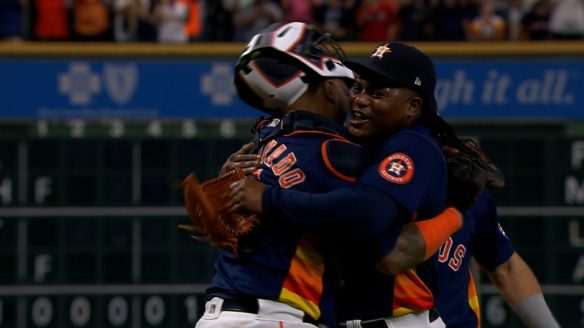
Framber Valdez gets a bear hug from his catcher Martin Maldonado after throwing a no-hitter at the Guardians Tuesday night.

What does it say that, on the day the Astros re-acquired the last man to throw a no-hitter in their silks, their struggling All-Star pitcher shakes off whatever it was prompting him to surrender fifteen earned runs over his past fifteen innings’ work to throw a no-hitter? The Astros may not be the only ones who’d like the answer.

But there it was. One minute, the Astros pulled the proverbial trigger on bringing future Hall of Famer Justin Verlander back. The next, after the trade deadline passed at 6 p.m. Eastern time Tuesday, Framber Valdez kept the Guardians hitless—with more than a little help from his friends—in a 2-0 win both of which Astro runs scored in the bottom of the third.

Verlander came home from the Mets in exchange for a pair of good-looking outfield prospects out of a farm system that was considered more than a little parched by any objective standard. Following their trade of fellow future Hall of Famer (and former Detroit rotation mate) Max Scherzer for a delicious Rangers prospect, the Mets actually looked smart in their unexpected circumstances.

“They did what they had to do, and I’m sure it wasn’t an easy call,” writes Smart Baseball author/Athletic analyst Keith Law, “but the Mets traded away six players from their big-league roster, including three pitchers all age 38 and up who either were heading for free agency or just unlikely to be that much help to the team in 2024 . . . ”

Dealing Justin Verlander and Max Scherzer—while paying enough of their salaries to return three solid prospects in Luisangel Acuña (No. 58 on my midseason top 60), Drew Gilbert (a first-round pick last year), and Ryan Clifford—are the kinds of moves more teams that have spent big only to fall short of contention should be making. And let’s give the Mets some credit for spreading the wealth around by sending one of those starters to Texas and the other to Houston.

I won’t pretend that that’s going to placate today’s generation of Met fans. You know. The generation that pronounces a season lost over one bad inning in early April. But Law is absolutely right. Especially with the coming off-season and, not merely to buy time, the pack of pitching free agents coming to within their glandular budget.

Particularly, a certain unicorn to whom the Angels held on for an (admittedly) outside postseason shot before he enters the market. The unicorn who’s both one of the best pitchers in the American League and a bona fide threat to Aaron Judge’s barely-year-old AL single-season home run record.

The Astros needed Verlander back more than anyone would have predicted when the season began. They’d just won a World Series and looked as though saying goodbye to a (controversial enough) era when they let the freshly-crowned Cy Young Award winner—the only baseball senior citizen ever to land one in his first year back from late-career Tommy John survery—walk into free agency.

But then they lost Lance McCullers, Jr., Luis Garcia, and José Urquidy to the injured list. Then, the Mets’s season went from World Series expectations to the landfill. Even as Verlander shook off early struggles and injury to round back into something resembling his old self (he has a 1.49 ERA over his last seven starts), it wasn’t enough to save this year’s Mets.

So the Mets elected to look 2023 reality in the eye and say time to start repairs. They dealt Scherzer to the Rangers after he delivered seven solid against his old team, the Nationals, en route the Mets taking three of four from the equally moribund Nats. When Scherzer asked the front office what the plan was, and learned it was moving on from deals expiring this year or next, he waived his no-trade clause and let the Mets move him onward.

The Astros are nipping at the Rangers in the AL West. The two teams square off themselves in a three-game set in early September. Tell me you won’t think it must-see television to see JV versus Max the Knife at least once in that set. Even if they’re not exactly young men anymore, they may yet have enough left in their tanks to have the eyes of all baseball upon them, especially with the AL West still at stake there.

It’s kind of a shame that Valdez picked Tuesday to pitch his jewel. Verlander back to Houston; St. Louis’s Jack Flaherty getting a fresh start in AL East-leading Baltimore (where he might get fixed enough to command a nice free agency pay day this coming winter);  the Cardinals otherwise reviving their own testy farm system without surrendering Nolan Arenado or Paul Goldschmidt.

Those were just too big to leave room. As were the Yankees even in inertia. They made no move other than landing middle relief pitcher Kenyan Middletown because they couldn’t realistically do a blessed thing. What they could move was either inconsistent or overpriced; what they could or might have brought in wouldn’t have been enough, even with Gerrit Cole at the head of the AL’s ERA pack and Judge back from his toe fracture.

You think today’s Met fan has the patience of a Nile crocodile? Don’t get me started on Yankee fans. From generation to generation, their credo is that a season lacking a postseason is illegitimate. For the generations since their last World Series win, the merest shortfall is enough to cause them to demand, “What would George do?”

The answer to that question is not what Yankee fan wants to hear anymore. They’d really rather have the late Boss’s tyranny and mutation back than what they have now. Never mind how it turned the 1980s Yankees into a basket case. Peace and quiet isn’t an option if the Yankees aren’t at the top of the AL East. Doesn’t it sound perverse to say a team with a winning record at this writing is also a basket case?

But there Valdez was, on the Minute Maid Park mound, striking seven out, letting his defenders take care of about 81 percent of the outs he needed otherwise, while Kyle Tucker took care of the game’s scoring with a two-run single in the bottom of the third.

Valdez stood at the top of the pitching heap Tuesday, and the trade deadline with all its attendant sidebars left him a hero without decoration. Even if Verlander’s first move on his arrival back with the Astros might be to congratulate him and welcome him to a unique club.

Sixteen no-hitters (four of which were combined, one of which was thrown by Hall of Famer Nolan Ryan) have been thrown by Colt .45s/Astros pitchers since their 1962 birth. From Don Nottebart (vs. the Phillies, 1963) through Valdez. That’s the most of any expansion franchise so far.

Valdez has a unique set of bragging rights while he’s at it. It took 61 years for an Astro  lefthander to do it. He can also say he’s the only man in baseball history, so far as anyone knows, to throw a no-hitter on deadline day, after the deadline hour passed but while the analysis and debates over the deals went hollering apace. The poor guy.

Season lost, Scherzer gone

Max Scherzer

Scherzer waived his no-trade clause to go from the deflating Mets to the AL West-leading Rangers.

The contemporary Mets fan, to whom a season is usually lost over one terrible inning in early to mid-April, sees Max Scherzer speaking without boilerplate about talking to the front office regarding, stop, hey, what’s that plan, after the Mets traded solid relief pitcher David Robertson to the Marlins for a prime-looking prospect. And, is barely amused.

Then, they see the three-time Cy Young Award-winning future Hall of Famer traded within a day or so to the American League West-leading Rangers, for a more prime-looking prospect. They are somewhere between dryly amused and snarkily contemptuous. Not to mention terribly inattentive or misinformed.

Nobody questions that age has begun to catch up to the righthander. Assorted small injuries plus lingering issues with his back and his side did a little too much to keep him from resembling his vintage self. One moment, Scherzer did a plausible impression of what he once was. The next, he did a plausible impression of a piñata.

There are some who see this year’s 9-4 won-lost record and say, so there! There are others who see this year’s 4.01 ERA and 4.73 fielding-independent pitching rate (FIP) and see a man whose youth and prime may not be visible in the rear view mirror anymore.

When the Mets traded Robertson a few days ago, Scherzer didn’t hold back. He was neither nasty nor snarky about saying it was time for him to talk to the Mets’ front office about the rest of the season and just who projected what. But, first, he was honest enough to begin with a sober assessment of the Mets’ deflating season thus far.

“[O]bviously, we put ourselves in this position,” he said. “We haven’t played well enough as a team. I’ve had a hand in that for why we’re in the position that we’re at. Can’t get mad at anybody but yourself, but it stinks.”

Then he went forward: “You have to talk to the brass. You have to understand what they see, what they’re going to do. That’s the best I can tell you. I told you I wasn’t going to comment on this until [owner] Steve [Cohen] was going to sell. We traded Robertson. Now we need to have a conversation.”

That was after Scherzer looked a little like the old Max the Knife against his old team, the Nationals: striking seven out in seven innings, scattering six hits one of which was a solo home run, and the Mets rewarding him with a 5-1 win, not to mention their seventh win in eleven games. But still.

Some Met fans think the front office elected to punt on third down, metaphorically speaking. Others think that, when Scherzer said they “needed to have a conversation,” it might have meant a conversation about Texas being the next destination for Scherzer himself.

If that involved Scherzer agreeing to go from the sinking Mets to a division-leading troop of Rangers in return for a prize prospect who turns out to be Ronald Acuña, Jr.’s promising brother, it probably took less than we think (even allowing the time) for Scherzer to say yes to one more active, not passive pennant race.

Scherzer had to waive his no-trade clause and exercise his contract’s 2024 opt-in to make the deal. Luisangel Acuña is a middle infielder and center fielder with a live bat (if not always as powerful as big brother’s) who can hit pitching from both sides readily, and wheels to burn on the bases. (42 stolen bases in 82 games; an .894 stolen base percentage.) Most known analyses of him say his challenge is to harness his aggressiveness.

The prime issue for Scherzer at 38 is staying healthy and avoiding home runs. His 1.9 home runs per nine this season are a career high. Yet, his tenure as a Met overall hasn’t exactly been a wash. His Met totals include a 3.02 ERA, a 3.52 FIP, and a 1.02 walks/hits per inning pitched rate. And, a 10.05 strikeouts-per nine rate with a 5.54 strikeout-to-walk ratio.

But they also include his having run out of fuel in Game One of last year’s National League wild card series, battered for four home runs that accounted for all the Padres scoring in a 7-1 loss.

“If [Scherzer] can limit the long ball and stay healthy,” observes The Athletic‘s Brittany Ghiroli, “he should help the Rangers fend off the Astro in the AL West and avoid the wild-card round. What’s more, his competitive personality and postseason experience could rub off on his new teammates.”

He’ll join a Rangers rotation that took a hit when former Met superpitcher Jacob deGrom went down to Tommy John surgery, but resuscitated itself via Nathan Eovaldi and Dane Dunning. He’ll be backed by a bullpen anchored by Will Smith. And a roster hitting .274. So far.

Mets players said goodbye to Scherzer Saturday night, during a rain delay before a game against the Nats that ended in an 11-6 Nats win. Surely they also started wondering what else and who else after Max the Knife could be talked into waiving his no-trade clause. They might have cast eyes first upon Justin Verlander, who’s showing his age as well, but who shook an early injury to look a little better than his old Detroit rotation mate this year.

“It’s not a certainty that Verlander will be traded,” say Athletic writers Will Sammon and Tim Britton, “but the Scherzer deal offered a blueprint of what to expect should the Mets decide to unload their other top starter. Verlander has performed better than Scherzer and, in theory, should net a better prospect.

“However, Verlander also has a no-trade clause in addition to being under contract for 2024 with a vesting option for 2025. It’s also unknown whether the Scherzer trade made Verlander feel any different about playing for the Mets.” Not to mention whether reported serious interest from the Dodgers, the Rangers, and Verlander’s old team in Houston might compel him to revisit his feelings.

The Mets barely said goodbye to Scherzer when Sports Illustrated reported they were in, quote, deep talks with the Astros about bringing back the future Hall of Famer who won an unlikely Cy Young Award in their silks last year but signed with the Mets as an offseason free agent. Unlikely because Verlander’s the oldest pitcher to win the prize after returning from late-career Tommy John surgery.

As with Scherzer, the Mets will likely demand a choice prospect or two (or even three) while the Astros will likely insist the Mets help them pay for Verlander’s return, including his 2025 vesting option. As the Rangers did with Max the Knife, the Astros may not be averse to helping the Mets continue their farm replenishment and remake for the privilege of one more term with JV.

There’s just one problem with that idea, from the Houston side, encunciated by Three Inning Fan podcaster Kelly Franco Throop: “[T]hey have nothing to give: they are considered to have one of the worst farm systems in the game.”

So much for providing a delicious pickle in the AL West, the two who once headed the Tigers’ rotation together going against each other to help decide that division. As of this morning, the Astros were only a game behind the Rangers in the division and in a dead heat with the Blue Jays for AL wild card number one.

The Mets may have pushed the plunger on a 2023 that was getting away from them through too much fault of their own, but all is not necessarily lost. There’s 2024 toward which to gaze.

There’s also a very outside chance that losing their best reliever and one of their better starters sticks the ginger into their tails. They’re “only” seven back in the National League wild card race. But a Met fan since the day they were born says, “Anything can happen (and often enough does).” Today’s patience-of-a-Nile-crocodile Met fan says, “This year’s been next year since the end of spring training.”

Playing the trade deadline period for prime prospects is a win-win, too. Either they become better than useful Mets soon enough, or they provide fodder for a bigger/better deal or three down the road.

Even if all they’ve sacrificed yet is Max the Knife and their best relief pitcher, the Mets are still in position to bring a certain front line starting pitcher into the ranks for a longer period and potentially better results. The unicorn who now wears Angels silks, threatens Aaron Judge’s AL single-season home run record while he’s at it, and becomes a free agent after this season.

On this much the lifelong Met fan and the contemporary Met fan can agree: The Mets are many things. Dull isn’t one of them.

Clocks and Clouds

Over a week ago, Mets pitcher Max Scherzer felt as though he’d awakened one fine morning to discover he had super powers. Very well, that’s a slight exaggeration. But after he’d spent two innings against his old team, the Nationals, striking out five despite surrendering a single run, Scherzer felt the newly-mandated pitch clock gave him, well…

“Really, the power the pitcher has now—I can totally dictate pace,” he crowed then. “The rule change of the hitter having only one timeout changes the complete dynamic of the hitter-and-pitcher dynamic. I love it. It’s a cat-and-mouse game. There’s rules, and I’ll operate within whatever the rules are. I can come set even before the hitter is really in the box. I can’t pitch until eight [seconds], but as soon as his eyes are up, I can go.”

Not so fast. Come last Friday, Scherzer faced the Nats once again and learned the hard way that he might have competition in the New Tricks Up Their Sleeves Department. With a man on first, he thought he could catch Victor Robles off guard the split second home plate umpire Jeremy Riggs re-set the pitch clock, after Robles stepped out of the box with his only allowable step-out during a plate appearance before stepping back in. Scherzer started to throw at that very split second. Riggs called a balk.

“He calls time, I come set, I get the green light,” Max the Knife told reporters post-game. “I thought that was a clean pitch. He said no. We have to figure out where the limit is.”

Baseball’s government thinks it did it for him. Hours after Scherzer’s little experiment was neutralized, MLB sent a memo to all 30 teams saying forthrightly that pitchers can’t throw “before the batter is reasonably set in the batter’s box.” Come Saturday, another Mets pitcher, Justin Verlander, discovered he’ll have to do something about his long-normal routine around the mound between pitches.

“Today I got on the mound a couple times and looked up and it was like, I only had seven seconds,” the future Hall of Famer said, after pitching three innings against the Marlins, surrendering a single run, and having to adjust his mound strolling. “If me and [Mets catcher] Omar [Narvaez] weren’t on the same page, it could have been a problem.”

When this spring training’s exhibition games began, Padres third baseman Manny Machado became baseball’s first to earn a 10-year, $350 million contract extension for opening with an 0-1 count on him before he even began a plate appearance. Okay, that’s a joke. But Machado did have strike one called on him when facing Mariners pitcher (and former Cy Young Award winner) Robbie Ray and failing to be in the batter’s box when eight seconds on the clock passed.

“I’m going to have to make a big adjustment,” Machado said with a hearty laugh after that game. “I might be 0-1 down a lot this year. It’s super fast. It’s definitely an adjustment period.”

Pitchers have 15 seconds to throw a pitch after receiving the ball back with the bases empty and 20 with men on base. Batters must be set and ready after 8 seconds are gone. And the pitchers aren’t the only ones looking to circumvent some of the new rules imposed by baseball’s attention-deficit commissioner. The notorious defensive infield shifts are now against the law, too, at least to the extent that there must be an infielder each on either side of second base itself at all times. Well, now. A few teams have already tried their own end run around that.

The Red Sox, for one. They thought they could get away with moving their left fielder to the shallowest patch of the right field grass against notorious all-or-nothing slugger Joey Gallo, now with the Twins. They got away with it long enough for Gallo—who’d torn one through the right side of the infield for a base hit earlier—to hammer a 3-1 service into the right field bleachers.

I’m reasonably certain I’m not the only one who thinks commissioner Rob Manfred didn’t stop to think that there was a reason for games going well over three hours having nothing to do with the actual play and everything to do with broadcast dollars. It never seems to have occurred to him that it wasn’t pitcher or batter gamesmanship, but two-minute-plus broadcast commercials after every half inning and during mid-jam pitching changes.

It seems to have occurred to Commissioner ADD less that he and his bosses might have landed the same delicious dollars by just limiting the spots to before each full inning and adjusting the dollars accordingly. Since it’s been established long and well enough that Manfred’s true concept of the good of the game is making money for it, that should have been child’s play for anyone applying brains.

And, speaking of dollars, try not to delude yourselves that MLB’s new so-called Economic Reform Committee will be for the good of the game, either. How about the Committee to Horsewhip Owners Who Actually Spend on Their Teams and Want to Win? The Committee to Immunize the Bob Nuttings and Bob Castellinis and John Fishers From Their Economic Malfeasance?

Manfred has pleaded that oh, but of course he’s after nothing more and nothing less than “a crisp and exciting game.” He’s been bereft, apparently, of the sense that baseball’s flavors come as much from the tensions in its pauses as from the cracks of the bats, the thwumps! of the pitches into the catchers’ mitts, and the brainstormings on the field and in the stands during jams.

Thus far, the games are shorter—by a measly 22 minutes. But the potential for such unintended consequences as, at extreme, a World Series-ending strikeout on a pitch clock violation is almost as vast as Manfred couldn’t stand single games having become. Those supporting the new arbitrary havoc like to say Manfred merely scoped what “the fans” wanted. It’s not inappropriate to ask, “which fans?”

Think about this: Hall of Fame pitcher Juan Marichal was fabled for an array of about sixteen different windups and ten different leg kicks, including the Rockettes-high kick that was his most familiar visual hallmark. The new pitch clock may actually come to erode the presence of pitchers who are that much fun to watch (I’m talking about you, Luis [Rock-a-Bye Samba] Garcia, among others) even if they’re not a barrel of laughs against whom to bat.

It might also erode the presence of batters who are as much fun before they swing as while they swing. What’s next—a base-running clock, mandating batters have x number of seconds before they’d better start hauling it around the bases on home runs? Oops. I’d better not go there. We don’t want to give Commissioner ADD any more brilliant ideas.

Note: This essay was published first by Sports-Central.