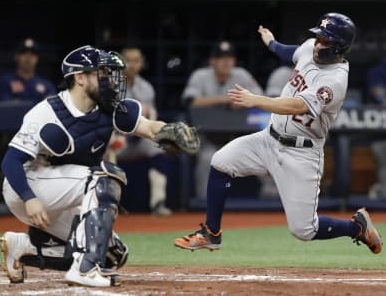
David and Goliath face elimination

2019-10-08 TravisDArnaudJoseAltuve

“They played beautiful defense, especially in that play right there.”—Jose Altuve, about the relay that nailed him at the plate above.

Sometimes you can’t afford to respect your elders. As in, when they’re on the mound on short rest, their less-than-well-rested arms and bodies refuse their lawful orders, and it’s still now or never until your American League division series is over.

There probably isn’t a Rays player or fan alive who doesn’t have a world of respect for Justin Verlander. There isn’t any baseball person alive lacking in such respect. Even at 36, the man has skills, the man has brains to burn, the man has no fear, the man has class, and the man has heart.

And when he says he wants the ball no matter how much rest it wouldn’t be on, nobody says no to Verlander. Not his manager. Not his front office. And sure as hell not Astroworld. Saying no to Justin Verlander with his cred is like it once was telling Evel Knievel the Snake River Canyon wasn’t going to be his new best friend.

But when even a Hall of Famer elects to take the mound in a bid to kick his team into the League Championship Series no matter how fully rested he isn’t, no matter how obedient his slider isn’t, there isn’t a Ray or anyone else alive either who’d spot him with his command gone AWOL and refuse to get the drop on him before he finds a reserve tank.

These Rays seem like nice guys. So do these Astros. But do you think the Astros would stay nice guys if they faced even a Hall of Famer with his tank down to its final fume? If you do, I have a freshly purchased Taj Mahal I’d like to sell you at cost.

Powerful teams are fun to watch when they dominate as these Astros have done all year long, and the Astros are fun to watch even on their very occasional off days. But there’s nothing like a band of upstarts that nobody else wanted pushing them to the equivalent brink of elimination as the Rays did Tuesday night.

Their 4-1 win over the Astros was as good as blowing almost anyone else out by three times that margin. That’s how tough the Astros are. And that’s how stubborn the Rays are proving to be.

Even if Gerrit Cole takes the mound Thursday back in Houston, delivers just half of what he threw at the Rays in Game Two, and sends the Astros to an American League Championship Series with the Yankees—you want to talk about E.R. vs. St. Elsewhere?—there isn’t a soul to be found who’d say the Rays didn’t prove they could hang with the big boys after it looked at first as though they’d get hanged.

So the Rays got cute sending Diego Castillo out to open, and Castillo got cute striking out the side in the first. And impressing the hell out of Astros manager A.J. Hinch. “Castillo, thank God he was an opener and not a regular starter,” he said after the game. “Having him out there for four, five, six innings would be devastating for anybody.”

The Rays got even more cute after Verlander opened the bottom of the first with a three-pitch strikeout of Austin Meadows. Tommy Pham was cute enough to work Verlander to a 2-2 count including one swing at a pitch missing the low and away corner, then send a slightly hanging changeup into the left center field seats.

A walk (to Ji-Hin Choi) and a single (to Avisail Garcia) later Travis d’Arnaud, whom the Mets thought expendable very early in the regular season, expended a base hit into left center field to send Choi home, and Joey Wendle expended a double down the right field line to send Garcia home. Verlander got rid of Kevin Kiermaier with a swinging strikeout to prevent further disaster but the Astros were in a 3-0 hole.

He’d survive first and second in the second and a man on third in the third, but he couldn’t stop Willy Adames (it almost rhymes with “Adonis”) from hitting the third pitch of the fourth over the center field fence. A strikeout, a line out, and a walk later, Hinch had to admit Verlander’d been had on a night when his spirit was willing but his arm and body demanded the rest of the night off.

For a second night running, the Astros got Rayed.

“A good approach for those guys in the first, and then honestly, I need those infield singles to be caught,” said Verlander after the game, referring to balls the Rays hit just past the Astros’ infielders. “When you don’t have it, you need the balls that are put in play to go your way, and they didn’t. Obviously, not the way you would script it. You know, it sucks.”

Thus the Astros joining up to the Rays bullpenning, which began with two out in the second and Rays manager Kevin Cash lifting Castillo for Ryan Yarborough. Whom he’d lift for Nick Anderson with Jose Altuve on second after maybe the single most important play of the game. Maybe even of the Rays’s season.

Yordan Alvarez, the Astros’ uber-rookie, sent a double to the rear of the yard. Kiermaier picked it off the wall hop and fired a perfect strike in to Adames out from short on the grass behind second, and Adames fired just as perfect a strike home to d’Arnaud at the plate spinning to tag the road-running Altuve about a split second before the Astros’ second baseman’s hand touched the plate.

And pop went the Astros’ best rally while the Rays were at it.

“That,” said Kiermaier of Adames’s strike home, “was probably the most incredible relay throw from an infielder I’ve ever seen. That was such a huge moment for us, huge momentum shift, and it just doesn’t get any better than that.”

Not even Choi turning Michael Brantley’s line drive into a single-handed double play in the sixth, bagging George Springer returning to the pillow while he was at it. That was child’s play compared to The Kiermaier-Adames Show.

And Kiermaier gets no argument from Altuve himself. “We’ve been playing aggressive all year long. I don’t see why we shouldn’t do it right now. But sometimes you have to give credit to the other team,” the Astros’ impish second baseman said after the game. “They played beautiful defense, especially in that play right there.”

“You have to tip your cap to those guys,” said Astros catcher Robinson Chirinos, whose just-passing-by solo home run off Chris Poche in the top of the eighth provided the lone Astros scoring. “The relay was perfect. It was textbook. They needed a perfect relay and they did it to throw Jose out at home plate. That was a big difference in the game tonight.”

When Jose Altuve himself gives you a five-star review, you’re being more than—what’s that overcooked word deployed about the Rays?—resilient.

Face it. On one postseason day when the Rays and the Astros had the nation’s baseball stage to themselves, the un-glamorous, un-beautiful, un-sexy, un-bankable Rays stole the show all for themselves. The Beatles themselves couldn’t have upstaged these No-Rays Tuesday night.

They were supposed to be about as deadly as babies in strollers at the plate. They were supposed to be a pitching staff full of anonymous relief pitchers with the occasional token starter and even Cy Young Award winner who couldn’t possibly keep getting away with all that bullpenning jazz.

Never mind that said Cy Young winner, Blake Snell, had Altuve on third and MVP candidate Alex Bregman on first with one out in the ninth when he went in from the pen Tuesday night, then struck Alvarez out swinging before coaxing Yuli Gurriel into the game-ending ground out right up the pipe, where Wendle just happened to be waiting to throw him out.

They have a manager named Cash for a team whose overseers seem allergic to spending any. They play their home games in a toxic waste dump that looks like a warped pressure cooker on the outside and an abandoned landfill on the inside, playing baseball on the last of the sliding-boxed zippered-billiards table surfaces.

And they are resilient, these No-Rays, even if the word “resilient” may turn into something less than a compliment before too long. “We’re good. Everybody uses the word resilient and that’s great but we’re also very good,” Cash told a reporter. “You can use that word resilient over and over and in a way it’s kind of knocking us. The truth is this is a very good team.”

The truth is also that the Astros are finding that out profoundly. The Rays may have finished with the American League’s fifth-best regular season record and the Show’s seventh best, but somehow, some way, the Rays have out-scored the Astros 17-13 in the division series so far. Somehow, some way, they’ve out-homered the Astros six to four. Somehow, some way, they have a better on-base percentage, a better slugging percentage, an OPS slightly over a hundred points higher, and more walks.

The Rays may not survive Game Five, after all, but they won’t leave the Astros thinking it wasn’t a battle royal even if Cole does go second-verse-same-as-the-first. Even if Cole will pitch on regular rest as opposed to Verlander asking to go on three days for the first time in his life and Zack Greinke getting nuked on eleven days’ rest.

“We have a great pitching staff, we play great defence and our bats are starting to come together,” said Pham, with all due modesty.

“People before this series started talking about David and Goliath,” Kiermaier. “I understand they are really good on paper and we might be the team that is not as appealing, but don’t ever count us out. We got guys feeling really good about themselves and we are clicking as a team all year. That is a dangerous recipe for success.”

Sounds a lot like what they once said about the Astros, doesn’t it?

After shoving the similar but slightly less obscure Athletics to one side in the wild card game to get their chance with the Astros—who have all the reputation and intimidation you could ask for in pushing 107 regular season winning chips to the middle of the division series table—the No-Rays and the Astros are equals for standing on the brink of elimination in Game Five.

Even with the Astros holding what they hope is the home field advantage trump. Not that the Astros are worried, necessarily, even if almost to a man they can’t wait to escape the Trop. (The Rays may not necessarily love the joint, either, but their 2019 season record shows ambivalence at best: they were the same on the road as they were at home, 48-33.)

The Astros opened the regular season against the Rays in the Trop and beat them once before losing three straight more. Aside from Games One and Two, they tangled in Minute Maid Park for three in late August. The Astros won the first two of that set; the Rays won the third. It’s not unheard of for the Rays to win in Minute Maid.

“We have done it years ago, when we have the home field. We win at home, then we lost on the road, then we come back home and make it happen,” Altuve said after the game. “So we’ve been here before. There’s no pressure right now.”

Altuve, one of the most intelligent as well as talented players the Astros have ever yielded up, also needs nobody to remind him there was no pressure on the original David, either.

Mortoned and mashed

2019-10-07 KevinKiermaier

Kevin Kiermaier trots home after his three-run homer in the second opened the can against Zack Greinke and the Astros Monday afternoon.

There’s only one problem with having three stud starting pitchers. You might have one of them going for you on too much rest. And just as too little rest is hazardous to a pitcher’s health, too much rest can get him killed to death, too. In Tropicana Field or elsewhere.

Just ask Zack Greinke, stud starter number three for the Astros. Who hadn’t pitched since 25 September. And, who got killed to death in American League division series Game Three Monday by a Rays team looking to keep their season alive in the first place.

After getting Verlandered in Game One and Coled in Game Two, the Rays flipped the script. They didn’t just Morton the Astros in Game Three, they bludgeoned Greinke for five runs before Greinke could get out of the fourth inning alive.

Charlie Morton, who was key enough to the Astros’ World Series triumph two years ago, had just enough to keep the Astros to Jose Altuve’s one-out, first-inning solo launch over the center field wall. And Greinke had little enough to resist early and often firepower, opening the gates to a 10-3 beating.

Remember with apologies to John Lennon: Baseball’s what happens when you’re busy making other plans. Put it in the bank—the Astros didn’t plan for a fourth division series game or anything else that didn’t involve opening an American League Championship Series with Justin Verlander on the mound against whomever. (Likely the Yankees at this writing, unless the Twins awaken somehow in their Game Three.)

Thanks to the Rays abusing Greinke and about half the Astro bullpen, A.J. Hinch had a decision to make, because Game Three exposed the Astros’ one wounding flaw: they, too, have a bullpen described most politely as questionable. And they’re up against baseball’s arguable best bullpen of the year.

It probably took Hinch all of about five seconds to decide. He wants the Rays to get Verlandered again in Game Four. On short rest, which fazes Verlander about as much as the sunrise fazes a rooster. On three days’ rest, which he’s done only once before in his major league life and almost a decade ago at that.

That may or may not prove a break for the Rays whose bats finally arose from the dead in Game Three. And the resurrection only began when a shaky second inning for Greinke climaxed after two hard earned outs sandwiching Avisail Garcia’s single up the pipe, when Greinke plunked Travis d’Arnaud and Kevin Kiermaier almost promptly hit one high over the left field wall

Just when Greinke looked briefly as though he’d find some reserves by bagging Austin Meadows and Tommy Pham on back-to-back swinging strikeouts in the bottom of the third, Ji-Man Choi, the Rays’ hefty and popular first baseman, unloaded on 2-2 and drove one over the right field wall.

And then the Rays really got rude after Morton—who’d been so important to the Astros’ 2017 World Series triumph, especially his Game Seven finish—shook off Altuve’s leadoff double to get an infield ground out and back-to-back strikeouts (Alex Bregman swinging, Yordan Alvarez looking) in the top of the fourth.

Brandon Lowe, the Rays’ second baseman, hit Greinke’s first service of the bottom of the fourth over the left center field wall. A line out, a strikeout, and a walk to Rays shortstop Willy Adames later, Greinke’s afternoon ended almost mercifully and Hector Rondon entered in time for Matt Duffy—who’d taken over at third in the third after Yandy Diaz experienced a sore foot—to single up the middle and send Rondon out in favour of Wade Miley.

Then Meadows sent one over Astros center fielder George Springer’s head and off the wall to send Adames and Duffy home And Pham slashed the next pitch into right for a base hit sending Meadows home. And after Choi walked but Garcia forced him at second for the side, there the Rays stood with an 8-1 lead after four.

The Astros managed two off Rays reliever Chad Roe in the top of the sixth when Bregman singled, Alvarez doubled, and Yuli Gurriel sent them both home with a turf-hop single up the pipe. But Carlos Correa lined out softly to second base and, after Brandon McKay relieved Roe, Aledmys Diaz pinch hitting for Josh Reddick flied out to right.

At the rate things were going by now it seemed almost natural for Adames to drive a 2-2 pitch over the left center field wall to make it 9-3, Rays in the bottom of the sixth. Or, for Choi to reach on an unlikely high throwing error from Bregman at third, Lowe to send Choi to third with a base hit right over Altuve’s reaching leap at second, and—after Joe Smith, the sidearmer, relieved Miley—d’Arnaud to fly deep enough to right to let Choi almost stroll home with the tenth Rays run in the bottom of the seventh.

In the interim, Oliver Drake pitched two strong innings in the seventh and eighth to further save the bigger bulls of the Rays pen for Game Four, namely Nick Anderson, Diego Castillo, and Emilio Pagan, with Colin Poche sandwiching a strikeout between a shallow pop out to center and a fly to normal right field depth to finish it.

These Astros who normally swing with authority went only 1-for-6 with men in scoring position Monday to the Rays going 3-for-7. Altuve’s first-inning launch tied him with Chase Utley for the most postseason home runs (ten) by second basemen in Show history, while Greinke continued his futility in Tampa Bay—he’s never won a game any time he’s ever pitched in the Trop.

Seven of the Rays’ runs scored with two out; seven Rays drove in runs. Not counting Diaz having to leave early with his foot issue, only d’Arnaud failed to hit safely even once otherwise.

And the Astros’ old buddy Morton showed no respect, either, striking out nine in five innings’ work and remaining perfect in postseason elimination games. Doing it Monday tied him at four such postseason elimination wins with Verlander, John Smoltz, Randy Johnson, Curt Schillling, and Clay Carroll.

Tuesday won’t give Verlander a shot at a fifth such win since the Astros still lead the set 2-1, but you can rest comfortably knowing he won’t complain. Unswept as they remain in postseason play, the Rays could still get Verlandered one more time in Game Four. They’ve never needed a running of their bulls as much as they will come Tuesday.

Masterpiece, then theater

2019-10-06 GerritCole

Gerrit Cole was the Dali of pitchers Saturday night . . .

You’d think a man who pitches like Bob Gibson in a postseason contest wouldn’t have to see his masterpiece turned into a hair raiser after he finally has to leave the game. But you can rest assured Gerrit Cole has seen a lot worse than the ninth inning Saturday night.

And you can rest assured further that he’d rather have seen his Astros survive that inning and come out one game from sweeping their way to the American League Championship Series than any known alternative.

Fifteen strikeouts. Five third strikes fastballs, five on curveballs, five on sliders. Missing by one measly walk an immaculate inning in which all three punchouts went swinging strike, foul, swinging strike. His lone walk being the one that ended his evening at last when his petrol ran empty at last.

Mentioned without apology in the same conversations as Gibson (with whom Cole shares uniform number 45), Howard Ehmke, Kevin Brown, and Gibson’s fellow Hall of Famers Sandy Koufax and Mike Mussina, among single postseason game punchout artists.

And what was Cole’s final reward for painting such a masterpiece as Dali himself would envy? Other than watching his Astros more or less sneak a run home in the seventh and eighth, to pad the lead Alex Bregman provided with a leadoff home run in the top of the fourth?

He had to watch his relief Roberto Osuna go from striking out Yandy Diaz—without whom the Rays wouldn’t even have been in the division series in the first place—on three pitches to end the eighth to stringing maybe the skinniest tightrope the Astros could possibly walk in the top of the ninth.

He had to watch Austin Meadows greet Osuna with a liner down the left field line that George Springer, moved over from center in a defensive re-alignment, couldn’t get to in time for a leadoff hit. He had to watch Tommy Pham stroke an immediate followup single right up the pipe. He had to watch Osuna walk Ji-Man Choi to load the bases once.

Then, he had to watch Bregman uncharacteristically bobble for just a moment Avisail Garcia’s bouncer to the left, settling for a force at second but no shot at a double play, and allowing Meadows to score. And, he had to watch Osuna wrestle Brandon Lowe to a full count before walking him to re-load the bases.

Exit Osuna, enter Will Harris, exit Rays catcher Travis d’Arnaud on a hard-earned swinging strikeout, exit Rays center fielder Kevin Kiermaier on a bouncer to first, and for the first time since the eighth Cole and the Astros could breathe without reaching for the oxygen tanks. And the 3-1 win put the Rays’s season on a respirator after all.

“Not the way we wanted to end it,” said Astros shortstop Carlos Correa after the game, “but we got it done and it’s a W.” Maybe the hardest-earned W of a season in which the Astros pushed 107 winning chips to the postseason table. Sometimes even the most powerful threshers in baseball don’t thank their mound lancers by finishing what he started simply.

If Rays manager Kevin Cash thought his team was Verlandered in Game One, they got even more Coled in Game Two. And the Astros’ bullpen got thatclose to throwing Game Two away. Astros manager A.J. Hinch must be feeling very fortunate that he has the kind of starters who make things like the Rays’ and others’ bullpenning a non-topic for him.

“Whether it’s about the new-age opener or pulling guys third time through, most of the people that support that haven’t had Verlander or Cole on their team,” the skipper said, and he’s speaking only the plain truth. Most teams would thank God and His servant Stengel for having just one superstud starter. He’s got three; Nationals manager Dave Martinez also has three.

“It’s hard for me to relate to having to pull guys early or wanting to pull guys early when these guys are putting up these kinds of performances,” Hinch continued. Right again, skip. “I’m going to roll with these boys while we have them.”

He may not yet have to get as creative with his boys as Martinez has had to with Stephen Strasburg relieved by Max Scherzer Friday night, but then Hinch normally doesn’t have a bullpen full of arsonists, either. Hinch has three stud relievers in Osuna, Smith, and Ryan Pressly. Make large room for all the bullpens who’d be grateful to have just one.

Pressly was a non-factor Saturday for having worked in Game One. It’s not scarifying just yet for Osuna to have one off-night, but even these finely tuned, well-oiled, near-perfectly calibrated Astros can’t afford another one too soon if at all. Because even superstud starters like Verlander and Cole have their absolute limits.

Let’s admit that for seven innings Cole didn’t know the meaning of the word “limits.” For seven innings he pitched like two Hall of Famers for the price of one, even as for six  innings the Astros pushed Rays starter Blake Snell—pitching gutsily after missing two thirds of the season on the injured list—and two Rays relievers but couldn’t quite break them except once.

Cole throttled the Rays with his mind almost more than his arm. His reputation in the game, very well earned by now, is that of a man who’ll throw a pitch in the first inning thinking it’s going to set up a pitch four or five innings later.

“He goes to areas of the strike zone whenever he needs to, whenever he wants to, whenever he sees something. That’s creative,” Hinch said after the game. “When we talk about creative, we often talk about guys that don’t have elite stuff like this. He can execute virtually any game plan for a reason . . . His mind and his ability to trust his adjustments set him apart.”

The only real breakage the Astros gave Snell opened the bottom of the fourth. Bregman worked  himself back from 0-2 with three straight solid takes on pitches low and away from him, fouled off an inside fastball, then sent the next fastball to the back of the Crawford Boxes to start what little scoring there’d be in the game.

Cash lifted Snell after he struck out Astros uber-rook Yordan Alvarez swinging right after the Bregman bomb. The Rays bullpen kept the Astros to just that run until the bottom of the seventh, while Cole looked more and more as though he’d go the entire distance without so much as a twitch of nerve or a flicker of exhaustion.

With the Rays’s usual closer Emilio Pagan opening the Houston seventh, Astros first baseman Yuli Gurriel grounded one hard to the hole at short and Willy Adames grabbed it, bobbled it, and threw in the dirt past first. Correa promptly ripped the first pitch down the left field line to the wall for second and third.

After rookie Kyle Tucker grounded out right back to the box, Astros catcher Martin Maldonado, Cole’s personal catcher who doesn’t hit well but handles pitchers like a symphonic conductor, checked in at the plate. He hit well enough this time, dumping a quail into left center enabling Gurriel to beat a throw home for a second Astros run.

It could have been worse for the Rays but somehow Pagan got George Springer to pop out to second and Jose Altuve, Game One’s co-hero, to fly out to the edge of the right field track to escape for the time being.

No such luck in the bottom of the eighth with Nick Anderson on the mound. Diaz knocked Bregman’s hard one-out grounder and threw wide of first enabling Bregman’s infield single. Alvarez then tore the first pitch into right for a base hit and first and second, and Gurriel flied deep enough to right to push Bregman tagging to third.

Then Correa slashed a 0-1 fastball into right to send Bregman home, before Colin Poche relieved Anderson and caught Tucker looking at strike three.

“We’ve got a lot more work to take care of,” said Cole after the game. “There’s a few months this winter that maybe we can sit back and have a drink about it. Right now, it’s on to the next one.”

That may come sooner than even the Astros think. And considering the results in New York—where the Yankees bludgeoned the Twins in the first two games of their division series, outscoring the Twins 18-6 over the two, with the crowning burial Didi Gregorius’s monstrous grand slam in a seven-run third Saturday—they’ve probably got the scouting reports on the Battered Bombers well enough studied.

An Astros-Yankees American League Championship Series would be a hell raiser. The league’s two most triumphant teams and their two most injury battered on the season, both of whom showed they were deeper than the Pacific Ocean when the casualties began. Gray’s Anatomy vs. House.

Says Cash: his guys know what’s at stake. Says Twins manager Rocco Baldelli: his guys know they can turn it around. Say the Astros and the Yankees, with Wade Miley (Astros) and Luis Severino (Yankees) due to start their Game Threes, and just as the man used to say on the radio: it ain’t gonna be easy, Clyde.


Can you top this?

2019-10-02 WashingtonNationals

Can the American League wild card game possibly beat the National League’s for surrealism?

An Athletics fan of my acquaintance in a Facebook baseball group told me this morning that, even in the dump of a Coliseum, the American League wild card game between the A’s and the Rays looked to be an absolute sellout. This is good.

Whether the A’s and the Rays come up with anything such as happened in the National League game Tuesday night is anybody’s guess until they play. And, hopefully, each team’s fans pray devoutly, it won’t be the kind of late twist of fate that squirted the Nationals to overthrow a win the Brewers looked to have in the safe.

Until Tuesday night it was the Nats who tended to suffer on wrong side of the pennant race’s or the postseason’s slings, arrows, slapsticks, anguishes, and surrealities. Then one unexpected skip on the grass of a bases-loaded eighth-inning single gave the Nats a deep taste of how it feels to be on the winning side of even one of those.

Maybe the Elysian Fields demigods decided at long enough last that, considering the toxic surreality that is Washington’s number one business—also known as the nation’s largest organised crime family—the nation’s capital and those who live there and root for the Nats deserved even a brief reprieve.

The history minded in the capital could see the ghosts of the last time a bad hop won something big for Washington baseball. Two bad hops in fact, both on the dime of Giants third baseman Freddie Lindstrom, one enabling the ancient Senators to tie and the other enabling them to win Game Seven of the 1924 World Series.

These Nats haven’t yet reached that close to World Series rings, of course. But after Juan Soto’s liner skipped surrealistically beyond the otherwise well positioned glove of rookie Brewers right fielder Trent Grisham, you might forgive the Nats and their fans if they permit themselves thoughts that, this time, they just might not get kicked to the rocks below after being led up the mountain to gaze upon the Promised Land.

The A’s and the Rays have a next-to-impossible act to follow Wednesday night. The Nats merely have a division series date with the Dodgers starting Friday in Los Angeles. They’ve crossed the Red Sea. Now comes the trek across the desert. As the man on the radio used to say, it won’t be easy, Clyde.

Some star-crossed teams can say at least that their signature transdimensional disasters were spread out over decades. The Nats have gotten theirs within just sixteen years of life adjacent to the Potomac. Their Montreal forebears never knew even a sixteenth of that. Maybe the 1994 strike costing them a clear postseason path.

Why, those Montreal forebears were even managed by Gene Mauch in their infancy and never had the chance to endure the kind of thing that sketched Mauch’s name into unfair infamy with the 1964 Phillies and the 1986 Angels. Lucky them.

But those now-ancient Expos never looked like the walking dead after a 19-31 season start, resurrected themselves after an embarrassing series loss to this year’s equally self-resurrected Mets, then romped to at least the first league wild card until they nearly blew it in September, either.

Those Expos never had the chance to go to four winner-take-all games before Tuesday night and lose every last one of them.

Those Expos were never betrayed by jumping out to a 6-0 lead in the first three innings of one of those games only to start swinging like they were trying to hit six-run homers on every pitch thrown to them or start pitching like they were trying to strike out the side on single pitches and enabling the Cardinals to overthrow them. The 2012 Nats thought of that.

Those Expos were never betrayed by their own manager hooking a sharp young pitcher with reserves still in the tank and two outs from a complete-game division series shutout, then failing to reach for Stephen Strasburg on call in the pen with the season absolutely on the line in another division series. Matt Williams dreamed that one up in 2014.

Those Expos didn’t get bastinadoed out of the race by the Mets when their skipper absolutely refused to betray The Book, whatever the hell it was at the time, and finally got caught completely out of the loop when his half-crazed closer tried to choke his right fielder in the dugout the weekend they were eliminated mathematically from the race. Williams conjured that one up, too, in 2015.

Those Expos didn’t out-score the Dodgers 24-19 in a division series only to lose Game Five on a four-run Dodger seventh and a slightly surrealistic Clayton Kershaw save. That brilliant idea came to the 2016 Nats.

Those Expos didn’t push a division series to a Game Five and then watch in horror when their catcher committed a passed ball, then threw wild past first, then got caught in catcher’s interference before the next batter up got hit by a bases-loaded pitch to finish a four-run fifth against them. 2017 Nats.

They may or may not miss baseball in Montreal but they probably don’t miss having avoided those kinds of disasters, either. Until Tuesday night, moving them to restore Washington baseball began to resemble the capital’s only known non-government-involved case of being careful what you wished for.

Long, long ago, it used to be said with only partial actual accuracy: “Washington—First in war, first in peace, and last in the American League.” Prior to Tuesday night it looked an awful lot like “Washington—First in war, first in peace, and first to disaster in the National League.”

For seven innings Tuesday it looked like they were going to get chaperoned right off the grounds of the postseason dance before they could even present their tickets, never mind get that last dance with the prettiest girl. And the odds looked reasonable that Brewers closer Josh Hader would make damn sure their tickets would be voided when he opened by striking out Victor Robles on a full count.

Except that Hader didn’t bring his customary authority to the door. Then, it was hitting pinch hitter Michael A. Taylor (for Strasburg, who’d pitched three scoreless relief innings in the Nats’ all-hands-on-deck bullpen plan) with a pitch that got his hand and bat one after the other in a split nanosecond. Then, Hader found enough to strike Trea Turner out and set the Brewers a mere four outs from going to Los Angeles, instead.

But venerable veteran Ryan Zimmerman pinch hit for Adam Eaton and slashed a broken-bat base hit right up the pipe, with Andrew Stevenson, a far more swift set of legs, sent out to run for him. Then, after forcing him back from 3-0 to a full count, with “M-V-P!” chanting pouring down from the stands, Hader walked Anthony Rendon to load up the pillows for Soto.

Then it was Soto’s frozen rope into right. It was Grisham, whose leadoff walk preceded Yasmani Grandal’s two-run homer in the top of the first that the Nats back onto their heels too early, hustling in from deep positioning to pick it off. It was the ball taking that odd skip away from Grisham’s otherwise well positioned glove. It was Taylor and Stevenson driving home at the speed limit and Rendon right behind them before Grisham’s relay throw hit his cutoff man.

And it was Brewers third baseman Mike Moustakas taking the relay throw just ahead of Soto’s arrival at third and starting the brief rundown that bagged Soto at second for the side. And what proved the end, when Nats manager Dave Martinez—who almost mismangaed himself right out of a job in May—reached for Daniel Hudson, who shook off a one-out single to get two air outs for the game.

These Brewers ironed up and fought hard enough after Christian Yelich inadvertently kneecapped himself for the rest of the year that even Nats fans ached for them for just a moment. They’d gotten a sad taste of the kind of thing that used to bedevil the Red Sox before the turn of the century, the Dodgers in Brooklyn from pre-Pearl Harbour through 1955, and the Cubs from the (Theodore) Roosevelt Administration until 2016.

The kind of thing, too, that usually happened to the Nats, not by them.

The realist may say, “Don’t count your Dodgers before they’re hatched,” but the optimist, given a license renewal Tuesday night, has a day and a half window to tell the realist to sit the hell down, shut the hell up, and stop spoiling the fun. Even if the Dodgers end up keeping the fun to a day and a half window, it’s a window Nats fans wouldn’t dare to close, and you can’t blame them one lick.

The A’s and the Rays may feel like the Rolling Stones tasked with trying to follow James Brown on television’s legendary The T.A.M.I. Show in 1965. Come to think of it, by comparison to following the Nats, the Stones may have had it easier. May.

One pitcher’s death and another’s murderous bereavement

2019-08-30 SkaggsBivens

The Angels’ Tyler Skaggs’s (left) painkiller-related death raises a suspicion or three; murder robbed Rays minor league reliever Blake Bivens (right) of his wife, infant son, and mother-in-law. Bivens should be just as worthy of our sympathy and perhaps a degree or three more . . .

Fetanyl is a synthetic pain reliever usually though not exclusively administered for relief in cancer patients. Oxycodone, perhaps the most infamous among opioid pain relievers, is prescribed normally for those who need long-term, around-the-clock pain relief.

The Tarrant County (Texas) medical examiner says both plus alcohol were in Tyler Skaggs’s system the night he died unexpectedly on 1 July. “[A]lcohol, fentanyl and oxycodone intoxication with terminal aspiration of gastric contents,” the medical examiner’s report is quoted as saying.

That clinical language translates to the 27-year-old Angels’ lefthander vomiting and choking on it under the influence in his sleep.

Skaggs’s death provoked a hurricane of grief around baseball that seemed exacerbated when the Rangers, whom the Angels were in town to play, not only canceled that night’s game out of respect to the Angels but put Skaggs’s uniform number, 45, in the Angels’ uniform lettering style, behind the pitching rubber the following night, before the Angels beat them 9-4.

And when the Angels returned home from that road trip, they kicked off their first homestand since Skaggs’s death with a staggering 13-0 combined no-hitter against the Mariners that electrified its own sport and others, from Taylor Cole pitching two and Felix Pena pitching the final seven innings to Mike Trout himself accounting for about half the Angels’ destruction, his share only beginning with a two-run homer into the Angel Stadium center field rocks in the bottom of the first.

Assorted players around baseball have scratched their own little tributes to Skaggs since, including many scrawling his number 45 onto their game hats. The sole admirable sight on the otherwise execrable black (for visiting teams) and white (for home teams) Players’ Weekend uniforms—which made the games resemble contests between Mad‘s memorably “Spy vs. Spy” strips—was the circular black patch with 45 in white in the middle on every sleeve.

We’ll know soon enough, I’m very certain, as to just why Skaggs needed to take fetanyl and oxycodone. There’s already an ugly rumour that an Angels employee may have had a hand in Skaggs’s death; Los Angeles Times sports editor Bill Shaikin says MLB will investigate the claim. And Skaggs’s family has hired a Texas attorney to investigate for themselves.

Unless there was foul play of the type Tarrant County’s police couldn’t determine, or unless Skaggs suffered a medical condition about which none seems to have been aware, his is only slightly less senseless a death than what was done to the family of Rays minor league relief pitcher Blake Bivens.

Bivens’s wife, Emily; their year-old son, Cullen; and, his mother-in-law, Joan Jefferson Bernard, were shot to death Tuesday morning. Emily and Cullen Bivens were found dead inside Mrs. Bernard’s Keeling, Virginia home; Mrs. Bernard was found dead in the driveway. Bivens’s teenage brother-in-law, Matthew Bernard, is in custody charged with the crimes.

A neighbour told police Bernard came to her door and punched her in the arm before she heard subsequent gunshots at Mrs. Bernard’s home. Investigators found shell casings from a 30-30 rifle near the victims’ bodies; Bernard was arrested naked and trembling up the road after being found in a nearby wooded area. He was jogging in a circle and refused to stop at first even despite being pepper-sprayed by one officer; when he tried to choke another neighbour, police finally subdued the naked Bernard.

“My life as I knew it was destroyed,” said Bivens, a righthanded pitcher with a 4-0 won-lost record and a 3.98 earned run average but a proneness to walks for the Montgomery Biscuits (AA) this season, in an Instagram post Thursday. “The pain my family and I feel is unbearable and cannot be put into words.”

The stricken reliever tried anyway.

He called his wife the one “who made me into the man I am today and you loved me with all of my flaws.” He said of his little son, “I can’t breathe without you here. I finally understood what love was when you were born and I would have done anything for you.” And, he said of his mother-in-law, “You loved your family more than anyone I’ve ever seen. You raised the most wonderful girl in the world. I’m so glad y’all are still together.”

It says nothing against Blake Bivens that an established major league pitcher freshly married and unexpectedly dead at 27 provoked a wider, deeper choke of game-wide grief than a six-year minor league pitcher having not even a single cup of major league coffee whose wife, infant child, and mother-in-law were murdered.

But it’s impossible not to notice that Skaggs left a loving wife behind while Bivens was robbed grotesquely of his. Both are to mourn a little more deeply.