First degree burglary

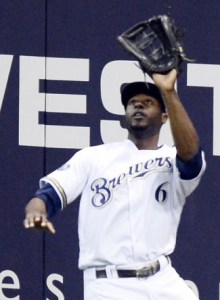
Jedd Gyorko’s two homers Wednesday were just part of the Brewers battering the Tigers.

The Miami Marlins aren’t the only one of Wednesday’s teams deserving of your sympathy. How would you like to be the guys who raided the other guys’ house, left nothing behind including hostages dead or alive, and the rest of the world says big deal! thanks to the holocaust in Atlanta?

OK, so the Milwaukee Brewers didn’t start their destruction of the Detroit Tigers with an early-and-often eleven-run break-in. They more or less slipped in barely noticed and performed a rather methodical room-by-room, occupant-by-occupant roust, joust, and ravage.

So give the Brewers their due. They came. They saw. They took neither prisoners nor hostages.

Once upon a time, the J. Geils Band wrote, sang, and played a party song called “Detroit Breakdown.” It showed up on a live album called Blow Your Face Out. On Wednesday night, the Brewers plundered the Tigers’ house and blew their faces out, 19-0. Setting a franchise record with their thirteen extra-base hits, eight doubles and five home runs.

The least insulting part for the Tigers had to be Brewers starter Corbin Burnes striking out eleven and allowing one hit in seven innings while his partners in crime picked off the Comerica Park hosts and their silver, jewelry, fine crystal, and negotiable securities.

If the Braves dropped the equivalent of the St. Valentine’s Day Massacre on the Marlins, the Brewers had to settle for being the gendarmes who sent the Appalachin Conference wiseguys scattering to the woods and anyplace else they could escape. Rest assured, the Brewers won’t object.

“Not much good happened for us,” lamented Tigers manager Ron Gardenhire, “other than no one got hurt.” That’s a matter of opinion, of course. “When you’re scoring runs like that,” Burnes told the Milwaukee Journal-Sentinel, “it makes it real easy on the pitcher. You just go out and pound the zone and play loose.”

Pound the zone? The Brewers hitters assaulted and battered it. Play loose? The way they were going, the Brewers could have loosened the fasteners on their arms and legs and still picked the Tigers’ house cleaner than the proverbial hound’s tooth.

They bit Tigers starter Matthew Boyd first, for seven runs and eight hits in three official innings before he was reprieved in the fourth without getting a single out from the three hitters he faced to open that inning. And one of the seven was surrendered by his successor.

He dodged the furies after giving up two walks in the first, but Orlando Arcia and Luis Urias doubled back-to-back to open the second, Arcia’s a ground-ruler. The good news: Urias got cuffed and stuffed trying to steal third. The bad news: Tyrone Taylor promptly doubled, Jacob Nottingham walked on four pitches, and Avisail Garcia promptly hit a hanging slider for a two-run double.

Two ground outs later Boyd escaped. The escape lasted just long enough for Jedd Gyorko (pronounced “jerko,” which is just what he would do to a full-count fastball) to open the third sending one over the right field fence. And even that was only the fourth Brewers run, since Boyd turned Ryan Braun’s base hit up the pipe into Arcia dialing into a step-and-throw double play at second base and Urias grounding out to third.

Still, a 4-0 deficit is manageable, right? Wrong. After Taylor opened the fourth beating out an infield hit, the Sheriff of Nottingham hit a hanging changeup over the left field fence and Garcia walked on 3-1. Gardenhire must have decided he wasn’t about to let any of his pitchers suffer excess abuse and lifted Boyd for John Schreiber.

Oops. Schreiber started his evening’s work by plunking Keston Hiura. Then, he got rid of slumping Brewers superman Christian Yelich on a fly to left and caught Gyorko looking at strike three without a single pitch leaving the strike zone or kissing Gyorko’s bat. So far, so good, right? Wrong. Braun hung the seventh run on Boyd’s jacket when Schreiber served him an unsinkable sinker to sink into left field to send Garcia home, before Schreiber struck Arcia out, again on three pitches.

Better: Schreiber zipped through the Brewers in order in the fifth. Worse: He opened the sixth feeding Garcia something to bounce over the wall for a ground rule double and, after Hiura flied out to right, Yelich remembered who he was supposed to be, after all, and doubled far down the right field line to cash Garcia in with the eighth Brewers run.

Now, Gardenhire ended Schreiber’s misery and brought in Rony Garcia. Gyorko popped out to shortstop but Braun worked out a walk, Arcia loaded the pillows with a base hit, and Urias on 2-2 hit a three-run double to left, followed almost immediately by Taylor on 2-1 doubling Urias home to just about the same real estate plot. Then Garcia busted the Sheriff of Nottingham with a punchout for the side.

Gardenhire’s next attempt to put the cuffs on the Brewers would be Kyle Funkhauser to open the seventh. Motown legend James Jamerson never cleaned his Fender bass because he swore the dirt made the funk. The Brewers decided the dirt would unmake the Funkhauser. It only began when Garcia wrestled his way to a full-count leadoff walk and, while working to pinch hitter Eric Sogard, Funkhauser wild-pitched Garcia to second.

Sogard singled him to third to climax another wrestle of a plate appearance, Yelich walked, and Gyorko dialing Area Code 6-4-3 didn’t exactly give the Tigers a recess from the burglary since Garcia came home on the play while Sogard claimed third. Braun announced recess over when he sent a first-pitch meatball over the left field fence.

Fifteen unanswered Brewers runs. These Tigers were being de-toothed, de-fanged, and de-clawed with not even a cursory roar in response.

“It’s been a long time coming,” Braun said post-game about the Brewers’ Wednesday night battery. “Obviously, things haven’t gone very well for us offensively [this season], so whenever you do have a rare, good day like that, you have to really enjoy it.”

Is it me, or are Gardenhire and other Show managers forgetting that this season’s three-batter minimum for relief pitchers doesn’t obligate them to leave the poor saps in past three batters on obviously modest nights? Funkhauser from there survived Arcia’s single to lure Urias into forcing him out at second for the side, but still . . .

Joe Jimenez opened the Milwaukee eighth hitting Taylor with a pitch before getting three prompt enough outs, and that was practically the cleanest Detroit pitching turn of the night. Then Travis Demeritte—a right fielder by profession—opened the ninth by getting Yelich to ground out. You knew it would be too good to last by now.

You were right. Gyorko promptly dropped his second bomb of the night, this time over the left field fence. Braun popped out to follow, but Arcia poked a base hit to very shallow left and helped himself to second on a throwing error by Tigers shortstop Willi Castro. Urias sent him home with a single up the pipe, and Taylor drove a 1-0 dead fish a little farther than Gyorko’s one-out drive landed.

“We weren’t going to use another pitcher,” Gardenhire told the Detroit Free Press, “so it was going to be somebody. And Demeritte was in the game as the DH for (Miguel) Cabrera, and, obviously, he was going to be the guy to pitch. We were not going to use any more pitchers out there, so it was a pretty simple thing. I told Demeritte, ‘Just don’t get killed’.”

Demeritte merely spent his professional pitching debut getting bounced off the walls. Nottingham flying out to left for the side was a show of Brewers mercy.

Josh Lindblom, usually a Brewers starter, retired the Tigers in order in the bottom of the ninth to end the raid. It would have been easier to mine plutonium with a swizzle stick than for the Tigers—who’d had eleven comebacks on the truncated season to date—to mount a nineteen-run comeback in the ninth as it was.

Schreiber and Funkhauser were optioned to the Tigers’ alternate site after the game. For the first time all night long, they must have felt as though somebody wanted to do something other than use, misuse, and abuse them.

This was the single worst shutout loss in Tiger history. The previous subterranean low was a 16-0 massacre at the hands of the St. Louis Browns in 1922, almost a century ago, and that was with Hall of Famer Ty Cobb in the lineup and going hitless in three trips to the plate. That day, they had five hits, three more than they could summon up Wednesday night.

“I think we all had a bad day,” Gardenhire said. “You guys had to have a bad day, you had to watch that, too. So, you know what? That wasn’t fun. We tried to survive.” After such a home invasion as Wednesday night, the Tigers might want to think about upgrading their alarm systems.
Ballplayers aren’t wild about qualified immunity, either

I am . . . a huge fan of getting rid of qualified immunity, and holding cops and everyone accountable, just like we hold ourselves.
—Lorenzo Cain.

Over two months ago, over 1,100 professional athletes and at least 300 front office workers in professional sports signed a letter from the Players Coalition. It expressed support for a Congressional bill to end qualified immunity for law enforcement personnel. No few incumbent and former baseball players signed the letter.

They only began with Tim Anderson, Chris Archer, Alex Bregman, Byron Buxton, Eric Davis, Jack Flaherty, Dexter Fowler, Jason Heyward, Jordan Hicks, Austin Jackson, CC Sabathia, Denard Span, and Giancarlo Stanton.

The Ending Qualified Immunity Act was introduced 4 June 2020 by Republican-turned-Libertarian Rep. Justin Amash of Michigan and Democratic Rep. Ayanna Pressley or Massachussetts. The Players Coalition letter appeared six days later. When Rep. Tom McClintock (R-California) signed on, the bill became the first tripartisan legislation in the history of Congress.

“[P]olice are legally, politically, and culturally insulated from consequences for violating the rights of the people whom they have sworn to serve,” Amash said after he and Pressley  introduced their bill. “That must change so that these incidents of brutality stop happening.”

Amash and Pressley wrote the bill specifically after George Floyd’s death at police hands, but it isn’t just non-white people who suffer or die at the hands of rogue police. It’s safe enough to presume that too many of those breaking entire cities over police atrocities care less about justice than about cover for their own destruction.

“Whatever his motive,” McClintock said announcing his co-sponsorship, “the killer of George Floyd had eighteen complaints for misconduct, and one of his accomplices had six. Why is such misconduct tolerated by big city police departments? Is it because the doctrine of qualified immunity shields corrupt officials from accountability for a wide range of crimes?”

Not long after that, the Supreme Court—which created qualified immunity in the first place in 1982—turned down seven cases in which it might have revisited the monster the Court itself created. Justice Clarence Thomas rejected that rejection. “There . . .  may be no justification,” he wrote in his dissent, “for a one-size-fits-all, subjective immunity based on good faith.”

Whether the end of qualified immunity would have prevented the Kenosha, Wisconsin police shooting of a suspect named Jacob Blake is your guess as well as mine. Rogue police have this much in common with the criminals they’re otherwise sworn to apprehend—they think the law doesn’t apply to them.

But absent qualified immunity at least the officer who pumped seven bullets into Blake’s back wouldn’t necessarily be protected from consequences above and beyond whatever a Kenosha police departmental investigation imposes upon him.

“[C]ivil society is impossible without a well‐​functioning criminal justice system,” wrote Clark Niely, vice president for criminal justice at the Cato Institute, a libertarian think tank, a month before the Amash-Pressley bill emerged, explaining why Cato took qualified immunity on as a specific analytical subject within a subject.

But in order to be well‐​functioning, it is not enough that a criminal justice system have the power to arrest, prosecute, and punish wrongdoers. The system must also be perceived by citizens as fundamentally legitimate and thus genuinely worthy of their confidence and support . . . [I]t is difficult to imagine anything more delegitimizing than a law‐​enforcement community that insists upon being held to a vastly lower standard of accountability than the one it imposes on ordinary citizens. But that, unfortunately, is precisely what we have. Even more tragically, it is an unforced error caused by a misbegotten blunder into judicial policymaking by the Supreme Court.

“The fact we’re talking about this in 2020, I don’t see the progress in that,” says Milwaukee Brewers outfielder Lorenzo Cain to The Athletic. “It’s almost like we’re going backwards. I think we’re going to be in the same situation until we start holding the people doing this accountable. Until that changes, it’s going to be tough for real change.”

Cain opted out of playing this season over the coronavirus world tour after the truncated season began but over safety concerns on road trips. He also prefers quiet protests like postponing baseball games over breaking the neighbourhood. “It’s burning buildings. It’s people out there shooting each other,” he tells The Athletic‘s Andy McCullough. It’s chaos. It’s bad.” And he’s not going to let rogue police off the hook, either.

I just feel like the change we need, as far as the top of our government, all the police forces out there, I just feel like deadly force shouldn’t be the first thing we go to. They’ve got Tasers and every other weapon on their tool belts. And deadly force is always the go-to.

That’s why I am such a huge fan of getting rid of qualified immunity, and holding cops and everyone accountable, just like we hold ourselves. That’s what I’m all about, getting rid of that qualified immunity.

Cain doesn’t have to be told that police officers don’t always have time to think before they fire. But neither does he need to remind anyone with a brain that shooting a suspect with his back turned even while possibly reaching for a knife makes a cop a crook.

So does killing an unarmed suspect. So does performing a home invasion based on questionable evidence. So does sending the SWAT team to terrorise a family accused wrongly of growing marijuana where it’s still illegal. So does holding Grandma and her four-year-old granddaughter at gunpoint while executing a sloppy or out-dated warrant.

When the men and women sworn to uphold the law become the lawless themselves, be afraid. Be very afraid. And you don’t need baseball players taking knees or postponing games to tell you. Among those who would tell you, and just did, are this paternal grandson of a New York police officer, the only known cop in my family. I’ve said it until I’m blue in the face but I’ll say it again. He’d have been just as appalled by rogue cops as he was by rogue citizens.

Today is baseball’s delayed commemoration of Jackie Robinson, who once lamented that violent contingencies would hurt more than help his people and all people.

We’ll never know truly what the Hall of Famer today would think of Kenosha, Minneapolis, and other places where rogue police make themselves judges and juries on the scene, and rogue citizens use rogue police acts as beards to burn the innocent and claim justice. Based on his own record in and after baseball, Robinson would likely reject both.

“He does not want society to burn,” Roger Kahn wrote after spending long time with him for The Boys of Summer. “Burn America and you burn the achievements of Jackie Robinson. After ruinous, anarchic blaze, who will remember the brave, fatherless boyhood, the fight for an inch of Army justice, the courage in baseball, the leadership and the triumph of a free man who walked with swift and certain strides?”

Very likely, Robinson himself would support the end of qualified immunity. As Lorenzo Cain does today. As did the Andersons, Bregmans, Flahertys, and Heywards signing the letter supporting the Amash-Pressley bill. The bill was referred to the House Judiciary Committee when last seen. I hope it’s not the last we’ve seen of it.

Protest by postponement

When Mookie Betts (far left) elected not to play in protest over Jacob Blake’s shooting by police, his Dodgers mates—including manager Dave Roberts (second from left) and pitchers Clayton Kershaw (second from right) and Kenley Jansen (far right)—had his back and joined him postponing against the Giants.

This is now: The Show’s government stood by teams postponing games Thursday in a show of respect to Jacob Blake, a young African-American man shot by rogue police, and quiet outrage over the manner in which Blake was shot. (Seven bullets in the back, with his children in sight in their car.)

But that was then: A Cincinnati Reds pitcher was hustled the hell out of Dodge for standing on behalf of not playing baseball during Robert F. Kennedy’s funeral. What a difference 52 years makes.

“Given the pain in the communities of Wisconsin and beyond following the shooting of Jacob Blake,” MLB’s official statement said Thursday, “we respect the decisions of a number of players not to play tonight. Major League Baseball remains united for change in our society and we will be allies in the fight to end racism and injustice.”

It could also have said plausibly that baseball stood athwart the grotesquery of Kyle Rittenhouse—a white teenager (seventeen), making his way from Antioch, Illinois to Kenosha, Wisconsin, where violence and destruction reigned courtesy of those who seize upon genuine grief, rage, and sorrow as a beard to destroy—now accused of shooting two to death after his arrival.

Once the National Basketball Association’s Milwaukee Bucks stepped up front as the first professional sports team to decline play Thursday in protest over Blake’s shooting, and theirs was a playoff game, baseball teams who had yet to play on the day—several games had finished already or were well enough in progress—began to step up front as well.

The Milwaukee Brewers and the Reds postponed, particularly after Brewers relief star Josh Hader spoke publicly about the team considering it. Those who chose to condemn Hader a few years ago, after immaturely racist tweets in his school days surfaced, should ponder once again (if it occurred to them in the first place, when Hader apologised publicly) that, yes, mis-oriented youth can and often does mature into thoughtful adulthood.

The Los Angeles Dodgers and San Francisco Giants postponed their Thursday night game after Dodgers outfielder Mookie Betts, informing his teammates earlier in the day he had no intention of playing as a show of protest, discovered to his happy surprise (he’d encouraged the Dodgers to play anyway) that one and all his teammates had his back on that.

The Dodgers’ long-enough-time franchise face Clayton Kershaw took the lead on backing him. “Mookie was saying, ‘If you guys want to play, I support that’,” Kershaw said when asked. “But we made a collective, group decision to not play tonight and let our voices be heard for standing up for what is right.”

The Seattle Mariners elected as a team not to play Thursday night, and their scheduled opponents, the San Diego Padres, agreed no questions asked. “For me, and for many of my teammates,” tweeted Mariners infielder Dee Gordon, “the injustices, violence, death and systemic racism is deeply personal. This is impacting not only my community, but very directly my family and friends. Our team voted unanimously not to play tonight.”

Elsewhere around the Show individual players declined to play even if their teams went ahead and played, and none of those players looks to face retribution or team discipline for their decisions while their teammates mostly (not unanimously, alas) likewise supported their stance.

Paralyzed waist down by his wounds, Jacob Blake isn’t exactly a model citizen, alas. He had a knife on his car’s floorboard though not in his hands, and police were dispatched to the location after a woman’s call that her boyfriend (Blake) was present when enjoined formally against being there. He also had an arrest warrant upon him. Neither gave Kenosha police officer Rusten Sheskey the right to pump seven bullets into his back.

Wherever he is in the Elysian Fields, Miltiades Stergios Papastergios must be thinking to himself, “Slowly comes the dawn.” You know him if at all by his Americanised name, Milton Steven Pappas. In 1968, he took a stand similar to that taken by the aforementioned teams and players and refused to budge when circumstances altered the original plan. The Reds traded him post haste afterward, and nobody knew for certain whether that stance provoked it.

Milt Pappas became a Red, of course, in the infamous trade that sent Hall of Famer Frank Robinson to the Baltimore Orioles, where Pappas was once part of the Orioles’ heralded but ruined “Baby Birds” starting rotation full of fresh youth. He pitched serviceably if not spectacularly for the Reds but, with Robinson winning a Triple Crown in his first Baltimore season and continuing to play like his Hall of Famer self, it wouldn’t have mattered if Pappas was the second coming of Robin Roberts.

When Dr. Martin Luther King, Jr., was assassinated in early April 1968, baseball’s Opening Day coincided with the day of King’s funeral. Baseball would have played fully if the Pittsburgh Pirates—with such non-white stars as Hall of Famers Roberto Clemente and Willie Stargell, plus former Dodgers shortstop Maury Wills—hadn’t refused to play. The Pirates triggered similar actions by other teams.

Baseball’s then-commissioner, William D. Eckert, was denounced for “calling up the club owners, not to tell them what to do, but to ask them” over the King funeral, wrote New York Daily News columnist Dick Young. But two months later former U.S. attorney general turned senator from New York, Robert F. Kennedy, freshly triumphant after winning California’s Democratic Party primary, was murdered after he left the stage at Los Angeles’s Ambassador Hotel on 6 June 1968.

With the Kennedy assassination, Eckert decreed no games should be played during Kennedy’s funeral. The man nicknamed Spike but derided previously as “the unknown soldier” (he was a retired Air Force general with no known previous baseball tie) proved he learned fast, even if he had to learn the hard way.

The Reds were scheduled to play the St. Louis Cardinals with a starting time well after the Kennedy funeral might have ended originally. Then, the funeral was delayed, after Washington’s notorious enough traffic issues delayed the funeral train’s procession. It looked as though the Reds and the Cardinals would play during the funeral after all.  Not so fast, Pappas insisted. He felt then and to the day he died four years ago that the game shouldn’t be played out of respect to Kennedy.

Reds manager Dave Bristol and general manager Bob Howsam felt the opposite. Howsam even visited the Reds clubhouse to pronounce that RFK himself would have wanted the game played. Pappas argued against playing right then and there. “Who is this guy, anyway,” Pappas told a reporter later on, “to tell us what Bobby Kennedy would have wanted us to do?”

The Reds’ players promptly took a team vote, some after having been strong-armed by Bristol, Howsam, or both. The vote was 13-12 in favour of playing. Pappas quit on the spot as the Reds’ player representative. Six games ended up postponed anyway despite the funeral delay. Three days later, in a deal Howsam swore was in the works before Kennedy’s assassination, he traded Pappas to the Atlanta Braves in a five-man swap making Reds out of fellow pitchers Tony Cloninger and Clay Carroll.

Baseball’s government, much like America’s, often has to learn the hard way about doing the right things as opposed to doing the expedient or the partisan things. There’s little to the appropriate causes monetarily as many do, other than symbolic acts that speak louder than rioters enough because their familiarity and popular appeal is powerful weight to throw above and beyond a game.

Those who think Thursday night’s players and team were out of line might care to ask what they’d prefer as a protest against rogue police and citizens alike—postponing baseball games and denouncing racism; or, breaking entire cities.

“At least the Reds are trying”

2019-12-03 MikeMoustakasGeorgeBrett

Mike Moustakas (8) sharing a World Series win commemoration with Hall of Famer George Brett. The Reds hope Moustakas helps them to a Series in the next four years.

It’s not that he’ll be the biggest off-season free agency signing, but Mike Moustakas landing four years and $64 million from the Reds made quite a bit of noise to open the week. On the surface, the Reds seem to be shifting into win-now gear, after remaking their starting rotation last year. Below it?

It may prove a mixed bag. May.

“The Cincinnati Reds finished twelfth in the National League in on-base percentage (OBP) in 2019, ahead of two teams in strong pitchers’ parks and the underpowered Miami Marlins,” writes Smart Baseball author Keith Law for ESPN. “So of course, the Reds just committed four years to a 31-year-old hitter without a position who has posted a .320 or better OBP twice in seven full seasons in the majors.”

Law thinks, therefore, that Moustakas might have fit “a lot of clubs” but not the Reds. They needed an upgrade at the plate, finishing twelfth, too, in 2019 runs scored despite their delicious home hitters’ park. And whenever Moustakas played in Great American Ballpark until now, he wasn’t exactly a game buster: he’s hit a buck ninety-eight with a .578 OPS in the big bat-embraceable park to date.

The Athletic‘s Jayson Stark demurs from Law: he thinks the Reds “love the bat, love the fit and love the edge this guy plays with. They’re not more talented than the Cardinals, Brewers or Cubs as currently constituted. But in the times we live in, we should all be applauding any team that is trying to win. It sure beats the alternative.”

As a Brewer in 2019, Moustakas posted a career-high .845 OPS, a career-second .329 OBP, and a career-second 270 total bases. He also hit the second-highest season home run total of his career (35) and was able to drive in the second-highest number of runs in any of his nine seasons. The Reds like power and reaching base about equally, but Moustakas gives them far more of the former.

Since it looks as though Eugenio Suarez has a vise grip on the Reds’ third base job the plan seems to be shifting Moustakas to second base. Not a terrible thought, since he’s played the position before and shaken out as about the league average in the 47 games he did play there. He won’t injure them around the keystone.

He’s had an odd journey to this deal. When he first hit free agency, nobody but his incumbent Royals seemed to want him—and he settled for a single-season $6.5 million deal with the team he helped win two pennants and a World Series. And they traded him to the Brewers in 2018 while they were at it. He looked good enough for the Brewers to want him back; last winter’s mostly dead market turned into a single season and $10.5 million.

But the Reds are also buying a player who earns respect in his clubhouses, takes a few burdens off his managers that way, and also fits with manager David Bell’s penchant for double switching when the games get hot and tight, and a two-position infielder is a fine fit for it.

Banking on Moustakas’s power (he doesn’t walk much, he can be double play prone, and he has little basepath speed despite a satchel full of basepath smarts), defensive steadiness, and personality—including his postseason experience (two World Series, three League Championship Series, and this year’s wild card game)—may show the Reds mean business for 2020. And since they say they’re willing to spend a little more, Moustakas won’t be the only card the play this winter.

“When a team spends to sign a good player to aid their chances to win, it merits acknowledgment, if not applause,” writes another Athletic scribe, Andy McCullough. “At least the Reds are trying. And at least Moustakas got paid.” Right there that could be the beginning of a beautiful friendship.

Dear Joe and Jane Cyberjerk

2019-10-02 TrentGrisham

Not even facing questions squarely after Tuesday night’s disaster prevented Trent Grisham from Joe and Jane Cyberjerk’s vulgar and witless wrath.

Now that I think about it, it’s a bloody good thing Fred Merkle, Freddie Lindstrom, Ernie Lombardi, Mickey Owen, Ralph Branca, Gene Mauch, Leon Durham, Don Denkinger, Donnie Moore, Bill Buckner, and Mitch Williams didn’t live in the cyberspace era. Not to mention too many Cubs, Red Sox, Phillies, and St. Louis Browns.

At least they had to wait for the next newspaper editions to suffer the sewage thrown their way for committing their immortal sins. They didn’t have Twitter feeds or Internet forums to explode with the sort of insults that would have been considered obscene in Larry Flynt’s playroom.

Trent Grisham doesn’t have their temporary luxury. And if Joe and Jane Cyberjerk had their way, the only luxury he’d have would be a coffin, the sooner the better. Just look him up on Twitter. At the minute I sat down to write the cyberjerks didn’t quite out-number those looking to give the Brewers’ rookie a hug, but they were as nasty as the year is long and Grisham’s off-season will be longer.

The goat business still does booming business even though it should have long, long gone the way of the buggy whip, the stove iron, and the autogyro. Maybe there’s no point asking when they’ll ever learn. Two more laws of sports remain impervious to sense: 1) Somebody has to lose. 2) Too many people think losing a game equals moral failure, if not terpitude.

All Grisham did with the Nats having the bases loaded and two out in the bottom of the eighth was scamper in from deep positioning in right field, get his glove down to cut off Juan Soto’s frozen rope single, and watch the ball skip to his right unexpectedly and behind him, ending any prayer he had of keeping the Nats from doing anything worse than tying the National League wild card game.

He didn’t start the Civil War or leave Mrs. Lincoln to answer questions about the play. He didn’t lead the Sand Creek massacre, sink the Titanic, assassinate Archduke Ferdinand, start the Chicago Fire, order the St. Valentine’s Day massacre, or found the Soviet Empire. He didn’t bomb Pearl Harbour, plot the Holocaust, or build the Edsel. He didn’t assassinate two Kennedys, a King, or a Beatle, blow up the Challenger, shoot down Korean Air Lines Flight 007, level the World Trade Center, or create New Coke, either.

So tell us, Joe and Jane Cyberjerk. Be honest for once. And can it with the “my five year old would have come up with that ball!” crapola, while you’re at it. That theme’s been beaten to death and back more than a bazillion times. Even the simplest plays turn rotten through no fault of a human’s own. And you don’t know whether your five year old would have come up with Soto’s single.

Now tell us: Would you have been willing to go to work in front of 55,000 people right there in your office, and a few million more watching you on the flat screen, or listening on the radio, and take the risk that one errant baseball skipping away from your properly positioned glove in right field would ruin your day? If not your team’s? Your year? And several more to come?

I didn’t think so.

There isn’t a baseball team alive or dead that failed to understand that nothing’s guaranteed even when you’re strong enough to guarantee it. The biggest braggarts the game’s ever known know in their heart of guts that the minute the umpire hollers “Play ball!” all bets are off, all boasts are void, and from the first pitch to the final out nothing’s given except that someone wins, someone loses, and anything can happen in between—and often does.

Bigger game than Merkle, Lindstrom, Lombardi, Owen, Branca, Mauch, Durham, Denkinger, Moore, Buckner, and Williams have come up fatefully short on the game’s biggest days and nights.

Or did you forget Babe Ruth being foolish enough to try stealing second with the Yankees down to their final out of the 1926 World Series but with Bob Meusel at the plate and Lou Gehrig on deck?

Did you forget Robin Roberts missing a pickoff sign and throwing right down the pipe to Duke Snider, his kishkes saved when Richie Ashburn playing shallow nailed Cal Abrams at the plate, letting the Phillies’ 1950 Whiz Kids live long enough for Dick Sisler to hit the pennant-winning home run?

Did you forget Willie McCovey hitting a speeding bullet of a line drive that would have blown anyone else’s brains out but somehow caught Bobby Richardson with a bulletproof vest (well, glove) ending the 1962 World Series?

Did you forget Carl Yastrzemski popping out against Goose Gossage with two on despite the chance to yank the Red Sox back from the dead instead of ending the 1978 American League East tiebreaker game?

Did you forget Tommy Lasorda thought it was secure to let a relief pitcher pitch to Jack (The Ripper) Clark with first base open and the Dodgers one out from the 1985 World Series, only to watch Clark hit a glandular three-run homer and the Dodgers have no answer in the bottom of the last?

Did you forget Dennis Eckersley hanging a slider to Kirk Gibson to end Game One of the 1988 World Series?

Did you forget Mariano Rivera throwing Luis Gonzalez the one cutter that didn’t cut but did cut the Yankees down for keeps in the 2001 World Series? Or having no answer when Dave Roberts broke for second with the Red Sox three outs from being swept out of the 2004 American League Championship Series?

Maybe only Hall of Famers have any business coming up short in the biggest hours. One and all of the foregoing errant Hall of Famers were allowed to go forward with their Cooperstown careers. Except that they weren’t yet Hall of Famers when those horrors beset them.

Or maybe Ruth, Yastrzemski, Lasorda, Eckersley, and Rivera had a license to shake it off because they’d been there, done that on the big stages.

Maybe rookie outfielders who enter a wild card game after committing no errors in 70 outfield chances during 42 regular-season games don’t have any business getting a glove down only to see the ball behave like a Super Ball for a split second and escape like Bugs Bunny outwitting the witless Elmer Fudd yet again.

Maybe they make it too easy to forget relief pitchers brought in to shoot for six-out saves but having enough less of their usual command to load the pillows for the Sotos in the first place. Lucky for Josh Hader. His pleading Tuesday night’s disaster was on him wasn’t half as much fun as sending Grisham to the stockade.

Or maybe Thomas Boswell was right thirty years ago, lamenting Donnie Moore’s suicide, when he wrote, “The reason we don’t forgive you is that there’s nothing to forgive.” And maybe Joe and Jane Cyberjerk picked the wrong day to miss their second grade teacher’s having that in her lesson plan.

Almost to a one, Grisham’s Brewers teammates got to him as fast as they could in the Nationals Park visitors’ clubhouse and let him know they had his back. Grisham himself made it even easier. He didn’t flinch from even the most ridiculous questions after the game. He answered honestly, candidly, making no attempt to blame anyone else or anything else. Obviously he wasn’t raised to become an American politician.

For that his Wikipedia page got vandalised, too. It only began with inserting parenthetically, next to his name, “AKA ‘Bill Buckner’ and ‘Helen Keller Player of the Year’.” How about awarding Joe and Jane Cyberjerk the Howitzer Prize for Extinguished Commentary?