Song for my father

I’m more than certain I have other things about which to write. Such things as the season-long plate of interleague games, right down to the regular season’s final days, begging the question of why beside the sponsorship dollars and contracted-for participants’ bonuses are we still bothering with the All-Star Game at all?

Such things as, if we must have the All-Star Game still amidst the protracted gimmickry of in-season interleague play, why do the fans still have an All-Star vote they’ve proven time and again to cast wrongly? Why has the Game all but become what FanSided‘s Zachary Rotman describes, “which fan base has the strongest labor organization?”

Such things as, why is every approach to every season’s trade deadline an exercise in exposing just which teams simply refuse to even try keeping their best players in honest efforts to compete? (And, concurrently, why isn’t the Major League Baseball Players Association being as stubborn in demanding the owners open their books to prove their financial hardships as the owners are demanding salary caps?)

Such things as, why do we continue tolerating the ridiculous free cookie on second base to begin each extra half-inning of play, as if the better rule changes such as the pitch clock (yes, I was wrong to oppose that) and the universal designated hitter (I’ll die on the hill once identified by George F. Will, a convert long before I: “Only serious batters shall hit”) haven’t turned elongated game times into exceptions?

(If not that hill, then I’ll die on the hill claimed by Thomas Boswell in February 2019: “It’s fun to see Max Scherzer slap a single to right field and run it out as if he thinks he’s Ty Cobb. But I’ll sacrifice that pleasure to get rid of the thousands of rallies I’ve seen killed when an inning ends with one pitcher working around a competent No. 8 hitter so he can then strike out the other pitcher. When you get in a jam in the AL, you must pitch your way out of it, not ‘pitch around’ your way out of it.”*)

But today it’ll be a song for my father. Today is sixty years since my father passed to the Elysian Fields. (Don’t ask what he thought of the Horace Silver vintage which lent its title to mine here. My father was so sternly vanilla he made Lawrence Welk resemble Lawrence Ferlinghetti.)

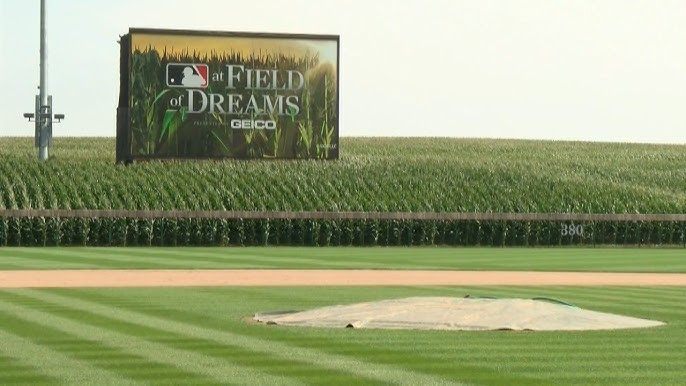
The last time I addressed him was five years ago, approaching the first Field of Dreams Game between the Yankees and the White Sox. This year’s game, 13 August, will feature the Twins against the Phillies. Didn’t I just wonder why on earth we still bother with an All-Star Game when regular-season interleague play now goes down to the season’s final weekend?

That was then: I wrote the following . . .

The author’s parents, presumably around the time of their marriage in 1950.

Father and son in Field of Dreams were estranged by disputes including the one in which the son chastised the father for worshipping a badly tainted baseball hero. Father and son in my case were estranged by contradictions that would be called child abuse today, followed by the ten-month battle against cancer that my father lost in 1966, when I was ten and he, thirty-nine.

My parents were foolish enough to believe nothing but physical discipline, with no concurrent attempt at real teaching, applied to mere human childhood mistakes the same as to real misbehaviour or disobedience. Confirmed decades later by an unimpeachable source (my father’s sister), my parents wanted children in the worst way possible—only to have no patience for children merely being children.

My father, alas, was even more foolish for believing the way to teach a son who didn’t know how to fight was to beat him even more violently, accompanied by every demeaning insult he could throw. The thought that a son needs to be taught to defend himself, that it isn’t knowledge with which you’re born, was never programmed into his software.

My father’s death stole any hope of eventual rapproachment in this world from me. Fantasy thought it is, the rapproachment between John and Ray Kinsella to conclude Field of Dreams was and remains something I envied every time I watched the film. The few things I had in common with my father included baseball. (And, in fairness, music, my interest in and facility for which my father encouraged but my mother rejected.)

I don’t remember whom he declared to be among his baseball heroes, other than his having been a Dodgers fan since their Brooklyn years. He spoke of various players without singling one out as a particular favourite, at least within my earshot, while I had as heroes assorted hapless 1962-66 Mets plus Sandy Koufax, Willie Mays, Juan Marichal, Henry Aaron, and Bob Gibson, among others.

But I do remember numerous catches, a few trips to the Polo Grounds and then Shea Stadium to see those embryonic Mets, and, in one fathers-and-sons game, my ripping a line drive off his crotch when he deliberately lifted his glove above it because (he admitted it later) he didn’t want to be the reason I made a hard out.

For all the contradictions and abuse, whenever I watch the Field of Dreams climax I’d give whatever I have to give to see my father walk toward me one more time, whether or not he wore a baseball uniform, and slip a baseball glove onto his left hand when I slip mine on and say, “Dad, want to have a catch?”

This is now:

Before he passed, Dad managed to find and give me my first guitar. I try to believe it was his way of saying he was sorry for the damage he did. Enough so that I don’t know what I’d love to do first, if he could walk toward me again: Pick up a guitar and play for him now . . . or slip my Rawlings glove onto my left hand and say, “Dad, want to have a catch?”


* When I sat down to write this morning, the designated hitters entered Monday’s play with a cumulative .746 OPS and a .244 batting average. From the end of the dead ball era’s final decade through the last day a pitcher not named Shohei Ohtani batted in a major league game, the pitchers posted a .344 OPS and a .162 batting average.

Commissioner, anyone?

Adapted from JK’s speech to the Las Vegas chapter of the Society for American Baseball Research delivered 10 June 2023.

Calling baseball commissioner Rob Manfred an inveterate tinkerer is calling Donald Trump and Joe Biden mountebanks. Calling Manfred a visionary denigrates the very definition of vision. But those who pine for the so-called good old days, while letting themselves think Manfred’s lust for rule remaking/remodeling points toward them, must first be made to answer, “Which good old days?”

Certainly not the days when the bases were large stones. Certainly not when pitchers were required to throw no way but underhanded and from a standing position strictly. Certainly not when the one-hop hit to the outfield was ruled an out if the fielder snagged the ball on that hop. Certainly not when none but white men were permitted to play the major league game. 

There are some things from the so-called Good Old Days that ought to be preserved or exhumed, of course. That’s without regard to the particular period of Good Old Days the get-off-my-lawn crowd prefers to revive. There are also things heretofore inconceivable to which today’s governors of our game, Manfred on down, should lend far more thought than they do. But it cannot be Manfred to shepherd it any longer.

Would you like to become baseball’s next commissioner? If your answer is yes, at minimum you’ll need a reasonable station from which to disembark your train. What follows is a fourteen-step platform:

1. The august office itself. Upon assuming office, the new commissioner shall convene a rules committee to explore broadening the means by which commissioners are chosen in the future. There’s no sound reason why the owners alone should choose the game’s public steward and top administrator, since it’s long been proven that under the owners alone the commissioner thinks the good of the game is little more than making money for it, and them.

The commissioner of the future should be elected by the following group of 79 people: Single representatives of the owners and the players, each; and, designated representatives from each of major league baseball’s nineteen umpiring crews.

2.Tick-tock clock. On paper, and in the imagination, the pitch clock seemed sound as a nut. In actuality, it wreaks more havoc than should be allowed. Havoc, and no few injuries ranging from the simple to the serious and back. Not to mention the imposition upon pitchers with unique or at least colourful pitching styles. Those concerned about the coming of the Clockwork Baseball Player should concern themselves about and stand athwart anything that would make that coming reality.

3. Game time. Are we supposed to applaud that, thus far, the pitch clock and its concurrent impositions upon the batter have shaved a whole . . . half an hour on average off the time of play? Are we supposed to applaud that the truest culprit of the elongated major league game—namely, the broadcast commercial blocks after each half inning and during each pitching change—remains unmolested?

The pitch clock’s elimination should be matched by all effort to make a new broadcasting agreement that includes no commercial blocks longer than one minute after half-innings and thirty seconds during pitching changes. (Yes, Virginia, it really does take less time now for a relief pitcher to get from the bullpen to the game mound than for the commercials to play.)

4. Manfred Man. The free cookie on second base to open each extra half inning shall be eliminated. Permanently. The only Manfred man that should ever be in the public mind shall be, once again, the hitmaking band of the 1964-66 British Invasion.

5. We’re on the air, anywhere. Eliminate all blackout rules for television. Allow any major league game to be broadcast in any region regardless of whether the ballpark is in the same broadcast region. Let a million television sets bloom because decades of evidence have proven that, of all the reasons for people to stay away from the ballpark, television like radio before it is the least of those reasons.

(As a relevant aside, I still remember seeing Dodger Stadium fans clutching tiny portable TV sets in the park. With the pictures turned down but the sound turned up. Why? Because they wouldn’t believe what they’d just seen from beginning to end unless they heard it from the late Vin Scully.)

6. Umpires can be impeached, too. The umpires have been laws unto themselves for long enough. It’s past time for them to be held as accountable for their malfeasance as players, managers, and team administrators. There’s no reason on earth for accuracy below 96 percent to be permissible. If you doubt that, ponder that a surgeon with a 96 percent accuracy rating wouldn’t face job security, he’d face malpractise suits.

Umpires with accuracy below 96 percent shall be placed on probation for the rest of the incumbent season or the first half of the following season. Failure to improve will result in suspensions. And, yes, the rule book strike zone shall be enforced strictly. The days of umpires deploying their own strike zones must end. That by itself should help assure accuracy of 96 percent or higher behind the plate.

7. No tank you veddy much. Team ownerships who fail repeatedly to invest properly in their major league product and their minor league support systems shall be put on notice. You have one year to decide: Will you invest properly in your teams, every year, regardless of the free spoils of revenue sharings you receive before each season begin; or, will you sell your team to a local/regional ownership willing to do what needs to be done to put an honestly competitive team on the field.

Tanking is fan abuse, plain and simple. If you can afford to buy a major league baseball team, you can afford to put forth a product that gives honest effort to compete. Rebuilding on the fly has been done for eons, before and after the free agency era.

Concurrently, past commissioner Bowie Kuhn’s ridiculous prohibition on player sales shall be rescinded. Teams shall be allowed to sell their players on an open market for whatever price other teams are willing to pay—and the players to be sold shall receive at least 25-30 percent of the sale price. This will allow the supposedly not-so-rich teams to stay minimally competitive, too.

Call it the Averill-Landis Rule, after the ancient commissioner who thought Hall of Famer Earl Averill wasn’t nuts to demand to know how much of the sale price he might receive when the Cleveland Indians bought him from the Pacific Coast League.

While we’re at it, a tanking team must never be given permission to relocate, which leads to . . .

8. If you want to build it, we will come. Under no circumstances shall any team seeking to build a new ballpark go to the local and/or state government for help. For now we mean you, Oakland Athletics. It takes colossal gall to try strongarming your incumbent locale into building you a new ballpark and, when they call your bluff, try to strongarm Las Vegas into building one for you; or, at least, paying for half if not more of it.

The willful self-destruction of a team fan base should never be sanctioned. Neither should regional taxpayers be made to foot all or most of the bill for a new playpen. The Voice in Field of Dreams assuredly did not say, If you build it, they will pay for it.

9. Interleague, schminterleague. Eliminate it from the regular season. Entirely. Save it for when it truly matters—during the All-Star Game, and during the World Series.

10. Are the All-Stars out tonight? Absent one fan, one vote, one time requirements, eliminate the fan vote. Why? Because the All-Star Game must include rosters containing none but the absolute best players on the season thus far. If this means one or more teams lack All-Star representation, tough. This isn’t T-Ball.

While we’re at it, the next commissioner must rule that the All-Star Game also needs to cease being used as a gold watch, even for future Hall of Famers. They’ll get their tributes appropriately around the circuit without a final All-Star honorarium, not to mention those so qualified getting the big one in Cooperstown in due course.

11. Competition, not compensation. This nonsense must cease. The regular season’s meaning has been compromised long enough. And the saturation of postseason games has compromised more than enhanced the game. There’s no reason on earth why any team not parked in first place at season’s end should be playing for baseball’s championship.

Expansion should be pursued to create divisions with even numbers of teams. Then, two conferences of two divisions each shall be fashioned in each league. The wild cards shall be eliminated entirely.

Then, each league’s division champions will meet in a best-of-three division series. The winners in each league will then meet in a best-of-five League Championship Series. (You want the Good Old Days restored, there’s a splendid restoration.) The World Series shall remain its best-of-seven self with its primacy thus restored. (Postseason saturation will be scaled back considerably under such a system, too.)

Thus will baseball fans no longer be subject to the thrills, spills, and chills of watching teams fighting to the last breath to finish in . . . second or even third place.

12. We want a real ball! Something’s very wrong when the Japanese leagues can develop baseballs pitchers can grip easily and are eminently fair to both sides of the ball but the American major leagues—which own a major baseball manufacturer—can’t. All effort to develop a baseball that doesn’t require that new-fashioned medicated goo for pitchers but is consistent and fair to hitters as well shall be undertaken.

A new, consistent baseball shall be developed and brought into play within one year of the new commissioner taking office. It’s long past time for the thinking person’s sport and those who support and supply it to start thinking. Hard.

13. Pensions. The new commissioner shall convene an immediate panel from among all team ownerships and the Major League Baseball Players Association. This panel, at once, shall agree that it was wrong to eliminate pre-1980 short-career major league players from the realignment of 1980. That realignment granted pensions to all players who accrued 43 days of major league service time, and health benefits to all players accruing one day of major league time.

The calculations shall be done to ensure full and proper pensions, based on their actual major league time, to all 500+ surviving short-career players who played before the 1980 realignment. The 2011 Weiner-Selig stipend—one small payment per 43 days service time, which today equals $718 per 43 days—was laudable, but insufficient.

Those players backed their players union’s actions that led to or upheld free agency, too. They do not deserve to remain frozen out.

14. As your absolute first order of business in office. Before assuming office, the new commissioner’s first official pronouncement shall be to demand . . . a recount.