Baseball Tease Day

Rafael Devers

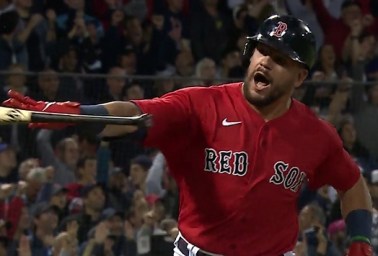
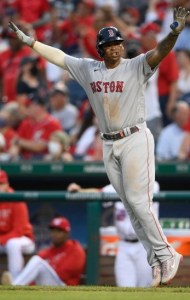
Wings and prayers—Rafael Devers’s tiebreaking two-run blast in the ninth Sunday punched the Red Sox’s ticket to the AL wild card game . . .

Crisis addicts of the world, unite. You won’t get the greatest possible fix for your addiction on what might have been Baseball Chaos Day. In fact, you’re getting a day off for reasonably good behaviour.

But at least you get four of the game’s most deeply storied franchises in the wild card games. That’s something, isn’t it?

If major league baseball fans must continue to bear with the thrills and chills of watching teams fight to the last breath to finish . . . in second place, at least you get to see the Cardinals host the Dodgers in the National League wild card game, and the Red Sox host the Yankees in the American League game. Right?

I know. I know. The crisis junkies among baseball’s fans were spoiling for that National League West tie between the Giants and the Dodgers. They wanted that four-way American League wild card tie so badly they could wrap themselves in it like frozen food in Reynolds Wrap.

The Blue Jays did their absolute best to make it happen when they parboiled the Orioles 12-4 Sunday afternoon. But the Mariners let them down by being unable to get past what was left of this year’s Angels.

Maybe we should have had a hint when Shohei Ohtani started the finish of his surrealistic individual season by hitting Mariners lefthander Tyler Anderson’s third pitch of the game about twelve rows into the right field seats.

Home run number 46, RBI number 100, for the guy who also finishes 2021 with a 3.18 ERA and a 10.8 strikeout-per-nine rate on the mound. If you can’t win it, just start playing spoiler. Ohtani’s surreal season could have finished a lot worse than becoming the Angels’ must-see-television in the injury-created absence of their all-universe Mike Trout.

The Mariners let themselves down, too, after a surprise season of playing slightly over their own heads to get thatclose to postseason-opening mayhem. Those were real tears in young outfielder Jarred Kelenic’s eyes as well as veteran third baseman Kyle Seager’s, when their run came one port short in losing two of three to the Angels over the weekend.

“It wasn’t a team where we were just more talented than the other team every single day,” said Seager postgame, after what may yet prove his last game as a Mariner, “but you had a group that just collectively played together and they collectively tried to win every single night.”

Trouble was, the Nationals couldn’t keep the Red Sox down despite opening an early 5-1 lead against them in Nationals Park. They couldn’t stop Red Sox third baseman Rafael Devers from hitting a hefty solo home run to open the top of the fourth and a five-all-tiebreaking two-run shot in the top of the ninth—with former National Kyle Schwarber, who’d reached on an inning-opening infield error—aboard ahead of him.

But two years after the Nats’ staggering World Series win, at least they could bask a little in the home crowd’s applause for possibly-retiring first baseman Ryan Zimmerman, the last truly Original Nat, the franchise’s first first-round draftee to play in their silks after moving from Montreal, when lifted from the game after the seventh. Even the Red Sox joined the applause unapologetically. Aretha Franklin used to spell that r-e-s-p-e-c-t.

Meanwhile, the American League East champion Rays battled the Yankees scoreless until the ninth. The Yankees even flashed something resembling past glories when third baseman Gio Urshela channeled his inner Derek Jeter in the sixth, chasing Austin Meadows’s foul pop 126 feet from an overshift position and catching it on the track, before he fell in a heap onto an empty spot on the Rays’ dugout bench.

But after Rays starter Michael Wacha pitched one-hit ball over five innings and the Yankees threw six pitchers at the Rays, Aaron Judge—the towering, snaggle-toothed, boyish-looking face of the Yankees—picked the right spot to deliver the first walk-off winner of his major league career.

With Rays reliever Andrew Kittredge freshly installed, after Josh Fleming allowed second and third with one out, Judge ripped a liner off Kittredge’s glove toward second, Tyler Wade dove home ahead of a throw from Rays second baseman Brandon Lowe. Thus the Yankees ducked a coming day’s chaos. “I wouldn’t say we exhaled,” Judge said of it postgame. “We still have work to do.”

Meanwhile, in San Francisco, the Padres’ second-half implosion finished when they all but rolled over and played dead for most of an 11-4 loss to the Giants. Enabling the Giants to become the first in Show ever to win their 107th regular season game while clinching a title on the regular season’s final regular day. Leaving the Dodgers, 10-3 assassins over the NL Central-winning Brewers, to deal with the Cardinals in the league’s wild card game.

That ages-old blood feud between the Giants and the Dodgers would just have to wait for a possible showdown in a National League division series, assuming the Dodgers get past a Cardinals aggregation that managed to do what enough teams couldn’t this year—shake off a few serious injuries and a few tough spells to get to at least the postseason’s entry game.

The Padres made life just a little too simple for the Giants Sunday afternoon. They had no answer for Giants starter Logan Webb—who struck out eight and, at the plate, threw in a line drive, insult-to-injury two-run homer in the fifth—until they finally chased him with three straight base hits in the eighth.

Entering the season it sometimes seemed as if the Padres were anointed the lords of the National League West by default and the Giants were anointed lucky to survive the races at all. But while growing pains, internal dissensions, key pitching injuries, and manager Jayce Tingler’s exposure as an inconsistent in-game thinker came more vivid as the Padres season went deeper, the Giants surprised just about the entire baseball world with their ability to hang with the Dodgers and take it literally to the last day.

Veteran or largely-veteran teams don’t work anymore, right? Baseball’s for the young, right? Letting the kids play means the veterans can’t romp, right? The Giants would like a few words with you. Their veterans played up and had just as much fun as the kiddie corps. And the Giants took their remarkable season right down to the wire to beat the Dodgers out for the title by one game.

“I think we all knew at the beginning of the season, or even dating back to the beginning of spring training, what the projections are and what the industry sort of thought of us as a club,” said Giants manager Gabe Kapler, who’d finally figured out what he couldn’t in Philadelphia—analytics hoists and supports you going in, but you’d better marry that to what’s in front of you inning by inning if you want to get the full job done.

“What I realized,” he continued, “is there are some intangibles that those projections and viewpoints failed to take into consideration.” There’s never a thing wrong with having the most possible information to open a game, but when it’s married unsuccessfully to the moments to come while you play, the offspring is usually disaster.

The Giants, the Brewers, the AL Central-winning White Sox, the Astros, and the NL East-winning Braves have to wait to begin their postseason dances. It’s both poetic and problematic that the party begins with the Olde Towne Team hosting the Empire Emeritus in a win-or-be-gone wild card game.

Poetic because of that similarly ages-old Yankee-Red Sox blood feud. Problematic because of . . . that ages-old feud having its script flipped in this century.

Go ahead and point to all those pennants and World Series rings, Yankee fan. You’ve only got one of those rings to show in the 21st Century. You may have the upper hand in division triumphs but that smothering Yankee dominance is just so 20th Century now. That’s the Red Sox sitting with four 21st Century World Series rings now.

If there’s one other thing by which the Yankees hold an edge over the Red Sox this time around, it’s a fan base that clings to “To err is human, to forgive cannot be Yankee policy” like a religious catechism. Calling for the manager’s perp walk and summary execution after a tough loss? Yankee manager Aaron Boone gets it after a tough inning as often as not.

The man who did what no Yankee manager before him could—lead his teams to back-to-back 100-wins-or-more seasons in his first two on the bridge—and has a .601 winning percentage as a Yankee manager must feel fortunate that his boss’s name is Hal, not George Steinbrenner. Hal Steinbrenner doesn’t have his father’s notorious hair trigger. It’s saved New York’s sanitation corps from barrels worth of washing blood from the streets around the House That Ruthless Built.

Maybe their own long-enough and disastrous enough history has finally given Red Sox Nation what some people thought would have been impossible to fathom—the patience of Job—compared to their counterparts turning to the south Bronx. The AL wild card game hasn’t been played yet, of course, but you don’t exactly hear Red Sox fans saying, to themselves and aloud, “OK, when’s it going to happen” and mean disaster over delight before the game actually begins.

Those two fan bases get only one day’s worth of living on the edge. If the Dodgers treat the Cardinals’ grand old man Adam Wainwright like target practise in the NL wild card game, the Dodger-Giant rivalry gets three games minimum, five maximum to go nuclear.

If the Cardinals treat the Dodgers’ cleverly imported grand old man Max (The Knife) Scherzer rudely, Giantland and Cardinal Country get to relive the 2014 disaster—disaster for the Cardinals, that is. This time, though, the Cardinals won’t have Mike Matheny on the bridge to decide The Book was more important than The Moment. Mike Schildt won’t risk paying through the feathers by allowing a Giant pennant to sail into the crowd atop Levi’s Landing behind right field. I think.

It’s enough to make you feel almost sorry for the White Sox facing the Astros in an American League division series. Even their first postseason meeting since the 2005 World Series the White Sox swept—that was before the Astros were traded to the American League, of course—doesn’t have half the blood boil potential. I think.

Baseball Chaos Day? Sunday’s regular season finales amounted more to Baseball Tease Time. It was fun to watch—but it was hell to pay. But as Hall of Fame scribe Jayson Stark would say, because . . . baseball!

Can’t we teach the thugs a real lesson?

Alex Verdugo, Alex Cora

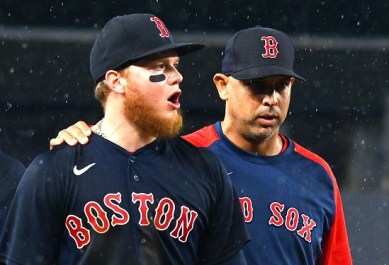
Alex Verdugo’s (left) generosity turned into a particularly nasty piece of Yankee fan foolishness.

If you want to know why baseball players come to see baseball fans with contempt, as some always have and always will, you can point to the Yankee Stadium doings Saturday night. Even knowing the eternal rivalry between the Empire Emeritus and the Olde Towne Team, this was above and beyond the call of insanity.

All Red Sox left fielder Alex Verdugo did before the bottom of the sixth started was see fit to toss a practise ball to a young Red Sox fan in the bleachers. The ball didn’t quite reach that young fan’s hands, but it did reach a Yankee fan to whom Red Sox generosity might just as well have been a home invasion leaving none alive.

That Yankee fan threw Verdugo’s should-have-been gift ball back to the field and hit Verdugo squarely in the back. Verdugo was anything but amused. He turned toward the bleachers hollering to the fans. Highly-touted Red Sox prospect Jarren Duran hustled over to pull Verdugo away. Umpires, stadium security, and Red Sox coaches sought only to find the miscreant.

Miscreant found. And ejected from the ballpark posthaste. Eliciting a few cheers and a few more boos among the fans in that section. Red Sox manager Alex Cora wasted no time pulling his team off the field after coach Tom Goodwin urged still-steaming Verdugo out of the outfield and toward the Red Sox dugout.

Cora even had to debate with the umpires over letting Verdugo have a few minutes to compose himself in the dugout. It shouldn’t even have been a debate point. This time, it was only Verdugo’s back. It could have been his head.

“I know my left fielder, I know Alex,” Cora said post-game. “He needed time to breathe and to get his thoughts.” Tell that to the umpires, as Cora ultimately did.

It seemed like nobody was listening to me. Like, imagine getting thrown at with an object in a sport and you’ve got to be out there right away because we have to continue to play the game — that part I didn’t agree. But Alex was OK with it. But you never know. What if he jumps the fence? What if he goes out there and attacks somebody? Whatever. That’s what I was telling them, just give us a chance to collect our thoughts, breathe a little bit and we’ll go out and play the game. That was the whole thing.

Verdugo knows the score only too well. Talk all the trash you want. Hammer all the family members you can think of. Chant your little heads off. Even holler “[Fornicate!] Verdugo” until your throat resembles a pair of sand blocks rubbing together. Throw a ball or other debris? Not so fast.

[T]he moment somebody throws — as players, we’re throwing balls in the stands to try to give people souvenirs, try to make little kids’ days and things like that. Just to hear people saying, ‘Throw it back’ and then someone actually throws it back and it felt like it was targeted towards me, it doesn’t sit right with me.

Throwing enemy home run balls back is a tradition almost as old as the live ball in some ballparks. Wrigley Field’s storied Bleacher Creatures have made it so much so that if you happen to watch a Cubs home game without a Creature throwing back an enemy home run ball (unless, of course, it’s a particular milestone mash with dollar value attached) it’s one step short of breaking-news bulletin time.

But no such Creature has ever been known to try separating an enemy outfielder from his assorted anatomy or his brains throwing a ball back. And not even the worst, most bombed out of his or her trees fan was ever been known (unless it just hasn’t been reported, until Saturday) to throw back a ball an opposing player tried to give a visiting fan as a souvenir.

Things weren’t hard enough between the Red Sox and the Yankees with the scheduled series opener last Thursday postponed after several Yankees—including right field star Aaron Judge—turned up COVID-positive? Things weren’t testy enough already Saturday, with a near-hour rain delay before the game and continuing rain during it?

Red Sox Nation should know that they now have an ally in Yankee manager Aaron Boone, who made no secret of his hope that the bleacher idiot ended up behind bars. Cora should also know that Boone would have acted the same as he did if the game had been in Fenway Park and a particularly brain-damaged Red Sox fan did likewise to one of his players.

It’s awful, embarrassing, unacceptable. My understanding is they did catch the guy. Hopefully he’s in jail right now. That’s just a bad situation. If I was Alex Cora, I would have done the same thing as far as going out and getting his guys off the field. There’s zero place for that in this great game, and in this great rivalry. Players should never feel like they have to worry about anything like that. I already reached out to Alex Cora, just to apologize, and to Alex Verdugo that, you know, that’s just a terrible, bad, sad situation. And sorry about that.

This during a season in which Reds first baseman Joey Votto—after getting ejected early in a game over an argument with an umpire, then learning a little girl named Abigail was heartbroken that she wouldn’t get to see her favourite Red play for just about all game long—reached out and sent Abigail a ball he signed, “I’m sorry I didn’t play the entire game. Joey Votto.”

Saturday’s game was supposed to be about Duran’s major league debut. (He went 1-for-2 with a base hit and a run scored, both in the top of the second.) And, about a pitching duel between Nathan Eovaldi (five innings, one earned run) and Gerrit Cole (six innings, one earned run, eleven punchouts).

The nasty weather ended the game after six in a 3-1 Yankee win. (Back-to-back solo bombs from Gary Sanchez and Gleyber Torres in the bottom of the sixth took care of that, on Red Sox reliever Hirokazu Sawamura’s dollar.) The nasty weather in the left field bleachers became the story of the game, unfortunately.

The Yankees travel to Boston for a set in Fenway Park starting this coming Thursday. Red Sox Nation, beware: don’t even think about trying any similar stupidity if any Yankee decides to toss a practise ball to a visiting Yankee fan before an inning begins.

Maybe the thing for baseball government and the players union to consider together is mandating a forfeit to the opposing team, when a team’s own fans get as thuggish as the thug who thought Verdugo’s reward for generosity to a visiting young fan should have been a ball attack upon the left fielder’s back.

Once upon a sad October 1971 time, umpires awarded the Yankees a forfeit after heartsick Washington Senators fans—with Second Nats reliever Joe Grzenda one out from saving what should have been a win, and the Senators playing their final game before moving to Texas—stormed the RFK Stadium field. Grzenda never got to throw a single pitch to Yankee second baseman Horace Clarke.

Those fans didn’t blame the Yankees or try to mangle, bangle, or dismember anything in a Yankee uniform. They’d have preferred decapitating duplicitous Senators owner Bob Short. (Banners with his initials proliferated in the stands.) Absent that, they took it out on RFK Stadium.

If you can forfeit to the visitors over breaking an entire ballpark, you ought to be able to forfeit to the visitors when a home fan decides a baseball offered a visiting fan should be the instrument for spontaneous back surgery upon the visiting player who offered it. Maybe (big maybe) that’ll teach the jackasses a few lessons.

On legally mandating the anthem before the games

If ten Texas state senators and its lieutenant governor have their way, it’ll be Texas law to play “The Star Spangled Banner” before all games in the Lone Star State including at the Houston Astros’ home.

Among many things, in his farewell address this nation’s first president hoped his thoughts and suggestions would move his countrymanpersons “to guard against the impostures of pretended patriotism.” The Father of His Country might have had legislating as well as posturing patriotism in mind. Even though Texas wasn’t even a gleam in the new nation’s eye just yet.

A tentet of Texas state senators wants “The Star Spangled Banner” as required playing, listening, and posturing before every sports contest hosted in the Lone Star State—preseason, regular season, and postseason. For openers. As reported by Reason‘s deputy managing editor, Jason Russell, the tentet would like to tell one and all playing games in the state, “or else!”

Or else, among other things, no government entity state or local can make deals “that require a financial commitment” with any sports team “unless the agreement includes written verification the team will play the anthem before all games,” Russell writes. “If a team fails to comply, it would be in default of the agreement.”

Apparently, the Texas Ten took their cue from Lt. Gov. Dan Patrick, who is no known relation to the longtime ESPN SportsCenter anchor now hosting his own show on Premiere Radio Networks. In February, Patrick was not amused to learn the NBA’s Dallas Mavericks weren’t playing “The Star Spangled Banner” before their pre- and regular-season home games.

It’s not that anybody noticed until the final such game, because thanks to the pan-damn-ic there were no fans present until that final game. Then the NBA decided, not so fast, it’s time to re-enforce the league’s rule that the national anthem will be played before all NBA games, whether or not the Mavericks or their owner Mark Cuban likes it.

What has this to do with baseball? Well, two American League teams hail from Texas. So do four minor league teams even under the dubious new minor league realignment. If Patrick and the Texas Ten get their way, they’ll be spanked, too.

Russell observes that if the bill passes and is signed into law, major sports teams that let teams dispense with “The Star Spangled Banner” would find such decisions “affect[ing] stadium subsidies, any kind of government-funded tourism sponsorship, and possibly even arrangements where local law enforcement provides security.” The good news: the bill isn’t likely to cut the mustard in the courts, possibly all the way to the Supreme Court.

It’s one thing for the NBA or the NFL (which has mandated it since after World War II) as essentially private organisations to require it. It’s something else entirely for any government at any level to do so.”This legislation already enjoys broad support,” Patrick harrumphed last month. “I am certain it will pass, and the Star Spangled Banner will not be threatened in the Lone Star State again.” (He meant the flag as well as the song.)

Threatened?

“Patrick’s proposal that the Texas Legislature pass a state law requiring the national anthem be played represents state action,” writes attorney and journalism professor Amy Kristin Sanders in an e-mail to the Website of televisions Law & Crime. “As a part of its speech protections, the First Amendment also bars state actors from compelling others to speak—and requiring someone to play the national anthem is just that.”

We can surmise with little fear of contradiction that that isn’t exactly what an ancient Red Sox third baseman named Fred Thomas had in mind during the 1918 World Series.

On leave from the Navy to play in the Series, with the Navy’s full blessing, Thomas heard a Navy band (it was common in those times for military bands to provide music at sports events) strike up “The Star Spangled Banner” during the seventh-inning stretch and saluted spontaneously, as he might have been expected as a Navy man himself.

Thomas’s salute prompted other players in both dugouts (the Red Sox played and would beat the Cubs in that Series) to stand and salute, not to mention the already-standing crowd to salute likewise. This, by the way, was thirteen years before “The Star Spangled Banner” became America’s official national anthem.

Red Sox owner Harry Frazee decided that for the rest of that Series two things would happen: 1) For all games played in Fenway Park wounded war veterans would have free admission. 2) “The Star Spangled Banner” would be played in their honour before the start of those games. As with Thomas’s spontaneous salute, Frazee’s gesture did not come to him at the wrong end of a gun, actual or rhetorical.

It inspired other sports teams and leagues to do likewise, gradually, and entirely on their own, in the years to follow before and after the anthem became official. Baseball has never had a formal rule mandating either “The Star Spangled Banner” or “God Bless America” (which became an unofficial but consistent tradition in the wake of the 9/11 atrocity), but neither has it rejected the tradition of it.

When kneeling protests emerged a few years ago among black athletes spearheaded by long-former NFL quarterback Colin Kaepernick over rogue police brutality against black suspects, the passions both ways soared like a grand slam. They still do when the anthem issue arises, with or without the kneeling protests, as with Cuban and the Mavericks.

And you can’t always interject that kneeling is as much a gesture of respect and genuflection as it might be a gesture of protest. Even if you argue that kneeling protesters might appeal as much to a higher authority as against a particularly abusive temporal one. Even if you agree without taking a knee that there should be no place for rogue police in any diligent such department.

I’ve gone on record about it before, but Patrick’s harrumph compels it one more time: Is it absolutely necessary to sound “The Star Spangled Banner” before every damn last sports contest played all year long? If we believe patriotism must originate and remain in the heart, doesn’t the day-in, day-out pre-game playing erode rather than enhance the patriotic impetus by making it formal obligation instead of free and organic?

My past thoughts haven’t changed. I have no wish to eliminate the National Anthem from sporting events entirely. I also have no wish that Patrick and the Texas Ten should prevail and inspire other states to likewise. I remain in agreement with National Review senior editor Jay Nordlinger, who wrote almost three years ago, “I’m not sure that patriotism is compatible with compulsion,” to which George Washington himself might have answered with a resounding if quiet “it isn’t.”

And, I remain convinced that, on behalf of removing only too much of the compulsory factor from an impetus that must come purely from the heart and soul, playing “The Star Spangled Banner” ought to be limited to the following sports events:

* Opening Day for major sports leagues’ regular seasons or, in the case of non-team sports, major tournaments. (The U.S. Open in tennis and golf; the Masters’ tournament; the PGA Championship; etc.)

* Any games played on major national holidays. (Since I’m a baseball writer, let’s start from there: Memorial Day, Flag Day, the Fourth of July, Labour Day. Also, Veterans Day, Thanksgiving, New Year’s Day, Martin Luther King, Jr.’s Birthday, Presidents Day.)

* All-Star Games in major sports leagues.

* The Super Bowl.

* Game One of each major sports league’s final round: the World Series (first things first!) NBA Championship, the WNBA Championship, the Stanley Cup Final (if Game One begins in the American team’s arena).

* Game Seven of such championship rounds, if they go that far.

And, in the immortal words of Porky Pig, eba-dee, eba-dee, eba-dee, eba-that’s all, folks.

I won’t expect the commissioners or governing bodies of major sports to stop and ponder, never mind enact the foregoing. They’re many things, but bold isn’t necessarily among them. Not the sort of bold that enhances and advances their games, anyway.

The eyes of the nation should be upon Texas, if only to see that the way to patriotic wisdom is more often than we think to travel the road assuredly not taken. Certainly not by the Lone Star State’s second in command plus ten lawmakers unaware that they wish to make dubious and unconstitutional law.

Alex Cora, prodigal manager

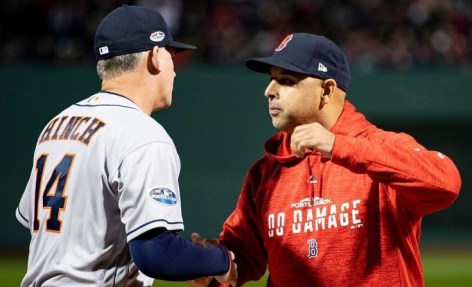
Red Sox manager Alex Cora (right) in a 2018 ALCS handshake with his Houston counterpart A.J. Hinch. Cora’s been re-hired by the Red Sox, while his fellow Astrogater Hinch gets his second chance in Detroit.

Well, I was wrong. About Sam Fuld possibly having the faster track to the job and Alex Cora finding a new one elsewhere. The Red Sox rehired Cora to manage them Friday. Have they let a cheater come back to the scene of the crime?

Cora’s Astro Intelligence Agency culpability was deep enough it was too easy to believe he had a hand or at least a fingertip in the 2018 (and maybe 2019) Rogue Sox Replay Room Reconnaissance Ring. It’s also a truism oft repeated (including by me) that when you lead you take responsibility for what’s done by the troops.

But baseball’s government pinned that replay reconnaissance responsibility on Red Sox video room operator J.T. Watkins. Pinned it on him or scapegoated him for it, depending on your point of view. Either he or someone he allowed decoded opposing signs and signaled them to Red Sox baserunners to send home to the hitters at the plate.

Watkins took the fall. The MLB investigation that discovered the Astros went above and beyond just using what MLB itself provided in the replay rooms behind all dugouts but that the Rogue Sox just got caught doing what a few other teams at minimum must have been doing likewise.

“I know J.T. and how he works,” Cora said when Watkins was taken on the perp walk. “I trust the guy. Was I surprised at what came out? Yes, I was.”

Whether Cora beat the Rogue Sox rap on a technicality, or really didn’t have any clue as to what Watkins and who knows which Red Sox players were up to, Cora has his old job back. His Astrogate suspension ended the moment the World Series did. Officially, anyone with the opening was free to hire him.

If he was in it up to his neck in Houston he was found caught pants down with everyone else in Boston, officially. Unofficially, suspicions will cling. That’s the nature of the human beast. Begging the question for many as to why the Red Sox elected to bring back someone who’d been caught dead to right cheating above and beyond in one town even if he just might have been innocent enough in theirs.

“Forgiveness comes a little easier,” writes The Athletic‘s Chad Jennings, “when there’s a [World Series] ring involved.”

In that sense, Cora was the Red Sox safest choice. Any other manager would have faced an inevitable comparison. Early losing streak? Cora could have stopped it. Under-performing player? Cora would have known what to say. Disappointing season? Not on Cora’s watch. He maintains some benefit of the doubt, even beneath the weight of his past transgressions.

In other words, the hapless Ron Roenicke—handed the bridge after Cora’s exit, but helpless to keep the Red Sox together following their winter trade of franchise player Mookie Betts, the ownership’s greater concern for staying beneath the luxury tax threshold over fortifying the team’s compromised pitching staff, and several key injuries (Andrew Benintendi, Eduardo Rodriguez, Chris Sale)—didn’t stand a chance.

According to Jennings, Roenicke might have felt Cora’s “spectre” hovering overhead—except that he denies it. “No, never,” the skipper who’d been Cora’s bench coach said. “And the reason I can say that is because Alex should be managing . . . I’m hoping he does this again, whether it’s here or somewhere else, he should be managing.”

“At the time that we parted ways with Alex,” says Chaim Bloom, the Red Sox GM/chief baseball officer, whose longtime knowledge of Fuld—former outfielder turned Phillies player information coordinator—helped drive speculation of Fuld taking the bridge, “we were clear that that was a result of his role and what happened with the Astros and everything the investigation over there revealed. It had nothing to do with what may or may not have occurred in Boston.”

It’s enough to make you wonder whether bringing Cora back was Bloom’s ultimate choice or whether—the way then-GM Ben Cherington had Bobby Valentine jammed down his throat after the 2011 collapse—the Red Sox ownership likewise stuck Cora down Bloom’s throat.

Valentine, of course, took on a fragmented team and detonated a season-long bomb worth of divide-and-conquer dissipation. His firing after that 2012 disaster practically detonated block parties around New England. Cora’s departure practically detonated mass mourning that a guy with his brains and his ability to keep his players on board had to go.

Players and others within the Red Sox organisation couldn’t bear to let Cora go entirely even as the Red Sox leadership pushed him away with little choice following the affirmation of his Astrogate culpability. For those players partaking of Watkins’s replay room espionage, it must have felt like Dad going to the calaboose unfairly for the kiddies’ breaking the neighbourhood.

Hinch was popular with his Astros players, too, but once the Astros fired him and GM Jeff Luhnow upon their Astrogate suspensions the Astros showed little inclination or longing to bring him back. Even as the Red Sox put distance between themselves and Cora, they kept their eye on him a little longingly in the distance, ultimately re-narrowing it.

“[O]nce he departed,” writes NBC Sports Boston’s John Tomase, that opened the door for Bloom to make his own hire, since the manager-GM relationship is the most important in baseball operations”

And Bloom sent consistent signals that he planned to look elsewhere, a point reinforced by the process that ultimately led us back where we started.

With Cora available and ready to be rehired, Bloom still conducted a lengthy search, interviewing multiple candidates and eventually identifying five finalists. The choice reportedly came down to Cora vs. . . . Fuld, whom Bloom knew from Tampa.

The Red Sox will insist that at the end of this process, Bloom and Bloom alone chose Cora, and that had better be true. Because otherwise it means that ownership either tacitly or explicitly overruled its baseball boss on his most consequential hire . . . Imagine bypassing a beloved figure for a first-timer like Fuld? The last thing a rookie manager needs to be greeted with is resentment.

Surely Tomase isn’t alone in pondering what might have been if the White Sox had reached out for Cora instead of Hall of Fame manager Tony La Russa, who was only too clearly an ownership move instead of their GM’s. Would Bloom have felt free to hand Fuld the Red Sox bridge after all? We’ll never know.

It’s not that cheaters haven’t been forgiven before. The New York Giants’ leadership may have been well aware of Leo Durocher’s telescopically-buzzing cheating scheme down the 1951 stretch, but it was a third-place finish the year after they swept the Indians in the World Series that got Durocher fired.

Fred Hutchinson may or may not have sanctioned scoreboard-based sign-stealing by his pennant-winning 1961 Reds, but it took 1964’s courageous but fatal battle with lung cancer, not 1961’s telescopic cheating, to seal Hutch’s fate.

Cora’s culpability in the Rogue Sox Replay Room Reconnaissance Ring isn’t even close to being as cut and dried as his Astro Intelligence Agency activities proved to be. For now, no matter. Officially, Watkins paid for any and all Rogue Sox sins. Unofficially, Lucy, they’ve still got some splainin’ to do.

Every baseball eye in and away from Boston will put Cora and the Olde Towne Team under the most acute microscope since Zachariah Janssen invented the thing—in the year Urban VII became the shortest-reigning Pope (three months) in the history of the Catholic Church. It won’t necessarily be inappropriate.

Could Fuld be the next Red Sox manager?

Sam Fuld, who fought the walls only too often as an outfielder, may have an immediate future as a manager—where he doesn’t have to bang his head on walls to make points.

Don’t look now, but someone is making a better impression upon the Boston Red Sox’s brass in the team’s managerial search than you might have thought. His name isn’t Alex Cora, either.

Sure, Cora’s still in the running to reclaim the job his Astrogate shenanigans cost him last winter. Sure, his squeeze-out happened even before we saw affirmed that his Rogue Sox turned out to be cheaters of a slightly less nefarious variety en route their own 2018 World Series conquest.

Like former Astros manager A.J. Hinch, Cora deserves another chance after having served the sentence that ended the moment the World Series did. But notice that Hinch is getting his in Detroit, not Houston. No matter how popular he was among his Red Sox players, Cora’s second chance cannot come in Boston.

You have to ask? Maybe Cora did or didn’t order, abet, or merely encourage his 2018 and maybe 2019 Rogue Sox to steal signs off the feeds in their video replay room. You don’t applaud cheating qua cheating when you say the Rogue Sox can be seen as led into temptation by MLB itself providing the apparatus. (Behind both dugouts in all parks, by the way)

But you don’t absolve Cora or his troops for giving in. Just because Mom and Dad left the keys to the hooch hutch lying around open before going out for the evening it doesn’t mean their short-of-legal-age kids have the license to get themselves swacked.

Let’s give the benefit of the doubt a moment and assume Cora didn’t order, abet, or merely encourage. No matter. The first responsibility of leadership is that you take responsibility for what your subordinates do. Or, undo. Hinch learned the hard way, too. He was a lot more forthcoming in the aftermath while he was at it. When he spoke of wishing for a second chance, he never exactly said it ought to be with the Astros.

To those Red Sox fans who were just as outraged over the Red Sox Replay Room Reconnaissance Ring as Astro fans outraged over the Astro Intelligence Agency, take heart. If Red Sox general manager Chaim Bloom gets his way, you might see a white knight riding in from Philadelphia soon enough.

MLB Network’s Jon Heyman says former outfielder turned Phillies coordinator for player information Sam Fuld has “a real chance” at landing the Red Sox bridge. “Fuld, who is from (New Hampshire) and is well regarded,” Heyman says, “can’t be ruled out here as Bloom is said to love him going back to their [Tampa Bay] Rays days.”

It’s not that Bloom’s unaware that previous Red Sox GMs found their ultimate managerial choices overruled by Red Sox ownership. Just ask now-Pittsburgh Pirates GM Ben Cherington. His choice after the infamous 2011 collapse, and Terry Francona walking subsequently before he could be booted, was anybody but Bobby Valentine.

Valentine wandered into a clubhouse already toxic from the 2011 collapse and played with matches. Even the 27 disabled-list trips Red Sox players made in 2012 weren’t half as detrimental as Valentine’s divide-and-conquer style. Questioning popular but aging Kevin Youkilis’s heart in hand with his physical health lost the skipper his clubhouse too early that season.

Valentine threw so many people under buses in Boston that Cherington probably sang “Happy Days Are Here Again” to himself when he got to fire Valentine after that season ended. The last thing Bloom should want now is to get an ownership boot in the backside by way of a forced hire he might have to can after 2021.

“Bloom may want a fresh start as he rebuilds this team from the ground up—in which case Fuld sounds like the man for the job,” writes Yahoo! Sports’s Darren Hartwell.

“The new chief baseball officer deserves his own hire, and Cora made his life miserable when he threw a managerial search on top of trading a franchise player last winter,” writes NBC Sports Boston’s John Tomase. Bloom’s public statements about Cora have been cool at best, suggesting the former skipper needed to undertake some serious soul searching and image rehabilitation following his central role in Houston’s cheating scandal. If Bloom wants to start fresh, why interview Cora at all?”

Why indeed. But Red Sox brass traveled to Cora’s home in Puerto Rico to talk to him. You might think that’s an exercise in futility, considering Cora isn’t exactly an unknown quantity to the Red Sox. You’d also think the Red Sox wouldn’t need to know anything—other than, perhaps, the depth of his contrition for his Astrogate role and Soxgate allowance—that they didn’t know already.

Fuld was a hustling outfielder who rarely met a wall or fence he didn’t think he could conquer on the run. His frequent spells on the disabled list reminded him there were more than a few walls and fences that didn’t suffer fools or outfielders gladly. If he studied baseball history formally, the one day he ditched was probably the day they taught the sad story of Pistol Pete Reiser.

He defied the still-lingering prejudice against players who weren’t six foot-plus galoots, yet he didn’t make his first team right out of spring training until he was 29. He was also a solid contact hitter who could extort his way on base and whose injuries—especially one to his wrist ligaments—probably eroded those skills far sooner than they should have.

Fuld was also as analytically-inclined as a player as he was the type who dared the outfield to blow him to Kingdom Come. When the Phillies hired him following his 2017 retirement, Fuld became so well respected that he was on the short list for several managerial openings including four last fall. The Cubs, the Mets, the Pirates, and the Giants gave him serious looks before Fuld turned them down to stay in his Phillies job.

But with the Phillies canning GM Matt Klentak and their next GM likely to look for his own people, Fuld is probably very available now. He’s not exactly alien to New England, either. He’s the son of a longtime University of New Hampshire dean and a former New Hampshire state senator, and he grew up an avid Red Sox fan, keeping posters of Nomar Garciaparra on his bedroom wall and visiting Fenway Park as often as he could.

Fuld once made a big day of his own at Fenway while playing for the Rays. On 11 April 2011, he went 4-for-6 and might have hit for the cycle except for his final plate appearance, where he needed a single to finish the cycle but hit the ball far enough down the line that he knew he had a shot at the clean double and had to take it.

Consummating the cycle would have made headlines, highlighted SportsCenter, and thrilled his visiting family even more. But baseball’s more than great theater, and Fuld knew it. “I never thought about stopping at first,” he told ESPN’s Tim Kurkjian post-game. “That’s not the right way to play the game. If you can advance to the next base, you advance. That’s the only way to play baseball.”

A guy who surrenders a cycle to play the game right is a guy who’ll take his marriage of right play and right analysis and get whatever rebuilding Red Sox are handed to him to play the game right. Assuming Bloom is allowed his head rather than unexpectedly bereft of it, Fuld should be more than just a little green dot on the Red Sox radar.