Could Fuld be the next Red Sox manager?

Sam Fuld, who fought the walls only too often as an outfielder, may have an immediate future as a manager—where he doesn’t have to bang his head on walls to make points.

Don’t look now, but someone is making a better impression upon the Boston Red Sox’s brass in the team’s managerial search than you might have thought. His name isn’t Alex Cora, either.

Sure, Cora’s still in the running to reclaim the job his Astrogate shenanigans cost him last winter. Sure, his squeeze-out happened even before we saw affirmed that his Rogue Sox turned out to be cheaters of a slightly less nefarious variety en route their own 2018 World Series conquest.

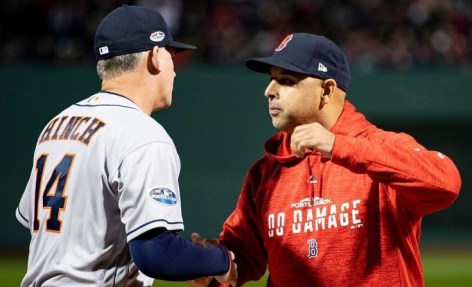
Like former Astros manager A.J. Hinch, Cora deserves another chance after having served the sentence that ended the moment the World Series did. But notice that Hinch is getting his in Detroit, not Houston. No matter how popular he was among his Red Sox players, Cora’s second chance cannot come in Boston.

You have to ask? Maybe Cora did or didn’t order, abet, or merely encourage his 2018 and maybe 2019 Rogue Sox to steal signs off the feeds in their video replay room. You don’t applaud cheating qua cheating when you say the Rogue Sox can be seen as led into temptation by MLB itself providing the apparatus. (Behind both dugouts in all parks, by the way)

But you don’t absolve Cora or his troops for giving in. Just because Mom and Dad left the keys to the hooch hutch lying around open before going out for the evening it doesn’t mean their short-of-legal-age kids have the license to get themselves swacked.

Let’s give the benefit of the doubt a moment and assume Cora didn’t order, abet, or merely encourage. No matter. The first responsibility of leadership is that you take responsibility for what your subordinates do. Or, undo. Hinch learned the hard way, too. He was a lot more forthcoming in the aftermath while he was at it. When he spoke of wishing for a second chance, he never exactly said it ought to be with the Astros.

To those Red Sox fans who were just as outraged over the Red Sox Replay Room Reconnaissance Ring as Astro fans outraged over the Astro Intelligence Agency, take heart. If Red Sox general manager Chaim Bloom gets his way, you might see a white knight riding in from Philadelphia soon enough.

MLB Network’s Jon Heyman says former outfielder turned Phillies coordinator for player information Sam Fuld has “a real chance” at landing the Red Sox bridge. “Fuld, who is from (New Hampshire) and is well regarded,” Heyman says, “can’t be ruled out here as Bloom is said to love him going back to their [Tampa Bay] Rays days.”

It’s not that Bloom’s unaware that previous Red Sox GMs found their ultimate managerial choices overruled by Red Sox ownership. Just ask now-Pittsburgh Pirates GM Ben Cherington. His choice after the infamous 2011 collapse, and Terry Francona walking subsequently before he could be booted, was anybody but Bobby Valentine.

Valentine wandered into a clubhouse already toxic from the 2011 collapse and played with matches. Even the 27 disabled-list trips Red Sox players made in 2012 weren’t half as detrimental as Valentine’s divide-and-conquer style. Questioning popular but aging Kevin Youkilis’s heart in hand with his physical health lost the skipper his clubhouse too early that season.

Valentine threw so many people under buses in Boston that Cherington probably sang “Happy Days Are Here Again” to himself when he got to fire Valentine after that season ended. The last thing Bloom should want now is to get an ownership boot in the backside by way of a forced hire he might have to can after 2021.

“Bloom may want a fresh start as he rebuilds this team from the ground up—in which case Fuld sounds like the man for the job,” writes Yahoo! Sports’s Darren Hartwell.

“The new chief baseball officer deserves his own hire, and Cora made his life miserable when he threw a managerial search on top of trading a franchise player last winter,” writes NBC Sports Boston’s John Tomase. Bloom’s public statements about Cora have been cool at best, suggesting the former skipper needed to undertake some serious soul searching and image rehabilitation following his central role in Houston’s cheating scandal. If Bloom wants to start fresh, why interview Cora at all?”

Why indeed. But Red Sox brass traveled to Cora’s home in Puerto Rico to talk to him. You might think that’s an exercise in futility, considering Cora isn’t exactly an unknown quantity to the Red Sox. You’d also think the Red Sox wouldn’t need to know anything—other than, perhaps, the depth of his contrition for his Astrogate role and Soxgate allowance—that they didn’t know already.

Fuld was a hustling outfielder who rarely met a wall or fence he didn’t think he could conquer on the run. His frequent spells on the disabled list reminded him there were more than a few walls and fences that didn’t suffer fools or outfielders gladly. If he studied baseball history formally, the one day he ditched was probably the day they taught the sad story of Pistol Pete Reiser.

He defied the still-lingering prejudice against players who weren’t six foot-plus galoots, yet he didn’t make his first team right out of spring training until he was 29. He was also a solid contact hitter who could extort his way on base and whose injuries—especially one to his wrist ligaments—probably eroded those skills far sooner than they should have.

Fuld was also as analytically-inclined as a player as he was the type who dared the outfield to blow him to Kingdom Come. When the Phillies hired him following his 2017 retirement, Fuld became so well respected that he was on the short list for several managerial openings including four last fall. The Cubs, the Mets, the Pirates, and the Giants gave him serious looks before Fuld turned them down to stay in his Phillies job.

But with the Phillies canning GM Matt Klentak and their next GM likely to look for his own people, Fuld is probably very available now. He’s not exactly alien to New England, either. He’s the son of a longtime University of New Hampshire dean and a former New Hampshire state senator, and he grew up an avid Red Sox fan, keeping posters of Nomar Garciaparra on his bedroom wall and visiting Fenway Park as often as he could.

Fuld once made a big day of his own at Fenway while playing for the Rays. On 11 April 2011, he went 4-for-6 and might have hit for the cycle except for his final plate appearance, where he needed a single to finish the cycle but hit the ball far enough down the line that he knew he had a shot at the clean double and had to take it.

Consummating the cycle would have made headlines, highlighted SportsCenter, and thrilled his visiting family even more. But baseball’s more than great theater, and Fuld knew it. “I never thought about stopping at first,” he told ESPN’s Tim Kurkjian post-game. “That’s not the right way to play the game. If you can advance to the next base, you advance. That’s the only way to play baseball.”

A guy who surrenders a cycle to play the game right is a guy who’ll take his marriage of right play and right analysis and get whatever rebuilding Red Sox are handed to him to play the game right. Assuming Bloom is allowed his head rather than unexpectedly bereft of it, Fuld should be more than just a little green dot on the Red Sox radar.

A calm, objective look at the Mookie Monster

Mookie Betts about to take a low-five from third base coach Dino Ebel after his sixth-inning Game One bomb.

The Mookie Monster is catching more than a few waves of adulation and hype lately. Making three National League Championship Series-altering or sustaining catches in the final three games, then doing something even Babe Ruth never achieved in a single World Series game, does that for you.

“He does things on a baseball field that not many people can do,” says Game One winning pitcher Clayton Kershaw, “and he does it very consistently, which I think separates him from other guys.”

On Tuesday  night, Betts let a couple of other Dodgers take the defensive spotlight gladly in return for drawing one walk, stealing two bases, and hitting a home run. Ruth drew three walks, off one of which he stole second and third, in Game Two of the 1921 World Series.

This Series is only one game old, and Betts hit as many home runs Tuesday night as Ruth hit in the entire ’21 Series—one. No, we’re not comparing Mookie Betts to Babe Ruth just yet, other than to say he has something else in common with the Bambino.

Betts, too, is a former Boston Red Sox star. Betts was traded away while Red Sox Nation was still seeing him in prime time; Ruth was sold before Red Sox fans got to see his complete transition to full-time position playing and his two prime periods—in a very different game—of 1920-24 and 1926-31. And Red Sox Nation isn’t the only baseball outpost still wondering just what the Red Sox were thinking when dealing Betts.

The Ruthian mythology held for too long that then-Red Sox owner Harry Frazee dumped Ruth purely to finance his musical hit No, No, Nanette. (How a 1919 sale finances a 1925 stage production should have escaped thinking people.) Frazee did need money, but not for one of his theatrical productions. He also didn’t need the headaches that came with Ruth, behaving even then like a law unto himself.

Fast forward a century. A very different Red Sox ownership is about as financially challenged as the Saudi royal family. They’re facing Betts hitting free agency after the 2020 season and making little apparent effort to sign him. Betts himself spoke often enough about pondering his market value in that 2020 free agency class. The Red Sox didn’t want to lose him for nothing in return.

Fair enough. But why the Red Sox made no effort to keep their arguable franchise face will be debated at least as long as the old and discredited Curse of the Bambino endured. No matter what the Red Sox didn’t do otherwise last winter to keep the team from collapsing to the basement even in a pandemic-altered year, the Olde Towne Team isn’t likely to go even half as long before its next World Series triumph as they did between selling Ruth and 2004.

“The Red Sox’s payroll issues were not inconsequential,” writes The Athletic‘s Ken Rosenthal, never mind that allowing that the Red Sox doing nothing to re-tool their pitching staff probably did as much to sink them as trading Betts. “The team needed to infuse young talent. But every rational argument club officials make pales in comparison to the importance of keeping a homegrown star, a franchise player, a role model for your organization and a potential Hall of Famer.”

Their loss is the Dodgers’ gain, even if the Red Sox did get some decent young talent in return and rid themselves, while they were at it, of the rest of David Price’s contract before Price’s decline added further miseries. Betts already had a taste of World Series conquest in 2018, even though he didn’t hit well at all while playing solid defense that postseason.

“He does all the little things right,” said Dodgers center fielder Cody Bellinger to Rosenthal, Bellinger having delivered a couple of key postseason hits and defensive gems himself. “You can really learn from that when a guy’s that good and wants to win and continues to do the small things that go unnoticed by a lot of people. It’s really special.”

The guy Betts is being compared to most now hasn’t even gotten more than one quick postseason taste in his rookie season. The Los Angeles Angels aren’t exactly in the poorhouse financially. They’re in the poorhouse in baseball terms, though, since they seem almost terminally unable to build a team their franchise player and the game’s best all around, still, can be proud of.

Once the Mookie Monster cranked his act into overdrive starting in NLCS Game Five, the concurrent subject became Mike Trout, his lack of postseason credentials, and even why Trout is therefore an overrated hype. The foolishness there only begins with the roll of Hall of Famers who either never got to strut in the postseason, came up too short when they got several chances, but still shook out as their generations’ best.

It only continues with ignoring that Trout wasn’t responsible for such ultimately backfiring moves as the Albert Pujols contract—which became an albatross mostly because of Pujols’s injury issues impacting his once-unshakable plate discipline—and the utter failure to develop credible pitching on both ends of the game. That may or may not have only begun with doing little to nothing to keep Zack Greinke beyond his second-half 2012 rental.

Trout’s loyalty to the organisation that brought him forward is nothing but admirable in a business for which loyalty is and has always been a disposable commodity. The only difference between pre- and post-free agency “loyalty” is that pre-free agency teams were under no such obligation and liberal to the point of libertine when it came to “loyalty” to most of their players.

A guy doesn’t sign an extension equivalent to the economy of a small country if he thinks he’s been done dirty off the field. Even nice-guy Trout has his limits, though. He said not too subtly this year that he’s tired of the Angels losing. But when the game’s all-universe player says he’s fed up with falling short and shorter, will the Angels listen at last?

The show Betts is putting on this postseason is as staggering as the 99 Cent Store-budget Tampa Bay Rays bumping, grinding, flying, and diving their way to the American League’s best irregular season record and into the World Series in the first place. But if Betts’s partisans really want to go there with the Trout comparisons, well, you asked for it.

Betts has seven seasons in the Show. Here they are next to Trout’s first seven. First, looking conventionally:

First Seven Seasons BA OBP SLG OPS OPS+
Mookie Betts .301 .373 .522 .895 135
Mike Trout .310 .420 .579 1.000 178

Well, I tried to warn you. And, in absolute fairness, Betts’s line is astonishing for a leadoff hitter, which I’ll take a different crack at shortly.

Now—sorry, can’t resist—look at the pair using my Real Batting Average metric, which I think gives you the complete look at a player at the plate. (It also does what the traditional batting average fails to do: treats hits as they should be treated, not treating all hits as having equal value—which they don’t.) Total bases + walks + intentional walks + sacrifice flies + hit by pitches, divided by total plate appearances:

Real Batting Average PA TB BB IBB SF HBP RBA
Mookie Betts 3875 1786 395 26 33 21 .583
Mike Trout 2012-2018 4538 2171 684 86 43 63 .671

Again, Betts has a remarkable profile for a leadoff hitter. But granted that distinction versus a guy who bats second much of the time and third almost as much of the time, the Mookie Monster isn’t quite the Millville Meteor just yet. (Since you went there: Betts does have a Most Valuable Player award—to Trout’s three that should have been four.)

On the other hand, it might be a lot more prudent and accurate to compare Betts to the first seven seasons of another leadoff man of certain renown.

Real Batting Average PA TB BB IBB SF HBP RBA
Mookie Betts 3875 1786 395 26 33 21 .583
Renowned Leadoff Man 4445 1639 674 24 20 23 .535

The leadoff man of certain renown is Hall of Famer Rickey Henderson. Did you figure for even one milli-second that there but for the grace of his life of crime on the bases would Henderson come up short of Betts? That the Mookie Monster in his first seven seasons is actually better at the plate than the Man of Steal?

Maybe you didn’t before, but you ought to now. Especially since Betts has a slightly better knowledge than Henderson of what to do when his bat takes unexpected time off and becomes a one-man version of the Rays’ collection of aerialists, acrobats, high-wire walkers, and tumblers.

It’s enough to make the Dodgers’ spanking new $396 million man the biggest bargain of the year. Just don’t ask Betts. All he’s ready to do is tell you the most important thing he did in Game One, and it wasn’t the jolt he hit the other way that landed in the right field seats in the bottom of the sixth. For him, it was the double steal that led to him scoring on an offline throw from first base an inning earlier.

“I think it just kept the line moving,” he told reporters. “It was a good play there, and I’ve gotta give credit to the hitters that came up after for driving in runs and keeping constant pressure. It just showed that we don’t have to hit home runs to be successful.”

Not even when it’s the aggregation that led the National League in bombs this irregular season and last full season. It ought to make for one hell of a World Series show going forward.

The wheeling, dealing, maybe stealing Padres

Mike Clevinger, from Cleveland outcast to the star of the San Diego Shuffle.

Entering the pandemic-truncated regular season, some thought the Show was going to be somewhere between dull and duller, not just by way of the rules experiments alone. They didn’t reckon with the San Diego Padres, of all people.

When not producing a youthful shortstop (Fernando Tatis, Jr.) who takes “let the kids play” to heart (and runs the boring old farts’ temperatures up the scale in the bargain), or hitting grand slams as if they’re going out of style, the Padres took what some presumed would be a sleepy trade deadline period and turned it into a bit of a thriller approaching Monday’s 1 p.m. Pacific time cutoff.

Landing Cleveland Indians pitcher/protocol violator Mike Clevinger and outfielder Greg Allen for a package including pitcher Cal Quantrill, infielder Gabriel Arias, outfielder Josh Naylor, and catcher Austin Hedges on Monday merely seems like what Duke Ellington once called “the cherries-and-cream topping to our sundae morning.”

Especially after the Friars already made four trades in a 24-hour period prior. The fourth of those trades looked like something of a nothingburger: on Sunday, the Padres sent a fringe relief pitcher from their 60-man roster (28 in Show; 32 at alternate camp), Gerardo Reyes, to the Los Angeles Angels for veteran catcher Jason Castro, who’s set to hit free agency after this season. And, who’s not much of a hitter but is respected for his abilities at pitch framing and new-rules plate blocking.

Now, look at what that deal followed doing the Slam Diego Shuffle:

* On Saturday, the Padres cast for and reeled in resurgent relief pitcher Trevor Rosenthal, sending the Kansas City Royals an outfield prospect (Edward Oliveres) and the proverbial player to be named later.

* On Sunday morning, the Padres more or less confirmed that the beleaguered Boston Red Sox were about to push the plunger on their season if not much of their roster, landing designated hitter/first baseman Mitch Moreland, a 2018 World Series hero, for a pair of prospects. (Hudson Potts, Jession Rosario.)

* And, a little later on Sunday, the Friars dealt big to the Seattle Mariners, sending two of their highest-rated prospects (pitcher Andres Munoz, outfielder Taylor Trammell) plus a pair of young sprouts with Show experience (catcher Luis Torrens, infielder Ty France) to land the Mariners’ best catcher, Austin Nola, plus relief pitchers Austin Adams and Dan Altavilla.

The Mariners were thin enough in the backstop ranks that nothing could have pried Nola out of their hands unless it was enough to think they might finally, maybe, possibly begin building a real future, as a good number of published reports suggest. When the Padres landed Clevinger Monday morning, what started as jaw-dropping hope turned into jaw-dropping actuality: They’re going all-in to win now as well as later.

How surreal is this season already? The Indians put Clevinger on ice when it turned out he’d made a team flight after violating coronavirus safety protocols with fellow pitcher Zach Plesac but said nothing about it—even after Plesac got bagged—until after that team flight. The Tribe sent both to their Eastlake, Ohio alternate site.

And all of a sudden Clevinger—who had a sterling 2019 season but had a struggle or two in four starts this season before his night out of dinner and cards with Plesac and other friends—became the most coveted starting pitcher on a weird trade market that figured to feature such arms as Lance Lynn (Texas Rangers), Trevor Bauer (Cincinnati Reds), and maybe Josh Hader (Milwaukee Brewers relief act) moving to fresh territory.

This must be heady stuff for Clevinger, who’s just gone from a Cleveland outcast to the star of the Slam Diego Shuffle.

One minute, Clevinger and Plesac were still recovering in Eastlake over the denunciations of their selfishness for sneaking out after dark no matter what Mom and Dad ordered. The next, he, at least, has moved from one pennant contender on the banks of Lake Erie to another down by that glistening San Diego waterfront. Where he gets to reap the pleasures and benefits of having one of the left coast’s two true marquee talents having his back at shortstop and lightening his loads at the plate.

It was enough for the Padres to swing and fling their way into the postseason picture, sitting five games behind the Los Angeles Dodgers in the West but tied with the Chicago Cubs at three and a half games up in the wild card picture. They’re not just making noise, they’re making memories of the kind San Diego hasn’t seen in a very long time.

These are fun days to be a Padre. And, a Padre fan. So much so that a Twitter wag couldn’t resist wondering if their trade deadline wheeling, dealing, and possible stealing didn’t set at least one weird record: most players sharing the name Austin (including Moreland: it’s his middle name) moving to one team or another in a series of trades made by one team in the same deadline period.

Well, what’s baseball, too, if not the still-singular repository for silly records? Now the Padres hope their wheeling, dealing, and possible stealing produce the kind of record that’s not so silly, if you don’t count the semi-Mad Hatter style postseason to come. The kind of record that gets them to the postseason in the first place.

All they have to do is make sure Clevinger can’t be too seduced by that delicious waterfront to break the safety protocols again.

“It’s never going to be good enough”

“They’re continuously advocating for this head-hunting season of the Astros.”–Lance McCullers, Jr.

At this writing, this season’s Houston Astros have been hit by pitches twelve times for fourth among American League teams. The on-field administration of that Astrogate justice denied by the commissioner produces a disturbing sidebar. Quick: Name the Astro who’s been hit by the most pitches since the pandemic-truncated season began.

The answer is Abraham Toro, reserve third baseman/designated hitter. He’s the only Astro to be hit by pitches three times thus far, and he wasn’t even a member of the 2017-18 Astrogate teams. His reasonable responses to such embryonic team plunk leadership might include thoughts of first-degree manslaughter.

Toro’s position is much like that of a bright young financial whiz, freshly graduated from a prestigious university, freshly hired by a brokerage firm that faced sanctions, fines, imprisonments, and in-the-toilet public relations a year before bringing him into their tattered ranks, and who now feels the stings and fastballs of guilt by association.

This year’s Astros include nine from the 2017-18 teams: their entire starting infield—Jose Altuve, Alex Bregman, Carlos Correa, Yuli Gurriel; two outfielders—Josh Reddick, George Springer; and, three pitchers—Chris Devenski, Lance McCullers, Jr., Justin Verlander. Gurriel and Springer have been hit by pitches twice this year; Altuve, Bregman, and Correa, once each. Reddick as of this writing has escaped thus far.

Toro is one of two non-2017-18 Astros to take one for the team with which they had nothing to do in the first place. Last year’s American League Rookie of the Year, Yordan Alvarez, possibly out for the season with a knee injury, got it once before his injury.

Exactly why Toro and Alverez should be taking balls to their ribs or other assorted anatomy is anyone’s guess aside from opponents believing that, if you wear an Astro uniform, the deets don’t matter, you’re fair game. That’s as patently unfair as would be a prosecutor taking one look at the aforementioned, hypothetical new brokerage recruit and filing an arrest warrant because, well, “That’s for even thinking about joining that cesspool house.”

You got why it seemed about seven-eighths if not more of the rest of the Show’s players wanted to administer the justice commissioner Rob Manfred didn’t in handing 2017-18 Astro players immunity in return for their spilling about the Astro Intelligence Agency. And you get why pitcher McCullers, one of the more thoughtful Astros, is just a little bit fed up with that desire.

McCullers thinks “they” continue advocating for the Astros to suffer the brushbacks, knockdowns, and beanballs over Astrogate’s perfidy. “They,” of course, are that majority of non-Astros players and enough press and fans who think the Astros’ players got away with murder over their 2017-18 illegal electronic sign-stealing operation. And “they,” of course, are wrong, as McCullers sees it.

“[S]peaking to players was probably the least part of [MLB’s] whole investigation,” McCullers told The Athletic‘s Jayson Stark and Doug Glanville (himself a former major league player) on the Starkville podcast.

I can’t go into it because I don’t know how much I am or am not allowed to say. But I’ll say that … the notion that, oh, players negotiated immunity, players then were interviewed and rolled on everyone just to save themself, isn’t the case. And that’s as much as I can say. That’s not what happened. That’s not how this went down. So if that’s what people are upset about, then I guess we can all move on because that’s not how it happened.

Manfred also suspended now-former general manager Jeff Luhnow, now-former manager A.J. Hinch, and now-former bench coach Alex Cora for the whole of 2020. Cora–who went on to manage the 2018 Boston Red Sox to a World Series title a year after the Astros’ now-tainted title—subsequently lost that job for his Astrogate involvement, too.

Manfred didn’t suspend the Astros’ 2017 designated hitter, Carlos Beltran, considered a key Astrogate operative himself, but his role cost him his freshly-minted job managing the New York Mets—before he had the chance to manage even a spring training exhibition game.

“And it’s never going to be good enough,” McCullers told Stark and Glanville. “The whole franchise could be dismantled, and it wouldn’t be good enough.”

Toro taking three plunks and Alvarez taking one gives a shard of credence to McCullers’s remark. There were observers and analysts, yours truly among them, who said early during the unfurling of the Astrogate revelations that it might indeed require a complete turnover of even the current roster before the stain dissipates from the franchise.

The 2020 Red Sox have enough trouble of their own on the field as it is. They’re collapsing like a rickety folding chair after losing their franchise face Mookie Betts in a lopsided, money-nourished trade to the Los Angeles Dodgers. But they’ve been scored by Manfred over their Replay Room Reconnaissance Ring of sign-stealing. And this year’s Red Sox have had nine players hit by pitches and ten such hits total, seventh in the American League.

At least four of the replay reconnaissance ring team members have been drilled thus far: Mitch Moreland, Rafael Devers, Kevin Pillar, and J.D. Martinez. But nobody huffed, puffed, or threatened to blow the house down over the Red Sox. If that bewilders McCullers, the Astros as a whole, and the Astros’ and Red Sox’s fan bases that continue coming to terms with their world champion cheaters, it’s both understandable and unfathomable.

The reasons may be simple. Cora was cashiered when Manfred’s Astrogate report came forth, well before the commissioner finished and released his Red Sox reconnaissance findings. Accurately or incompletely, the Red Sox looked far more decisive doing so, and there remained the prospect that Cora got his not just because of Astrogate but because the Red Sox brass suspected he had at least a fingertip on the reconnaissance ring.

More to the point, the Rogue Sox simply used what was handed to them and every major league team at home and on the road. They didn’t have to alter an incumbent camera’s mandatory eight-second delay or install a separate real-time camera. All they had to do, and did, was read the replay room monitors and signal their baserunners who’d send the pilfered intelligence to their hitters.

Neither the AIA nor the Rogue Sox Replay Room Reconnaissance Team had anything to do with their pitchers, whether McCullers in Houston or Joe Kelly, now with the Dodgers, who dropped Bregman and Correa on 28 July but was a Red Sox pitcher in 2017-18.

The whatabout argument doesn’t pass muster, either. Just because others did it, and we don’t really know yet whom and when in recent seasons (other than the New York Yankees, perhaps), it doesn’t mean the Asterisks or the Rogue Sox do or should get off the hook.

Just when you thought McCullers earned your stubborn admiration for trying to defend his team, however edgily, he had to spoil it. Alluding to Kelly’s recent podcast dismissing the Astro players accepting immunity to spill as “snitches,” McCullers huffed, “By the way, there was only one snitch. And that’s the person who spoke to The Athletic.”

So Astrogate is still all Mike Fiers’s fault. Never mind that he and others (including the Oakland Athletics administration) couldn’t persuade the Show’s government or reporters to convince their editors to investigate or publish, until Fiers finally blew the Astrogate whistle last November. Never the cheaters’ fault, always the whistleblower’s

Well, to this day there may well remain people who think New York’s police corruption scandal of the early 1970s was all the fault of the two clean cops, Frank Serpico and David Durk, who took it to The New York Times after they couldn’t persuade their own department to clean up and wise up, too. Never the crooked cops’ fault, always the whistleblowers’.

What was a terrible look for New York’s Finest then is still a terrible look for the Astros now. McCullers may want to ponder that further and deeper while he laments with some justification how little seems good enough to sate Astrogate critics.

But Kelly at least sent his messages to a pair of actual Astrogaters. Holding Toro, Alvarez, and any other Astro answerable for baseball crimes they didn’t commit and weren’t there to commit is a terrible look, too.

Clueless Crane

2020-08-01 JimCrane

Astros owner Jim Crane—Playing what-about-ism, implying everyone else’s fault, possibly sorry only that his boys got caught, talking to USA Today’s a still-bad look for him.

In a 1964 novel about Navy fliers in World War II, Richard Newhafer’s The Last Tallyho, a fresh group of pilots assigned to a carrier performs a target hop. One of the young men overshoots the tow plane target and hits the plane, instead, flown by their squadron lieutenant. Forcing the lieutenant to a fatal water landing.

The tow pilot happened to be the squadron skipper’s best friend. When the skipper and their air group commander face questioning by the task force commander flying his flag aboard their carrier, the latter asks the skipper why they were called in. “We’re here,” the skipper replies, “because we are responsible for what happened.”

“I don’t see it that way,” the CAG practically snaps. “No matter who did what,” the skipper rejoins, “[CAG] and I are in positions of command. When you command you accept the responsibility for what is done by your subordinates.”

Maybe Houston Astros owner Jim Crane should have read The Last Tallyho. He might have learned something about command responsibility and avoiding mealymouthed avoidance of it, the latter of which he availed himself in an interview with USA Today columnist Bob Nightengale.

Astrogate returned to the otherwise coronavirus-dominant baseball news last week after Los Angeles Dodgers pitcher Joe Kelly threw fastballs twice behind Astros third baseman Alex Bregman and breaking balls twice making their shortstop Carlos Correa skip rope. They got Kelly an eight-game suspension and the Astros on the receiving end of fresh rounds of fury.

Remember: Commissioner Rob Manfred handed Astro players on the 2017-18 teams immunity to spill about the Astro Intelligence Agency’s off-field-based electronic sign stealing those seasons, instead of bringing the powers of his office to bear and ordering one and all to spill or be spilled. Even if the players’ union filed countering grievances, Manfred would have sent a far stronger message than a few brushback pitches.

The outrage over Kelly’s suspension was, basically, “He gets eight games for doing in essence what Manfred wouldn’t, but those guys still get off scot free?” Nobody’s justifying throwing at Bregman’s head, but the outraged are right. As a matter of fact, Nightengale asked Crane the same question, phrased a little differently. The answer may or may not surprise you.

“People are aggravated the players didn’t get suspended,’’ said the owner, “but I didn’t have anything to do with that. That was Rob’s call. Listen, it’s always going to be whatever you want to call it. A black mark. An asterisk. It happened. It’s not good for anybody. It’s not good for the game. We broke the rules. We got penalized. We were punished. There’s no doubt it weighs on all of us every single day.”

Crane seemed to say it as though he hoped that would be the end of the story. Except that it wasn’t, quite. After apologising for sounding like a fool at the infamous February spring training press conference, the subject detoured briefly toward the Boston Red Sox and the New York Yankees, both of whom have been reprimanded for a little espionage of their own, though not quite performed the way the Astros developed it.

“I think (MLB) had a bigger problem than everybody realized,’’ Crane told Nightengale, playing the what-about-ism card. “[The Yankees and the Red Sox] were doing things and got caught, but we’re the ones who took the bullet. That’s the way it works. I’m not trying to blame anyone else. It was our problem. We dealt with it.”

Except that, after a little talk about things such as revelations about the Astros’ less than honourable front office “culture,” Crane tried to blame, well, something close enough to everyone else as well as the Yankees and the Red Sox.

“I just think everybody was paranoid that everybody was doing it,” he said. “The technology was right in front of you. We already know two others teams were doing it and got caught. But the way we were doing it, that was pretty (stupid). I mean, banging on trash cans? You could have found a better way to do it.”

“Crane’s take . . . seems to be that he and the Astros are the real victims here, and everyone else should leave them alone already,” writes NBC Sports’s Craig Calcaterra. “Really. That’s the vibe he gives off on all of this. Crane seems to believe that the Astros sign-stealing fallout is overblown and that the public’s anger mostly has to do with how Crane himself bungled the P.R.”

Crane seems indeed clueless that, except for the Red Sox’s AppleWatch incident late in the 2017 season and an extra Yankee dugout phone the same time, the AIA didn’t stop at just the technology just being “right in front of you.” Not even close.

The Red Sox’s Replay Room Reconnaissance Ring didn’t involve anyone altering a real-time monitor feed to decipher opposing pitch signs to signal to their baserunners who’d then send the pilfered intelligence to their hitters. Needless to say by now, it also didn’t depend upon having a man on base to receive the stolen signs in the first place.

It would have shocked nobody to learn that the Rogue Sox weren’t the only team to operate a similar reconnaissance ring out of the replay room. And, yes, MLB handed them the keys to the hooch hutch with the replay rooms at home and on the road. Boys will be boys, alas, and asking them to resist such temptation would have been like asking Donald Trump to give up Twitter.

But the replay room reconnaissance ringers didn’t alter ballpark cameras off their  mandatory eight-second delays or install second cameras not on the delay to send signs to a clubhouse monitor in front of which someone, several someones perhaps, decoded the signs and then banged the can slowly for the benefit of Astro hitters.

Using what’s there for a little chicanery is one thing. Altering it or supplementing it illegally is something else entirely. When a team as genuinely great as the 2017-18 Astros were takes up such subterfuge—and if you need proof they were great without the AIA (which operated in Minute Paid Park and wasn’t portable), remember that those Astros had better road than home winning percentages in both seasons—it’s well past boys being boys.

Some accuse Kelly of hypocrisy because of his membership on the 2017 AppleWatch Red Sox. Well, now. Their replay room reconnaissance ring apparently began in 2018—after they hired, what do you know, the Astros’ 2017 bench coach and (we’ve known since the Manfred Report on Astrogate) AIA co-mastermind Alex Cora to manage them. All the way to a World Series ring.

Before Manfred released his Rogue Sox findings, Kelly wondered aloud, “Whenever the investigation is done I’m interested in seeing what is in the investigation.”

If there is cheating involved with how good our team was we should have won every single out. We should have not even lost an inning if there was some good cheating involved, which would have been a lot more fun because we would have won in four. We would have swept through the playoffs and made it really, really fast and been able to go to Hawaii or go to Mexico and go on vacation a lot sooner than we did.

Known to be an erratic pitcher who isn’t shy about a little headhunting when he thinks it’s called for, Kelly inverted the old observation, “If you can’t beat them, join them,” and became a Dodger last year.

The Astros’ mealymouthed responses to Astrogate questioning as spring training opened outraged the Dodgers more than most, and enough players around the Show were outraged, because they’d been the team the Astros beat in seven to win the ’17 Series. It’s not impossible that Kelly had in mind both Astrogate and what was subsequently revealed about his former Rogue Sox when he decked Bregman and Correa.

If the Dodgers weren’t playing this year’s pandemic-inspired regional season schedule, they might have faced the Red Sox. And, inspired perhaps by a few revelations in Manfred’s Rogue Sox report and his Dodger teammates, Kelly might have sent a few messages to those 2018 Sox still on the team for tainting those ’18 Series rings.

Astroworld’s been buffeted harshly by Astrogate. It’s still tussling between those of its citizens who think the AIA was a reasonable defense against whomever else was doing illegal sign stealing and those who think their faith in their team’s greatness was misplaced or abused.

Crane hasn’t said much if anything about that yet.

Meanwhile, note once again Crane’s choice of phrasing to Nightengale: [T]he way we were doing it, that was pretty (stupid). I mean, banging on trash cans? You could have found a better way to do it. Is he saying the AIA itself was stupid? Is he saying he’s sorry only that the Astros got caught committing high crime?

“We’re sorry. We apologized. But no matter what happened, it wasn’t going to be enough,” Crane told Nightengale. “People wanted me out of baseball. They wanted players to be suspended. They wanted everything.” Setting aside that those February apologies were as non-apologetic as apologies can get, what did he expect people to want? A whitewash?