ALCS Game Three: Rock and troll

Carlos Correa, Eduardo Rodriguez

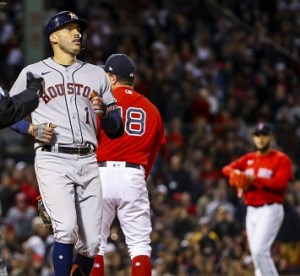
Rodriguez (right) couldn’t resist trolling Carlos (It’s My Time!) Correa as the top of the sixth ended . . .

Carlos Correa grounded out to end the Astros’s sixth Tuesday night. Red Sox starter Eduardo Rodriguez couldn’t resist pointing to his wrist, trolling Correa’s becoming-more-familiar “It’s my time!” gesture whenever nailing a key Astros hit. There was a birthday boy in the house who wasn’t necessarily amused.

“No, no,” Alex Cora hollered, as Rodriguez returned to the dugout during the sides changing. “Don’t do that!” The last thing the manager wanted on his 46th birthday was any of his Red Sox poking the Houston bear they were taking down, before the bear could even think about stealing their picnic baskets.

Not even the pitcher who’d just pitched six solid innings the only blemish of which was a three-run homer two innings earlier. Not even while the Red Sox still held a six-run lead that finished in a 12-3 demolition giving the Red Sox a 2-1 American League Championship Series advantage and the Astros a monumental migraine.

An inning and a half worth of three-up, three-down baseball that looked to shape into a pitching duel between Rodriguez and Astros starter Jose Urquidy got ripped into a Red Sox demolition in the bottom of the second after starting as a mere tear. Two walks sandwiching a J.D. Martinez one-out double merely loaded the bases for Christian Vazquez’s line single the other way to right field and kept them there.

Oops. Christian Arroyo ripped one off the mound and off Astros second baseman Jose Altuve to send Martinez home with a second Red Sox run. Falling into an early 2-0 hole with ducks still on the pond against these Astros still seemed surmountable. Until Kyle Schwarber told them otherwise.

After taking ball one inside, ball two downstairs, and ball three just inside, Schwarber took Urquidy’s fastball around the middle halfway up the right field seats. It was the third salami slice for the Red Sox in three ALCS games. As if slicing two in Game Two wasn’t precedent enough, the Schwarbinator’s blast made the Red Sox the first ever to slice three in any postseason series.

Kiké Hernández followed Schwarber at once with a base hit pulled up the left field line, and Xander Bogaerts ripped a single up the pipe one out later, and finally Astros manager Dusty Baker got Urquidy out of there before the Red Sox could cover his grave. Yimi Garcia shook off a second-and-third-making wild pitch to dispatch Alex Verdugo for the side at last, but aftershocks were still to come.

They started an inning later, when Hunter Renfroe drew a one-out walk, stole second, then took third when Astros catcher Martin Maldonado’s throw to second bounced away from Altuve, before coming home on Vazquez’s floating base hit into short center. Then Arroyo drove Garcia’s slightly hanging slide into the rear row of the Green Monster seats.

The Astros may have punctured the impenetrable when Astros center fielder Kyle Tucker parked one into the right field seats with Michael Brantley (leadoff single) and Yordan Alvarez (one-out single banged off the Monster but played perfectly by left fielder Verdugo to hold him) aboard in the top of the fourth.

Two innings and three Astro pitchers later, Rafael Devers took a leadoff walk and the Astros got two outs quick enough to follow, especially center field insertion Jose Siri’s sliding catch running in long to take Verdugo’s floater into shallow center. Phil Maton then relieved Brooks Raley for the Astros, and he arrived just in time to feed Martinez something to hit into the Monster seats about as deep as Arroyo’s blast traveled.

Kyle Schwarber

The Schwarbinator slicing salami in the second to start the Red Sox romp in earnest . . .

Before this ALCS ends, the Red Sox may need to put new tires on the laundry cart into which they dump their home run hitters to celebrate the blasts in each moment. They’re already down to the last millimeter of tread as it is.

As if making sure the sealant on the first puncture held fast, Devers turned on Astro relieve Ryan Stanek’s first one-out pitch in the bottom of the eighth and sent that into the Monster seats, too. Renfroe’s diving catch on Correa’s two-out, opposite-field drive in the top of the ninth must have felt like the first mercy shown the Astros all night long.

Astros pitching coach Brent Strom wondered aloud whether his charges might be tipping pitches. Not willing to commit to that quite all the way, he acknowledged that—between the Red Sox’s postseason plate discipline and all-fields approaches and Astro pitchers falling behind in counts so often now—he’s more than a little concerned.

“This is a very good hitting team,” Strom said of the Red Sox, “and they’re very adept at picking up little things, much more so than most teams,” Strom said. “We need to be very cognizant of the little things, tipping-type things, things like that, that they’re very astute at. We’ve just gotten behind hitters.”

Cora said the Red Sox approach began changing when Schwarber came aboard in a July trade with the Nationals. “We were expanding,” Cora said, meaning the strike zone. “We didn’t walk too much, and when he got here and when he started playing, it was different. It’s a different at-bat, and other guys have followed his lead, and right now, like I said, this is the best I’ve seen this team this season offensively.”

Correa thinks the Red Sox aren’t picking up Astro pitch tips so much as they’re just doing their jobs at the plate when the Astros’ pitchers aren’t doing theirs on the mound. As an Astro, it’s murder for Correa. But as a baseball fan, pardon the expression, it’s a blast.

“It’s fun to watch as a fan of the sport, see how everybody in the lineup has the same approach,” the shortstop said. “They’re not chasing. They’re staying in the zone. They’re not swinging at borderline pitches. It’s beautiful what they’re doing. We’ve got to find a way to throw more strikes and keep the ball in the ballpark.”

But as much talk came about Rodriguez giving Correa a taste of his own celebratory medicine as about the Red Sox’s thorough dismantling of the Astros’ balky pitching staff and shaky offense—particularly their big three of Altuve, Brantley, and Alex Bregman now standing a combined 5-for-36 in the set so far—after the game finally ended.

Cora didn’t exactly hold it against Rodriguez, making a point of embracing his pitcher when Rodriguez returned to the dugout. But he still didn’t want Rodriguez or any of his players re-awakening the suddenly sleeping Astro giants.

“We don’t act that way,” he said postgame. “We just show up, we play, and we move on, and he knows. I let him know. We don’t have to do that. If we’re looking for motivation outside of what we’re trying to accomplish, we’re in the wrong business. The only motivation we have is to win four games against them and move on to the next round.”

Correa didn’t exactly mind. The way he spoke postgame, you’d have thought the Astros forgot about such concepts as bulletin-board fodder. “He did my celebration,” said the shortstop liable to command a nice free agency deal this winter, no matter his Astrogate past.

“I thought it was kind of cool,” continued Correa, who’d done his “It’s my time” wrist-tap in Game One after breaking a three-all tie with an eighth-inning bomb. “It’s just the way baseball should trend. I loved it personally . . . I keep it real all the time and say how it is.”

Rodriguez admitted he was caught up in the moment after getting Correa to end the sixth. Cora was stern but not exactly harsh with his pitcher back in the dugout. His embrace fit perfectly with Rodriguez’s previous insistence that Cora was like a father or older brother to his players as well as a manager.

“He understands that we’re not that way.” said Cora, whose Red Sox almost got humbled out of the races in the second half between injuries, COVID sufferings, and a bullpen remake. “We talk about humble approach and humble players, and that’s who we are. We like to grind, and we like to play, but we don’t do that.”

Well, good Lord, a team hammering and blasting its way to a rout can’t be faulted for being just a little less than humble in the moment here and there. Can they?

ALCS Game Two: The traveling Red Sox delicatessen

J.D. Martinez

Martinez—slicing salami in the top of the first . . . (Fox Sports screen capture.)

Two innings. Two thick slices of beef salami. Never before done in a single postseason game.

If there’s a spicier way for the Red Sox to recover from a tight enough American League Championship Series-opening loss than that, you may need to deploy an archaelogical expedition to exhume it.

Six teams have hit pairs of grand slams in the same postseason series, from the 1956 Yankees (World Series) to the 1977 Dodgers (National League Championship Series), from the 1987 Twins (World Series) to the 1998 Braves (NL division series), from the 2001 Diamondbacks (NLDS) to the 2013 Red Sox (ALCS).

Then came J.D. Martinez in the top of the first and Rafael Devers in the top of the second. Just like that, they powered themselves into postseason history and the Red Sox toward a 9-5 series-evening Game Two win. Even if the Astros managed to scrape, scratch, and then launch themselves out of an embarrassing blowout.

There were those asking before the postseason began whether the Red Sox could handle the team who beat them the most frequently when they met in October. The Rays beat them eleven times over the season’s final 89 games. Well, now. After an opening game shutout, the Red Sox sent the Rays home from the division series with three straight losses.

Then, they asked whether the Red Sox could handle the team that beat them with the most ammunition. The Astros beat them in five out of seven meetings in May and June and outscored them 42-25. Well, now. This ALCS is about to shift to Fenway Park after a set-opening split in Minute Maid Park.

The scoring thus far is 13-10, Red Sox. But don’t fool yourselves. The racket only sounded larger than life in Houston because the Astros elected to keep their home playpen’s roof closed for the most part. In open and cooler Fenway Park, the lack of a roof doesn’t matter. The postseason racket is manna for the Red Sox and anything but for visitors.

Right now, the Red Sox ride momentum they snatched back from the Astros in Game Two even more swiftly than the Astros wrestled it for themselves in Game One.

Things were bad enough for the Astros on Saturday with their starting pitcher Luis Garcia taking the ball on a balky right knee, the leg on which he pushes off the pitching rubber. They got worse when Kyle Schwarber opened Game Two with a double to deep left center, Rafael Devers returned from 0-2 to work a one-out walk, and Alex Verdugo waited a two-out walk to set up the ducks on the pond for Martinez.

Rafael Devers

Devers, slicing salami in the second . . . (Fox Sports screen capture.)

The Red Sox designated hitter brought a string of no hits in his twelve previous plate appearances with men on base. Martinez made up for it with one swing, driving a 1-0 fastball just off the strike zone’s bull’s eye the other way and into the right field seats.

Unaware in the moment about Garcia’s push knee, Martinez knew the pressure was almost entirely on the Houston righthander who looks almost as though he does the rhumba at the rubber before he delivers home. “[The pressure’s] not on me to come through there,” Martinez said postgame.

“It’s the first inning,” he continued. “He has the bases loaded. I’m trying to tell myself that, trying to stay relaxed and just looking for a pitch so I can just put a barrel on it.” Barrel? Martinez put a depth charge into it.

Garcia was probably lucky to get out of the inning on life support by striking Hunter Renfroe out. But after Red Sox starter Nathan Eovaldi slithered out of his own lesser two-out jam in the bottom of the first, Alex Bregman aboard with a two-out double as Yordan Alvarez flied out to deep center, Garcia wouldn’t be so fortunate in the second.

He walked Kevin Plawecki, Eovaldi’s personal catcher, on four high pitches. Manager Dusty Baker and head trainer Jeremiah Randall visited the mound. The entire Astros infield plus catcher Martín Maldonado surrounded them. Garcia finally admitted his right knee bothered him a good while before Game Two.

Baker lifted him for another righthander, Jake Odorizzi, who might have waited to start Game Four otherwise in the Astro plan. Inadvertently, Baker did the Red Sox what may yet prove the largest favour done the Olde Towne Team this year. Pitchers who relieve by profession get themselves ready swiftly enough when they get the call, even if they’re brought in with all the time they need to heat up when taking over for the wounded Starters don’t.

Being a starter by trade, given all the time he needed to warm up, Odorizzi went through as quick a version of his normal pre-start routine as he could muster in the moment. For him it was quick, but for the Red Sox it meant getting a good, acute, long look at him to determine just what he would or wouldn’t have coming in—and how they could or couldn’t exploit it.

And Odorizzi knew it going in.

“I was caught off guard by it, obviously,” Odorizzi said postgame, referencing the Garcia knee issue. “I didn’t know what was going on. I knew he was healthy coming into the game, so I was caught off guard by it. I think everybody was.

“My typical routine is out the window at that point,” he continued. “I hadn’t even stretched, thrown, anything, so it was going to take me a good while to warm up. I think all things (considered) — I’m sure it felt like forever for y’all — but for me, that was about the fastest I can warm up. Usually it takes me 30-plus minutes. I think I did it in under 15. So not ideal, and it’s not like it’s a fun warmup. You’re sitting there pretty much naked in front of the other team.”

Finally, the game got back underway, and the Red Sox showed how much they appreciate naked models with which to work.

Odorizzi dodged one bullet when Christian Arroyo’s long drive down the left field line banged foul off the box seat rail. But he couldn’t dodge Arroyo finally lining a base hit through the open right side, contravening the Astros’ defensive shift. Schwarber struck out swinging, but Kiké Hernández lofted a fly base hit to left.

This time, the ducks on the pond were set up for Rafael Devers, the Red Sox’s lefthanded hitting third baseman bothered himself by a balky forearm. But the forearm knew how to behave when it mattered the most. Devers pulled a 1-1 cutter that arrived up in the middle and a little inward high down the right field line and just inside and past the foul pole.

That second slice of salami tastes even better than the first. Especially with a little spicy mustard on it.

Xander Bogaerts popped out near first base, Verdugo dropped a jam shot into left for a base hit, but Martinez grounded sharply right back to Odorizzi to stop the Red Sox merry-go-round. But an 8-0 lead in two innings meant the music would play onward and upward.

With Eovaldi pitching a gutsy five and a third innings, Hernández himself cranked the music up a little further with one out in the top of the fourth. He yanked a 2-1, down-and-in  Odorizzi splitter into the Crawford Boxes. It was merely the fifth home run of the postseason for the streaky guy who once couldn’t convince the Dodgers he was worth everyday play.

Kike Hernandez

. . . and, Fox Sports getting cute demonstrating just how well Hernández sees pitches lately . . . (Fox Sports screen capture.)

The infielder-outfielder’s first Red Sox postseason’s success continued so dramatically that Fox Sports couldn’t resist developing a special visual to demonstrate how hitters on a roll are believed to see pitches coming their way—it showed Odorizzi’s splitter blowing up into a beach ball just after leaving his hand, floating up and down toward Hernández’s hitting wheelhouse.

According to The Athletic‘s Ken Rosenthal, also an in-game Fox analyst, the Red Sox hitters had a pre-game confab reviewing their attack plan against Astro pitching when Schwarber piped up with a plan of his own: “Let’s be like Kike,” the Schwarbinator said. “Spray balls all over the park. Hit ’em on top of the railroad tracks.”

Ask Hernández what turns him from a mere jack-of-all-trades with a little power and a modest career curriculum vitae into a weapon in the postseason lifetime thus far but into Hank Aaron in this postseason—especially after he was wrung out by a battle with COVID from late August through early September—and he’s either stuck for an answer or reduced to boilerplate.

“I don’t know,” he said when Rosenthal asked. “I guess feeling good. The importance of the game is allowing me to stay focused, stay locked in, not think too much about it. I’m just glad I’m able to put good at-bats, get on base, drive myself in to help us win, to get to this position.”

Sure. That oh-so-slight move forward in the batter’s box, especially on the breaking balls Hernández formerly had trouble handling, had nothing that much to do with it. From a lifetime .196 hitter on breakers in the regular season to a .700 hitter with three bombs on breakers this postseason. We’ll buy that not-think-about-it jazz—as soon as we make the last payment on that Antarctican beach club.

The Astros’s five runs seemed almost incidental compared to the Red Sox’s mayhem Saturday afternoon. With two out in the bottom of the fourth, Kyle Tucker drove one bouncing off the left field scoreboard wall to send Yordan Alvarez (walk) home, and Yuli Gurriel lined a two-run single the other way to right.

The next time they scored, in the bottom of the ninth, Gurriel hit a full-count fastball up from Red Sox reliever Darwinzon Hernandez into the Crawfords and, one out later, late-game catching insertion Jason Castro hit Hernandez’s 2-1 meatball over the center field fence. Compelling Red Sox manager Alex Cora to bring in Ryan Brasier to fool Jose Altuve into hitting a pitch on the strike zone’s ceiling to deep left for the game-ending out.

“We won the seventh, eighth, and ninth,” Baker said postgame. “But those two innings in the beginning, that’s a tremendous mountain to climb.”

In absolute fairness, the Astros’ pitching issues have proven a bump to the Red Sox’s plate formidability now. Even winning Game One the Astros were forced to get six and two thirds innings from their bullpen after starter Framber Valdez couldn’t get out of the third inning alive. Garcia being salamied on a balky knee meant eight bullpen innings Saturday.

Odorizzi gave the Astros’ proper relief corps a break Saturday, but José Urquidy—who hasn’t pitched since 3 October, and who carries a 4.14 fielding-independent pitching [FIP] rate for the regular season—is now listed to start Game Three. He’s a calculated risk even in Fenway Park, since the Red Sox team OPS was almost thirty points higher against righthanded than lefthanded pitching this year.

It also meant Odorizzi out of any Game Four plan, maybe not even a topic until a Game Six if the set gets there. It may mean Valdez having to start Game Four on short rest. Not to mention that the Astros can’t afford any more short starts—and once-formidable Zack Greinke isn’t exactly stretchable anymore. With his own regular season 4.16 ERA but 4.71 FIP, Greinke may even be a bigger risk now if he has to work past forty pitches.

Losing Lance McCullers, Jr. to a forearm muscle strain for the ALCS is hurting a lot more than the Astros bargained for, so far.

Cora bet the ranch that he could get away with a running of the bulls in Game One because Eovaldi would give the pen itself relief on Saturday and leave the manager the option of starting Nick Pivetta and Eduardo Rodriguez in the first two Fenway games, the order unknown at this writing. Cora won that bet.

It didn’t hurt that the Red Sox opened a traveling delicatessen in Houston Sunday with salami prominently on display, either.

ALCS Game One: The world didn’t implode

Jose Altuve

Jose Altuve’s two-run homer tied Game One and turned the game’s momentum to the Astros . . . (Fox Sports screen capture.)

Before the American League Championship Series began, it was easy to remember but so hard to forget. The elephant still lingered in the room.

The American League West-winning Astros. The American League wild card-winning Red Sox. Electronic sign-stealing cheaters versus electronic sign-stealing cheaters. Right?

Not quite that simple. Not even if Red Sox fans and others still cringe over the 2017-18 Astro Intelligence Agency. Not even if Astro fans and others still think the 2018 Rogue Sox Replay Room Reconnaissance Ring proved the Astros weren’t alone in high-tech cheating.

Those Red Sox got nailed using their replay room as a sign-stealing helpmate. But they didn’t install the video apparatus in there, MLB did—for them and all thirty teams, behind all home and visitors’ dugouts in all thirty ballparks. Their way, and they probably weren’t the only team doing it, depended on having men on base to relay stolen signs to their batters.

I’ve said it before, I’ll say it one more time: With the best intentions, MLB in essence were Mom and Dad leaving the keys to the liquor cabinet behind expecting the kids were mature enough not to open up and party while they were out of town for the weekend. The 2018 Rogue Sox opened up and partied. The 2017-18 Astros built their own distillery.

Their front office used an in-house-designed computer algorithm devised for sign stealing during games, despite the designer’s warning that doing it in-game was illegal. They used a high-speed, real-time camera to abrogate the mandatory eight-second transmission delay and send opposing signs to clubhouse monitors, next to which someone sent the hitters the dope via the infamous trash can bangs.

Both teams cheated then. Both teams seemed like deer frozen in the proverbial headlights when asked to show public accountability and contrition. The Astros were far, far worse. They went far, far above and beyond both the traditional on-the-field, in-the-dugout gamesmanship and the sort of boys-will-be-boys thing the Rogue Sox and others did with the MLB-gifted replay rooms.

Commissioner Rob Manfred may have erred in granting players from those teams immunity in return for the details, but his investigation did at least turn up and discipline the key overseers.

He suspended then-Astros general manager Jeff Luhnow and manager A.J. Hinch before owner Jim Crane fired the pair. He suspended then-Astros bench coach Alex Cora over Astrogate, but determined the 2018 Rogue Sox’s prime culprit was video room operator J.T. Watkins while manager Cora, his coaches, the front office, and maybe half the Red Sox’s players weren’t in on the replay room reconnaissance ring.

Nobody can redeem those Astros or Red Sox, even if the Red Sox did re-hire a contrite-enough Cora to manage them this year. But we can remind ourselves that, today, only five Astrogate players remain with the team. We should remind ourselves that at least one such suspect, second baseman Jose Altuve, actually demurred from accepting stolen signs and even told his teammates and others to knock off the trash can banging while he was at the plate.

Only nine Rogue Sox members remain in uniform today, too. And, the rules against electronic sign-stealing were tightened in Astrogate’s aftermath. Video room security is now three people deep. Video feed delays are now fifteen seconds over the previous eight. Players caught stealing signs electronically can be suspended without pay or credited major league service time.

This year’s Astros and this year’s Red Sox got to this year’s ALCS regardless. Remove their former taints, and you have two opponents who entered the set with suspect pitching (particularly the Astros, losing Lance McCullers, Jr. to a forearm issue) but very strong offenses. Then, you watched Game One Friday night, even if in spite of yourselves.

You watched Red Sox center fielder Kike Hernandez strike long twice but Altuve strike once to change the game’s momentum toward the eventual 5-4 Astros win.

You watched Astros starting pitcher Framber Valdez and Red Sox starter Chris Sale unable to get out of the third inning alive. You watched the ordinarily suspect Astros bullpen hold the Red Sox to four hits, one walk, and one measly run, when Hernandez—who tied the game leading off the top of the third by hitting a Valdez curve ball far over the left center field seats—caught hold of a Ryan Pressly slider and send it deep into the Crawfords in the top of the ninth.

You watched the Red Sox take a 3-1 lead in that third a ground out, a walk, and a base hit up the pipe later, when designated hitter J.D. Martinez’s hopping grounder bumped off Altuve’s glove to send shortstop Xander Bogaerts (the walk) home, before right fielder Hunter Renfroe ripped an RBI double past Astros third baseman Alex Bregman and down the left field line to score Bregman’s Red Sox counterpart Rafael Devers (the base hit).

You watched Altuve ruin that lead in the bottom of the sixth, with Astros center fielder Chas McCormick aboard on a one-out single, when he hit the first pitch he saw from Red Sox reliever Tanner Houck into the Crawfords.

You watched another Red Sox reliever, Hansel Robles, fire sub-100 mph bullets in the bottom of the seventh to get rid of Bregman on a grounder to short and left fielder Yordan Alvarez on a hard-swinging strikeout, before offering Astros shortstop Carlos Correa a changeup that hung up enough for him to yank into the Crawfords to break the three-all tie.

You watched a Red Sox reliever who hadn’t pitched in almost two weeks, Hirokazu Sawamura, surrender a leadoff walk to Astros first baseman Yuli Gurriel before McCormick bounced a base hit in front of Red Sox left-field insertion Danny Santana (a top-of-the-eighth pinch hitter). You saw Martin Maldonado take a pitch off his right wrist to load the pads with nobody out.

And you saw Altuve hit a sacrifice fly to center to send Gurriel home with the fifth Houston run, though a slightly more on-line throw might have gotten Gurriel at the plate to keep things within a single run for Hernandez’s second launch of the night.

Kike Hernandez

Hernandez’s dive-and-roll catch of Michael Brantley’s second-inning-ending, bases-loaded sinking liner wasn’t enough to stop the Astros Friday night. Neither were his two long home runs. (Fox Sports screenshot.)

Hernandez’s mayhem—the two homers on a 4-for-5 night (the first such leadoff hitter in the Show to do it), bringing him to fourteen hits in 28 postseaon at-bats this time around, his MLB-record third lifetime postseason game of ten total bases—may not have been quite enough for the Red Sox to take Game One. But it was more than enough to impress Astros manager Dusty Baker.

“I haven’t seen a hitter this hot in the last week than Kike Hernandez,” the skipper said post-game, after Hernandez’s first launch came during Baker’s brief turn talking to Fox Sports broadcasters Joe Buck and Hall of Fame pitcher John Smoltz. “Boy, when I saw that ball go up, I was like, oh man, that was a blast. Then he blasted another one. It’s not a good feeling when you know you’re live on air and you see that ball leaving the ballpark.”

Hernandez wasn’t the only one dancing with the record books. Altuve and Correa became the first teammates to homer in the same postseason game for a fourth time. “He is just so dangerous,” said Correa of Altuve post-game. “His track record in the playoffs is insane, and he just inspires me. He inspires me without saying much.”

That track record includes tying Hall of Famer Derek Jeter for number three on the all-time postseason bomb roll with his 20th such launch Friday night. But you should have heard Altuve speak of Correa, too. “He is amazing,” the compact second baseman said of his keystone partner at shortstop. “He likes this kind of game. He wants to go out there and hit big homers. It seems like he expects to go out there and do it, so if you’re expecting something, eventually you’re going to make it happen, and that’s him.”

Hernandez also impressed the Astros and maybe even some of their home crowd Friday night with a few defensive gems, particularly his dive-and-roll catch of designated hitter Michael Brantley’s bases-loaded, sinking line drive to end the bottom of the second. But he’d have swapped all that for a Red Sox win.

“I think overall we played a good game,” he said postgame. “Once again, we didn’t do a good job of adding on to the lead, and at the end of the day, that’s why we lost. We weren’t able to add any more runs.” That was in large part because the usually suspect Astro bullpen managed to keep them to a measly four hits and a walk in the unexpected bullpen game.

With Nathan Eovaldi starting Game Two, and the still-fresh memory of being shut out by the Rays to start a division series in which they won the next three straight, the Red Sox don’t exactly have reasons to cringe just yet. Even Sale admitted Eovaldi was their best foot forward to launch Saturday.

“We’ve got the right guy on the right mound, and that’s all we can say,” he said. “Our lineup is going to bang with the best of them. There’s no doubt about that. We’ve got to do the little things right, and with Nate taking the ball, that’s everything we could ask for.”

So guess what didn’t happen when the two teams still recovering from their own Astrogate and Rogue Sox scandals—yes, listed in the order of true gravity—tangled in Game One? Knowing that no one will be comfortable with either one wholly, but the Astros especially, until the last Astrogater or the last of the Rogue Sox no longer wears either uniform?

The world didn’t implode. The flora didn’t wilt. The fauna didn’t commit mass suicide. The moon didn’t fall into the river. The sun didn’t awaken before its appointed time. The nations didn’t fall from the earth. The earth didn’t go flat.

Unless there comes fresh contravening evidence, the Astros and the Red Sox played it straight, no chaser, in a game that would have classified as a bit of a thriller had it not been for that still-lingering elephant. The one aboard which the Astros, like it or not, still look far, far worse than the Red Sox or their fellow unverified-but-certain replay room rogues do.

“Whatever it takes to win”

Kike Hernandez (center, hatless) surrounded by Red Sox teammates after his walk-off sacrifice fly sealed their trip to the American League Championship Series.

Well, the Rays only thought their rather decisive first-game win in this now-concluded American League division series meant the beginning of another deep postseason trip. Who knew it would prove to be just the last win of the year for the American League’s winningest regular season team?

Come to think of it, a lot of people only thought the Red Sox’s apparent disarray in enough of the regular season, including their final home set while the Yankees swept them, and in losing two of three to the Orioles before sweeping the also-ran re-tooling Nationals to finish the schedule?

The Rays won the AL East decisively, and with the best regular-season record in franchise history. The Red Sox had to wrestle their way into the wild card game before beating the Yankees in a game featuring the sort of thing happening to the Empire Emeritus that used to mean surrealistic disaster for the Olde Towne Team.

Lovely way to send the Yankees home, many must have thought, but oh, are they going to feel it when the Rays get hold of them.

The only thing the Red Sox must feel now is that their postseason work has only just begun. But if the ways they shook off that Game One 5-0 loss to take the next three from the Rays are any indication, they’re about as up to the task as any formerly buffeted team awaiting their American League Championship Series opponent can be.

They live by the team play motto to such a fare-thee-well that you can suggest any given one will sacrifice for the good of the team—which makes it so appropriate that they finally won this division series with . . . a sacrifice fly.

Lose a 2-0 top of the first Game Two lead to a grand salami in the bottom of that inning? “No panic,” said manager Alex Cora. No panic—and allow only one more Tampa Bay run while turning that quick-as-you-please 5-2 deficit into a 14-6 blowout.

Lose a 6-2 Game Three lead on an eighth-inning leadoff homer by Rays rookie star Wander Franco and a two-out RBI double by not-too-young Rays rookie star Randy Arozarena, then have to ride a Phillies throwaway named Nick Pivetta for four extra innings? No sweat—just let Christian Vazquez rip a one-out two-run homer into the Green Monster seats in the bottom of the thirteenth and win, 6-4.

Blow a 5-0 Game Four lead off a five-run third crowned by Rafael Devers sending a three-run homer over Fenway Park’s second-highest wall and into the center field seats? We do this kinda stuff to them all through the picture. Just let Kike Hernandez say thank you to the nice Rays for not putting him on to load the bases for an any place/any time/extra-innings ticket double play—by banging the game and set-winning sacrifice fly short of the left center field track.

“I mean, here we are surprising everybody but ourselves,” said Hernandez post-game, once he escaped drowning in the Red Sox celebration. “We knew in spring training we had the team to make it this far and here we are.”

Well, the Red Sox did lead the entire Show in comeback wins during the regular season. They also managed a rather impressive .591 winning percentage in one-run games. But they also suffered a 12-16 August that wasn’t necessarily as disastrous as some other Augusts by some other teams this year. (Hello, Mess—er, Mets.) Between injuries, COVID-19 illnesses, and assorted other mishaps. nobody else seemed to remember if they knew what Hernandez said the Red Sox knew last spring.

Surprising everybody but themselves? Sure. Let’s buy into that despite the Red Sox trailing in three of these four division series games. Let’s buy into that despite the Red Sox having to win twice in their final plate appearances. Let’s buy into that despite an ankle-compromised designated hitter, a second baseman getting his first daily plate appearances in around three months, and pulling a hutch of rabbits out of their hats.

Well, guess what? You’ve probably bought into more improbabilities than those in your lives as baseball fans, observers, writers. If you speculated on the Red Sox’s apparent pitching goulash out-pitching the Rays’ more obvious pitching depth going in? You ought to think about buying lottery tickets in every state that offers them.

If you bought into Garrett Whitlock, a find on the Rule 5 minor league draft heap, pitching no-hit, no-run relief for the final two Game Four innings and becoming the Red Sox’s highest-leverage bullpen bull, forget the lottery? You ought to be investing on Wall Street. You can’t lose. Yet.

If you bought into Jordan Luplow doubling and scoring in the fifth, Franco abusing Red Sox reliever Tanner Houck for a two-run homer in the sixth, and Kevin Kiermaier whacked an RBI double ahead of Arozarena whacking a two-run double to tie things at five in the eighth? You ought to seed the advent of Jetsons-style flying cars.

But if you bought into Game Three hero Vazquez leading off the Red Sox ninth with a base hit, Christian Arroyo sneaking a sacrifice bunt to the short right of the first base line, pinch hitter Travis Shaw slow bouncing a tough hopper toward third that wouldn’t get him in time at first, then taking second on defensive indifference with Hernandez at the plate? That’s beyond my pay grade, too.

Why didn’t Cash put Hernandez on with one out? He wasn’t really about to load the pads for Devers and be forced to prayer that he could get away with it. Devers already had three hits on the night. With the winning run already ninety fee from scoring, putting Hernandez aboard would have meant only the possibility of having put the insult-adding-to-injury run on base.

So Cash trusted his reliever J.P. Feyereisen to take care of Hernandez. The first pitch tied Hernandez up by sailing up and in tight on the Red Sox center fielder. The next pitch sailed into Austin Meadows’s glove in left center, too far back to keep pinch-runner Danny Santana from sailing home with the Red Sox’s ALCS tickets punched.

“It was quick,” Feyereisen said postgame, and he could have been talking the series as well as the end of Game Four. “I think that’s one of the main things when we sat down, like, ‘Wow, I didn’t think it was gonna be over this quickly’. We felt good. We played some good games. You come in here, especially with this atmosphere with these [Fenway] crowds and two walk-off wins, that’s tough.”

What was even more tough for the Rays is that, all series long, they struck out 46 times at the plate to the Red Sox’s 23—and that includes 20 Rays strikeouts in Game Three’s thirteen-inning theater. By contrast, the Red Sox picked up from being shut out in Game One to hit .364 with nine home runs in Games Two through Four and delivered 56 hits the entire set.

The Rays’ wounding offensive flaw, being Three True Outcomes enough all year long, bit their heads off in the division series. They hit seven homers and ten doubles but had a collective .211 team batting average all set long. They’ll have to figure out how to improve their overall contact without sacrificing their impressive power.

They’re young, they’re deep, they’re they’re tenacious, they’re a model of resourcefulness despite their limited dollars. Their championship window isn’t being boarded up just yet.

Their farm is considered deep and still promising. They’ve got their own kind of guts, playing and pitching rookies in the postseason as if it was the natural thing to do. Even if it was borne of the unpleasant necessities delivered by injuries, near-habitual turnover, and in-season moves that didn’t work. The rooks—shortstop Franco, pitchers Shane McClanahan and Luis Patino in particular—showed heart beyond their years even in defeat.

Yes, it’s tough to remember Arozarena was still a rookie this season, technically. His coming-out part last postseason took care of that, and he shone like a well-established veteran this time around. From homering and stealing home in Game One through two hits and that Game Four-tying hit in the eighth, Arozarena was a rookie in name only this year.

Losing righthander Tyler Glasnow to Tommy John surgery was probably the key blow to the Rays in the end. Free-agent veteran Michael Wacha took a 5.05 regular season ERA into the postseason . . . and allowed a mere two-run deficit to turn into that 14-6 Game Two blowout in two and two thirds innings. One more veteran other than Game Four opener Collin McHugh might have made a big difference.

The Red Sox are just as conscious of analytics as any other team so advanced, including the Rays who practically live by it. But they’re a lot better in balancing analytics to the moment. Cora is as much an advance information maven as any skipper in baseball, but he’s also unafraid to shift his cards and play to what’s in front of him when it’s demanded of him.

He doesn’t play October baseball like the regular season. If he did, he wouldn’t have gone to eight postseason series as a manager or a bench coach and been on the winning side in each of them. He’s not afraid to take risks, he doesn’t sweat it if and when they backfire.

“That’s our motto right now: Whatever it takes to win,” said Hernandez. “Just win today, and we’ll worry about tomorrow, tomorrow. Lineup, bullpen, starting rotation, like, it doesn’t matter. We’re a team, and we’re one. We’re not 26 dudes, we’re just one.” Lucky for them the Red Sox aren’t out of tomorrows just yet.

Cora’s Game Four starting pitcher, Eduardo Rodriguez—lifted after an inning and two thirds in Game One following that first-inning disaster, but pitching shutout ball until Luplow scored on a ground out in the fifth, then coming out after Kiermaier doubled to open the sixth—calls Cora “like a father, brother, manager, whatever. He trusts us. He trusts everybody in that clubhouse. He gives you the chance every time that he hands (the ball) to you, and you’ve just got to go out there and do your job.”

“He’s a guy you’d run through a wall for,” said Whitlock. “If he told me to run through that wall, I’d believe that he had something there to make sure it would fall for me.”

It turned out the Rays wall wasn’t quite as sturdy as everyone else thought going in. The Red Sox have sturdier walls to face going forward. Walls that won’t be as friendly to them as the Green Monster seems to be.

Off the wall in Fenway Park

Christian Vazquez

Christian Vazquez’s walk-off bomb should have been the co-story of Game Three with Nick Pivetta’s stout four extra innings’ shutout relief. But no . . .

You could hear the blue-murder screaming even before Christian Vazquez ended American League division series Game Three in the bottom of the thirteenth. You could hear furious Rays fans and sympathisers thinking Game Four deserves no shorter justice than the Red Sox getting killed to death.

They saw Vazquez hit a two-run homer, igniting a berserk celebration around all Fenway Park, and thought to themselves before hollering loud and long, We wuz robbed!!! They probably still think so.

They think the Rays should have come out of the top of the thirteenth with a 5-4 lead, the run scored from first by Yandy Diaz off Kevin Kiermaier’s two-out double against Red Sox reliever Nick Pivetta. That thought would have been wholly reasonable—except for the umpires calling for a rules review, ruling ground-rule double, and thus ruling Diaz back to third base.

The problem was Kiermaier’s drive bounced off the right field wall, off the track, then off Red Sox right fielder Hunter Renfroe and over the wall. Official Rule 5.05(a)(8) spells out the wherefore: If a fair ball not in flight is deflected by a fielder and then goes out of play, the award is two bases from the time of that pitch.

Rule 5.05(a)8 distinguishes between intent and lack of intent. Had Renfroe actually tried and succeeded in deflecting the ball over the wall, Diaz would have been awarded home because he’d passed second base just as the ball ricocheted off Renfroe’s thigh over the wall. But Renfroe never touched the ball with either hand.

Postgame, Kiermaier remained in abject disbelief. “I can’t believe that happened or we don’t get the chance to score right there,” the Rays center fielder said. “For one, I crushed that ball. I was hoping to leave the yard. I got a lot of snap and crackle but no pop. First and foremost, for that to happen right there, it just doesn’t make sense to me.”

Even the Red Sox didn’t know what to think at first.

“I’ve never seen that before in my life,” said center fielder Kike Hernandez, whose fifth-inning homer put the Red Sox up 4-2. “I wasn’t sure what was going to get called. I wasn’t sure if the runners had to return. I wasn’t sure if it was going to be like an errant throw where the runner would get two bags. Like I had no idea.”

It made sense to home plate umpire Sam Holbrook after the review mandated the ground-rule double ruling. “Very simple,” the ump said. “From an umpire’s standpoint, very simple textbook in the rule.”

Maybe the rule should be reviewed and changed, maybe it shouldn’t, if you consider intent paramount on a play that was so freakish in the first place. But within its strict letter, lacking verifiable intent on Renfroe’s part, Kiermaier indeed had to settle for the ground rule double and Diaz indeed had to return to third.

The game remained tied at four. Red Sox reliever Nick Pivetta recovered to finish his fourth inning worth of three-hit, no-run, seven-strikeout relief. Rays fans may consider it having added insult to insulting injury when Renfroe himself held on for the full-count walk with one out in the bottom of the thirteenth.

Then Vazquez—who’d only come into the game as a pinch-hitter for his catching predecessor Kevin Plawecki in the sixth—caught hold of Rays reliever Luis Patino’s first offering and sent it into the Monster seats above left center for the 6-4 Red Sox win. If the would-have-been Diaz run had held up, it would have meant the Rays losing by a single run instead of two.

In a game about which it was entirely fair to say it would be a shame for either side to lose, the Rays wrestled back from a 4-2 deficit in the top of the eighth off Red Sox reliever Hansel Robles. Wander Franco hit a 3-1 fastball down the chute for a leadoff homer over the Monster; Randy Arozarena with two outs doubled pinch-runner Manuel Margot home.

Before that, the Rays re-learned how stingy Red Sox starter Nathan Eovaldi can be after he gets touched up in the beginning. Once Austin Meadows parked a one-out two-run homer into the bullpens in the top of the first, Eovaldi went forward to pitch shutout ball the next four-and-a-third innings.

The Red Sox chased Rays starter Drew Rasmussen with three straight singles in the third, including Hernandez sending leadoff singler Christian Arroyo home with the tying run at two. Josh Fleming relieved Rasmussen and Rafael Devers greeted him with an RBI single up the pipe to put the Red Sox up, 3-2.

After Hernandez’s leadoff yank into the Monster seats off Rays reliever Pete Fairbanks to open the fifth, and the Rays tied things at four in the eighth, Game Three’s big story figured to be Pivetta. His stout extra-innings shutout relief reminded observers of Eovaldi’s own bullpen-saving, six innings stout relief in that marathon Game Three of the 2018 World Series.

Pivetta’s outing probably changed Red Sox manager Alex Cora’s plan to start him in Game Four. After Sunday night’s win Cora probably won’t complain too much. He’d said previously that whatever the plan going in the game itself would govern the moves and the changes. When he needed a stopper before the Rays got any more ornery than tying the game at four, he picked the right man for the job.

Don’t blame the ground-rule double for costing the Rays Game Three. The Red Sox led each of the first six innings off with a man reaching base. The Rays’ none-too-shabby lineup struck out twenty times and worked only four walks. They had one hit in nine opportunities with runners in scoring position.

Don’t use it to steal Vasquez’s big moment, either. The moment in which he became only the fifth catcher in Show history to end an extra-inning postseason game with a walk-off home run. The other three: Carlton Fisk (Game Six, 1975 World Series), Tony Pena (1995 AL division series Game One), Jim Leyritz (1995 AL division series Game Two), and Todd Pratt (1999 National League divison series Game One).

The moment, too, in which he hit the sixth postseason walkoff bomb in Red Sox history, joining Fisk, Manny Ramirez (Game Two, 2007 ALDS), David Ortiz (Game Four, 2004 American League Championship Series; Game Three, 2004 ALDS), and Trot Nixon (Game Three, 2003 ALDS).

“There’s no, ‘He would have done this, would have done that’,” Holbrook said. “It’s just flat-out in the rule book, it’s a ground-rule double.” Though even Holbrook couldn’t remember having seen any similar play in the quarter century he’s been a major league umpire.

But this was not Don Denkinger absolutely blowing what should have been an out call to start the bottom of the ninth of Game Six, 1985 World Series. A blown call that infuriated those Cardinals so much that, after the Royals forced Game Seven and the umpire rotation placed Denkinger behind the plate for it, the Cardinals imploded almost completely to lose that Series.

These Rays are made of far better stuff than that. These Red Sox know it. The Red Sox now stand on the threshold of going to the American League Championship Series, but they won’t kid themselves that the Rays will be pushovers. Neither should you.