The spirit of 74

Aaron Judge

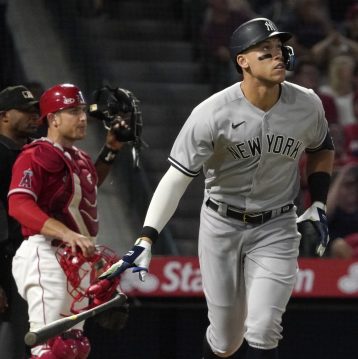
Hitting number 51 against the Angels Tuesday, Aaron Judge may yet break the single-season home run record. May.

We’re well enough past the point where looking at the scores to see how the Yankees are doing has nothing to do with a certain Yankee’s performance. If you turn to see the latest in any Yankee game without checking first on Aaron Judge’s in-game doings to that point, you’re going to flunk a polygraph hooked upon that question.

The Leaning Tower of River Avenue (how the mind’s eye produces fantasies of him squaring off against such lamp post-tall pitchers as Hall of Famer Randy Johnson and the late J.R. Richard) is having his best unimpeded (yet) season since his Rookie of the Year campaign five years ago. But nobody cares a whit about anything other than what he hits over the fence.

This year, the baseballs may still come having been consciously deadened but Judge couldn’t care less. He’s sent 51 of the miniature medicine balls into the seats through this writing. Those who care will note that he did that fourteen days before Babe Ruth reached 51 in 1927 and four days after Roger Maris reached it in 1961.

That’s talking purely about single-season home run record held by Yankees, about which there was once and still often enough not always cheerful insanity. Yankee chauvinists insist that and just about any other slugging record lack legitimacy unless set or held by Yankee batters. Which is almost (underline, please) as obnoxious as their (frequent enough) insistence that the postseason is illegitimate without a Yankee team in it.

Judge is one of the most likeable players on a team with which baseball fans not roosted in New York (and enough who are) have had, shall we say, a mixed relationship. The Yankees’ history is respected and even admired, however grudgingly, but the team is not always beloved. What’s true of several other teams is true exponentially about them.

But now and then even such parochial rooting or anti-rooting steps to one side when an individual Yankee threatens to launch himself into the precincts of the gods. That polygraph’s needles will jump right off the machine and onto the floor the moment you say that you don’t care if Judge hits a hundred home runs by the time this regular season ends just as long as the Yankees don’t win.

He’s not going to hit a hundred, of course. Seventy isn’t an unrealistic expectation at his pace. Seventy-four, which is what Judge would need to become the undisputed all-time single-season home run champion, may not be as much of a pipe dream as you think.

Judge doesn’t play under the witless lash of a commissioner who insisted without true authority to do so that the record would be illegitimate if broken after 154 games. He does play under the eye of a considerable crowd praying he gets to 74, the better to knock a suspect player out of the way. The incumbent record holder was a) not a Yankee and b) suspected of using actual or alleged performance-enhancing substances to get there.

And that record holder took the record from another who was not a Yankee and suspected of actual or alleged PEDs. The point that they were quite the outliers, in a generation where numerous players using or suspected of using such substances actually saw statistical dips instead of spikes (and, yes, you can look it up), usually escapes the usually self-appointed arbiters of sports morality.

It won’t condone those users or elevate those accusers if and when Judge parks number 74. But it would be nice to remember that baseball government did nothing about the plague until that government bumped into the government government. And the government government seemed far more interested in leading players on the perp walk than they were in sending swell if hypocritical messages to kids.

Without all that, we might be allowed to watch the Judge pursuit with more joy. Without all that, we might have nothing more grave to consider than this: If Judge can send baseballs that might as well be miniature medicine balls into earth orbit, what incentive does the sport’s administration have to iron up, remove its blinders, and insist upon a uniformly made baseball that allows both pitchers and hitters a fair shake?

The only blemish I can think of that attaches to Judge was his extremely rare attack of hubris in trolling Red Sox fans after the Yankees tied their 2018 American League division series, blasting Frank Sinatra singing “New York, New York” (a staple in Yankee Stadium after Yankee wins) from his boom box as he departed Fenway Park.

That’d teach him. In New York, the Red Sox destroyed the Yankees in the third division series game (16-4) and hung in despite a Craig Kimbrel meltdown in the bottom of the ninth to take it with a 4-3 Game Four win. Yankee fans were grateful that, to the best of anyone’s knowledge, none of those Red Sox (who went on to win the World Series) trolled them with boom boxes blasting the Standells’s garage band classic “Dirty Water.” (Boston, you’re my home . . .)

If that’s the only crime against common sense Judge has committed in his career, it’s not exactly a rap sheet on which to hang a man. Facing his first free agency this coming off-season, Judge stands to reap a payday equal to the value of some companies and a few tiny nations. He couldn’t have made a more powerful case in his dreams.

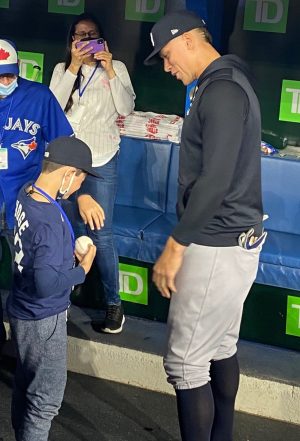
But this is the same player who was made aware of a Blue Jays fan handing one of his mammoth-blasted balls to another Rogers Centre fan who’d made no secret of Judge being his baseball idol and hoping to have a ball hit by Judge himself.

“That’s what’s special about this game, man,” he told reporters, after learning video of the moment went viral. “It doesn’t matter what jersey you wear, everybody is fans, everybody appreciates this game. That’s pretty cool. I’ve got to check out that video. That’s special.”

He did more than check the video out. The following say, before the game, he made a point of meeting the boy and his family and the fan who handed the ball to the boy, signing the home run ball for him and giving him the batting gloves he wore while hitting it.

Judge still resembles an eager nine-year-old boy himself when he flashes his familiar snaggle-toothed grin. But in the batter’s box he resembles the Jolly Green Giant when he pumps his bat and turns a pitcher’s mistake into another long bomb. Where he does it from hardly matters. His 199 OPS+ through this writing indicates he could clear several zip codes from the Grand Canyon or the last known surviving telephone booth.

If the Leaning Tower of River Avenue does it 23 more times between this writing and the regular season’s conclusion, there shouldn’t be a single baseball fan (even of the Yankee-hating variety) declining to stand up and cheer. If he doesn’t make it, stand up and cheer, anyway. Between his pursuit of 74 and Albert Pujols’s renaissance pursuit of career number 700, they’ve made the home run fun again.
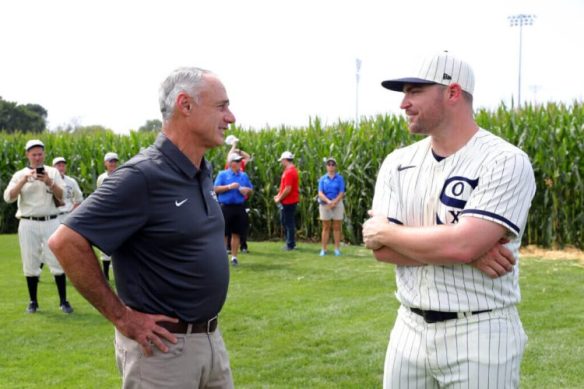
Mr. Commissioner, meet the real faces of the game

Rob Manfred, Liam Hendriks

Commissioner Rob Manfred with White Sox relief pitcher Liam Hendriks before last year’s Field of Dreams game. (The Athletic.)

Having a read of ESPN writer Don Van Natta, Jr.’s profile of commissioner Rob Manfred, I was almost convinced that maybe, just maybe, there really was more to Manfred than met the eye. Or, more than what comes forth in his stiff presence and often clumsy remarks.

Just maybe, the man isn’t the baseball-hating or baseball-illiterate Rube Goldberg-like abecedarian the caricatures so often portray. He did, after all, grow up a Yankee fan in upstate New York and can say proudly enough that he’s the only baseball commissioner ever who played Little League baseball. “All glove, no bat,” he remembers of being a Little League infielder.

My parents received a set of classic Revere copper-bottom cookware as a wedding present eight years before Manfred was born. (I still remember the fragrance of that special powder used to clean the copper bottoms, too.) Who knew Manfred (three years my junior) was the son of Revere’s production supervisor at their home plant in Rome, New York? An hour’s drive from Cooperstown, as it happens.

Born in 1958, Manfred took in his first live major league game at Yankee Stadium with his sports-obssessed father, sitting between the plate and first base on an Old Timers’ Day. Come game time, Hall of Famer Mickey Mantle crashed a pair of home runs and the Yankees beat the Twins, 3-2. When he finally became the game’s commissioner, he handed his father the first baseball with his stamp upon it.

“This is really an unbelievable thing,” Manfred, Sr. told his son. “I can’t say I disagree,” Manfred, Jr. told Van Natta.

A couple of hundred fathoms down, though, Van Natta noted that “more than once” Manfred told him what few baseball commissioners have dared to admit, that being the buffer absorbing the heat that should go to his bosses, the owners, is part of his job. Even if it’s about as pleasant as your private parts being caught in the vacuum cleaner’s handle.

And then it came.

“Every time it’s me, it ain’t one of those 30 guys—that’s good,” Van Natta quoted Manfred as saying. “Look, who the hell am I? I don’t have $2 billion invested in a team. I’m just a guy trying to do a job. I mean it. [The owners] deserve that layer. I believe they deserve that layer of protection. I’m the face of the game, for good or for bad.”

Mr. Manfred, unless it’s to boo and hiss your heads off over this or that piece of mischief, you may rest assured that no baseball fan anywhere in this country is paying his or her hard-earned money to head for the ballpark to see you or your bosses.

But I’m going to do you a small favour, as if you know me from the greenest bat boy on any professional baseball team. I’m going to introduce you to the true faces of the game. The ones whom those fans do pay their hard-earned money to see at the ballpark regardless of the machinations and deceptions of your bosses and theirs.

Mr. Manfred, meet Mike Trout. This is the guy you blamed once upon a time for not being baseball’s face, based upon his committing no crime more grave than letting his play and his clubhouse presence and his agreeability with fans before and after games speak for themselves, with no jive about the magnitude of being him.

Meet Shohei Ohtani. This is the two-way star who lights up the joint just by flashing that thousand-watt grin of his, never mind when he strikes thirteen out on the mound one night and belts baseballs onto the Van Allen Belt the very next. Between himself and Mr. Trout, you should be asking what on earth is wrong with the Angels that they still can’t find quality pitching enough to keep them in a race after they start in one but sputter unconscionably.

Meet Aaron Judge. This is the Leaning Tower of River Avenue who sends baseballs into the Delta Quadrant one moment and then, when made aware, goes out of his way to meet a Canadian kid to whom he’s number one among baseball men and who was handed one of his mammoth home run balls by an adult fan who knew the boy wanted nothing more than to catch one Judge hit out.

Meet Joey Votto. This is the future Hall of Fame first baseman who got himself tossed from a game early last year, but—after he learned his ejection broke the heart of a little California girl to whom he’s a hero above heroes—sent her a ball with his handwritten apology and autograph on it, prompting his team to drop game tickets and a little extra swag upon her the very next day.

Meet Bryce Harper. This is the guy who never apologised for being on board with letting the kids play. The guy now on the injured list with a thumb fracture and surgery to repair it after getting hit by a pitch thrown with one of the baseballs you and yours still can’t see fit to manufacture uniformly and with allowance for fairness on both sides of it, fairness for the pitchers and for the hitters alike.

Meet Vladimir Guerrero, Jr. and Bo Bichette. One is the son of a Hall of Famer who did last season what even his old man never did: led his league in on base percentage, slugging percentage, OPS, and OPS+, and led the entire Show in total bases. The other is the son of a respected major league slugger, has quite a lethal bat in his own right when his swing is right, and currently leads his league in trips to the plate. Together they’ve put some zip back into the Blue Jays.

Meet Oneil Cruz. The bat has yet to come to full life but the footwork, the glove, the throwing arm, have shown so far that you can be as tall as Frank Howard, J.R. Richard, and Randy Johnson and still play shortstop as though the position was created for you and not the Little Rascals in the first place. They’re falling in love with him in Pittsburgh, which needs all the love it can get, but they ought to fall in love with him all around the Show—except when he’s going so deep into the hole grabbing a grounder or a hopper that an enemy batter loses his lunch when he’s had a base hit stolen from him.

Meet Clayton Kershaw. He’s been around the block a few times. He’s a Hall of Fame lock as maybe the best pitcher of his generation. He’s still a quality pitcher and a class act. They still buy tickets on the road when they know he’s going to take the ball for the Dodgers. He’s faced his baseball aging curve with grace under pressure. And, for good measure, he’s the one active player who was seen fit to be part of the ceremony when the Dodgers unveiled that statue of their Hall of Fame legend Sandy Koufax this month, and you know (well, you damn well should know) what a class act Koufax was on the mound and has been in the decades since off it.

(You’re not still P.O.ed that Koufax waxed your Yankees’ tails twice while his Dodgers swept them in the 1963 World Series when you were seven, are you?)

Meet Justin Verlander. Missed a year plus recovering from Tommy John surgery. He has a 2.23 ERA and a 3.53 fielding-independent pitching rate so far this season. For any pitcher that’d be a remarkable return so far. For a future Hall of Famer who’s still suiting up at Jack Benny’s age (that’s a joke, son), it’s off the chart so far.

Meet Verlander’s 25-year-old Astros teammate, Yordan Álvarez. He’s leading the entire Show with his .667 slugging percentage, his 1.081 OPS, and his 206 OPS+. If there’s one untainted Astro who’s must-see viewing whenever he checks in at the plate, it’s him.

Meet Xander Bogaerts and Rafael Devers. The left side of the Red Sox infield is a big reason why the Olde Towne Team yanked themselves back up from the netherworld into second place in that rough and tumble American League East. Did I mention that Devers currently leads the entire Show with 177 total bases?

Meet José Ramírez. The Guardians’ third baseman is giving Devers a run for his money in the All-Star balloting that closes today. That thumb injury has put a crimp into his bat for now, and it’s had its role in the Guardians’ sudden deflation at the plate, but this guy just may be the face of his franchise right now. He ought to be one of the faces of this game.

Meet Mark Appel. This is the guy who went from number one in the draft to injuries as well as pressures and even to an exit from the game only to try giving it one more try—and finally coming up with the Phillies, nine years after that draft, and tossing a scoreless inning . . . at age 30. That’s as feel good a story as it gets for the oldest former number one to make his Show debut, no matter what happens with the rest of what remains of Appel’s career. They don’t all go to hell and back.

Those are only some of baseball’s faces, Mr. Commissioner. They’re the ones the fans want to see and pay through the nose to see. Despite your tinkerings. Despite your often erroneous readings of the room. Despite your inability or unwillingness to demand the same accountability of umpires that you do of players, coaches, and managers.

Despite your inability to let your professed deep love of the game come through without tripping over itself because, as an improvisor, well, if you were a musician the consensus would be that Miles Davis you ain’t.

Listen up, Bleacher Creatures

Derek Rodriguez, Mark Lanzillotta

Derek Rodriguez (in his Yankee hat and Aaron Judge T-shirt) hugging Mark Lanzillotta gratefully, after Lanzillotta handed the boy a sixth-inning bomb Judge hit in Rogers Centre.

Recall if you will that I went to Opening Day in Anaheim with my 28-year-old son. From the moment he became a baseball fan in earnest at age six, his dreams included catching or otherwise obtaining one bona-fide major league baseball at the ballpark. On said Opening Day, 22 years later, I managed to make his wish come true.

An Astro lined a foul into our section during batting practise. Thanks to a small but clustered group of fans standing up adjacent to us, neither Bryan nor myself could see which Astro hit the ball. No matter. It bounded around a few times before making its way beneath my seat, where I snatched it and handed it to him.

Neither Bryan nor I cared that it came off an Astro bat, even if he (and I) might have preferred it courtesy of an Angels bat. It was a baseball, major league regulation, a simple but profound little prize of fandom that you can go a lifetime without obtaining, regardless of how often you’re at the ballpark.

My son’s gratitude was boundless, of course, even at age 28. “You gotta be a man to play baseball for a living,” Hall of Fame catcher Roy Campanella once said, “but you gotta have a lot of little boy in you, too.” Savouring and rooting and appreciating this game means the same thing when you’re watching at home or at the ballpark. Even professionally.

So imagine easily how it felt for a nine-year-old boy in Rogers Centre Tuesday, wearing a Yankee T-shirt with Aaron Judge’s surname and number 99 on his back, praying to God and His servants in the Elysian Fields that maybe, just maybe, he might catch a ball hit by his hero. He got the absolute next best thing.

A Blue Jays fan named Mike Lanzillotta sat in the second deck behind young Derek Rodriguez and his father, Cesar, Venezuelan natives living in Toronto the past five years.  Somehow, the boy’s eagerness got to Lanzillotta throughout the game. He didn’t have to imagine when lo! Judge batted a third time in the top of the sixth inning, against Jays pitcher Alek Manoah, who’d struck him out twice earlier in the game.

Not even Mark Harris, W.P. Kinsella, Ring Lardner, Bernard Malamud, or John Updike could have sketched this one. I’m nowhere in their league so I’m not sure I’m doing it right.

Judge caught hold of a fastball sailing a little inside and drove it . . . right into Lanzilotta’s hands. As Judge rounded the bases, Lanzillotta kept the promise he made to himself and handed Derek the ball. The boy’s gratitude poured into a hug around the older man’s neck and shameless tears of joy. Television cameras caught the moment and it went viral almost at once.

“I almost started crying,” Lanzillotta admitted to reporters. “For real, I almost started crying.” The father soon enough faced a question from his son: “I said, ‘If you were young, and the same thing happened to you, but with a home run off of Derek Jeter, what would you do?’” the boy revealed. “And he said I would cry the same. And fun fact, I was named after Derek Jeter.”

Aaron Judge, Derek Rodriguez

Derek got to meet his Yankee hero before Wednesday’s game.

Funner fact: The tale of Derek Rodriguez, Mike Lanzilotta, and Aaron Judge’s blast reached Judge himself after the Yankees demolished the Jays, 9-1. Reporters told Judge of the Kodak moment. (Oops! Today we’d call it an iPhone moment.) Known for being as fan friendly as the day is long, Judge himself seemed almost overcome by the revelation.

“That’s what’s special about this game, man,” the Yankees’ Leaning Tower of River Avenue told reporters, after grinning and observing you’ll find Yankee fans around the world. “It doesn’t matter what jersey you wear, everybody is fans, everybody appreciates this game. That’s pretty cool. I’ve got to check out that video. That’s special.”

He did more than just check out that video. Before today’s game, Derek got to meet his Yankee hero, who signed the home run ball for him. The still boyish-looking Judge looked as though he’d been taken back to his own boyhood for a few shining moments.

The Blue Jays didn’t exactly appreciate being blown away by the Yankees Tuesday, but it didn’t stop the team from giving more than a tip of the beak to Lanzillotta. They dropped a special team gift package on him for his sportsmanship. Cesar Rodriguez called him a friend for life. His cell phone was all but nuked with texts and calls following his gesture.

“I spilled my beer” retrieving the Judge home run ball, Lanzillotta said, “but it was worth it.”

Now listen up, all you Bleacher Creatures around the Show. You, the mental midgets who think it’s funny as hell throwing the opposition’s home runs back onto the field, pouring  abuse upon an opposition pitcher known to struggle with clinical depression, thinking it’s funny as hell throwing garbage and other debris on the field when an opposition fielder is injured on a play.

You should be made to watch that Judge bomb, that Lanzillotta gift to nine-year-old Derek Tuesday, and the boy’s meeting with Judge today. You might learn or re-learn a few things about sportsmanship. About real baseball rooting and caring. About plain human decency.

Mystique and Aura have left the building

Xander Bogaerts

Bogaerts throwing the perfect strike to the plate to bag Aaron Judge, after Yankee third base coach Phil Nevins didn’t stop Judge rounding third at the moment Bogaerts released the throw. This is the kind of thing that used to make Red Sox life living hell—in the last century.

If we must suffer the wild card system still, we hope yet that the wild card games themselves have potential for excitement, and maybe even a little transcendence. The kind that happened in the American League wild card game Tuesday night, in Fenway Park, was everything the Yankees didn’t have in mind.

Their season ended in a 6-2 loss to the Red Sox that flipped the too-long script of Yankee-Red Sox surrealities past and ancient. Because something that usually happened in the last century to the Red Sox, when they could just taste even a piece of glory, happened to the Yankees Tuesday night.

Two teams about whose seasons it could be said most politely that they threatened to implode at too many points collided. The Red Sox played like a championship team. The Yankees played like a team whose destiny was disaster. This was not the natural order of things for either side before the turn of this century.

That was the Twentieth Century: Dubious decisions with games on the line or close enough to it compounded what seemed ages of Red Sox disaster. This was Tuesday night: A dubious decision when the Yankees could have had a clean chance at possibly tying the wild card game all but guaranteed their homegoing instead.

Much as you’d like to see the sports goat business put out of business once and for all, it’s going to be hard to resist planting those horns squarely upon the head of Yankee third base coach Phil Nevin for what transpired in the top of the sixth.

Nevin only thought he could send Aaron Judge all the way home from first, when Giancarlo Stanton drove one off Red Sox reliever Ryan Brasier that looked like it was going to fly into the Green Monster seats. Until it didn’t. It banged off that notorious wall and to the ground in left center, where Red Sox left fielder Alex Verdugo overran the ball but center fielder Enrique Hernandez running right played the carom almost perfectly and threw in.

Hernandez fired a perfect strike to Red Sox shortstop Xander Bogaerts as the cutoff man, and—as Judge rounded third barreling home on his long legs—Bogaerts whipped around to fire a perfect strike to Red Sox catcher Kevin Plawecki. Judge started his dive as Plawecki caught the throw, and Judge was a dead pigeon with his right hand about two feet from touching the plate.

Instead of first and third and one out, after finally ridding themselves of Boston’s lights-out starting pitcher Nathan Eovaldi, the Yankees settled for Stanton on second and two out. With Joey Gallo coming to the plate and popping out to Red Sox third baseman Rafael Devers playing it back on the short outfield grass for the side.

And, with every cheering jaw in Fenway Park still dropped over Nevin turning Judge into a kamikaze.

Yankee manager Aaron Boone takes an excessive share of abuse for the Yankees’ in-season hiccups and postseason shortfalls—especially with his contract expiring now, but just about since he first took the Yankee bridge. Never mind that Boone managed back-to-back 100+ win seasons in his first two years on that bridge, which no Yankee manager did before him. Never mind the Yankees averaging 98 wins a year in his three full seasons on that bridge.

But even Boone’s worst critics can’t get away with hanging this one on him. Not that they’re not trying. From almost the moment Boone took the bridge in the first place, the first Yankee shortfall of any given series or season—a bad pitch, a bad plate appearance, a bad inning, a one-game losing streak—has brought demands for Boone’s perp walk and summary execution. Preferably five minutes earlier.

You’d think Yankeetown still hasn’t grasped the concept that it’s entirely possible for the other guys to play better and smarter when it means the most. Which is exactly what happened Tuesday night.

Boone once broke Red Sox Nation hearts with his pennant-winning blast in the bottom of the eleventh in Yankee Stadium in 2003. Now the poor man seemed as befuddled himself as everyone else in Fenway Park and in the ESPN television audience for making sense of Nevin’s send.

“I think . . . the ball coming in looked like it was going to be kind of an in-between hop to the infielder,” Boone said postgame about Hernandez’s throw in to Bogaerts. “Bogaerts did a good job of creating a hop, catching it clean and and obviously throwing home and getting him. And that kind of squashed the potential rally there, so I think what [Nevin] saw was what he thought was going to be kind of an in-between hop and really a tough chance.”

“Create” the hop? Bogaerts was simply standing on the short center field grass waiting for the throw and the hop created itself, right into Bogaerts’s glove held out to his left. He turned at the split second the ball hit his glove and threw home perfectly.

Bogaerts talking postgame said that play and his part in it meant even more than the two-run homer he drilled into the center field bleachers off Yankee starter Gerrit Cole in the top of the first. Small wonder. The Red Sox were the American League’s most defensively challenged team of the regular season. On Tuesday night they found it in them to play far above their own defensive heads when it mattered the most.

“That [play] was better than a homer for me, personally,” he said. “I mean, if that run scores, it’s 3-2. Stanton is at second base, the whole momentum is on their side. The dugout is getting pumped up. As Judge was out at home, I saw Stanton was pretty mad. He probably wanted a homer there, but also an RBI, and he didn’t get that, and he probably felt like he didn’t do much because that run didn’t score. But that changed the game.”

The Monster factor was made only too vivid in the bottom of the sixth, when Alex Verdugo sent a high liner to deep right off Yankee pitcher Luis Severino working in relief. The ball bounced off the lower part of the fence, a clean enough double, well enough to enable Bogaerts (aboard with a one-out walk) to score the fourth Red Sox run of the night.

Three times Tuesday night Stanton hit what looked like certain home runs. Aside from the sixth-inning rip that indeed turned out to change the game irrevocably, he ripped one so high toward the Monster that even the Red Sox thought it was going to disappear. Until it didn’t. Stanton was so certain that he settled into his home run trot and was held to a measly single.

In the top of the ninth, against Red Sox relief pitcher (and former Yankee product) Garrett Whitlock, Stanton sent a parabolic launch the other way into the right field seats just past the Pesky Pole himself. By then it was an excuse-me! shot for only the second Yankee run. Whittaker ended the game by getting Yankee second baseman Gleyber Torres to pop out to right.

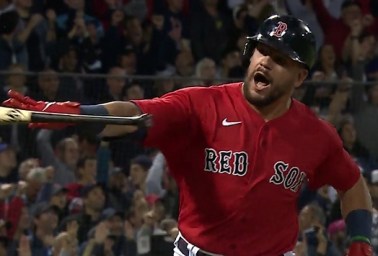
Kyle Schwarber

The Schwarbinator became the first of two former Cubs batting leadoff Tuesday night to strike big . . .

Legends real and alleged used to include longtime Chicago newspaper star Mike Royko’s postulate that the team with the most ex-Cubs lost. The Red Sox and the Yankees may have really tempted real or imagined ancient fates with their chosen leadoff men Tuesday night: World Series-winning ex-Cub teammates Kyle Schwarber (designated hitter, Red Sox, by way of the Nationals) and Anthony Rizzo (first baseman, Yankees, at this year’s trade deadline).

Those moves came of dire necessity, actually. The Red Sox lacked designated hitter J.D. Martinez after he rolled his ankle in the Red Sox season finale, and the Yankees lacked second base regular D.J. LeMahieu thanks to a sports hernia. So, naturally, the Elysian Fields gods decided to have a little mad fun. Right?

Schwarber struck first. With Cole already having a miserable evening in the hole 2-0, the Schwarbinator led off the bottom of the third by driving a 1-2 service no doubt and about twelve rows into the right field seats. Rizzo struck back with one out in the top of the sixth, hitting Red Sox starter Nathan Eovaldi’s first service on a high line inside that Pesky Pole for the first Yankee run. Then Judge promptly beat out a tough bouncer to shortstop.

The good news for the Yankees is that that finally got Eovaldi out of the game, after he’d manhandled them brilliantly through five and a third including eight strikeouts and no walks. The bad news was Judge on the threshold of disaster on the Stanton home run that wasn’t and the Nevin send that shouldn’t have been.

No Yankee reached base on walks all night. Seven Red Sox reached on walks from Cole and three Yankee relievers. Only Clay Holmes out of the Yankee pen, facing five batters, didn’t walk a single Red Sox batter while surrendering one hit and striking one out. The walks really burned the Yankees in the bottom of the seventh, when Verdugo sent the insurance runs home with two out, slashing a two-run single against Yankee reliever Chad Green to score Hernandez and Schwarber—both of whom had reached on walks.

That Yankee sixth is what used to happen to the Red Sox when they could just taste even a piece of glory in their mouths. Something surreal. Something from The Twilight Zone. Something else from The Outer Limits. Something more from Alfred Hitchcock Presents. Leaving the Red Sox yet again fallen to the rocks below when they’d gotten to within one mile or a few innings of the mountaintop.

Why, even B.F. Dent himself—hitter of the home run that broke an earlier generation of New England hearts in the 1978 American League East playoff game—was in the Fenway stands and chatting for one minute with ESPN analyst Buster Olney. (He admitted he’s still asked about that three-run homer into the ancient Monster net—about two or three times a day.)

Except that the ESPN audience probably noticed Dent a lot more than the crowd around him in the stands did. They were too well and appropriately occupied with the Yankees incurring the kind of outrageous malfortune that once seemed the birthright of Red Sox baseball.

Before the game Dent predicted to Boston Globe columnist (and author of The Curse of the Bambino) Dan Shaughnessy, “I think Gerrit Cole will pitch a great game, and I think the Yankees will beat ’em.” That’d teach him. Cole pitched two full innings in the hole 2-0 and got nobody out while facing two more batters after Schwarber’s leadoff launch in the third.

This time, it was the Yankees crushed by trans-dimensional furies and a fatal miscalculation. It’s starting to become as much a Yankee thing this century as a Red Sox thing last. From Dave Roberts stealing second to launch that surreal 2004 Red Sox self-resurrection to Jose Altuve’s pennant-winning two-run homer, it looks as though Mystique and Aura really have left the building.

The ladies didn’t have to take Phil Nevin’s baseball brain with them, though.

Wherever the Red Sox go from here, and they know it won’t be easy tangling with the AL East champion Rays in a division series, nothing can change the extraterrestrial triumph over the Empire Emeritus that gives them that chance in the first place.

On a sober anniversary

New York Mets, New York Yankees

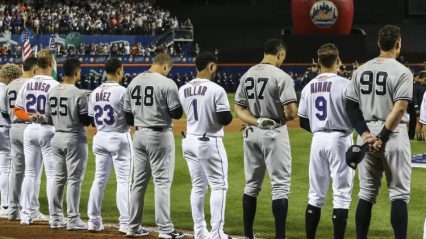
Honouring the murdered and the fallen who tried to save them during the original 9/11 atrocity at the World Trade Center, the Mets and the Yankees stood shoulder-to-shoulder before Saturday night’s game. Shown left to right here: Pete Alonso, Gleyber Torres, Javier Baez, Anthony Rizzo, Jonathan Villar, Giancarlo Stanton, Brandon Nimmo (still on the injured list), and Aaron Judge.

Members of the 2001 Mets, including Hall of Famer Mike Piazza, escorted various groups of first responders onto and around the field Saturday night. The Citi Field audience cheered loud and long, not just for those Mets but for those first responders who survived or whose comrades were lost in the 11 September 2001 atrocity upon the World Trade Center.

Several of today’s Yankees and Mets—wearing assorted New York first-responder hats, this time with the blessing of baseball’s government—lined up intermingled on the baseline and came close enough to tears. The Mets wore the same non-pinstriped home whites the team wore in 2001, complete with “9-11-2001” embroidered on the right sleeve, but this time with a  black-shadowed version of their “New York” traveling letters across the chest.

After a moment of silence in honour of those murdered in the WTC attacks,  and those who died trying to rescue the attacked, the New York City Cops & Kids Choir sang “The Star Spangled Banner” in a striking balance of chorale, section, and soloist. The cheer at the finish amounted as much to a prayer that a country now fragmented in enough ways might yet un-fragment once again in enough ways, as it did the performance that truly honoured the dead.

The Fox Sports telecast cut to a special anniversary video story, recalling the moment New York can never forget, ten days after baseball ended its self-imposed hiatus following the original atrocities—Piazza blasting what proved a game-winning, two-run homer in the bottom of the eighth, in old Shea Stadium, off Braves reliever Steve Karsay, off the second tier of a television camera stand behind the center field fence.

Then, the Mets’ and Yankees’ 2001 managers, Bobby Valentine and Hall of Famer Joe Torre, threw ceremonial first pitches to the plate, after Valentine puckishly ran back onto the mound to toe the rubber. That was a very far cry from Valentine having led his 2001 Mets in running rescue-and-recovery efforts outside old Shea Stadium itself—and having fear of further danger, as he’s acknowledged often since—after the WTC attacks.

After a commercial break—including a stunning montage of a young lady named Rowen Emerson Jones playing “God Bless America” on her violin, at various New York spots including the Brooklyn Bridge and a 9/11 memorial—it was time at last to set sober reflection and ceremony to one side, play baseball, and grip the Citi Field crowd until the last out of an 8-7 Yankee win.

On baseball terms, the Mets’ home crowd would have loved to have back the awkward should-have-been double play finisher second baseman Javier Baez—hurrying the throw to first—sent airmail past first baseman Pete Alonso that allowed the eighth Yankee run in the top of the eighth in the first place.

This was an interleague game whose sole significance otherwise rested solely in the now-faint postseason hopes of both the Mets in the National League East and the Yankees in the American League East. Had it not been for 9/11’s twentieth anniversary, the bigger baseball news of the night might have been Brewers pitchers Corbin Burnes and Josh Hader collaborating on a major league record ninth no-hitter of the season in their 3-0 win over the Indians—now the first team to be no-hit three times in a season.

The Yankees and the Mets exchanged single-hit halves of the first inning off their starting pitchers, Corey Kluber for the Yankees and Taijuan Walker for the Mets. The baseball fun really began in the top of the second, when the Yankees battered Walker for a pair of two-run homers (catcher Kyle Higashioka, center fielder Brett Gardner), a solo bomb (Aaron Judge, right after Gardner), and a too-early 5-0 lead.

Aaron Judge

Judge led the Yankee attack with two home runs Saturday night.

The Mets got right back into the game in the bottom of the inning. Second baseman Javier Baez, one of the notorious Thumb Bunch, waited out a leadoff four-pitch walk and stole second while left fielder Jeff McNeil struck out swinging. Then a second Thumb Buncher, Kevin Pillar, drove Baez home with a liner just inside the left field line, before catcher James McCann—who’s seen as one of the Mets’ more dubious free agency signings ordinarily—hit a drive that eluding a leaping Judge at the right field wall into an RBI triple. Walker himself followed with a line single to right sending McCann home effortlessly.

From there, Walker overcame his own wounding flaw, trouble commanding his fastball, and retired each the next thirteen Yankees he faced. Along the way, Baez turned on a Kluber service with two out in the bottom of the third and ripped it on a fast high line into the lower left field seats to pull the Mets back to within a run.

Kluber endured through four innings before Yankee manager Aaron Boone opened his bullpen and brought Lucas Luetge in to work the bottom of the fifth. The good news for the Yankees: Luetge shook off a one-out base hit by Mets right fielder Michael Conforto, shot through unoccupied shortstop territory on the defensive shift, to get rid of Alonso on a fly to the back of right field and Baez on a bullet liner Yankee third baseman Gio Urshela speared in a somewhat spinning crouch for the side.

The bad news for the Yankees was Luetge opening the Mets’ half of the sixth by walking McNeil on four straight pitches. Exit Luetge, enter Chad Green in a double switch sending Tyler Wade to play third base. Unfortunately, enter three baseballs thrown onto the field in right by unknown Citi Field idiots, followed by another couple of jackasses running onto the field but taken down swiftly enough by stadium security.

The unruly delay knocked Pillar out of his batting rhythm and into a swinging strikeout. But it didn’t stop McCann from turning on a 1-1 service and driving it into the left field seats, yanking the Mets into a 6-4 lead and inspiring one fan adjacent to the broadcast booth to holler, “Rock ’em! Sock ’em!” Those who remembered Piazza’s 2001 blast hoped against hope that another Met catcher’s bomb would prove the winner on the actual 9/11 anniversary, instead of in the first Mets home game back after baseball’s self-imposed September 2001 break.

The Mets had one more run in them in the bottom of the seventh, when with two outs and Clay Holmes on the mound for the Yankees, Baez chopped one off the plate up toward third, with Wade having a tough throw to make and Baez beating it by a hair as a few television replays plus the umpires’ review showed. McNeil singled him to third, Pillar singled him home with a liner to left, and it looked as though the Mets had an insurance run.

Seth Lugo had relieved Walker and thrown a spotless top of the sixth, and now Trevor May took over for the seventh. Oops. Gardner opened with a base hit through the hole at second, and Judge hit a parabolic punt sailing above the top of the stadium roof but landing halfway up the left field seats to tie the game at six. Yankee left fielder Giancarlo Stanton chased May with a long single, and Aaron Loup took the mound for the Mets.

It looked like Loup would have a simple gig when he got rid of Yankee first baseman Anthony Rizzo in a hurry on a fly out that nudged Conforto back almost to the track in right. Shortstop Gleyber Torres smashed one hard enough on the ground to short that his Mets counterpart Francisco Lindor couldn’t handle properly and got ruled a base hit.

Luke Voit pinch hit for Holmes. He grounded one to short on a very weird hop, but this time Lindor snapped it up at once and threw to second to get Torres. Baez in his rush to end the inning threw flatfoot off his right leg, mid-pivot, and the ball sailed over and past Alonso, enabling Stanton’s pinch runner Andrew Velasquez to score the eighth Yankee run.

The blameless Loup promptly struck Higashioka swinging on four pitches, but the Mets couldn’t cash in the two-out baserunner they got when Lindor wrung Yankee reliever Albert Abreu for a full-count walk. After another delay from another idiot running on the field—Hall of Fame pitcher/Fox Sports analyst John Smoltz wondered aloud, and appropriately, why people pick even evenings of sober commemoration for their “look at me!” moments—Conforto wrung Abreu for another walk.

Up to the plate came Alonso, the Met everyone in the ballpark wanted in this situation. He gave it his best shot, too. On 1-1 he hit one high and deep to center field, but he’d connected just on the underside of the ball, enough to give the Yankees a momentary jolt but not enough to keep Gardner from catching it on the edge of the track.

Veteran Mets relief pickup Brad Hand rid himself of Wade (ground out to second), Yankee second baseman D.J. LeMahieu (identical ground out to second), and Gardner (foul tip swinging strikeout) in the top of the ninth. But Mets pinch-hitter J.D. Davis’s one-out ground-rule double wasn’t enough in the bottom. He took third when strike three escaped Higashioka but the Yankee catcher recovered the ball soon enough to keep Pillar from taking first by just a step.

Then McCann gave one a ride out to right. It wasn’t enough of a ride. Judge snapped the ball into his glove to end the game, snapping a low for the Yankees in which they’d entered Saturday night having lost seven straight and—how cruel the irony—nine of eleven.

In baseball terms, the win put the Yankees into a tie with the Blue Jays for the second AL wild card, the Blue Jays having taken a doubleheader from the hapless Orioles. The loss kept the Mets five behind the Braves in the NL East and four behind the Reds and the Padres—both defeated earlier Saturday—for the second NL wild card.

In spiritual terms, the full Citi Field house, the pre-game ceremonies, and the shoulder-to-shoulder interweaving of Mets and Yankees on the baseline during those ceremonies reminded people of the better sides of New York City. The sides that show recovery and perseverance with little more than just basic effort of the heart. Even commemorating the anniversary of an atrocity that—who could have predicted—killed fewer people than were reported to have died Friday alone from COVID-19-related illness.

Maybe sports don’t really heal, but maybe something like a baseball game relieves the sting of certain atrocities, pestilences, and sorrows for just a little while.

But to the idiots throwing balls on the field, running onto the field, and even booing the 7 Line Army—that particular group of orange-shirted, die-hard Met fans—for refusing to partake of the still-idiotic Wave in the seventh inning (if the 1980s call demanding it back, let them have it back, unapologetically), three words: Go to hell.