Short of the track, short of the Giants

Fernando Tatis, Jr.

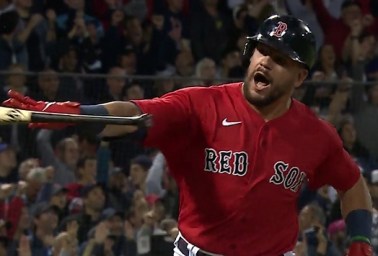
Tatis destroyed a hanging slider for homer number 40 in the seventh Wednesday night, but he couldn’t quite walk it off in the ninth, though not for lack of effort . . .

Fernando Tatis, Jr. started the Padres’ Wednesday night comeback attempt when he hit one out with one out in the bottom of the seventh. Why shouldn’t he have wanted to finish it by way of a game-winning blast with two on in the bottom of the ninth?

The National League’s leading home run hitter this year so far gave the Giants’ righthanded submariner Tyler Rogers’s climbing slider a high ride to Petco Park’s deep left. Even Giants broadcasters Duane Kuiper and Mike Krukow thought it was likely to go and the Padres were likely to win.

Except that it didn’t, and they didn’t. That’s been the Padres’ story in the season’s second half. Minutes late and dollars short.

The drive hung up just enough to fall short enough and into the waiting glove of Kris Bryant, playing left near the track for the Giants, snapping the ball shut to end an 8-6 Giants win that looked like a blowout in the making after six and a half innings.

“I wish I could celebrate in a different story,” Tatis said post-game, “but it’s been a long year, a lot of ups and downs, especially coming back from those injuries. At the end of the day, I’m pretty happy with the results and how I bounced back and this is history. It’s something to celebrate.”

He’d had to recover from a couple of shoulder injuries to become only the tenth man in Show history to hit forty homers or more in a season before his 22nd birthday. He might celebrate history, but he probably would have celebrated a Padres win more.

Every Giant fan in the house—there were plenty making the trek to San Diego, especially the group of orange-clad elders known as the Game Geezers—should thank Rogers for delivering the narrow escape. They should thank rookie Giants reliever Camilo Doval even more profoundly for the one he delivered in the bottom of the fifth.

One of the Giants’ soon-to-be-fabled retreads, lefthanded starting pitcher Scott Kazmir, ran into big trouble after delivering four innings of one-run ball that weren’t exactly on the virtuoso side but weren’t exactly on the weak side, either. But he walked Victor Caratini on a full count, surrendered a base hit to pinch-hitter Jake Marisnick, and walked Tatis on four straight.

Then Giants catcher Buster Posey made a might-have-been grave mistake. He got his glove out far enough to catch a piece of Jake Cronenworth’s bat as Cronenworth slashed a foul down the left field line. The interference call brought Caratini home, kept the bases loaded, and told manager Gabe Kapler Kazmir had had it for the night.

He brought Doval into the impossible nightmare. Ducks on the pond, nobody out, and Manny Machado checking in at the plate. This can be something comparable to trying to bring a Boeing 747 home without a scratch, bump, or crash after three of the four engines blow.

Doval attacked Machado as though he was just playing catch with Posey. Three hard, quivering sliders that didn’t get anywhere near the middle of the plate. Three hard, hell-bent swings on each of which Machado looked as though he wanted to send his mates on the bases around the horn twice on one drive. Then, Doval wrestled Tommy Pham into dialing Area Code 6-4-3 for the side.

Even the Padres’ faithful had to appreciate that kind of narrow-escape, safe landing, which Kapler called “one of the gutsier performances of the year from anybody in our pen.”

The irony of Caratini scoring on catcher’s interference wasn’t necessarily lost on anyone. It was Caratini’s glove touching Tommy La Stella’s bat, as LaStella fouled one high down the left field line opening the game, that put La Stella aboard and began Padres starter Vince Velasquez’s three-run nightmare, giving the Giants the extremely early lead in the first place.

Velasquez wasn’t exactly sharp in the first place. Not after starting Brandon Belt 0-2 and finishing by walking him, then throwing a 1-1 jammer that Posey somehow fisted into a balloon shot into short right center to load the pads.

He might have wrestled Lamonte Wade, Jr. into an eight-pitch strikeout, but Bryant nailed him for a bases-clearing double off the right center field wall, before Brandon Crawford pushed Bryant to third with a fly out to the back of center and Evan Longoria struck out swinging for the side.

La Stella’s no stranger to catcher’s interference. It happened to him twice in one game, as a Cub, on 7 June 2018, making him only the seventh player to benefit thus. Then-Phillies catcher Andrew Knapp’s mitt touched his bat twice—in the first, when he grounded one back to pitcher Nick Pivetta; and, in the eighth, against reliever Adam Morgan, when Knapp’s mitt hit the bat as La Stella fouled one off. But neither one figured in that game’s scoring, the Cubs beating the Phillies by a run.

The game ended up thickening the Giants’ National League West lead to two games with the Dodgers getting slapped silly, 10-5, by the Rockies in Coors Field. The Rockies’ season burial isn’t wholly official yet; the Padres still have a very outside, very slim wild card hope.

Kazmir, last seen among the silver medalists on the U.S. Olympic baseball team earlier this summer, pitched like an elder looking for one more season in the sun and finding various ways to justify it. He pitched into and out of trouble in the bottom of the second, turning a one-out single (Eric Hosmer), a two-out ground-rule double (Trent Grisham), and then offered evidence for the defense in favour of making the designated hitter universal.

Caratini came to the plate with Padres relief pitcher Ryan Weathers due to bat next. DH partisans often cite the frequent National League pitchers’ cop-out, described best by Thomas Boswell when recalling the “thousands of rallies I’ve seen killed when an inning ends with one pitcher working around a competent No. 8 hitter so he can then strike out the other pitcher. When you get in a jam in the [American League], you must pitch your way out of it, not ‘pitch around’ your way out of it.”

Kazmir threw Caratini two so-obviously weak changeups, then handed Caratini first on the house. Then he got Weathers to ground one to Crawford at short for the inning-ending force out. Exactly why the Giants thought that dangerous .215-hitting Caratini was liable to tie the game with one swing—he’s hit as many home runs over five years as Tatis hit by 15 June this year—escapes.

And exactly why the Padres didn’t think to pinch hit for Weathers escapes as well, particularly with known Giant-puncturer Adam Frazier (he’s hit .365 against them this year) on the bench for the evening. Casey Stengel once believed that when you have an opening, you shove with your shoulder. Padres manager Jayce Tingler forgot he had a shoulder (and enough decent bullpen still) with which to shove.

Until Kazmir ran into that fifth inning trouble, he kept the Padres mostly off balance from there, while Weathers and his successor Ross Detwiler kept the Giants mostly quiet until yielding to converted-from-shortstop Javy Guerra for the top of the sixth.

Oops. Posey lined the first pitch down the right field line, falling in fair to lead off with a double. Wade swatted a full-count sinker up the middle for first and third. Bryant grounded out to Hosmer playing first, but Crawford slapped an opposite-field single to left to send Posey home.

One Longoria strikeout and pitching change to Nabil Crismatt later, Mike Yastrzemski singled Wade home with a base hit right back up the pipe, before pinch hitter Wilmer Flores flied out to right to keep things 5-1, Giants.

Crismatt ended up really taking one for the team in the seventh. He handed La Stella a four-pitch leadoff walk, and Belt promptly hit the first pitch he saw for a line single into right. Then Posey lined a 1-2 changeup the other way down the right field line again, sending La Stella home. Wade doubled Belt and Posey home before going down trying to steal. Bryant grounded out to first, but Crawford shot a single past third before Longoria struck out for the third time on the night.

That made it 8-1, Giants. Then, with one out against Giants reliever Jarlin Garcia, Tatis fought back from 0-2, caught hold of a hanging slider on 2-2, and drove it into the left field seats. Cronenworth promptly doubled to the back of right field and Machado sent a hard liner over the hole at short to send Cronenworth home.

Exit Garcia, enter Domonic Leone, and Pham’s first-pitch liner the other way to right loaded the pads for the Padres again. But all they had to show for that was Hosmer poking a single up the middle to send Machado home, before Wil Myers struck out and Grisham slapped his way into an inning-ending force out at second.

Going 3-for-12 with men in scoring position wasn’t exactly the way to overthrow the Giants. Things weren’t helped any for the Padres when Crawford made an acrobatic spin and grab of a Myers grounder that had one-out base hit stamped on it, Crawford throwing Myers out off balance but right on the button for the second out of the fourth.

Against the submarining Rogers in the ninth, Pham worked a leadoff walk and Hosmer hit a ground-rule double to send him to third. Finally the Padres sent Frazier to the plate to pinch hit, and he pushed Pham home while grounding out to second, before Grisham singled Hosmer home with the sixth Padre run.

After Caratini flied out to left, up came Tatis. He wanted to hit that three-run homer so badly the entire ballpark could taste it. Especially after he opened with a foul out of play to the right side. Then Rogers’s slider climbed up to the middle of the zone somewhat away from Tatis. Tatis swung as if his and the Padres’ lives depended on it.

It wasn’t enough.

Things haven’t been enough for the reeling Padres since the middle of August. And just as they were about to lose their fifth straight and eleventh in fourteen games, general manager A.J. Preller continued an apparent organisational shakeup—shuffling assorted farm system roles two days after firing seven-year farm director Sam Geaney.

The Padres have gone from Preller’s inability to fortify a decimated starting rotation (they failed spectacularly at the trade deadline after the world only thought they’d bag Max Scherzer) to Tingler’s apparent inability to keep his clubhouse consistently steady. They’re already thinking wait till next year in San Diego. Next year, and maybe a new manager.

For the Giants the season’s going to end up with them finishing what they started, taking hold of their division and holding on no matter the overqualified Dodgers snapping at their heels. Those two antagonists could end up squaring off in a postseason set that’s liable to do what earthquakes can’t—blow the Richter scale to bits.

Reality check: He’s not the catchers’ bomb king—yet.

Salvador Perez

I don’t want to bust your bubble, Salvy, but you ain’t the single-season home run champ among actual catchers just yet. You still have a shot at it, though . . .

I don’t want to spoil the party, but the American League’s current home run leader hasn’t really broken the single-season record for home runs by a catcher. Yet.

Come to think of it, neither, really, did the Hall of Famer he’s being lauded for surpassing, Johnny Bench.

Perez teed off on Indians starter Triston McKenzie in the top of the fifth Monday, with Nicky Lopez aboard, and sent his 46th homer of the season into the Progressive Field bleachers to send home the sixth and seventh Royals runs. (The Royals won, 7-2, and went on to sweep the doubleheader.) And, yes, Perez was the catcher at the time he hit the blast.

ESPN made a note that Perez topped Bench’s 45 in 1970 “for the most by a player who played at least 75% of his team’s games at catcher.” Well, there are two Hall of Famers who did hit 40 home runs in a season as catchers. One of them did it twice. Both of them played ninety percent or better as their teams’ catchers in those seasons. So did the non-Hall of Famer who hit 41 as a backstop one fine season.

But nobody thought about mentioning Roy Campanella or Mike Piazza while Perez approached Bench’s 1970 season total. They didn’t say a single word about Piazza hitting 40 each in 1997 and 1999, hitting every one of them strictly when he was his team’s catcher in both seasons.

Perez this season has actually hit 31 homers when he was the Royals’ catcher and fifteen when he was the Royals’ designated hitter, on those days the Royals elected to keep his fat bat in the lineup while giving his 31-year-old, well-enough-worn knees a break.

When Bench hit his 45 in 1970, he hit 38 of them as the Reds’ catcher. He also hit one each when he played first base and right field, and five when he played left field. Bench hit an even forty homers total in 1972, and he hit 34 of those as the Reds’ catcher. He hit two playing third base and four playing right field while he was at it.

The previous catcher with the most big bops was Campanella, hitting 41 in 1953. But what do you know: Campy hit forty of those as the Dodgers’ catcher. (He hit the other as a pinch hitter.) Piazza’s pair of 40-homer seasons as a catcher really tied Campanella, then. He’s still the only catcher in Show history to do that twice.

Never mind “the most by a player who played at least 75 percent of his team’s games at catcher.” How about recognising Piazza playing 91 percent of his 1997 games at catcher when he hit forty homers as the Dodgers’ catcher? How about recognising Piazza playing 96 percent of his 1999 games behind the plate when he hit forty homers as the Mets’ catcher? How about recognising Campanella playing 93 percent of his 1953 games behind the plate when he hit forty as the Dodgers’ catcher?

How about that non-Hall of Famer who hit 41 as a catcher in 1996—hitting every one of those as a catcher while playing 94 percent of his games behind the plate? Todd Hundley, anyone? There’s your real single-season homers-by-catcher record holder. My guess is that Hundley not being a Hall of Famer slips him through the proverbial cracks; I’d forgotten him myself until a friend of good standing reminded me.

Various breeds of fans and analysts love to nit-pick and cherry-pick when a player seems to knock a predecessor out of the record book. I didn’t hear a lot of nit-picking and cherry-picking about Perez approaching Bench.

But if you’re going to continue crowning Bench the now-dethroned single-season home run king among catchers, you really ought to see what he actually hit when he actually strapped the tools of ignorance on. He came up two short of Campanella as a catcher in 1970 and six short of Campy behind the dish in 1972. Not to mention three short of Hundley.

Piazza actually matched Campanella for power while actually catching, dead-even, in 1997 and 1999, though he still fell one short of Hundley. But you didn’t hear that in the middle of the hoopla preparing to anoint Perez the new single-season home run champion among catchers, either.

Yet when Bench broke Hall of Famer Yogi Berra’s record for career homers by a catcher (you may remember hearing that Berra sent Bench a congratulatory telegram saying, “I always thought that record would stand until it was broken”), they mentioned the 327 Bench hit specifically as a catcher (overall, he sent 389 over the fences) and the 293 Yogi hit while actually behind the plate.

And when Piazza broke the total of the man who broke Bench’s lifetime homers-by-catcher total, fellow Hall of Famer Carlton Fisk, they mentioned the 396 Piazza launched specifically as a catcher, too.

But they didn’t talk that way when Perez approached Bench’s overall 1970 season total. I couldn’t possibly predict how many more home runs Perez has in his bat with eleven games left on the Royals’ season schedule. I’m not sure anyone else can, even with the Royals closing out against the Indians, the Tigers, the Indians again, and the Twins.

He’s hit eight this month so far. But he needs to hit seven more while catching if he wants to tie Bench’s actual 1970 bombs as a catcher; and, he needs nine more to tie, ten more to pass Piazza and Campanella, and eleven more to pass Hundley, the real record holder.

Then, again, with the way he’s hit this season, and assuming the Royals let him continue catching with their season lost long enough, it’s not necessarily out of bounds to think Perez still has a real shot.

Manny Machado teaches a hard-learned lesson

Manny Machado, Fernando Tatis, Jr.

Machado gestures emphatically while putting Tatis in his place in the fifth Saturday night.

More often than I care to admit, I miss the real fun stuff. That’s when I have to play catch-up as best I can with what I have.

On Saturday night, I watched my Mess (er, Mets) lose to the Phillies, 5-3, because the game was available to me on Fox Sports via Hulu.

But out in St. Louis, there were Padres veteran Manny Machado and boy wonder Fernando Tatis, Jr. having it out as the sides began changing in the middle of the fifth in St. Louis.

There, moreover, was Machado actually behaving like a team leader in the bargain. Go ahead and say it, until now you thought putting Machado and “team leader” in the same sentence was the equivalent of mining a diamond with a dental pick. But hear me out.

In both games, both sides spent enough time chirping over, shall we say, floating strike zones—the Mets and the Phillies about plate umpire C.B. Bucknor’s, the Padres and the Cardinals about their plate umpire Phil Cuzzi’s. That isn’t exactly new business when it comes to that pair of arbiters.

But the worst out of either the Mets or the Phillies  about Bucknor in Citi Field was chirping. In Busch Stadium, Tatis didn’t just take it when Cuzzi rang him up on a called, full-count, third strike from Cardinals starting pitcher Adam Wainwright leading off the top of the fifth.

The Padres led 2-0 at the time, in a game they absolutely had to win to stay alive in the National League wild-card race. First, Tatis gave an obviously frustrated sigh. Then, he bent his head over his left shoulder and made a few body-language movements plus some utterances . . . but he did it facing away from Cuzzi.

The bad news is that replays showed Cuzzi actually called the pitch right. It hit just under the strike zone ceiling. The worse news for the moment was Padres manager Jayce Tingler hustling out of the dugout to argue the call, trying to protect his player, but getting himself tossed post haste.

As Tingler got the ho-heave, Tatis returned to the dugout and banged the bench a few times in his frustration. Then, apparently, he continued grumbling about that third strike as the inning went forward, with Jake Cronenworth stranded on second following a one-out double. Machado is known to have befriended Tatis personally, but he’d also had more than enough of whatever bellyaching Tatis continued during the inning.

The next thing anyone knew, Machado could be heard hollering clearly enough at Tatis, Go play baseball! You play baseball. You can’t worry about that sh@t! You go play baseball! [Fornicate] that sh@t! Tatis must have tried to interject something about the disputed strike right there, because Machado then hollered, No, it’s not. It’s not about you! It’s not [fornicating] about you! Go [fornicating] play baseball.

Then the Padres’ veteran third baseman and their youthful superstar shortstop went back to the field to continue [fornicating] playing baseball.

The Padres lead held until the bottom of the eighth, when Cardinals third baseman Tommy Edman lofted a one-out sacrifice fly, first baseman Paul Goldschmidt wrung Padres reliever Emilio Pagan for a walk, and left fielder Tyler O’Neill hit a 2-2 cutter into the left field bullpen.

Perhaps ironically, two innings before that blast, O’Neill was no more thrilled with Cuzzi’s strike zone than any Padre on the night. He simply didn’t let mere frustration turn into a fuming that might require a Cardinal veteran or two dressing him down on the spot before the ump might throw him out.

“That was a great job by him not getting too animated there,” said Wainwright, who’d surrendered only a pair of RBI singles to Victor Caratini and Tommy Pham in the top of the fourth. “If we lose him right there, we probably lose the game . . . That was a lot of maturity by him to not get thrown out right there on some tough calls.”

O’Neill’s blast overthrew the lead Padres starter Yu Darvish handed the Padres bullpen after seven shutout innings during which he’d allowed a mere three hits while striking nine Cardinals out. The Padres had no answer in return against Cardinals reliever Giovanny Gallegos in the top of the ninth, with their own veteran first baseman Eric Hosmer striking out swinging on a slightly high fastball to end it.

Machado and Tatis had to be separated by Padres coach Ryan Flaherty before they returned to the field. Post-game, Tingler said only that the dustup wasn’t viewed “negatively” around the team that’s now lost 23 of their last 33 games after entering the season practically crowned the World Series winners-to-be by an awful lot of people now dining on roast crow.

“I’m sure people on the outside think it’s whatever they think, but we’re family,” Tingler told the press. “We’re not going to discuss the details, but we care. There’s passion, there’s frustration. Those are all emotions that are natural and those things happen. But it comes down to a group of men caring.”

The details were captured on more than one video that went slightly viral within moments of the dustup ending, as things turned out. Then the real focus became Machado, who once had a reputation for just the kind of petulance over which he’d now dressed Tatis down so dramatically and, shall we say, colourfully.

Those trying to score the dressing-down as just another example of Machado still being a self-centered pain in the rump roast might be shocked to discover a former Padre, Will Middlebrooks, tweeting very much otherwise in the immediate wake:

I know people will take the angle of “Machado is a bad teammate”…but you couldn’t be more wrong here. This was a leadership move. Let’s not forget FTJ is still 22. A phenomenal player, but still a lot to learn. Tatis can’t get tossed in the 5th inning of a game they need to win.

During an exchange featuring more than a few dissenting tweeters, Middlebrooks added, “History tells me that Machado had the experiences to know better. He’s grown up a lot and learned from his past.

The Padres didn’t make either Machado or Tatis available to the press after the game. But a week earlier, Machado spoke to Athletic writer Britt Ghrioli, during a weekend on which the Padres lost twice to the Dodgers. Machado only began by saying he’d learned some things at last.

There’s a time and place for everything. In Baltimore, I was young. I was just there to play. There were other guys that were leaders—Adam (Jones), J.J. (Hardy), (Matt) Wieters . . . Now, obviously, it’s different. Guys are looking up to me.

I think what’s happening now in this game is we are losing track of the older guys, the respect of the veterans, guys who have been here and done it a long time. You got to earn that respect; you got to earn that role. It’s not just given. A lot of players now are just expected to be the guy [when they reach the majors]. But I’m old-school baseball; I want to teach it how I was taught.

When you are young you make a lot of mistakes. You make mistakes as you grow and hopefully you learn from them, you gain experience. You [fornicate] up again, give your thoughts and learn from it again. That’s what it’s about. I messed up a lot at a young age, like a lot of people, but you take that and you try to learn from it. I’m at the point now where — I’ll be 30 [next year], I want to win. I just want to win.  And I think we can do that here.

“I would say Manny’s done a good job with all his leadership throughout the year,” Tingler said, though he refused again to speak of the deets involving the dugout dustup. “But I would say Manny being able to share his experience and share his past experiences of coming up in the league is a good thing.”

It hasn’t turned Machado into a grump refusing to let the kids play. He still has clear fun playing the game. It’s simply made him one of the adults in the room who knows from bitter experience when the kids can’t afford to get sent to bed without their supper and tries to stop it as best he can with what he has.

While all that happened, I was watching Phillies second baseman Jean Segura hit a pair of solo homers in the first and third off Mets starter Carlos Carrasco. I watched Mets center fielder Brandon Nimmo hit a one-out triple off the top of the right field wall and score on an infield ground out in the sixth to cut the deficit in half.

But I also watched Bryce Harper hit a two-run double in the seventh off Mets relief retread Brad Hand to put the game just out of the Mets’ reach. The other guys have now hit .357 off Hand since the Mets lifted him from the waiver wire at the beginning of this month.

And, after Mets reliever Miguel Castro sank into but escaped a bases-loaded jam with no further Phillies scoring in the top of the eighth, I saw Nimmo hit one over the right field fence to lead their half off but no further Met scoring the rest of the way.

It put the Phillies a mere game behind the Braves in the NL East, with the Braves losing to the Giants, 2-0, in San Francisco. It also kept the Mets five and a half out of first in the East but pushed them to seven games back in the wild card race. The Phillies knock on the door of improbability; the Mets—now losers of five straight—are only a step or three from going through the floor.

Catching up to the Padres and their once-unexpected adult in the room in St. Louis proved just as intriguing.

It’s a Gaus, Gaus, Gaus—sort of

Kevin Gausman

Kevin Gausman isn’t exactly swinging into McCovey Cove here—and he needed a little help from his friend sliding home head first to win Friday night.

Look, I don’t want to be a spoil sport. OK, maybe I do. A little. But anyone getting any ideas about celebrating Giants pitcher Kevin Gausman’s game-winning pinch loft Friday night as evidence against the universal designated hitter . . .

Seriously?

It’s not as though it meant the National League West for the re-tread Giants. They’d already nailed a postseason berth days before. It’s not as though Gausman was the best pinch-hitting option available to manager Gabe Kapler in the bottom of the eleventh with the bases loaded, one out, and relief pitcher Camilo Doval due up.

And, it’s not as though Braves reliever Jacob Webb threw him something with a nasty enough dance to the plate that the biggest boppers in the National League would have had trouble keeping time and step with it.

So come on. Let’s have a little fun with the home crowd in Oracle Park booing the hapless Gausman—who’s actually in the back of this year’s Cy Young Award conversation, having a splendid season on the mound (he woke up this morning with a 2.78 ERA, a 2.88 fielding-independent pitching rate, a 4.2 strikeout-to-walk ratio, and a 10.7 strikeouts-per-nine rate)—because they had no clue Kapler was clean out of position players to send to the plate.

Let’s have a little more fun than that with Webb and Gausman midget-mud-wrestling the count from 1-2 to a full count, because Webb couldn’t find the zone with a search party and a bloodhound and because the Braves handed Evan Longoria and Donovan Solano free passes to load the pads in the first place.

Let’s have a little more fun than that with the Oracle crowd going from lusty booing to standing-O cheering after Webb pumped and delivered a 3-2 meatball that had so much of the zone a real hitter could have turned it into a walk-off grand slam while looking over his shoulder at Brandon Belt in the Giants’ on-deck circle.

But let’s give ourselves a reality check. Gausman’s loft to Braves right fielder Joc Pederson didn’t exactly push Pederson back to the edge of the warning track. It landed in Pederson’s glove while he took a couple of steps forward in more or less shallow positioning.

Shallow enough that the game missed going to the twelfth by about a foot south, on what might have been an inning-ending double play. Except that Brandon Crawford—who’d opened the inning as the free cookie on second and took third on Webb’s wild pickoff throw—had to beat Pederson’s throw home by sliding head first to the plate.

Crawford would have been dead on arrival if he hadn’t taken the dive and traveled beneath Braves catcher Travis d’Arnaud whirling around for the tag that would have gotten the veteran Giants shortstop squarely even if he’d dropped into a standard slide. Even Gausman knows he had a better chance at breaking the land speed record aboard a Segway than there was of him walking it off.

“More than anything,” he said in the middle of his did-I-do-that postgame, “I was trying to not look ridiculous, just take good swings, swing at strikes. Obviously I never would have thought I would have got in that situation coming to the ballpark today.”

Not with a .184/.216/.184 slash line entering Friday night’s follies. Not with a lifetime .036 hitting average entering this season, despite having a reputation as the Giants pitcher with the best bat control at the plate. Not with tending to go the other way when he does connect on those very rare occasions. “Um, well, that’s the first time I’ve pulled a ball,” he said post-game. “Like, in the big leagues.”

Thanks to the rule that says a sacrifice fly doesn’t count as an official at-bat, Gausman’s loft actually cost him four points on his on-base percentage.

The game got to the extras in the first place because, after d’Arnaud himself hit one into the left field seats with two aboard and one out to overthrow a 4-2 Giants lead in the top of the ninth, another Giants pinch-hitter—Solano, hitting for earlier pinch-hitter/outfield insertion Mike Yastrzemski—hit a two-out, 2-2 service from Braves reliever Will Smith only a few feet away from where d’Arnaud’s blast landed.

After not having swung the bat in a major league plate appearance in three weeks, thanks to a turn on the COVID list, Solano at least entered a record book. His game-tyer meant the Giants have hit a franchise-record sixteen pinch-hit bombs this season, and possibly counting.

Gausman, on the other hand, is only the third pitcher in the Giants’ San Francisco era to win a game with a pinch swing. He joins Don Robinson (bases-loaded pinch single, 1990) and Madison Bumgarner (pinch single, 2018) without a base hit for his effort.

The way the Giants have played this year, cobbled together like six parts Clyde Crashcup and half a dozen parts Rube Goldberg, nobody puts anything past them now.

Gausman is respected as one of the nicer guys in the game. Before Friday night’s contest the Bay Area chapter of the Baseball Writers Association of America handed him their Bill Rigney Award for cooperation with the Bay Area press. “He’s been terrific, including during some trying times with his family,” said the San Francisco Chronicle‘s Susan Slusser announcing the award presentation.

But he didn’t really do any anti-DH people any real favours after all. He hasn’t augmented any legitimate case for keeping any pitchers swinging the bat any further than this year. The best thing you can say for his Friday night flog is that he connected. He ought to buy Crawford steaks for the rest of the season for sliding astutely.

This year’s pitchers at the plate woke up this morning with a whopping collective .110/.150/.142 slash line and an absolutely jaw-dropping .291 OPS. They’re also leading the league in wasted outs (388 sacrifice bunts), with the next-most-prolific such among the position players being the shortstops. (55.)

Now, for the money shot. Belt is one of the National League’s more consistent hitters this season. He took a .942 OPS into Friday night’s game. He whacked a two-run homer to vaporise a Giants deficit in the first inning. With one out, would any sane manager ask a pitcher to do anything more than stand at the plate like a mannequin, with a bat like that waiting on deck to hit with ducks on the pond?

Kapler’s living the proverbial charmed life. As a player, he was a member of the 2004 Red Sox who finally won their first World Series since the Spanish flu pandemic. He wasn’t exactly one of those Red Sox’s big bats, but he was a late-Game Four insertion as a pinch runner, with then-manager Terry Francona letting him hang around in right field as the Red Sox nailed the Series sweep in the ninth.

As the Dodgers’ director of player development in 2015, Kapler got away with a feeble response at best, when a couple of Dodger minor leaguers were accused plausibly of videotaping an assault by two young women against a third, plus sexual misconduct involving a player’s hand down the victim’s panties. The team elected not to report it to the commissioner’s office or to the police—and he didn’t go over their heads to do so, either.

Then, Kapler was run off the Phillies bridge because, in two seasons, he couldn’t marry his analytical bent to the live situations in front of him and the Phillies ended up three games under .500 total with him on their bridge.

Now, he has the bridge of the National League West leaders fighting tooth, fang, claw, and charm against those pesky Dodgers with a two-game division lead and fourteen games left. He’d better not get too comfortable emptying his bench again any time soon. His pitchers are only hitting .081 this season. And they won’t always have Crawford on third to bail them out in a pinch.

“It’s been a show for quite awhile”

Bryce Harper

Philadelphia’s king of swing launches one into the second deck Thursday night.

When April was just about over, Bryce Harper resembled dead meat. He’d just been nose-coned by an errant Genesis Cabrera fastball, and it turned out worse for him. No, his schnozz wasn’t smashed, but the pitch ricocheted onto his left wrist.

After an April that finished with him showing a 1.063 OPS Harper’s May was abbreviated to fifteen games and a .634 OPS to show for them. Clearly enough the lefthanded launcher struggled through the injury, making far less than his normal hard contact, and probably should have been tied down to rest and let it heal properly.

Finally, after an 0-for-5 game on 22 May, Harper was indeed put on the injured list. Phillies manager Joe Girardi got caught lying through his teeth about the depth of Harper’s wrist injury. Some believed the Phillies would rather “engage in subterfuge to trick the opposing manager than play with an actual full roster.”

One way or the other, for all the tricks and lack of treats, Harper clawed his way back. All the way back to awakening this morning with the major league leadership in OPS (1.055) and OPS+ (183). All the way back to the rare standing of a .300+/.400+/.600+ slash line. (Harper’s: .314/.428/.627.)

All the way back into the National League’s Most Valuable Player Award conversation. All the way back from that balky wrist to entering a weekend set against the Mets as Philadelphia’s king of swing.

All the way back to helping as big as Harper can help in yanking the Phillies back to three games behind the Braves in the National League East and 2.5 games away from the second National League wild card.

If you wonder how big that can be at the most extreme, you should have watched the Phillies resurrect themselves against the Cubs, 17-8 Thursday night—with Harper doing the critical damage, especially a mammoth home run in the seventh.

So the Cubs battered seven runs out of the Phillies in the top of the third? The Phillies tore seven out of the Cubs in the bottom of the fourth. The Cubs who thought they had it made after the third didn’t know yet that they’d all but had it for the night.

Harper had already walked twice in the game when he squared off against Cub reliever Manuel Rodrigez in the bottom of the sixth with first and second and one out. On 1-2 he hit a long double sending Odubel Herrera home with the tiebreaking run. One out later, Didi Gregorius—who’d been drilled by a Cabrera pitch immediately after Harper took one off his beak in that late April game—singled Juan Segura and Harper home to make it 10-7, Phillies.

The next inning, after Willson Contreras got one back for the Cubs with a homer in the top of the frame, Harper got even more frisky. After Herrera doubled a pair home with one out, Harper faced yet another Cub reliever, Rex Brothers, and showed anything but brotherly love with first and third—he hit a three-run homer.

Segura merely added insult to injury with a two-run double in the bottom of the eighth. The Cubs, who’ve been dying since their trade deadline fire sale, gave up the ghost several innings earlier.

They must have wondered whether they’d been a little too greedy over apparent Phillies generosity in that seven-run third. Phillies starter Matt Moore walked the bases loaded and then hit Ian Happ with a pitch to start the Cub fun. Contreras then lined Rafael Ortega home, Patrick Wisdom sent a two-run double to the back of left center, and—one strikeout later—Matt Duffy hit one over the left center field fence.

The Phillies must have said to themselves, “Greed shall be its own downfall” in the fourth. Andrew McCutchen started that party with a two-run double down the right field line. A base hit and a hit batsman later, Matt Joyce wrung Cubs starter Kyle Hendricks for a bases-loaded walk. Herrera drove Brad Miller home with a base hit, and Freddy Galvis scored on a ground out, before Harper drew his second walk and J.T. Realmuto singled Joyce and Herrera home.

The full fifth and the top of the sixth passed cleaner than hounds’ teeth before Matt Vierling opened the bottom with a base hit up the pipe. After Herrera reached on an error at first base and Segura forced Vierling at third, Harper hit one the other way down the left field line to break the seven-all tie, before coming home with Segura when Grigorius shot one through the hole at shortstop into left.

Those were just warmups for what proved the main attraction in the seventh, with Herrera on third, Segura on first, and Harper hitting Brothers’s first pitch into the second deck behind right field.

“It feels good,” Harper said post-game, “but we’ve got a while to go. I want to keep playing well and have good at-bats, have good games and just be where we need to be down the stretch.”

“We’re all involved in this, right? And the game is always, to me, about our team,” Girardi said. “But he’s a big reason why we’ve hung around, just because of the season that he’s had and the last two-and-a-half months, whatever he’s done. It’s been incredible to watch. It’s been a show for quite awhile.”

“The challenge,” writes The Athletic‘s Matt Gelb, “has always been squeezing enough from the roster around Harper. It is flawed and will continue to be flawed even if the Phillies sneak into the postseason. It will not dampen the doubts about the organization’s long-term plan. But Harper has given the Phillies everything he promised, and the rest of the franchise has seventeen days to make it count for something.”

Neither Girardi nor the Phillies want the show to end. It might or might not be just a sliver outside possibility’s realm. But in theory, at least, they could even reach the postseason by a nose.