Sunday, bloody Sunday

2020-07-27 RickPorcello

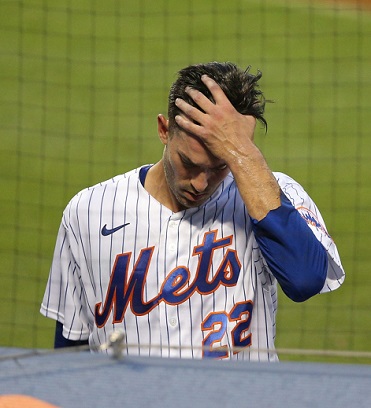
Rick Porcell wasn’t the only person in Citi Field smacking his head over Sunday’s carnage.

If the coronavirus doesn’t get the New York Mets, their pitching staff might based on Sunday’s lack of results. With apologies to Clark Griffith, Mets fans like home runs as much as the next fans, and—Jacob deGrom excepted—they seem to have assembled a pitching staff that is certain to please them.

Especially in the middle of the 14-1 massacre.

When Hunter Strickland, a relief pitcher who has surrendered a few significant launches in his past, is the first and only Mets pitcher to work an inning without surrendering anything more than a base hit that wasn’t cashed in one way or another by the Atlanta Braves, something is amiss.

Reviewing the Mets’ maiden season of 1962, Jimmy Breslin (in Can’t Anybody Here Play This Game?) ruefully observed, “For a Mets pitcher in 1962 only two things were certain. Either he was going to be hit for some of the longest home runs in baseball history, or he was going to have to stand helpless and watch his teammates make those amazing plays.”

Reviewing Sunday afternoon, any writer old enough to have seen the Original Mets is liable to write likewise. Except that Sunday’s Mets committed only one error through eight innings. They’re definitely not going to cut the mustard in Marvelous Marv Throneberry’s rumpus room at his Elysian Fields residence.

Four Braves hit for distance against the Mess Sunday, and they started that bombardment after the Mets already helped the Braves to a 7-1 score. The Braves started building that score on a pair of first-inning RBI singles and three RBI doubles in the third. The lone rude interruption was Brandon Nimmo doubling home Tomas Nido in the second. Why, the nerve of him.

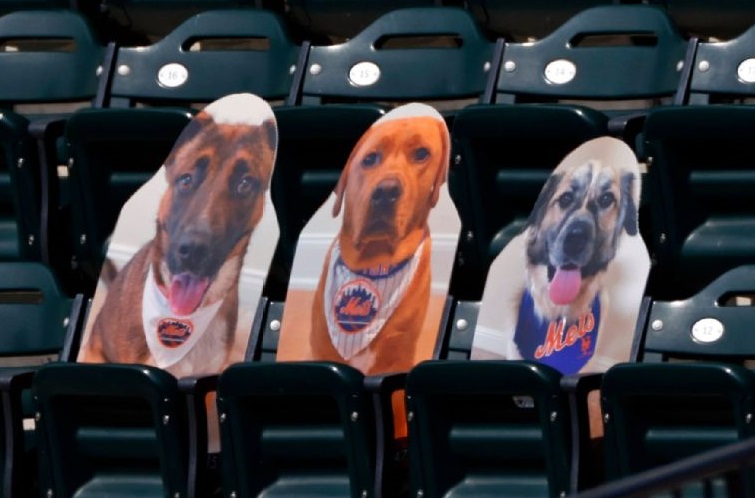
The cardboard cutout of Jeff McNeil’s Alaskan malamute pup, Willow, was joined by cutouts of five more Mets doggie friends. Maybe manager Luis Rojas should have sent Willow and her friends out there to pitch.

Instead, he started Rick Porcello, the erstwhile Boston Red Sox pitcher and very erstwhile Cy Young Award winner. The good news: Porcello didn’t give up a single home run. The bad news: His afternoon only began with those back-to-back RBI singles, with two out in the first, escaping only when former now-you-see-him/now-you-don’t Met Matt Adams—who hit one of those RBI singles through that delicious open meadow created by an infield overshift—was thrown out trying to take third on the second of those.

Porcello shook off back-to-back one-out singles in the second by tricking Ronald Acuna, Jr. into dialing Area Code 5-4-3. Nimmo returned the favour in the bottom of the inning when he drove Atlanta starter Sean Newcomb’s 1-2 meatball to the back of left field to send home Nido, who’d walked with two outs.

Then, after McNeil mishandled a throw from short on Ozzie Albies’s inning-opening grounder, the third inning is where the fun really began. For the Braves. With one RBI double to left center by Marcell Ozuna and, a walk to Adams later, a two-run double to the same neighbourhood by Dansby Swanson on a meatier meatball.

Rojas finally decided Porcello was punished enough for punishing the Mets and brought in Corey Oswalt to relieve him. Remember, the three-batter minimum for all relief pitchers this season, which can prove dangerous if the reliever in question hasn’t got much to deliver. Oswalt didn’t. Except as far as the Braves were concerned.

Did the Mets have to find a young pitcher who was especially certain to please the home run lovers among their fans? Oswalt was making his twentieth major league appearance. When it ended at last, he could claim to have given fans eighteen major league home runs worth of pleasure.

Met fans would prefer that he’d hit them instead of served them.

He fought Austin Riley to a full count before walking him. He threw Endier Inciarte a canteloupe down the middle and Inciarte ripped it to the rear end of right field, sending Adams and Swanson home on poor Porcello’s dollar. That’s how Porcello’s box score ledger shows seven earned runs allowed and only six outs obtained. Oswalt isn’t likely to appear on Porcello’s Christmas list this coming winter.

Then Oswalt got three straight outs to escape further use, misuse, and abuse. But the poor young man was sent out to pitch the fourth. Just when it looked as though he’d escape Freddie Freeman’s leadoff double, with two outs and a full count on Swanson, he threw Swanson a sinker that rose instead of sinking. And Swanson sunk it over the right field fence. Unlike his teammate Adam Duvall on Saturday, Swanson’s bomb didn’t hit a single doggie cutout in the seats. Oh, well.

Same old song and dance in the Atlanta fifth. Almost. Again Oswalt had two outs and a man on second. Only this time it was two outs to open the inning and Acuna doubling to left. This time, Oswalt threw the canteloupe to Albies for the RBI double to the back end of right.

The worse news was that Oswalt seemed too anxious to get the worst of it over with in the top of the sixth. Ozuna must have sensed it, too, because he drove a 2-1 service over the left field fence to open the inning. Oswalt then got two swift outs that looked soon enough as though he were just dying to serve up the next cantaloupe, this time to Riley, who sent it likewise over the left field fence.

Rojas finally decided Oswalt had suffered enough for his sins and sent Paul Sewald out to pitch the top of the seventh. We may be using “pitch” facetiously here.

Sewald had William Contreras 1-2 when he served something just enough for Contreras to whack into right for a leadoff hit. He tricked Acuna into forcing Contreras out at second on a grounder to third. To which Albies said, “It’s not nice to trick Junior Nature,” driving a 3-1 fastball over the center field fence.

Sewald escaped with a ground out, a walk, and a swinging strikeout. The scoring ended on the day. The final two and a half innings must have seemed like simply trying to put the Mets out of their misery once and for all. You didn’t even have the heart to tell them they’d faced four Atlanta pitchers, gone 1-for-8 with runners in scoring position, and left ten men on base.

Nor did you have the heart to remind them that Newcomb was taken out of the game after three and a third innings, despite an eight-run lead, because he was actually erratic enough to start seven of his first nine batters faced with balls instead of strikes, threw only slightly more than half his 82 pitches for strikes, plunked two, and threw a wild pitch. Because it would have reminded the Mets that they had but one run to show for such generosity.

The Mets didn’t waste any time after the game sending Oswalt to their alternate training site in Brooklyn after he worked those four horrific innings to be saddled with the official loss. Far as Oswalt’s concerned, it just might be the sweetest relief he experienced all Sunday long. Might.

The word emerged when the game was just about over that, presumably for safety’s sake, the Mets planned to travel to Boston for an engagement with the Red Sox aboard six chartered buses. Outfielder Michael Conforto said lots of Mets planned to bring their XBoxes and/or PlayStations for lots of Call of Duty play.

They may miss things like team dinners or dinners among groups of teammates on the road, but better to be safe than sorry and, anyway, they’ll have lots of Call of Duty players to help ease the burden. Except that what they need most in Boston is lots of baseball players. On Sunday afternoon, they didn’t seem to have many.
That’s the way the cookies crumble

2020-07-26 McNeil'sDog

I’ve heard of Bark in the Park but this was ridiculous, sort of: Cardboard cutouts of (left to right) Griffey (belonging to Michael Conforto), Kali (also Conforto’s), and Willow (belonging to Jeff McNeil), watching from the right field seats in Citi Field Saturday . . . moments before Adam Duvall’s home run caught Willow right in the snoot.

So you’re still not thrilled about those new rules this year about the free runner on second to open the extra inning or the three-batter minimum for relief pitchers? You’re not alone. Cleveland Indians righthander Mike Clevinger is on your side. (And mine.)

You could say Clevinger has solid reason. In the Indians’ second game of the new truncated season, after his rotation mate Shane Beiber came up one short of the Opening Day strikeout record, Clevinger saw his seven-inning Saturday start (ruined only by a pair of Kansas City Royals homers back to back in the first) laid waste by the cookie on second.

He also got to see the Royals’ new manager Mike Matheny roll serious dice and come up boxcars. The Royals got what proved the game-winning run without a single official at-bat on the ledger. We tried to warn you this kind of mischief was possible.

It went like this: Since the free cookie on second is the guy who batted last for the team, Kansas City veteran Alex Gordon opened the top of the tenth on second. Until he didn’t; Matheny sent reserve outfielder Brett Phillips to run for him to open. He ordered Erick Mejia to bunt Phillips to third, before Matt Franco sent Phillips home with a sacrifice fly to break the two-all tie.

After Royals second baseman Nicky Lopez walked, he got thrown out stealing with center fielder Bubba Starling at the plate. Then Greg Holland—the prodigal Royals reliever, far enough removed from the days he anchored their once-feared H-D-H bullpen (Holland, Wade Davis, Kelvim Herrera)—shook off plunking Indians center fielder Bradley Zimmer leading off and struck out the side in the bottom of the tenth.

Clevinger thought it was all about as amusing as a boom box aboard a hearse.

“This isn’t travel ball,” he told reporters after the game. “You know how hard it is to get a runner on second base off the back end of any bullpen, how incredibly hard that is? I’m not happy about it. I’m sure when other teams face the situation and this happens to them, you’re going to get similar reactions.”

Calling the New York Mets. They got burned but good Saturday afternoon. It was bad enough that closer Edwin Diaz followed an excellent save on Opening Day with having the Atlanta Braves down to their final strike—after he fell behind 3-0 on Marcell Ozuna—only to have Ozuna send one over the right field fence to send the game to the tenth tied likewise at two.

Then Mets manager Luis Rojas, knowing the three-batter minimum, sent Hunter Strickland (erstwhile Giant and National) out to pitch the tenth. This was something like naming Mrs. O’Leary’s cow the official mascot of the Chicago Fire Department.

The good news was that, unlike on outings past, Strickland didn’t have long balls to serve, a la carte or otherwise. The bad news was that, since the Braves didn’t exactly have bunts on their minds, Rojas didn’t think to order Strickland to put the inning’s leadoff hitter, Dansby Swanson, aboard—with Adam Duvall, the last Brave to bat in the ninth, as the free cookie on second—to set up a prompt double play.

Instead, Rojas let Strickland pitch to Swanson and the Braves’ shorstop lined a Strickland slider just above the middle floor of the strike zone into center field, sending Duvall home promptly with the tiebreaking run. Johan Comargo, the Braves’ lesser-hitting third baseman, bounced one up the middle that Mets late-insertion second baseman Andres Gimenez couldn’t spear to send Swanson to third.

If Rojas ordered Swanson a free pass to open the inning, Gimenez might instead have speared that bouncer for either a step-and-throw double play or a quick flip to shortstop Amed Rosario to dial Area Code 4-6-3. Leaving the Braves no recourse but a base hit to get Duvall home.

And the inning would have gone 3-2 to the bottom of the tenth, and the Mets’ run would have tied the game. Sending it to the eleventh and . . . oops. Free cookies on second and three-batter relief minimums to open each half inning there, too, if each skipper reached for a fresh bullpen bull.

Stuck now with Strickland having to face a third batter at minimum by current law, Rojas could only watch helplessly when Strickland got the Braves’ late-insertion center fielder Endier Inciarte to bounce one right back to the box but bobbled the ball before having to take the sure out at first. Now it was 4-2, Braves, and Rojas had all the legal room on earth to get Strickland out of there before playing with another match.

Oops.

Even with Drew Smith up and ready in the Mets’ bullpen, Rojas stuck with Strickland. And Strickland played with another match. William Contreras, the younger brother of Chicago Cubs catcher Willson Contreras, smashed a first-pitch slider to the back of right center for an RBI double.

Then Rojas brought in Smith. And Smith promptly got Ronald Acuna, Jr. to look at strike three before Ozzie Albies grounded out to first base for the side but a 5-3 deficit the Mets couldn’t overthrow in the bottom of the tenth. Not even with free cookie Jeff McNeil on second to open and Jake Marisnick (erstwhile Houston Astro) and Pete Alonso singling up the pipe to load the pads for pinch hitter Dominic Smith.

That was last year: Smith returning from the injured list for the Mets’ final regular season game, pinch-hitting with two on in the bottom of the eleventh, and hitting a game-winning three-run homer. This was Saturday afternoon: The best Smith could get this time was a measly sacrifice fly. Not enough. Mets catcher Wilson Ramos grounded to short to force Alonso at second for the game.

It only takes one game to make a manager go from resembling a genius, which Rojas resembled when the Mets beat the Braves on Opening Day, to a nut, which Rojas resembled trusting the top of the tenth—after his closer blew the ninth in the first place—to a once-decent relief pitcher whom the eventual world champion Washington Nationals practically ordered held hostage out of sight after he surrendered three homers in last year’s division series.

But if Braves manager Brian Snitker thinks he’s liking the extra-inning free runner and the three-batter relief minimum now, wait until his Braves get burned likewise by it in a game. He may have something different to say about it then.

I have something to say about it now: if commissioner Rob Manfred is still foolish enough to insist on using the free cookies on second to start the extra innings this season, then he should declare the three-batter-minimum for relief pitchers void for those innings. No questions asked.

At least there was one amusement for both sides before the game ended. Duvall smacked a home run off Mets starter Steven Matz in the top of the second. With Citi Field empty beyond a smattering of cardboard cutouts in the seats, Duvall’s blast sailed into the right field seats . . . where it smacked the cardboard cutout of one of McNeil’s dogs, an Alaskan Malamute puppy named Willow, sitting next to cutouts of outfielder Michael Conforto’s dogs, Griffey and Kali.

Right in the snoot.

If you’ll pardon the expression, the wags said it was the easiest game of fetch Willow played all year so far. The game result, however, had some thinking the poochie took such postgame requests as “Willow Weep for Me.”

From scandal to Opening Night carnage

2020-07-25 AstroTheGrouch

The only trolling of either the Asterisks or the Rogue Sox on their Opening Nights was this cutout fellow . . . in the Oakland Coliseum.

Regular-season day one of the Houston Astros’ post-Astrogate era came in with a bang. Not the kind that indicates transmitting signs stolen off an illegally-installed camera by way of a clubhouse monitor, but the kind that means a five-run inning and an 8-2 win over the Seattle Mariners.

Their fellow sign-stealing criminals, the Boston Red Sox, saw and raised on day one of their post-Red Sox Replay Room Reconnaissance Ring era. Even if, considering their opposition, you could accuse them this time of doing it the easy way, blowing the Baltimore Orioles out 13-2.

The best news for the Asterisks other than their Opening Day win? Not a single batter faced a knockdown pitch. The best news for the Rogue Sox likewise? Not a single batter got plunked, either—but Red Sox relief pitcher Phillips Valdez did hit two Orioles, one each in the eighth and the ninth. Quite unintentionally.

Neither the Astros nor the Red Sox looked good when they were exposed and affirmed as high-tech cheaters during the seasons of their recent World Series championships and barely brought themselves to own it, man up, and apologise properly this past winter. Leaving many, even their own die-hards, wondering whether retribution would be swift and sure.

The coronavirus world tour that suspended the Show until delayed “summer camp” training opened up may or may not have knocked those thoughts out, even if three Astros got hit very unintentionally during an exhibition game against the Kansas City Royals last week. Baseball in the age of pandemic isn’t very likely to put cheaters’ retribution high on its priority list.

Don’t even think about it, conspiracy theorists. Whatever the origin of the virus that launched out of China, it wasn’t anybody’s idea of giving either the Asterisks or the Rogue Sox cover for their crimes, either. Public humiliation sometimes beats a pestiferous pestilence for humbling the formerly haughty.

Just ask Orioles manager Brandon Hyde. His pitching staff was so futile Friday night that social media wags suggested the Orioles needed (and were about) to sign Dr. Anthony Fauci. The epidemiologist whose stiff-armed ceremonial first pitch, before the Washington Nationals’ season opener against the New York Yankees, sailed far enough past the home plate circle that the same wags also said controversial home plate umpire Angel Hernandez called it a strike on the corner.

“For me,” Hyde said balefully after the carnage ended at last, “I’d like to flush this one.” He’ll need the Ty-D-Bol Man to clean the commode after that one.

In a way, the Astros could have been accused of winning the easy way too on Friday night. They met the Mariners nineteen times in 2019 and won eighteen. For the Astros, no matter what they’re coming away from, competition like that is the next best thing to summer camp.

Justin Verlander, their future Hall of Famer starting pitcher, worked six innings, struck out seven, walked only one, and surrendered both Seattle runs by way of the solo long ball, from Kyle Lewis in the second and Korey Seager in the fourth. Just another night at the office.

But he was in a sober mood after the game, and not because of the two long balls he surrendered after surrendering 36 last season. (He averages 23 homers surrendered per 162 game lifetime, by the way. Turn off the alarm bells, there are Hall of Famers who surrendered a little more. Robin Roberts lifetime surrendered two fewer [503] than Eddie Murray hit. [505.])

“Obviously guys are risking a lot here,” Verlander said post-game, “myself included with a young daughter at home, to bring America’s pastime back to people and hopefully cheer them up and give them a little bit of a reprieve from a lot of the stuff that’s been happening.”

Peculiarly, considering the net result, Michael Brantley was the only Astro to collect more than one hit on a night that only George Springer and Yuli Gurriel went hitless for them. And they were down 2-0 when the fifth inning arrived and the fun began for them.

Aledmys Diaz opened with a base hit to somewhat deep center field, then took third as Martin Maldonado’s shot to third was thrown off line enabling Maldonado himself to have first on the house, before taking second on Springer’s ground out back to Seattle starting pitcher Marco Gonzales.

Jose Altuve dumped a single to left to send Diaz home and chase Gonzales in favour of Zac Grotz. The new and dubious three-batter minimum rule bit Grotz and the Mariners right in the kishkes right off the bat, when Alex Bregman singled Maldonado home and Brantley drove one into the right field seats, before Grotz got Gurriel to ground out to third and Carlos Correa to pop out to second.

The Astros tacked single runs on in the sixth and the seventh and let the bullpen finish what Verlander started. No muss, no fuss, and no known shenanigans. And it was nothing compared to what the Red Sox detonated against the Orioles. Their 10-0 lead after five innings was enough to tempt the Orioles to petition the Hague lodging human rights violations charges.

The Red Sox scored four in the third and six in the fourth, and their starting pitcher Nathan Eovaldi—who opened the game with a 100-mph fastball to Austin Hays—found himself in the unusual position of having such a comfort zone he could have let each Oriole batter know what was coming and still gotten rid of them fast enough.

Three RBI doubles including a two-runner by Kevin Pillar hung up the third-inning four-spot. Well enough into the Oriole bullpen in the fourth, Andrew Benintendi walked the fifth Red Sox run home to start that inning’s fun and prompt a pitching change. Fat lot of good that did the Orioles. J.D. Martinez promptly scored Jackie Bradley, Jr. and Jose Peraza with a ground-rule double.

Rafael Devers then hit into the first Red Sox out of the inning. That relief lasted long enough for Xander Bogaerts to single Benintendi home, Pillar to single Martinez home, and Christian Vazquez to single Bogaerts home. And Bradley and Peraza had more destruction to offer the Orioles in the sixth, Bradley hitting a two-run double and Peraza hitting a single-run double right after that.

Somewhere, the Orioles snuck two runs home on a sixth-inning double (Renato Nunez) and a seventh-inning homer. (Rio Ruiz.) They may still be trying to figure out how those happened, when they’re not trying to figure out just how the Red Sox mustered the burial without Mookie Betts, who’s now the Los Angeles Dodgers’ $396 million man after the Sox sent him and David Price out west in an unlikely salary dump.

For the Astros’ new manager, Dusty Baker, it was his 3,500th game as a major league manager. “That,” he said about Friday night’s flogging, “was the strangest opener of my career.”

Maybe playing in their home playpens helped, and likewise the lack of live fans in the stands, but the only thing trolling either the Astros or the Red Sox over their high-tech cheating scandals was in the Oakland Coliseum, where the Athletics—whose pitcher Mike Fiers (a 2017 Astro) blew the whistle on Astrogate last November—hosted the Los Angeles Angels to open the season.

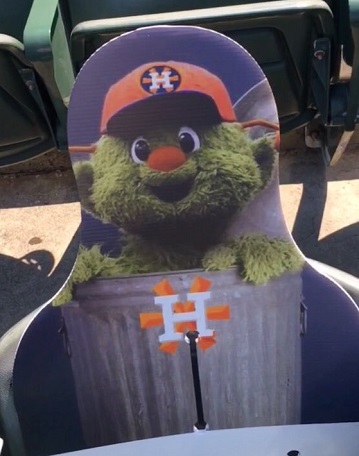
One of the fan-financed cutouts in the Coliseum seats showed Oscar the Grouch in an Astros hat in a trash can marked with the Asterisk logo that went viral as Astrogate unfurled last winter. The Astros travel to Oakland for the first time for a series beginning 7 August. Bet on Oscar the Astrogrouch being among the cutouts then. That should be the least of their problems.

It’s deja vu all over again for the Mets

2020-07-24 YoenisCespedes

Cespedes went into the seats in his return but deGrom added just more evidence for a non-support case Friday.

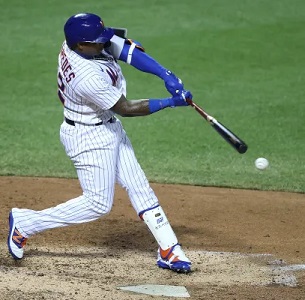
Pandemic delay or no pandemic delay, the 2020 season finds the New York Mets picking up just about where they left off last year. Not that beating the Atlanta Braves 1-0 on Friday was a terrible thing for them, of course. And not that Yoenis Cespedes, too long among the Mets’ living dead on the injured list, going long his first day back was terrible, either.

But their neglect of theirs and the National League’s best pitcher two seasons running, pending Jack Flaherty’s continuing maturation, continues yet. He’s too much a team player to say it, but surely Jacob deGrom thinks of games like Friday’s and thinks to himself, “It’s been lovely, but I have to scream now.”

Defending back-to-back Cy Young Awards, pitching like a future Hall of Famer, eight strikeouts in five innings, one walk, and one measly hit. (The innings limit was the Mets taking no chances after deGrom’s back tightness last week.) And nothing to show for it other than an ERA opening at zero.

Last year, deGrom had twelve such quality starts, averaging seven innings per, and came out with nothing to show for those. If his team played the way he pitched, he’d have been a 23-game winner and the Mets might have ended up in the postseason. Him definitely; them, might. As a former Mets manager once said, it was deja vu all over again Friday afternoon in Citi Field.

The Braves’ starting pitcher, Mike Soroka, got a grand taste himself of how deGrom must feel at times. He pitched six innings and, while he wasn’t deGrom’s kind of strikeout pitcher Friday afternoon, he did punch out three, scatter four hits, and come away with nothing to show for it but handshakes from the boss and whatever equals a pat on the back in the social-distancing season.

His relief, Chris Martin, wasn’t so fortunate. After ridding himself of Michael Conforto to open the bottom of the seventh on a fly out to deep enough center field, Martin got Cespedes to look at a first-strike slider just above the middle of the plate. Then he threw Cespedes a fastball just off it, and Cespedes drove it parabolically into the empty left field seats.

The piped-in crowd noise at Citi Field drowned out the thunk! when the ball landed in no man, woman, or child’s land. It was the game’s only scoring, but the Mets’ bullpen had a surprise of their own in store once deGrom’s afternoon was done.

They left the matches, blow torches, gasoline cans, and incendiary devices behind. They performed no known impression of an arson squad. They cleaned up any mess they might have made swiftly enough.

Seth Lugo, maybe the Mets’ least incendiary reliever last year, shook off a double to left by newly minted Brave Marcell Ozuna, and his advance to third on a passed ball, to get Matt Adams—signed but let loose by the Mets and scooped up by the Braves—to ground out to third and Austin Riley to look at strike three. Crowning two innings relief in which Lugo also made strikeout work of Alex Jackson and Ronald Acuna, Jr.

Justin Wilson, taking over for the eighth and looking like he was finding the right slots last year, shook off Dansby Swanson’s leadoff single to strike Adam Duvall out looking, before luring pinch hitter Johan Comargo into grounding out to second and striking Acuna out for the side.

Then Edwin Diaz, the high-priced closer who vaporised last year, opened by getting Ozzie Albies to ground out, shook off a walk to Freddie Freeman, and struck Ozuna out looking and Adams out swinging for the game.

Already freshly minted Mets manager Luis Rojas looks like a genius, or at least unlike a lost explorer. And Cespedes—about whom it was reasonable to wonder if he’d ever play major league baseball again—made sure any complaints about this season’s universal DH were silenced for this game at least.

“The funny thing is I joked with him before the game,” deGrom told reporters postgame. “I said ‘why are you hitting for me?’ He went out and hit a home run for us which was big. I was inside doing some shoulder stuff, my normal after pitching routine and yeah I was really happy for him.”

It didn’t work out quite that well for the Braves, with Adams going 0-for-4 with two strikeouts on the afternoon. Neither side mustered an especially pestiferous or throw-weight offense other than Cespedes’s blast.

But you half expected a low-score, low-hit game out of both deGrom and Soroka considering the disrupted spring training, the oddity of “summer camp,” and perhaps just a little lingering unease over just how to keep playing baseball like living, breathing humans while keeping a solid eye and ear on social distancings and safety protocols.

In a sixty-game season it all counts even more acutely than it would have on a normal Opening Day. The Mets and the Braves were each expected to contend this season before the coronavirus world tour yanked MLB’s plans over-under-sideways-down. They’re not taking their eyes off that just yet.

Before the game began, the Mets and the Braves—like the New York Yankees and Washington Nationals in D.C., like the Los Angeles Dodgers and San Francisco Giants by the Bay Thursday night—lined up on the baselines and held a long, long, long black ribbon. This time, with nobody kneeling before “The Star Spangled Banner” was played.

Maybe athletes can remind people that it’s dead wrong for rogue police to do murder against black and all people without running into the buzz saws of explicit national anthem protests and fury over the protests, after all.

The Braves have other alarms, though. Freeman, of course, is recently recovered from COVID-19 but two of their three catchers—Tyler Flowers and former Met Travis d’Arnaud—showed COVID-19 symptoms and went to the injured list. The good news: both catchers tested negative for the virus.

But lefthanded pitcher Cole Hamels hit the IL with triceps tendinitis. Not good. Every live arm counts in a short season, especially for legitimate contenders. Just ask the Mets, who’ll be missing Marcus Stroman with a calf muscle tear, even if Stroman historically heals quickly.

You hope both teams recover swiftly enough. You also hope the Mets find a way to make deGrom’s won-lost record look as good as he pitches and fast. Those non-support filing papers don’t take that long to draw up.


Alfred Hitchcock presents Opening Night

AlfredHitchcockAt long enough last came Opening Day. Well, Opening Night. On which New York Yankees right fielder Aaron Judge nailed the COVID-19 delayed season’s first hit and his teammate Giancarlo Stanton nailed its first home run two batters later.

On which the Washington Nationals opened without a key element, outfielder Juan Soto, whose positive COVID-19 test result came back well enough before game time to make him a scratch.

Before that rain-shortened game even got started, the word came from the opposite coast that Clayton Kershaw was scratched from his Opening Night start thanks to a back problem sending him onto the injured list.

In Washington, the Nats’ co-ace Max Scherzer would have loved if Judge and Stanton were Thursday night scratches. They accounted for all Yankee runs in the 4-1 final shortened in the top of the sixth when the rains smashed in with the Yankees having first and third and one out.

In San Francisco, Los Angeles Dodgers rookie Dustin May pitched five innings to San Francisco Giants veteran Johnny Cueto’s four, both men leaving with a one-all tie, and the Dodgers’ new $396 million man Mookie Betts broke the tie scoring on an infield ground out in the top of the seventh.

Scherzer’s good news Thursday night: eleven strikeouts. His bad news: four walks and an inability to solve Judge and Stanton. Judge also doubled home Tyler Wade in the third and Stanton singled home Gio Urshela in the fifth. Remove Judge and Stanton from the Yankee lineup and the Nats’ Adam Eaton’s hefty solo home run in the bottom of the first would have been the game’s only score.

Betts singled with one out in the top of the seventh and called for the ball. Published reports indicate that ball plus the evening’s official lineup card now repose in his home. “It’s just a new chapter in life,” he told reporters after the 8-1 Dodgers win.

After he came home when Justin Turner grounded into a force out, Corey Seager’s grounder got Cody Bellinger caught in a rundown at the plate, but Enrique Hernandez singled home Turner and Seager (who’d taken second during the rundown), Joc Pederson and A.J. Pollock walked back-to-back to load the pads, Austin Barnes sent Hernandez home with an infield hit, and Max Muncy walked Pederson home.

And, on both coasts, all four teams figured out a solution to the issue of whether or not to take a knee for “The Star Spangled Banner” that might actually help more than hurt the too-easily outraged.

Abetted by a suggestion from Philadelphia Phillies outfielder Andrew McCutchen, the Yankees and the Nats lined up on the base lines holding a long, long, long black ribbon, standing apart enough for social distance, then took their knees before “The Star Spangled Banner” was played.

On the same suggestion, the Dodgers and the Giants held a similar long, black ribbon and took their knees before the anthem’s playing. In Washington, both the Yankees and the Nats rose from their knees while the anthem was played. In San Francisco, ten Giants including manager Gabe Kapler plus Betts on the Dodgers’ side stayed on their knees during the anthem, with Bellinger and Muncy putting hands on Betts’s shoulder as a gesture of support.

I went back on record Thursday saying that there are far worse ways than kneeling before a national anthem to protest something you think is dead wrong. Kneeling, as two Scientific American writers I cited remind us, is anything except disrespect.

“While we can’t know for sure, kneeling probably derives from a core principle in mammalian nonverbal behavior: make the body smaller and look up to show respect, esteem, and deference,” wrote psychologists Jeremy Adam Smith and Dacher Keltner in 2017.  “. . . Kneeling can also be a posture of mourning and sadness. It makes the one who kneels more vulnerable. In some situations, kneeling can be seen as a request for protection.”

I’ll ask again: Would you rather those outraged by rogue police doing murder against black or any people raise clenched fists, burn a flag on the field, or start a riot with or without looting and plundering in the bargain? Neither would I. But if only now-former football quarterback Colin Kaepernick had thought in the first place to take his original knee before the anthem played, would that have worked very differently for himself and the outraged?

Let me repeat, too, that you don’t have to subscribe to every last clause or every last impulse of the social justice warriors to agree that rogue police doing murder is not what the land of the free and the home of the brave was supposed to mean. Neither must you subscribe to the formal Black Lives Matter movement itself to agree that black lives and all lives don’t deserve to end when those entrusted to uphold the law break it instead.

Let me repeat further that it’d be far better for baseball to limit playing “The Star Spangled Banner” to before games on Opening Days, games played on significant national holidays, the All-Star Game, and Games One and (if it goes that far) Seven of the World Series. Not so much to cut back on the kneeling protests but to re-emphasise that patriotism compulsory is patriotism illusory.

Back on the field, Soto’s COVID-19 positive test approaching Opening Night shook the game up just enough to provoke serious questions as to how MLB is going to navigate even this truncated season without further medical issues. And, whether the most stringent health and safety protocols will keep more Sotos from turning up positive.

Other surrealities include the empty stands, other than cardboard cutouts of fans in the seats, and the canned crowd sounds at the ballparks. The coronavirus world tour already turned baseball into something between The Twilight Zone and the Mad Hatter’s tea party. Now that the season is underway at last, should we throw Alfred Hitchcock Presents into the mix?

At least neither Opening Night game went to extra innings, so we didn’t have to deal right off the bat with the free cookie on second base awarded each team to start its extra half-inning. The mischief that’ll inspire will just have to wait.

Funny thing, though, about that equally nefarious three-batter minimum for pitchers. Two Giants relievers faced the minimum in that five-run Dodger seventh before surrendering any runs. If bullpen preservation was part of it even if those two got pried, I can see already that this dumb rule isn’t going to end well for Kapler and other managers.

And, let’s be real, the PA people in charge of the piped-in sounds are only human, after all. Who’s going to be the first poor sap having to live down the accident of cranking up the wild cheering when the home team’s batter gets hit by a pitch?

On the other hand, it was easy enough to feel normal again once the Yankees and the Nats got underway . . . when home plate umpire Angel Hernandez began blowing pitch calls. Calling a few strikes balls and a few balls strikes? That’s about par for the course for him. So when’s that umpire accountability coming at last?

Before the game, Dr. Anthony Fauci—otherwise doing his best to battle a pandemic involving both a stubborn virus and a political (lack of) class that surely makes him wonder if he was really there when all this happened—threw out a ceremonial first pitch. Later, he was seen in the stands with his Nats-themed face mask off his face a spell. What’s up with that, Doc?

You’d love to say Fauci threw a perfect strike to Nats relief pitcher Sean Doolittle behind the plate, but you’d be lying like an office holder. Fauci’s delivery is described politely as resembling a man trying to compensate for a fractured upper arm. The ball sailed almost to the on-deck circle. Rumour has it that Hernandez called it a strike on the outside corner.