The adult in the room wasn’t

AlexCintronJoseAltuve

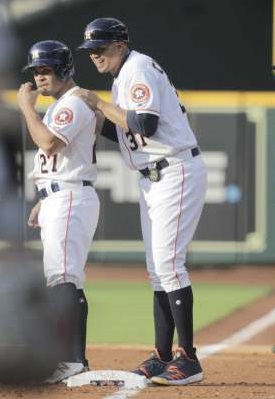
Alex Cintron (right) counsels Astros second baseman Jose Altuve after a hit. Cintron’s nasty, brawl-triggering  insult to Oakland’s Ramon Laureano Sunday shouldn’t go as lightly as Cintron got off for Astrogate.

It’s a shame, really, when something like Sunday afternoon’s basebrawl is what you need to discover a particular player is a decent-seeming fellow. Even when he’s willing to call a man who goaded him obscenely into a fight a loser. Now it still remains to be seen whom commissioner Rob Manfred will suspend more heavily.

Will the hammer fall harder on Oakland Athletics outfielder Ramon Laureano for charging the Houston Astros dugout? On Astros hitting coach Alex Cintron for climbing the dugout steps forward, urging Laureano to bring it, after calling Laureano something Latino men consider the most vile insult on earth?

Suspensions were expected Monday afternoon, so swiftly because the brief skirmish by the dugout violated MLB’s tightened COVID-19 safety protocols that enjoin against such rumbles no matter who did what.

By 7:30 pm Pacific time Monday, though, suspension lengths hadn’t even been rumoured, even if a host of observers expected if not hoped that Cintron would get the harder hammer drop for being the adult in the room who wasn’t.

On Monday, Laureano told reporters including ESPN’s Jeff Passan that despite being hit by pitches three times over the weekend including twice on Sunday he didn’t hold it against the Astros. Not even against Brandon Bailey, the Astros relief pitcher for whom Laureano was traded by the Astros to the A’s in the first place when they were minor leaguers in 2017.

Bailey drilled Laureano in the fifth on Sunday afternoon. Another Astros reliever, Humberto Castellanos, plunked Laureano on Friday night in extra innings and Sunday in the seventh. Laureano wasn’t exactly alone; his fellow A’s outfielder Robbie Grossman got it twice on Friday night. Laureano (five) and Grossman (four) lead the parade of A’s (fourteen) taking one for the team so far this truncated season.

The latter triggered Laureano to pantomime a proper slider grip toward Castellanos before he took first base and returned chirpings wafting from the Astros dugout. But the chirpings apparently included Cintron referring to Laureano as the crude euphemism for maternal fornicator.

“[Saying] in Spanish something you don’t say about my mother,” is how Laureano put it to Passan. In places where they don’t play professional baseball, saying that to most  Latino men can get you beaten senseless, assuming you can be beaten into a pre-existing condition. It can also get you stabbed or even shot.

Cintron being Latino himself should have known better. Suppose the reverse was true and it was Laureano who called Cintron a maternal fornicator? Would Cintron have resisted the urge to charge his fellow Latino with drawing and quartering on his mind?

We’ll never know what Laureano would have done if he could have reached Cintron Sunday afternoon. The coach who urged Laureano to bring it after the insult stepped aside and let other Astros do his dirty work. Except that Laureano’s former A’s teammate, Astros reserve catcher Dustin Garneau, tackled him specifically to keep him from getting bloodied.

The insult resonated with Laureano more than many of his peers, since his parents courageously enough sent him from the Dominican Republic to the United States alone so he could chase his baseball dreams. The chase has borne fruit; Laureano in three Show seasons has become something of a stealth star who’s thought to have the game’s best outfield throwing arm and showed some pop at the plate in the bargain last year.

Ask and he’ll tell you the only thing he hates about playing major league baseball is being away from his family. “Every day I wake up with the motivation to be with them,” he told Passan. “They sacrificed their life for me.”

They made the tough decision to let their own kid go to the States by himself and follow his own dreams. I’ve been away from my family for 10 years. It’s tough to be away from them. Any chance I have to be with them, I feel like I’m in heaven. So for [Cintron] to say that to me about my mom, it doesn’t sit well. I’ve got a fire inside me right away in that second.

A’s manager Bob Melvin swore to Cintron hurling the vile epithet at Laureano. Cintron denies he said that specific compound word. The A’s wouldn’t let Laureano tangle with the Astros alone. Their catcher Austin Allen took down Astros catcher Martin Maldonado, who was behind the plate calling every Astro pitch in the set, including the ones that drilled Laureano and Grossman.

Melvin said Monday that Laureano was remorseful about charging the dugout. “I’m a man, I’m a freaking man,” said Laureano, who accepts a suspension being likely. “Whatever happens, happens. I’ll take it. I couldn’t keep my cool and I should have. And I wasted my time with that guy.”

He even went out of his way to say he didn’t think any Astro pitcher who plunked him over the weekend did so with malice aforethought. “The other days I’ve been on base,” the ex-Astro product said, “we’ve been chitchatting, talking about life and family on the bases. Everything’s great. I get along with everybody on the Astros.”

That would make Laureano another kind of minority this season. Seven-eighths of MLB players, seemingly, wanted the justice Manfred didn’t exact when he immunised Astro players from the 2017-18 electro-cheating. Even if they didn’t dare suggest who’d be the first to deliver or how many would from there.

It might have been turned to one side over the coronavirus world tour, but then Los Angeles Dodgers relief pitcher Joe Kelly served four pungent reminders to two Astros a fortnight ago. Kelly’s eight-game suspension was thought too severe and remains under appeal.

Almost forgotten, too, in Sunday’s rumble by the Bay: Cintron turns out to be suspected of being one of the 2017 men who sent the Astro Intelligence Agency’s illegally pilfered sign intelligence from the monitors to the dugout and to the hitters at the plate. Like the players Manfred handed blanket immunity in return for the Astrogate deets, Cintron escaped the woodshed.

Let’s remind ourselves, too, that not a single Astro batter saw a brushback, knockdown, or plunk all weekend long, no matter how often Grossman and Laureano got dusted or drilled.

The Astros couldn’t possibly have been thrilled that A’s pitcher Mike Fiers, himself a former Astro, blew the whistle on Astrogate last November. The A’s may have been fortunate that their starting rotation schedule meant Fiers facing the Texas Rangers the night before the Astro set started and thus not scheduled to go again until this week against the Los Angeles Angels.

Intentional or no, five weekend Oakland plunks from four Astros pitchers (Zack Greinke plunked Grossman earlier in Friday’s game) was a terrible look for a team against the guys whose ranks include their whistleblower. Even if three of those pitchers are rookies.

Even if Laureano is too decent to entertain the prospect that veteran teammates or even a coach or two might have urged those Astros rooks, none of whose minor league jackets show immunity to hit batsmen, to send some messages meant to shoot the messenger’s enablers.

It’ll be a terrible look, too, if Manfred comes down harder on Laureano for charging the dugout than on Cintron for instigating the charge. But Commissioner Nero seems immune to the looks produced by his fiddling reign of error.

Houston, you still have a problem

2020-08-10 RamonLaureano

Drilled once Friday night and twice Sunday afternoon, Ramon Laureano (22) also wasn’t thrilled an Astros coach called him something that gets people up to and including shot if aimed at Latino men.

The question before the house to begin is, which was the worst look of the weekend now done. The answer may depend on a fiddling commissioner’s disciplinary response.

Until Sunday afternoon’s rumble by the Bay, the worst look might have been otherwise-touted Los Angeles Angels rookie Jo Adell channeling his inner Jose Canseco, letting a fly ball bounce off his upraised glove (alas, not his head) and over the fence.

Was the worst look now Houston Astros pitchers hitting a pair of Oakland Athletics batters five times total during the three-game A’s sweep? Was it Astros hitting coach Alex Cintron goading A’s outfielder Ramon Laureano into a safety protocols-violating dugout charge and brawl after his third such plunk and second on Sunday alone?

Sunday’s story should have been the A’s winning their ninth straight game with a 7-2 triumph following a one-run extra-inning win Friday and a two-run win Saturday. Thanks to the Astros, at this writing the main story’s likely to be Laureano’s punishment for deciding he’d had enough of being used for apparent Astro target practise.

Fellow A’s outfielder Robbie Grossman got hit twice on Friday night, once by well-established veteran Zack Greinke and once by rookie Enoli Paredes. Laureano got it once Friday night, from rookie Humberto Castellanos, and twice Sunday, the second from Castellanos and the first from another Astro rookie, Brandon Bailey.

The tales will include whether Laureano’s fed-up hollering from first base Sunday—he’d gestured previously to Castellanos in a way suggesting he had more to learn about pitching, indicating Laureano allowed that rookies will be rookies, sort of—didn’t turn into Cintron’s throwing an expletive to the outfielder that’s considered grounds for a beatdown at minimum in Laureano’s world.

“We’ll know more soon,” tweeted former Astros beat writer Jose de Jesus Ortiz after Sunday’s skirmish, “but a person I respect has been told that the A’s Ramón Laureano charged toward Alex Cintron because Cintron mentioned Laureano’s mother in a bad way. In Latino culture, those are fighting words.”

“Ramón doesn’t go there unless something completely offensive came out of the dugout,” said A’s manager Bob Melvin to reporters after the game. “And I think the league knows who that is. And that person should be suspended. So hopefully that’s the case.”

It probably wasn’t brilliant for Laureano to charge the Houston dugout in his outrage, a charge that provoked no few Astros to pour forth and mill and holler and violate the Show’s protocols on health and safety distancing and against brawling on those grounds.

But it was far less brilliant if indeed Cintron threw Laureano the crude expletive for maternal fornicator. Throwing that toward most Latino men (and no few Latino women, for that matter) usually means you come away fortunate if all you got was beaten into a pulp. People have been stabbed or even shot for it.

Cintron also resembled a craven coward for all but telling the outraged Laureano to bring it only to jump to one side when Laureano brought it. Even as Astros catcher Dustin Garneau tackled Laureano in a peacemaking bid for his former teammate.”I was just trying to stop the situation before punches were really thrown and stuff got out of hand,” Garneau told reporters. “That’s really what my whole goal was for that incident.”

“Cintron shouldn’t be suspended for being a coward; that’s just something he’ll have to live with,” writes an outraged enough San Jose Mercury-News columnist Dieter Kurtenbach.

[Laureano] had a right to be mad at Houston, and that’s beyond the sign-stealing stuff.

But the coaches are supposed to be the “adults in the room” and this “adult” was challenging a kid to a fight.

The sidebars are liable to include a little speculation as to whether even the rookie Astros pitchers who did most of the drilling weren’t counseled toward a little payback over a lot of lingering resentment that an A’s pitcher (veteran Mike Fiers) finally blew the Astrogate whistle last November.

Rookies want to impress their teams. They’re sensitive to orders or at least strong suggestions from their elders and superiors, even those that might get them into a little hot water. Even if acting on them tells their elders and superiors that they’re reliable, dependable guys who’ll go to the mattresses for the team right or wrong if need be.

Don’t discount the prospect that Castellanos, Bailey, and Paredes might have been following orders or taking strong suggestions strongly, too. Might. Managers and coaches will still deny to their deaths that they gave the orders, but they’ve been giving such orders or at least hinting very strong such suggestions as long as there’s been organised baseball.

There’s also the prospect that the trio picked up enough from their more established teammates that they might, even for mere moments, have thought about sending the A’s messages regarding Fiers. Might.

They do have rather well enough established control issues among them. In four minor league and winter league seasons Castellanos hit seventeen batters. In three college and four minor league seasons, Bailey hit 21 batters. And, in four minor league seasons, Paredes hit thirteen batters.

The Astros aren’t alone in having to lean upon still-shaky rookies in this truncated season. But five plunks in three games, two against one A’s outfielder and three on another one including two in one game, does. not. look. kosher. whether the plunkers are a trio of shaky rookies, a trio of veterans experienced enough to know better, or a combination of the two.

Unfortunately, the Astros haven’t looked kosher for long enough, either.

Their passionate enough fan base has wrestled since with the revelation that the genuinely great team they rooted for turned out to be high-tech cheaters in the season of their otherwise so-far greatest triumph. That fan base has also wrestled with knowing that it isn’t just other fan bases who think the current generation of Astros is tainted, even if only six regular position players remain from the 2017 roster.

Commissioner Rob Manfred let off the hook every Astro player who partook of the Astro Intelligence Agency’s illegal electronic sign-stealing espionage in return for spilling what they knew. Come spring training, the Astros weren’t exactly apologetic about their high crimes and misdemeanors, provoking what seemed seven-eighths of Show players who didn’t wear Astros fatigues to demand where the justice was or threaten to administer what Commissioner Nero wouldn’t.

Los Angeles Dodgers relief pitcher Joe Kelly answered those calls a fortnight ago. He decked Alex Bregman and dusted Carlos Correa twice each, in the same inning. It made him a Los Angeles folk hero and a nationwide object of empathy when he was hit with a severe suspension. (It’s still under appeal.) Even those Astro fans admitting their heroes were grand theft felons may think Kelly got burned a little too deep.

Astro batters have been hit nine times since this truncated season finally began. (Third in the league, incidentally.) Of those batters, five were 2017-18 Astros including 2017 World Series MVP George Springer getting it twice. In case you’re curious, A’s batters have been hit fourteen times on the season so far. Grossman’s been drilled four times, Laureano five. There isn’t a jury on the planet who’d say either was unjustified for harbouring lustful thoughts of murder.

The Astros’ new manager, Dusty Baker, has tried playing peacemaker with the rest of the game while trying to shepherd his Astros past the Astrogate stain. Elder though he is it’s not as though Baker has an easy time of such things, all things considered. In a managing career that has taken him to great enough heights and equivalent disaster, Baker this season must surely think there are times when hell would seem a tropical vacation by comparison.

But he’s old school enough to provoke speculation. Would you be shocked upon seeing any speculation, specious though it might be, that Baker or another coach ordered their rookie lancers to give those snitch-sheltering A’s a little something to think about?

(Codicil: Fiers—who actually faced death threats over his whistleblowing—didn’t face the Astros all weekend; he pitched against the Texas Rangers last Thursday and his next scheduled start is tonight against the Los Angeles Angels. The A’s assuredly were not trying to keep him from facing his one-time team over the weekend.)

On the other hand, of course, you wouldn’t necessarily be shocked if Baker knew or was told reliably that Cintron had indeed leveled at Laureano a phrase virtually guaranteed to raise a Latino temperature to nuclear level, and that Baker decided thus that there was no place in an already self-bedeviled Astro clubhouse for such a provocateur.

Especially when the provocation put both sides afoul of the safety protocols the Show tightened up after the Miami Marlins and, especially, the St. Louis Cardinals wrestled en masse with COVID-19 crises canceling games and throwing this Hitchcockian season into further reasonable doubt.

“Baker says he doesn’t know if Alex Cintron mentioned Ramón Laureano’s mother while yelling at him before Laureano charged him,” Ortiz tweeted. “But Baker says he learned the hard way how different it is when you mention a Latino’s mother. He vowed to check on the matter.”

Baker might also be reminded that the A’s didn’t get anywhere near hitting a single Astro all weekend long, even when Astro arms hitting Grossman twice on Friday and Laureano once Friday and twice on Sunday might have given any A’s pitcher all the reason on earth to return the disfavour.

Trusty Dusty can be forgiven if he starts wondering just what the hell he signed up for in the first place.

Indictment in Skaggs death, but . . .

Los Angeles Angels v. Seattle Mariners

Wearing Tyler Skaggs’ jersey as his teammates did that night, Mike Trout walks in front of the center field fence displaying a memorial to the pitcher who died of an overdose in Texas last year. A former Angels media person is now indicted for giving Skaggs the drug that helped kill him.

Beckham Aaron Trout was born 30 July. His father, a baseball player of some renown, attended his son’s birth, returned to his team, and hit a 2-2 slider over the left center field fence. This morning, Jessica Trout tweeted a photograph for her husband’s 29th birthday, their new son proclaiming himself the best present ever.

In a career that would indeed qualify him as a Hall of Famer should it end after this season, and Los Angeles Angels fans aren’t the only ones who hope devoutly that that doesn’t prove the case, Mike Trout has shown among other things a genuine human decency and a penchant for rising to particularly heartfelt occasions.

Homering his first time up after fatherhood blessed him is just one. Last year, alas, Trout did it in the middle of soul-wrenching grief.

His teammate Tyler Skaggs died unexpectedly after the Angels landed in Texas to finish a pre All-Star Game road trip. When the team returned home, to face the Seattle Mariners, a wrenching pre-game memorial to the fallen pitcher was followed by Trout opening the scoring with a mammoth two-run homer in the bottom of the first.

That launched a 13-0 blowout and a combined no-hitter by Angels pitchers Taylor Cole and Felix Pena that electrified a game wracked in grief over Skaggs’s mortal demise. (“Absolutely incredible,” Houston Astros pitcher Justin Verlander tweeted. “Meant to be.”) His teammates, all of whom wore Skaggs jerseys for the game, laid those jerseys around the mound after the game, leaving only Skaggs’s number 45 behind the rubber exposed.

On the same morning Jess Trout helped her new son tell his father who was the best present ever, the news broke out of Texas that former Angels media relations employee Eric Kay was indicted by a federal court for distributing at least the fentanyl that contributed to Skaggs’s overdose death last year.

The Tarrant County, Texas coroner’s report revealed alcohol, fentanyl, and oxycodone in Skaggs’s system when he died, but, as the Los Angeles Times reports, an affidavit on behalf of the criminal complaint against Kay suggested the fentanyl presence was the likely specific cause of the asphyxiation that killed Skaggs. The Angels themselves said in a formal Friday statement that they hired a former federal prosecutor to help the team investigate their pitcher’s death.

We learned that there was unacceptable behavior inconsistent with our code of conduct, and we took steps to address it. Our investigation also confirmed that no one in management was aware, or informed, of any employee providing opioids to any player, nor that Tyler was using opioids.

As we try to heal from the loss of Tyler, we continue to work with authorities as they complete their investigation.

The statement contradicts Kay’s statement last October that team officials knew there was an opioid issue involving at least five Angels while he denied providing the fatal pills to Skaggs, a fun-loving and popular teammate who seemed to shield his issues with the drugs effectively enough until his death. (How effectively? His widow, Carli, told the Times two months ago her husband didn’t behave like an addict.)

Skaggs underwent Tommy John surgery in 2014, missing the entire 2015 season rehabbing. “Keep in mind,” wrote Halos Heaven‘s Jessica DeLine, “opioid abuse often begins after surgeries, when the drug may be prescribed to the patient. Per the Mayo Clinic, opioids are highly addictive and your risk of addiction is increased after taking the drug for just a few days.”

Two years after that rehab season, Skaggs went to the old disabled list for 98 days with a strained oblique, followed by missing three months in 2018 with hip adductor muscle problems. “If he wasn’t prescribed any opiate after his Tommy John surgery,” I wrote last October, “who’s to say the pain of those injuries instead didn’t lead him to opiates’ doors?”

Kay’s remarks in his statement last fall practically accused the Angels of covering up. “I felt and continue to feel that it is time for everyone to stand up and take responsibility for their respective roles in this,” the statement began.

Nothing anyone does will ever provide closure for the Skaggs family. I can’t, the Angels can’t, and the courts can’t, regardless of what happens there. But at least I can help them “know”‘ instead of “wonder.” My hope is that there is some peace in that for them.

Recent Angels history says the team’s administration didn’t necessarily suffer drug issues gladly or sympathetically. When talented but drug-recovering outfielder Josh Hamilton signed a big free agency deal with the Angels, but saw his Angels service and performance disrupted by injuries, he relapsed infamously while watching a Super Bowl game.

As required by MLB’s drug agreement, Hamilton didn’t waste any time reporting his relapse to the Angels. They rewarded him for his forthrightness by running him out of town before sundown on the first unoccupied rail they could find. Right back to the Texas Rangers from whence he’d come in the first place. Barely caring either that Hamilton manned up or that they looked grotesque punishing him.

Angels owner Arte Moreno paid Hamilton’s entire remaining salary just to get him out of sight. Then, insult-to-injury: then-Angels manager Mike Scioscia demanded Hamilton apologise publicly when the Rangers next came to town. Don’t think there aren’t Angel personnel fearful that, if Moreno could exile a Hamilton, he might be liable to hang those aware of Skaggs’s ultimately fatal struggle.

Kay’s attorney, Michael Molfetta, said last fall that blaming Kay alone for the Skaggs tragedy was shortsighted and misguided. “When all the facts come out,” the attorney continued, “I think that what happened is a tragedy. What happened is very sad on many levels. But to say it’s any one person’s fault is not right.”

Barring any plea bargain, Kay’s trial is liable to bring at least a few such facts forward. It won’t be pleasant. It surely won’t assuage the Skaggs family’s loss and grief. But it may not leave the Angels—to whom Mike Trout plighted his baseball troth for life, and for the equivalent of a tiny island republic’s economy—smelling pleasant, either.

“When stuff comes out,” said Trout, after the Skaggs toxicology report was made public last fall, “you want to know if it’s true.” If the Angels’ administration really does have any responsibility, even if it was mere knowledge upon which the team didn’t act, Trout may not want to know.

It’s never too late

2020-08-04 TheSoulOfAmericaCover

Is it ever too late to read and recommend a genuine lyrical ballad such as this soulful book?

When you argue as I have on behalf of putting an end to baseball’s (and all sports’) goat business, part of the argument is that to err is human, though not all err before audiences of millions on television and 55,000+ at the ballpark. The trouble is that most of us forget the part about forgiveness being divine.

Buck O’Neil, Negro Leagues legend and the first African-American coach in Show history, had enough to say about forgiveness to make a book in its own right. (He’d written one himself, his memoir I Was Right on Time.) But there’s one story above all that’s going to stick with me for the rest of a life in which I’ve had to re-learn forgiveness repeatedly.

Watching a game with O’Neil in Houston, a writer saw a man and a boy, strangers to each other, stretch for a ball tossed into the stands by an Astros outfielder named Jason Lane. The man being taller, he caught the ball, then celebrated the catch. The boy looked absolutely crestfallen.

The writer quietly denounced the man as a jerk. O’Neil counseled him gently, “Don’t be so hard on him. He might have a kid of his own at home.” The writer, admitting he’d learned to try seeing things through O’Neil’s eyes, thought about it. Then, he asked, “Wait a minute. If this jerk has a kid, why didn’t he bring the kid to the ball game?” Smiling, O’Neil replied, “Maybe his child is sick.”

The writer was Joe Posnanski, now a senior writer for The Athletic but then a columnist for the Kansas City Star. Their travels together delivered The Soul of Baseball: A Road Trip Through Buck O’Neil’s America, published the year following O’Neil’s death at 94.

If you haven’t read it yet—as I hadn’t, until this week—put baseball’s Hitchcockian  coronavirus season to one side and buy it. Read it. What began when O’Neil asked Posnanski how he fell in love with baseball became maybe the single most lyrical epic ballad ever written about one man’s love affair with a game that didn’t always treat O’Neil and his fellow Negro Leaguers, legends and scrubs alike, with the same love.

What Pete Rose merely thinks he’s been, O’Neil really was: baseball’s possible greatest ambassador, from the moment Ken Burns reached him to speak of the Negro Leagues generations for Burns’s mid-1990s documentary series, Baseball.  From there, O’Neil spread the words, the stories, the achievements of the Negro Leagues as if anointed by the God in whom he believed deeply to be that messenger.

Other baseball legends taking their stories on the road win fans. O’Neil made friends. But God wouldn’t have had to do anything more than just nudge the line drive-hitting, longtime Kansas City Monarchs first baseman turned manager. (Among others, he played with and managed Hall of Famer and colour line breaker Jackie Robinson.) Getting Buck O’Neil to shut up about baseball, Negro Leagues and otherwise, would have been like taking the alto saxophone out of Charlie Parker‘s mouth.

If you think that’s a stretch, be advised or reminded that the only thing that ever animated O’Neil more than baseball was jazz. This sunny man who meant every word when he said nothing in his experience could ever force him to hate any human being of any colour once said, in Posnanski’s earshot, answering whether he had fun playing baseball when black men such as him were barred from the Show, “People feel sorry for me. Man, I heard Charlie Parker!”

O’Neil’s passion for music equaled that for baseball, and he linked them unapologetically.

Music can’t be racist. I don’t care what. It’s like baseball. Baseball is not racist. Were there racist ballplayers? Of course. The mediocre ones . . . They were worried about their jobs. They knew that when black players started getting into the major leagues, they would go, and they were scared.

But we never had any trouble with the real baseball players. The great players. No, to them it was all about one thing. Can he play? That was it. Can he play?

“For five seasons,” Posnanski wrote, meaning nature’s and not baseball’s, “I would watch Buck look at the bright side. He had every reason to feel cheated by life and time—he had been denied so many things, in and out of baseball, because of what he called ‘my beautiful tan.’ Yet his optimism never failed him. Hope never left him. He always found good in people.”

2020-08-04 BuckONeil

Buck O’Neil running the bases for the Monarchs: “I wasn’t no power hitter. I hit those line drives.”

Part of O’Neil’s reason for going on the road with Posnanski was knowing he wouldn’t write just another clinical analysis of Negro Leagues baseball. “The books . . . mostly read like encyclopedias,” Posnanski wrote, “and that was no way to get people interested.” O’Neil put it more directly: “Somebody needs to write that book—the one that tells what it was really like. You’ll do it.”

Poring through the morgues of the old black American newspapers such as the Pittsburgh Courier and the Chicago Defender wasn’t enough. Interviewing O’Neil’s fellow living former Negro Leaguers wasn’t enough. Then O’Neil mentioned an appearance in Nicodemus, Kansas, one of O’Neil’s inumerable stops to promote Negro Leagues baseball and the Negro Leagues Baseball Museum. Posnanski asked to join him. “Be on time,” O’Neil replied.

O’Neil asked Posnanski inumerable questions instead of the writer doing the questioning. From there was birthed a portrait of an elder gentleman who wanted the world to know and remember just how good, exciting, and even transcendent Negro Leagues baseball, and those who played it before the disgraceful colour line broke, could be and usually were. And, its role helping America try to grow up in due course.

He was a player/manager for the Monarchs in the final decade of their existence and the Negro Leagues’s existence. As the Monarchs’ manager and then a Cubs coach, O’Neil could (and did) claim to have turned Hall of Famer Ernie Banks from a shy kid to the effervescent icon for whom every day was beautiful enough to play two.

“I learned how to play the game from Buck O’Neil,” Banks would say. Buck said no, Ernie Banks knew how to play, but what he did learn was how to play the game with love.

If he missed becoming one of the infamous Cubs’ experiment of rotating leaders known as the College of Coaches because of his race, since black men weren’t thought  managerial material still in the 1960s, O’Neil also missed being remembered as a cog in a laughing-stock experiment that didn’t change the Cubs’ losing ways. As a major league scout before and after his coaching days, O’Neil’s finds included Hall of Famer Lou Brock and, in due course, 1993 World Series winner Joe Carter.

When seventeen Negro Leagues figures were elected to the Hall of Fame by the Committee on African-American Baseball in 2006—including Effa Manley, the longtime co-owner of the Newark Eagles—O’Neil was on the same ballot but missed election by two votes. He would have been the only living person in the group if he’d made it. We can only marvel at what his induction speech might have been.

The country that once enabled his and dozens of his peers’ exclusion from the Show now wept that this soulful, effervescent, accessible man would see Cooperstown only as a visitor or guest. I’m not ashamed to say I was one of them. From the moment I saw O’Neil on Burns’s Baseball, my lone regret about the man is that I never had the honour of meeting him.

If O’Neil’s actual playing record isn’t as glittering as those of Satchel Paige, Josh Gibson, Monte Irvin, or Double Duty Radcliffe (Radcliffe died over a year before O’Neil), marry it to his self-appointed ambassadorship and his work on behalf the Negro Leagues Baseball Museum and you should have had a Hall of Famer.

Speculation ran rampant that O’Neil’s exclusion rooted in a feud between the impossible-to-dislike O’Neil and Larry Lester, the Negro Leagues Baseball Museum’s original research director, who’d battled with O’Neil—who’d been the museum’s chairman and face—over policy issues.

The winners included Eagles legend Biz Mackey, who managed them to the 1946 Negro Leagues World Series championship (future Show Hall of Famer Roy Campanella was his catcher) and Cum Posey, the longtime owner of the Homestead Grays. And, Willard Brown, an O’Neil teammate on the Monarchs who owned a pocketful of Negro National League home run titles and became the first black player to homer (off Hall of Famer Hal Newhouser) in the American League. (It was Brown’s only major league homer.)

Characteristically, O’Neil could only bear to look on the bright side. This son of a Florida whose segregation included denying him high school in his youth saw his mere presence on the ballot at all as a sign America was growing up and getting better all the time, even if the growing pains remain profound. “I was on the ballot, man! I was on the ballot!”

God’s been good to me. They didn’t think Buck was good enough to be in the Hall of Fame. That’s the way they thought about it and that’s the way it is, so we’re going to live with that. Now, if I’m a Hall of Famer for you, that’s all right with me. Just keep loving old Buck. Don’t weep for Buck. No, man, be happy, be thankful.

Graciously, O’Neil accepted the Hall of Fame’s invitation to introduce those seventeen new Hall of Famers. His speech was as memorable for its affection as for its evocation of living history, not to mention his getting everyone present, from the Hall of Famers on the podium to the crowd of all colours holding hands and singing a line from his favourite gospel song: The greatest thing in all my life is loving you.

O’Neil had humane ways of putting in their place people who only think they know the “way it was” in his generation. “I wondered,” Posnanski wrote. “What did they know about his day?”

They knew nothing about riding from one dot on the map to the next—one town named for a former president to one named for an old explorer—and playing baseball on dusty infields against furious dreamers on town teams. They were not there when Buck worked for the post office during the winters, and when he stepped outside for his five-minute break, he would smoke a cigarette, close his eyes against the chill, and think of sun and grass and spring training. And yet Buck never stopped them. He gently corrected them . . .

“I remember catching batting-practise home runs,” [a television reporter] said. “That was when baseball was still baseball.”

“I don’t mean to interrupt,” Buck O’Neil said, “but baseball is still baseball.”

Posnanski cited a verse fashioned out of one of O’Neil’s recollections about those Negro Leagues years, when the men who played the Negro Leagues game could only fantasise about being allowed to play with and against white men to whom they felt at least equal in talent if not yet in station.

People used to tell me
How they thought it was
Way back then.
Used to tell me
How they imagined it.
And I tried to say
It wasn’t like that.
We were men
Flesh and blood
And we played baseball in the sunshine.
We hit doubles off the wall,
Slid hard into second base.
We had fights, and we made love.
We sang songs and prayed on Sundays.
Before games.
We were real. Yeah. We laughed and cried.
There was a lot wrong with the world.
But we weren’t sad, man.
We had the times of our lives.
I told them that for fifty years.
They heard. But they didn’t listen.
They listened. But they didn’t hear.

When Posnanski asked O’Neil to identify his greatest day, ever (“I’d heard him tell it a hundred times. I wanted to know if he was awake”), the old first baseman/manager/coach/scout didn’t flinch. Easter Sunday, 1943, in Memphis. The Monarchs played the Memphis Red Sox. O’Neil hit for the cycle. In his hotel later that evening, a friend introduced him to some local schoolteachers.

“I walked downstairs and walked right up to one of those teachers. I said, ‘My name’s Buck O’Neil, what’s yours?’ That was Ora. And we were married for fifty-one years. Easter Sunday, 1943. I hit for the cycle and met my Ora.”

O’Neil’s only regret was that his baseball life kept him from his Ora far too often. She died eight years before her husband did. After you read The Soul of America, you’ll believe more powerfully that they were reunited serenely and happily in the Elysian Fields, where she grins as he reminds those who preceded him how to see the good through the bad, the beauty on the other side of the dark side.

You’ll also believe that Ora O’Neil—as should we who remain on earth, where he made America make him its friend—just keeps on loving Old Buck, as he keeps loving her and the game to which he gave more than it deserved.

If it’s never too late to read and recommend such a lyrical ballad to a man who was a gift to a country that didn’t always appreciate him and his generation, then Posnanski made one of my baseball wishes come true. I’ve finally met and gotten to know Buck O’Neil.

They stink the body electric

AlfredHitchcockMets

Some say this season came out of Stephen King. Others might think the Mets are Alfred Hitchcock Presents The Outer Limits of The Twilight Zone.

Dysfunctional organisations are about as alien to baseball as a pack of cigarettes rolled into a T-shirt sleeve once was to a 1950s greaser. But then there are the New York Mess—er, Mets—whose 58-year history has had several administrations that could give lessons in chaos to any given White House.

On Sunday, the Mets’ game against the Atlanta Braves had just gotten underway, seemingly, when a statement from the Mets hit the ground running like the Flash: Yoenis Cespedes, who’d homered for their only run in an Opening Day win against the same Braves, was AWOL.

As of game time, Yoenis Céspedes has not reported to the ballpark today. He did not reach out to management with any explanation for his absence. Our attempts to contact him have been unsuccessful.

In due course Sunday it transpired that Cespedes opted out of the rest of 2020. For COVID-19 reasons? For dwindling plate appearance opportunities as the Mets’ number one designated hitter this year? For both? Inquiring minds wanted to know and, seemingly, almost didn’t want to know, at the same time.

The only thing everyone in Mets Land and elsewhere seemed to agree with for long enough on Sunday was that Cespedes’s absence scared the Mets and their observers alike.

“When Yoenis Cespedes didn’t show up today, the Mets sent security to his room,” tweeted ESPN writer Jeff Passan later Sunday afternoon. “They found it empty. He had taken his belongings, just up and left, and through his agent informed the team mid-game that he was opting out, according to Mets GM Brodie Van Wagenen.”

“UPDATE: Yoenis Céspedes has decided not to play the remainder of the season for COVID-19 related reasons,” tweeted MLB.com writer Anthony DiComo around the same time as Passan’s tweet.

The Mets-inclined Twittersphere wavered between wondering whether Cespedes’s none-too-glittering stats since that opening day home run were one factor, whether Cespedes possibly losing interest was another factor, and whether the Mets not exactly burning up the league was a third. One or two even contemplated aloud whether the injuries that originally took Cespedes down and cost him all 2019 were legitimate after all.

Already rehabbing on his Florida ranch after surgery to remove calcification on both his heels, Cespedes suffered multiple ankle fractures last May when he hit a hole on his grounds—revealed in due course to have happened while tangling with a wild boar he tried releasing from a trap.

Sure it sounded absurd on the surface. Haven’t enough baseball players and other professional athletes gotten themselves injured in some of the craziest, most hare-brained ways? Yes, they have. They’re funny to everyone except the injured.

A Hall of Famer, George Brett, once suffered a toe fracture . . . because, on a day off, he was just that anxious to get back to the television set to watch his buddy Bill Buckner take a turn at bat and smashed the toe against a door jamb. Another Hall of Famer, Rickey (The Man of Steal) Henderson, fell asleep with an ice bag on his ankle and woke up with a nasty case of frostbite. In August.

Once upon a time, last year’s World Series MVP Stephen Strasburg might have had murder in his heart if you’d known he struggled through a rough outing after getting a little Icy Hot balm on his family jewels accidentally. His method of your execution would have depended on whether you serenaded him with a certain Jerry Lee Lewis oldie.

Cespedes fracturing both ankles in multiple places after a tangle with a wild boar is nothing in the absurdity department compared to those. And that’s without remembering that freshly-crowned Cy Young Award winner Jim Lonborg, of the 1967 “Cinderella Red Sox,” tore up the knee on his landing leg when he was or wasn’t chasing movie star Jill St. John down the ski slopes that winter.

Lonborg’s mishap compromised his pitching career; when he returned, he inadvertently altered his motion to go easy on the landing knee and caused himself shoulder issues for the rest of his pitching days. It also inspired adding the “Jim Lonborg Clause” to the universal players contract enabling teams to bar players from “dangerous” off-field activities.

Whether the Mets looked askance out of the public eye about Cespedes’ battle of the boar is anybody’s guess. But the New York Post‘s Mike Puma and Joel Sherman say that, twice during this truncated regular season’s first nine games, Cespedes complained that he may have been kept out of the lineup a few times the better to block him from reaching certain incentive bonuses.

One of those came Saturday, when Cespedes first talked to [manager] Luis Rojas and then [general manager] Brodie Van Wagenen about his playing status and bonuses. Then Cespedes knew before the buses left for Truist Park on Sunday he was not in the starting lineup and he never showed for the game against the Braves, triggering a bizarre day even for the Mets.

Cespedes might have been struggling since his Opening Day launch, but this wouldn’t exactly be the first time a team has tried playing cute with a player over performance bonuses. It probably won’t be the last, either. But it doesn’t often happen when the team’s general manager just so happens to be the player’s former agent, either.

That same Saturday just so happened to be the fifth anniversary of the day Cespedes first arrived in New York and flipped the switch all the way up on the Mets’ season turnaround, the turnaround that took them all the way to the World Series they lost—thanks mostly to the porous defense they finally couldn’t out-hit—to the Kansas City Royals.

Cespedes may be rolling glandular dice with his opt-out. He becomes an unrestricted free agent at season’s end. It’s difficult if not impossible to fathom him getting even the kind of money he agreed to take for this year, after he and the Mets negotiated it from $20 million down to six. Even the Mets’ apparent dysfunction doesn’t leave him with a great look now.

“There is no way to defend Cespedes on this, at all, if we are to believe multiple sources,” writes another Post columnist, Mike Vaccaro, “and on two levels: Not just using the COVID opt-out as cover—think about that one for a minute—but also, given how much of a fiasco his four-year contract . . . has been, that he would make this kind of stand over money.”

Fair play: Cespedes’s mother is ill and at-risk. He does have legitimate health concerns. He also did say goodbye to several Mets teammates Saturday night, but he told his agency, Roc Nation, about his decision, and either Cespedes or the Roc Nation group didn’t tell the Mets’ brass right away. Is that so Mets, or what?

This coronavirus-truncated and mishap of a season has already been described by yet another writer as something straight out of a particularly literary Red Sox fan named Stephen King. I’m more convinced it’s Alfred Hitchcock Presents . . . The Outer Limits of The Twilight Zone. With the Mets’ latest mess (or is that the Mess’s latest mets?) as the episode called “I Stink the Body Electric.”